Pathogen Genomics and Genomic Surveillance Market (2026-2036)
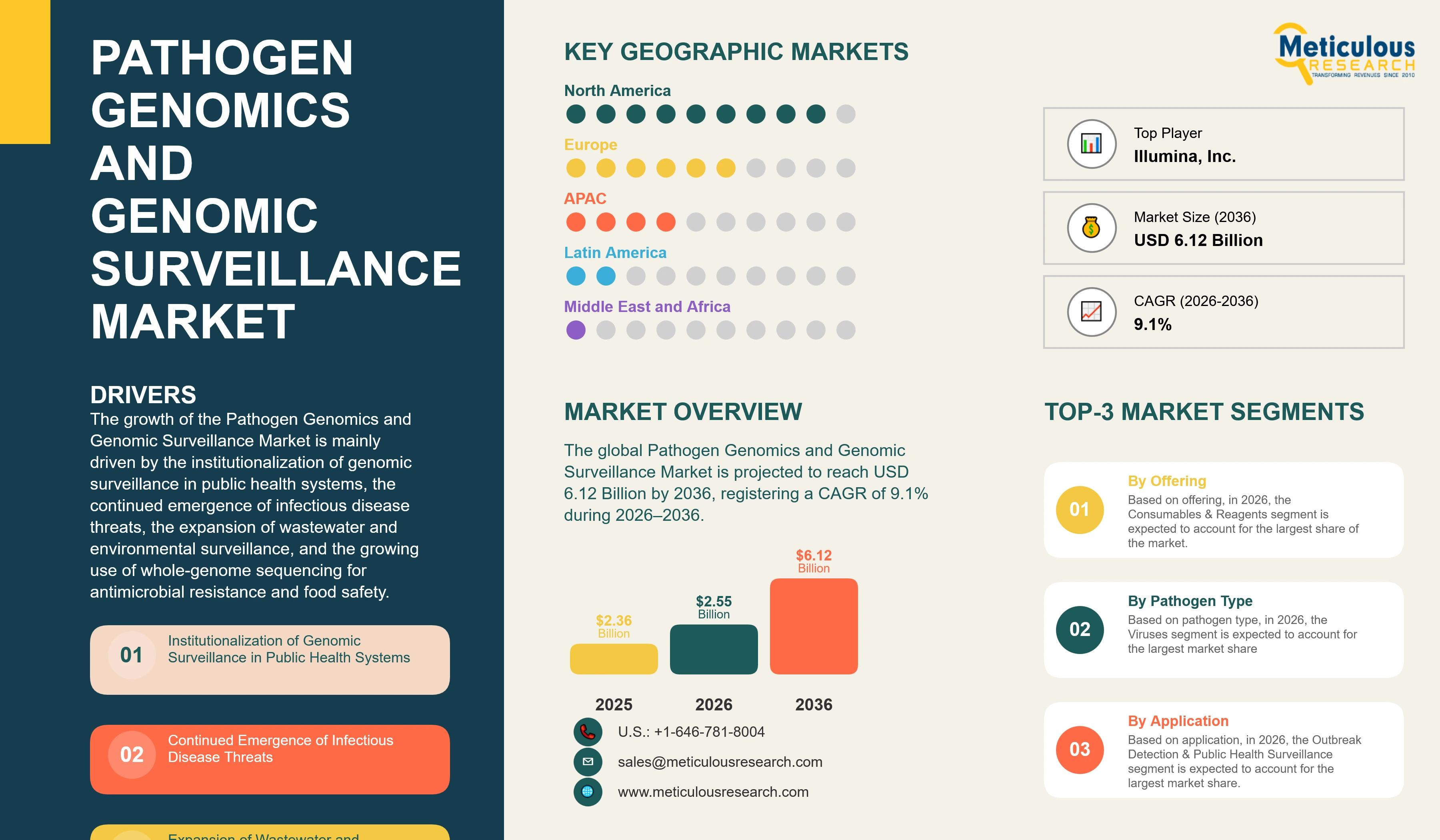
The global Pathogen Genomics and Genomic Surveillance Market was valued at USD 2.36 billion in 2025. This market is expected to reach USD 6.12 billion by 2036 from an estimated USD 2.55 billion in 2026, registering a CAGR of 9.1% during the forecast period (2026-2036).
- Published
- Oct 2026
- Pages
- 357
- Format
- PDF + Excel
- Report ID
- MR-2348
- Base year
- 2025
- 2025 · BASELINE
- $2.36B
- 2036
- $6.12B
- CAGR 2026–2036
- 9.1%
2025 baseline · 2026–2036 forecast at 9.1% CAGR · hover a bar for the value
Key highlights
The global Pathogen Genomics and Genomic Surveillance Market is projected to reach USD 6.12 billion by 2036, driven by public health genomic surveillance, wastewater monitoring, antimicrobial resistance tracking, and clinical metagenomic sequencing.
North America is expected to account for the largest market share in 2026, while Asia-Pacific is projected to register the fastest growth during the forecast period. The U.S. National Wastewater Surveillance System (NWSS) of the Centers for Disease Control and Prevention (CDC) included about 1,300 testing sites covering about 144 million people as of June 2026, monitoring SARS-CoV-2, seasonal and avian influenza, RSV, measles, and mpox; the Consolidated Appropriations Act, 2026, signed in February 2026, averted an immediate funding crisis, but sustained funding beyond fall 2026 remains under discussion, with the American Society for Microbiology requesting at least USD 120 million for NWSS in the fiscal year 2027 budget.
Global surveillance networks are expanding capacity in low- and middle-income countries. In April 2026, the International Pathogen Surveillance Network (IPSN), housed by the World Health Organization (WHO) Hub for Pandemic and Epidemic Intelligence in Berlin and funded by the Gates Foundation, Rockefeller Foundation, Wellcome Trust, and Institute of Philanthropy, launched a second round of USD 1.8 million in catalytic grants for pathogen genomic and wastewater and environmental surveillance in low- and middle-income countries.
By application, Outbreak Detection & Public Health Surveillance is expected to account for the largest market share in 2026, whereas Wastewater & Environmental Surveillance is projected to witness the fastest growth through 2036. The CDC Traveler-based Genomic Surveillance program, launched in 2021, operates at nine U.S. international airports, analyzing voluntary nasal swabs from international travelers and wastewater from aircraft and airport facilities for more than 30 viral and bacterial targets.
Metagenomic sequencing is moving into routine clinical care. In April 2026, Karius made its Karius Spectrum plasma test and Karius Focus BAL test, which use metagenomic next-generation sequencing (mNGS) to detect pathogens with results within 24 hours of sample receipt, available to order through Mayo Clinic Laboratories for immunocompromised patients with complicated infections.
Report summary
| Particulars | Details |
|---|---|
| Forecast Period | 2026-2036 |
| Base Year | 2025 |
| Estimated Year | 2026 |
| CAGR (Value) | 9.1% |
| Format | PDF, Excel & Cloud Portal · 357 pages |
| Market Size (Value) in 2026 | USD 2.55 Billion |
| Market Size (Value) in 2036 | USD 6.12 Billion |
| Segments Covered | By Offering: Consumables & Reagents, Instruments, Software & Bioinformatics, Services (Surveillance Services, Clinical Testing Services, Research Sequencing Services). By Sequencing Approach: Whole-Genome Sequencing, Targeted & Amplicon Sequencing, Metagenomic Sequencing. By Platform: Short-Read Sequencing, Long-Read Sequencing. By Pathogen Type: Viruses, Bacteria, Fungi, Parasites. By Application: Outbreak Detection & Public Health Surveillance, Wastewater & Environmental Surveillance, Clinical Infectious Disease Diagnostics, Antimicrobial Resistance Monitoring, Food Safety & One Health Surveillance, Vaccine & Drug Development. By End User: Public Health Laboratories & Government Agencies, Hospitals & Clinical Laboratories, Academic & Research Institutes, Pharmaceutical & Biotechnology Companies, Food, Agriculture & Animal Health Organizations. |
| Countries Covered | North America: U.S., Canada. Europe: U.K., Germany, France, Denmark, Netherlands, Spain, Rest of Europe. Asia-Pacific: China, Japan, South Korea, Singapore, India, Australia, Rest of Asia-Pacific. Latin America: Brazil, Mexico, Rest of Latin America. Middle East & Africa: South Africa, Nigeria, Kenya, Saudi Arabia, UAE, Rest of Middle East & Africa. |
| Key Companies | Illumina, Inc., Thermo Fisher Scientific Inc., Oxford Nanopore Technologies plc, QIAGEN N.V., Twist Bioscience Corporation, Eurofins Scientific SE, Karius, Inc., and MGI Tech Co., Ltd. |
Report overview
Segments covered: offering, sequencing approach, platform, pathogen type, application, end user.
The growth of this market is mainly driven by the institutionalization of genomic surveillance in public health systems after the COVID-19 pandemic, the continued emergence of infectious disease threats such as highly pathogenic avian influenza H5N1, mpox, and measles, the expansion of wastewater and environmental surveillance, and the growing use of whole-genome sequencing to track antimicrobial resistance and foodborne outbreaks. In addition, the adoption of metagenomic sequencing for clinical infectious disease diagnosis, the declining cost and increasing portability of sequencing, global initiatives to build surveillance capacity in low- and middle-income countries, and the use of artificial intelligence (AI) in genomic epidemiology are further supporting the growth of this market. However, the normalization of public health funding after the pandemic is moderating near-term growth.
The Pathogen Genomics and Genomic Surveillance Market, also referred to as the infectious disease genomics market, public health sequencing market, or microbial genomic surveillance market, comprises the instruments, consumables and reagents, software, and services used to sequence and analyze the genomes of viruses, bacteria, fungi, and parasites for disease surveillance, outbreak investigation, clinical diagnosis, antimicrobial resistance monitoring, food safety, and vaccine and drug development. The market includes short-read and long-read sequencers; whole-genome, targeted amplicon, and metagenomic library preparation kits and pathogen panels; bioinformatics and genomic epidemiology software; and sequencing and surveillance services, including wastewater and traveler-based surveillance programs and clinical metagenomic testing. The market ecosystem extends from sequencing platform and reagent providers to bioinformatics developers, public health laboratories, hospitals and clinical laboratories, academic and research institutes, food safety and animal health agencies, pharmaceutical and vaccine developers, and international organizations and funders.
The COVID-19 pandemic transformed pathogen genomics from a specialized research activity into a core public health capability. Countries around the world built sequencing capacity to track SARS-CoV-2 variants, and many have since expanded their programs to cover influenza, RSV, mpox, measles, foodborne pathogens, and antimicrobial-resistant bacteria. Genomic data allow public health agencies to identify new variants, trace transmission chains, detect outbreaks earlier, and evaluate vaccines and treatments. As a result, genomic surveillance is now embedded in national public health strategies and international health security frameworks.
Public health programs in the U.S. illustrate the scale and evolution of genomic surveillance. The U.S. National Wastewater Surveillance System (NWSS) of the Centers for Disease Control and Prevention (CDC) included about 1,300 testing sites covering about 144 million people as of June 2026, monitoring SARS-CoV-2, seasonal and avian influenza, RSV, measles, and mpox; the Consolidated Appropriations Act, 2026, signed in February 2026, averted an immediate funding crisis, but sustained funding beyond fall 2026 remains under discussion, with the American Society for Microbiology requesting at least USD 120 million for NWSS in the fiscal year 2027 budget. The CDC Traveler-based Genomic Surveillance program, launched in 2021, operates at nine U.S. international airports, analyzing voluntary nasal swabs from international travelers and wastewater from aircraft and airport facilities for more than 30 viral and bacterial targets. The CDC Advanced Molecular Detection (AMD) program supports the integration of genomics into public health laboratories, and genomic sequencing played a central role in the response to highly pathogenic avian influenza H5N1 in dairy cattle, where sequencing of virus from cattle, milk, and retail dairy products was used to track spillover events and viral evolution.
International initiatives are building capacity in regions with limited sequencing infrastructure. In April 2026, the International Pathogen Surveillance Network (IPSN), housed by the World Health Organization (WHO) Hub for Pandemic and Epidemic Intelligence in Berlin and funded by the Gates Foundation, Rockefeller Foundation, Wellcome Trust, and Institute of Philanthropy, launched a second round of USD 1.8 million in catalytic grants for pathogen genomic and wastewater and environmental surveillance in low- and middle-income countries. The Africa Pathogen Genomics Initiative, launched by the Africa Centres for Disease Control and Prevention (Africa CDC) with USD 100 million over four years from partners including the Gates Foundation, the U.S. CDC, Illumina, Oxford Nanopore Technologies, and Microsoft, has built genomic surveillance capacity in more than 20 African countries for COVID-19, HIV, tuberculosis, malaria, cholera, and other threats. These initiatives aim to ensure that new threats can be detected and characterized wherever they emerge and that genomic data are shared rapidly to support global response.
Clinical applications of pathogen genomics are expanding. Metagenomic next-generation sequencing can detect a broad range of pathogens in a single test without prior knowledge of the cause of infection, which is particularly valuable for immunocompromised patients and complex infections. In April 2026, Karius made its Karius Spectrum plasma test and Karius Focus BAL test, which use metagenomic next-generation sequencing (mNGS) to detect pathogens with results within 24 hours of sample receipt, available to order through Mayo Clinic Laboratories for immunocompromised patients with complicated infections. Whole-genome sequencing is also increasingly used in hospitals to investigate healthcare-associated infection outbreaks and characterize antimicrobial resistance, and targeted sequencing is used for tuberculosis drug resistance testing and HIV drug resistance analysis.
Technology developments are making pathogen sequencing faster, cheaper, and more accessible. Portable nanopore sequencers from Oxford Nanopore Technologies enable sequencing in field settings and resource-limited laboratories, while high-throughput short-read platforms from Illumina and others support large-scale surveillance. Pathogen panels and hybrid capture kits from companies such as Twist Bioscience, Illumina, and Thermo Fisher Scientific enable the detection of many pathogens in a single assay, and cloud-based bioinformatics platforms and open-source tools support the rapid analysis and sharing of genomic data.
At the same time, the market faces challenges related to the sustainability of public health funding after the pandemic, data sharing and integration, and workforce capacity. Ginkgo Bioworks, which partnered with the CDC on traveler-based surveillance, reported that its biosecurity revenue fell 30% to USD 37.4 million in 2025 and agreed to sell its biosecurity business to a group of investors, reflecting the decline of pandemic-era surveillance spending. As a result, providers that can deliver cost-effective, integrated surveillance solutions and demonstrate public health value beyond COVID-19 are expected to capture the largest share of growth over the forecast period.
Report infographic
Market dynamics
15 factors across 5 forcesInstitutionalization of Genomic Surveillance in Public Health Systems
The institutionalization of genomic surveillance in public health systems is a major factor driving the Pathogen Genomics and Genomic Surveillance Market, as countries that built sequencing capacity during the COVID-19 pandemic are integrating genomics into routine surveillance for a growing range of pathogens. National public health agencies are using sequencing to monitor respiratory viruses, foodborne pathogens, sexually transmitted infections, tuberculosis, and antimicrobial-resistant bacteria, and international health regulations and pandemic preparedness frameworks increasingly emphasize genomic surveillance capacity.
The transition of programs such as NWSS toward more permanent line-item budgets in the U.S. fiscal year 2026 appropriations reflects this institutionalization. As genomics becomes a standard public health tool, demand for sequencing instruments, consumables, and bioinformatics in public health laboratories is expected to remain steady over the forecast period.
Continued Emergence of Infectious Disease Threats
The continued emergence and re-emergence of infectious disease threats is significantly accelerating market growth. Highly pathogenic avian influenza H5N1 has spread among wild birds, poultry, and dairy cattle, with sequencing used to detect repeated spillover events into cattle and track viral evolution, while mpox clade I, measles outbreaks, and new SARS-CoV-2 variants continue to require genomic monitoring. Each new threat creates demand for rapid sequencing, pathogen-specific assays, and analysis, and reinforces the importance of sustained surveillance capacity.
Expansion of Wastewater and Environmental Surveillance
The expansion of wastewater and environmental surveillance is creating a new and growing source of demand. Wastewater surveillance provides an early, community-level indicator of pathogen circulation that does not depend on individual testing, and sequencing of wastewater samples can identify variants and emerging pathogens. The U.S. National Wastewater Surveillance System (NWSS) of the Centers for Disease Control and Prevention (CDC) included about 1,300 testing sites covering about 144 million people as of June 2026, monitoring SARS-CoV-2, seasonal and avian influenza, RSV, measles, and mpox; the Consolidated Appropriations Act, 2026, signed in February 2026, averted an immediate funding crisis, but sustained funding beyond fall 2026 remains under discussion, with the American Society for Microbiology requesting at least USD 120 million for NWSS in the fiscal year 2027 budget. Wastewater sequencing is also being expanded in other countries and supported by international initiatives such as IPSN, which includes wastewater and environmental surveillance among its grant focus areas.
Growing Use of Whole-Genome Sequencing for Antimicrobial Resistance and Food Safety
The growing use of whole-genome sequencing for antimicrobial resistance (AMR) and food safety is an important driver of market growth. Whole-genome sequencing allows public health and food safety agencies to identify resistance genes, track the spread of resistant strains, and link foodborne illness cases to their sources with high precision. Sequencing of foodborne pathogens such as Salmonella, Listeria, and Escherichia coli has become standard practice in many national surveillance programs, and AMR surveillance is a priority under global action plans. As these programs expand, demand for bacterial whole-genome sequencing is expected to grow.
Table of contents
14 chapters · 157 sections · 357 pages · click to expandSegmental analysis
| Segment | Largest share (2026) | Fastest growth (2026–2036) |
|---|---|---|
| By Offering | Consumables & Reagents | Software & Bioinformatics |
| By Sequencing Approach | Whole-Genome Sequencing | Metagenomic Sequencing |
| By Platform | Short-Read Sequencing | — |
| By Pathogen Type | Viruses | Bacteria |
| By Application | Outbreak Detection & Public Health Surveillance | Wastewater & Environmental Surveillance |
| By End User | Public Health Laboratories & Government Agencies | Hospitals & Clinical Laboratories |
By Offering
- Pathogen Genomics and Genomic Surveillance Market Analysis by Offering
- Services are further segmented into Surveillance Services, Clinical Testing Services, and Research Sequencing Services.
- The Consumables & Reagents segment is expected to account for the largest share of the global Pathogen Genomics and Genomic Surveillance Market.
- The large share of this segment is mainly due to the recurring use of library preparation kits, pathogen panels, and sequencing reagents in public health, clinical, and research laboratories, and the large installed base of sequencers established during the COVID-19 pandemic.
- However, the Software & Bioinformatics segment is projected to register the highest CAGR during the forecast period.
- The rapid growth of this segment is attributed to the need for automated analysis in laboratories with limited bioinformatics capacity, the integration of genomic, clinical, and epidemiological data, and the adoption of AI-enabled genomic epidemiology tools.
- The Services segment is expected to record strong growth, supported by clinical metagenomic testing and outsourced wastewater and traveler-based surveillance programs, while the Instruments segment is expected to grow more slowly as laboratories utilize capacity installed during the pandemic.
By Sequencing Approach
- Pathogen Genomics and Genomic Surveillance Market Analysis by Sequencing Approach
- The Whole-Genome Sequencing segment is expected to account for the largest market share, due to its use as the standard method for viral variant surveillance, foodborne outbreak investigation, and antimicrobial resistance tracking.
- However, the Metagenomic Sequencing segment is projected to register the highest CAGR during the forecast period, owing to the adoption of clinical metagenomic tests, the use of agnostic detection in wastewater and traveler surveillance, and the need to detect novel and unexpected pathogens.
By Platform
- Pathogen Genomics and Genomic Surveillance Market Analysis by Platform
- The Short-Read Sequencing segment is expected to account for the larger market share, due to its high accuracy, high throughput, and established use in public health laboratories.
- However, the Long-Read Sequencing segment is projected to register the higher CAGR during the forecast period, driven by the portability and speed of nanopore sequencing, its use in field and resource-limited settings, and its ability to resolve complete genomes, plasmids, and resistance genes.
By Pathogen Type
- Pathogen Genomics and Genomic Surveillance Market Analysis by Pathogen Type
- The Viruses segment is expected to account for the largest market share, due to the continued surveillance of SARS-CoV-2, influenza including H5N1, RSV, mpox, measles, and HIV.
- However, the Bacteria segment is projected to register the highest CAGR during the forecast period, driven by the growing use of whole-genome sequencing for antimicrobial resistance surveillance, foodborne outbreak investigation, tuberculosis drug resistance testing, and healthcare-associated infection control.
- The Fungi segment is also expected to record strong growth, supported by surveillance of drug-resistant fungal pathogens.
By Application
- Pathogen Genomics and Genomic Surveillance Market Analysis by Application
- The Outbreak Detection & Public Health Surveillance segment is expected to account for the largest market share, due to the routine use of sequencing by national and regional public health laboratories.
- However, the Wastewater & Environmental Surveillance segment is projected to register the highest CAGR during the forecast period, driven by the expansion of wastewater programs such as NWSS, with about 1,300 sites in the U.S., and international support for wastewater surveillance.
- The Clinical Infectious Disease Diagnostics segment is also expected to record strong growth, supported by metagenomic testing.
By End User
- Pathogen Genomics and Genomic Surveillance Market Analysis by End User
- The Public Health Laboratories & Government Agencies segment is expected to account for the largest market share, as national and regional public health agencies operate most genomic surveillance programs.
- However, the Hospitals & Clinical Laboratories segment is projected to register the highest CAGR during the forecast period, driven by the adoption of metagenomic diagnostics, outbreak investigation of healthcare-associated infections, and antimicrobial resistance testing in hospitals.
Geographic analysis
North America
Largest shareIn 2026, North America is expected to account for the largest share of the global Pathogen Genomics and Genomic Surveillance Market. The large share of this region is mainly attributed to large public health genomic surveillance programs, advanced clinical laboratories, and the presence of leading technology and service providers, including Illumina, Thermo Fisher Scientific, Twist Bioscience, and Karius. The U.S. National Wastewater Surveillance System (NWSS) of the Centers for Disease Control and Prevention (CDC) included about 1,300 testing sites covering about 144 million people as of June 2026, monitoring SARS-CoV-2, seasonal and avian influenza, RSV, measles, and mpox; the Consolidated Appropriations Act, 2026, signed in February 2026, averted an immediate funding crisis, but sustained funding beyond fall 2026 remains under discussion, with the American Society for Microbiology requesting at least USD 120 million for NWSS in the fiscal year 2027 budget. The CDC Traveler-based Genomic Surveillance program, launched in 2021, operates at nine U.S. international airports, analyzing voluntary nasal swabs from international travelers and wastewater from aircraft and airport facilities for more than 30 viral and bacterial targets. However, uncertainty about the sustainability of public health funding beyond fall 2026 is expected to moderate near-term growth. Canada is expected to contribute to regional growth, supported by national wastewater and genomic surveillance programs.
Europe
Europe is expected to account for a significant share of the market, supported by strong public health genomic surveillance capabilities, coordination by the European Centre for Disease Prevention and Control, and the presence of technology providers such as Oxford Nanopore Technologies in the U.K., QIAGEN in Germany, and Eurofins. The U.K., through the UK Health Security Agency, has one of the most advanced pathogen genomics programs in the world, and Germany, France, Denmark, the Netherlands, and Spain are expected to account for significant shares, supported by national surveillance programs and the European Union wastewater surveillance initiatives. Germany also hosts the WHO Hub for Pandemic and Epidemic Intelligence in Berlin, which houses IPSN.
Asia-Pacific
Fastest growthAsia-Pacific is projected to register the highest CAGR during the forecast period. The growth of this region is driven by large populations, the frequent emergence of zoonotic and respiratory threats, investment in public health infrastructure and pandemic preparedness, and growing sequencing capacity. China is expected to account for the largest share within Asia-Pacific, supported by large public health and research sequencing programs and domestic sequencing technology providers, while Japan, South Korea, Singapore, India, and Australia are expected to see strong growth, supported by national surveillance programs and research. IPSN grants are also supporting capacity in lower-income countries in the region.
Latin America
Latin America and the Middle East & Africa are expected to account for smaller shares of the market but to record strong growth. The Africa Pathogen Genomics Initiative, launched by the Africa Centres for Disease Control and Prevention (Africa CDC) with USD 100 million over four years from partners including the Gates Foundation, the U.S. CDC, Illumina, Oxford Nanopore Technologies, and Microsoft, has built genomic surveillance capacity in more than 20 African countries for COVID-19, HIV, tuberculosis, malaria, cholera, and other threats. In Latin America, Brazil and Mexico have developed significant genomic surveillance capacity, while Gulf countries in the Middle East are investing in public health genomics as part of national health strategies.
Competitive landscape
The global Pathogen Genomics and Genomic Surveillance Market is moderately consolidated, with a small number of sequencing platform providers accounting for a significant share of the market, alongside reagent and panel suppliers, bioinformatics providers, clinical metagenomic testing companies, and surveillance service providers. Market participants compete primarily on speed and turnaround time, throughput and cost per sample, portability, breadth of pathogen coverage, bioinformatics and data sharing capabilities, regulatory status for clinical use, and support for public health programs and capacity building.
Leading companies are developing multi-pathogen panels, portable and rapid sequencing solutions, automated bioinformatics, and clinical metagenomic tests, and are partnering with public health agencies, international organizations, and clinical laboratories. Recent examples include the availability of Karius tests through Mayo Clinic Laboratories in April 2026, the second round of IPSN catalytic grants in April 2026, and the agreement by Ginkgo Bioworks to sell its biosecurity business to a group of investors, reflecting the restructuring of pandemic-era surveillance services.
The report provides a comprehensive competitive assessment of the leading companies operating in the global Pathogen Genomics and Genomic Surveillance Market. The key players profiled in the report include Illumina, Inc. (U.S.), Thermo Fisher Scientific Inc. (U.S.), Oxford Nanopore Technologies plc (U.K.), QIAGEN N.V. (Netherlands), Twist Bioscience Corporation (U.S.), Eurofins Scientific SE (Luxembourg), Karius, Inc. (U.S.), and MGI Tech Co., Ltd. (China).
- Illumina, Inc.
- Thermo Fisher Scientific Inc.
- Oxford Nanopore Technologies plc
- QIAGEN N.V.
- Twist Bioscience Corporation
- Eurofins Scientific SE
- Karius, Inc.
- MGI Tech Co., Ltd
Expert perspectives
The Pathogen Genomics and Genomic Surveillance Market is entering a period in which genomic surveillance must prove its value as a permanent public health capability rather than an emergency response. With about 1,300 wastewater sites in the U.S. covering about 144 million people, international networks funding surveillance in low- and middle-income countries, and sequencing used to track H5N1, mpox, and measles, the infrastructure built during the pandemic is now being applied to a broad range of threats. The binding constraint is shifting from sequencing capacity to sustained funding, workforce, and the integration of genomic data into public health decisions.
Three structural changes are expected to shape competitive positions through 2036. First, public health programs are shifting from SARS-CoV-2 to multi-pathogen and One Health surveillance, favoring providers with broad panels and integrated solutions. Second, clinical metagenomic sequencing is expanding pathogen genomics into hospital diagnostics, creating a new source of demand less dependent on public health budgets. Third, portable sequencing and AI-enabled analysis are expanding access in low- and middle-income countries.
For companies planning entry or expansion, the most defensible positions over the forecast period are likely to be found in clinical metagenomic diagnostics, wastewater and environmental surveillance, AMR and food safety sequencing, and portable sequencing and bioinformatics solutions for capacity building. For established providers, the principal risks are uncertain public health funding, data sharing barriers, and workforce constraints.
Overall, the market is expected to grow steadily after the post-pandemic normalization, with consumables, whole-genome sequencing, short-read platforms, viruses, and public health surveillance providing the core of demand and software, metagenomic sequencing, long-read platforms, bacteria, wastewater surveillance, hospitals, and Asia-Pacific providing the fastest growth.
Customer perspectives
Insights gathered during primary interviews with public health laboratory directors, clinical microbiologists, and genomic epidemiologists operating in this market highlight where procurement priorities are shifting. The following perspectives reflect recurring themes raised across these discussions.
“This reflects the shift from emergency to routine surveillance.”
“This indicates the growing role of metagenomics in clinical diagnosis.”
“This points to the importance of bioinformatics and data integration.”
Frequently asked questions
The global Pathogen Genomics and Genomic Surveillance Market is estimated at USD 2.55 billion in 2026.
Cite this report
Meticulous Research. (2026). Pathogen Genomics and Genomic Surveillance Market - Global Opportunity Analysis And Industry Forecast (2026-2036) (Report No. MR-2348). Meticulous Market Research Pvt. Ltd. https://www.meticulousresearch.com/product/pathogen-genomics-genomic-surveillance-market-7031