Offshore Platform Decommissioning Market (2026-2036)
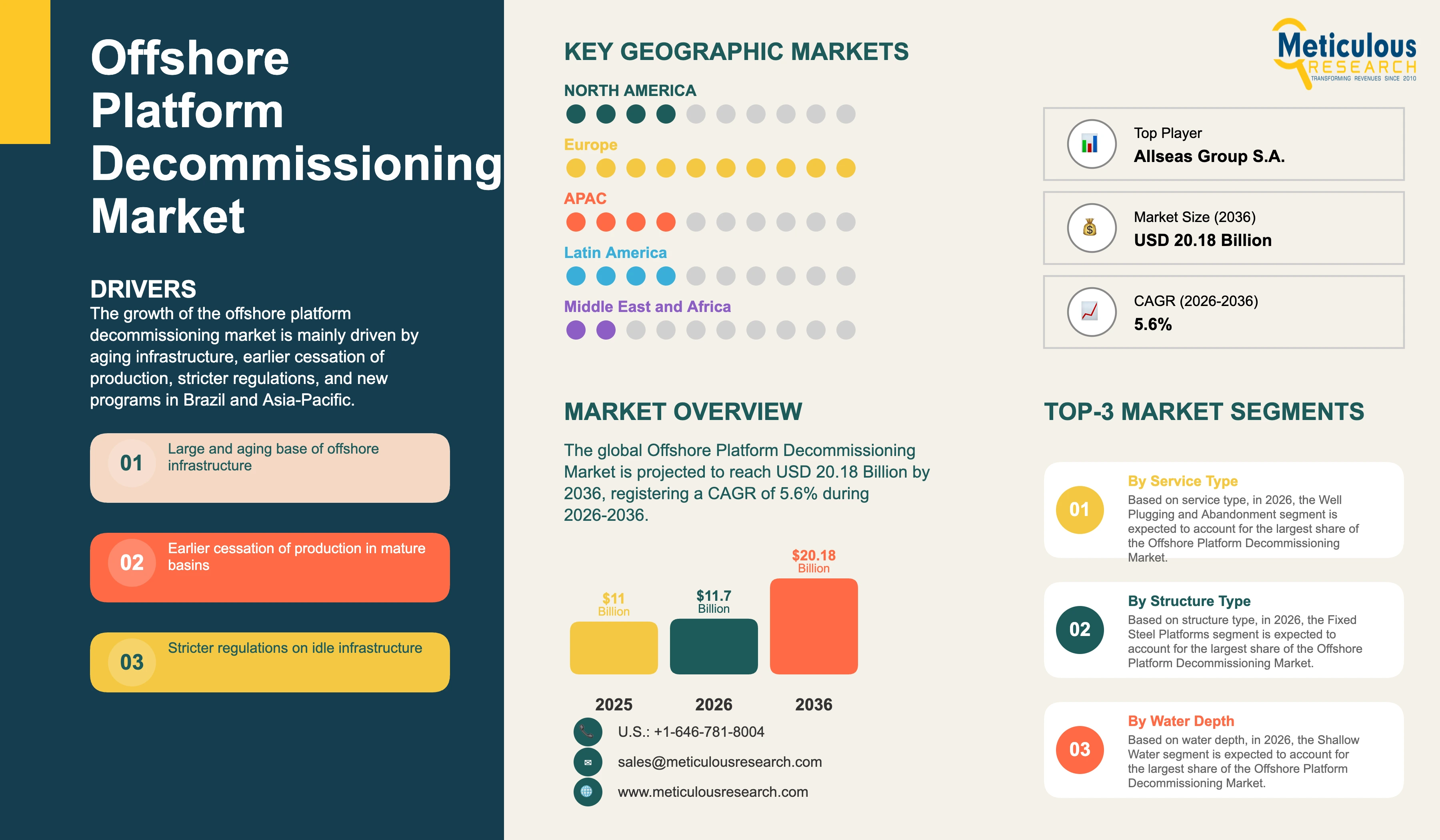
The global offshore platform decommissioning market was valued at USD 11.00 billion in 2025. This market is expected to reach USD 20.18 billion by 2036 from an estimated USD 11.70 billion in 2026, registering a CAGR of 5.6% during the forecast period (2026-2036).
- Published
- Nov 2026
- Pages
- 270
- Format
- PDF + Excel
- Report ID
- MREP - 1042720
- Base year
- 2025
- 2025 · BASELINE
- $11.00B
- 2036
- $20.18B
- CAGR 2026–2036
- 5.6%
2025 baseline · 2026–2036 forecast at 5.6% CAGR · hover a bar for the value
Key highlights
According to the North Sea Transition Authority, decommissioning spending on the U.K. Continental Shelf reached a record GBP 2.6 billion in 2025, while the estimated cost of completing the remaining U.K. decommissioning program was GBP 43.4 billion, with about GBP 21 billion expected to be spent in the period to 2032.
Offshore Energies UK reported that annual U.K. decommissioning spending passed GBP 2 billion for the first time in 2024 and is forecast to rise to an average of almost GBP 3 billion a year over the rest of the decade, with decommissioning accounting for 15% of all U.K. oil and gas expenditure in 2024 and potentially more than 30% by 2030.
Petrobras' 2026-2030 Business Plan allocates USD 9.7 billion to the decommissioning of facilities and the abandonment of wells, and the company expects about 50 platforms, including 43 fixed platforms and more than 500 wells, to be decommissioned after 2031.
An Australian Government study published in November 2025 estimated that the full removal of offshore oil and gas infrastructure in Commonwealth waters will cost AUD 43.6 billion through 2070, or AUD 66.8 billion including inflation, with about 55% of the work expected before 2040.
According to the U.S. Bureau of Safety and Environmental Enforcement, the offshore industry has averaged about 127 platform removals per year over the past decade, and the Government Accountability Office reported in 2024 that there were about 1,600 platforms and 8,000 wells in the Gulf of Mexico.
Allseas' Pioneering Spirit removed the more than 17, 000-metric-ton North Cormorant topsides in a single lift, and the company is upgrading the vessel's lifting capacity to 60,000 tonnes for the single-lift removal of Equinor's Statfjord A topsides in the Norwegian North Sea.
Allseas has also secured contracts for TAQA's Brae Alpha platform in the U.K. North Sea and for Australia's largest offshore decommissioning project, which covers the removal of up to 12 retired platforms in the Bass Strait.
By service type, well plugging and abandonment accounts for the largest share of 45.0% in 2026, while subsea infrastructure and pipeline decommissioning registers the highest CAGR.
By structure type, fixed steel platforms account for the largest share of 50.0% in 2026, while floating production units register the highest CAGR.
By water depth, shallow water accounts for the larger share in 2026, while deepwater registers the higher CAGR.
By geography, Europe accounts for the largest share of 42.0% in 2026, while Latin America registers the highest CAGR of 8.2%.
Report summary
| Particulars | Details |
|---|---|
| Base Year | 2025 |
| Estimated Year | 2026 |
| Forecast Period | 2026-2036 |
| Market Size in 2025 | USD 11.00 billion |
| Market Size in 2026 | USD 11.70 billion |
| Market Size by 2036 | USD 20.18 billion |
| CAGR (2026-2036) | 5.6% |
| Format | PDF, Excel & Cloud Portal · 270 pages |
| Largest Segment by Service Type (2026) | Well Plugging and Abandonment (45.0%) |
| Largest Segment by Structure Type (2026) | Fixed Steel Platforms (50.0%) |
| Largest Region (2026) | Europe (42.0%) |
| Fastest-Growing Region | Latin America (CAGR 8.2%) |
| Companies Profiled | 12 companies and other companies |
| Segments Covered | Service Type, Structure Type, Water Depth, Geography |
| Countries Covered | U.K., Norway, Netherlands, Denmark, Rest of Europe, Australia, Thailand, Malaysia, Indonesia, China, Rest of Asia-Pacific, U.S., Canada, Brazil, Mexico, Rest of Latin America, Saudi Arabia, UAE, Qatar, Nigeria, Rest of Middle East & Africa |
Report overview
Segments covered: service type, structure type, water depth.
The growth of this market is mainly driven by the large and aging base of offshore oil and gas infrastructure that is reaching the end of its productive life, earlier cessation of production in mature basins such as the U.K. North Sea, stricter regulatory requirements for the timely removal of idle wells and facilities, the start of large decommissioning programs in Brazil, Australia, Southeast Asia, and the Gulf of Mexico, and the growing number of floating production units and subsea systems that will need to be removed. However, factors such as the high cost of decommissioning, the limited availability of heavy-lift vessels and well abandonment rigs, uncertainty over the timing of cessation of production, and the financial weakness of some late-life asset owners are expected to restrain the growth of this market to some extent.
Offshore platform decommissioning is the process of safely ending oil and gas production at an offshore field and removing or making safe its infrastructure at the end of its productive life. The process typically includes planning and regulatory approvals, the permanent plugging and abandonment of wells, the cleaning and making safe of facilities, the removal of topsides and substructures, the decommissioning of subsea infrastructure and pipelines, the transportation of removed structures to shore, onshore dismantling, recycling, and disposal, and post-decommissioning site surveys and monitoring. Each stage involves specialized services, equipment, and vessels.
This report covers global spending on offshore oil and gas decommissioning services, including well plugging and abandonment, platform removal, subsea infrastructure and pipeline decommissioning, project management, engineering, and planning, onshore dismantling, recycling, and disposal, and site remediation and monitoring. It covers fixed steel platforms, concrete gravity-based structures, floating production units, and subsea systems and pipelines in shallow water and deepwater. Owner costs such as operator staff, insurance, and taxes, the decommissioning of onshore facilities, the decommissioning of offshore wind farms, and the ongoing operation of fields before cessation of production are excluded from the scope of this report.
Decommissioning is a large and growing activity in mature offshore basins around the world, especially in the North Sea. In the U.K. North Sea, spending reached a record GBP 2.6 billion in 2025, and the remaining cost of the U.K. program is estimated at GBP 43.4 billion. In the Gulf of Mexico, there are about 1,600 platforms, many of which are idle or approaching the end of their lives, and the industry has averaged about 127 platform removals per year over the past decade. In Brazil, Petrobras has allocated USD 9.7 billion to decommissioning in its 2026-2030 plan, and in Australia, the total liability is estimated at AUD 43.6 billion through 2070.
Well plugging and abandonment is the largest single component of offshore decommissioning spending in most regions. In the U.K., well decommissioning accounts for nearly half of forecast decommissioning spending, and in Australia, wells account for the largest share of the estimated liability. Plugging and abandonment requires rigs, light well intervention vessels, or riserless vessels, along with cementing, cutting, and logging services. Platform removal is the next largest component, and it uses heavy-lift vessels such as Allseas' Pioneering Spirit and Heerema's semi-submersible crane vessels, as well as piece-small removal methods for smaller structures.
Regulations play a central role in shaping the timing, scope, and cost of decommissioning projects. In the U.K., the North Sea Transition Authority and the Offshore Petroleum Regulator for Environment and Decommissioning oversee decommissioning programs, and OSPAR Decision 98/3 generally requires the complete removal of installations in the North-East Atlantic, with limited exceptions for large concrete and steel structures. In the U.S., the Bureau of Safety and Environmental Enforcement requires the removal of idle infrastructure, and the rigs-to-reefs program allows some structures to be left as artificial reefs. Australia and Brazil have strengthened their decommissioning regimes, and Australia is consulting on reforms to financial assurance after the Northern Endeavour case.
The market includes heavy-lift and installation contractors, well services and plugging and abandonment specialists, subsea services companies, engineering and project management firms, and onshore recycling yards. Leading companies include Allseas, Heerema Marine Contractors, Saipem, Subsea7, Petrofac, AF Gruppen, Helix Energy Solutions, Well-Safe Solutions, Expro, DOF Group, Boskalis, and Oceaneering. Many projects are delivered through engineering, preparation, removal, and disposal contracts, which combine several stages under a single contractor.
Over the forecast period, the market is expected to grow steadily as more fields reach the end of their lives. Well plugging and abandonment is expected to remain the largest service type, while subsea infrastructure and pipeline decommissioning is expected to grow fastest. Fixed steel platforms are expected to remain the largest structure type, while floating production units grow fastest. Europe is expected to remain the largest region, while Latin America is expected to grow fastest as Brazil's decommissioning program accelerates.
Our biggest cost is plugging wells, so we are joining multi-operator campaigns and using rigless methods where we can to bring the cost per well down.
This comment explains why well plugging and abandonment is the largest service type and why campaign approaches are growing.
We have a long list of fixed platforms and floating units to retire, and we need contractors and recycling yards that can work locally and meet our environmental standards.
This comment explains why Latin America is the fastest-growing region and why floating production units are growing fastest.
For our largest platforms, a single-lift removal reduces offshore work and risk, so we plan early to secure the right vessel.
This comment shows why heavy-lift capacity is a key factor in the market.
Across all three groups, buyers are seeking predictable costs, safe execution, and solutions that reduce the total cost of decommissioning programs. Many buyers also value contractors that can take responsibility for the full scope, from engineering to onshore disposal, which reduces the number of interfaces they need to manage and the risk of delays. Safety performance remains a non-negotiable requirement for all buyers. Buyers also expect clear reporting.
In 2026, the shallow water segment is expected to account for the larger share of the offshore platform decommissioning market, while the deepwater segment is projected to register the higher CAGR during the forecast period.
Report infographic
Market dynamics
16 factors across 5 forcesLarge and aging base of offshore infrastructure
A large share of the world's offshore oil and gas infrastructure was installed in the 1970s, 1980s, and 1990s and is now approaching or past the end of its design life. The Gulf of Mexico has about 1,600 platforms and 8,000 wells, the U.K. North Sea has hundreds of platforms and thousands of wells, and mature basins in Southeast Asia, Australia, Brazil, the Middle East, and West Africa also have large numbers of aging facilities. As production from these fields declines, operators must plug wells and remove or make safe their facilities.
Offshore Energies UK expects decommissioning to account for an increasing share of U.K. oil and gas spending, rising from 15% in 2024 to potentially more than 30% by 2030. This shift reflects the growing number of fields reaching cessation of production, and similar trends are expected in other mature basins over the forecast period. In Australia, more than 700 wells, 7,600 kilometers of pipelines, and 520 subsea structures in Commonwealth waters will eventually need to be decommissioned, and about 55% of this work is expected before 2040.
The size of the remaining liabilities ensures a long-term pipeline of work for decommissioning contractors. The U.K. alone has a remaining program estimated at GBP 43.4 billion, and Australia's liability is estimated at AUD 43.6 billion, which together exceed the total annual size of the global market by several times. Other mature basins, including the Gulf of Mexico, the Gulf of Thailand, offshore Malaysia, and the Campos Basin in Brazil, add further large liabilities that will be addressed over the coming decades.
Earlier cessation of production in mature basins
Fiscal changes, rising operating costs, and lower production have led some operators to bring forward cessation of production in mature basins. In the U.K., Offshore Energies UK has said that the pace of decommissioning is accelerating as the basin responds to earlier cessation of production decisions, rising costs, and wider political and economic pressures, including the Energy Profits Levy. Earlier cessation of production brings decommissioning work forward and increases near-term spending.
This trend has supported record U.K. decommissioning spending in 2024 and 2025, and it is expected to sustain high levels of activity through the end of the decade. The North Sea Transition Authority has described the period to 2032 as a critical phase for U.K. decommissioning, with around half of the remaining forecast expenditure expected during this period.
Stricter regulations on idle infrastructure
Regulators in many countries are tightening requirements for the timely decommissioning of idle wells and facilities and for financial assurance from operators. In the U.S., the Bureau of Safety and Environmental Enforcement requires lessees to decommission idle infrastructure within set timeframes, and Congress is considering bills on decommissioning enforcement and bonding requirements. The Government Accountability Office reported in 2024 that a large number of Gulf of Mexico platforms and wells were inactive and overdue for decommissioning.
In the U.K., seventeen operators have backed a North Sea Transition Authority charter to accelerate well decommissioning, and in Australia, regulators have ordered operators to carry out decommissioning work and are consulting on reforms to financial assurance. These measures increase the volume of work and reduce the scope for operators to defer decommissioning indefinitely.
In Brazil, the national regulator ANP has also strengthened its rules for decommissioning plans and the removal of facilities, and Petrobras has made decommissioning a formal part of its business plan. These regulatory changes across multiple regions are expected to increase the predictability of decommissioning demand over the forecast period.
Start of large programs in brazil, Asia-pacific, and other regions
Large decommissioning programs are starting outside the North Sea and the Gulf of Mexico. Petrobras has allocated USD 9.7 billion to decommissioning in its 2026-2030 Business Plan and expects about 50 platforms, including 43 fixed platforms, to be decommissioned after 2031. Petrobras is also seeking to bring forward the decommissioning of some floating production units.
In Australia, Esso's Bass Strait program, which includes the removal of up to 12 platforms, and the Northern Endeavour project are among the largest decommissioning projects in the region. Thailand, Malaysia, Indonesia, and China also have large numbers of aging shallow-water platforms, and national oil companies in these countries are developing decommissioning programs. These programs are expected to make Latin America and Asia-Pacific the fastest-growing regions.
Table of contents
11 chapters · 127 sections · 270 pages · click to expandSegmental analysis
| Segment | Largest share (2026) | Fastest growth (2026–2036) |
|---|---|---|
| By Service Type | Well plugging and abandonment | Subsea infrastructure and pipeline decommissioning |
| By Structure Type | Fixed steel platforms | Floating production units |
| By Water Depth | Shallow water | Deepwater |
By Service Type
- Offshore Platform Decommissioning Market Analysis by Service Type
- The well plugging and abandonment segment is expected to account for the largest share of 45.0% of the global offshore platform decommissioning market.
- The large share of this segment is mainly attributed to the large number of offshore wells that must be permanently plugged before facilities can be removed, the high cost of plugging and abandonment per well, especially for subsea wells and wells with complex completions, and the regulatory focus on reducing the number of idle wells.
- Well decommissioning accounts for nearly half of forecast decommissioning spending in the U.K. and the largest component of the estimated liability in Australia.
- Platform wells can often be abandoned using rigless methods from the platform, while subsea wells generally require a rig or a light well intervention vessel, which increases the cost per well.
- Contractors are developing new barrier materials, such as bismuth alloys and resins, and new logging tools to verify barriers, which could reduce the cost and duration of well abandonment over time.
- However, the subsea infrastructure and pipeline decommissioning segment is projected to register the highest CAGR during the forecast period.
- The rapid growth of this segment is primarily driven by the increasing number of subsea fields reaching the end of their lives, the large lengths of pipelines that must be decommissioned in Australia, the North Sea, and the Gulf of Mexico, and the growing use of subsea tiebacks in the past two decades, which will need to be removed or made safe.
- Subsea decommissioning requires remotely operated vehicles, construction support vessels, and specialized cutting and recovery tools.
- Meanwhile, the platform removal, project management, engineering, and planning, onshore dismantling, recycling, and disposal, and site remediation and monitoring segments are expected to witness steady growth, supported by the removal of topsides and substructures using heavy-lift vessels or piece-small methods, the regulatory planning and assessments required before work can begin, and the onshore recycling and disposal of removed structures.
By Structure Type
- Offshore Platform Decommissioning Market Analysis by Structure Type
- The fixed steel platforms segment is expected to account for the largest share of 50.0% of the global offshore platform decommissioning market.
- The large share of this segment is mainly attributed to the large number of fixed steel jacket platforms in the Gulf of Mexico, the North Sea, Southeast Asia, the Middle East, and other shallow-water regions, many of which were installed several decades ago and are now reaching the end of their lives.
- Fixed platforms require the plugging of platform wells, the removal of topsides, and the cutting and removal of steel jackets.
- Fixed steel platforms vary greatly in size, from small unmanned platforms in the southern North Sea and the Gulf of Mexico to large integrated platforms in the northern North Sea weighing tens of thousands of tonnes.
- Small platforms are often removed using jack-up barges, liftboats, or sheerleg crane vessels, while large platforms require heavy-lift vessels.
- However, the floating production units segment is projected to register the highest CAGR during the forecast period.
- The rapid growth of this segment is primarily driven by the large number of floating production, storage, and offloading vessels and other floating units in Brazil, West Africa, Australia, and Southeast Asia that are approaching the end of their contracts or design lives.
- Petrobras is seeking to bring forward the decommissioning of some floating production units, and these units require disconnection, towing, and recycling at certified yards.
- Meanwhile, the subsea systems and pipelines and concrete gravity-based structures segments are expected to witness steady growth, supported by the growing number of subsea fields reaching the end of their lives and the removal of topsides from large concrete structures in the Norwegian and U.K. North Sea, whose substructures are generally left in place.
By Water Depth
- Offshore Platform Decommissioning Market Analysis by Water Depth
- The shallow water segment is expected to account for the largest share of 68.0% of the global offshore platform decommissioning market.
- The large share of this segment is mainly attributed to the large number of shallow-water platforms and wells in the Gulf of Mexico, the southern and central North Sea, Southeast Asia, the Middle East, and other regions, many of which are among the oldest offshore installations in the world.
- Shallow-water decommissioning involves jack-up rigs, liftboats, and heavy-lift vessels for well abandonment and platform removal.
- Shallow-water decommissioning is generally less expensive per structure than deepwater decommissioning, but the large number of shallow-water facilities makes it the largest part of the market.
- In the Gulf of Mexico, the Gulf of Thailand, and the southern North Sea, operators decommission large numbers of small platforms and wells each year, often through multi-platform campaigns.
- However, the deepwater segment is projected to register the highest CAGR during the forecast period.
- The rapid growth of this segment is primarily driven by the aging of deepwater developments installed since the 1990s in the Gulf of Mexico, Brazil, West Africa, the northern North Sea, and Australia, and by the higher cost of decommissioning subsea wells, floating production units, and long pipelines in deepwater.
- Deepwater decommissioning requires semi-submersible rigs, well intervention vessels, and construction vessels with deepwater capabilities.
- Deepwater projects are fewer but much larger, and a single deepwater field with several subsea wells, a floating production unit, and long flowlines can cost several hundred million dollars to decommission.
Geographic analysis
Europe
Largest shareIn 2026, Europe is expected to account for the largest share of 42.0% of the global offshore platform decommissioning market. The large share of this region is mainly due to the high level of decommissioning activity in the U.K. North Sea, where spending reached a record GBP 2.6 billion in 2025, as well as decommissioning in Norway, the Netherlands, and Denmark. Strict regulations under OSPAR, earlier cessation of production, and a mature supply chain of heavy-lift contractors, well services companies, and onshore recycling yards support activity in this region. Within Europe, the U.K. is the largest country market, followed by Norway, where large platforms such as Statfjord A are being removed using single-lift methods, and the Netherlands, where many small gas platforms in the southern North Sea are reaching the end of their lives.
Asia-Pacific
Asia-Pacific is the second-largest market and is expected to grow rapidly, driven by Australia's decommissioning liability of AUD 43.6 billion and large numbers of aging platforms in Thailand, Malaysia, Indonesia, and China. In Asia-Pacific, Thailand's Gulf of Thailand has hundreds of aging platforms, and PETRONAS in Malaysia and national oil companies in Indonesia and China are planning large decommissioning programs.
Latin America
Fastest growthLatin America is projected to register the highest CAGR of 8.2% during the forecast period. The rapid growth of this region is mainly due to Petrobras' large decommissioning program, which includes USD 9.7 billion in its 2026-2030 Business Plan and about 50 platforms after 2031, the decommissioning of older floating production units in the Campos Basin, and decommissioning activity in Mexico and other countries.
North America
In North America, regulatory pressure on idle infrastructure in the Gulf of Mexico is expected to keep platform removals at a steady level, while decommissioning of platforms offshore California is also under way.
Middle East & Africa
In the Middle East & Africa, national oil companies in the Arabian Gulf operate large numbers of shallow-water platforms, some of which are being replaced or decommissioned as fields are redeveloped, and Nigeria has a large number of aging shallow-water and swamp facilities. Regulators in these countries are developing decommissioning frameworks, which are expected to support growth over the forecast period.
Competitive landscape
The global offshore platform decommissioning market is fragmented, with the top five players estimated to account for about 30% of the market in 2025. The market includes heavy-lift and installation contractors, well services and plugging and abandonment specialists, subsea services companies, engineering and project management firms, and onshore recycling yards, and many projects involve several companies working together.
Allseas and Heerema Marine Contractors are leading heavy-lift contractors that remove large topsides and jackets, with Allseas' Pioneering Spirit capable of single-lift removal of the largest structures. Saipem and Subsea7 provide removal and subsea decommissioning services, and Boskalis provides heavy transport and removal services. Petrofac and AF Gruppen provide decommissioning project management and onshore dismantling, and AF Gruppen operates a large decommissioning and recycling facility in Norway.
Well-Safe Solutions, Helix Energy Solutions, and Expro are leading providers of well plugging and abandonment services, with Helix operating light well intervention vessels and Well-Safe operating converted rigs and vessels. DOF Group and Oceaneering provide subsea decommissioning services using construction support vessels and remotely operated vehicles. Companies compete on vessel capabilities, technical expertise, safety performance, cost, and track record. Key strategies include engineering, preparation, removal, and disposal contracting, multi-operator campaigns, investment in vessels and onshore facilities, and the development of rigless and riserless abandonment technologies.
Recent developments include Allseas' contracts for the Brae Alpha and Statfjord A platforms and for the Bass Strait program in Australia, the single-lift removal of the North Cormorant topsides, DOF Group's North Sea subsea decommissioning contract, and Hornbeck Offshore's riserless abandonment contract. Well services companies such as SLB, Halliburton, and Baker Hughes also provide plugging and abandonment services as part of their wider offerings, and the market includes many smaller specialist companies in engineering, cutting, and recycling.
We expect consolidation among smaller specialist companies, as well as more partnerships between heavy-lift contractors, well services companies, and recycling yards, to offer complete decommissioning solutions. Contractors with local operations in Brazil and Australia are expected to gain a competitive advantage as these markets grow. Vessel ownership will remain a key source of competitive advantage, as heavy-lift and well intervention capacity is scarce.
Some of the key players operating in the offshore platform decommissioning market are Allseas Group S.A., Heerema Marine Contractors Nederland SE, Saipem S.p.A., Subsea 7 S.A., Petrofac Limited, AF Gruppen ASA, Helix Energy Solutions Group, Inc., Well-Safe Solutions Ltd., Expro Group Holdings N.V., DOF Group ASA, Royal Boskalis B.V., and Oceaneering International, Inc., among others.
- —
Allseas secured contracts for the Brae Alpha and Statfjord A platforms and for Australia's largest decommissioning project in the Bass Strait, DOF Group won a North Sea subsea decommissioning contract in October 2026, and Hornbeck Offshore secured a riserless well abandonment contract in the North Sea starting in 2027.
- Allseas Group S.A.
- Heerema Marine Contractors Nederland SE
- Saipem S.p.A
- Subsea 7 S.A.
- Petrofac Limited
- AF Gruppen ASA
- Helix Energy Solutions Group, Inc.
- Well-Safe Solutions Ltd.
- Expro Group Holdings N.V.
- DOF Group ASA
- Royal Boskalis B.V.
- Oceaneering International, Inc.
Expert perspectives
The offshore platform decommissioning market is entering a period of sustained growth as a large share of the world's offshore infrastructure reaches the end of its life. We expect the North Sea to remain the largest market, while Brazil, Australia, and Southeast Asia drive the fastest growth.
Over the forecast period, the market is expected to grow at a CAGR of 5.6%, from USD 11.70 billion in 2026 to USD 20.18 billion in 2036. Growth will be supported by aging infrastructure, earlier cessation of production, stricter regulations, and new programs in Brazil and Asia-Pacific, while high costs, vessel and rig constraints, and uncertainty over timing will moderate growth.
In terms of segments, well plugging and abandonment remains the largest service type, while subsea infrastructure and pipeline decommissioning grows fastest. Fixed steel platforms remain the largest structure type, while floating production units grow fastest. Shallow water remains the largest water depth, while deepwater grows fastest. Europe remains the largest region, while Latin America grows fastest at a CAGR of 8.2%.
For contractors, the key priorities are to secure vessel and rig capacity, develop lower-cost abandonment technologies, offer integrated removal and disposal solutions, and build local capabilities in growing regions such as Brazil and Australia. For operators, early planning and campaign approaches can significantly reduce costs. We believe that cost reduction will be the main theme of the market over the forecast period, as operators and governments seek to reduce the large remaining liabilities in mature basins.
We expect the U.K. market to remain at a high level through the early 2030s and then gradually slow, while Brazil and Asia-Pacific become increasingly important. The timing of Petrobras' platform retirements and of the large Australian projects will be key factors for market growth in the second half of the forecast period. We also expect technological improvements in well abandonment to reduce the cost per well, which will partly offset growth in the number of wells being abandoned.
Our forecast assumes that oil prices remain in a range that allows operators to fund decommissioning, that regulators maintain current requirements for removal, and that no major change in fiscal regimes significantly delays decommissioning. A large increase in reuse for carbon storage could delay some decommissioning, while stricter enforcement in the Gulf of Mexico could accelerate it.
In our view, contractors that invest early in Brazil and Asia-Pacific will be best positioned to capture the next phase of market growth. Contractors that reduce the cost per well and per tonne removed will also win a larger share of work in mature basins.
Customer perspectives
Buyers of decommissioning services include international oil companies, national oil companies, independent operators, and, in some cases, governments that have taken responsibility for orphaned facilities. Their decisions depend mainly on safety, cost, regulatory compliance, and the contractor's track record.
Frequently asked questions
The global offshore platform decommissioning market was valued at USD 11.00 billion in 2025, up from USD 10.20 billion in 2024, and is estimated at USD 11.70 billion in 2026. The market includes well plugging and abandonment, platform removal, subsea and pipeline decommissioning, project management, onshore disposal, and site remediation.
The global offshore platform decommissioning market is expected to reach USD 20.18 billion by 2036, supported by aging infrastructure, earlier cessation of production, stricter regulations, and new programs in Brazil and Asia-Pacific.
The market is expected to register a CAGR of 5.6% from 2026 to 2036, with the fastest growth in subsea infrastructure and pipeline decommissioning, floating production units, deepwater, and Latin America.
According to the North Sea Transition Authority, U.K. decommissioning spending reached a record GBP 2.6 billion in 2025, and the remaining cost of the U.K. program is estimated at GBP 43.4 billion, with about GBP 21 billion expected to be spent in the period to 2032.
Market growth is mainly driven by the large and aging base of offshore infrastructure, earlier cessation of production in mature basins, stricter regulations on idle infrastructure, and the start of large programs in Brazil, Asia-Pacific, and other regions.
The high cost of decommissioning and the limited availability of vessels and rigs restrain growth, while uncertainty over timing and financial liability, as well as safety, environmental, and technical risks, are key challenges.
Key opportunities include single-lift removal of large structures, rigless and riserless well abandonment, subsea infrastructure and floating production unit decommissioning, and reuse, repurposing, and carbon storage.
Well plugging and abandonment is expected to account for the largest share of 45.0% of the market in 2026, while subsea infrastructure and pipeline decommissioning is projected to register the highest CAGR.
Floating production units are projected to register the highest CAGR, driven by the retirement of floating units in Brazil, West Africa, Australia, and Southeast Asia, while fixed steel platforms account for the largest share of 50.0%.
Europe is expected to account for the largest share of 42.0% of the market in 2026, mainly due to high decommissioning activity in the U.K. and Norwegian North Sea.
Latin America is projected to register the highest CAGR of 8.2% during the forecast period, driven mainly by Petrobras' decommissioning program in Brazil.
Petrobras' 2026-2030 Business Plan allocates USD 9.7 billion to the decommissioning of facilities and the abandonment of wells, and the company expects about 50 platforms, including 43 fixed platforms, to be decommissioned after 2031.
The report profiles 12 companies, including Allseas Group S.A., Heerema Marine Contractors Nederland SE, Saipem S.p.A., Subsea 7 S.A., Petrofac Limited, AF Gruppen ASA, Helix Energy Solutions Group, Inc., Well-Safe Solutions Ltd., Expro Group Holdings N.V., DOF Group ASA, Royal Boskalis B.V., and Oceaneering International, Inc.
Allseas secured contracts for the Brae Alpha and Statfjord A platforms and for Australia's largest decommissioning project in the Bass Strait, DOF Group won a North Sea subsea decommissioning contract in October 2026, and Hornbeck Offshore secured a riserless well abandonment contract in the North Sea starting in 2027.
In 2026, the shallow water segment is expected to account for the larger share of the offshore platform decommissioning market, while the deepwater segment is projected to register the higher CAGR during the forecast period.
Cite this report
Meticulous Research. (2026). Offshore Platform Decommissioning Market - Global Opportunity Analysis and Industry Forecast (2026-2036) (Report No. MREP - 1042720). Meticulous Market Research Pvt. Ltd. https://www.meticulousresearch.com/product/offshore-platform-decommissioning-market-7403