Occupant Monitoring Systems (OMS) Market (2026-2036)
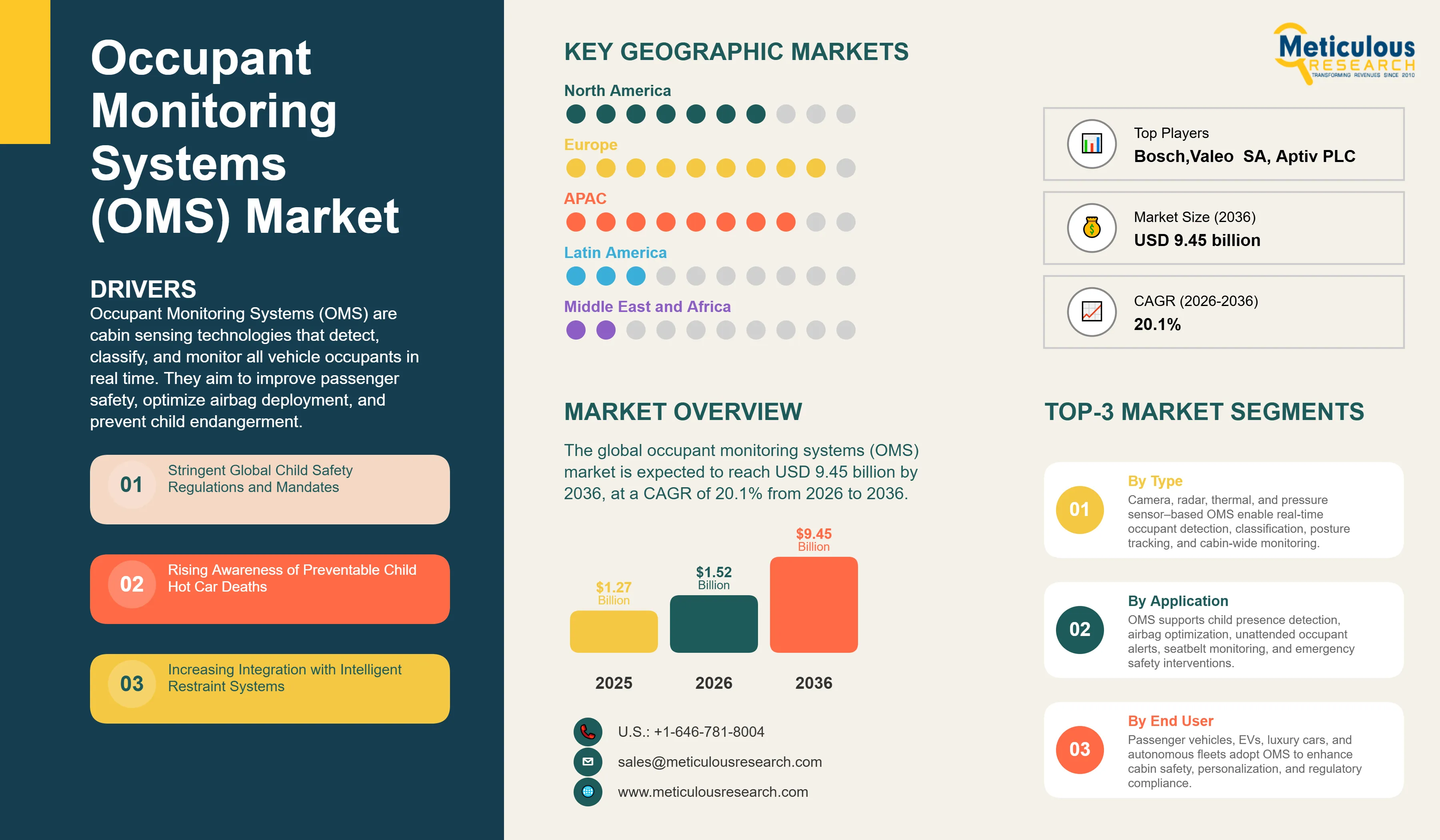
The global occupant monitoring systems (OMS) market is expected to reach USD 9.45 billion by 2036 from USD 1.52 billion in 2026, at a CAGR of 20.1% from 2026 to 2036.
- Published
- Jan 2026
- Pages
- 220
- Format
- PDF + Excel
- Report ID
- MR-1647
- Base year
- 2025
- 2026 · ESTIMATED
- $1.52B
- 2036
- $9.45B
- CAGR 2026–2036
- 20.1%
2025 baseline · 2026–2036 forecast at 20.1% CAGR · hover a bar for the value
Key highlights
In 2026, Europe is estimated to account for the largest share of the global occupant monitoring systems market, driven by stringent regulatory mandates including the EU's General Safety Regulation (GSR) requiring child presence detection systems in all new vehicles starting July 2024.
Asia-Pacific is projected to register the highest CAGR during the forecast period, fueled by rapidly growing automotive production, increasing adoption of comprehensive cabin safety features, and rising awareness of child safety in emerging economies.
Based on sensor modality, the camera-based segment is estimated to hold the largest share of the market in 2026, driven by its comprehensive ability to detect, classify, and monitor multiple occupants simultaneously across various cabin zones.
Based on AI algorithm, the child presence detection segment is estimated to dominate the market in 2026, owing to its critical role in preventing hot car deaths and widespread regulatory focus on rear-seat child monitoring.
Based on safety application, the airbag deployment optimization segment is expected to witness significant growth during the forecast period, driven by the need for intelligent restraint systems that adapt to occupant size, position, and seating configuration.
Based on vehicle segment, the passenger vehicle segment is expected to account for the largest share of the market in 2026, fueled by mandatory safety regulations and growing consumer demand for comprehensive cabin safety systems.
The premium and luxury vehicle segment is expected to grow at a significant CAGR during the forecast period, driven by early adoption of advanced multi-zone cabin monitoring and integration with personalization systems.
The U.S. occupant monitoring systems market is projected to grow at a CAGR of around 19% during the forecast period 2026 to 2036, driven by increasing NHTSA hot car prevention initiatives and voluntary adoption by major automakers.
China is expected to lead the Asia-Pacific occupant monitoring systems market, driven by massive automotive production volumes, government child safety initiatives, and rapid EV market expansion requiring advanced cabin monitoring features.
In 2026, Germany is projected to account for the largest share of the European occupant monitoring systems market, driven by its premium automotive segment and early adoption of comprehensive cabin sensing technologies by manufacturers like BMW, Mercedes-Benz, and Audi.
Report summary
| Particulars | Details |
|---|---|
| Market Size Value in 2026 | USD 1.52 Billion |
| Revenue Forecast in 2036 | USD 9.45 Billion |
| Growth Rate | CAGR of 20.1% from 2026 to 2036 |
| Format | PDF, Excel & Cloud Portal · 220 pages |
| Base Year for Estimation | 2025 |
| Historical Data | 2021–2025 |
| Forecast Period | 2026–2036 |
| Quantitative Units | Revenue in USD Billion and CAGR from 2026 to 2036 |
| Report Coverage | Revenue forecast, company ranking, competitive landscape, growth factors, and trends |
| Segments Covered | Sensor Modality, AI Algorithm, Safety Application, Vehicle Segment, Integration Level, Region |
| Regional Scope | North America, Europe, Asia-Pacific, Latin America, Middle East & Africa |
| Countries Covered | U.S., Canada, Germany, U.K., France, Italy, Spain, Sweden, China, Japan, South Korea, India, Australia, Brazil, Mexico, Saudi Arabia, UAE, South Africa |
| Key Companies Profiled | Bosch GmbH, Continental AG, Denso Corporation, Valeo SA, Aptiv PLC, Magna International Inc., Visteon Corporation, Seeing Machines Limited, Smart Eye AB, Cipia Vision Ltd., Jungo Connectivity Ltd., Eyeris Technologies Inc., Hyundai Mobis Co. Ltd., LG Innotek Co. Ltd., Panasonic Automotive Systems Co. Ltd., Gentex Corporation, Faurecia SE (FORVIA), Harman International (Samsung Electronics), ZF Friedrichshafen AG, Infineon Technologies AG |
Report overview
Segments covered: sensor modality, ai algorithm, safety application, vehicle segment.
Occupant Monitoring Systems (OMS) are cabin sensing technologies that detect, classify, and monitor all vehicle occupants in real time. They aim to improve passenger safety, optimize airbag deployment, and prevent child endangerment. These AI-powered systems use advanced sensors including cameras, radar, thermal imaging, and pressure sensors to track occupant presence, position, size classification, and physical condition throughout the vehicle cabin. OMS can identify if a child is in the rear seats, detect unattended occupants, classify occupant size for airbag optimization, monitor seatbelt usage, and assess occupant posture. The system provides real-time alerts and interventions such as warnings for forgotten children, airbag suppression for out-of-position occupants, and emergency notifications. This helps ensure safety for all passengers.
Occupant Monitoring Systems are an important step forward in automotive safety technology. They protect not just the driver but all vehicle occupants by using cabin sensors. These smart systems act as vigilant guardians of the entire car interior. They constantly monitor who is inside, determine their classification, and check their condition to prevent tragedies and improve safety measures. By using sensor fusion technology and deep learning algorithms, OMS creates a safety ecosystem that tackles various critical cabin safety issues. These include preventing hot car deaths, improving airbag deployment, detecting unattended children, and ensuring proper use of restraints.
Several significant trends are changing the occupant monitoring systems market. These include stricter global safety rules that require child presence detection, rapid progress in multi-modal sensing and AI classification algorithms, the integration of OMS with vehicle access control and climate systems, and the shift from basic presence detection to complete wellness monitoring. The combination of regulatory pressure, technological advancements, greater awareness of preventable child deaths, and the move toward smart vehicle cabins has made OMS a vital part of modern vehicle safety.
The convergence of OMS with connected vehicle technologies is opening new applications and market opportunities. Modern systems can communicate with emergency services when unattended occupants are detected, integrate with vehicle climate control to prevent dangerous temperature exposure, and connect with parental smartphone applications for alerts. This connectivity enables proactive interventions, data-driven safety improvements, and new service models centered around family safety and peace of mind.
Integration with vehicle access and personalization systems is expanding OMS capabilities beyond traditional safety functions. Advanced systems can identify regular occupants, adjust vehicle settings automatically, and even monitor passenger wellness during travel. This creates opportunities for enhanced user experience alongside core safety benefits.
Report infographic
Market dynamics
7 factors across 3 forcesStringent Global Child Safety Regulations and Mandates
Regulatory requirements focused on preventing child hot car deaths are driving the quick adoption of OMS in automotive markets around the world. The European Union's General Safety Regulation (GSR), which takes effect in July 2024, requires child presence detection systems and rear door opening warning systems in all new vehicle types. This regulation creates strong market demand for OMS technology. It requires systems that can detect children left in vehicles and provide alerts through sound, visual signals, and connected notifications. Other markets are launching similar initiatives. In the United States, the Hot Cars Act would mandate rear-seat reminder systems and child detection technology. The Euro NCAP safety rating system has added child presence detection to its assessment protocols. This encourages automakers to use advanced OMS for better safety ratings and to stand out in the market.
Rising Awareness of Preventable Child Hot Car Deaths
Growing awareness of pediatric vehicular heatstroke as a preventable tragedy is increasing the demand for technological solutions. Safety organizations report that an average of 38 children die each year in the United States from heatstroke after being left or trapped in hot vehicles. These deaths affect all demographic groups and often involve caring parents who experience memory lapses or disruptions to their routines. The heartbreaking nature of these preventable deaths has raised public awareness and sparked strong consumer demand for technology to prevent such incidents. Automakers are taking action by voluntarily adding OMS features even before regulations require them. They see both a moral responsibility and a market advantage in providing comprehensive cabin safety systems.
Table of contents
14 chapters · 166 sections · 220 pages · click to expandGeographic analysis
Europe
Largest shareIn 2026, Europe is projected to hold the largest share of the global occupant monitoring systems market. This leadership comes from strict regulations requiring child presence detection and comprehensive cabin safety systems in all new vehicles, a strong automotive safety culture, and premium manufacturers that focus on safety technologies. The influence of Euro NCAP safety ratings also speeds up OMS adoption. Germany leads the region due to its concentration of premium automakers like BMW, Mercedes-Benz, Audi, and Porsche, which have pioneered cabin sensing technologies and continue to innovate in whole-cabin monitoring solutions.
Asia-Pacific
The Asia-Pacific region is anticipated to grow at the highest rate during the forecast period. This growth is fueled by rapidly increasing automotive production, a growing middle class wanting better safety features, heightened government focus on child safety and reducing traffic fatalities, and the significant shift to electric vehicles featuring the latest cabin sensing technologies. China, as the largest automotive market, will be the main driver of regional growth, supported by government initiatives promoting intelligent connected vehicles and comprehensive safety systems. Japan and South Korea will also contribute significantly with their advanced automotive industries and key OMS technology suppliers.
North America
North America is a substantial market driven by increasing child safety awareness, proactive voluntary adoption by automakers preparing for federal regulations, strong consumer interest in family-oriented safety features, and the presence of major tech companies developing AI and sensor solutions for cabin monitoring. In the United States, the advancing Hot Cars Act legislation is building regulatory momentum. Organizations like the Insurance Institute for Highway Safety (IIHS) and NHTSA provide guidance and incentives for OMS implementation.
Competitive landscape
- Bosch GmbH · Germany
- Continental AG · Germany
- Denso Corporation · Japan
- Valeo SA · France
- Aptiv PLC · Ireland
- Magna International Inc. · Canada
- Visteon Corporation (U.S.)
- Seeing Machines Limited · Australia
- Smart Eye AB · Sweden
- Cipia Vision Ltd. · Israel
- Jungo Connectivity Ltd. · Israel
- Eyeris Technologies Inc. (U.S.)
- Hyundai Mobis Co. Ltd. · South Korea
- LG Innotek Co. Ltd. · South Korea
- Panasonic Automotive Systems Co. Ltd. · Japan
- Gentex Corporation (U.S.)
- Faurecia SE (FORVIA) · France
- Harman International (Samsung Electronics) · South Korea
- ZF Friedrichshafen AG · Germany
- Infineon Technologies AG · Germany
Frequently asked questions
The AI-powered occupant monitoring systems market is expected to grow from USD 1.52 billion in 2026 to USD 9.45 billion by 2036.
Cite this report
Meticulous Research. (2026). Occupant Monitoring Systems (OMS) Market - Global Opportunity Analysis and Industry Forecast (2026-2036) (Report No. MR-1647). Meticulous Market Research Pvt. Ltd. https://www.meticulousresearch.com/product/occupant-monitoring-systems-market-6330