Nutrigenomics Market (2026-2036)
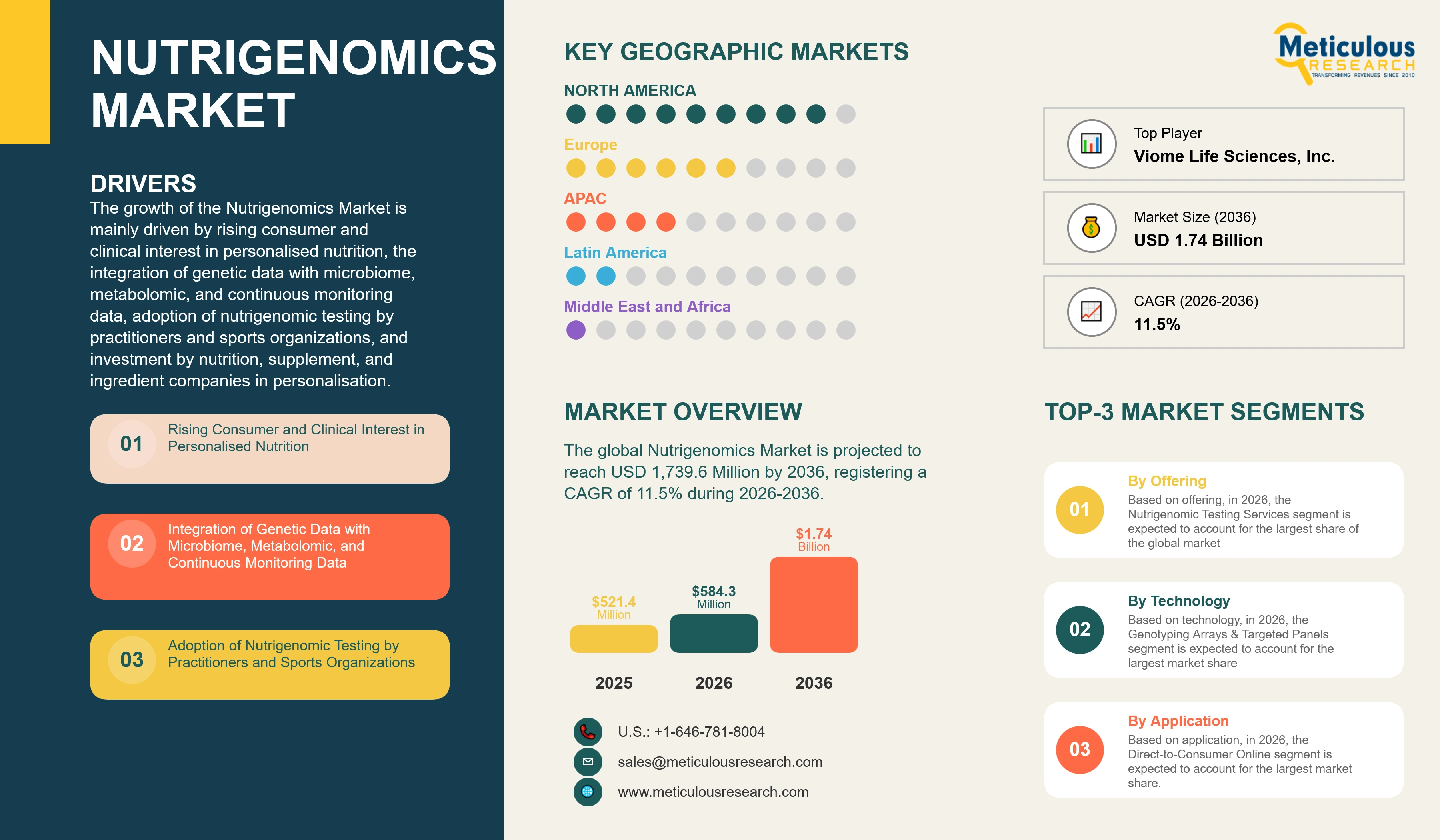
The global Nutrigenomics Market was valued at USD 521.4 million in 2025. This market is expected to reach USD 1,739.6 million by 2036 from an estimated USD 584.3 million in 2026, registering a CAGR of 11.5% during the forecast period (2026-2036).
- Published
- Oct 2026
- Pages
- 367
- Format
- PDF + Excel
- Report ID
- MRHC - 1042369
- Base year
- 2025
- 2025 · BASELINE
- $521.4M
- 2036
- $1.74B
- CAGR 2026–2036
- 11.5%
2025 baseline · 2026–2036 forecast at 11.5% CAGR · hover a bar for the value
Key highlights
The global Nutrigenomics Market is projected to reach USD 1, 739.6 million by 2036, driven by personalised nutrition demand, multi-omic integration, practitioner adoption, and investment in personalised supplement and food products.
The evidence base and the provider landscape remain early-stage. A review published by the U.K. Food Standards Agency found that personalised nutrition has evolved slowly over more than two decades, that the science is largely convincing in clinical settings but requires significant improvement for consumer use, that approximately 50 genomics-based personalised nutrition providers operate globally with around 15 in the U.K., and that most customers are curiosity buyers making one-off purchases or subscribing for only a few months.
Multi-omic approaches are attracting substantial investment. Viome Life Sciences, founded in 2016 and employing between 201 and 500 people, raised USD 175 million to accelerate research and development, improve its at-home testing technology, and expand access to its health insights and personalised nutrition recommendations, using technology licensed from Los Alamos National Laboratory to analyse both microbial and human gene expression from a single sample.
North America is expected to account for the largest market share in 2026, supported by consumer willingness to pay for wellness services, practitioner adoption, and the concentration of providers, while Asia-Pacific is projected to register the fastest growth during the forecast period.
By offering, Nutrigenomic Testing Services are expected to account for the largest market share in 2026, whereas Personalised Nutrition & Supplement Products are projected to witness the fastest growth through 2036, as providers shift from selling a one-time test toward selling a recurring product informed by it.
Report summary
| Particulars | Details |
|---|---|
| Forecast Period | 2026-2036 |
| Base Year | 2025 |
| Estimated Year | 2026 |
| CAGR (Value) | 11.5% |
| Format | PDF, Excel & Cloud Portal · 367 pages |
| Market Size (Value) in 2026 | USD 584.3 Million |
| Market Size (Value) in 2036 | USD 1,739.6 Million |
| Segments Covered | By Offering: Nutrigenomic Testing Services (Genotype-Only Testing, Multi-Omic Testing), Research Products & Reagents, Interpretation Software & Platforms, Personalised Nutrition & Supplement Products (Personalised Supplements, Personalised Food & Meal Services). By Technology: Genotyping Arrays & Targeted Panels, Sequencing-Based Approaches, Gene Expression & Transcriptomic Analysis, Integrated Multi-Omic Platforms. By Application: Weight Management & Obesity, Metabolic & Cardiovascular Health, Sports & Performance Nutrition, Food Intolerance & Sensitivity, Micronutrient Status & Supplementation, Other Applications. By Distribution Channel: Direct-to-Consumer Online, Practitioner & Clinical Channels, Employer, Insurer & Wellness Programs, Retail & Other Channels. By End User: Individual Consumers, Dietitians, Nutritionists & Clinical Practitioners, Food, Beverage & Supplement Companies, Sports Organizations & Fitness Providers, Academic & Research Institutes. |
| Countries Covered | North America: U.S., Canada. Europe: U.K., Germany, Nordic Countries, Italy, Spain, Rest of Europe. Asia-Pacific: China, Japan, South Korea, India, Australia, Rest of Asia-Pacific. Latin America: Brazil, Mexico, Rest of Latin America. Middle East & Africa: Saudi Arabia, UAE, Rest of Middle East & Africa. |
| Key Companies | Viome Life Sciences, Inc., Zoe Limited, Nutrigenomix Inc., GX Sciences, LLC, GenoPalate Inc., Prenetics Global Limited (DNAfit), dsm-firmenich AG, Metagenics, LLC, Thermo Fisher Scientific Inc., and Illumina, Inc. |
Report overview
Segments covered: offering, application, channel, end user.
The growth of this market is mainly driven by rising consumer and clinical interest in personalised approaches to diet and chronic disease prevention, the integration of genetic information with microbiome, metabolomic, and continuous glucose data into multi-omic nutrition services, the adoption of nutrigenomic testing by dietitians, functional medicine practitioners, and sports organizations as a practice tool, and investment by nutrition and ingredient companies seeking to differentiate products through personalisation. In addition, the growth of personalised supplement subscription models, the use of nutrigenomic research in food and ingredient development, the expansion of academic nutrition genomics research, and growing adoption in Asia-Pacific are further supporting the growth of this market, although growth is tempered by an evidence base that remains stronger in research settings than in consumer applications.
The Nutrigenomics Market, also referred to as the nutritional genomics market, genotype-based personalised nutrition market, or nutrigenetics and nutrigenomics market, comprises the testing services, research products, software, and personalised products through which genetic and related molecular information is used to inform dietary guidance, nutritional products, and research into the interaction between nutrients and the genome. The market includes nutrigenomic and nutrigenetic testing services sold to consumers and through practitioners; research reagents, arrays, and panels used in nutritional genomics research; interpretation software, algorithms, and practitioner platforms that translate genotype and other molecular data into dietary recommendations; and personalised supplement, functional food, and meal planning products formulated or selected on the basis of test results. The market distinguishes nutrigenetics, which examines how genetic variation affects an individual response to nutrients, from nutrigenomics, which examines how nutrients influence gene expression, and in commercial practice most offerings combine both. The market ecosystem extends from testing laboratories, research tool suppliers, software developers, and supplement and food manufacturers to dietitians, functional and integrative medicine practitioners, sports organizations, consumers, academic researchers, and the regulators that govern health claims.
The scientific premise of this market is well established at the level of individual gene-nutrient interactions. Variation in genes affecting caffeine metabolism, lactose digestion, folate metabolism, alcohol processing, and sensitivity to sodium and saturated fat demonstrably influences how individuals respond to specific dietary components, and several of these relationships are robust enough to support dietary advice. The commercial difficulty lies in the distance between these individual findings and a comprehensive personalised diet, because most dietary outcomes are polygenic, heavily influenced by environment and behaviour, and modestly affected by any single variant.
The evidence position is therefore uneven, and credible assessments say so. A review published by the U.K. Food Standards Agency found that personalised nutrition has evolved slowly over more than two decades, that the science is largely convincing in clinical settings but requires significant improvement for consumer use, that approximately 50 genomics-based personalised nutrition providers operate globally with around 15 in the U.K., and that most customers are curiosity buyers making one-off purchases or subscribing for only a few months. This assessment is important commercially rather than merely academically, because it describes a market in which demand is real but retention is poor, and in which the provider base is small and fragmented relative to the attention the category receives.
Multi-omic integration is the principal technical development reshaping the market. Rather than relying on genotype alone, providers increasingly combine genetic variants with gut microbiome composition and activity, metabolomic markers, blood biomarkers, and continuous glucose monitoring, on the reasoning that genotype is fixed while these other measures reflect current state and respond to intervention. Viome Life Sciences, founded in 2016 and employing between 201 and 500 people, raised USD 175 million to accelerate research and development, improve its at-home testing technology, and expand access to its health insights and personalised nutrition recommendations, using technology licensed from Los Alamos National Laboratory to analyse both microbial and human gene expression from a single sample. This approach addresses the central weakness of genotype-only services, which is that a fixed result cannot demonstrate whether an intervention is working.
Practitioner-mediated delivery has proved more durable than direct consumer sales. Dietitians, nutritionists, functional medicine practitioners, and sports organizations use nutrigenomic panels as a structured tool for client assessment and engagement, which places interpretation in professional hands and embeds the test in an ongoing relationship rather than a single purchase. Providers such as Nutrigenomix have built their businesses on this channel, supplying tests through registered practitioners rather than selling directly, and this model attracts less regulatory exposure than consumer health claims made without professional involvement.
The consumer channel has been shaped by the wider consumer genetics market and shares its difficulties. According to database tracking published in March 2026, AncestryDNA was approaching 30 million DNA kits while 23andMe held just under 14 million, down from approximately 15 million in October 2024, indicating both the size of the consumer genotyped population from which nutrigenomic services can draw and the maturity of the consumer genetic testing channel through which many such services have been sold. Nutrition and wellness reports were commonly offered as an add-on to ancestry and health testing, which gave the category reach but associated it with the same problems of one-time purchase, variable scientific rigour, and privacy concern that affected consumer genomics generally.
Regulation of claims is the defining constraint on how this market can be commercialised. Enforcement precedent in this market was established when the U.S. Federal Trade Commission settled with a marketer of genetically customized nutritional supplements over claims that the company could not substantiate, establishing that nutrigenomic product claims are subject to the same substantiation requirements as other health claims and that genetic personalisation does not exempt a supplement claim from the need for competent and reliable scientific evidence. The same review concluded that advice based on DNA data sits at the edge of regulatory remit, that DNA-based claims require a stronger regulatory position, that test results should come from certified laboratories meeting national validation standards, and that the algorithms generating personalised advice are frequently built on the knowledge of individual company scientists and should be open to external validation, recommending a harmonised framework covering test validity, algorithm standards, data ownership, and privacy. The practical consequence is that providers must either confine themselves to claims supported by robust evidence, which limits the scope of what they can offer, or route advice through a qualified practitioner, which limits scale but transfers interpretive responsibility.
The market includes practitioner-channel testing providers such as Nutrigenomix and GX Sciences, multi-omic consumer providers including Viome and Zoe, genetics-led wellness providers such as DNAfit within Prenetics and GenoPalate, personalised supplement companies, and nutrition and ingredient companies including dsm-firmenich that use nutrigenomic research in product development and offer personalisation platforms to brands. Research tool suppliers including Thermo Fisher Scientific, Illumina, QIAGEN, and Agilent Technologies supply the arrays, panels, and reagents used in nutritional genomics research. Participants compete on the scientific defensibility of their panels and algorithms, the credibility of their claims, practitioner relationships, integration of multi-omic data, subscription retention, and the quality of the dietary guidance delivered.
At the same time, the market faces substantial challenges, including an evidence base that supports individual gene-nutrient relationships far better than comprehensive personalised diets, poor consumer retention characteristic of curiosity purchases, the absence of harmonised standards for algorithm validation, regulatory limits on claims, scepticism among dietitians and clinical nutrition bodies about the clinical utility of genotype-based advice, and competition from phenotype-based personalisation using glucose or microbiome data that does not require genetic testing at all. As a result, participants that combine defensible science, practitioner distribution, multi-omic measurement that can demonstrate response, and recurring-revenue products are expected to capture the largest share of growth over the forecast period.
Report infographic
Market dynamics
15 factors across 5 forcesRising Consumer and Clinical Interest in Personalised Nutrition
Rising consumer and clinical interest in personalised nutrition is a major factor driving the Nutrigenomics Market. Consumers have become sceptical of population-level dietary guidance that does not account for individual variation, and the observation that individuals respond differently to the same diet is both intuitively compelling and supported by research. Clinical interest has grown alongside, as practitioners managing obesity, metabolic syndrome, and cardiovascular risk seek tools that improve adherence by making guidance feel specific to the individual.
Engagement itself appears to carry value independent of the genetic content. Several studies have found that dietary advice framed as genetically personalised produces greater behaviour change than identical generic advice, which means a nutrigenomic test may improve adherence even where its specific recommendations add little beyond standard guidance. This is commercially useful but scientifically awkward, and it is part of why the category attracts both sustained demand and professional criticism.
Integration of Genetic Data with Microbiome, Metabolomic, and Continuous Monitoring Data
The integration of genetic data with microbiome, metabolomic, and continuous monitoring data is significantly driving market growth. Viome Life Sciences, founded in 2016 and employing between 201 and 500 people, raised USD 175 million to accelerate research and development, improve its at-home testing technology, and expand access to its health insights and personalised nutrition recommendations, using technology licensed from Los Alamos National Laboratory to analyse both microbial and human gene expression from a single sample. Genotype is fixed, which means a genotype-only service cannot show whether an intervention has worked, whereas microbiome composition, metabolomic markers, and glucose response change in response to diet and can therefore demonstrate progress. Combining a fixed genetic baseline with dynamic measures allows providers to offer monitoring and iterative adjustment, which supports subscription relationships and gives the service a function beyond initial insight.
Adoption of Nutrigenomic Testing by Practitioners and Sports Organizations
The adoption of nutrigenomic testing by practitioners and sports organizations is an important driver of demand. Dietitians, nutritionists, and functional and integrative medicine practitioners use genetic panels as a structured assessment and engagement tool, and providers supplying through this channel benefit from professional interpretation, higher client trust, and an ongoing relationship within which the test is one component. Sports organizations and performance nutritionists apply nutrigenomic panels to caffeine metabolism, recovery, and micronutrient requirements, where individual optimisation carries competitive value and willingness to pay is high.
Practitioner delivery also addresses the interpretive gap that has limited consumer offerings. A dietitian can place a genetic finding in the context of a client dietary history, clinical status, and goals, distinguish a variant that warrants a change from one that does not, and adjust advice as circumstances change, none of which an automated report can do. This improves the quality of the intervention, supports repeat consultation revenue, and makes the test a component of professional practice rather than a product sold on its own.
Investment by Nutrition, Supplement, and Ingredient Companies in Personalisation
Investment by nutrition, supplement, and ingredient companies in personalisation supports market growth. Personalisation allows a supplement or functional food to be differentiated in a crowded and commoditised market, to be sold on subscription rather than at retail, and to command a higher price than an equivalent generic product. Ingredient and nutrition companies including dsm-firmenich conduct nutrigenomic research to support product development and offer personalisation platforms to brands, which creates business-to-business demand for testing, algorithms, and research services distinct from consumer sales.
Table of contents
13 chapters · 151 sections · 367 pages · click to expandSegmental analysis
| Segment | Largest share (2026) | Fastest growth (2026–2036) |
|---|---|---|
| By Offering | Nutrigenomic Testing Services | Personalised Nutrition & Supplement Products |
| By Technology | Genotyping Arrays & Targeted Panels | Integrated Multi-Omic Platforms |
| By Application | Weight Management & Obesity | Metabolic & Cardiovascular Health |
| By Distribution Channel | Direct-to-Consumer Online | Practitioner & Clinical Channels |
| By End User | Individual Consumers | Food, Beverage & Supplement Companies |
By Offering
- Nutrigenomics Market Analysis by Offering
- Nutrigenomic Testing Services are further segmented into Genotype-Only Testing and Multi-Omic Testing, while Personalised Nutrition & Supplement Products are further segmented into Personalised Supplements and Personalised Food & Meal Services.
- The Nutrigenomic Testing Services segment is expected to account for the largest share of the global Nutrigenomics Market.
- The large share of this segment is mainly due to the position of the test as the entry point to every nutrigenomic offering, the sale of panels through both consumer and practitioner channels, and the established presence of practitioner-channel providers supplying tests through registered dietitians and nutritionists.
- However, the Personalised Nutrition & Supplement Products segment is projected to register the highest CAGR during the forecast period.
- The rapid growth of this segment is attributed to the shift from selling a one-time test toward selling a recurring product informed by it, which addresses the retention problem that has constrained the category, the price premium personalisation supports, and the investment of supplement and nutrition companies in subscription models.
By Technology
- Nutrigenomics Market Analysis by Technology
- The Genotyping Arrays & Targeted Panels segment is expected to account for the largest share of the market.
- The large share of this segment is mainly due to the low cost of genotyping selected variants with established gene-nutrient associations, which suits the price points at which nutrigenomic tests are sold, and the construction of most commercial nutrigenomic panels around a defined set of variants rather than broad sequencing.
- However, the Integrated Multi-Omic Platforms segment is projected to register the highest CAGR during the forecast period.
- The rapid growth of this segment is attributed to the limitation of fixed genotype data in demonstrating response to intervention, the capital directed toward multi-omic approaches, and the ability of platforms combining genetic, microbiome, and metabolic measurement to support monitoring and subscription rather than a single report.
By Application
- Nutrigenomics Market Analysis by Application
- Other Applications include healthy ageing, gut health, and research.
- The Weight Management & Obesity segment is expected to account for the largest share of the market.
- The large share of this segment is mainly due to the scale of consumer demand for weight management solutions, the appeal of an explanation for why standard diets have not worked for an individual, and the willingness of consumers to pay out of pocket in this category.
- However, the Metabolic & Cardiovascular Health segment is projected to register the highest CAGR during the forecast period.
- The rapid growth of this segment is attributed to the clinical relevance of gene-diet interactions in lipid metabolism, sodium sensitivity, and glucose regulation, the integration of continuous glucose monitoring with genetic and microbiome data, and the greater prospect of clinical and employer-funded adoption where measurable risk factors can be shown to improve.
By Distribution Channel
- Nutrigenomics Market Analysis by Distribution Channel
- The Direct-to-Consumer Online segment is expected to account for the largest share of the market.
- The large share of this segment is mainly due to the origin of the category in consumer wellness testing sold online, frequently as an extension of consumer genetic testing, and the continuing dependence of consumer-facing providers on digital marketing and subscription sign-up.
- However, the Practitioner & Clinical Channels segment is projected to register the highest CAGR during the forecast period.
- The rapid growth of this segment is attributed to better retention and interpretation where a professional is involved, reduced regulatory exposure on claims, the use of nutrigenomic panels as a practice tool by dietitians and functional medicine practitioners, and access to clinical populations with higher engagement than general wellness consumers.
By End User
- Nutrigenomics Market Analysis by End User
- The Individual Consumers segment is expected to account for the largest share of the market, since the category is predominantly funded by out-of-pocket consumer spending on wellness.
- The large share of this segment reflects consumer purchase of tests, reports, and personalised supplement subscriptions, whether bought directly or through a practitioner.
- However, the Food, Beverage & Supplement Companies segment is projected to register the highest CAGR during the forecast period.
- The rapid growth of this segment is attributed to investment in personalisation as a means of product differentiation and subscription conversion, the use of nutrigenomic research to substantiate claims and identify responsive populations, and the deployment of personalisation platforms by ingredient and nutrition companies on behalf of consumer brands.
Geographic analysis
North America
Largest shareIn 2026, North America is expected to account for the largest share of the global Nutrigenomics Market. The large share of this region is mainly attributed to high consumer willingness to pay out of pocket for wellness services, a large supplement industry accustomed to direct-to-consumer subscription models, the concentration of nutrigenomic testing providers and multi-omic companies, and an established functional and integrative medicine practitioner base that uses genetic panels as a practice tool. Enforcement precedent in this market was established when the U.S. Federal Trade Commission settled with a marketer of genetically customized nutritional supplements over claims that the company could not substantiate, establishing that nutrigenomic product claims are subject to the same substantiation requirements as other health claims and that genetic personalisation does not exempt a supplement claim from the need for competent and reliable scientific evidence.
Europe
Europe is expected to account for a significant share of the market, supported by consumer health awareness and an established nutrition science research base, although growth is constrained by stricter regulation of health claims, by data protection requirements under the General Data Protection Regulation, and by national restrictions in several countries on genetic testing conducted without medical supervision. A review published by the U.K. Food Standards Agency found that personalised nutrition has evolved slowly over more than two decades, that the science is largely convincing in clinical settings but requires significant improvement for consumer use, that approximately 50 genomics-based personalised nutrition providers operate globally with around 15 in the U.K., and that most customers are curiosity buyers making one-off purchases or subscribing for only a few months. The U.K. and the Nordic countries are among the more active markets within the region.
Asia-Pacific
Fastest growthAsia-Pacific is projected to register the highest CAGR during the forecast period. The growth of this region is driven by rising disposable income and health awareness in China, Japan, South Korea, and India, strong cultural receptiveness to the idea of diet as the foundation of health, a large and growing functional food and supplement industry, and the relative prominence of wellness and nutrition applications over genealogy in consumer genetic testing demand in these markets.
Latin America
Latin America and the Middle East & Africa are expected to account for smaller shares of the market. In Latin America, growing wellness and supplement markets in Brazil and Mexico are expected to support demand, while in the Middle East, high rates of diabetes and obesity in Gulf countries, combined with disposable income and interest in preventive health services, are expected to support growth.
Competitive landscape
The global Nutrigenomics Market is fragmented and early-stage, with approximately 50 genomics-based personalised nutrition providers operating globally, no participant holding a dominant position, and considerable variation in scientific rigour between providers. Practitioner-channel testing providers, multi-omic consumer companies, genetics-led wellness brands, personalised supplement companies, nutrition and ingredient companies, and research tool suppliers participate across different parts of the value chain. Participants compete on the scientific defensibility of their panels and algorithms, the credibility of their claims, practitioner relationships, multi-omic integration, subscription retention, and the quality of dietary guidance delivered.
Participants are adding dynamic measurement to fixed genetic testing, moving from reports toward personalised products, building practitioner and enterprise channels, and investing in evidence to support claims. Recent developments include the raising of USD 175 million by Viome Life Sciences to advance its multi-omic at-home testing and personalised nutrition recommendations, and continuing assessment by regulators and food authorities of how DNA-based nutritional claims and advice algorithms should be governed.
The report provides a comprehensive competitive assessment of the leading organizations operating in the global Nutrigenomics Market. The key players profiled in the report include Viome Life Sciences, Inc. (U.S.), Zoe Limited (U.K.), Nutrigenomix Inc. (Canada), GX Sciences, LLC (U.S.), GenoPalate Inc. (U.S.), Prenetics Global Limited (DNAfit) (Hong Kong), dsm-firmenich AG (Switzerland), Metagenics, LLC (U.S.), Thermo Fisher Scientific Inc. (U.S.), and Illumina, Inc. (U.S.).
- Viome Life Sciences, Inc.
- Zoe Limited
- Nutrigenomix Inc.
- GX Sciences, LLC
- GenoPalate Inc.
- Prenetics Global Limited (DNAfit)
- Metagenics, LLC
- Thermo Fisher Scientific Inc.
- Illumina, Inc
Expert perspectives
The Nutrigenomics Market is a category in which the idea has consistently outrun the evidence, and the commercial history reflects that. The U.K. Food Standards Agency assessment that the science is largely convincing in clinical settings but requires significant improvement for consumer use, that only around 50 genomics-based providers operate globally, and that most customers are curiosity buyers who purchase once or subscribe briefly, describes a market with genuine demand and poor economics. The binding constraint is not consumer interest, which is abundant, but the ability to offer something a fixed genotype report cannot: demonstrable response to intervention.
Three structural changes are expected to shape the market through 2036. First, multi-omic measurement is expected to displace genotype-only reporting, because dynamic data can show whether an intervention worked and a fixed genotype cannot. Second, value is expected to migrate from the test to the recurring product it informs, which is the only demonstrated solution to the retention problem. Third, distribution is expected to shift toward practitioner, clinical, and enterprise channels, which improve retention and reduce exposure on claims.
For companies planning entry or expansion, the most defensible positions over the forecast period are likely to be found in multi-omic services with monitoring and iteration, personalised supplement and food subscriptions informed by testing, practitioner-channel panels with professional interpretation, nutrigenomic research services for food and ingredient companies, and expansion in Asia-Pacific where wellness demand is strong and penetration is low. For established providers, the principal priority is building evidence sufficient to withstand both regulatory substantiation requirements and professional scepticism.
Overall, the market is expected to grow strongly from a small base while remaining a specialty category rather than becoming mainstream clinical nutrition, with testing services, genotyping panels, weight management applications, direct consumer channels, and individual consumers in North America providing the core of demand, and personalised products, integrated multi-omic platforms, metabolic and cardiovascular applications, practitioner channels, food and supplement companies, and Asia-Pacific providing the fastest growth.
Customer perspectives
Insights gathered during primary interviews with registered dietitians, performance nutritionists, and supplement brand executives operating in this market highlight where priorities are shifting. The following perspectives reflect recurring themes raised across these discussions.
“This reflects engagement value alongside evidential caution.”
“This indicates selective rather than comprehensive application.”
“This points to the commercial logic of test-informed subscriptions.”
Frequently asked questions
The global Nutrigenomics Market is estimated at USD 584.3 million in 2026.
Cite this report
Meticulous Research. (2026). Nutrigenomics Market - Global Opportunity Analysis And Industry Forecasts (2026-2036) (Report No. MRHC - 1042369). Meticulous Market Research Pvt. Ltd. https://www.meticulousresearch.com/product/nutrigenomics-market-7052