Genetic Counseling Services Market (2026-2036)
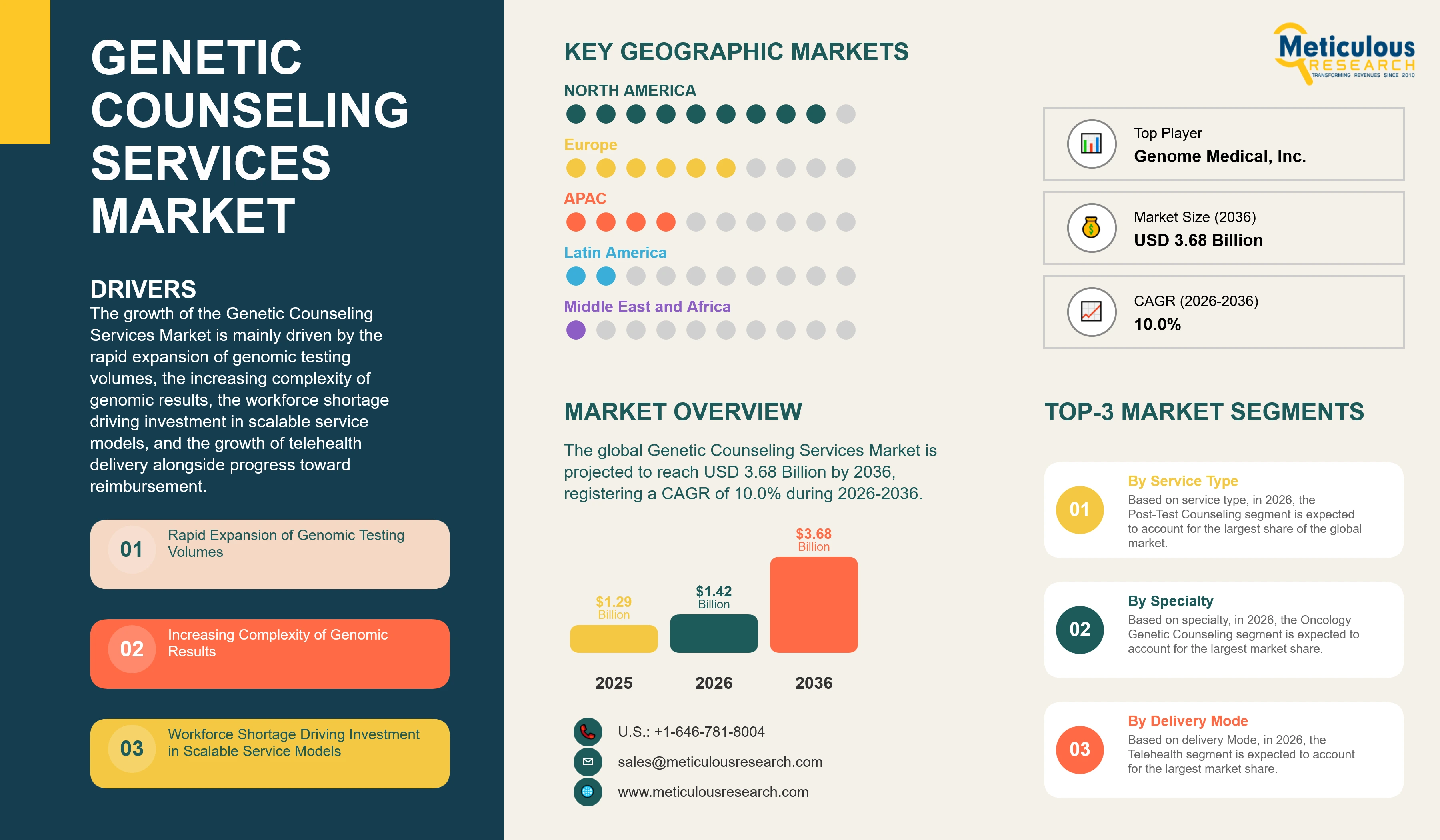
The global Genetic Counseling Services Market was valued at USD 1.29 billion in 2025. This market is expected to reach USD 3.68 billion by 2036 from an estimated USD 1.42 billion in 2026, registering a CAGR of 10.0% during the forecast period (2026-2036).
- Published
- Oct 2026
- Pages
- 325
- Format
- PDF + Excel
- Report ID
- MRHC - 1042367
- Base year
- 2025
- 2025 · BASELINE
- $1.29B
- 2036
- $3.68B
- CAGR 2026–2036
- 10.0%
2025 baseline · 2026–2036 forecast at 10.0% CAGR · hover a bar for the value
Key highlights
The global Genetic Counseling Services Market is projected to reach USD 3.68 billion by 2036, driven by genomic testing volumes, result complexity, workforce constraints, telehealth delivery, and progress toward direct reimbursement.
Reimbursement reform is advancing in the U.S. In January 2026, the Access to Genetic Counselor Services Act of 2026 was introduced in the U.S. Senate as S. 3607 and referred to the Committee on Finance, proposing to add covered genetic counseling services as a Medicare Part B benefit, to recognize state-licensed or board-certified genetic counselors as eligible providers, and to pay 80% of the lesser of the actual charge or 85% of the physician fee schedule amount, for services furnished on or after January 1, 2027.
Telehealth has become the predominant delivery model. The 2023 Professional Status Survey of the National Society of Genetic Counselors, which drew more than 3,000 respondents, projected that the workforce would grow 100% over the following ten years to more than 10,000 certified genetic counselors, reported that 82% of genetic counselors used audiovisual telehealth and that 90% of those providing direct patient care used more than one delivery model, up from 48% in 2019, and identified cancer genetics as the largest specialty at 34% of the profession.
North America is expected to account for the largest market share in 2026, supported by the concentration of certified genetic counselors, testing volumes, and established service providers, while Asia-Pacific is projected to register the fastest growth during the forecast period.
By specialty, Oncology Genetic Counseling is expected to account for the largest market share in 2026, whereas Rare & Undiagnosed Disease Counseling is projected to witness the fastest growth through 2036, as genome sequencing becomes routine in diagnostic odysseys and as genetically targeted therapies reach the clinic.
Report summary
| Particulars | Details |
|---|---|
| Forecast Period | 2026-2036 |
| Base Year | 2025 |
| Estimated Year | 2026 |
| CAGR (Value) | 10.0% |
| Format | PDF, Excel & Cloud Portal · 325 pages |
| Market Size (Value) in 2026 | USD 1.42 Billion |
| Market Size (Value) in 2036 | USD 3.68 Billion |
| Segments Covered | By Service Type: Pre-Test Counseling, Post-Test Counseling, Cascade Testing & Family Counseling, Variant Reinterpretation & Follow-Up Services. By Specialty: Oncology Genetic Counseling, Reproductive & Prenatal Genetic Counseling, Rare & Undiagnosed Disease Counseling, Cardiovascular Genetic Counseling, Pharmacogenomic Counseling, Other Specialties. By Delivery Mode: Telehealth (Audiovisual Telehealth, Telephone & Asynchronous Delivery), In-Person. By Provider Type: Hospital & Health System Genetics Services, Laboratory-Employed Counseling Services, Independent Telehealth Counseling Providers, Academic Medical Centre Genetics Services. By End User: Patients & Families, Hospitals & Health Systems, Clinical Laboratories, Payers & Employers, Pharmaceutical & Biotechnology Companies. |
| Countries Covered | North America: U.S., Canada. Europe: U.K., Germany, France, Netherlands, Italy, Spain, Rest of Europe. Asia-Pacific: Japan, China, South Korea, India, Australia, Rest of Asia-Pacific. Latin America: Brazil, Mexico, Rest of Latin America. Middle East & Africa: Saudi Arabia, UAE, Rest of Middle East & Africa. |
| Key Companies | Genome Medical, Inc., InformedDNA, Genetic Support Foundation, Laboratory Corporation of America Holdings, Quest Diagnostics Incorporated, Myriad Genetics, Inc., Natera, Inc., GeneDx Holdings Corp., Exact Sciences Corporation, and Fulgent Genetics, Inc. |
Report overview
Segments covered: service type, service, specialty, delivery mode, provider, end user.
The growth of this market is mainly driven by the rapid expansion of genomic testing in oncology, reproductive health, and rare disease, each test requiring informed consent before testing and interpretation afterward; the increasing complexity of genomic results, including variants of uncertain significance and secondary findings that non-specialist clinicians are not equipped to interpret; the shortage of genetic counselors relative to testing volumes, which is driving investment in service models that extend their reach; and the growth of telehealth delivery, which removes the geographic constraint that previously limited access. In addition, progress toward direct reimbursement for genetic counselor services, the expansion of population and cascade testing programs, the growth of pharmacogenomic and cardiovascular genetic counseling, and the establishment of national genomic medicine programs in Europe, the Middle East, and Asia-Pacific are further supporting the growth of this market.
The Genetic Counseling Services Market, also referred to as the genetic counselling market, genomic counseling services market, or clinical genetics advisory services market, comprises the professional services through which trained counselors help patients and families understand genetic and genomic information, decide whether to undergo testing, interpret results, and act on them. The market includes pre-test counseling, covering indication assessment, family history, test selection, and informed consent; post-test counseling, covering result disclosure, interpretation of pathogenic variants, variants of uncertain significance, and secondary findings, risk communication, and management recommendations; cascade testing counseling for at-risk relatives; and variant reinterpretation and follow-up as classifications change. Services are delivered in person, by audiovisual telehealth, and by telephone, and are provided by hospital and health system genetics services, laboratory-employed counselors, independent telehealth providers, and physicians with genetics training. The market ecosystem extends from counselors and the organizations employing them to hospitals, cancer centres, reproductive and prenatal services, clinical laboratories, payers, employers, pharmaceutical companies, and patients and families.
Genetic counseling exists because a genomic result is not self-explanatory. A test may report a pathogenic variant that changes management for the patient and for relatives, a variant of uncertain significance that cannot yet be acted on, or a secondary finding unrelated to the reason for testing. Communicating what each means, what it does not mean, and what should follow requires training in both genetics and counseling, and doing it badly produces measurable harm, including unnecessary surgery, missed surveillance, and avoidable distress. As testing extends from specialist genetics clinics into oncology, cardiology, obstetrics, and primary care, the gap between the number of results generated and the number of clinicians able to interpret them has become the central constraint on genomic medicine.
Testing volumes set the scale of demand. In the second quarter of 2026, Natera, Inc. processed approximately 1,043,900 tests, up 22.4% year over year, including approximately 296,700 oncology tests, up 57.2%, illustrating the volume of genomic testing that generates demand for pre-test and post-test counseling. In the second quarter of 2026, Guardant Health, Inc. reported screening revenue of USD 52.9 million on approximately 66,000 Shield blood-based cancer screening tests, compared with approximately 16,000 a year earlier, and raised full-year guidance to 270,000-285,000 tests, indicating the scale at which population screening generates counseling requirements. Each test ordered creates a potential counseling requirement before and after, and population screening in particular generates counseling demand at a scale no specialist workforce can meet through traditional one-to-one appointments.
The workforce is growing quickly but from a small base. According to the National Society of Genetic Counselors, the American Board of Genetic Counseling had certified 5,629 genetic counselors as of 2021, up from 1,155 in 1999, representing growth of 100% since 2010, with approximately one certified genetic counselor per 75,000 people and approximately one clinical genetic counselor per 100,000 people. At roughly one clinical counselor per 100,000 people, the profession cannot absorb testing growth through headcount alone, and the arithmetic of the shortage is what drives most of the service innovation in this market, including group and digital pre-test education, counselor-extender models using genetic counseling assistants, risk-stratified triage so that specialist time is reserved for complex cases, and laboratory-employed counselors supporting ordering clinicians.
Telehealth has resolved the geographic component of access. The 2023 Professional Status Survey of the National Society of Genetic Counselors, which drew more than 3,000 respondents, projected that the workforce would grow 100% over the following ten years to more than 10,000 certified genetic counselors, reported that 82% of genetic counselors used audiovisual telehealth and that 90% of those providing direct patient care used more than one delivery model, up from 48% in 2019, and identified cancer genetics as the largest specialty at 34% of the profession. Audiovisual delivery allows a counselor in one state or country to serve patients anywhere licensure permits, which both improves access in areas with no local genetics service and allows employers and health plans to offer counseling as a covered benefit. In July 2026, Genome Medical, a telehealth genetic services company founded in 2016, marked its tenth anniversary, reporting more than 250,000 genetic counseling sessions delivered, more than 110,000 genetic tests facilitated, care delivered to patients in all 50 states, in-network relationships with health plans covering more than 148 million individuals, and a strategic shift announced in early 2025 toward rare disease, in which its share of patients grew threefold over two years. The strategic shift of that provider toward rare disease also illustrates where commercial value is concentrating, as genetically targeted therapies create a direct link between diagnosis and treatment.
Reimbursement has been the structural weakness of the market and is now changing. In January 2026, the Access to Genetic Counselor Services Act of 2026 was introduced in the U.S. Senate as S. 3607 and referred to the Committee on Finance, proposing to add covered genetic counseling services as a Medicare Part B benefit, to recognize state-licensed or board-certified genetic counselors as eligible providers, and to pay 80% of the lesser of the actual charge or 85% of the physician fee schedule amount, for services furnished on or after January 1, 2027. In the absence of Medicare recognition, counseling has frequently been delivered without direct payment, funded instead by hospital genetics departments, built into laboratory test pricing, or offered by laboratories as a service that supports test ordering. Direct billing would allow counseling to be sustained as a service in its own right, and would be expected to increase both the supply of counseling and the number of settings in which it is offered.
The market includes hospital and academic genetics services, which remain the largest providers overall, national reference and specialty laboratories that employ counselors to support testing, including Labcorp, Quest Diagnostics, Myriad Genetics, Natera, Invitae, GeneDx, and Exact Sciences, and independent telehealth providers such as Genome Medical, InformedDNA, and Genetic Support Foundation. Participants compete and differentiate on counselor availability and turnaround, specialty depth, licensure coverage across jurisdictions, integration with ordering workflows and electronic health records, payer contracting, and patient experience.
At the same time, the market faces challenges, including the workforce shortage itself, which limits how quickly services can scale, the absence in most jurisdictions of a billing mechanism that recognizes counselors as providers, variation in state and national licensure that constrains cross-border telehealth, difficulty demonstrating the economic value of counseling to payers, uneven integration with ordering clinicians, and the risk that testing proceeds without counseling where no counselor is available. As a result, providers that combine scalable service models, broad licensure coverage, secured reimbursement, specialty depth in oncology and rare disease, and demonstrable integration with testing workflows are expected to capture the largest share of growth over the forecast period.
Report infographic
Market dynamics
15 factors across 5 forcesRapid Expansion of Genomic Testing Volumes
The rapid expansion of genomic testing volumes is a major factor driving the Genetic Counseling Services Market, because counseling demand is a function of tests performed rather than of patients seen in genetics clinics. In the second quarter of 2026, Natera, Inc. processed approximately 1,043,900 tests, up 22.4% year over year, including approximately 296,700 oncology tests, up 57.2%, illustrating the volume of genomic testing that generates demand for pre-test and post-test counseling. Hereditary cancer testing, carrier and prenatal screening, exome and genome sequencing for rare disease, and pharmacogenomic testing have all moved from specialist referral into routine ordering by oncologists, obstetricians, cardiologists, and primary care physicians.
Population screening changes the scale of the requirement rather than merely increasing it. In the second quarter of 2026, Guardant Health, Inc. reported screening revenue of USD 52.9 million on approximately 66,000 Shield blood-based cancer screening tests, compared with approximately 16,000 a year earlier, and raised full-year guidance to 270,000-285,000 tests, indicating the scale at which population screening generates counseling requirements. When a screening test is offered to an eligible population measured in millions, the counseling requirement cannot be met by individual appointments, which is why screening programs are built around tiered models in which digital or group education precedes testing and specialist counseling is reserved for those with positive or complex results.
Increasing Complexity of Genomic Results
The increasing complexity of genomic results is significantly driving market growth. Broad panels, exomes, and genomes report variants of uncertain significance, secondary findings unrelated to the indication, and results whose interpretation changes as evidence accumulates, and each of these requires explanation that a non-specialist clinician is generally not trained to provide. Variant reclassification creates a further obligation, since a result reported as uncertain may later become pathogenic, which requires the patient and relatives to be recontacted.
Complexity also extends the duration of the relationship. A hereditary cancer result implies surveillance decisions, risk-reducing options, reproductive considerations, and cascade testing for relatives, each of which may arise years apart. Counseling is therefore increasingly longitudinal rather than a single encounter, which increases the number of counseling episodes generated per result.
Workforce Shortage Driving Investment in Scalable Service Models
The workforce shortage is an important driver of demand and of investment in the service models that address it. According to the National Society of Genetic Counselors, the American Board of Genetic Counseling had certified 5,629 genetic counselors as of 2021, up from 1,155 in 1999, representing growth of 100% since 2010, with approximately one certified genetic counselor per 75,000 people and approximately one clinical genetic counselor per 100,000 people. With roughly one clinical counselor per 100,000 people and testing volumes growing far faster than the workforce, health systems and laboratories are investing in group and digital pre-test education, genetic counseling assistants who handle administrative and intake work, risk-stratified triage, and outsourced counseling capacity, all of which create commercial demand for services rather than merely for employment.
Growth of Telehealth Delivery and Progress Toward Reimbursement
The growth of telehealth delivery and progress toward reimbursement supports market growth. The 2023 Professional Status Survey of the National Society of Genetic Counselors, which drew more than 3,000 respondents, projected that the workforce would grow 100% over the following ten years to more than 10,000 certified genetic counselors, reported that 82% of genetic counselors used audiovisual telehealth and that 90% of those providing direct patient care used more than one delivery model, up from 48% in 2019, and identified cancer genetics as the largest specialty at 34% of the profession. Telehealth removes the geographic constraint that previously limited counseling to patients near an academic centre, and it allows providers to operate at national scale. In January 2026, the Access to Genetic Counselor Services Act of 2026 was introduced in the U.S. Senate as S. 3607 and referred to the Committee on Finance, proposing to add covered genetic counseling services as a Medicare Part B benefit, to recognize state-licensed or board-certified genetic counselors as eligible providers, and to pay 80% of the lesser of the actual charge or 85% of the physician fee schedule amount, for services furnished on or after January 1, 2027. Together, a delivery model that scales and a payment mechanism that recognizes the provider address the two constraints that have most limited the market.
Table of contents
13 chapters · 141 sections · 325 pages · click to expandSegmental analysis
| Segment | Largest share (2026) | Fastest growth (2026–2036) |
|---|---|---|
| By Service Type | Post-Test Counseling | Cascade Testing & Family Counseling |
| By Specialty | Oncology Genetic Counseling | Rare & Undiagnosed Disease Counseling |
| By Delivery Mode | Telehealth | Telehealth |
| By Provider Type | Hospital & Health System Genetics Services | Independent Telehealth Counseling Providers |
| By End User | Hospitals & Health Systems | Pharmaceutical & Biotechnology Companies |
By Service Type
- Genetic Counseling Services Market Analysis by Service Type
- The Post-Test Counseling segment is expected to account for the largest share of the global Genetic Counseling Services Market.
- The large share of this segment is mainly due to the complexity of result disclosure, which requires explanation of pathogenic variants, variants of uncertain significance, and secondary findings, the clinical consequence of these discussions for surveillance, treatment, and reproductive decisions, and the longer duration and greater specialist involvement of post-test encounters compared with pre-test counseling.
- However, the Cascade Testing & Family Counseling segment is projected to register the highest CAGR during the forecast period.
- The rapid growth of this segment is attributed to recognition that each identified variant implies risk in multiple relatives, the low current uptake of cascade testing, which represents substantial unmet volume, and the interest of payers in identifying carriers before disease onset.
- Variant Reinterpretation & Follow-Up Services are also expected to grow strongly as the accumulated stock of uncertain results requires periodic review.
By Specialty
- Genetic Counseling Services Market Analysis by Specialty
- Other Specialties include neurogenetics, metabolic disease, and population screening.
- The Oncology Genetic Counseling segment is expected to account for the largest share of the market.
- The large share of this segment is mainly due to the volume of hereditary cancer and tumour genomic testing, the clinical consequence of hereditary cancer results for surveillance and risk-reducing surgery, the implications for relatives, and the concentration of the profession in this specialty, identified as the largest at 34% in the 2023 Professional Status Survey.
- However, the Rare & Undiagnosed Disease Counseling segment is projected to register the highest CAGR during the forecast period.
- The rapid growth of this segment is attributed to the adoption of exome and genome sequencing as a first-line diagnostic approach, the arrival of genetically targeted therapies that give a molecular diagnosis direct therapeutic consequence, and commercial investment in this area, reflected in the strategic shift of Genome Medical toward rare disease and the threefold growth in its rare disease patient share over two years.
By Delivery Mode
- Genetic Counseling Services Market Analysis by Delivery Mode
- Telehealth is further segmented into Audiovisual Telehealth and Telephone & Asynchronous Delivery.
- The Telehealth segment is expected to account for the largest share of the market and is also projected to register the highest CAGR during the forecast period.
- This is mainly due to the adoption of audiovisual telehealth by 82% of genetic counselors, the use of more than one delivery model by 90% of those providing direct patient care, the suitability of counseling to remote delivery given that it involves discussion rather than physical examination, and the ability of telehealth providers to serve patients in all 50 states.
- The In-Person segment is expected to retain a meaningful position, particularly in prenatal settings where counseling accompanies imaging or procedures, in paediatric and rare disease assessment where physical examination contributes to diagnosis, and in settings where patients lack the connectivity or privacy that telehealth requires.
By Provider Type
- Genetic Counseling Services Market Analysis by Provider Type
- The Hospital & Health System Genetics Services segment is expected to account for the largest share of the market.
- The large share of this segment is mainly due to the location of most clinical genetics activity within hospitals and health systems, the integration of counseling with oncology, cardiology, and reproductive services, and the role of health systems as the employer of the majority of clinical counselors.
- However, the Independent Telehealth Counseling Providers segment is projected to register the highest CAGR during the forecast period.
- The rapid growth of this segment is attributed to the ability of these providers to operate at national scale, their contracting with health plans, employers, laboratories, and pharmaceutical companies, and their role in supplying capacity to health systems that cannot recruit counselors directly, illustrated by the in-network relationships of Genome Medical with health plans covering more than 148 million individuals.
By End User
- Genetic Counseling Services Market Analysis by End User
- The Hospitals & Health Systems segment is expected to account for the largest share of the market, measured by the party procuring or funding the service.
- The large share of this segment is mainly due to the funding of genetics departments and embedded counselors by hospitals, the integration of counseling into oncology and reproductive care pathways, and the role of health systems in meeting accreditation and clinical quality expectations for genomic testing.
- However, the Pharmaceutical & Biotechnology Companies segment is projected to register the highest CAGR during the forecast period.
- The rapid growth of this segment is attributed to the funding of diagnosis, counseling, and trial identification programs in rare disease, where a molecular diagnosis leads to a genetically targeted therapy, and to the use of counseling services in clinical trial recruitment, which Genome Medical added to its offering.
Geographic analysis
North America
Largest shareIn 2026, North America is expected to account for the largest share of the global Genetic Counseling Services Market. The large share of this region is mainly attributed to the concentration of the certified genetic counseling profession, with 5,629 counselors certified by the American Board of Genetic Counseling as of 2021, the scale of genomic testing volumes, the establishment of independent telehealth counseling providers operating nationally, and the prospect of direct Medicare reimbursement. In January 2026, the Access to Genetic Counselor Services Act of 2026 was introduced in the U.S. Senate as S. 3607 and referred to the Committee on Finance, proposing to add covered genetic counseling services as a Medicare Part B benefit, to recognize state-licensed or board-certified genetic counselors as eligible providers, and to pay 80% of the lesser of the actual charge or 85% of the physician fee schedule amount, for services furnished on or after January 1, 2027.
Europe
Europe is expected to account for a significant share of the market, supported by national genomic medicine programs that incorporate counseling into designated care pathways, established clinical genetics services in academic centres, and growth in hereditary cancer and rare disease testing. The profession is organized differently from North America in much of the region, with counseling frequently delivered by clinical geneticists and specialist nurses within publicly funded services, which means growth is driven by programme expansion rather than by a commercial services market.
Asia-Pacific
Fastest growthAsia-Pacific is projected to register the highest CAGR during the forecast period. The growth of this region is driven by the rapid expansion of genomic testing in China, Japan, South Korea, India, and Australia, national genomic medicine and cancer genomic programs, the establishment of training programs for genetic counselors in several countries, and very low current counselor density relative to population, which means that even modest absolute growth produces high percentage growth from a small base.
Latin America
Latin America and the Middle East & Africa are expected to account for smaller shares of the market. In Latin America, the growth of oncology and reproductive genetic testing in Brazil and Mexico is expected to support demand, while in the Middle East, national genome programs and high rates of consanguinity-associated genetic conditions in Gulf countries are expected to support investment in counseling capacity.
Competitive landscape
The global Genetic Counseling Services Market is fragmented, with the majority of counseling delivered within hospital and academic genetics services that do not compete commercially, alongside laboratory-employed counseling teams and a smaller group of independent telehealth providers that operate as commercial service businesses. Participants compete and differentiate on counselor availability and turnaround, specialty depth, licensure coverage across jurisdictions, integration with ordering workflows and electronic health records, payer and employer contracting, and patient experience.
Commercial providers are expanding licensure coverage, contracting with health plans and employers, specializing in high-value indications, integrating with laboratory ordering systems, and adding adjacent services including trial recruitment and digital pre-test education. Recent examples include the tenth anniversary of Genome Medical in July 2026, by which point it reported more than 250,000 counseling sessions delivered and in-network relationships with plans covering more than 148 million individuals, together with its strategic shift toward rare disease announced in early 2025.
The report provides a comprehensive competitive assessment of the leading organizations operating in the global Genetic Counseling Services Market. The key players profiled in the report include Genome Medical, Inc. (U.S.), InformedDNA (U.S.), Genetic Support Foundation (U.S.), Laboratory Corporation of America Holdings (U.S.), Quest Diagnostics Incorporated (U.S.), Myriad Genetics, Inc. (U.S.), Natera, Inc. (U.S.), GeneDx Holdings Corp. (U.S.), Exact Sciences Corporation (U.S.), and Fulgent Genetics, Inc. (U.S.).
- Genome Medical, Inc.
- InformedDNA
- Genetic Support Foundation
- Laboratory Corporation of America Holdings
- Quest Diagnostics Incorporated
- Myriad Genetics, Inc.
- Natera, Inc.
- GeneDx Holdings Corp.
- Exact Sciences Corporation
- Fulgent Genetics, Inc
Expert perspectives
The Genetic Counseling Services Market is defined by a structural mismatch. Testing volumes are growing at rates exceeding 20% annually at the leading laboratories, while the counseling workforce, at 5,629 certified counselors as of 2021 and roughly one clinical counselor per 100,000 people, cannot grow at anything approaching that pace. The binding constraint is not demand, which is abundant, nor clinical consensus, which supports counseling, but the combination of workforce capacity and the absence of a payment mechanism that recognizes counselors as providers. Both constraints are now being addressed, which is what makes this market interesting over the forecast period.
Three structural changes are expected to shape the market through 2036. First, service models are expected to shift decisively from specialist referral toward tiered delivery, in which digital education and counselor-extender roles handle routine volume and specialist time is reserved for complex cases, which will shift purchasing from employment toward services and platforms. Second, direct reimbursement, if enacted, would convert counseling from a cost absorbed by health systems and laboratories into a billable service, which would increase both supply and measured market value. Third, rare disease and genetically targeted therapy counseling is expected to attract commercial funding at a level other specialties do not, because a molecular diagnosis there leads directly to treatment.
For companies planning entry or expansion, the most defensible positions over the forecast period are likely to be found in scalable tiered service models for population and screening programs, rare disease counseling linked to genetically targeted therapies, cascade testing and family risk management programs, counseling capacity supplied to health systems unable to recruit, and workforce development and service establishment in Asia-Pacific. For established providers, the principal priorities are broadening licensure coverage, securing payer contracting ahead of reimbursement reform, and demonstrating economic value in terms payers accept.
Overall, the market is expected to grow strongly, with post-test counseling, oncology, telehealth delivery, hospital and health system providers, and North America providing the core of demand, and cascade testing and family counseling, rare and undiagnosed disease, independent telehealth providers, pharmaceutical customers, and Asia-Pacific providing the fastest growth.
Customer perspectives
Insights gathered during primary interviews with health system genetics service leaders, medical oncologists, and payer medical directors operating in this market highlight where priorities are shifting. The following perspectives reflect recurring themes raised across these discussions.
“This reflects workforce capacity as the operative constraint.”
“This indicates demand from non-specialist ordering clinicians.”
“This points to value evidence as the barrier to coverage.”
Frequently asked questions
The global Genetic Counseling Services Market is estimated at USD 1.42 billion in 2026.
Cite this report
Meticulous Research. (2026). Genetic Counseling Services Market - Global Opportunity Analysis And Industry Forecasts (2026-2036) (Report No. MRHC - 1042367). Meticulous Market Research Pvt. Ltd. https://www.meticulousresearch.com/product/genetic-counseling-services-market-7050