Laboratory Developed Tests Market (2026-2036)
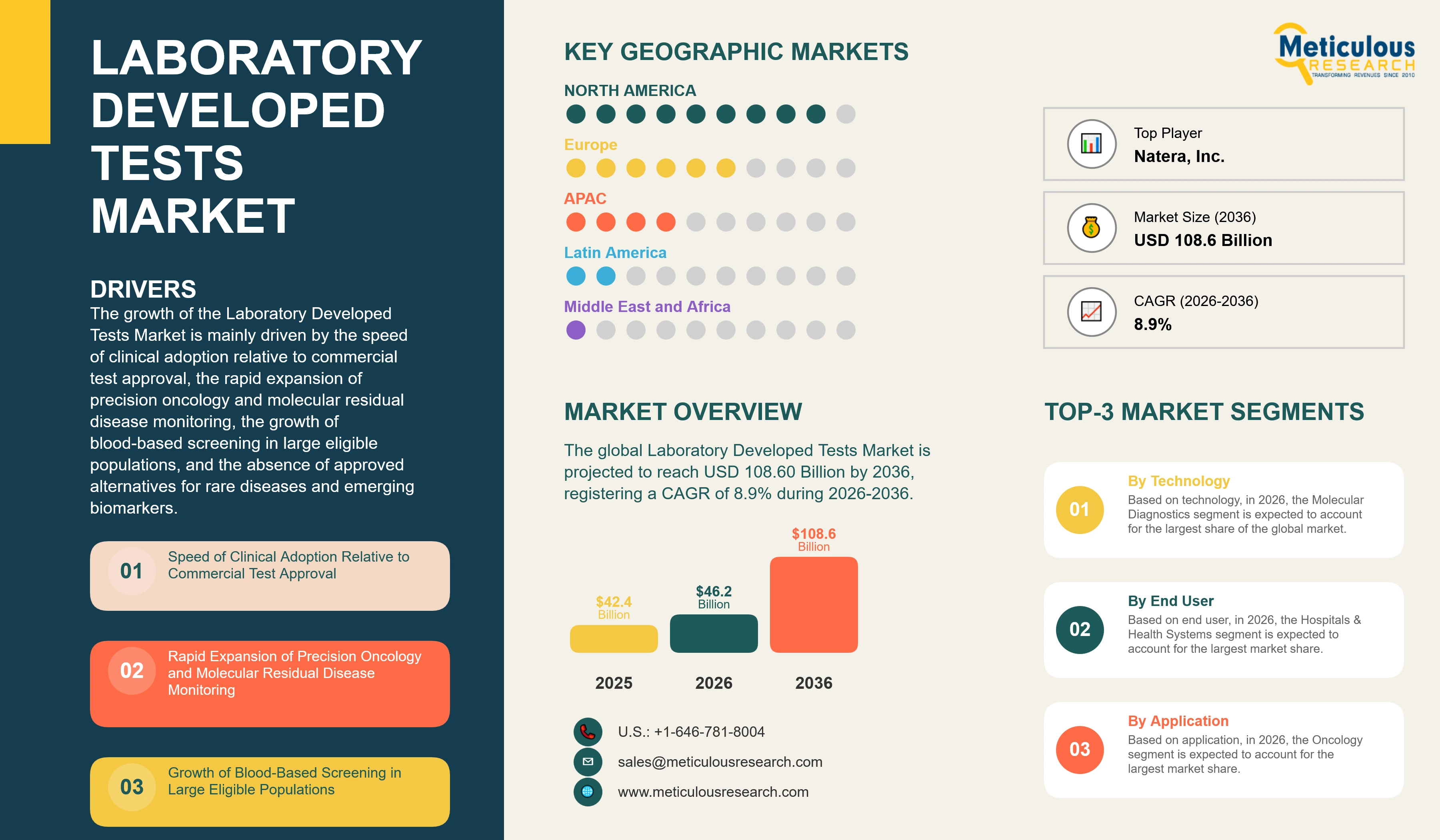
The global Laboratory Developed Tests Market was valued at USD 42.40 billion in 2025. This market is expected to reach USD 108.60 billion by 2036 from an estimated USD 46.20 billion in 2026, registering a CAGR of 8.9% during the forecast period (2026-2036).
- Published
- Oct 2026
- Pages
- 367
- Format
- PDF + Excel
- Report ID
- MRHC - 1042368
- Base year
- 2025
- 2025 · BASELINE
- $42.40B
- 2036
- $108.6B
- CAGR 2026–2036
- 8.9%
2025 baseline · 2026–2036 forecast at 8.9% CAGR · hover a bar for the value
Key highlights
The global Laboratory Developed Tests Market is projected to reach USD 108.60 billion by 2036, driven by precision oncology, molecular residual disease monitoring, blood-based screening, rare disease testing, and the speed with which laboratories can bring new tests into use.
Regulatory uncertainty in the U.S. has resolved in favour of laboratory oversight. In the U.S., the Food and Drug Administration (FDA) final rule of May 2024, which would have phased laboratory developed tests into device regulation, was vacated by the U.S. District Court for the Eastern District of Texas in March 2025, no appeal was filed, and in August 2025 the FDA signaled its intention to rescind the rule, leaving laboratory developed tests to be regulated primarily under Clinical Laboratory Improvement Amendments (CLIA) requirements and laboratory accreditation programs.
Leading specialty laboratories are growing rapidly. In the second quarter of 2026, Natera, Inc. reported revenue of USD 752.8 million, up 37.7% year over year, processed approximately 1,043,900 tests, up 22.4%, including approximately 296,700 oncology tests, up 57.2%, and raised its full-year 2026 revenue guidance by USD 100 million at the midpoint to USD 2.85-2.91 billion.
North America is expected to account for the largest market share in 2026, supported by the CLIA framework, the scale of specialty laboratory activity, and reimbursement for advanced molecular testing, while Asia-Pacific is projected to register the fastest growth during the forecast period.
By application, Oncology is expected to account for the largest market share in 2026, whereas Molecular Residual Disease & Early Cancer Detection is projected to witness the fastest growth through 2036, as monitoring and screening tests reach large eligible populations.
Report summary
| Particulars | Details |
|---|---|
| Forecast Period | 2026-2036 |
| Base Year | 2025 |
| Estimated Year | 2026 |
| CAGR (Value) | 8.9% |
| Format | PDF, Excel & Cloud Portal · 367 pages |
| Market Size (Value) in 2026 | USD 46.20 Billion |
| Market Size (Value) in 2036 | USD 108.60 Billion |
| Segments Covered | By Technology: Molecular Diagnostics (Next-Generation Sequencing, PCR & Digital PCR, Other Molecular Methods), Immunoassay & Protein-Based Testing, Mass Spectrometry, Flow Cytometry & Cytogenetics, Other Technologies. By Application: Oncology (Comprehensive Genomic Profiling, Therapy Selection & Companion Testing), Molecular Residual Disease & Early Cancer Detection, Hereditary & Rare Disease, Reproductive & Prenatal Health, Infectious Disease, Pharmacogenomics, Other Applications. By Laboratory Type: Specialty & Molecular Reference Laboratories, National Clinical Laboratories, Academic Medical Centre & Non-Profit Reference Laboratories, Hospital & Health System Laboratories. By Test Volume Category: High-Volume Routine Tests, Specialty Tests, Rare & Ultra-Rare Disease Tests. By End User: Hospitals & Health Systems, Physician Offices & Specialty Clinics, Pharmaceutical & Biotechnology Companies, Other End Users. |
| Countries Covered | North America: U.S., Canada. Europe: Germany, U.K., France, Italy, Spain, Netherlands, Rest of Europe. Asia-Pacific: China, Japan, South Korea, India, Australia, Rest of Asia-Pacific. Latin America: Brazil, Mexico, Rest of Latin America. Middle East & Africa: Saudi Arabia, UAE, Rest of Middle East & Africa. |
| Key Companies | Laboratory Corporation of America Holdings, Quest Diagnostics Incorporated, Natera, Inc., Guardant Health, Inc., Exact Sciences Corporation, Tempus AI, Inc., Myriad Genetics, Inc., NeoGenomics, Inc., Fulgent Genetics, Inc., F. Hoffmann-La Roche Ltd (Foundation Medicine), ARUP Laboratories, and Mayo Clinic Laboratories. |
Report overview
Segments covered: technology, application, laboratory type, end user.
The growth of this market is mainly driven by the ability of laboratories to bring tests into clinical use far more quickly than the commercial approval pathway allows, which makes laboratory developed tests the route by which most novel molecular, genomic, and biomarker testing reaches patients; the rapid expansion of precision oncology, molecular residual disease monitoring, and multi-cancer early detection; the absence of commercially approved equivalents for rare diseases and for many emerging biomarkers; and the resolution of regulatory uncertainty in the U.S. following the vacatur of the FDA final rule. In addition, the growth of blood-based screening, the expansion of pharmacogenomic and reproductive testing, the integration of artificial intelligence (AI) with laboratory testing, and the growth of specialty and academic laboratory capacity in Asia-Pacific and Europe are further supporting the growth of this market.
The Laboratory Developed Tests Market, also referred to as the LDT market, in-house diagnostic test market, or clinical laboratory in-house assay market, comprises the clinical testing services performed using assays that a laboratory designs, validates, manufactures, and uses within its own facility, rather than purchasing an approved test kit from a diagnostic manufacturer. The market covers testing revenue earned from these assays across molecular and genomic methods, including polymerase chain reaction (PCR), next-generation sequencing (NGS), and digital PCR; immunoassay and protein-based methods; mass spectrometry; flow cytometry and cytogenetics; and multi-analyte algorithmic assays that combine measured markers with computational interpretation. The market ecosystem extends from academic medical centre laboratories, national reference laboratories, and specialty commercial laboratories to hospitals and health systems, physicians and oncologists who order the tests, payers who reimburse them, pharmaceutical companies that use them in trials and companion testing, and the accreditation bodies and regulators that oversee them.
Laboratory developed tests exist because the pace of clinical science exceeds the pace of commercial test approval. When a new biomarker, gene, or variant becomes clinically actionable, a laboratory with the necessary expertise can design and validate an assay for it within months, whereas a manufacturer must develop a kit, run clinical studies, and obtain regulatory clearance over a far longer period, and will only do so where the market is large enough to justify the investment. The consequence is that most novel molecular and genomic testing, and almost all testing for rare conditions, reaches patients as a laboratory developed test. This is a structural feature of diagnostics rather than a transitional one.
The regulatory position in the U.S. has resolved in a way that supports the model. In the U.S., the Food and Drug Administration (FDA) final rule of May 2024, which would have phased laboratory developed tests into device regulation, was vacated by the U.S. District Court for the Eastern District of Texas in March 2025, no appeal was filed, and in August 2025 the FDA signaled its intention to rescind the rule, leaving laboratory developed tests to be regulated primarily under Clinical Laboratory Improvement Amendments (CLIA) requirements and laboratory accreditation programs. The College of American Pathologists has aligned its Laboratory Accreditation Program checklists with revised CLIA requirements that took effect in December 2024, including changes to laboratory director and testing personnel qualifications and extended eligibility for individualized quality control plans, reflecting the accreditation framework under which laboratory developed tests are validated and monitored. Laboratories must validate each assay, establish and monitor performance specifications, operate documented quality control, participate in proficiency testing, and demonstrate all of this during inspection. Responsibility for analytical and clinical validity therefore rests with the laboratory, which is a substantial obligation, but one that laboratories are equipped to discharge and that does not require the time and cost of premarket review.
Precision oncology is the largest and most dynamic application. Comprehensive genomic profiling, molecular residual disease monitoring, and therapy selection testing are performed predominantly as laboratory developed tests, because gene content, variant interpretation, and reporting must be updated continuously as evidence changes. In the second quarter of 2026, Natera, Inc. reported revenue of USD 752.8 million, up 37.7% year over year, processed approximately 1,043,900 tests, up 22.4%, including approximately 296,700 oncology tests, up 57.2%, and raised its full-year 2026 revenue guidance by USD 100 million at the midpoint to USD 2.85-2.91 billion. In the second quarter of 2026, Tempus AI, Inc. reported revenue of USD 382.5 million, up 22% year over year, with oncology testing volume up 31%, 9,000 molecular residual disease tests, and Data and Applications revenue of USD 93.2 million, up 28%. The growth rates these laboratories report substantially exceed those of the wider clinical laboratory market.
Blood-based screening represents the newest and potentially largest opportunity. In the second quarter of 2026, Guardant Health, Inc. reported revenue of USD 335.0 million, up 44% year over year, with oncology revenue of USD 219.1 million on approximately 104,000 tests, up 63%, and screening revenue of USD 52.9 million on approximately 66,000 Shield tests, compared with approximately 16,000 a year earlier, and raised its full-year 2026 revenue guidance to USD 1.34-1.36 billion. A screening test addresses an eligible population measured in tens of millions rather than the much smaller populations eligible for diagnostic or monitoring tests, and the volume trajectory of early screening offerings indicates how rapidly adoption can proceed once reimbursement and guideline support are in place.
Established reference laboratories participate alongside the specialists. In the second quarter of 2026, Quest Diagnostics Incorporated reported revenue of USD 3.04 billion, up 10.2% year over year, with requisition volume up 13.1%, double-digit revenue growth in several advanced diagnostics areas including its Alzheimer blood test and advanced cardiometabolic testing, New York State approval of its Haystack molecular residual disease test, and raised full-year 2026 revenue guidance of USD 11.95-12.05 billion. Quest Diagnostics and Labcorp operate extensive menus of in-house assays alongside approved kits, and have expanded into molecular residual disease, neurology, and advanced cardiometabolic testing, in several cases through acquisition of specialty capability. Academic medical centre laboratories and national reference laboratories such as ARUP and Mayo Clinic Laboratories remain the principal source of testing for rare and ultra-rare conditions.
Reimbursement, rather than regulation, is now the principal commercial constraint. In the second quarter of 2026, Myriad Genetics, Inc. reported revenue of USD 190.7 million, down 11% year over year, with hereditary cancer testing volume up 8% but hereditary cancer revenue down 13% on lower reimbursement and unfavorable estimate changes, and lowered its full-year 2026 revenue guidance to USD 770-790 million while suspending adjusted EBITDA guidance. The contrast between laboratories reporting rapid growth and those reporting revenue declines despite rising volumes illustrates that coverage decisions, coding, and payment rates determine commercial outcomes more directly than scientific merit or test volume. Laboratories consequently invest heavily in evidence generation, guideline inclusion, and payer engagement.
The market includes specialty molecular laboratories such as Natera, Guardant Health, Exact Sciences, Tempus AI, Myriad Genetics, NeoGenomics, and Fulgent Genetics; national reference laboratories including Quest Diagnostics and Labcorp; Foundation Medicine within Roche; and academic and non-profit reference laboratories including ARUP Laboratories and Mayo Clinic Laboratories. These organizations compete on clinical validity and published evidence, guideline inclusion, reimbursement coverage, turnaround time, menu breadth, physician and health system relationships, interpretive reporting, and the integration of testing with clinical and data platforms.
At the same time, the market faces challenges, including reimbursement uncertainty and the cost of generating the evidence coverage requires, the possibility that legislative proposals will revive a federal oversight framework, variation in test performance and interpretation between laboratories offering nominally similar assays, pricing pressure on established test categories, shortages of clinical laboratory and genetic counselling personnel, and the cost of validating and maintaining large and frequently updated test menus. As a result, laboratories that combine demonstrated clinical utility, secured reimbursement, efficient operations at scale, and defensible interpretive capability are expected to capture the largest share of growth over the forecast period.
Report infographic
Market dynamics
15 factors across 5 forcesSpeed of Clinical Adoption Relative to Commercial Test Approval
The speed with which laboratories can bring tests into clinical use is a major factor driving the Laboratory Developed Tests Market. When evidence establishes that a biomarker is clinically actionable, a laboratory can design, validate, and offer an assay within months, whereas a manufacturer must complete development and regulatory review over a far longer period. For rapidly evolving fields such as precision oncology, where gene content and variant interpretation change continuously, a test that cannot be updated without regulatory resubmission is impractical.
This advantage is structural rather than temporary. In the U.S., the Food and Drug Administration (FDA) final rule of May 2024, which would have phased laboratory developed tests into device regulation, was vacated by the U.S. District Court for the Eastern District of Texas in March 2025, no appeal was filed, and in August 2025 the FDA signaled its intention to rescind the rule, leaving laboratory developed tests to be regulated primarily under Clinical Laboratory Improvement Amendments (CLIA) requirements and laboratory accreditation programs. With oversight resting on validation and quality control within the laboratory, assays can be revised as evidence changes, which is why most novel molecular testing continues to reach patients through this route and why laboratories rather than manufacturers lead in emerging test categories.
Rapid Expansion of Precision Oncology and Molecular Residual Disease Monitoring
The rapid expansion of precision oncology and molecular residual disease monitoring is significantly driving market growth. Comprehensive genomic profiling has become standard for many advanced cancers, and monitoring for residual disease after treatment creates recurring testing for each patient rather than a single diagnostic event. In the second quarter of 2026, Natera, Inc. reported revenue of USD 752.8 million, up 37.7% year over year, processed approximately 1,043,900 tests, up 22.4%, including approximately 296,700 oncology tests, up 57.2%, and raised its full-year 2026 revenue guidance by USD 100 million at the midpoint to USD 2.85-2.91 billion. In the second quarter of 2026, Tempus AI, Inc. reported revenue of USD 382.5 million, up 22% year over year, with oncology testing volume up 31%, 9,000 molecular residual disease tests, and Data and Applications revenue of USD 93.2 million, up 28%.
Monitoring applications change the revenue profile of oncology testing. A diagnostic test is performed once, whereas residual disease monitoring may be performed every few months for years, which means each patient enrolled generates a stream of testing. The 57.2% growth in oncology volume reported by Natera and the sequential increase of 34,000 clinical residual disease units in a single quarter indicate the rate at which these programs scale once adopted.
Growth of Blood-Based Screening in Large Eligible Populations
The growth of blood-based screening in large eligible populations is an important driver of demand. In the second quarter of 2026, Guardant Health, Inc. reported revenue of USD 335.0 million, up 44% year over year, with oncology revenue of USD 219.1 million on approximately 104,000 tests, up 63%, and screening revenue of USD 52.9 million on approximately 66,000 Shield tests, compared with approximately 16,000 a year earlier, and raised its full-year 2026 revenue guidance to USD 1.34-1.36 billion. Screening addresses populations measured in tens of millions, and a test that achieves guideline inclusion and reimbursement can grow volumes far faster than any diagnostic application. The increase from approximately 16,000 to approximately 66,000 tests in a year, and raised full-year guidance of 270,000 to 285,000 tests, illustrate the trajectory available where coverage is secured.
Absence of Approved Alternatives for Rare Diseases and Emerging Biomarkers
The absence of commercially approved alternatives for rare diseases and emerging biomarkers supports market growth. Thousands of rare and ultra-rare conditions have patient populations too small for a manufacturer to justify kit development and regulatory review, and the same applies to newly identified biomarkers before their clinical use is established. Academic medical centre and national reference laboratories provide this testing as laboratory developed tests, and for most of these conditions no alternative exists at any price.
Table of contents
13 chapters · 149 sections · 367 pages · click to expandSegmental analysis
| Segment | Largest share (2026) | Fastest growth (2026–2036) |
|---|---|---|
| By Technology | Molecular Diagnostics | Within molecular diagnostics the Next-Generation Sequencing |
| By Application | Oncology | Molecular Residual Disease & Early Cancer Detection |
| By Laboratory Type | Specialty & Molecular Reference Laboratories | Hospital & Health System Laboratories |
| By Test Volume Category | Specialty Tests | Specialty Tests |
| By End User | Hospitals & Health Systems | Pharmaceutical & Biotechnology Companies |
By Technology
- Laboratory Developed Tests Market Analysis by Technology
- Molecular Diagnostics is further segmented into Next-Generation Sequencing, PCR & Digital PCR, and Other Molecular Methods, while Other Technologies include multi-analyte algorithmic assays and biochemical testing.
- The Molecular Diagnostics segment is expected to account for the largest share of the global Laboratory Developed Tests Market.
- The large share of this segment is mainly due to the predominance of molecular methods in precision oncology, hereditary disease, reproductive, and infectious disease testing, the pace at which molecular evidence changes, which makes in-house assays the practical route to clinical use, and the concentration of specialty laboratory growth in molecular testing.
- However, within molecular diagnostics the Next-Generation Sequencing segment is projected to register the highest CAGR during the forecast period, attributed to the expansion of comprehensive genomic profiling, residual disease monitoring, exome and genome sequencing for rare disease, and blood-based screening.
- Mass Spectrometry is expected to record steady growth, supported by specialized endocrine, metabolic, and therapeutic drug monitoring testing for which approved kits are frequently unavailable.
By Application
- Laboratory Developed Tests Market Analysis by Application
- Oncology is further segmented into Comprehensive Genomic Profiling and Therapy Selection & Companion Testing, while Other Applications include neurology, endocrinology, transplant monitoring, and autoimmune testing.
- The Oncology segment is expected to account for the largest share of the market.
- The large share of this segment is mainly due to the volume of comprehensive genomic profiling performed for advanced cancers, the continuing expansion of biomarker-driven therapy, the high reimbursed value of these tests, and the requirement to update gene content and interpretation continuously as evidence changes, which makes in-house assays the practical approach.
- However, the Molecular Residual Disease & Early Cancer Detection segment is projected to register the highest CAGR during the forecast period.
- The rapid growth of this segment is attributed to the recurring nature of monitoring testing, the very large eligible populations for blood-based screening, the volume trajectories reported by leading laboratories, and the entry of national reference laboratories into the category.
By Laboratory Type
- Laboratory Developed Tests Market Analysis by Laboratory Type
- The Specialty & Molecular Reference Laboratories segment is expected to account for the largest share of the market.
- The large share of this segment is mainly due to the concentration of high-value molecular and genomic testing in laboratories built around specific test franchises, the scale these laboratories have achieved, reflected in the revenue and volume growth reported by Natera, Guardant Health, and Tempus in the second quarter of 2026, and their investment in the evidence and payer engagement that coverage requires.
- However, the Hospital & Health System Laboratories segment is projected to register the highest CAGR during the forecast period.
- The rapid growth of this segment is attributed to the decentralization of molecular testing into hospital laboratories seeking faster turnaround and retained margin, the increasing affordability of sequencing platforms, and the integration of in-house molecular testing with health system oncology and genetics services.
By Test Volume Category
- Laboratory Developed Tests Market Analysis by Test Volume Category
- The Specialty Tests segment is expected to account for the largest share of the market and is also projected to register the highest CAGR during the forecast period.
- This is mainly due to the position of specialty testing between routine assays, for which approved kits are generally available, and rare disease testing, which generates little revenue individually, and because precision oncology, hereditary cancer, reproductive, and monitoring tests all fall within this category and command substantial reimbursed value per test.
- The Rare & Ultra-Rare Disease Tests segment is expected to account for a modest share of revenue despite its clinical importance, since individual test volumes are very low, while High-Volume Routine Tests are expected to grow slowly, as approved kits are available for most routine analytes and pricing is competitive.
By End User
- Laboratory Developed Tests Market Analysis by End User
- Other End Users include direct-access testing, employers, and government programs.
- The Hospitals & Health Systems segment is expected to account for the largest share of the market, measured by the setting from which testing is ordered.
- The large share of this segment is mainly due to the concentration of oncology, rare disease, and inpatient testing in hospital and health system settings, and the role of tumour boards and specialist clinics in ordering advanced molecular testing.
- However, the Pharmaceutical & Biotechnology Companies segment is projected to register the highest CAGR during the forecast period.
- The rapid growth of this segment is attributed to the use of laboratory developed tests for patient selection and stratification in clinical trials, companion testing arrangements in advance of approved kits, and the growth of data and biopharma services, reflected in the 28% growth in Data and Applications revenue reported by Tempus in the second quarter of 2026.
Geographic analysis
North America
Largest shareIn 2026, North America is expected to account for the largest share of the global Laboratory Developed Tests Market. The large share of this region is mainly attributed to the CLIA framework, which provides an established route for laboratories to validate and offer in-house assays, the scale and capital available to specialty molecular laboratories, reimbursement for advanced molecular testing under Medicare and commercial coverage, and the concentration of precision oncology and screening activity. In the U.S., the Food and Drug Administration (FDA) final rule of May 2024, which would have phased laboratory developed tests into device regulation, was vacated by the U.S. District Court for the Eastern District of Texas in March 2025, no appeal was filed, and in August 2025 the FDA signaled its intention to rescind the rule, leaving laboratory developed tests to be regulated primarily under Clinical Laboratory Improvement Amendments (CLIA) requirements and laboratory accreditation programs.
Europe
Europe is expected to account for a significant share of the market, supported by academic and national laboratory capacity, national genomic medicine programs that direct testing to designated laboratories, and provisions permitting health institutions to manufacture and use in-house devices under defined conditions. At the same time, the In Vitro Diagnostic Regulation imposes requirements on in-house assays where an equivalent approved device is available, which constrains the model more than the U.S. framework does and is prompting some laboratories to reassess their menus.
Asia-Pacific
Fastest growthAsia-Pacific is projected to register the highest CAGR during the forecast period. The growth of this region is driven by the rapid expansion of precision oncology and hereditary cancer testing in China, Japan, South Korea, and India, national genomic medicine and cancer genomic programs, the growth of specialty and hospital laboratory capacity, and the expansion of domestic sequencing capability, which allows laboratories to develop assays without reliance on imported kits.
Latin America
Latin America and the Middle East & Africa are expected to account for smaller shares of the market. In Latin America, the growth of oncology and reproductive testing in Brazil and Mexico is expected to support demand, while in the Middle East & Africa, national genome programs and investment in specialty laboratory capacity in Gulf countries are expected to support growth.
Competitive landscape
The global Laboratory Developed Tests Market is fragmented overall but concentrated within individual test categories, where a small number of laboratories frequently account for most volume in a given franchise. Specialty molecular laboratories, national clinical laboratories, academic and non-profit reference laboratories, and hospital laboratories participate across applications and regions. Market participants compete primarily on clinical validity and published evidence, guideline inclusion, reimbursement coverage, turnaround time, menu breadth, physician and health system relationships, interpretive reporting quality, and the integration of testing with clinical and data platforms.
Leading laboratories are investing in clinical evidence and payer engagement, expanding from diagnosis into monitoring and screening, building data and AI services on the results their testing generates, and acquiring specialty capability. Recent examples include revenue growth of 37.7% at Natera and 44% at Guardant Health in the second quarter of 2026, with Shield screening volumes rising from approximately 16,000 to approximately 66,000 tests year over year, and New York State approval of the Quest Haystack molecular residual disease test.
The report provides a comprehensive competitive assessment of the leading organizations operating in the global Laboratory Developed Tests Market. The key players profiled in the report include Laboratory Corporation of America Holdings (U.S.), Quest Diagnostics Incorporated (U.S.), Natera, Inc. (U.S.), Guardant Health, Inc. (U.S.), Exact Sciences Corporation (U.S.), Tempus AI, Inc. (U.S.), Myriad Genetics, Inc. (U.S.), NeoGenomics, Inc. (U.S.), Fulgent Genetics, Inc. (U.S.), F. Hoffmann-La Roche Ltd (Foundation Medicine) (Switzerland), ARUP Laboratories (U.S.), and Mayo Clinic Laboratories (U.S.).
- Laboratory Corporation of America Holdings
- Quest Diagnostics Incorporated
- Natera, Inc.
- Guardant Health, Inc.
- Exact Sciences Corporation
- Tempus AI, Inc.
- Myriad Genetics, Inc.
- NeoGenomics, Inc.
- Fulgent Genetics, Inc.
- F. Hoffmann-La Roche Ltd · Foundation Medicine
- ARUP Laboratories
- Mayo Clinic Laboratories
Expert perspectives
The Laboratory Developed Tests Market has emerged from several years of regulatory uncertainty with its foundations intact. With the FDA final rule vacated in March 2025, no appeal filed, and rescission signaled in August 2025, the question of whether these tests would be brought into device regulation has been answered for the present, and laboratories can plan on the basis of CLIA and accreditation oversight. The binding constraint has shifted decisively from regulatory approval to reimbursement: the laboratories growing fastest are those that have secured coverage, and the clearest cases of difficulty are laboratories whose volumes rise while revenue falls.
Three structural changes are expected to shape competitive positions through 2036. First, the shift from single-event diagnosis to longitudinal monitoring is expected to increase revenue per patient substantially and to reward laboratories able to sustain physician relationships over years. Second, blood-based screening addresses populations an order of magnitude larger than diagnostic testing, and successful entrants in that category may come to dominate market composition. Third, data and AI services built on accumulated molecular and clinical results are expected to become a material revenue stream that is not subject to clinical reimbursement.
For companies planning entry or expansion, the most defensible positions over the forecast period are likely to be found in molecular residual disease and recurrence monitoring, blood-based screening where coverage can be secured, rare disease testing where no alternative exists, data and biopharma services, and specialty testing in Asia-Pacific and Europe. For established laboratories, the principal priorities are generating the evidence coverage requires, operating efficiently at scale as prices compress, and defending interpretive quality as a differentiator.
Overall, the market is expected to grow steadily and considerably faster than the clinical laboratory market as a whole, with molecular diagnostics, oncology applications, specialty reference laboratories, specialty test categories, hospital-ordered testing, and North America providing the core of demand, and next-generation sequencing, molecular residual disease and early detection, hospital laboratories, pharmaceutical customers, and Asia-Pacific providing the fastest growth.
Customer perspectives
Insights gathered during primary interviews with medical oncologists, health system laboratory directors, and payer medical directors operating in this market highlight where priorities are shifting. The following perspectives reflect recurring themes raised across these discussions.
“This reflects the speed advantage that sustains the model.”
“This indicates menu maintenance as the operational burden.”
“This points to clinical utility evidence as the determinant of coverage.”
Frequently asked questions
The global Laboratory Developed Tests Market is estimated at USD 46.20 billion in 2026.
Cite this report
Meticulous Research. (2026). Laboratory Developed Tests Market - Global Opportunity Analysis And Industry Forecasts (2026-2036) (Report No. MRHC - 1042368). Meticulous Market Research Pvt. Ltd. https://www.meticulousresearch.com/product/laboratory-developed-tests-market-7051