Molecular Quality Control Market (2026-2036)
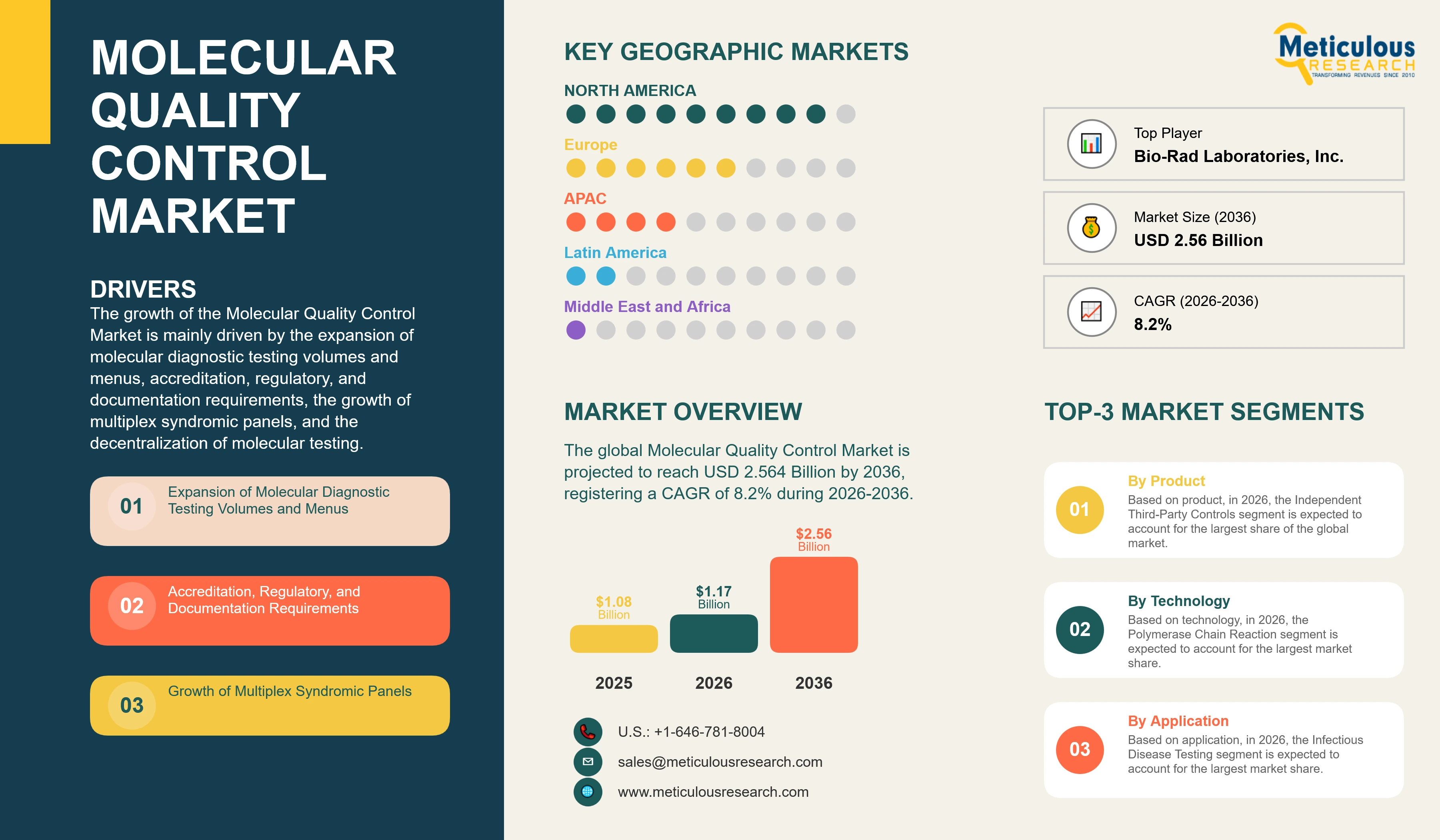
The global Molecular Quality Control Market was valued at USD 1.082 billion in 2025. This market is expected to reach USD 2.564 billion by 2036 from an estimated USD 1.171 billion in 2026, registering a CAGR of 8.2% during the forecast period (2026-2036).
- Published
- Oct 2026
- Pages
- 348
- Format
- PDF + Excel
- Report ID
- MRHC - 1042366
- Base year
- 2025
- 2025 · BASELINE
- $1.08B
- 2036
- $2.56B
- CAGR 2026–2036
- 8.2%
2025 baseline · 2026–2036 forecast at 8.2% CAGR · hover a bar for the value
Key highlights
The global Molecular Quality Control Market is projected to reach USD 2.564 billion by 2036, driven by molecular testing volumes, accreditation requirements, multiplex panels, decentralized testing, and the shift to independent third-party controls.
Quality systems are a growth driver for diagnostics suppliers. In the second quarter of 2026, Bio-Rad Laboratories, Inc. reported Clinical Diagnostics segment net sales of USD 399.0 million, up 2.6% year over year, with growth attributed to quality systems, diabetes, and blood typing products, partly offset by lower infectious disease sales, while its Life Science segment declined 4.1% on continuing weakness in the academic research market.
Suppliers are consolidating the quality control landscape. LGC has built its quality control portfolio through successive acquisitions, including Technopath Clinical Diagnostics, which supplies multi-constituent chemistry and immunoassay controls, and, in December 2024, DiaMex of Heidelberg, Germany, which manufactures third-party serology and molecular quality controls, including its Optitrol range of ready-to-use multimarker controls for clinical laboratories and blood banks across Europe, Asia-Pacific, and Latin America.
North America is expected to account for the largest market share in 2026, supported by the scale of molecular testing, CLIA and accreditation requirements, and the presence of leading control manufacturers, while Asia-Pacific is projected to register the fastest growth during the forecast period.
By product, Independent Third-Party Controls are expected to account for the largest market share in 2026 and are also projected to witness the fastest growth through 2036, as laboratories and accreditation bodies increasingly prefer controls that are independent of the assay manufacturer.
Report summary
| Particulars | Details |
|---|---|
| Forecast Period | 2026-2036 |
| Base Year | 2025 |
| Estimated Year | 2026 |
| CAGR (Value) | 8.2% |
| Format | PDF, Excel & Cloud Portal · 348 pages |
| Market Size (Value) in 2026 | USD 1.171 Billion |
| Market Size (Value) in 2036 | USD 2.564 Billion |
| Segments Covered | By Product: Independent Third-Party Controls (Single-Analyte Controls, Multi-Analyte & Syndromic Panels, Whole-Process Controls in Matrix), Instrument- & Assay-Specific Controls, Calibrators & Quantitative Standards, Quality Control Data Management Software. By Analyte Type: Viral Controls (Respiratory Viruses, Blood-Borne Viruses, Other Viruses), Bacterial Controls, Human Genomic & Somatic Variant Controls, Fungal & Parasitic Controls, Other Controls. By Technology: Polymerase Chain Reaction (Real-Time PCR, Digital PCR), Next-Generation Sequencing, Isothermal & Other Amplification Methods, Hybridization & Other Technologies. By Application: Infectious Disease Testing (Respiratory Infections, Sexually Transmitted Infections, Gastrointestinal Infections, Other Infections), Oncology Testing, Genetic & Inherited Disease Testing, Blood & Plasma Screening, Other Applications. By End User: Hospital & Clinical Laboratories, Reference & Commercial Laboratories, Public Health & Government Laboratories, Blood & Plasma Screening Centres, In Vitro Diagnostic Manufacturers & Other End Users. |
| Countries Covered | North America: U.S., Canada. Europe: Germany, U.K., France, Italy, Spain, Ireland, Rest of Europe. Asia-Pacific: China, Japan, India, South Korea, Australia, Rest of Asia-Pacific. Latin America: Brazil, Mexico, Rest of Latin America. Middle East & Africa: Saudi Arabia, UAE, South Africa, Rest of Middle East & Africa. |
| Key Companies | LGC Limited (LGC Clinical Diagnostics), Bio-Rad Laboratories, Inc., Thermo Fisher Scientific Inc., Microbiologics, Inc., ZeptoMetrix LLC (Cole-Parmer), Maine Molecular Quality Controls, Inc., Randox Laboratories Ltd, Revvity, Inc. (Horizon Discovery), Streck, Inc., and Qnostics Ltd. |
Report overview
Segments covered: product, analyte, technology, application, end user.
The growth of this market is mainly driven by the continuing expansion of molecular diagnostic testing in infectious disease, oncology, and genetic testing, each run of which requires characterized controls to demonstrate analytical validity; accreditation and regulatory requirements that oblige laboratories to run controls, document performance, and investigate deviations; the growth of multiplex syndromic panels, which require controls covering many targets at once; and the decentralization of molecular testing to hospital, regional, and near-patient settings, which multiplies the number of sites operating independent quality control programs. In addition, the shift from manufacturer-supplied kit controls toward independent third-party controls, the growth of molecular oncology and liquid biopsy testing requiring low-level controls, the adoption of quality control data management software and peer-group reporting, and the expansion of accredited laboratory capacity in Asia-Pacific are further supporting the growth of this market.
The Molecular Quality Control Market, also referred to as the molecular diagnostics quality control market, molecular controls market, or nucleic acid testing quality control market, comprises the characterized control materials, calibrators, panels, and associated data management software that clinical laboratories and diagnostic manufacturers use to verify and monitor the performance of molecular assays. The market includes independent third-party controls supplied by manufacturers other than the assay provider; instrument- and assay-specific controls supplied with or for a particular platform; quantitative calibrators and standards used to establish and verify measurement scales; multi-analyte and syndromic panels covering respiratory, gastrointestinal, sexually transmitted, blood-borne, and other target groups; whole-process controls supplied in swab, plasma, or other matrix formats that challenge extraction as well as amplification; and quality control data management and peer-group comparison software. The market covers controls for polymerase chain reaction (PCR) and quantitative PCR, digital PCR, next-generation sequencing, transcription-mediated amplification and other isothermal methods, and hybridization-based assays. The market ecosystem extends from control manufacturers, calibrator and standards producers, and software providers to hospital and reference laboratories, public health laboratories, blood and plasma screening centres, in vitro diagnostic manufacturers, and external quality assessment organizers.
Quality control performs a function that no amount of assay sophistication can replace. A molecular assay reports a result, but only a control of known composition establishes that the assay was performing within specification at the moment the result was generated. Controls challenge the complete analytical process, including extraction, amplification, detection, and interpretation, and they detect the failure modes that matter most in molecular testing, including reagent lot variation, instrument drift, inhibition, contamination, and pipeline or software changes. Because a control must be run with each batch or at a defined frequency, demand is recurring and scales with the number of runs performed rather than with instrument placements alone.
Molecular testing volumes underpin the market. Testing for respiratory and other infectious diseases remains substantially above pre-pandemic levels, multiplex syndromic panels have become routine in many settings, and molecular oncology and genetic testing continue to expand. In the second quarter of 2026, Tempus AI, Inc. reported 31% growth in oncology testing volume and 9,000 molecular residual disease tests, illustrating the growth of molecular oncology and liquid biopsy testing that requires characterized controls in every analytical run. In the second quarter of 2026, Illumina, Inc. reported sequencing instrument revenue of USD 125 million, up 31% year over year, and sequencing consumables revenue of USD 775 million, up 5%, reflecting an expanding installed base of molecular platforms that each require routine quality control. Each additional assay in a laboratory menu, and each additional instrument placed, creates a discrete and continuing quality control requirement.
Accreditation and regulation are the principal reason controls are purchased rather than merely recommended. The College of American Pathologists has aligned its Laboratory Accreditation Program checklists with revised Clinical Laboratory Improvement Amendments (CLIA) requirements that took effect in December 2024, and extended individualized quality control plan eligibility to all microbiology culture media, reflecting the continuing evolution of accreditation expectations that govern how laboratories design and document their quality control programs. Laboratories must establish a quality control strategy for each assay, run controls at a defined frequency, review results against established limits, document deviations and corrective action, and demonstrate all of this during inspection. In the U.S., the Food and Drug Administration final rule on laboratory developed tests was vacated by the U.S. District Court for the Eastern District of Texas in March 2025, and in August 2025 the agency signaled its intention to rescind the rule, leaving laboratory developed tests to be validated and monitored primarily under CLIA requirements and accreditation programs rather than FDA premarket review. With laboratory developed tests validated and monitored primarily under CLIA and accreditation programs, the responsibility for demonstrating continuing analytical performance rests squarely with the laboratory, which sustains demand for controls.
Independent third-party controls have become the preferred approach in many laboratories. A control supplied by the manufacturer of the assay shares its reagents, lot history, and design assumptions, and may therefore fail to reveal a systematic problem; an independent control provides an unbiased assessment of the complete process. Accreditation bodies and professional guidance increasingly favour independent controls, and laboratories running assays from several manufacturers value controls that allow performance to be compared consistently across platforms.
The supplier landscape has consolidated considerably. LGC has built its quality control portfolio through successive acquisitions, including Technopath Clinical Diagnostics, which supplies multi-constituent chemistry and immunoassay controls, and, in December 2024, DiaMex of Heidelberg, Germany, which manufactures third-party serology and molecular quality controls, including its Optitrol range of ready-to-use multimarker controls for clinical laboratories and blood banks across Europe, Asia-Pacific, and Latin America. In the second quarter of 2026, Bio-Rad Laboratories, Inc. reported Clinical Diagnostics segment net sales of USD 399.0 million, up 2.6% year over year, with growth attributed to quality systems, diabetes, and blood typing products, partly offset by lower infectious disease sales, while its Life Science segment declined 4.1% on continuing weakness in the academic research market. Bio-Rad has built its molecular control position partly through the acquisition of Exact Diagnostics, and ZeptoMetrix, a long-established supplier of infectious disease controls, was acquired by Cole-Parmer. Consolidation reflects the attraction of recurring, accreditation-driven revenue and the advantage of broad menus that allow a laboratory to source most of its controls from one supplier.
Regulatory grade is becoming a differentiator. In the European Union, the In Vitro Diagnostic Regulation continues to phase in, with manufacturers of Class C self-declared devices required to sign a written agreement with a notified body by September 26, 2026 in order to continue placing legacy devices on the market until the end of 2028, and extended transition timelines running to the end of 2027, 2028, and 2029 for devices that meet the conditions set in the Regulation. Controls supplied for diagnostic use in Europe must meet the Regulation requirements applicable to them, and in vitro diagnostic manufacturers require controls with documented characterization and traceability to support technical documentation. This is driving demand for controls manufactured under quality systems with full documentation rather than research-grade materials repurposed for clinical use.
The market includes dedicated quality control manufacturers and diagnostics companies such as LGC through LGC Clinical Diagnostics, Bio-Rad Laboratories, Thermo Fisher Scientific through its AcroMetrix portfolio, Microbiologics, ZeptoMetrix under Cole-Parmer, Maine Molecular Quality Controls, Randox Laboratories, Revvity through Horizon Discovery, Streck, and Qnostics. These companies compete on menu breadth, commutability with patient samples, whole-process challenge, lot-to-lot consistency, stability and shelf life, matrix and format options, regulatory grade, peer-group data and software, and price per determination.
At the same time, the market faces challenges, including the use of residual patient samples and in-house pooled material in place of commercial controls, cost pressure in laboratories operating under constrained reimbursement, the difficulty of producing controls that behave like genuine clinical specimens, the short notice on which assay and panel content changes, and the absence of fully harmonized expectations for how molecular quality control should be designed. As a result, companies that combine broad menus, demonstrated commutability, whole-process formats, regulatory-grade manufacturing, and useful peer-group data are expected to capture the largest share of growth over the forecast period.
Report infographic
Market dynamics
15 factors across 5 forcesExpansion of Molecular Diagnostic Testing Volumes and Menus
The expansion of molecular diagnostic testing volumes and menus is a major factor driving the Molecular Quality Control Market, as each assay in a laboratory menu requires its own control strategy and each analytical run requires controls to be processed alongside patient samples. Molecular testing for respiratory, gastrointestinal, sexually transmitted, and hospital-acquired infections remains well above pre-pandemic levels, and molecular oncology and genetic testing continue to grow. In the second quarter of 2026, Tempus AI, Inc. reported 31% growth in oncology testing volume and 9,000 molecular residual disease tests, illustrating the growth of molecular oncology and liquid biopsy testing that requires characterized controls in every analytical run.
Menu breadth matters as much as volume. A laboratory running twenty molecular assays requires controls covering the targets of all twenty, and the number of distinct controls it purchases does not fall when the volume of any individual test declines. In the second quarter of 2026, Illumina, Inc. reported sequencing instrument revenue of USD 125 million, up 31% year over year, and sequencing consumables revenue of USD 775 million, up 5%, reflecting an expanding installed base of molecular platforms that each require routine quality control. The combination of growing volumes and broadening menus therefore produces demand that is more resilient than test volume alone would suggest.
Accreditation, Regulatory, and Documentation Requirements
Accreditation, regulatory, and documentation requirements are significantly driving market growth, because they convert quality control from good practice into an obligation. The College of American Pathologists has aligned its Laboratory Accreditation Program checklists with revised Clinical Laboratory Improvement Amendments (CLIA) requirements that took effect in December 2024, and extended individualized quality control plan eligibility to all microbiology culture media, reflecting the continuing evolution of accreditation expectations that govern how laboratories design and document their quality control programs. Laboratories must define control frequency and acceptance criteria for each assay, review results, investigate out-of-specification findings, and present documentary evidence during inspection, and controls are the instrument through which these obligations are met.
In the U.S., the Food and Drug Administration final rule on laboratory developed tests was vacated by the U.S. District Court for the Eastern District of Texas in March 2025, and in August 2025 the agency signaled its intention to rescind the rule, leaving laboratory developed tests to be validated and monitored primarily under CLIA requirements and accreditation programs rather than FDA premarket review. Because the laboratory itself must demonstrate that an assay continues to perform as validated, and because that demonstration rests on control results accumulated over time, regulatory arrangements that place validation responsibility on laboratories tend to increase rather than reduce control consumption.
Growth of Multiplex Syndromic Panels
The growth of multiplex syndromic panels is an important driver of demand. Panels that detect fifteen or more respiratory or gastrointestinal targets from a single specimen have become routine in many hospital laboratories, and each target requires evidence that it can be detected. Multi-analyte control panels that cover the full target list of a commercial panel allow a laboratory to verify performance across all targets efficiently, and they command substantially higher prices than single-target controls.
Decentralization of Molecular Testing
The decentralization of molecular testing supports market growth. Molecular platforms have moved from central laboratories into hospital laboratories, satellite sites, urgent care, and near-patient settings, and each site operating under a CLIA certificate or equivalent must run its own quality control program. This multiplies the number of locations purchasing controls, and near-patient settings often require simpler, ready-to-use formats, such as swab-based whole-process controls, that suppliers price at a premium per determination.
Table of contents
13 chapters · 153 sections · 348 pages · click to expandSegmental analysis
| Segment | Largest share (2026) | Fastest growth (2026–2036) |
|---|---|---|
| By Product | Independent Third-Party Controls | Independent Third-Party Controls |
| By Analyte Type | Viral Controls | Human Genomic & Somatic Variant Controls |
| By Technology | Polymerase Chain Reaction | Next-Generation Sequencing |
| By Application | Infectious Disease Testing | Oncology Testing |
| By End User | Hospital & Clinical Laboratories | In Vitro Diagnostic Manufacturers & Other End Users |
By Product
- Molecular Quality Control Market Analysis by Product
- Independent Third-Party Controls are further segmented into Single-Analyte Controls, Multi-Analyte & Syndromic Panels, and Whole-Process Controls in Matrix.
- The Independent Third-Party Controls segment is expected to account for the largest share of the global Molecular Quality Control Market and is also projected to register the highest CAGR during the forecast period.
- This is mainly due to the preference of laboratories and accreditation bodies for controls independent of the assay manufacturer, the ability of independent controls to reveal systematic problems that kit controls may not, the value of consistent comparison across platforms in laboratories running assays from several suppliers, and the growth of multi-analyte panels and whole-process formats within this segment.
- The Calibrators & Quantitative Standards segment is expected to record steady growth, supported by quantitative viral load monitoring and other applications requiring an established measurement scale, while the Quality Control Data Management Software segment is expected to grow strongly as laboratories adopt statistical review and peer-group comparison.
By Analyte Type
- Molecular Quality Control Market Analysis by Analyte Type
- Viral Controls are further segmented into Respiratory Viruses, Blood-Borne Viruses, and Other Viruses.
- The Viral Controls segment is expected to account for the largest share of the market.
- The large share of this segment is mainly due to the volume of molecular testing performed for respiratory viruses, blood-borne viruses in diagnostic and blood screening settings, and sexually transmitted infections, the use of quantitative viral load monitoring requiring both controls and calibrators, and the inclusion of many viral targets in multiplex syndromic panels.
- However, the Human Genomic & Somatic Variant Controls segment is projected to register the highest CAGR during the forecast period.
- The rapid growth of this segment is attributed to the expansion of molecular oncology, liquid biopsy, inherited disease, and pharmacogenomic testing, and to the demanding specification of controls required to demonstrate detection of variants at low allele frequencies.
By Technology
- Molecular Quality Control Market Analysis by Technology
- Polymerase Chain Reaction is further segmented into Real-Time PCR and Digital PCR.
- The Polymerase Chain Reaction segment is expected to account for the largest share of the market.
- The large share of this segment is mainly due to the position of real-time PCR as the dominant method in clinical molecular diagnostics, the very large number of PCR runs performed worldwide, and the requirement to process controls with each run or at a defined frequency.
- However, the Next-Generation Sequencing segment is projected to register the highest CAGR during the forecast period.
- The rapid growth of this segment is attributed to the expansion of clinical sequencing in oncology and inherited disease, the complexity of sequencing workflows, which require controls challenging library preparation, sequencing, and bioinformatics, and the growing installed base of sequencing platforms in clinical laboratories.
By Application
- Molecular Quality Control Market Analysis by Application
- Infectious Disease Testing is further segmented into Respiratory Infections, Sexually Transmitted Infections, Gastrointestinal Infections, and Other Infections, while Other Applications include transplant monitoring, pharmacogenomics, and research.
- The Infectious Disease Testing segment is expected to account for the largest share of the market.
- The large share of this segment is mainly due to the volume of molecular infectious disease testing, which remains well above pre-pandemic levels, the widespread adoption of multiplex syndromic panels requiring controls covering many targets, and the established practice of running independent controls in infectious disease molecular testing.
- However, the Oncology Testing segment is projected to register the highest CAGR during the forecast period.
- The rapid growth of this segment is attributed to the expansion of comprehensive genomic profiling, liquid biopsy, and molecular residual disease testing, reflected in the 31% growth in oncology testing volume reported by Tempus in the second quarter of 2026, and the requirement for controls at low variant allele frequencies.
By End User
- Molecular Quality Control Market Analysis by End User
- The Hospital & Clinical Laboratories segment is expected to account for the largest share of the market.
- The large share of this segment is mainly due to the number of hospital laboratories performing molecular testing, their obligation to operate a documented quality control program for each assay under accreditation requirements, and the decentralization of molecular testing into hospital and satellite settings, which increases the number of independent quality control programs.
- However, the In Vitro Diagnostic Manufacturers & Other End Users segment is projected to register the highest CAGR during the forecast period.
- The rapid growth of this segment is attributed to the quantity of control material consumed during assay development, verification, and lot release, and to the requirement for documented characterization and traceability in technical documentation under the European In Vitro Diagnostic Regulation.
Geographic analysis
North America
Largest shareIn 2026, North America is expected to account for the largest share of the global Molecular Quality Control Market. The large share of this region is mainly attributed to the scale of molecular diagnostic testing, CLIA and accreditation requirements that oblige laboratories to operate documented quality control programs, the established practice of using independent third-party controls, and the presence of leading manufacturers including Bio-Rad Laboratories, Thermo Fisher Scientific, Microbiologics, Maine Molecular Quality Controls, ZeptoMetrix, and Streck. The College of American Pathologists has aligned its Laboratory Accreditation Program checklists with revised Clinical Laboratory Improvement Amendments (CLIA) requirements that took effect in December 2024, and extended individualized quality control plan eligibility to all microbiology culture media, reflecting the continuing evolution of accreditation expectations that govern how laboratories design and document their quality control programs.
Europe
Europe is expected to account for a significant share of the market, supported by established accreditation under international laboratory standards, high molecular testing volumes, blood and plasma screening programs, and the presence of suppliers including LGC Clinical Diagnostics, Randox Laboratories, and Qnostics. In the European Union, the In Vitro Diagnostic Regulation continues to phase in, with manufacturers of Class C self-declared devices required to sign a written agreement with a notified body by September 26, 2026 in order to continue placing legacy devices on the market until the end of 2028, and extended transition timelines running to the end of 2027, 2028, and 2029 for devices that meet the conditions set in the Regulation.
Asia-Pacific
Fastest growthAsia-Pacific is projected to register the highest CAGR during the forecast period. The growth of this region is driven by the rapid expansion of molecular testing capacity in China, India, Japan, and South Korea, the progressive adoption of international accreditation standards by clinical laboratories, which brings formal quality control obligations with it, government investment in public health laboratory networks, and the expansion of supplier presence in the region, including the focus of the LGC Optitrol range on Europe, Asia-Pacific, and Latin America.
Latin America
Latin America and the Middle East & Africa are expected to account for smaller shares of the market. In Latin America, the growth of molecular testing and accreditation in Brazil and Mexico is expected to support demand, while in the Middle East & Africa, investment in clinical and public health laboratory capacity in Gulf countries and in national disease programs is expected to support growth.
Competitive landscape
The global Molecular Quality Control Market is moderately consolidated and has consolidated further through acquisition, with a group of dedicated quality control manufacturers and diagnostics companies holding substantial shares, alongside specialist suppliers serving particular analyte groups and software providers supplying data management and peer comparison. Market participants compete primarily on menu breadth, commutability with patient samples, whole-process challenge, lot-to-lot consistency, stability and shelf life, matrix and format options, regulatory grade, peer-group data and software, and price per determination.
Leading companies are broadening menus to match commercial panel content, extending into molecular oncology and low-level variant controls, introducing whole-process and ready-to-use formats for decentralized settings, investing in data management and peer-group reporting, and acquiring complementary portfolios. Recent examples include the acquisition by LGC of DiaMex in December 2024, adding the Optitrol serology and molecular control range, and the growth in quality systems products that Bio-Rad cited within its Clinical Diagnostics segment in the second quarter of 2026.
The report provides a comprehensive competitive assessment of the leading companies operating in the global Molecular Quality Control Market. The key players profiled in the report include LGC Limited (LGC Clinical Diagnostics) (U.K.), Bio-Rad Laboratories, Inc. (U.S.), Thermo Fisher Scientific Inc. (U.S.), Microbiologics, Inc. (U.S.), ZeptoMetrix LLC (Cole-Parmer) (U.S.), Maine Molecular Quality Controls, Inc. (U.S.), Randox Laboratories Ltd (U.K.), Revvity, Inc. (Horizon Discovery) (U.S.), Streck, Inc. (U.S.), and Qnostics Ltd (U.K.).
- LGC Limited (LGC Clinical Diagnostics)
- Bio-Rad Laboratories, Inc.
- Thermo Fisher Scientific Inc.
- Microbiologics, Inc.
- ZeptoMetrix LLC (Cole-Parmer)
- Maine Molecular Quality Controls, Inc.
- Randox Laboratories Ltd
- Revvity, Inc. · Horizon Discovery
- Streck, Inc.
- Qnostics Ltd
Expert perspectives
The Molecular Quality Control Market occupies an unusually defensible position within diagnostics, because demand is created by obligation rather than by discretionary choice. A laboratory may defer an instrument purchase, but it cannot defer the controls its accreditation requires. With molecular testing volumes and menus continuing to expand, accreditation expectations tightening, and laboratory developed tests validated primarily under CLIA and accreditation programs, the binding constraint is shifting from whether laboratories run controls to whether the controls they run genuinely represent patient samples and challenge the whole analytical process.
Three structural changes are expected to shape competitive positions through 2036. First, the preference for independent third-party controls over kit-supplied controls is expected to continue, which favours dedicated manufacturers over assay suppliers. Second, decentralization is expected to multiply the number of sites running independent quality control programs, favouring suppliers with ready-to-use and whole-process formats. Third, data management and peer-group comparison are expected to become a principal differentiator, and because the value of peer comparison grows with participation, early scale advantages are likely to compound.
For companies planning entry or expansion, the most defensible positions over the forecast period are likely to be found in whole-process controls in clinically representative matrices, oncology and low-level variant controls, panel-matched multiplex controls that track commercial assay content, regulatory-grade controls for European markets and diagnostic manufacturers, and quality control software with peer-group reporting. For established providers, the principal priorities are demonstrating commutability, keeping menus aligned with changing panel content, and extending software to retain customers.
Overall, the market is expected to grow steadily, with independent third-party controls, viral analytes, polymerase chain reaction, infectious disease testing, hospital and clinical laboratories, and North America providing the core of demand, and human genomic and somatic variant controls, next-generation sequencing, oncology testing, in vitro diagnostic manufacturers, and Asia-Pacific providing the fastest growth.
Customer perspectives
Insights gathered during primary interviews with clinical microbiology directors, molecular laboratory quality managers, and diagnostic manufacturing leaders operating in this market highlight where procurement priorities are shifting. The following perspectives reflect recurring themes raised across these discussions.
“This reflects the shift toward independent third-party controls.”
“This indicates demand for whole-process controls in matrix.”
“This points to regulatory grade as a procurement requirement.”
Frequently asked questions
The global Molecular Quality Control Market is estimated at USD 1.171 billion in 2026.
Cite this report
Meticulous Research. (2026). Molecular Quality Control Market - Global Opportunity Analysis And Industry Forecasts (2026-2036) (Report No. MRHC - 1042366). Meticulous Market Research Pvt. Ltd. https://www.meticulousresearch.com/product/molecular-quality-control-market-7049