DNA Synthesis Market (2026-2036)
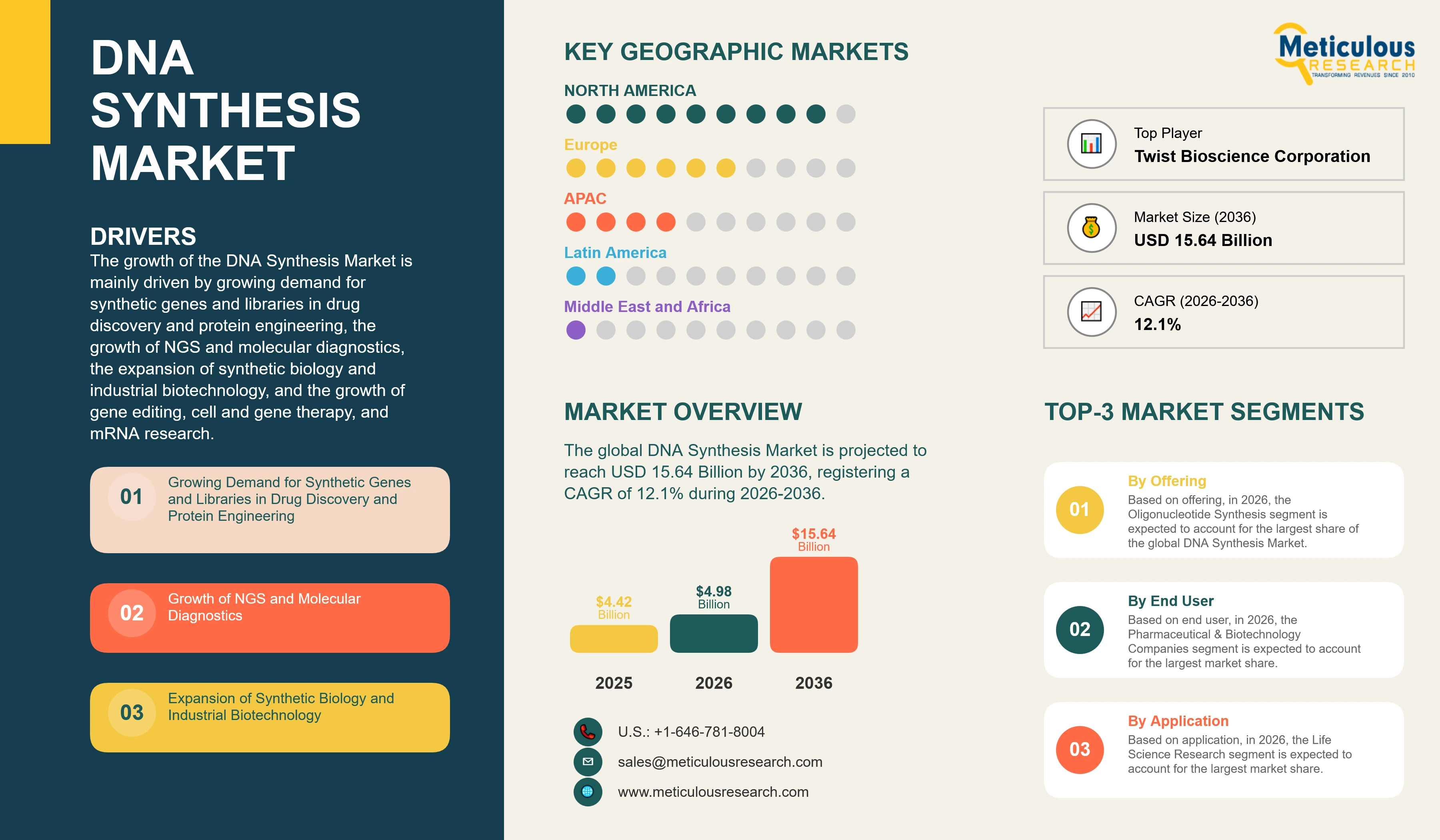
The global DNA Synthesis Market was valued at USD 4.42 billion in 2025. This market is expected to reach USD 15.64 billion by 2036 from an estimated USD 4.98 billion in 2026, registering a CAGR of 12.1% during the forecast period (2026-2036).
- Published
- Oct 2026
- Pages
- 328
- Format
- PDF + Excel
- Report ID
- MRHC - 1042364
- Base year
- 2025
- 2025 · BASELINE
- $4.42B
- 2036
- $15.64B
- CAGR 2026–2036
- 12.1%
2025 baseline · 2026–2036 forecast at 12.1% CAGR · hover a bar for the value
Key highlights
The global DNA Synthesis Market is projected to reach USD 15.64 billion by 2036, driven by AI-driven drug discovery and protein engineering, NGS and molecular diagnostics, synthetic biology, and genetic medicine research.
Gene synthesis demand is growing rapidly. In its fiscal third quarter of 2026, ended June 30, 2026, Twist Bioscience Corporation reported record revenue of USD 118.4 million, up 23% year over year, with DNA Synthesis and Protein Solutions revenue of USD 56.6 million, up 39%, approximately 369,000 genes shipped compared with approximately 237,000 a year earlier, and products shipped to approximately 2,650 customers, and raised its fiscal 2026 revenue guidance to USD 456-457 million.
Diagnostic and sequencing applications sustain demand for oligonucleotides. In the second quarter of 2026, Illumina, Inc. reported sequencing consumables revenue of USD 775 million, up 5% year over year, reflecting continued growth in sequencing volumes that use synthetic oligonucleotides for adapters, index sequences, and target enrichment probes.
North America is expected to account for the largest market share in 2026, supported by large pharmaceutical, biotechnology, and synthetic biology industries, substantial research funding, and the presence of leading synthesis providers, while Asia-Pacific is projected to register the fastest growth during the forecast period.
By synthesis method, Chemical Synthesis is expected to account for the largest market share in 2026, whereas Enzymatic Synthesis is projected to witness the fastest growth through 2036, as enzymatic chemistry matures for longer sequences, higher accuracy, and reduced solvent use.
Report summary
| Particulars | Details |
|---|---|
| Forecast Period | 2026-2036 |
| Base Year | 2025 |
| Estimated Year | 2026 |
| CAGR (Value) | 12.1% |
| Format | PDF, Excel & Cloud Portal · 328 pages |
| Market Size (Value) in 2026 | USD 4.98 Billion |
| Market Size (Value) in 2036 | USD 15.64 Billion |
| Segments Covered | By Offering: Oligonucleotide Synthesis (Standard Oligonucleotides, Modified Oligonucleotides, Oligonucleotide Pools), Gene Synthesis (Synthetic Genes & Gene Fragments, Variant & Combinatorial Libraries, Plasmids & Vectors), DNA Synthesizers, Reagents & Consumables. By Synthesis Method: Chemical Synthesis (Column-Based Synthesis, Array- & Chip-Based Synthesis), Enzymatic Synthesis. By Application: Life Science Research (Genomics & Sequencing, Protein Engineering & Antibody Discovery, Other Research), Diagnostics, Therapeutics Development (Gene Editing & Genetic Medicine Research, Cell & Gene Therapy Development, mRNA & RNA Therapeutics Research), Industrial & Synthetic Biology. By End User: Pharmaceutical & Biotechnology Companies, Academic & Research Institutes, Diagnostic Laboratories & Kit Manufacturers, CROs & CDMOs, Industrial & Synthetic Biology Companies. |
| Countries Covered | North America: U.S., Canada. Europe: Germany, U.K., France, Belgium, Switzerland, Italy, Rest of Europe. Asia-Pacific: China, Japan, India, South Korea, Singapore, Rest of Asia-Pacific. Latin America: Brazil, Mexico, Rest of Latin America. Middle East & Africa: Saudi Arabia, UAE, Rest of Middle East & Africa. |
| Key Companies | Twist Bioscience Corporation, Danaher Corporation (Integrated DNA Technologies), Thermo Fisher Scientific Inc., Merck KGaA, GenScript Biotech Corporation, Azenta, Inc. (GENEWIZ), Eurofins Scientific SE (Eurofins Genomics), LGC Limited (LGC Biosearch Technologies), Kaneka Eurogentec S.A., DNA Script SAS, Ansa Biotechnologies, Inc., and Molecular Assemblies, Inc. |
Report overview
Segments covered: offering, method, application, end user.
The growth of this market is mainly driven by the growing demand for synthetic genes and variant libraries in antibody discovery, protein engineering, and artificial intelligence (AI)-driven molecular design; the growth of next-generation sequencing (NGS) and molecular diagnostics, which consume custom primers, probes, adapters, and target enrichment panels; the expansion of synthetic biology for pharmaceuticals, chemicals, agriculture, and materials; and the growth of gene editing, cell and gene therapy, and mRNA research programs that require synthetic templates and constructs. In addition, the declining cost per base of high-throughput synthesis platforms, the maturation of enzymatic synthesis chemistry, the integration of synthesis with protein expression and screening services, and the expansion of biotechnology research capacity in Asia-Pacific are further supporting the growth of this market.
The DNA Synthesis Market, also referred to as the synthetic DNA market, oligonucleotide and gene synthesis market, or custom DNA synthesis market, comprises the services, instruments, and reagents used to produce DNA sequences specified by researchers and companies, without the need for a natural template. The market includes custom oligonucleotide synthesis, such as primers, probes, adapters, and modified oligonucleotides; oligonucleotide pools; gene synthesis, including synthetic genes, gene fragments, codon-optimized constructs, and variant and combinatorial libraries; DNA synthesizer instruments; and synthesis reagents and consumables, such as phosphoramidites, solid supports, and enzymatic synthesis reagents. The market covers products supplied for research, diagnostic, and preclinical development use, and excludes good manufacturing practice (GMP) manufacturing of oligonucleotide and mRNA drug substances for clinical and commercial supply. The market ecosystem extends from synthesis service providers, instrument and reagent manufacturers, and technology developers to academic and research institutes, pharmaceutical and biotechnology companies, diagnostic laboratories and kit manufacturers, contract research organizations (CROs), and synthetic biology and industrial biotechnology companies.
Synthetic DNA is a foundational input to modern biology. Researchers use oligonucleotides in almost every molecular biology experiment, from PCR and sequencing to cloning and gene editing, and synthetic genes allow genetic designs to be built and tested without cloning them from natural sources. As biology becomes more design-driven, with computational models proposing proteins, pathways, and genetic constructs, the ability to produce DNA quickly, accurately, and affordably has become a central enabler of research productivity.
Gene synthesis and libraries represent the fastest-growing area. In its fiscal third quarter of 2026, ended June 30, 2026, Twist Bioscience Corporation reported record revenue of USD 118.4 million, up 23% year over year, with DNA Synthesis and Protein Solutions revenue of USD 56.6 million, up 39%, approximately 369,000 genes shipped compared with approximately 237,000 a year earlier, and products shipped to approximately 2,650 customers, and raised its fiscal 2026 revenue guidance to USD 456-457 million. Pharmaceutical and biotechnology companies use synthetic genes and variant libraries for antibody discovery and optimization, protein engineering, and enzyme design, and the number of sequences tested in each program is rising as computational design improves and as screening becomes more automated.
Oligonucleotides remain the largest product category, used across research, diagnostics, and sequencing. In the second quarter of 2026, Illumina, Inc. reported sequencing consumables revenue of USD 775 million, up 5% year over year, reflecting continued growth in sequencing volumes that use synthetic oligonucleotides for adapters, index sequences, and target enrichment probes. In the second quarter of 2026, Tempus AI, Inc. reported 31% growth in oncology testing volume and 9,000 molecular residual disease tests, illustrating the growth of NGS-based diagnostics that rely on custom synthetic probes and primers. PCR and quantitative PCR assays, NGS target enrichment panels, and gene-editing experiments all require custom oligonucleotides, frequently with modifications such as fluorescent dyes, quenchers, and chemical linkers, and diagnostic kit manufacturers source oligonucleotides as critical raw materials under supply agreements with defined quality specifications.
Genetic medicine and synthetic biology research are expanding demand further. In July 2026, the U.S. Food and Drug Administration (FDA) expanded the approval of CASGEVY, the first CRISPR-based gene-editing therapy, to children aged two years and older with sickle cell disease or transfusion-dependent beta thalassemia. Gene-editing research requires synthetic templates and constructs, cell and gene therapy development uses synthetic genes, promoters, and regulatory elements, and mRNA research requires linear DNA templates for in vitro transcription. Synthetic biology companies use synthetic DNA to engineer microorganisms and cell lines for the production of pharmaceuticals, specialty chemicals, food ingredients, and materials, often testing large numbers of designs in automated facilities.
Synthesis technology continues to advance. Conventional phosphoramidite chemistry, used for several decades, is limited in the length of product it can produce reliably and uses organic solvents and reagents that generate chemical waste. Silicon-based and high-throughput miniaturized platforms have substantially lowered the cost per base and increased the number of sequences that can be produced in parallel. Enzymatic synthesis, developed by companies including DNA Script, Ansa Biotechnologies, and Molecular Assemblies, uses engineered enzymes in aqueous conditions and is intended to produce longer sequences with fewer errors and less solvent use. Providers also compete on digital design and ordering tools that allow customers to upload, validate, and track sequences.
The market includes leading synthesis providers such as Twist Bioscience, Danaher through Integrated DNA Technologies, Thermo Fisher Scientific, Merck KGaA, GenScript Biotech, Azenta through GENEWIZ, Eurofins Scientific through Eurofins Genomics, LGC through LGC Biosearch Technologies, and Kaneka Eurogentec. These companies compete on turnaround time, sequence accuracy and achievable length, cost per base, success rate with complex sequences, manufacturing scale, modification chemistry, quality systems for diagnostic and regulated customers, and the breadth of adjacent protein, antibody, and cell line services that can be bundled with synthesis.
At the same time, the market faces challenges, including the difficulty and cost of producing long, repetitive, and high-GC sequences, error rates that require sequence verification and correction, commoditization and price competition in standard products, variability in academic research funding, and the solvent and waste burden of conventional chemistry. As a result, companies that combine fast turnaround, high success rates for long and complex constructs, scalable low-cost platforms, robust quality systems, and integration with downstream protein and screening services are expected to capture the largest share of growth over the forecast period.
Report infographic
Market dynamics
15 factors across 5 forcesGrowing Demand for Synthetic Genes and Libraries in Drug Discovery and Protein Engineering
The growing demand for synthetic genes and variant libraries in drug discovery and protein engineering is a major factor driving the DNA Synthesis Market, as companies design and test increasing numbers of protein and antibody variants. Antibody discovery and optimization, enzyme engineering, and the development of biologics and novel modalities all require synthetic genes and libraries, and computational design is increasing the number of candidate sequences that must be built and tested in each program. In its fiscal third quarter of 2026, ended June 30, 2026, Twist Bioscience Corporation reported record revenue of USD 118.4 million, up 23% year over year, with DNA Synthesis and Protein Solutions revenue of USD 56.6 million, up 39%, approximately 369,000 genes shipped compared with approximately 237,000 a year earlier, and products shipped to approximately 2,650 customers, and raised its fiscal 2026 revenue guidance to USD 456-457 million.
The 39% growth in DNA Synthesis and Protein Solutions revenue reported by Twist Bioscience, together with an increase in genes shipped from approximately 237,000 to approximately 369,000 in a single year, illustrates the scale of this shift. As design, synthesis, expression, and screening are integrated into faster iterative cycles, demand for high-throughput gene synthesis and libraries is expected to grow strongly through the forecast period.
Growth of NGS and Molecular Diagnostics
The growth of NGS and molecular diagnostics is significantly driving market growth. In the second quarter of 2026, Illumina, Inc. reported sequencing consumables revenue of USD 775 million, up 5% year over year, reflecting continued growth in sequencing volumes that use synthetic oligonucleotides for adapters, index sequences, and target enrichment probes. Sequencing workflows require synthetic adapters, index sequences, and target enrichment probes, and PCR and quantitative PCR diagnostics require sequence-specific primers and probes for every assay developed and manufactured. In the second quarter of 2026, Tempus AI, Inc. reported 31% growth in oncology testing volume and 9,000 molecular residual disease tests, illustrating the growth of NGS-based diagnostics that rely on custom synthetic probes and primers. As NGS panels, liquid biopsy, and molecular diagnostic menus expand, demand for custom and diagnostic-grade oligonucleotides is expected to increase, particularly for suppliers able to meet the documentation and consistency requirements of kit manufacturers.
Expansion of Synthetic Biology and Industrial Biotechnology
The expansion of synthetic biology and industrial biotechnology is an important driver of demand. Companies are engineering microorganisms and cell lines to produce pharmaceuticals, specialty chemicals, food ingredients, fragrances, and materials, and these programs require synthetic genes, pathways, and regulatory elements that are designed, built, and tested in repeated cycles. Automated facilities can build and screen thousands of designs, creating large and recurring demand for synthetic DNA at falling cost per construct.
Synthetic biology is also being applied in agriculture, where engineered microbes and plant traits are developed for yield, nitrogen fixation, and stress tolerance, and in materials and environmental applications. As the cost of synthetic DNA declines and design tools improve, a broader set of organizations is expected to adopt design-driven biological engineering, extending demand beyond traditional pharmaceutical and academic customers.
Growth of Gene Editing, Cell and Gene Therapy, and mRNA Research
The growth of gene editing, cell and gene therapy, and mRNA research supports market growth. In July 2026, the U.S. Food and Drug Administration (FDA) expanded the approval of CASGEVY, the first CRISPR-based gene-editing therapy, to children aged two years and older with sickle cell disease or transfusion-dependent beta thalassemia. Research and preclinical development in these areas require synthetic templates, donor and repair constructs, promoters, and linear DNA templates for in vitro transcription, and each program typically tests many sequence variants before selecting a candidate. The growing number of programs in discovery and preclinical development is increasing demand for research-grade synthetic DNA, while successful programs subsequently create demand for regulated manufacturing supplied outside the scope of this market.
Table of contents
12 chapters · 145 sections · 328 pages · click to expandSegmental analysis
| Segment | Largest share (2026) | Fastest growth (2026–2036) |
|---|---|---|
| By Offering | Oligonucleotide Synthesis | Gene Synthesis |
| By Synthesis Method | Chemical Synthesis | Enzymatic Synthesis |
| By Application | Life Science Research | Therapeutics Development |
| By End User | Pharmaceutical & Biotechnology Companies | Industrial & Synthetic Biology Companies |
By Offering
- DNA Synthesis Market Analysis by Offering
- Oligonucleotide Synthesis is further segmented into Standard Oligonucleotides, Modified Oligonucleotides, and Oligonucleotide Pools, while Gene Synthesis is further segmented into Synthetic Genes & Gene Fragments, Variant & Combinatorial Libraries, and Plasmids & Vectors.
- The Oligonucleotide Synthesis segment is expected to account for the largest share of the global DNA Synthesis Market.
- The large share of this segment is mainly due to the use of oligonucleotides in nearly every molecular biology workflow, the very large number of primers and probes consumed by PCR and NGS in research and diagnostics, and the recurring nature of oligonucleotide orders from academic, industrial, and diagnostic customers.
- However, the Gene Synthesis segment is projected to register the highest CAGR during the forecast period.
- The rapid growth of this segment is attributed to the expansion of antibody discovery, protein engineering, and AI-driven design programs that order large numbers of genes and variant libraries, the shift toward longer constructs and complete pathways, and the growth in genes shipped reported by leading providers, with Twist Bioscience shipping approximately 369,000 genes in its fiscal third quarter of 2026 compared with approximately 237,000 a year earlier.
By Synthesis Method
- DNA Synthesis Market Analysis by Synthesis Method
- Chemical Synthesis is further segmented into Column-Based Synthesis and Array- & Chip-Based Synthesis.
- The Chemical Synthesis segment is expected to account for the largest share of the market.
- The large share of this segment is mainly due to the long-established use of phosphoramidite chemistry across the industry, the extensive installed base of column and array-based platforms, the broad range of chemical modifications available, and the high-throughput, low-cost production enabled by array and chip-based platforms used by leading gene synthesis providers.
- However, the Enzymatic Synthesis segment is projected to register the highest CAGR during the forecast period.
- The rapid growth of this segment is attributed to the potential of enzymatic chemistry to produce longer sequences with fewer errors, its substantially lower use of organic solvents and generation of hazardous waste, and the commercialization efforts of companies such as DNA Script, Ansa Biotechnologies, and Molecular Assemblies.
- Adoption is expected to accelerate as achievable length, cost, and reliability improve.
By Application
- DNA Synthesis Market Analysis by Application
- Life Science Research is further segmented into Genomics & Sequencing, Protein Engineering & Antibody Discovery, and Other Research, while Therapeutics Development is further segmented into Gene Editing & Genetic Medicine Research, Cell & Gene Therapy Development, and mRNA & RNA Therapeutics Research.
- The Life Science Research segment is expected to account for the largest share of the market.
- The large share of this segment is mainly due to the use of synthetic DNA across academic, government, and industrial research, the consumption of oligonucleotides in sequencing and PCR workflows, and the growth of protein engineering and antibody discovery programs that order genes and libraries in large numbers.
- However, the Therapeutics Development segment is projected to register the highest CAGR during the forecast period.
- The rapid growth of this segment is attributed to the expansion of gene editing, cell and gene therapy, and mRNA research pipelines, the approval and widening use of gene-editing therapies such as CASGEVY, and the large number of sequence variants tested during the discovery and preclinical phases of these programs.
By End User
- DNA Synthesis Market Analysis by End User
- The Pharmaceutical & Biotechnology Companies segment is expected to account for the largest share of the market.
- The large share of this segment is mainly due to their extensive use of synthetic genes and libraries in discovery and preclinical development, their substantial research and development budgets, and their investment in antibody, protein, and genetic medicine programs that order large volumes of synthetic DNA.
- However, the Industrial & Synthetic Biology Companies segment is projected to register the highest CAGR during the forecast period.
- The rapid growth of this segment is attributed to the expansion of engineered biology for pharmaceuticals, chemicals, food ingredients, agriculture, and materials, the use of automated facilities that build and test thousands of designs, and the falling cost per construct that makes large-scale design testing economically viable.
Geographic analysis
North America
Largest shareIn 2026, North America is expected to account for the largest share of the global DNA Synthesis Market. The large share of this region is mainly attributed to the concentration of pharmaceutical, biotechnology, and synthetic biology companies, substantial research funding, leadership in antibody discovery, protein engineering, and genetic medicine development, and the presence of leading providers including Twist Bioscience, Integrated DNA Technologies, Thermo Fisher Scientific, Azenta, and Ansa Biotechnologies. In February 2026, the U.S. Consolidated Appropriations Act, 2026 set the National Institutes of Health (NIH) program level at USD 47.49 billion for fiscal year 2026, an increase of 1.0% over fiscal year 2025, after the administration had proposed a cut of more than 40%.
Europe
Europe is expected to account for a significant share of the market, supported by strong academic research, a large pharmaceutical and biotechnology sector, growing synthetic biology and industrial biotechnology activity, and the presence of providers such as Merck KGaA, Eurofins Genomics, LGC Biosearch Technologies, Kaneka Eurogentec, and DNA Script. European research infrastructure programs and sustainability expectations are also supporting interest in lower-waste synthesis methods.
Asia-Pacific
Fastest growthAsia-Pacific is projected to register the highest CAGR during the forecast period. The growth of this region is driven by the rapid expansion of biopharmaceutical research, CRO capacity, and molecular diagnostics in China, India, South Korea, and Japan, substantial government investment in biotechnology, the growth of domestic synthesis providers including GenScript Biotech, and competitive pricing and turnaround that is attracting international customers as well as serving local demand.
Latin America
Latin America and the Middle East & Africa are expected to account for smaller shares of the market. In Latin America, academic research and agricultural biotechnology in Brazil and Mexico are expected to support demand, while in the Middle East & Africa, investment in genomics and biotechnology research in Gulf countries is expected to support growth from a small base.
Competitive landscape
The global DNA Synthesis Market is moderately fragmented, with a group of established providers holding significant shares across oligonucleotide and gene synthesis, alongside technology-focused entrants developing enzymatic platforms and a growing number of regional providers competing on price and turnaround. Market participants compete primarily on turnaround time, sequence accuracy and achievable length, cost per base, success rate with complex sequences, manufacturing scale, modification chemistry, quality systems, digital design and ordering tools, and the breadth of adjacent protein and screening services.
Leading companies are investing in high-throughput synthesis capacity, expanding gene and library portfolios, integrating synthesis with protein expression and screening, developing digital design platforms, and advancing enzymatic synthesis technology. Recent market context includes record revenue of USD 118.4 million and 39% growth in DNA Synthesis and Protein Solutions reported by Twist Bioscience in its fiscal third quarter of 2026, together with raised full-year guidance of USD 456-457 million.
The report provides a comprehensive competitive assessment of the leading companies operating in the global DNA Synthesis Market. The key players profiled in the report include Twist Bioscience Corporation (U.S.), Danaher Corporation (Integrated DNA Technologies) (U.S.), Thermo Fisher Scientific Inc. (U.S.), Merck KGaA (Germany), GenScript Biotech Corporation (China), Azenta, Inc. (GENEWIZ) (U.S.), Eurofins Scientific SE (Eurofins Genomics) (Luxembourg), LGC Limited (LGC Biosearch Technologies) (U.K.), Kaneka Eurogentec S.A. (Belgium), DNA Script SAS (France), Ansa Biotechnologies, Inc. (U.S.), and Molecular Assemblies, Inc. (U.S.).
- Twist Bioscience Corporation
- Danaher Corporation (Integrated DNA Technologies)
- Thermo Fisher Scientific Inc.
- Merck KGaA
- GenScript Biotech Corporation
- Azenta, Inc. (GENEWIZ)
- Eurofins Scientific SE · Eurofins Genomics
- LGC Limited (LGC Biosearch Technologies)
- Kaneka Eurogentec S.A.
- DNA Script SAS
- Ansa Biotechnologies, Inc.
- Molecular Assemblies, Inc
Expert perspectives
The DNA Synthesis Market is being reshaped by the shift from reading biology to designing it. With Twist Bioscience reporting 39% growth in DNA synthesis revenue and a 56% increase in genes shipped, sequencing consumables continuing to grow, and gene-editing therapies reaching wider patient populations, demand is moving from small numbers of carefully selected sequences toward large design spaces tested in parallel. The binding constraint is shifting from the cost of a single construct to the speed, reliability, and scale at which complex designs can be built and verified.
Three structural changes are expected to shape competitive positions through 2036. First, falling cost per base and rising throughput are expected to expand total volume even as unit prices decline, favoring providers with highly parallel platforms and efficient operations. Second, integration of synthesis with protein expression, screening, and design software is expected to shift competition from unit price toward program-level value, favoring providers with broad service portfolios. Third, enzymatic synthesis is expected to progress from early commercialization toward meaningful share, favoring companies with proven length, accuracy, and cost performance.
For companies planning entry or expansion, the most defensible positions over the forecast period are likely to be found in high-throughput gene and library synthesis for discovery programs, diagnostic-grade oligonucleotide supply under quality agreements, integrated design-build-test services, enzymatic synthesis platforms, and local capacity in Asia-Pacific. For established providers, the principal priorities are expanding capacity ahead of demand, improving success rates for long and complex constructs, and defending differentiated products against price competition.
Overall, the market is expected to grow strongly, with oligonucleotide synthesis, chemical synthesis, life science research, and pharmaceutical and biotechnology companies in North America providing the core of demand, and gene synthesis, enzymatic synthesis, therapeutics development, industrial and synthetic biology companies, and Asia-Pacific providing the fastest growth.
Customer perspectives
Insights gathered during primary interviews with antibody discovery leaders, synthetic biology platform directors, and diagnostic development managers operating in this market highlight where procurement priorities are shifting. The following perspectives reflect recurring themes raised across these discussions.
“This reflects the shift toward large-scale design testing.”
“This indicates that reliability outweighs headline pricing.”
“This points to quality systems as a barrier to supplier switching.”
Frequently asked questions
The global DNA Synthesis Market is estimated at USD 4.98 billion in 2026.
Cite this report
Meticulous Research. (2026). DNA Synthesis Market - Global Opportunity Analysis And Industry Forecasts (2026-2036) (Report No. MRHC - 1042364). Meticulous Market Research Pvt. Ltd. https://www.meticulousresearch.com/product/dna-synthesis-market-7047