Molecular Biology Enzymes and Reagents Market (2026-2036)
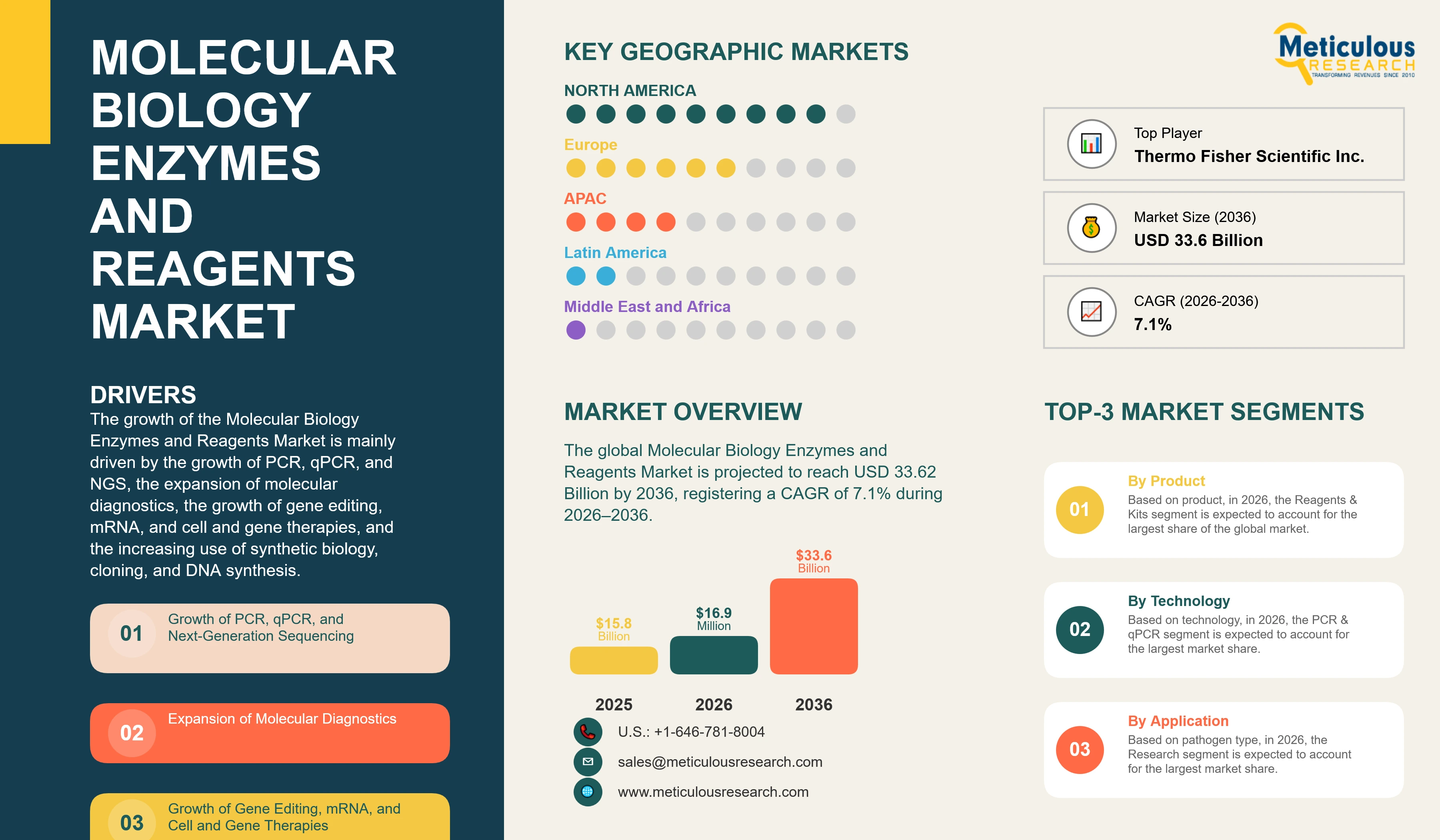
The global Molecular Biology Enzymes and Reagents Market was valued at USD 15.86 billion in 2025. This market is expected to reach USD 33.62 billion by 2036 from an estimated USD 16.98 billion in 2026, registering a CAGR of 7.1% during the forecast period (2026-2036).
- Published
- Oct 2026
- Pages
- 317
- Format
- PDF + Excel
- Report ID
- MR-2353
- Base year
- 2025
- 2025 · BASELINE
- $15.86B
- 2036
- $33.62B
- CAGR 2026–2036
- 7.1%
2025 baseline · 2026–2036 forecast at 7.1% CAGR · hover a bar for the value
Key highlights
The global Molecular Biology Enzymes and Reagents Market is projected to reach USD 33.62 billion by 2036, driven by PCR and NGS growth, molecular diagnostics, gene editing, mRNA and cell and gene therapy manufacturing, and synthetic biology.
Sequencing volumes continue to drive demand for library preparation enzymes. In the second quarter of 2026, Illumina, Inc. reported sequencing consumables revenue of USD 775 million, up 5% year over year, and sequencing instrument revenue of USD 125 million, up 31%, reflecting continued growth in sequencing volumes that consume library preparation enzymes and reagents.
GMP-grade enzymes for mRNA and genetic medicines are a growing segment. In the second quarter of 2026, Maravai LifeSciences reported revenue of USD 51.4 million, up 8.5% year over year, with its TriLink nucleic acid production business growing 11.5% to USD 34.7 million on demand for research-use mRNA raw materials and GMP consumables for clinical trials, and opened a GMP enzyme manufacturing facility to complete its portfolio of in vitro transcription (IVT) raw materials.
North America is expected to account for the largest market share in 2026, supported by large research funding, pharmaceutical and biotechnology industries, molecular diagnostics, and leading enzyme and reagent manufacturers, while Asia-Pacific is projected to register the fastest growth during the forecast period.
By grade, Research-Use-Only products are expected to account for the largest market share in 2026, whereas GMP- and IVD-Grade products are projected to witness the fastest growth through 2036, as gene-editing, mRNA, and cell and gene therapies move into commercial manufacturing and molecular diagnostics require regulated reagents.
Report summary
| Particulars | Details |
|---|---|
| Forecast Period | 2026-2036 |
| Base Year | 2025 |
| Estimated Year | 2026 |
| CAGR (Value) | 7.1% |
| Format | PDF, Excel & Cloud Portal · 317 pages |
| Market Size (Value) in 2026 | USD 16.98 Billion |
| Market Size (Value) in 2036 | USD 33.62 Billion |
| Segments Covered | By Product: Enzymes (Polymerases [DNA Polymerases, Reverse Transcriptases, RNA Polymerases], Ligases, Restriction Endonucleases, Gene-Editing Nucleases, Other Nucleases, Modifying Enzymes, Other Enzymes), Reagents & Kits (PCR & qPCR Master Mixes, Library Preparation Kits & Reagents, Cloning & Mutagenesis Kits, Transfection Reagents, Nucleotides & Cap Analogs, Buffers & Other Reagents). By Technology: PCR & qPCR, Next-Generation Sequencing, Cloning & Synthetic Biology, Gene Editing, mRNA & In Vitro Transcription, Other Technologies. By Grade: Research-Use-Only, GMP- & IVD-Grade. By Application: Research (Genomics & Transcriptomics, Cell Biology, Other Research), Diagnostics, Therapeutic Development & Manufacturing, Other Applications. By End User: Pharmaceutical & Biotechnology Companies, Academic & Research Institutes, Hospitals & Diagnostic Laboratories, CROs & CDMOs, Other End Users. |
| Countries Covered | North America: U.S., Canada. Europe: Germany, U.K., France, Switzerland, Italy, Spain, Rest of Europe. Asia-Pacific: China, Japan, India, South Korea, Australia, Rest of Asia-Pacific. Latin America: Brazil, Mexico, Rest of Latin America. Middle East & Africa: Saudi Arabia, UAE, Rest of Middle East & Africa. |
| Key Companies | Thermo Fisher Scientific Inc., Merck KGaA, Danaher Corporation, QIAGEN N.V., F. Hoffmann-La Roche Ltd, Promega Corporation, New England Biolabs, Inc., Takara Bio Inc., Agilent Technologies, Inc., Bio-Rad Laboratories, Inc., Illumina, Inc., and Maravai LifeSciences Holdings, Inc. |
Report overview
Segments covered: product, technology, grade, application, end user.
The growth of this market is mainly driven by the growth of PCR, quantitative PCR (qPCR), and next-generation sequencing (NGS) in research and diagnostics, which consume polymerases, master mixes, and library preparation reagents in every reaction; the expansion of molecular diagnostics in oncology, infectious diseases, and genetic testing; the growth of cell and gene therapies, gene editing, and mRNA therapeutics and vaccines, which require GMP-grade enzymes and reagents; and the increasing use of synthetic biology, cloning, and DNA synthesis in research and biomanufacturing. In addition, the development of engineered enzymes with higher fidelity, speed, and inhibitor tolerance, the growth of single-cell, spatial, and long-read sequencing, the shift to ready-to-use and lyophilized reagent formats, and the expansion of life science research in Asia-Pacific are further supporting the growth of this market.
The Molecular Biology Enzymes and Reagents Market, also referred to as the molecular biology enzymes, kits, and reagents market, nucleic acid enzymes market, or molecular biology reagents market, comprises the enzymes, master mixes, kits, and reagents used to amplify, copy, cut, join, modify, edit, and synthesize nucleic acids in research, diagnostics, and therapeutic development and manufacturing. The market includes DNA polymerases, reverse transcriptases, and RNA polymerases; ligases; restriction endonucleases; gene-editing nucleases such as CRISPR-associated (Cas) enzymes; other nucleases; modifying enzymes such as kinases and phosphatases; PCR and qPCR master mixes; NGS library preparation kits and reagents; cloning, assembly, and mutagenesis kits; transfection reagents; nucleotides, cap analogs, and other building blocks; and buffers and other reagents. The market covers research-use-only, diagnostic-grade, and GMP-grade products. The market ecosystem extends from enzyme and reagent manufacturers, including companies that supply enzymes as raw materials to other manufacturers, to academic and research institutes, pharmaceutical and biotechnology companies, hospitals and diagnostic laboratories, contract research organizations (CROs), contract development and manufacturing organizations (CDMOs), and diagnostic kit manufacturers.
Molecular biology enzymes and reagents are the consumable foundation of modern life science. Every PCR test, sequencing library, cloning experiment, gene-editing workflow, and mRNA manufacturing run depends on enzymes and reagents, and most are consumed in each reaction, creating recurring demand that grows with the volume of molecular testing and research. Improvements in enzyme engineering, such as high-fidelity and hot-start polymerases, thermostable reverse transcriptases, and engineered Cas enzymes, have expanded the capabilities of molecular methods and allow suppliers to differentiate their products.
Sequencing and PCR are the largest sources of demand. In the second quarter of 2026, Illumina, Inc. reported sequencing consumables revenue of USD 775 million, up 5% year over year, and sequencing instrument revenue of USD 125 million, up 31%, reflecting continued growth in sequencing volumes that consume library preparation enzymes and reagents. Library preparation for whole-genome, exome, transcriptome, single-cell, and long-read sequencing requires fragmentation, end repair, ligation, amplification, and cleanup enzymes and reagents, while qPCR and digital PCR in research and diagnostics consume polymerases and master mixes. The growth of molecular diagnostics in oncology, infectious diseases, and genetic testing creates demand for diagnostic-grade enzymes and master mixes, often supplied to diagnostic kit manufacturers.
Genetic medicines are creating a new, high-value segment. In July 2026, the U.S. Food and Drug Administration (FDA) expanded the approval of CASGEVY (exagamglogene autotemcel), the first CRISPR-based gene-editing therapy, to children aged two years and older with sickle cell disease or transfusion-dependent beta thalassemia, with the therapy available at more than 75 authorized treatment centers in the U.S. Gene-editing therapies require GMP-grade Cas nucleases and guide RNAs, and mRNA therapeutics and vaccines require GMP-grade T7 RNA polymerase, capping enzymes or cap analogs, nucleotides, and other IVT raw materials. In the second quarter of 2026, Maravai LifeSciences reported revenue of USD 51.4 million, up 8.5% year over year, with its TriLink nucleic acid production business growing 11.5% to USD 34.7 million on demand for research-use mRNA raw materials and GMP consumables for clinical trials, and opened a GMP enzyme manufacturing facility to complete its portfolio of in vitro transcription (IVT) raw materials. Cell and gene therapy manufacturing also uses enzymes for plasmid and vector production and quality control.
Research funding remains an important factor. In February 2026, the U.S. Consolidated Appropriations Act, 2026 set the National Institutes of Health (NIH) program level at USD 47.49 billion for fiscal year 2026, an increase of 1.0% over fiscal year 2025, after the administration had proposed a cut of more than 40%. Academic and government laboratories are major users of enzymes and reagents, and funding uncertainty affected purchasing during the year, while pharmaceutical, biotechnology, and diagnostic demand has been more resilient. In the third quarter of fiscal year 2026, Agilent Technologies, Inc. reported revenue of USD 1.88 billion, up 8.1% year over year, with its Life Sciences and Diagnostics Markets segment growing 11% to USD 746 million.
The market includes leading life science companies such as Thermo Fisher Scientific, Merck KGaA, Danaher (including Integrated DNA Technologies), QIAGEN, Roche, Agilent Technologies, Bio-Rad Laboratories, and Illumina; specialized enzyme and reagent suppliers such as Promega, New England Biolabs, and Takara Bio; and suppliers of mRNA and genetic medicine raw materials such as Maravai LifeSciences. These companies compete on enzyme performance, including fidelity, sensitivity, speed, and inhibitor tolerance, product quality and lot-to-lot consistency, regulatory grade and documentation, formats such as lyophilized and ready-to-use reagents, breadth of portfolio, intellectual property, price, and supply reliability.
At the same time, the market faces challenges, including variability in academic research funding, the decline in demand for COVID-19 testing and vaccine raw materials from pandemic peaks, price competition, particularly from manufacturers in China and other Asia-Pacific countries, the high cost and complexity of producing GMP-grade enzymes, and intellectual property constraints on certain enzymes and technologies, such as CRISPR. As a result, companies that combine engineered high-performance enzymes, GMP and IVD manufacturing capability, reliable supply, broad workflow portfolios, and strong technical support are expected to capture the largest share of growth over the forecast period.
Report infographic
Market dynamics
15 factors across 5 forcesGrowth of PCR, qPCR, and Next-Generation Sequencing
The growth of PCR, qPCR, and NGS is a major factor driving the Molecular Biology Enzymes and Reagents Market, as these technologies consume polymerases, master mixes, and library preparation reagents in every reaction. In the second quarter of 2026, Illumina, Inc. reported sequencing consumables revenue of USD 775 million, up 5% year over year, and sequencing instrument revenue of USD 125 million, up 31%, reflecting continued growth in sequencing volumes that consume library preparation enzymes and reagents. Population genomics, clinical genome sequencing, single-cell and spatial genomics, and long-read sequencing are increasing the number of libraries prepared, while qPCR and digital PCR remain the most widely used molecular methods in research and diagnostics.
New sequencing technologies also create demand for specialized enzymes and reagents. Long-read sequencing requires library preparation methods that preserve long DNA fragments, single-cell methods require reverse transcription and barcoding reagents, and new platforms such as the AXELIOS 1 sequencing platform launched by Roche in June 2026 use their own library preparation kits. As sequencing applications diversify, demand for specialized enzymes and kits is expected to grow.
Expansion of Molecular Diagnostics
The expansion of molecular diagnostics is significantly driving market growth. Molecular testing for infectious diseases, oncology, genetic diseases, and reproductive health has grown substantially, and oncology testing in particular is expanding rapidly; Tempus AI reported 31% growth in oncology testing volume in the second quarter of 2026. Diagnostic tests require diagnostic-grade enzymes and master mixes with consistent performance and regulatory documentation, and diagnostic kit manufacturers increasingly source these as raw materials from specialized suppliers.
Growth of Gene Editing, mRNA, and Cell and Gene Therapies
The growth of gene editing, mRNA, and cell and gene therapies is an important driver of demand. In July 2026, the U.S. Food and Drug Administration (FDA) expanded the approval of CASGEVY (exagamglogene autotemcel), the first CRISPR-based gene-editing therapy, to children aged two years and older with sickle cell disease or transfusion-dependent beta thalassemia, with the therapy available at more than 75 authorized treatment centers in the U.S. In the second quarter of 2026, Maravai LifeSciences reported revenue of USD 51.4 million, up 8.5% year over year, with its TriLink nucleic acid production business growing 11.5% to USD 34.7 million on demand for research-use mRNA raw materials and GMP consumables for clinical trials, and opened a GMP enzyme manufacturing facility to complete its portfolio of in vitro transcription (IVT) raw materials. These therapies require GMP-grade enzymes, nucleotides, cap analogs, and other reagents produced under quality systems suitable for clinical and commercial manufacturing, and as more therapies move through clinical development and approval, demand for these high-value products is expected to increase.
Research into genetic medicines also drives demand for research-grade products. Discovery and preclinical development of gene-editing, mRNA, and RNA therapies require Cas enzymes, guide RNA synthesis, IVT kits, and transfection reagents, and the number of programs in development continues to grow.
Increasing Use of Synthetic Biology, Cloning, and DNA Synthesis
The increasing use of synthetic biology, cloning, and DNA synthesis supports market growth. Synthetic biology for pharmaceuticals, chemicals, agriculture, and materials relies on DNA assembly, cloning, mutagenesis, and genome engineering, which use ligases, polymerases, restriction enzymes, and assembly kits. Enzymatic DNA synthesis is also emerging as an alternative to chemical synthesis. As synthetic biology and biomanufacturing expand, demand for these enzymes and reagents is expected to grow.
Table of contents
13 chapters · 157 sections · 317 pages · click to expandSegmental analysis
| Segment | Largest share (2026) | Fastest growth (2026–2036) |
|---|---|---|
| By Product | Reagents & Kits | Enzymes |
| By Technology | PCR & qPCR | Gene Editing |
| By Grade | Research-Use-Only | GMP- & IVD-Grade |
| By Application | Research | Therapeutic Development & Manufacturing |
| By End User | Pharmaceutical & Biotechnology Companies | CROs & CDMOs |
By Product
- Molecular Biology Enzymes and Reagents Market Analysis by Product
- Enzymes are further segmented into Polymerases, including DNA Polymerases, Reverse Transcriptases, and RNA Polymerases, Ligases, Restriction Endonucleases, Gene-Editing Nucleases, Other Nucleases, Modifying Enzymes, and Other Enzymes, while Reagents & Kits are further segmented into PCR & qPCR Master Mixes, Library Preparation Kits & Reagents, Cloning & Mutagenesis Kits, Transfection Reagents, Nucleotides & Cap Analogs, and Buffers & Other Reagents.
- The Reagents & Kits segment is expected to account for the largest share of the global Molecular Biology Enzymes and Reagents Market.
- The large share of this segment is mainly due to the widespread use of ready-to-use PCR and qPCR master mixes, NGS library preparation kits, and cloning and transfection reagents in research and diagnostic laboratories, the convenience and reproducibility of kits, and the higher value of kits compared with individual enzymes.
- However, the Enzymes segment is projected to register the highest CAGR during the forecast period.
- The rapid growth of this segment is attributed to the growing demand for GMP-grade Cas nucleases, RNA polymerases, and capping enzymes for gene-editing and mRNA manufacturing, the supply of engineered enzymes as raw materials to diagnostic and sequencing kit manufacturers, and the development of engineered enzymes for advanced applications.
By Technology
- Molecular Biology Enzymes and Reagents Market Analysis by Technology
- Other Technologies include epigenetics and Sanger sequencing.
- The PCR & qPCR segment is expected to account for the largest share of the market.
- The large share of this segment is mainly due to the widespread use of PCR, qPCR, and digital PCR in research, molecular diagnostics, and applied testing, the large volume of reactions performed worldwide, and the consumption of polymerases and master mixes in every reaction.
- However, the Gene Editing segment is projected to register the highest CAGR during the forecast period.
- The rapid growth of this segment is attributed to the expansion of CRISPR-based research, the growing number of gene-editing therapies in clinical development, the approval and expanding use of CASGEVY, including the July 2026 expansion to children aged two and older, and the development of base and prime editing technologies that require engineered enzymes.
By Grade
- Molecular Biology Enzymes and Reagents Market Analysis by Grade
- The Research-Use-Only segment is expected to account for the largest share of the market.
- The large share of this segment is mainly due to the large number of academic, government, and industrial research laboratories using enzymes and reagents for PCR, sequencing, cloning, and gene editing, and the broad range of research products available.
- However, the GMP- & IVD-Grade segment is projected to register the highest CAGR during the forecast period.
- The rapid growth of this segment is attributed to the growth of gene-editing, mRNA, and cell and gene therapy manufacturing, which require GMP-grade materials, the expansion of molecular diagnostics, which require IVD-grade enzymes and master mixes, and investment by suppliers in GMP manufacturing capacity.
By Application
- Molecular Biology Enzymes and Reagents Market Analysis by Application
- Research is further segmented into Genomics & Transcriptomics, Cell Biology, and Other Research, while Other Applications include agriculture, food testing, and forensics.
- The Research segment is expected to account for the largest share of the market.
- The large share of this segment is mainly due to the widespread use of enzymes and reagents in academic, government, and pharmaceutical research, the growth of genomics, single-cell, and gene-editing research, and the large number of research laboratories worldwide.
- However, the Therapeutic Development & Manufacturing segment is projected to register the highest CAGR during the forecast period.
- The rapid growth of this segment is attributed to the growth of mRNA therapeutics and vaccines, gene-editing therapies, and cell and gene therapies, the requirement for GMP-grade raw materials, and the progression of programs from clinical development to commercial manufacturing.
By End User
- Molecular Biology Enzymes and Reagents Market Analysis by End User
- Other End Users include diagnostic kit manufacturers, agricultural organizations, and forensic laboratories.
- The Pharmaceutical & Biotechnology Companies segment is expected to account for the largest share of the market.
- The large share of this segment is mainly due to their extensive use of enzymes and reagents in drug discovery, development, and manufacturing, their investment in genetic medicines, and their significant research and development budgets.
- However, the CROs & CDMOs segment is projected to register the highest CAGR during the forecast period.
- The rapid growth of this segment is attributed to the outsourcing of research, sequencing, and genetic medicine manufacturing by pharmaceutical and biotechnology companies, the expansion of CDMO capacity for mRNA, gene editing, and cell and gene therapies, and the growth of CROs in Asia-Pacific.
Geographic analysis
North America
Largest shareIn 2026, North America is expected to account for the largest share of the global Molecular Biology Enzymes and Reagents Market. The large share of this region is mainly attributed to substantial research funding, large pharmaceutical and biotechnology industries, leadership in gene-editing and mRNA therapies, high volumes of molecular diagnostics and sequencing, and the presence of leading manufacturers such as Thermo Fisher Scientific, Danaher, Promega, New England Biolabs, Agilent Technologies, Bio-Rad Laboratories, Illumina, and Maravai LifeSciences. In February 2026, the U.S. Consolidated Appropriations Act, 2026 set the National Institutes of Health (NIH) program level at USD 47.49 billion for fiscal year 2026, an increase of 1.0% over fiscal year 2025, after the administration had proposed a cut of more than 40%.
Europe
Europe is expected to account for a significant share of the market, supported by strong research institutions, a large pharmaceutical and biotechnology sector, growing gene and cell therapy development, molecular diagnostics, and the presence of manufacturers such as Merck KGaA, QIAGEN, and Roche.
Asia-Pacific
Fastest growthAsia-Pacific is projected to register the highest CAGR during the forecast period. The growth of this region is driven by the expansion of life science research, biopharmaceutical development, and CRO and CDMO capacity in China, India, South Korea, and Japan, growing investment in genomics and molecular diagnostics, and the growth of domestic enzyme and reagent manufacturers, particularly in China, together with the presence of Takara Bio in Japan.
Latin America
Latin America and the Middle East & Africa are expected to account for smaller shares of the market. In Latin America, research and molecular diagnostics in Brazil and Mexico are expected to support demand, while in the Middle East & Africa, investment in genomics and biotechnology in Gulf countries is expected to support growth.
Competitive landscape
The global Molecular Biology Enzymes and Reagents Market is moderately consolidated, with large life science companies holding significant shares through broad portfolios, alongside specialized enzyme suppliers, suppliers of raw materials for genetic medicines, and a growing number of regional manufacturers. Market participants compete primarily on enzyme performance, quality and consistency, regulatory grade and documentation, formats, portfolio breadth, intellectual property, price, and supply reliability.
Leading companies are developing engineered enzymes, expanding GMP and IVD-grade portfolios, investing in manufacturing capacity, offering lyophilized and custom formats to OEM customers, and pursuing acquisitions and partnerships. Recent examples include the opening of a GMP enzyme manufacturing facility by Maravai LifeSciences in 2026 and the launch of library preparation kits for the Roche AXELIOS 1 sequencing platform in June 2026.
The report provides a comprehensive competitive assessment of the leading companies operating in the global Molecular Biology Enzymes and Reagents Market. The key players profiled in the report include Thermo Fisher Scientific Inc. (U.S.), Merck KGaA (Germany), Danaher Corporation (U.S.), QIAGEN N.V. (Netherlands), F. Hoffmann-La Roche Ltd (Switzerland), Promega Corporation (U.S.), New England Biolabs, Inc. (U.S.), Takara Bio Inc. (Japan), Agilent Technologies, Inc. (U.S.), Bio-Rad Laboratories, Inc. (U.S.), Illumina, Inc. (U.S.), and Maravai LifeSciences Holdings, Inc. (U.S.).
- Thermo Fisher Scientific Inc.
- Merck KGaA
- Danaher Corporation
- QIAGEN N.V.
- F. Hoffmann-La Roche Ltd
- Promega Corporation
- New England Biolabs, Inc.
- Takara Bio Inc.
- Agilent Technologies, Inc.
- Bio-Rad Laboratories, Inc.
- Illumina, Inc.
- Maravai LifeSciences Holdings, Inc
Expert perspectives
The Molecular Biology Enzymes and Reagents Market is moving past the volatility of the pandemic toward growth driven by sequencing, diagnostics, and genetic medicines. With Illumina reporting continued growth in sequencing consumables, Maravai reporting growth in mRNA raw materials and opening a GMP enzyme facility, and the FDA expanding the use of the first CRISPR therapy in July 2026, demand is increasingly shifting toward higher-value, application-specific, and regulated products. The binding constraint is shifting from the availability of standard enzymes to the supply of engineered, high-quality, and GMP-grade enzymes and reagents.
Three structural changes are expected to shape competitive positions through 2036. First, genetic medicines are expected to create a large market for GMP-grade enzymes and raw materials, favoring suppliers with GMP capacity and regulatory expertise. Second, engineered enzymes are expected to enable new applications and command premium prices, favoring companies with strong protein engineering. Third, price competition from regional manufacturers is expected to intensify for standard products, particularly in Asia-Pacific.
For companies planning entry or expansion, the most defensible positions over the forecast period are likely to be found in GMP-grade enzymes for gene editing and mRNA, engineered enzymes for sequencing and diagnostics, lyophilized and OEM formats for diagnostic manufacturers, and local manufacturing in Asia-Pacific. For established providers, the principal priorities are expanding GMP capacity, protecting differentiated products, and maintaining supply reliability.
Overall, the market is expected to grow steadily, with reagents and kits, PCR and qPCR, research-use-only products, research applications, pharmaceutical and biotechnology companies, and North America providing the core of demand and enzymes, gene editing, GMP- and IVD-grade products, therapeutic development and manufacturing, CROs and CDMOs, and Asia-Pacific providing the fastest growth.
Customer perspectives
Insights gathered during primary interviews with genomics laboratory managers, diagnostic kit developers, and genetic medicine manufacturing leaders operating in this market highlight where procurement priorities are shifting. The following perspectives reflect recurring themes raised across these discussions.
“This reflects the priority of GMP quality and supply security.”
“This indicates demand for engineered enzymes and stable formats.”
“This points to the value of optimized library preparation reagents.”
Frequently asked questions
The global Molecular Biology Enzymes and Reagents Market is estimated at USD 16.98 billion in 2026.
Cite this report
Meticulous Research. (2026). Molecular Biology Enzymes and Reagents Market - Global Opportunity Analysis And Industry Forecasts (2026-2036) (Report No. MR-2353). Meticulous Market Research Pvt. Ltd. https://www.meticulousresearch.com/product/molecular-biology-enzymes-and-reagents-market-7036