Aquaculture Genomics Market (2026-2036)
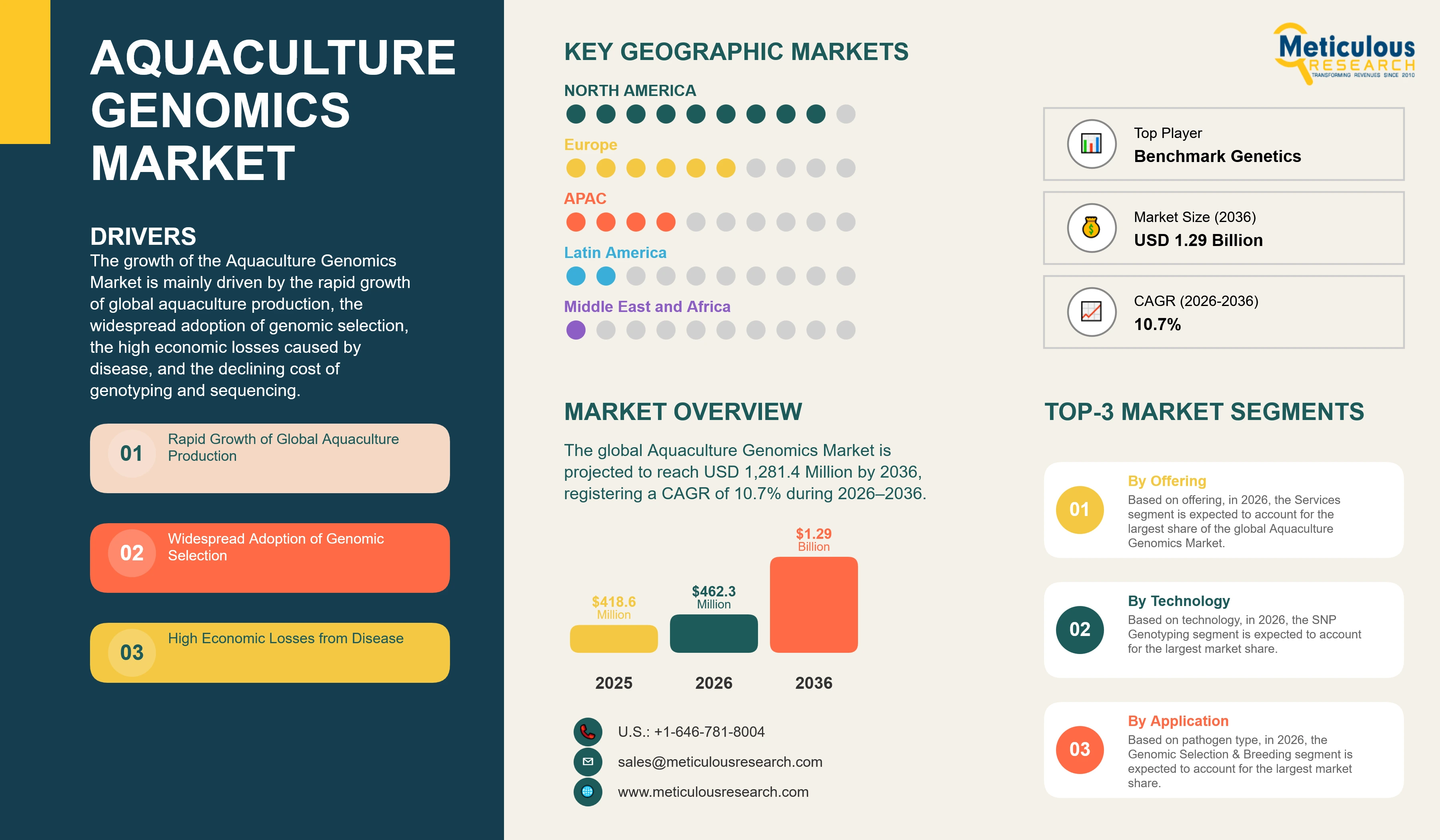
The global Aquaculture Genomics Market was valued at USD 418.6 million in 2025. This market is expected to reach USD 1,281.4 million by 2036 from an estimated USD 462.3 million in 2026, registering a CAGR of 10.7% during the forecast period (2026-2036).
- Published
- Oct 2026
- Pages
- 319
- Format
- PDF + Excel
- Report ID
- MR-2352
- Base year
- 2025
- 2025 · BASELINE
- $418.6M
- 2036
- $1.28B
- CAGR 2026–2036
- 10.7%
2025 baseline · 2026–2036 forecast at 10.7% CAGR · hover a bar for the value
Key highlights
The global Aquaculture Genomics Market is projected to reach USD 1, 281.4 million by 2036, driven by growing aquaculture production, genomic selection, disease resistance breeding, gene editing, and lower-cost genotyping.
Aquaculture is now the main source of aquatic animal production. According to the Food and Agriculture Organization of the United Nations (FAO) State of World Fisheries and Aquaculture 2024 report, global aquaculture production reached a record 130.9 million tonnes in 2022, including 94.4 million tonnes of aquatic animals, and aquaculture surpassed capture fisheries for the first time to account for 51% of aquatic animal production, with Asia producing 70% of aquatic animals.
Europe is expected to account for the largest market share in 2026, led by advanced salmon breeding programs in Norway, while Asia-Pacific is projected to register the fastest growth during the forecast period, supported by the expansion of genetically improved shrimp, tilapia, carp, and marine finfish farming. In March 2025, Novo Holdings, the investment company wholly owned by the Novo Nordisk Foundation, completed the acquisition of Benchmark Genetics, the salmon and shrimp breeding business of Benchmark Holdings, for up to GBP 260 million, with plans to invest in genetic services, biosecurity, genomics, phenotyping, and reproductive biotechnology and production capacity in Norway, Iceland, and Chile.
By technology, SNP Genotyping is expected to account for the largest market share in 2026, whereas Gene Editing is projected to witness the fastest growth through 2036. In Japan, Regional Fish Co. Ltd. received approval to market genome-edited red sea bream and tiger puffer in October and November 2021, the first genome-edited fish sold commercially; the red sea bream, in which the myostatin gene was knocked out, has an edible portion 1.2 to 1.6 times that of conventional fish and about 14% better feed utilization, while the tiger puffer grows 1.9 times heavier over the same farming period.
By species, Salmonids are expected to account for the largest market share in 2026, while Shrimp & Crustaceans are projected to grow the fastest, as shrimp breeders adopt genomic selection and gene editing to address disease-related mortality.
Report summary
| Particulars | Details |
|---|---|
| Forecast Period | 2026-2036 |
| Base Year | 2025 |
| Estimated Year | 2026 |
| CAGR (Value) | 10.7% |
| Format | PDF, Excel & Cloud Portal · 319 pages |
| Market Size (Value) in 2026 | USD 462.3 Million |
| Market Size (Value) in 2036 | USD 1,281.4 Million |
| Segments Covered | By Offering: Services (Genotyping Services, Sequencing Services, Genomic Selection & Breeding Services, Gene Editing Services), Products (Genotyping Arrays & Panels, Sequencing Reagents & Kits, Instruments), Software & Bioinformatics. By Technology: SNP Genotyping (SNP Arrays, Genotyping-by-Sequencing & Targeted Panels), Sequencing (Whole-Genome & Low-Pass Sequencing, Transcriptome Sequencing), Gene Editing, Other Technologies. By Application: Genomic Selection & Breeding, Disease Resistance & Health Management, Gene Editing & Trait Development, Parentage, Sex Determination & Traceability, Environmental DNA & Pathogen Monitoring. By Species: Salmonids, Shrimp & Crustaceans, Tilapia, Carps, Marine Finfish, Molluscs, Other Species. By End User: Aquaculture Breeding Companies, Fish & Shrimp Producers, Research Institutes & Universities, Government & Public Agencies. |
| Countries Covered | Europe: Norway, U.K., Iceland, Greece, Spain, Netherlands, Rest of Europe. Asia-Pacific: China, India, Vietnam, Indonesia, Thailand, Japan, Australia, Rest of Asia-Pacific. North America: U.S., Canada. Latin America: Chile, Ecuador, Brazil, Mexico, Rest of Latin America. Middle East & Africa: Egypt, Saudi Arabia, Rest of Middle East & Africa. |
| Key Companies | Benchmark Genetics, Hendrix Genetics B.V., AquaGen AS, Mowi ASA, Thermo Fisher Scientific Inc., Illumina, Inc., LGC Limited (Biosearch Technologies), Center for Aquaculture Technologies, and Regional Fish Co., Ltd. |
Report overview
Segments covered: offering, technology, application, specy, end user.
The growth of this market is mainly driven by the rapid growth of global aquaculture production, the widespread adoption of genomic selection in salmon, shrimp, tilapia, and other species to improve growth and disease resistance, the high economic losses caused by disease in fish and shrimp farming, and the declining cost of genotyping and sequencing. In addition, the commercial introduction of genome-edited fish, the growing use of genomics for sterility, sex control, parentage, and traceability, investment by private equity and strategic investors in aquaculture breeding companies, and the use of environmental DNA and pathogen genomics for farm health monitoring are further supporting the growth of this market.
The Aquaculture Genomics Market, also referred to as the aquaculture genetics and genomics market, aquatic animal genomics market, or fish and shrimp genomics market, comprises the products, services, and software used to analyze and modify the genomes of farmed fish, crustaceans, and molluscs to improve breeding, health, and production. The market includes SNP genotyping arrays and targeted genotyping panels; whole-genome, low-pass, and transcriptome sequencing; genotyping, sequencing, and genomic selection services; genome editing services and technologies; parentage, sex determination, and traceability testing; pathogen and environmental DNA genomics for farm health monitoring; and bioinformatics and breeding software. The market ecosystem extends from genotyping and sequencing technology providers to genomics service laboratories, aquaculture breeding companies, gene editing developers, fish and shrimp farmers, feed and animal health companies, research institutes, and government agencies.
The market is experiencing strong growth as aquaculture becomes the main source of aquatic food. According to the Food and Agriculture Organization of the United Nations (FAO) State of World Fisheries and Aquaculture 2024 report, global aquaculture production reached a record 130.9 million tonnes in 2022, including 94.4 million tonnes of aquatic animals, and aquaculture surpassed capture fisheries for the first time to account for 51% of aquatic animal production, with Asia producing 70% of aquatic animals. Meeting growing demand for seafood with limited land, water, and feed resources requires farmed species that grow faster, use feed more efficiently, resist disease, and tolerate changing environmental conditions. Selective breeding has been the main tool for improving these traits, and genomics is making breeding faster, more accurate, and more effective.
Genomic selection has transformed breeding in leading aquaculture species. In genomic selection, breeding candidates are genotyped with thousands of SNP markers, and their genetic merit is predicted from genomic data, allowing breeders to select for traits such as disease resistance and fillet quality that cannot be measured directly on the breeding candidates themselves. Salmon breeding companies in Norway, such as AquaGen, Mowi Genetics, and Benchmark Genetics, have used genomic selection for many years, and it is increasingly applied in shrimp, tilapia, sea bream, sea bass, trout, and oysters. In March 2025, Novo Holdings, the investment company wholly owned by the Novo Nordisk Foundation, completed the acquisition of Benchmark Genetics, the salmon and shrimp breeding business of Benchmark Holdings, for up to GBP 260 million, with plans to invest in genetic services, biosecurity, genomics, phenotyping, and reproductive biotechnology and production capacity in Norway, Iceland, and Chile. Hendrix Genetics has also expanded into shrimp breeding, reflecting the growing commercial importance of genetics in shrimp aquaculture.
Disease is one of the largest constraints on aquaculture, and genomics is central to the response. Sea lice and viral and bacterial diseases in salmon, and acute hepatopancreatic necrosis disease, white spot syndrome, and other diseases in shrimp, cause large economic losses. Genomic selection for disease resistance, the identification of major-effect resistance loci, and pathogen genomics for diagnosis and surveillance help farmers reduce losses and the use of antibiotics and other treatments.
Gene editing is emerging as a powerful new tool. In Japan, Regional Fish Co. Ltd. received approval to market genome-edited red sea bream and tiger puffer in October and November 2021, the first genome-edited fish sold commercially; the red sea bream, in which the myostatin gene was knocked out, has an edible portion 1.2 to 1.6 times that of conventional fish and about 14% better feed utilization, while the tiger puffer grows 1.9 times heavier over the same farming period. The Center for Aquaculture Technologies operates a Shrimp Genetics Innovation Center in San Diego, which quadrupled its shrimp research capacity and includes a genome editing laboratory, alongside its Finfish Genetics Innovation Center, to develop genome-edited traits that improve efficiency and reduce disease-related mortality. Gene editing can introduce beneficial traits, such as disease resistance, faster growth, and sterility, much faster than conventional breeding, although regulatory approaches and consumer acceptance vary by country.
Technology costs are declining, expanding access to genomics. Lower-cost genotyping arrays, targeted genotyping-by-sequencing panels, and low-pass sequencing with imputation are making genomic selection affordable for species and producers with smaller breeding programs, while technology providers such as Thermo Fisher Scientific, Illumina, and LGC Biosearch Technologies supply genotyping solutions for aquaculture. Genomic tools are also used for parentage assignment, sex determination, and traceability of farmed seafood.
At the same time, the market faces challenges related to the fragmented structure of aquaculture, the limited genomic resources for many species, and regulatory and consumer concerns about gene editing. Many aquaculture species, particularly in Asia and Africa, are farmed using unimproved or poorly managed stocks, and small producers often lack access to genetically improved seed. As a result, providers that can deliver affordable genomic tools, integrated breeding services, and improved genetics to producers in emerging markets are expected to capture the largest share of growth over the forecast period.
Report infographic
Market dynamics
15 factors across 5 forcesRapid Growth of Global Aquaculture Production
The rapid growth of global aquaculture production is a major factor driving the Aquaculture Genomics Market, as producers seek to increase output and efficiency to meet rising demand for seafood. According to the Food and Agriculture Organization of the United Nations (FAO) State of World Fisheries and Aquaculture 2024 report, global aquaculture production reached a record 130.9 million tonnes in 2022, including 94.4 million tonnes of aquatic animals, and aquaculture surpassed capture fisheries for the first time to account for 51% of aquatic animal production, with Asia producing 70% of aquatic animals. As aquaculture expands and intensifies, the value of genetic improvement increases, because gains in growth rate, feed efficiency, and survival are multiplied across large production volumes.
This growth is creating demand for genotyping, sequencing, and breeding services across a widening range of species and regions, particularly in Asia-Pacific, where most aquaculture production is concentrated.
Widespread Adoption of Genomic Selection
The widespread adoption of genomic selection is significantly accelerating market growth. Genomic selection allows breeders to select for traits that are difficult or impossible to measure on breeding candidates, such as resistance to specific diseases and fillet quality, by combining genotype data on candidates with phenotype data on their siblings. Leading salmon breeders use genomic selection routinely, and its use is expanding to shrimp, tilapia, trout, sea bream, sea bass, and oysters. In March 2025, Novo Holdings, the investment company wholly owned by the Novo Nordisk Foundation, completed the acquisition of Benchmark Genetics, the salmon and shrimp breeding business of Benchmark Holdings, for up to GBP 260 million, with plans to invest in genetic services, biosecurity, genomics, phenotyping, and reproductive biotechnology and production capacity in Norway, Iceland, and Chile. Each generation of a genomic selection program requires genotyping thousands of animals, generating recurring demand for genotyping products and services.
High Economic Losses from Disease
The high economic losses caused by disease in aquaculture are an important driver of demand for genomics. Diseases such as sea lice infestations and viral diseases in salmon and acute hepatopancreatic necrosis disease and white spot syndrome in shrimp cause major losses and require costly treatments. Genomic selection for disease resistance has been successful in reducing the impact of some diseases, and pathogen genomics supports rapid diagnosis and surveillance. As disease pressure increases with intensification and climate change, demand for disease resistance breeding and pathogen genomics is expected to grow.
Declining Cost of Genotyping and Sequencing
The declining cost of genotyping and sequencing is making genomic tools accessible to more species and producers. Low-density SNP panels combined with imputation, targeted genotyping-by-sequencing, and low-pass whole-genome sequencing reduce the cost per animal, allowing genomic selection in species with lower value per individual, such as tilapia, carp, and shrimp. Lower costs are also enabling the development of reference genomes and genomic resources for species that previously lacked them.
Table of contents
13 chapters · 162 sections · 319 pages · click to expandSegmental analysis
| Segment | Largest share (2026) | Fastest growth (2026–2036) |
|---|---|---|
| By Offering | Services | Software & Bioinformatics |
| By Technology | SNP Genotyping | Gene Editing |
| By Application | Genomic Selection & Breeding | Gene Editing & Trait Development |
| By Specy | Salmonids | Shrimp & Crustaceans |
| By End User | Aquaculture Breeding Companies | Fish & Shrimp Producers |
By Offering
- Aquaculture Genomics Market Analysis by Offering
- Services are further segmented into Genotyping Services, Sequencing Services, Genomic Selection & Breeding Services, and Gene Editing Services.
- Products are further segmented into Genotyping Arrays & Panels, Sequencing Reagents & Kits, and Instruments.
- The Services segment is expected to account for the largest share of the global Aquaculture Genomics Market.
- The large share of this segment is mainly due to the outsourcing of genotyping, sequencing, and genomic evaluation by aquaculture breeding companies and producers, and the provision of integrated genetic services by breeding companies such as Benchmark Genetics, which is investing in genetic services and genomics.
- However, the Software & Bioinformatics segment is projected to register the highest CAGR during the forecast period.
- The rapid growth of this segment is attributed to the increasing use of genomic prediction, imputation, and integration of genomic data with farm management and performance data.
By Technology
- Aquaculture Genomics Market Analysis by Technology
- SNP genotyping is further segmented into SNP Arrays and Genotyping-by-Sequencing & Targeted Panels, while sequencing is further segmented into Whole-Genome & Low-Pass Sequencing and Transcriptome Sequencing.
- The SNP Genotyping segment is expected to account for the largest market share, due to its routine use in genomic selection programs for salmon, shrimp, tilapia, and other species, and in parentage and traceability testing.
- However, the Gene Editing segment is projected to register the highest CAGR during the forecast period, owing to the commercial introduction of genome-edited fish in Japan, the development of gene-edited traits for disease resistance, growth, and sterility by companies such as the Center for Aquaculture Technologies, and growing investment in reproductive biotechnology by breeding companies.
By Application
- Aquaculture Genomics Market Analysis by Application
- The Genomic Selection & Breeding segment is expected to account for the largest market share, due to the routine use of genomic selection in leading aquaculture breeding programs and its expansion to new species.
- However, the Gene Editing & Trait Development segment is projected to register the highest CAGR during the forecast period, driven by the development of gene-edited traits and the commercialization of genome-edited fish.
- The Disease Resistance & Health Management segment is also expected to record strong growth, supported by the high economic losses caused by disease.
By Specy
- Aquaculture Genomics Market Analysis by Species
- The Salmonids segment is expected to account for the largest market share, due to the advanced genomic breeding programs of Atlantic salmon and trout breeders in Norway, Chile, Iceland, and other countries, the high value of salmon production, and the routine use of genomic selection for disease resistance.
- However, the Shrimp & Crustaceans segment is projected to register the highest CAGR during the forecast period, owing to the large and growing shrimp farming industry in Asia and Latin America, the severe impact of disease on shrimp production, and the expansion of genomic breeding and gene editing in shrimp, as reflected in the Shrimp Genetics Innovation Center of the Center for Aquaculture Technologies and the entry of Hendrix Genetics into shrimp breeding.
By End User
- Aquaculture Genomics Market Analysis by End User
- The Aquaculture Breeding Companies segment is expected to account for the largest market share, as these companies operate the genomic selection programs that generate most demand for genotyping and genomic services.
- However, the Fish & Shrimp Producers segment is projected to register the highest CAGR during the forecast period, driven by the growing use of genomic tools for parentage, traceability, disease monitoring, and stock selection by producers, particularly in Asia-Pacific.
Geographic analysis
Europe
Largest shareIn 2026, Europe is expected to account for the largest share of the global Aquaculture Genomics Market. The large share of this region is mainly attributed to the advanced salmon and trout breeding programs in Norway, Iceland, Scotland, and the Faroe Islands, the presence of leading aquaculture breeding companies, including AquaGen, Mowi, Benchmark Genetics, and Hendrix Genetics, and strong research institutions in aquaculture genetics. Benchmark Genetics moved its headquarters to Bergen, Norway, following its acquisition by Novo Holdings in March 2025, and is investing in production capacity in Norway and Iceland. The Mediterranean region, including Greece, Spain, and Türkiye, is also an important market for genomic breeding of sea bream and sea bass.
Asia-Pacific
Fastest growthAsia-Pacific is projected to register the highest CAGR during the forecast period. The growth of this region is driven by its dominance of global aquaculture production, accounting for 70% of aquatic animal production according to FAO, the large shrimp, tilapia, carp, and marine finfish farming industries, and the growing adoption of genetically improved stocks. China is expected to account for the largest share within Asia-Pacific, supported by large-scale aquaculture and investment in breeding and genomics, while India, Vietnam, Indonesia, Thailand, and the Philippines are expected to see strong growth, supported by shrimp and tilapia farming. Japan is an important market for gene editing, as the first country to allow the sale of genome-edited fish, and Australia has advanced breeding programs for salmon, prawns, and oysters.
North America
North America is expected to account for a significant share of the market, supported by research institutions, genomics technology providers such as Thermo Fisher Scientific and Illumina, and gene editing developers such as the Center for Aquaculture Technologies, which operates facilities in San Diego and on Prince Edward Island. Salmon and trout farming in Canada and the U.S. and shrimp and catfish research also contribute to demand.
Latin America
Latin America and the Middle East & Africa are expected to account for smaller shares of the market. Latin America is an important market, led by salmon farming in Chile, where Benchmark Genetics is investing in production capacity, and shrimp farming in Ecuador, one of the largest shrimp exporters in the world.
Middle East & Africa
In the Middle East & Africa, the expansion of aquaculture and genetic improvement programs for tilapia and other species is expected to support demand.
Competitive landscape
The global Aquaculture Genomics Market is fragmented, with specialized aquaculture breeding companies, genotyping and sequencing technology providers, genomics service laboratories, gene editing developers, and research institutes participating across species and regions. Market participants compete primarily on the genetic gain delivered by breeding programs, disease resistance and performance of genetic stocks, cost per genotype, genotyping panel content for each species, genomic prediction and bioinformatics capabilities, biosecurity, and access to gene editing technologies.
Leading companies are investing in genomic selection, phenotyping, gene editing, reproductive biotechnology, and expansion into new species and regions, and the industry is attracting new investors. Recent examples include the acquisition of Benchmark Genetics by Novo Holdings for up to GBP 260 million in March 2025, the expansion of Hendrix Genetics into shrimp breeding, the development of shrimp and finfish gene editing by the Center for Aquaculture Technologies, and the commercialization of genome-edited fish by Regional Fish in Japan. In March 2026, Neogen agreed to sell its livestock and companion animal genomics business to Zoetis for USD 160 million, reflecting continued consolidation in animal genomics more broadly.
The report provides a comprehensive competitive assessment of the leading companies operating in the global Aquaculture Genomics Market. The key players profiled in the report include Benchmark Genetics (Norway), Hendrix Genetics B.V. (Netherlands), AquaGen AS (Norway), Mowi ASA (Norway), Thermo Fisher Scientific Inc. (U.S.), Illumina, Inc. (U.S.), LGC Limited (Biosearch Technologies) (U.K.), Center for Aquaculture Technologies (U.S.), and Regional Fish Co., Ltd. (Japan).
- Benchmark Genetics
- Hendrix Genetics B.V.
- AquaGen AS
- Mowi ASA
- Thermo Fisher Scientific Inc.
- Illumina, Inc.
- LGC Limited · Biosearch Technologies
- Regional Fish Co., Ltd
Expert perspectives
The Aquaculture Genomics Market is entering a period in which genomic tools are moving from a few advanced species and companies to the broader aquaculture industry. With aquaculture now producing 51% of aquatic animals, genomic selection routine in salmon breeding and expanding in shrimp and tropical species, and genome-edited fish already sold in Japan, genomics is becoming a central driver of productivity and disease resilience. The binding constraint is shifting from the availability of genomic technology to the ability to deliver improved genetics to fragmented producers, phenotype key traits at scale, and navigate regulation of gene editing.
Three structural changes are expected to shape competitive positions through 2036. First, investment and consolidation are strengthening leading breeding companies and accelerating their expansion into shrimp and new regions. Second, low-cost genotyping and imputation are extending genomic selection to lower-value species and smaller programs. Third, gene editing is expected to become an important source of new traits, with adoption depending on regulatory and consumer acceptance in each market.
For companies planning entry or expansion, the most defensible positions over the forecast period are likely to be found in genomic breeding services for shrimp and tropical species, low-cost genotyping panels, gene editing for disease resistance and sterility, and genomic monitoring tools for farm health. For established providers, the principal risks are regulatory uncertainty for gene editing, the fragmentation of the industry, and the cost of phenotyping and biosecurity.
Overall, the market is expected to grow strongly, with services, SNP genotyping, genomic selection, salmonids, breeding companies, and Europe providing the core of demand and software, gene editing, shrimp, producers, and Asia-Pacific providing the fastest growth.
Customer perspectives
Insights gathered during primary interviews with aquaculture breeding managers, fish health specialists, and aquaculture geneticists operating in this market highlight where procurement priorities are shifting. The following perspectives reflect recurring themes raised across these discussions.
“This reflects the role of genomic selection and genotyping cost in breeding.”
“This indicates the importance of disease resistance and monitoring in shrimp farming.”
“This points to the role of regulation in the adoption of gene editing.”
Frequently asked questions
The global Aquaculture Genomics Market is estimated at USD 462.3 million in 2026.
Cite this report
Meticulous Research. (2026). Aquaculture Genomics Market - Global Opportunity Analysis And Industry Forecasts (2026-2036) (Report No. MR-2352). Meticulous Market Research Pvt. Ltd. https://www.meticulousresearch.com/product/aquaculture-genomics-market-7035