Methane Emissions Monitoring Market (2026-2036)
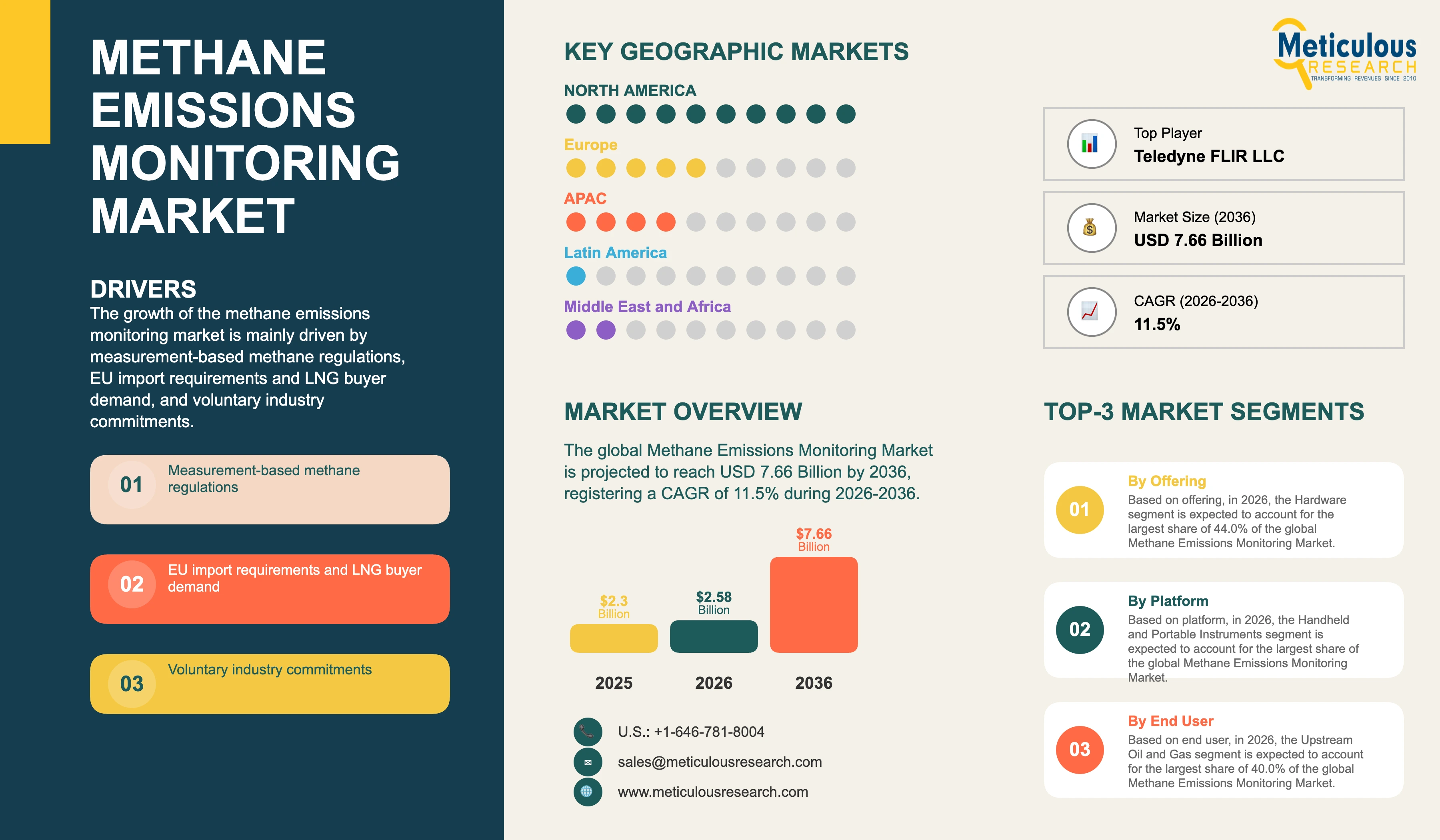
The global methane emissions monitoring market was valued at USD 2.30 billion in 2025. This market is expected to reach USD 7.66 billion by 2036 from an estimated USD 2.58 billion in 2026, registering a CAGR of 11.5% during the forecast period (2026-2036).
- Published
- Nov 2026
- Pages
- 280
- Format
- PDF + Excel
- Report ID
- MREP - 1042536
- Base year
- 2025
- 2025 · BASELINE
- $2.30B
- 2036
- $7.66B
- CAGR 2026–2036
- 11.5%
2025 baseline · 2026–2036 forecast at 11.5% CAGR · hover a bar for the value
Key highlights
The International Energy Agency's Global Methane Tracker 2025 estimated that methane emissions from the fossil fuel sector remained above 120 million tonnes in 2024, close to the record high reached in 2019, and that around 70% of these emissions could be avoided with existing technologies.
The IEA also reported that more than 25 satellites in orbit can now provide insights into methane emissions, and that very large leaks from oil and gas facilities detected by satellites rose to a record high in 2024, which shows both the scale of the problem and the growing role of satellite monitoring.
Regulation (EU) 2024/1787 on the reduction of methane emissions in the energy sector requires source-level measurement, leak detection and repair, and independent verification by EU operators, and requires importers of oil, gas, and coal to show equivalent monitoring, reporting, and verification from 1 January 2027.
In the U.S., the Environmental Protection Agency extended many compliance deadlines under its NSPS OOOOb and EG OOOOc methane standards to 22 January 2027, but the fugitive emissions monitoring requirements at well sites and compressor stations remain in force, and initial annual OOOOb reports are due by 30 November 2026.
The IEA found that current methane pledges by companies and countries cover 80% of global oil and gas production, but only around 5% of global oil and gas output demonstrably meets a near-zero methane emissions standard, which creates a large gap that measurement-based monitoring is needed to close.
UNEP's International Methane Emissions Observatory reported that its Methane Alert and Response System has sent thousands of notifications to governments and companies about large methane plumes detected by satellites, although only a small share of notified events have so far received a response, which highlights the need for faster follow-up monitoring and repair by operators on the ground.
By offering, the hardware segment accounts for the largest share of 44.0% in 2026, while the software and analytics segment registers the highest CAGR.
By platform, handheld and portable instruments account for the largest share in 2026, while satellite-based monitoring registers the highest CAGR.
By end user, the upstream oil and gas segment accounts for the largest share of 40.0% in 2026, while the agriculture and livestock segment registers the highest CAGR.
By geography, North America accounts for the largest share of 44.0% in 2026, while Asia-Pacific registers the highest CAGR of 14.7%.
Report summary
| Particulars | Details |
|---|---|
| Base Year | 2025 |
| Estimated Year | 2026 |
| Forecast Period | 2026-2036 |
| Market Size in 2025 | USD 2.30 billion |
| Market Size in 2026 | USD 2.58 billion |
| Market Size by 2036 | USD 7.66 billion |
| CAGR (2026-2036) | 11.5% |
| Format | PDF, Excel & Cloud Portal · 280 pages |
| Largest Segment by Offering (2026) | Hardware (44.0%) |
| Largest Segment by End User (2026) | Upstream Oil and Gas (40.0%) |
| Largest Region (2026) | North America (44.0%) |
| Fastest-Growing Region | Asia-Pacific (CAGR 14.7%) |
| Segments Covered | Offering, Platform, End User, and Geography |
| Geographic Scope | North America, Europe, Asia-Pacific, Middle East and Africa, and Latin America |
| Key Companies Profiled | Teledyne FLIR, Honeywell, ABB, Emerson, Picarro, Baker Hughes, Bridger Photonics, GHGSat, Kayrros, Kuva Systems, Project Canary, Qube Technologies, SeekOps, Montrose Environmental Group, and Sensirion |
Report overview
Segments covered: offering, platform, end user.
The growth of this market is mainly driven by measurement-based methane regulations in the EU, the U.S., Canada, and other countries, the EU's import requirements that extend monitoring, reporting, and verification obligations to oil and gas exporters, voluntary commitments under the Oil and Gas Methane Partnership 2.0 and the Oil and Gas Decarbonization Charter, the rapid growth of satellite and aerial detection capabilities, demand from LNG buyers for certified low-methane gas, and the economic value of captured gas. However, factors such as the rollback and delay of some U.S. federal methane rules, the high cost of continuous monitoring across large numbers of small sites, limits in the accuracy of some detection technologies, and the difficulty of reconciling measurement data with inventory estimates are expected to restrain the growth of this market to some extent.
Methane emissions monitoring refers to the hardware, software, and services used to detect, locate, quantify, and report methane emissions from industrial facilities, waste sites, and agricultural operations. Methane is a powerful greenhouse gas that the IEA estimates is responsible for around 30% of the rise in global temperatures since the Industrial Revolution, and because it has a short lifetime in the atmosphere, cutting methane emissions is one of the fastest ways to slow near-term warming. The main human sources of methane are oil and gas operations, coal mining, landfills and wastewater, and agriculture, particularly livestock and rice cultivation.
This market covers the global revenue from methane monitoring hardware, software and analytics, and services. Hardware includes optical gas imaging cameras, handheld laser detectors, fixed continuous monitoring sensors, aerial and drone-mounted sensors, and vehicle-based analyzers. Software and analytics include emissions management platforms, data analytics, and satellite data subscriptions, while services include leak detection and repair (LDAR) surveys, aerial and satellite survey services, quantification, reporting, and verification services. The market is segmented by offering, platform, end user, and geography. Methane abatement equipment, such as vapor recovery units and flare systems, and general gas safety detectors used only for worker protection are not included.
Methane monitoring has changed significantly over the past decade, as new technologies have made it possible to find and measure emissions that older methods missed. Traditional leak detection relied on periodic manual surveys using handheld instruments and optical gas imaging cameras, which find many small leaks but can miss large intermittent emissions. Today, operators use a tiered approach that combines satellites to detect very large plumes, aircraft and drones to survey whole regions and facilities, fixed continuous sensors to watch high-risk sites around the clock, and handheld instruments to pinpoint and confirm leaks for repair. Software platforms bring these data together, estimate emissions at site and source level, and support regulatory and voluntary reporting.
The IEA's Global Methane Tracker 2025 found that methane emissions from the fossil fuel sector remain far above the levels implied by official reporting, and that around 70% of energy sector emissions could be avoided with existing technologies. The Tracker also estimated that methane abatement could have brought around 100 billion cubic metres of additional gas to market in 2024, which shows that monitoring and repair programs can create economic value as well as climate benefits. This gap between estimated emissions and reported emissions is a key reason why regulators and buyers are moving from emission factors to measurement-based reporting.
Regulation is the strongest force shaping the market, because it turns monitoring from a voluntary activity into a recurring legal obligation. The EU Methane Regulation requires oil and gas operators in the EU to measure emissions at source level, run regular leak detection and repair programs, and have their reports checked by independent verifiers, and it extends equivalent requirements to imports from 2027. In the U.S., the EPA's OOOOb and OOOOc standards require frequent monitoring at well sites and compressor stations and allow advanced technologies such as continuous monitors and aerial surveys, although some deadlines have been extended. Canada, Colorado, New Mexico, and other jurisdictions have their own methane rules, and many national oil companies have joined the Oil and Gas Methane Partnership 2.0, which sets measurement-based reporting standards up to Level 5.
Satellite monitoring has become an important part of the market and has changed how regulators, investors, and the public see methane emissions. The IEA reported that more than 25 satellites can now provide methane data, including government missions such as Sentinel-5P and EnMAP and commercial constellations operated by GHGSat. The non-profit Carbon Mapper launched its Tanager-1 satellite in 2024, and the United Nations Environment Programme's International Methane Emissions Observatory uses satellite data in its Methane Alert and Response System to notify governments and companies of large emission events. Analytics companies such as Kayrros process satellite data to identify and track major emitters.
The market includes a wide range of companies, from large instrument makers to specialist start-ups and satellite operators. Instrument makers such as Teledyne FLIR, Honeywell, ABB, Emerson, and Picarro supply cameras, analyzers, and fixed sensors. Specialist detection companies such as Bridger Photonics, Kuva Systems, Project Canary, Qube Technologies, and SeekOps provide aerial, drone, and continuous monitoring solutions, while GHGSat and Kayrros provide satellite-based data and analytics. Service companies such as Montrose Environmental Group and Baker Hughes provide LDAR, quantification, and emissions management services.
Over the forecast period, the methane emissions monitoring market is expected to grow steadily, as measurement-based requirements spread, satellite and continuous monitoring scale up, and buyers of oil and gas demand verified methane data. North America is expected to remain the largest market, while Asia-Pacific is expected to grow fastest at a CAGR of 14.7%.
Oil and gas production in the U.S. and other countries involves hundreds of thousands of small well sites, many of which produce low volumes and have thin margins. Installing continuous monitoring sensors or conducting frequent surveys at every site is expensive, and smaller operators often lack the resources and staff to run advanced monitoring programs. Coal mines, landfills, and farms face similar challenges, since their emissions are spread over large areas and are difficult to measure. These costs slow adoption among smaller operators and in cost-sensitive markets, and they restrain the growth of this market to some extent. Many small operators therefore rely on the minimum survey frequency required by regulation, rather than investing in continuous or advanced monitoring, and some delay purchases until regulators approve lower-cost technologies or until shared monitoring services become available in their basin. Price sensitivity is particularly high in emerging markets, where monitoring budgets are often limited and operators compete for scarce technical staff.
We joined OGMP 2.0 and committed to Level 5 reporting, so we are building a monitoring program that combines satellite screening, drone surveys, and software that reconciles our inventories with measurements.
From 2027, we must show that our imported gas is covered by equivalent monitoring, so methane data has become part of our contracts.
Report infographic
Market dynamics
17 factors across 5 forcesMeasurement-based methane regulations
Governments are moving from estimated, factor-based methane reporting to measurement-based monitoring and reporting. The EU Methane Regulation, which entered into force in 2024, requires oil and gas operators to measure emissions at source and site level, conduct regular leak detection and repair surveys with defined repair timelines, and submit reports checked by independent accredited verifiers. It also bans most routine venting and flaring and sets monitoring requirements for coal mines. In the U.S., the EPA's 2024 methane rule, known as OOOOb and OOOOc, requires frequent fugitive emissions monitoring at well sites and compressor stations, allows approved advanced technologies such as continuous monitors and aerial surveys, and creates a super-emitter program that uses third-party detections.
Canada has finalized stricter oil and gas methane regulations, and states such as Colorado and New Mexico have their own measurement and reporting rules. Countries such as Nigeria, Mexico, and Brazil have also introduced methane rules for oil and gas operations. These rules create recurring demand for monitoring hardware, survey services, and reporting software, since operators must monitor their facilities year after year. Upstream oil and gas operators, which are the main target of these rules, account for the largest share of the market by end user.
EU import requirements and LNG buyer demand
The EU Methane Regulation requires importers of oil, gas, and coal to provide information on the monitoring, reporting, and verification practices of their suppliers, and from 1 January 2027, importers must show that contracts for oil and gas are covered by monitoring, reporting, and verification measures equivalent to EU standards. The regulation also plans to introduce maximum methane intensity values for imports later in the decade. Because the EU imports large volumes of LNG and pipeline gas from the U.S., Norway, Qatar, Algeria, and other countries, these rules effectively extend measurement requirements to producers around the world.
At the same time, LNG buyers in Europe and Asia are increasingly asking for certified low-methane gas and measurement-based methane intensity data. Certification programs such as MiQ and the Oil and Gas Methane Partnership 2.0 Gold Standard rely on site-level measurement, which increases demand for continuous monitoring, aerial surveys, and reconciliation software. These requirements support demand across the oil and gas value chain, including in exporting regions such as the Middle East and Africa.
Voluntary industry commitments
Oil and gas companies have made major voluntary commitments to reduce methane emissions. More than 140 companies have joined the Oil and Gas Methane Partnership 2.0, which requires companies to report measurement-based emissions data and progress toward Level 5 reporting, which reconciles source-level estimates with site-level measurements. More than 50 companies representing a large share of global oil production have signed the Oil and Gas Decarbonization Charter, launched at COP28, committing to near-zero methane emissions by 2030. The IEA reported that methane pledges now cover 80% of global oil and gas production.
Meeting these commitments requires companies to measure their emissions accurately, find and fix leaks quickly, and show progress to investors and buyers. National oil companies in the Middle East, Africa, and Asia, which have joined these initiatives, are increasing investment in monitoring programs, which supports market growth outside North America and Europe. Investors and lenders are also asking companies for measured methane data as part of climate disclosures, which adds further pressure to improve monitoring.
Advances in detection technology and falling costs
Detection technologies have improved rapidly in sensitivity, coverage, and cost over the past five years. Continuous monitoring sensors have become cheaper and more accurate, aerial technologies such as gas mapping lidar can survey hundreds of sites per day, and drones can carry sensitive laser analyzers to quantify emissions from individual facilities. The number of satellites able to detect methane has grown to more than 25, according to the IEA, and new satellites with higher resolution and more frequent revisits are being launched.
At the same time, software platforms that use artificial intelligence and atmospheric modeling are making it easier to combine data from different sources, estimate emission rates, and prioritize repairs. These advances lower the cost of monitoring per site and make it practical for operators to monitor large numbers of facilities. Software and analytics form the fastest-growing offering, and satellite-based monitoring is the fastest-growing platform.
Table of contents
11 chapters · 119 sections · 280 pages · click to expandGeographic analysis
North America
Largest shareIn 2026, North America is expected to account for the largest share of 44.0% of the global methane emissions monitoring market. The large share of this region is mainly due to the size of the oil and gas industry in the U.S. and Canada, the EPA's OOOOb and OOOOc monitoring requirements, Canada's methane regulations, strict state rules in Colorado, New Mexico, and other states, the presence of leading detection technology and service companies, and the use of monitoring to support exports of LNG to Europe and Asia. The U.S. is home to many of the world's leading methane monitoring companies, including Bridger Photonics, Kuva Systems, Project Canary, SeekOps, Picarro, and Montrose Environmental, and its large producing basins, such as the Permian, have become testing grounds for advanced monitoring technologies. Canada has adopted stricter oil and gas methane rules and supports alternative monitoring technologies through its federal and provincial programs. Although changes in U.S. federal policy have created uncertainty, the EU's import requirements and buyer demand for certified low-methane gas continue to support monitoring investment by U.S. producers and LNG exporters, and North America is expected to remain the largest region throughout the forecast period.
Europe
Europe is the second-largest region, driven by the EU Methane Regulation, Norway's long-standing methane management programs, and the presence of companies such as Kayrros and major instrument makers.
Asia-Pacific
Fastest growthAsia-Pacific is projected to register the highest CAGR of 14.7% during the forecast period. The rapid growth of this region is mainly driven by large coal mining and landfill emissions in China, India, and Indonesia, growing monitoring programs by national oil companies, Japan and South Korea's role as major LNG buyers demanding methane data, and Australia's National Greenhouse and Energy Reporting scheme, which has moved toward measurement-based methods for some sources. China, which has the largest energy-related methane emissions globally mainly because of its coal sector according to the IEA, published a methane action plan and is improving monitoring of coal mines and gas facilities across its major producing provinces.
Middle East & Africa
The Middle East and Africa is also growing quickly, as national oil companies such as ADNOC and Saudi Aramco expand monitoring programs, while Latin America is supported by methane rules in Mexico and Brazil.
Competitive landscape
The methane emissions monitoring market is fragmented, with many companies offering different technologies and services. Leading companies include instrument and automation companies such as Teledyne FLIR, Honeywell International, ABB, Emerson Electric, and Picarro; specialist detection companies such as Bridger Photonics, Kuva Systems, Project Canary, Qube Technologies, and SeekOps; satellite and analytics companies such as GHGSat and Kayrros; and service companies such as Montrose Environmental Group and Baker Hughes.
Companies compete on detection sensitivity, quantification accuracy, coverage, cost per site, regulatory approval, data integration, and service quality. Many operators want a single provider that can combine several technologies and deliver reliable, auditable data, so companies are building integrated platforms that combine satellites, aircraft, drones, continuous sensors, and software. Regulatory approval of alternative technologies under the EPA's OOOOb rule and acceptance under OGMP 2.0 and EU rules are important competitive factors.
The top five players are estimated to account for 30.0% of the methane emissions monitoring market in 2025. This moderate concentration reflects the wide range of technologies and services in the market and the large number of specialist providers.
Players use several strategies to grow in this market, including product launches, partnerships between satellite, aerial, and ground monitoring companies, acquisitions of specialist detection firms, agreements with major oil and gas operators and national oil companies, and participation in technology testing programs. For example, larger instrument and energy service companies have acquired or partnered with continuous monitoring and analytics start-ups to build complete monitoring offerings.
Competition is expected to focus on integrated monitoring programs, quantification accuracy, and software that supports regulatory and certification reporting, and the market is expected to consolidate as larger companies acquire specialist providers. Partnerships between satellite operators and ground-based monitoring companies are expected to become more common, since operators want a single view of emissions across all detection tiers. Companies that can show independent test results and regulatory approvals are expected to win the largest contracts with major producers and national oil companies. New entrants, particularly in satellite analytics and AI-based software, continue to raise venture funding, which keeps the market competitive and drives innovation.
Some of the key players operating in the methane emissions monitoring market are Teledyne FLIR LLC (Teledyne Technologies Incorporated), Honeywell International Inc., ABB Ltd., Emerson Electric Co., Picarro, Inc., Baker Hughes Company, Bridger Photonics, Inc., GHGSat Inc., Kayrros SAS, Kuva Systems, Inc., Project Canary, PBC, Qube Technologies Inc., SeekOps Inc., Montrose Environmental Group, Inc., and Sensirion AG.
- —
The EU Methane Regulation's first monitoring and inspection obligations took effect, the EPA extended OOOOb deadlines to January 2027 while keeping fugitive monitoring requirements, Carbon Mapper's Tanager-1 satellite began providing public methane data, and the IEA reported a record number of satellite-detected large leaks in 2024.
- Teledyne FLIR
- Honeywell
- ABB
- Emerson
- Picarro
- Baker Hughes
- Bridger Photonics
- GHGSat
- Kayrros
- Kuva Systems
- Project Canary
- Qube Technologies
- SeekOps
- Montrose Environmental Group
- Sensirion
Expert perspectives
The methane emissions monitoring market is moving from periodic, compliance-driven surveys to continuous, measurement-based monitoring programs that combine many technologies. The main forces behind this shift are the EU Methane Regulation and its import requirements, buyer demand for certified low-methane gas, voluntary commitments by oil and gas companies, and rapid improvements in satellite and sensor technology. These forces are global, which makes the market less dependent on any single regulator than it was a few years ago.
Over the forecast period, the market is expected to grow at a CAGR of 11.5%. Changes in U.S. federal policy create near-term uncertainty, but the core OOOOb monitoring requirements remain in force, and EU import rules, state regulations, and buyer demand continue to push U.S. producers toward better monitoring. We expect demand outside North America to grow faster, as the EU rules take full effect and national oil companies in the Middle East, Africa, and Asia expand their programs.
Hardware is the largest offering, while software and analytics grow fastest as operators need to combine data and meet reconciliation and certification requirements. Handheld instruments remain the largest platform, while satellites grow fastest. Upstream oil and gas remains the largest end user, while agriculture and livestock grow fastest from a small base.
North America remains the largest region because of its large oil and gas industry and strong technology base, while Asia-Pacific is the fastest-growing region at a CAGR of 14.7%, driven by coal, landfill, and LNG-related demand.
For technology providers, the key priorities are proving detection and quantification accuracy through independent testing, securing regulatory approvals, and integrating with other technologies and software platforms. For service providers, the opportunity lies in offering complete monitoring programs for operators that lack internal resources, particularly national oil companies and smaller producers. For oil and gas operators, the priority is to build tiered monitoring programs that meet regulatory requirements, support certification, and deliver value through captured gas. Companies that can deliver trusted, auditable data at low cost per site are expected to gain the most as the market grows.
We also expect the line between monitoring and abatement to blur, as monitoring providers offer repair verification, emissions reduction tracking, and certification support, and as abatement equipment suppliers bundle monitoring with their products. Over time, methane data is likely to become part of gas trading and contracts, similar to quality specifications, which would make monitoring a permanent part of the gas value chain and support stable long-term demand for monitoring hardware, software, and services.
Customer perspectives
Director of Environmental Compliance - upstream oil and gas producer, U.S.
We run optical gas imaging surveys to meet our regulatory requirements, but we have added continuous sensors at our larger sites and aerial surveys across the basin. Our LNG customers now ask for measured methane intensity, so we need data that can stand up to third-party verification.
Frequently asked questions
Based on revenue from hardware, software, and services, the market was valued at USD 2.30 billion in 2025 and USD 2.05 billion in 2024, and is estimated at USD 2.58 billion in 2026. These values cover monitoring hardware, software and analytics, and services.
The market is expected to reach USD 7.66 billion by 2036, supported by measurement-based regulations, EU import requirements, voluntary industry commitments, and advances in detection technology.
The market is expected to register a CAGR of 11.5% from 2026 to 2036, as monitoring programs expand beyond North America and Europe and operators adopt continuous and satellite-based monitoring.
Methane emissions monitoring refers to the hardware, software, and services used to detect, locate, quantify, and report methane emissions from oil and gas facilities, coal mines, landfills, agriculture, and other sources, using handheld instruments, fixed sensors, aircraft, drones, vehicles, and satellites.
Growth is driven by measurement-based methane regulations, EU import requirements and LNG buyer demand, voluntary industry commitments under OGMP 2.0 and the Oil and Gas Decarbonization Charter, and advances in detection technology and falling costs.
Regulatory rollbacks and delays in the U.S. and the high costs of monitoring large numbers of small sites restrain growth, while the accuracy and comparability of detection technologies and the reconciliation of measurements with inventories remain key challenges.
Satellite-based monitoring is projected to register the highest CAGR during the forecast period, driven by new satellite launches, falling data costs, and the use of satellite detections in regulatory and certification programs, while handheld and portable instruments remain the largest platform.
Key opportunities include satellite data and analytics services, measurement-based certification and reconciliation software, monitoring in landfills, coal mines, and agriculture, and growth in emerging oil and gas regions.
Hardware is expected to account for the largest share of 44.0% of the market in 2026, mainly due to the wide use of optical gas imaging cameras, handheld detectors, and fixed continuous sensors, while software and analytics are projected to register the highest CAGR.
Upstream oil and gas is expected to account for the largest share of 40.0% of the market in 2026, mainly due to strict monitoring rules for well sites and production facilities, while agriculture and livestock are projected to register the highest CAGR.
North America is expected to account for the largest share of 44.0% of the market in 2026, mainly due to its large oil and gas industry, federal, state, and Canadian methane rules, and the presence of leading monitoring technology companies.
Asia-Pacific is projected to register the highest CAGR of 14.7% during the forecast period, driven by coal mine and landfill emissions, national oil company monitoring programs, and LNG buyer demand for methane data.
The report profiles 15 companies, including Teledyne FLIR, Honeywell, ABB, Emerson, Picarro, Baker Hughes, Bridger Photonics, GHGSat, Kayrros, Kuva Systems, Project Canary, Qube Technologies, SeekOps, Montrose Environmental Group, and Sensirion. The top five players account for an estimated 30.0% of the market in 2025.
The EU Methane Regulation's first monitoring and inspection obligations took effect, the EPA extended OOOOb deadlines to January 2027 while keeping fugitive monitoring requirements, Carbon Mapper's Tanager-1 satellite began providing public methane data, and the IEA reported a record number of satellite-detected large leaks in 2024.
Cite this report
Meticulous Research. (2026). Methane Emissions Monitoring Market - Global Opportunity Analysis and Industry Forecast (2026-2036) (Report No. MREP - 1042536). Meticulous Market Research Pvt. Ltd. https://www.meticulousresearch.com/product/methane-emissions-monitoring-market-7219