Immunogenomics Market (2026-2036)
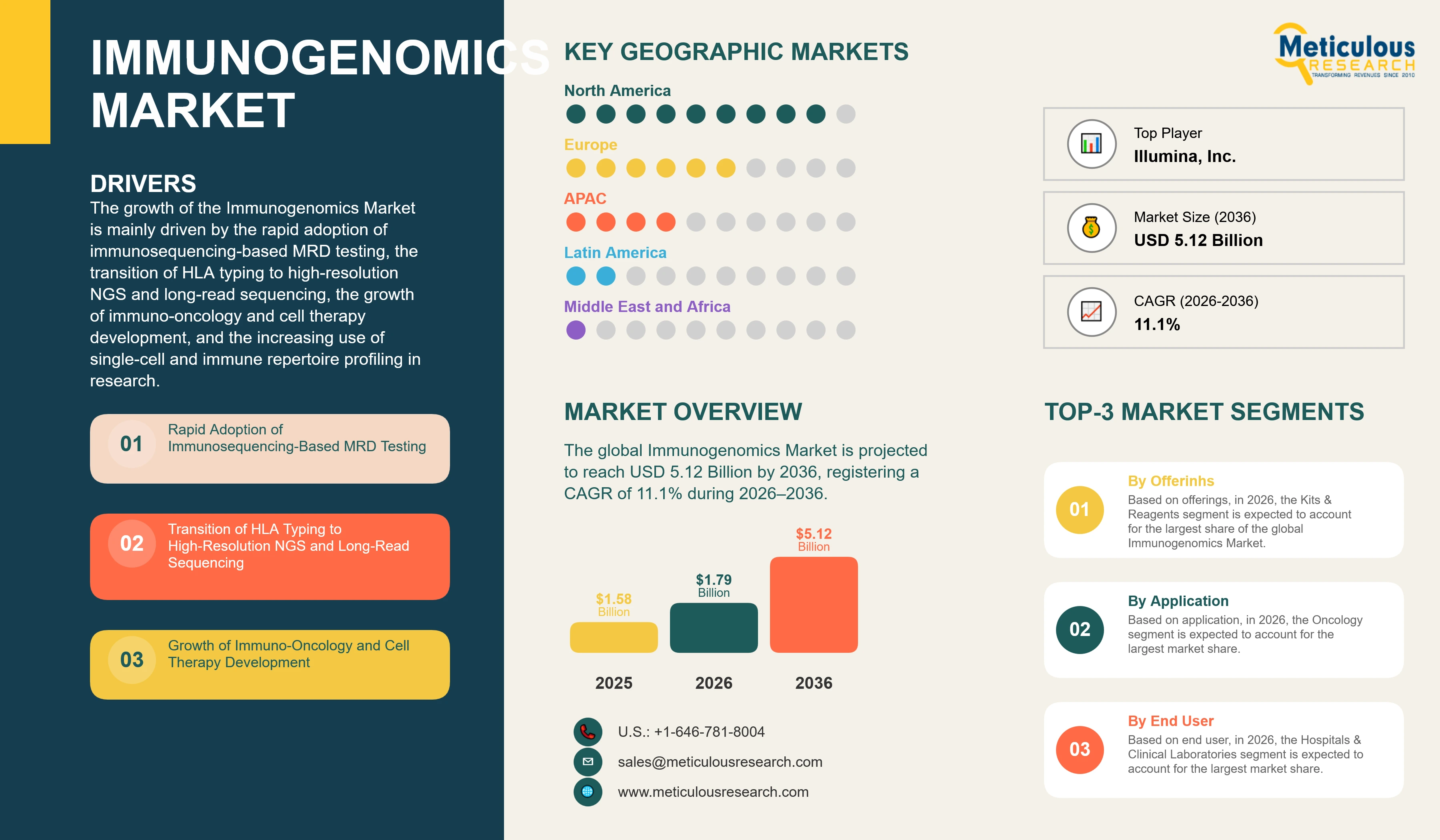
The global Immunogenomics Market was valued at USD 1.58 billion in 2025. This market is expected to reach USD 5.12 billion by 2036 from an estimated USD 1.79 billion in 2026, registering a CAGR of 11.1% during the forecast period (2026-2036).
- Published
- Oct 2026
- Pages
- 397
- Format
- PDF + Excel
- Report ID
- MR-2346
- Base year
- 2025
- 2025 · BASELINE
- $1.58B
- 2036
- $5.12B
- CAGR 2026–2036
- 11.1%
2025 baseline · 2026–2036 forecast at 11.1% CAGR · hover a bar for the value
Key highlights
The global Immunogenomics Market is projected to reach USD 5.12 billion by 2036, driven by immunosequencing-based MRD testing, NGS and long-read HLA typing, immuno-oncology, and cell therapy development.
North America is expected to account for the largest market share in 2026, while Asia-Pacific is projected to register the fastest growth during the forecast period. Adaptive Biotechnologies reported Q2 2026 minimal residual disease (MRD) revenue of USD 66.2 million, up 33%, with clonoSEQ test volume rising 43% to 36,111 tests, raised its 2026 MRD revenue guidance to USD 268 million to USD 278 million, and announced plans to separate its MRD and Immune Medicine businesses.
By analysis type, HLA & KIR Typing is expected to account for the largest market share in 2026, whereas Immune Repertoire Sequencing is projected to witness the fastest growth through 2036. In April 2026, CareDx introduced AlloSeq Nano at the European Federation for Immunogenetics (EFI) conference, a nanopore-based long-read HLA typing assay that genotypes eleven HLA loci plus ABO in a single assay in under three hours, with about 45 minutes of hands-on time and reduced phasing ambiguities.
The transplant immunogenetics segment is consolidating. In April 2026, CareDx agreed to divest its Lab Products business, including NGS-based and PCR-based HLA typing kits and the newly introduced AlloSeq Nano long-read HLA typing assay, to Eurobio Scientific for USD 170 million in cash, with closing expected by the end of the third quarter of 2026.
By end user, Hospitals & Clinical Laboratories are expected to account for the largest market share in 2026, while Pharmaceutical & Biotechnology Companies are projected to grow the fastest, driven by immuno-oncology, cell therapy, and MRD-based clinical trial endpoints.
Report summary
| Particulars | Details |
|---|---|
| Forecast Period | 2026-2036 |
| Base Year | 2025 |
| Estimated Year | 2026 |
| CAGR (Value) | 11.1% |
| Format | PDF, Excel & Cloud Portal · 397 pages |
| Market Size (Value) in 2026 | USD 1.79 Billion |
| Market Size (Value) in 2036 | USD 5.12 Billion |
| Segments Covered | By Offering: Kits & Reagents, Instruments, Software & Bioinformatics, Services (Clinical Testing Services, Research Services). By Technology: Short-Read NGS, Long-Read Sequencing, PCR-Based Methods, Single-Cell Sequencing, Other Technologies. By Analysis Type: HLA & KIR Typing, Immune Repertoire Sequencing (TCR Sequencing, BCR Sequencing), Immune Gene Expression Profiling, Neoantigen & Immunopeptidome Analysis, Other Analysis Types. By Application: Oncology (Hematologic Malignancies & MRD, Immuno-Oncology & Solid Tumors), Transplantation, Autoimmune & Inflammatory Diseases, Infectious Diseases & Vaccine Research, Other Applications. By End User: Hospitals & Clinical Laboratories, Histocompatibility Laboratories & Donor Registries, Academic & Research Institutes, Pharmaceutical & Biotechnology Companies, Other End Users. |
| Countries Covered | North America: U.S., Canada. Europe: Germany, U.K., France, Italy, Spain, Netherlands, Rest of Europe. Asia-Pacific: China, Japan, South Korea, India, Australia, Rest of Asia-Pacific. Latin America: Brazil, Mexico, Rest of Latin America. Middle East & Africa: Saudi Arabia, UAE, Israel, Rest of Middle East & Africa. |
| Key Companies | Adaptive Biotechnologies Corporation, Thermo Fisher Scientific Inc., Illumina, Inc., CareDx, Inc., Eurobio Scientific SA, Werfen S.A. (Immucor), Invivoscribe, Inc., 10x Genomics, Inc., and Takara Bio Inc. |
Report overview
Segments covered: offering, technology, analysis type, application, end user.
The growth of this market is mainly driven by the rapid adoption of immunosequencing-based minimal residual disease testing in hematologic malignancies, the transition of HLA typing from serological and PCR-based methods to high-resolution next-generation sequencing (NGS) and long-read sequencing, the growth of immuno-oncology and cell therapy development, and the increasing use of immune repertoire and single-cell immune profiling in research. In addition, the expansion of solid organ and stem cell transplantation, the growing application of immunogenomics in autoimmune and infectious diseases, the development of neoantigen-based personalized cancer vaccines, and the use of artificial intelligence (AI) to interpret immune receptor data are further supporting the growth of this market.
The Immunogenomics Market, also referred to as the immune genomics market, immune repertoire and HLA genomics market, or immunogenetics sequencing market, comprises the kits and reagents, instruments, software, and services used to analyze the genes and genetic diversity of the immune system. The market includes immune repertoire sequencing of T-cell receptors (TCRs) and B-cell receptors (BCRs), including clinical immunosequencing for MRD detection; HLA and killer-cell immunoglobulin-like receptor (KIR) typing using NGS, long-read sequencing, and PCR-based methods; immune gene expression profiling; single-cell immune profiling that links immune receptor sequences to gene expression; neoantigen prediction and immunopeptidome analysis; and the bioinformatics tools used to interpret immune genomic data. The market ecosystem extends from sequencing platform and reagent providers to HLA typing kit manufacturers, clinical immunosequencing laboratories, bioinformatics providers, transplant and histocompatibility laboratories, donor registries, academic research institutions, and pharmaceutical and biotechnology companies.
The market is experiencing strong growth as the immune system becomes central to the diagnosis and treatment of many diseases. The diversity of immune receptors and HLA genes determines how individuals respond to infections, cancers, transplants, and vaccines, and sequencing technologies now allow this diversity to be measured comprehensively. In oncology, immune repertoire sequencing allows clonal B-cell and T-cell populations to be tracked with very high sensitivity, enabling the detection of MRD in blood cancers. In transplantation, high-resolution HLA typing improves donor-recipient matching and outcomes. In research and drug development, immunogenomic data are used to understand immune responses, discover therapeutic antibodies and TCRs, and design immunotherapies and vaccines.
Clinical immunosequencing is one of the most important growth drivers. Adaptive Biotechnologies reported Q2 2026 minimal residual disease (MRD) revenue of USD 66.2 million, up 33%, with clonoSEQ test volume rising 43% to 36,111 tests, raised its 2026 MRD revenue guidance to USD 268 million to USD 278 million, and announced plans to separate its MRD and Immune Medicine businesses. The clonoSEQ assay identifies and tracks the clonal immune receptor sequences of malignant cells in multiple myeloma, B-cell acute lymphoblastic leukemia, chronic lymphocytic leukemia, and lymphomas, and MRD status is increasingly used to guide treatment decisions and as an endpoint in clinical trials. The strong growth of MRD testing illustrates how immunogenomics is moving from research into routine clinical practice.
HLA typing is also evolving rapidly. Histocompatibility laboratories have moved from serological and low-resolution PCR methods toward high-resolution NGS-based typing, which provides more accurate matching for solid organ and hematopoietic stem cell transplantation. In March 2025, Thermo Fisher Scientific introduced the One Lambda HybriType HLA Plus Typing Flex kit, an NGS hybrid capture assay for HLA genotyping from whole blood and buccal swabs with at least 99.8% concordance and a total workflow time of under 5.5 hours, supported by One Lambda TypeStream Visual NGS Software. In April 2026, CareDx introduced AlloSeq Nano at the European Federation for Immunogenetics (EFI) conference, a nanopore-based long-read HLA typing assay that genotypes eleven HLA loci plus ABO in a single assay in under three hours, with about 45 minutes of hands-on time and reduced phasing ambiguities. Long-read sequencing reduces phasing ambiguities in highly polymorphic HLA genes, supporting more accurate and faster typing, particularly for deceased donor typing where speed is critical.
The competitive landscape is consolidating as companies focus their portfolios. In April 2026, CareDx agreed to divest its Lab Products business, including NGS-based and PCR-based HLA typing kits and the newly introduced AlloSeq Nano long-read HLA typing assay, to Eurobio Scientific for USD 170 million in cash, with closing expected by the end of the third quarter of 2026. Adaptive Biotechnologies has announced plans to separate its MRD and Immune Medicine businesses, and Thermo Fisher Scientific offers a broad transplant diagnostics portfolio through One Lambda. In research, single-cell platforms such as those of 10x Genomics enable paired immune receptor and gene expression analysis, while companies such as Takara Bio and Invivoscribe offer immune repertoire library preparation and clonality assays.
Immunogenomics is also expanding into new applications. In autoimmune diseases, immune repertoire sequencing is being used to identify disease-associated T-cell and B-cell clones and to monitor immune responses to therapies, including emerging cell therapies for autoimmune conditions. In infectious diseases, immune repertoire data can reveal past and current exposures and vaccine responses. In immuno-oncology, neoantigen prediction from tumor sequencing supports the development of personalized cancer vaccines, and TCR sequencing is used to monitor responses to checkpoint inhibitors and cell therapies.
At the same time, the market faces challenges related to the complexity of immune genomic data, the cost of high-resolution analysis, and reimbursement and regulatory requirements for clinical tests. Adaptive Biotechnologies reported a decline in Immune Medicine revenue to USD 5.4 million in Q2 2026, reflecting the difficulty of commercializing immune repertoire data for drug discovery outside clinical MRD testing. As a result, providers that can deliver clinically validated tests, rapid and accurate HLA typing, and interpretable immune profiling are expected to capture the largest share of growth over the forecast period.
Report infographic
Market dynamics
15 factors across 5 forcesRapid Adoption of Immunosequencing-Based MRD Testing
The rapid adoption of immunosequencing-based MRD testing is a major factor driving the Immunogenomics Market, as MRD status is a strong predictor of relapse and survival in hematologic malignancies and is increasingly used to guide treatment decisions. Adaptive Biotechnologies reported clonoSEQ test volume of 36,111 in Q2 2026, up 43% year over year, and MRD revenue of USD 66.2 million, up 33%, and raised its 2026 MRD revenue guidance to USD 268 million to USD 278 million.
MRD testing is used across multiple myeloma, acute lymphoblastic leukemia, chronic lymphocytic leukemia, and lymphomas, and is increasingly incorporated into clinical trials as an endpoint. As MRD-guided treatment becomes standard practice and expands to new indications, demand for immunosequencing tests and the reagents and sequencing capacity that support them is expected to grow strongly over the forecast period.
Transition of HLA Typing to High-Resolution NGS and Long-Read Sequencing
The transition of HLA typing from serological and PCR-based methods to high-resolution NGS and long-read sequencing is significantly accelerating market growth. High-resolution typing improves donor-recipient matching for solid organ and stem cell transplantation and reduces the risk of rejection and graft-versus-host disease. In March 2025, Thermo Fisher Scientific introduced the One Lambda HybriType HLA Plus Typing Flex kit, an NGS hybrid capture assay for HLA genotyping from whole blood and buccal swabs with at least 99.8% concordance and a total workflow time of under 5.5 hours, supported by One Lambda TypeStream Visual NGS Software. In April 2026, CareDx introduced AlloSeq Nano at the European Federation for Immunogenetics (EFI) conference, a nanopore-based long-read HLA typing assay that genotypes eleven HLA loci plus ABO in a single assay in under three hours, with about 45 minutes of hands-on time and reduced phasing ambiguities. These products are making high-resolution typing faster and more accessible to histocompatibility laboratories, supporting the replacement of older methods.
Growth of Immuno-Oncology and Cell Therapy Development
The growth of immuno-oncology and cell therapy development is creating strong demand for immunogenomic analysis. TCR sequencing is used to monitor T-cell responses to checkpoint inhibitors and cell therapies, track the persistence of engineered T cells, and discover therapeutic TCRs, while neoantigen prediction from tumor sequencing supports the development of personalized cancer vaccines. As the number of immunotherapies and cell therapies in development grows, pharmaceutical and biotechnology companies are using immunogenomic data to understand mechanisms of response and resistance, increasing demand for immune repertoire sequencing, single-cell immune profiling, and analysis services.
Increasing Use of Single-Cell and Immune Repertoire Profiling in Research
The increasing use of single-cell and immune repertoire profiling in research is expanding the market. Single-cell platforms allow the paired sequencing of TCR or BCR chains together with gene expression in individual cells, linking immune receptor specificity to cell function. These methods are widely used in immunology, oncology, autoimmunity, infectious disease, and vaccine research, and support the discovery of therapeutic antibodies and TCRs. As single-cell technologies scale to larger numbers of cells and samples, demand for immune profiling kits, sequencing, and bioinformatics is expected to grow.
Table of contents
13 chapters · 154 sections · 397 pages · click to expandSegmental analysis
| Segment | Largest share (2026) | Fastest growth (2026–2036) |
|---|---|---|
| By Offering | Kits & Reagents | Services |
| By Technology | Short-Read NGS | Long-Read Sequencing |
| By Analysis Type | HLA & KIR Typing | Immune Repertoire Sequencing |
| By Application | Oncology | Autoimmune & Inflammatory Diseases |
| By End User | Hospitals & Clinical Laboratories | Pharmaceutical & Biotechnology Companies |
By Offering
- Immunogenomics Market Analysis by Offering
- Services are further segmented into Clinical Testing Services and Research Services.
- The Kits & Reagents segment is expected to account for the largest share of the global Immunogenomics Market.
- The large share of this segment is mainly due to the recurring use of HLA typing kits, immune repertoire library preparation kits, single-cell immune profiling reagents, and sequencing reagents in histocompatibility, clinical, and research laboratories worldwide, and the scale of the HLA typing kit business, as reflected in the USD 170 million value of the CareDx Lab Products business.
- However, the Services segment is projected to register the highest CAGR during the forecast period.
- The rapid growth of this segment is attributed to the strong growth of clinical immunosequencing tests, including the 43% increase in clonoSEQ test volume in Q2 2026, and the outsourcing of immune repertoire and neoantigen analysis by pharmaceutical companies.
By Technology
- Immunogenomics Market Analysis by Technology
- The Short-Read NGS segment is expected to account for the largest market share, due to its use in clinical immunosequencing tests such as clonoSEQ, high-resolution HLA typing assays such as the One Lambda HybriType kit, and research immune repertoire sequencing.
- However, the Long-Read Sequencing segment is projected to register the highest CAGR during the forecast period, owing to its ability to resolve full-length HLA alleles and reduce phasing ambiguities, and the introduction of assays such as AlloSeq Nano.
- The PCR-Based Methods segment is expected to grow more slowly, as laboratories move to sequencing-based typing, while the Single-Cell Sequencing segment is expected to record strong growth in research.
By Analysis Type
- Immunogenomics Market Analysis by Analysis Type
- Immune repertoire sequencing is further segmented into TCR Sequencing and BCR Sequencing.
- The HLA & KIR Typing segment is expected to account for the largest market share, due to the routine use of HLA typing in solid organ and stem cell transplantation, donor registries, and disease association studies, and the transition to high-resolution sequencing-based typing.
- However, the Immune Repertoire Sequencing segment is projected to register the highest CAGR during the forecast period, driven by the rapid growth of immunosequencing-based MRD testing, the use of TCR sequencing in immuno-oncology and cell therapy development, and expanding applications in autoimmune and infectious diseases.
By Application
- Immunogenomics Market Analysis by Application
- Oncology is further segmented into Hematologic Malignancies & MRD and Immuno-Oncology & Solid Tumors.
- The Oncology segment is expected to account for the largest market share, due to the strong growth of MRD testing in hematologic malignancies and the extensive use of immunogenomics in immuno-oncology research and drug development.
- However, the Autoimmune & Inflammatory Diseases segment is projected to register the highest CAGR during the forecast period, owing to the growing use of immune repertoire sequencing to identify disease-associated clones, the development of cell therapies for autoimmune diseases, and expanding research into the genetic basis of autoimmunity.
- The Transplantation segment is expected to account for a significant share, supported by the routine use of HLA typing and the adoption of rapid and long-read typing.
By End User
- Immunogenomics Market Analysis by End User
- The Hospitals & Clinical Laboratories segment is expected to account for the largest market share, due to the clinical use of MRD testing and HLA typing in patient care.
- However, the Pharmaceutical & Biotechnology Companies segment is projected to register the highest CAGR during the forecast period, driven by the use of immunogenomics in immuno-oncology, cell therapy, and vaccine development and the increasing use of MRD as a clinical trial endpoint.
Geographic analysis
North America
Largest shareIn 2026, North America is expected to account for the largest share of the global Immunogenomics Market. The large share of this region is mainly attributed to the high adoption of clinical immunosequencing for MRD, the large number of transplant centers and histocompatibility laboratories, strong immuno-oncology and cell therapy research and development, and the presence of leading companies, including Adaptive Biotechnologies, Thermo Fisher Scientific, Illumina, CareDx, Invivoscribe, and 10x Genomics. The growth of clonoSEQ test volume to 36,111 in Q2 2026 reflects strong demand for MRD testing in the U.S. In addition, the exclusive right of CareDx to distribute post-transplant monitoring tests in North America under its agreement with Eurobio Scientific maintains its presence in the regional transplant market. The U.S. performed more than 48,000 organ transplants in 2024, each requiring HLA typing of donors and recipients, which supports steady demand for histocompatibility testing across the country. Canada is expected to contribute to regional growth, supported by transplant programs and academic immunology research.
Europe
Europe is expected to account for a significant share of the market, supported by strong histocompatibility and immunogenetics networks, active transplant programs, and the presence of companies such as Eurobio Scientific in France and GenDx in the Netherlands. The European Federation for Immunogenetics, where CareDx introduced AlloSeq Nano in April 2026, coordinates standards and accreditation for histocompatibility laboratories across the region. Germany, the U.K., France, Italy, Spain, and the Netherlands are expected to account for the largest shares, supported by large donor registries, transplant centers, and immunology research.
Asia-Pacific
Fastest growthAsia-Pacific is projected to register the highest CAGR during the forecast period. The growth of this region is driven by expanding transplant programs, growing donor registries, increasing cancer incidence, and rising investment in immuno-oncology and cell therapy research. China is expected to account for the largest share within Asia-Pacific, supported by a large and growing cell therapy industry and expanding transplant services, while Japan, home to Takara Bio, South Korea, India, and Australia are expected to see strong growth, supported by transplantation, cancer research, and clinical genomics.
Latin America
Latin America and the Middle East & Africa are expected to account for smaller shares of the market. In Latin America, demand is supported by transplant programs and cancer care in Brazil and Mexico, while in the Middle East, investment in transplantation, stem cell registries, and genomic medicine in Saudi Arabia, the UAE, and Israel is expected to support demand for immunogenomic testing.
Competitive landscape
The global Immunogenomics Market is moderately consolidated, with a small number of companies leading clinical immunosequencing and HLA typing, alongside sequencing platform providers, single-cell technology providers, research reagent suppliers, bioinformatics companies, and service providers. Market participants compete primarily on sensitivity and accuracy, resolution and turnaround time, regulatory approvals and accreditation, reimbursement, workflow simplicity, data analysis software, and global distribution and support.
Leading companies are launching higher-resolution and faster HLA typing assays, expanding MRD testing to new indications and settings, developing single-cell and immune repertoire products, investing in bioinformatics and AI, and refocusing their portfolios through divestitures and separations. Recent examples include the introduction of the One Lambda HybriType HLA Plus Typing Flex kit by Thermo Fisher Scientific in March 2025, the agreement by CareDx to divest its Lab Products business to Eurobio Scientific and the introduction of AlloSeq Nano in April 2026, and the announcement by Adaptive Biotechnologies of plans to separate its MRD and Immune Medicine businesses.
The report provides a comprehensive competitive assessment of the leading companies operating in the global Immunogenomics Market. The key players profiled in the report include Adaptive Biotechnologies Corporation (U.S.), Thermo Fisher Scientific Inc. (U.S.), Illumina, Inc. (U.S.), CareDx, Inc. (U.S.), Eurobio Scientific SA (France), Werfen S.A. (Immucor) (Spain), Invivoscribe, Inc. (U.S.), 10x Genomics, Inc. (U.S.), and Takara Bio Inc. (Japan).
- Adaptive Biotechnologies Corporation
- Thermo Fisher Scientific Inc.
- Illumina, Inc.
- CareDx, Inc.
- Eurobio Scientific SA
- Werfen S.A. · Immucor
- Invivoscribe, Inc.
- 10x Genomics, Inc.
- Takara Bio Inc
Expert perspectives
The Immunogenomics Market is entering a period in which clinical applications, rather than research tools, are becoming the main source of growth. With clonoSEQ test volume growing 43% in Q2 2026, MRD revenue guidance of more than USD 268 million for 2026, and HLA typing moving to high-resolution NGS and long-read sequencing, immunogenomics is now a core part of hematologic oncology and transplant medicine. The binding constraint is shifting from the ability to sequence immune genes to the ability to deliver clinically validated, reimbursed, and interpretable tests that change patient management.
Three structural changes are expected to shape competitive positions through 2036. First, MRD testing is expanding to new indications, blood-based testing, and community settings, favoring providers with established clinical evidence and reimbursement. Second, HLA typing is shifting to faster, higher-resolution sequencing-based methods, including long-read assays, while the laboratory products segment is consolidating. Third, applications in autoimmune diseases, cell therapy, and personalized cancer vaccines are expanding the market beyond oncology and transplantation.
For companies planning entry or expansion, the most defensible positions over the forecast period are likely to be found in clinical immunosequencing for MRD and disease monitoring, rapid and long-read HLA typing, immunogenomic services for cell therapy and vaccine development, and AI-enabled interpretation of immune receptor data. For established providers, the principal risks are reimbursement limitations, the difficulty of commercializing immune repertoire data for drug discovery, and regulatory requirements for clinical tests.
Overall, the market is expected to grow strongly, with kits and reagents, short-read NGS, HLA typing, oncology, and clinical laboratories providing the core of demand and services, long-read sequencing, immune repertoire sequencing, autoimmune applications, pharmaceutical customers, and Asia-Pacific providing the fastest growth.
Customer perspectives
Insights gathered during primary interviews with hematologists, histocompatibility laboratory directors, and immuno-oncology researchers operating in this market highlight where procurement priorities are shifting. The following perspectives reflect recurring themes raised across these discussions.
“This reflects the role of MRD testing in clinical decision-making.”
“This indicates the importance of speed and resolution in HLA typing.”
“This points to the growing role of immunogenomics in therapy development.”
Frequently asked questions
The global Immunogenomics Market is estimated at USD 1.79 billion in 2026.
Cite this report
Meticulous Research. (2026). Immunogenomics Market - Global Opportunity Analysis And Industry Forecast (2026-2036) (Report No. MR-2346). Meticulous Market Research Pvt. Ltd. https://www.meticulousresearch.com/product/immunogenomics-market-7029