Human Microbiome Analysis Market (2026-2036)
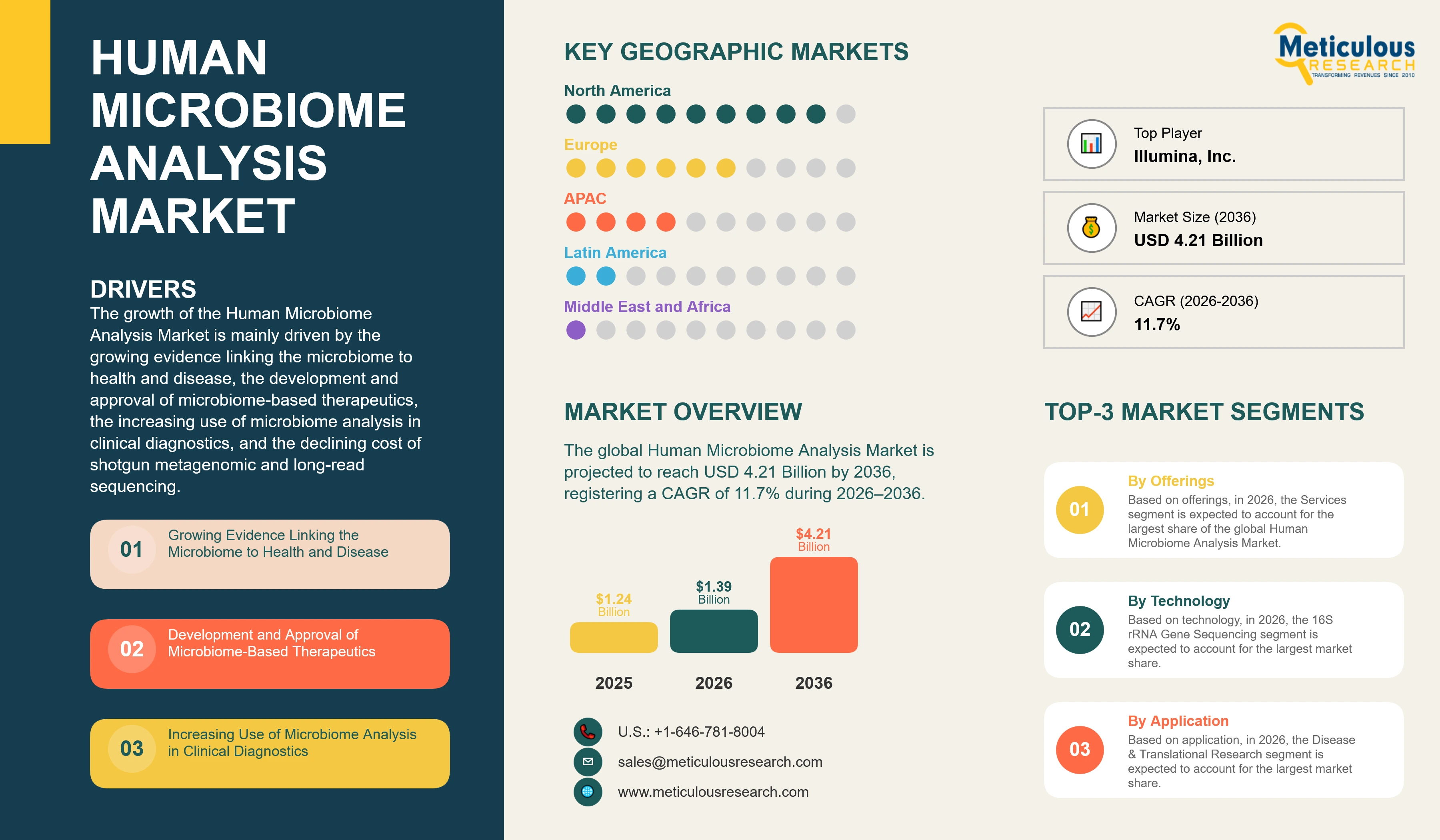
The global Human Microbiome Analysis Market was valued at USD 1.24 billion in 2025. This market is expected to reach USD 4.21 billion by 2036 from an estimated USD 1.39 billion in 2026, registering a CAGR of 11.7% during the forecast period (2026-2036).
- Published
- Oct 2026
- Pages
- 378
- Format
- PDF + Excel
- Report ID
- MR-2349
- Base year
- 2025
- 2025 · BASELINE
- $1.24B
- 2036
- $4.21B
- CAGR 2026–2036
- 11.7%
2025 baseline · 2026–2036 forecast at 11.7% CAGR · hover a bar for the value
Key highlights
The global Human Microbiome Analysis Market is projected to reach USD 4.21 billion by 2036, driven by microbiome research, therapeutics development, clinical diagnostics, consumer testing, and lower-cost metagenomic sequencing.
North America is expected to account for the largest market share in 2026, while Asia-Pacific is projected to register the fastest growth during the forecast period, supported by expanding microbiome research, large populations with diverse microbiomes, and growing investment in precision nutrition and gut health in China, Japan, South Korea, and Australia.
Clinical metagenomic testing is scaling rapidly. Microba Life Sciences, an Australian provider of metagenomic gut microbiome testing, reported fiscal year 2026 core testing revenue of AUD 9.0 million, up 92%, on 22,418 tests, up 78%, with an annualized run rate of more than 25,000 tests across Australia and the U.K. by the fourth quarter, and plans to launch its GI Navigator diagnostic in September 2026.
Microbiome therapeutics are creating demand for analysis in drug development. The U.S. Food and Drug Administration (FDA) approved VOWST, developed by Seres Therapeutics and now owned by Nestlé Health Science, as the first orally administered microbiome-based therapeutic to help prevent recurrence of Clostridioides difficile infection in adults, and in June 2026 Nestlé Health Science agreed to pay USD 25 million to buy out potential VOWST sales-based milestones.
By technology, 16S rRNA Gene Sequencing is expected to account for the largest market share in 2026, whereas Shotgun Metagenomic Sequencing is projected to witness the fastest growth through 2036, as falling sequencing costs make species- and strain-level and functional analysis more affordable.
Report summary
| Particulars | Details |
|---|---|
| Forecast Period | 2026-2036 |
| Base Year | 2025 |
| Estimated Year | 2026 |
| CAGR (Value) | 11.7% |
| Format | PDF, Excel & Cloud Portal · 378 pages |
| Market Size (Value) in 2026 | USD 1.39 Billion |
| Market Size (Value) in 2036 | USD 4.21 Billion |
| Segments Covered | By Offering: Services (Research Sequencing & Analysis Services, Clinical Testing Services, Consumer Testing Services), Kits & Reagents (Sample Collection & Stabilization Kits, Extraction Kits, Library Preparation Kits, Reference Standards), Instruments, Software & Bioinformatics. By Technology: 16S rRNA Gene Sequencing, Shotgun Metagenomic Sequencing, Metatranscriptomics & Multi-Omics, qPCR, Other Technologies. By Sample Type: Gut & Fecal Samples, Oral Samples, Skin Samples, Vaginal & Urogenital Samples, Respiratory Samples, Other Samples. By Application: Disease & Translational Research, Drug Discovery & Development, Clinical Diagnostics, Consumer Wellness & Personalized Nutrition, Other Applications. By End User: Academic & Research Institutes, Pharmaceutical & Biotechnology Companies, Hospitals & Clinical Laboratories, Food, Nutrition & Consumer Health Companies, Other End Users. |
| Countries Covered | North America: U.S., Canada. Europe: U.K., France, Germany, Netherlands, Belgium, Denmark, Ireland, Rest of Europe. Asia-Pacific: China, Japan, South Korea, Australia, India, Rest of Asia-Pacific. Latin America: Brazil, Mexico, Rest of Latin America. Middle East & Africa: Saudi Arabia, UAE, Israel, Rest of Middle East & Africa. |
| Key Companies | Illumina, Inc., Thermo Fisher Scientific Inc., QIAGEN N.V., Pacific Biosciences of California, Inc., Oxford Nanopore Technologies plc, Zymo Research Corporation, Microba Life Sciences Limited, CosmosID, Inc., and Novogene Co., Ltd. |
Report overview
Segments covered: offering, technology, sample type, application, end user.
The growth of this market is mainly driven by the growing body of evidence linking the human microbiome to gastrointestinal, metabolic, immune, neurological, and oncological conditions, the development and approval of microbiome-based therapeutics, the increasing use of microbiome analysis in clinical diagnostics, and the declining cost of shotgun metagenomic and long-read sequencing. In addition, the use of microbiome biomarkers in drug development, including immuno-oncology, the growth of consumer microbiome testing and personalized nutrition, the development of microbial reference standards, and the use of artificial intelligence (AI) to interpret complex microbiome data are further supporting the growth of this market.
The Human Microbiome Analysis Market, also referred to as the microbiome testing market, microbiome sequencing and analysis market, or human metagenomics market, comprises the services, kits and reagents, instruments, and software used to characterize the composition and function of the microbial communities that live in and on the human body, including the gut, oral cavity, skin, vagina and urogenital tract, and respiratory tract. The market includes sample collection and stabilization kits, nucleic acid extraction kits, library preparation kits, and microbial reference standards; sequencers and other instruments used for 16S rRNA gene sequencing, shotgun metagenomic sequencing, metatranscriptomics, and qPCR; bioinformatics software for taxonomic and functional profiling; and microbiome analysis services, including research sequencing services, clinical microbiome testing, and consumer microbiome tests. The market ecosystem extends from sequencing platform and reagent providers to service laboratories, bioinformatics companies, academic and clinical researchers, microbiome therapeutics developers, pharmaceutical companies, food and nutrition companies, healthcare providers, and consumers.
The market is experiencing strong growth as research increasingly links the microbiome to human health and disease. Changes in microbial communities have been associated with inflammatory bowel disease, irritable bowel syndrome, Clostridioides difficile infection, obesity and type 2 diabetes, cardiovascular disease, allergies and autoimmune conditions, neurological and psychiatric conditions, and responses to cancer immunotherapy. As a result, microbiome analysis has become a standard component of research in gastroenterology, immunology, metabolism, oncology, and neuroscience, generating sustained demand for sequencing and analysis.
The development of microbiome-based therapeutics is an important driver of demand. The U.S. Food and Drug Administration (FDA) approved VOWST, developed by Seres Therapeutics and now owned by Nestlé Health Science, as the first orally administered microbiome-based therapeutic to help prevent recurrence of Clostridioides difficile infection in adults, and in June 2026 Nestlé Health Science agreed to pay USD 25 million to buy out potential VOWST sales-based milestones. Seres Therapeutics continues to develop SER-155, which has Breakthrough Therapy and Fast Track designations for patients undergoing allogeneic hematopoietic stem cell transplantation, and is evaluating it in immune checkpoint inhibitor-related enterocolitis. Microbiome therapeutics developers use microbiome analysis to select patients, confirm engraftment of therapeutic microbes, and identify biomarkers of response, creating demand for clinical-grade sequencing and analysis.
Clinical microbiome testing is also expanding. Microba Life Sciences, an Australian provider of metagenomic gut microbiome testing, reported fiscal year 2026 core testing revenue of AUD 9.0 million, up 92%, on 22,418 tests, up 78%, with an annualized run rate of more than 25,000 tests across Australia and the U.K. by the fourth quarter, and plans to launch its GI Navigator diagnostic in September 2026. Clinical microbiome tests are being used to support the assessment of gastrointestinal conditions and to guide dietary and therapeutic interventions, and the development of validated clinical tests is expected to increase as evidence and reimbursement develop.
Technology advances are improving the resolution and reproducibility of microbiome analysis. Shotgun metagenomic sequencing provides species- and strain-level resolution and functional information that 16S rRNA gene sequencing cannot, and its cost is falling as sequencing becomes cheaper. Long-read sequencing from PacBio and Oxford Nanopore Technologies enables full-length 16S sequencing and the assembly of complete microbial genomes from complex samples. At the same time, standardization is becoming a priority. At ASM Microbe 2026 in June 2026, Zymo Research highlighted microbial community standards, metagenomic reference materials, extraction and library preparation technologies, and microbiome sequencing and multi-omics services, emphasizing the need to reduce lysis bias and improve standardization and reproducibility across microbiome workflows.
The microbiome is also becoming an important consideration in drug development more broadly. Gut microbes can metabolize drugs, influence drug efficacy and toxicity, and modulate immune responses, and pharmaceutical companies are increasingly collecting microbiome samples in clinical trials to understand variability in drug response. Research linking the gut microbiome to the response to immune checkpoint inhibitors has been particularly influential, encouraging the inclusion of microbiome analysis in oncology trials and the development of microbiome-based approaches to improve immunotherapy outcomes. These applications are creating demand for standardized, high-quality microbiome data that can be compared across trial sites and studies.
Consumer and nutrition applications are another source of demand. Consumer microbiome tests offer personalized insights and dietary recommendations, and food, nutrition, and probiotic companies use microbiome analysis to develop and substantiate products. Microba Life Sciences reported that unit sales of its PHGG prebiotic fiber more than doubled in the fourth quarter of fiscal year 2026, reflecting consumer interest in gut health.
At the same time, the market faces challenges related to the lack of standardization, the difficulty of establishing causal links between microbes and disease, and the limited clinical validation and reimbursement of many microbiome tests. The financial pressure on microbiome therapeutics developers, illustrated by Seres Therapeutics projecting cash runway only into the first quarter of 2027, also reflects the challenges of translating microbiome science into products. As a result, providers that can deliver standardized, high-resolution, and clinically meaningful microbiome analysis are expected to capture the largest share of growth over the forecast period.
Report infographic
Market dynamics
15 factors across 5 forcesGrowing Evidence Linking the Microbiome to Health and Disease
The growing evidence linking the human microbiome to health and disease is a major factor driving the Human Microbiome Analysis Market, as researchers investigate the role of microbes in gastrointestinal, metabolic, immune, neurological, and oncological conditions. Microbiome analysis is now a routine component of research in many fields, and large cohort studies and clinical trials increasingly include microbiome sampling. This expanding research base is generating sustained demand for sample collection kits, extraction and library preparation reagents, sequencing, and bioinformatics.
As research moves from describing associations toward understanding mechanisms and developing interventions, studies are becoming larger and more complex, requiring higher-resolution methods such as shotgun metagenomics and multi-omics, and increasing the value of microbiome analysis per sample.
Development and Approval of Microbiome-Based Therapeutics
The development and approval of microbiome-based therapeutics is significantly accelerating market growth. The U.S. Food and Drug Administration (FDA) approved VOWST, developed by Seres Therapeutics and now owned by Nestlé Health Science, as the first orally administered microbiome-based therapeutic to help prevent recurrence of Clostridioides difficile infection in adults, and in June 2026 Nestlé Health Science agreed to pay USD 25 million to buy out potential VOWST sales-based milestones. Developers of live biotherapeutics and microbiome-modulating drugs use microbiome analysis throughout development to identify therapeutic targets, select patients, measure engraftment and colonization, and identify biomarkers of response. As more microbiome therapeutics advance through clinical development in conditions such as C. difficile infection, inflammatory bowel disease, transplantation, and immuno-oncology, demand for clinical-grade microbiome analysis is expected to increase.
Increasing Use of Microbiome Analysis in Clinical Diagnostics
The increasing use of microbiome analysis in clinical diagnostics is an important growth driver. Metagenomic gut microbiome tests are being used to support the assessment of gastrointestinal symptoms and conditions, and to guide dietary, probiotic, and therapeutic interventions. Microba Life Sciences, an Australian provider of metagenomic gut microbiome testing, reported fiscal year 2026 core testing revenue of AUD 9.0 million, up 92%, on 22,418 tests, up 78%, with an annualized run rate of more than 25,000 tests across Australia and the U.K. by the fourth quarter, and plans to launch its GI Navigator diagnostic in September 2026. As clinical evidence grows and healthcare providers become more familiar with microbiome testing, clinical demand is expected to expand.
Declining Cost of Shotgun Metagenomic and Long-Read Sequencing
The declining cost of shotgun metagenomic and long-read sequencing is making high-resolution microbiome analysis more affordable. Shotgun metagenomics provides species- and strain-level resolution and information on microbial genes and functions, while long-read sequencing enables full-length 16S sequencing and complete genome assembly. As sequencing costs fall, researchers and test providers are moving from 16S sequencing to shotgun and long-read approaches, increasing the depth of analysis and supporting market growth.
Table of contents
13 chapters · 161 sections · 378 pages · click to expandSegmental analysis
| Segment | Largest share (2026) | Fastest growth (2026–2036) |
|---|---|---|
| By Offering | Services | Software & Bioinformatics |
| By Technology | 16S rRNA Gene Sequencing | Shotgun Metagenomic Sequencing |
| By Sample Type | Gut & Fecal Samples | Vaginal & Urogenital Samples |
| By Application | Disease & Translational Research | Clinical Diagnostics |
| By End User | Academic & Research Institutes | Hospitals & Clinical Laboratories |
By Offering
- Human Microbiome Analysis Market Analysis by Offering
- Services are further segmented into Research Sequencing & Analysis Services, Clinical Testing Services, and Consumer Testing Services, while kits and reagents are further segmented into Sample Collection & Stabilization Kits, Extraction Kits, Library Preparation Kits, and Reference Standards.
- The Services segment is expected to account for the largest share of the global Human Microbiome Analysis Market.
- The large share of this segment is mainly due to the widespread outsourcing of microbiome sequencing and analysis by academic researchers, pharmaceutical and microbiome therapeutics companies, and food and nutrition companies, and the growth of clinical and consumer microbiome testing, as reflected in the 92% growth in core testing revenue reported by Microba Life Sciences in fiscal year 2026.
- However, the Software & Bioinformatics segment is projected to register the highest CAGR during the forecast period.
- The rapid growth of this segment is attributed to the increasing size and complexity of shotgun metagenomic and multi-omics datasets, the need for standardized taxonomic and functional profiling, and the adoption of AI-based interpretation.
- The Kits & Reagents segment is expected to record strong growth, supported by the adoption of standardized sample collection and stabilization kits, extraction kits, and microbial reference standards.
By Technology
- Human Microbiome Analysis Market Analysis by Technology
- The 16S rRNA Gene Sequencing segment is expected to account for the largest market share, due to its low cost, established methods, and widespread use in large research studies.
- However, the Shotgun Metagenomic Sequencing segment is projected to register the highest CAGR during the forecast period, owing to the declining cost of sequencing, the demand for species- and strain-level resolution and functional information, and its use in clinical tests.
- The Metatranscriptomics & Multi-Omics segment is expected to record strong growth from a smaller base as research becomes more functional.
By Sample Type
- Human Microbiome Analysis Market Analysis by Sample Type
- The Gut & Fecal Samples segment is expected to account for the largest market share, due to the central role of the gut microbiome in research, clinical testing, consumer testing, and therapeutics development.
- However, the Vaginal & Urogenital Samples segment is projected to register the highest CAGR during the forecast period, driven by growing research into the role of the vaginal microbiome in reproductive health, pregnancy outcomes, and infections, and the development of related diagnostics and therapeutics.
By Application
- Human Microbiome Analysis Market Analysis by Application
- Disease and translational research is further analyzed across Gastrointestinal Diseases, Metabolic Disorders, Immune & Inflammatory Diseases, Oncology, Neurological Disorders, and Infectious Diseases.
- The Disease & Translational Research segment is expected to account for the largest market share, due to the extensive use of microbiome analysis in academic and clinical research across gastroenterology, immunology, metabolism, oncology, and neuroscience.
- However, the Clinical Diagnostics segment is projected to register the highest CAGR during the forecast period, driven by the growth of clinical metagenomic gut microbiome testing, the launch of new diagnostics such as the GI Navigator of Microba Life Sciences, and the growing evidence base for microbiome-guided care.
- The Drug Discovery & Development segment is expected to record strong growth, supported by microbiome therapeutics and microbiome biomarkers in immuno-oncology.
By End User
- Human Microbiome Analysis Market Analysis by End User
- The Academic & Research Institutes segment is expected to account for the largest market share, as universities and research institutes conduct a large share of microbiome research.
- However, the Hospitals & Clinical Laboratories segment is projected to register the highest CAGR during the forecast period, driven by the adoption of clinical microbiome testing and the use of microbiome analysis in transplant, oncology, and gastroenterology care.
Geographic analysis
North America
Largest shareIn 2026, North America is expected to account for the largest share of the global Human Microbiome Analysis Market. The large share of this region is mainly attributed to strong research funding, a large number of academic microbiome research centers, the concentration of microbiome therapeutics developers and pharmaceutical companies, the commercial availability of the first FDA-approved microbiome therapeutics, and the presence of leading technology and service providers, including Illumina, Thermo Fisher Scientific, PacBio, Zymo Research, and CosmosID. The FDA approval of VOWST, now owned by Nestlé Health Science, and the clinical development of therapies such as SER-155 are supporting demand for clinical-grade microbiome analysis. Canada is expected to contribute to regional growth, supported by academic microbiome research.
Europe
Europe is expected to account for a significant share of the market, supported by strong academic microbiome research, large cohort studies, and the presence of food, nutrition, and pharmaceutical companies investing in the microbiome. The U.K., where Microba Life Sciences offers clinical microbiome testing, is an important market for clinical and consumer testing, and the presence of Oxford Nanopore Technologies supports long-read microbiome analysis. France, Germany, the Netherlands, Belgium, Denmark, and Ireland are also expected to account for significant shares, supported by microbiome research centers and companies in nutrition and probiotics.
Asia-Pacific
Fastest growthAsia-Pacific is projected to register the highest CAGR during the forecast period. The growth of this region is driven by expanding microbiome research, large and diverse populations, rising prevalence of metabolic and gastrointestinal diseases, and growing consumer interest in gut health and functional foods. Australia, home to Microba Life Sciences, which reported an annualized testing run rate of more than 25,000 tests across Australia and the U.K. in the fourth quarter of fiscal year 2026, is an important market for clinical metagenomic testing. China is expected to account for the largest share within Asia-Pacific, supported by large research programs and genomics service providers such as Novogene, while Japan and South Korea are expected to see strong growth, supported by functional food and probiotic industries and microbiome research.
Latin America
Latin America and the Middle East & Africa are expected to account for smaller shares of the market. In Latin America, demand is supported by academic microbiome research in Brazil and Mexico, while in the Middle East, investment in precision medicine and research in Saudi Arabia, the UAE, and Israel is expected to support demand for microbiome analysis.
Competitive landscape
The global Human Microbiome Analysis Market is fragmented, with sequencing platform providers, reagent and kit suppliers, microbiome sequencing and analysis service providers, clinical and consumer microbiome testing companies, and bioinformatics companies competing across research, clinical, and consumer segments. Market participants compete primarily on taxonomic and functional resolution, workflow standardization and reproducibility, turnaround time, cost per sample, bioinformatics and reference databases, clinical validation, and the ability to support large research and clinical studies.
Leading companies are developing standardized sample collection and extraction workflows, microbial reference standards, shotgun metagenomic and long-read solutions, multi-omics services, clinical microbiome tests, and AI-enabled analysis platforms. Recent examples include the presentation of microbiome standards and workflows by Zymo Research at ASM Microbe 2026, the growth of clinical metagenomic testing by Microba Life Sciences in fiscal year 2026 and its planned launch of the GI Navigator diagnostic in September 2026, and the June 2026 agreement under which Nestlé Health Science will buy out VOWST sales-based milestones from Seres Therapeutics.
The report provides a comprehensive competitive assessment of the leading companies operating in the global Human Microbiome Analysis Market. The key players profiled in the report include Illumina, Inc. (U.S.), Thermo Fisher Scientific Inc. (U.S.), QIAGEN N.V. (Netherlands), Pacific Biosciences of California, Inc. (U.S.), Oxford Nanopore Technologies plc (U.K.), Zymo Research Corporation (U.S.), Microba Life Sciences Limited (Australia), CosmosID, Inc. (U.S.), and Novogene Co., Ltd. (China).
- Illumina, Inc.
- Thermo Fisher Scientific Inc.
- QIAGEN N.V.
- Pacific Biosciences of California, Inc.
- Oxford Nanopore Technologies plc
- Zymo Research Corporation
- Microba Life Sciences Limited
- CosmosID, Inc.
- Novogene Co., Ltd
Expert perspectives
The Human Microbiome Analysis Market is entering a period in which the field is moving from describing microbial communities toward clinically and commercially actionable analysis. With the first FDA-approved oral microbiome therapeutic on the market, clinical metagenomic testing growing rapidly, and leading providers emphasizing standardization and reference materials, microbiome analysis is gradually becoming a tool for diagnosis and drug development as well as research. The binding constraint is shifting from the ability to sequence microbial communities to the ability to generate standardized, high-resolution, and clinically meaningful results that can guide decisions.
Three structural changes are expected to shape competitive positions through 2036. First, the shift from 16S sequencing to shotgun, long-read, and multi-omics approaches is increasing the depth and value of analysis. Second, standardization and reference materials are expected to become prerequisites for clinical use, favoring providers with validated workflows. Third, clinical diagnostics and microbiome biomarkers in drug development, including immuno-oncology, are expected to become the fastest-growing sources of demand.
For companies planning entry or expansion, the most defensible positions over the forecast period are likely to be found in clinical-grade metagenomic testing, standardized workflows and reference materials, functional and multi-omics analysis services, and AI-enabled interpretation. For established providers, the principal risks are the lack of standardization, limited reimbursement, and financial pressure on microbiome therapeutics developers.
Overall, the market is expected to grow strongly, with services, 16S sequencing, gut samples, research, and academic users providing the core of demand and software, shotgun metagenomics, vaginal and urogenital samples, clinical diagnostics, hospitals, and Asia-Pacific providing the fastest growth.
Customer perspectives
Insights gathered during primary interviews with microbiome researchers, gastroenterologists, and microbiome therapeutics developers operating in this market highlight where procurement priorities are shifting. The following perspectives reflect recurring themes raised across these discussions.
“This reflects the shift toward higher-resolution methods.”
“This indicates the importance of standardization in drug development.”
“This points to the importance of clinical validation for adoption.”
Frequently asked questions
The global Human Microbiome Analysis Market is estimated at USD 1.39 billion in 2026.
Cite this report
Meticulous Research. (2026). Human Microbiome Analysis Market - Global Opportunity Analysis And Industry Forecast (2026-2036) (Report No. MR-2349). Meticulous Market Research Pvt. Ltd. https://www.meticulousresearch.com/product/human-microbiome-analysis-market-7032