Home Energy Management Systems Market (2026-2036)
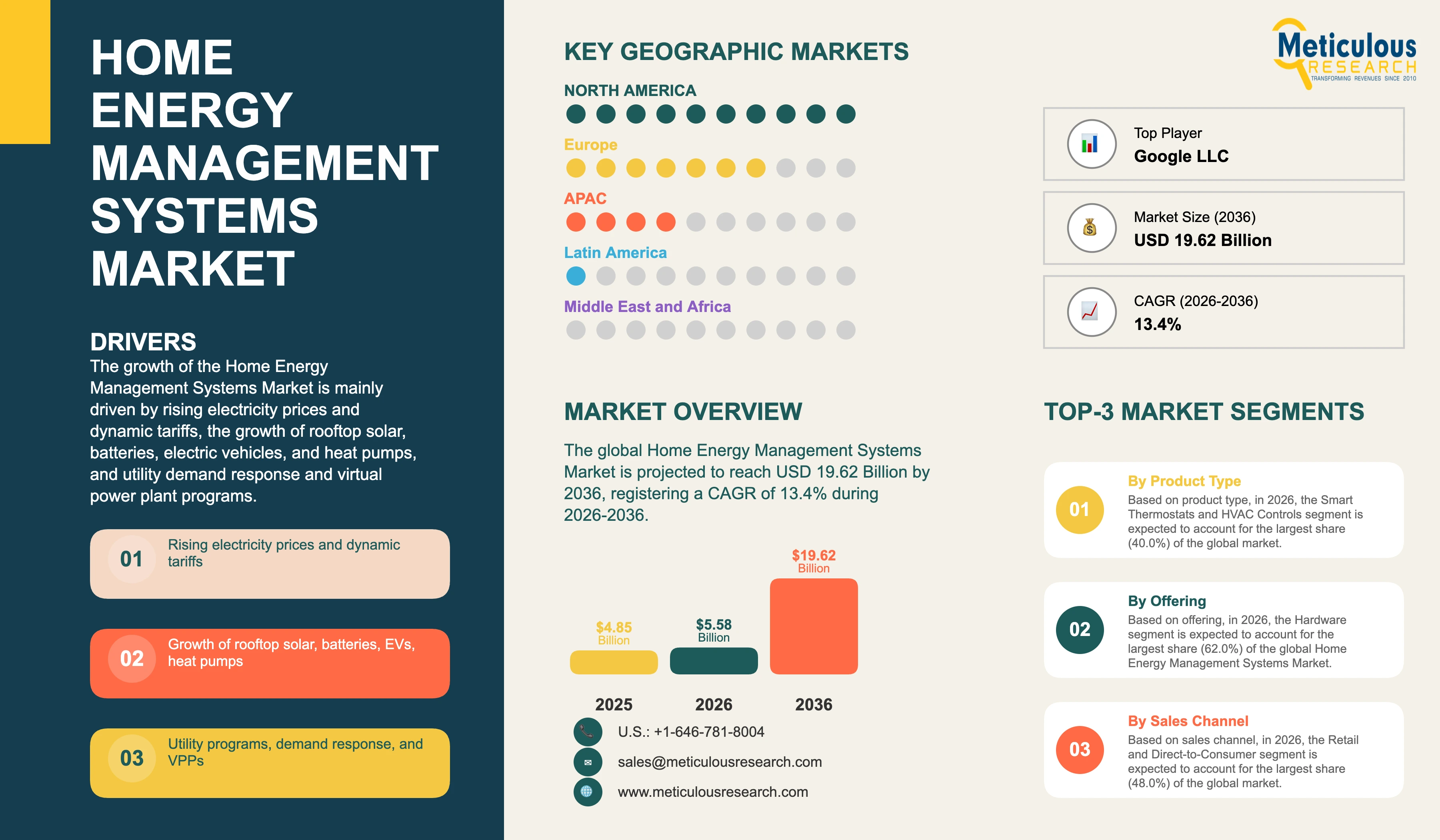
The global home energy management systems (HEMS) market was valued at USD 4.85 billion in 2025. This market is expected to reach USD 19.62 billion by 2036 from an estimated USD 5.58 billion in 2026, registering a CAGR of 13.4% during the forecast period (2026-2036).
- Published
- Nov 2026
- Pages
- 291
- Format
- PDF + Excel
- Report ID
- MREP - 1042537
- Base year
- 2025
- 2025 · BASELINE
- $4.85B
- 2036
- $19.62B
- CAGR 2026–2036
- 13.4%
2025 baseline · 2026–2036 forecast at 13.4% CAGR · hover a bar for the value
Key highlights
The International Energy Agency's Global EV Outlook 2025 reported that more than 17 million electric cars were sold worldwide in 2024, and many of these vehicles are charged at home, which increases demand for systems that schedule charging around tariffs, solar output, and the capacity of household electrical panels.
The EU's recast Energy Performance of Buildings Directive, which entered into force in May 2024, requires all new buildings to be zero-emission from 2030, promotes rooftop solar and building automation, and supports the use of a smart readiness indicator to assess the ability of buildings to manage energy, which supports demand for home energy management.
The Connectivity Standards Alliance released Matter 1.4 in November 2024, adding support for solar inverters, home batteries, heat pumps, water heaters, and electric vehicle chargers, which allows energy devices from different manufacturers to work together and be controlled by a single home energy management app or hub.
In the U.S., the federal tax credits for residential clean energy and energy-efficient home improvements under sections 25D and 25C were ended for expenditures after 31 December 2025, which is expected to slow some residential solar and battery installations in 2026, although state rebates, utility incentives, and virtual power plant payments continue to support demand.
Utilities in the U.S., Europe, and Australia are rapidly expanding bring-your-own-device programs that pay households to let smart thermostats, batteries, and electric vehicles respond to grid needs, and many of these programs are delivered through home energy management platforms.
Australia's Cheaper Home Batteries Program, which began in July 2025 and offers a discount of around 30% on eligible home batteries, has led to a rapid increase in battery installations, most of which are sold with energy management software that can also participate in virtual power plants.
Energy retailers in the U.K., Germany, and the Nordic countries have built large customer bases on smart tariffs that automatically schedule electric vehicle charging, heat pumps, and home batteries, showing how home energy management and dynamic tariffs can work together to cut bills.
By product type, smart thermostats and HVAC controls account for the largest share of 40.0% in 2026, while smart electrical panels and circuit controllers register the highest CAGR.
By offering, hardware accounts for the largest share in 2026, while software and platforms register the highest CAGR.
By sales channel, retail and direct-to-consumer sales account for the largest share in 2026, while utility programs register the highest CAGR.
By geography, North America accounts for the largest share of 44.0% in 2026, while Asia-Pacific registers the highest CAGR of 16.1%.
Report summary
| Particulars | Details |
|---|---|
| Forecast Period | 2026-2036 |
| Base Year | 2025 |
| Estimated Year | 2026 |
| CAGR (Value) | 13.4% |
| Format | PDF, Excel & Cloud Portal · 291 pages |
| Market Size (Value) in 2025 | USD 4.85 billion |
| Market Size (Value) in 2026 | USD 5.58 billion |
| Market Size (Value) in 2036 | USD 19.62 billion |
| Segments Covered | Product Type, Offering, Installation Type, Sales Channel, and Geography |
| Countries Covered | North America, Europe, Asia-Pacific, Latin America, and Middle East and Africa |
| Key Companies | Google, Resideo, Generac (ecobee), Schneider Electric, Siemens, Span, Tesla, Enphase Energy, SolarEdge, Sense, tado, Bosch, Samsung, Panasonic, and Eaton |
| Largest Segment by Product Type (2026) | Smart Thermostats and HVAC Controls (40.0%) |
| Largest Region (2026) | North America (44.0%) |
| Fastest-Growing Region | Asia-Pacific (CAGR 16.1%) |
Report overview
Segments covered: product type, offering, installation type, sales channel.
The growth of this market is mainly driven by rising and more volatile household electricity prices, the rapid adoption of rooftop solar, home batteries, electric vehicles, and heat pumps that need to be coordinated to save money and avoid overloading home electrical systems, the spread of smart meters and time-of-use and dynamic tariffs, utility demand response and virtual power plant programs that pay households for flexibility, building energy regulations such as the EU's recast Energy Performance of Buildings Directive, and the growth of interoperability standards such as Matter that make it easier to connect devices from different brands. However, factors such as the high upfront cost of advanced systems, the complexity of installation and setup, fragmented device ecosystems, the expiry of some household clean energy tax credits in the U.S., and concerns about data privacy and cybersecurity are expected to restrain the growth of this market to some extent.
Home energy management systems (HEMS) are combinations of devices, software, and services that allow households to monitor, control, and optimize their energy use. They include smart thermostats and heating, ventilation, and air conditioning controls, smart plugs, switches, and load controllers, energy monitors and in-home displays, smart electrical panels and circuit-level controllers, and integrated systems that coordinate rooftop solar, home batteries, electric vehicle chargers, and heat pumps. HEMS use data from devices and smart meters, together with weather forecasts and electricity tariffs, to decide when to run appliances, charge batteries and vehicles, and heat or cool the home, with the goal of reducing bills, increasing self-consumption of solar power, and responding to signals from utilities.
This market covers the global sales of home energy management hardware, software and platforms, and related services, measured in value. It is segmented by product type, offering, installation type, sales channel, and geography. Solar panels, inverters, batteries, electric vehicle chargers, and heat pumps themselves are not included, except for the energy management controllers, gateways, and software sold with them, nor are general smart home devices, such as cameras and voice assistants, that do not manage energy, or utility-owned smart meters.
Households are facing major changes in how they use and pay for energy. Electricity prices have risen in many countries in recent years, and in Europe the energy crisis of 2022 and 2023 showed households how exposed they are to volatile prices. At the same time, homes are becoming small power systems, with rooftop solar, batteries, electric vehicles, and heat pumps that together can draw or supply large amounts of power. Without coordination, these devices can increase bills, overload household electrical panels, and add to peaks on the grid. Home energy management systems coordinate these devices so that they run at the best times, which saves money for households and helps utilities manage demand.
Smart meters and time-varying tariffs are making home energy management more valuable. Most U.S. electricity customers now have smart meters, according to the U.S. Energy Information Administration, and smart meters are widely deployed in many European countries, China, Japan, and Australia. Utilities and retailers increasingly offer time-of-use, critical peak, and dynamic tariffs that reward customers for shifting consumption to cheaper periods. Home energy management systems automate this shifting, for example by pre-cooling a home before a price peak or charging an electric vehicle overnight, so that households can benefit without changing their routines.
Utilities are also using home energy management systems as part of demand response and virtual power plant programs. Through bring-your-own-device programs, households receive payments or bill credits for allowing their smart thermostats, batteries, or electric vehicles to reduce or shift consumption when the grid is stressed. These programs have grown rapidly in the U.S., Australia, and the U.K., and they create a new channel for selling home energy management devices and software.
The market includes a wide range of companies from several industries that approach the home from different starting points. Smart thermostat and HVAC control leaders include Google through Nest, Resideo with its Honeywell Home brand, Generac through ecobee, and tado in Europe. Solar, battery, and inverter companies, such as Tesla, Enphase Energy, and SolarEdge, offer home energy management software and controllers that coordinate their products with electric vehicle chargers and heat pumps. Electrical equipment companies, such as Schneider Electric, Siemens, and Eaton, offer smart panels, load controllers, and home energy management platforms, while Span offers smart electrical panels. Consumer electronics and appliance companies, such as Samsung, Panasonic, and Bosch, include energy management in their smart home ecosystems, and Sense offers home energy monitors.
Over the forecast period, the home energy management systems market is expected to grow strongly, supported by electrification, distributed solar and storage, dynamic tariffs, utility programs, and interoperability standards. North America is expected to remain the largest market, while Asia-Pacific is expected to grow fastest as smart home adoption, rooftop solar, and electric vehicles spread in China, Japan, Australia, South Korea, and India.
Smart thermostats are still the backbone of our residential program. Customers enroll in minutes, and we get reliable peak reduction on the hottest afternoons.
This explains why smart thermostats and HVAC controls account for 40.0% of the market and why utility programs form the fastest-growing sales channel for home energy management devices.
With batteries now subsidized, almost every solar job includes a battery and an energy management system. Customers want one simple app that runs everything, including the car charger.
This explains why Asia-Pacific is the fastest-growing region and why integrated ecosystems are becoming a key competitive factor.
Our dynamic tariff customers want their heat pump and car to run when power is cheap. Home energy management is what makes the tariff work for them.
This explains why software and platforms are the fastest-growing offering and why Europe holds a large share of the market, as retailers use home energy management to make dynamic tariffs simple and attractive for households.
Report infographic
Market dynamics
16 factors across 5 forcesRising electricity prices and dynamic tariffs
Household electricity prices have increased in many countries over the past several years, driven by fuel costs, investment in grids, and policy costs, and prices have become more volatile. In Europe, the energy crisis led to sharp price increases and encouraged millions of households to look for ways to reduce consumption. In the U.S., average residential electricity prices have risen steadily, and rapid load growth from data centers and electrification is expected to put further pressure on prices in some regions.
At the same time, utilities and energy retailers are introducing time-of-use, critical peak, and dynamic tariffs that charge different prices at different times of day. EU rules require larger electricity suppliers to offer dynamic price contracts to customers with smart meters, and retailers in the U.K., the Nordic countries, Germany, and Australia offer tariffs linked to wholesale prices. Home energy management systems allow households to benefit from these tariffs automatically by shifting consumption to cheaper periods, which is a key reason for their adoption. Smart thermostats and HVAC controls account for the largest share of the market by product type, reflecting the large share of household energy used for heating and cooling.
Growth of rooftop solar, home batteries, electric vehicles, and heat pumps
The rapid adoption of distributed energy resources in homes is a major driver of home energy management. Rooftop solar is installed on millions of homes in Australia, Germany, the U.S., the Netherlands, Japan, and other countries, and home batteries are increasingly installed alongside solar to store excess generation and provide backup power. The International Energy Agency reported that more than 17 million electric cars were sold worldwide in 2024, and most electric vehicle owners charge at home. Heat pumps are replacing gas and oil boilers in many European countries and are growing in North America and Asia.
These devices create both opportunities and challenges for households that want to lower bills without compromising comfort. Coordinating solar, batteries, electric vehicles, and heat pumps can greatly reduce bills by maximizing self-consumption of solar power and avoiding expensive peak periods, but running them all at once can exceed the capacity of household electrical panels and require costly upgrades. Integrated home energy management systems and smart panels solve these problems by managing loads intelligently. Integrated solar, battery, and electric vehicle energy management systems are among the fastest-growing product types, while smart electrical panels and circuit controllers form the fastest-growing product type in this market.
Utility programs, demand response, and virtual power plants
Utilities and grid operators are increasingly using household devices to manage peak demand and support the grid, as electricity demand rises and the share of variable renewables grows. Bring-your-own-device programs pay households for allowing smart thermostats, batteries, water heaters, and electric vehicles to respond to grid events, and many utilities offer rebates for smart thermostats and other devices. In the U.S., utilities in California, Texas, Colorado, the Northeast, and other states run large residential demand response and virtual power plant programs, and similar programs are growing in Australia, the U.K., and Japan.
These programs reduce the cost of devices for households, provide ongoing payments, and create a large sales channel for home energy management providers, which often partner with utilities to enroll customers and dispatch devices. Utility programs form the fastest-growing sales channel in this market.
Building regulations and interoperability standards
Building regulations are increasingly requiring or encouraging smart energy management in homes. The EU's recast Energy Performance of Buildings Directive requires all new buildings to be zero-emission from 2030, promotes solar installations and building automation, and supports a smart readiness indicator that rates buildings on their ability to manage energy. Building codes in California and other U.S. states require solar on new homes and are moving toward all-electric construction, while some codes require electric vehicle charger readiness and energy management capability.
Interoperability standards are also removing one of the main barriers that has slowed home energy management adoption. The Matter smart home standard, supported by Apple, Google, Amazon, Samsung, and many device makers, added energy management device types in version 1.4 in November 2024, allowing solar inverters, batteries, heat pumps, water heaters, and electric vehicle chargers from different brands to work with the same controllers and apps. Standards such as OpenADR and IEEE 2030.5 also allow devices to communicate with utility programs.
Table of contents
12 chapters · 117 sections · 291 pages · click to expandSegmental analysis
| Segment | Largest share (2026) | Fastest growth (2026–2036) |
|---|---|---|
| By Product Type | Smart thermostats and HVAC controls | Smart electrical panels and circuit controllers |
| By Offering | Hardware | Software and platforms |
| By Installation Type | Retrofit homes | — |
| By Sales Channel | Retail and direct-to-consumer | Utility programs |
By Product Type
- The smart thermostats and HVAC controls segment is expected to account for the largest share of 40.0% of the market.
- The large share of this segment is mainly due to the large share of household energy used for heating and cooling, the wide availability and familiarity of smart thermostats, utility rebates and demand response programs that support their adoption, and their compatibility with most existing HVAC systems.
- Smart thermostats learn household schedules, adjust temperatures automatically, respond to time-of-use prices and utility events, and provide energy reports, and many can be installed by homeowners in less than an hour.
- Google Nest, Resideo's Honeywell Home, ecobee, and tado are leading brands, and smart thermostats are widely sold through retailers, utilities, and HVAC installers.
- In North America, smart thermostats are one of the most common devices enrolled in utility demand response programs, while in Europe smart thermostats and radiator controls are widely used to manage gas and heat pump heating.
- The segment is evolving with the growth of heat pumps, since smart controls can improve heat pump efficiency and coordinate heating with solar generation and dynamic tariffs.
- Smart thermostats and HVAC controls are expected to remain the largest product type over the forecast period, although their share is expected to decline as integrated solar, battery, and electric vehicle systems and smart panels grow faster.
- Replacement cycles, new heat pump installations, and utility programs are expected to support steady demand.
- Integrated solar, battery, and electric vehicle energy management systems are the second-largest product type and are growing rapidly as solar and battery installations increase and as inverter and battery companies offer energy management software that coordinates multiple devices.
- Smart plugs, switches, and load controllers allow households to control individual appliances and water heaters, while energy monitors and in-home displays show real-time consumption and help households identify savings.
- Smart electrical panels replace or supplement traditional circuit breaker panels and allow circuit-level monitoring and control, which is particularly valuable for homes adding electric vehicles and heat pumps.
- Product innovation is accelerating across all product types, with new devices adding support for Matter, utility program integration, and AI-based optimization, which shortens replacement cycles and supports growth.
- Smart plugs, switches, and load controllers are a low-cost entry point for many households, while energy monitors are often used by households that want detailed insight into appliance use before investing in larger upgrades.
- Water heater controllers are an important category in utility programs, since water heaters can store energy as hot water and shift consumption without affecting comfort.
- The variety of products allows households to start with simple devices and add more advanced systems over time, which supports repeat purchases and long-term customer relationships.
- However, the smart electrical panels and circuit controllers segment is projected to register the highest CAGR during the forecast period.
- The rapid growth of this segment is driven by electrification and the need to avoid costly electrical service upgrades.
- Integrated solar, battery, and electric vehicle energy management systems, smart plugs, switches, and load controllers, energy monitors and in-home displays, and other products make up the rest of the market.
By Offering
- The hardware segment is expected to account for the largest share of the market, due to sales of thermostats, panels, controllers, monitors, gateways, and other connected devices.
- However, the software and platforms segment is projected to register the highest CAGR during the forecast period, driven by subscriptions, virtual power plant participation, and energy optimization services.
- Services, including installation, commissioning, energy advice, and support, make up the rest of the market.
- Hardware sales are driven by new device purchases and replacements, while software and platforms generate recurring revenue from subscriptions, energy services, and revenue sharing from grid programs.
- Many providers offer basic features for free and charge for advanced optimization, solar and battery management, or premium support.
- Services include professional installation, commissioning, energy audits, and ongoing support, which are especially important for integrated systems and smart panels.
- As a result, providers are increasingly bundling hardware with software subscriptions and services, and some offer hardware at low cost in exchange for long-term service contracts or a share of grid program revenues.
By Installation Type
- The retrofit homes segment is expected to account for the largest share of the market, due to the large stock of existing homes that are adding smart devices, solar, batteries, and electric vehicles.
- However, the new homes segment is projected to register the higher CAGR during the forecast period, driven by building codes and builders offering all-electric, solar-ready homes with integrated energy management, smart panels, and electric vehicle charging as standard features.
- Retrofit adoption is supported by utility rebates, heat pump and solar installations, and electric vehicle purchases, while new home adoption is supported by builders that market energy-efficient, solar-equipped homes with smart controls as standard features.
- In Europe, the Energy Performance of Buildings Directive is expected to increase the adoption of energy management in both new and renovated homes.
- Retrofit installations are also driven by the replacement of older thermostats and HVAC systems, which provides a steady base of demand across all regions.
By Sales Channel
- The retail and direct-to-consumer segment is expected to account for the largest share of the market, due to sales of smart thermostats, plugs, and monitors through online and physical retailers.
- Installers and home builders account for a large share of integrated systems and smart panels.
- However, the utility programs segment is projected to register the highest CAGR during the forecast period, driven by bring-your-own-device and virtual power plant programs.
- Utility programs reduce the cost of devices for households through rebates and provide ongoing incentives through demand response and virtual power plant payments, which makes them an increasingly important sales channel, particularly for smart thermostats, batteries, and electric vehicle chargers.
- Installers and builders are important for integrated systems and smart panels, which require professional installation by licensed electricians and are often sold as part of solar, battery, or renovation projects.
- Online retailers, home improvement stores, and electronics chains remain the main channel for smart thermostats, plugs, and monitors, while solar installers and electricians sell most integrated systems and smart panels.
Geographic analysis
North America
Largest shareIn 2026, North America is expected to account for the largest share of 44.0% of the global home energy management systems market. The large share of this region is mainly due to high adoption of smart thermostats, large homes with high heating and cooling loads, widespread smart meters, extensive utility rebate and demand response programs, and growing adoption of rooftop solar, batteries, and electric vehicles. The U.S. is the largest market in the world for home energy management, with leading companies such as Google Nest, Resideo, ecobee, Tesla, Enphase, Span, and Sense, and large utility programs in California, Texas, and other states. California's time-of-use tariffs and net billing rules have increased the value of batteries and energy management for solar homes, and utilities in Texas and the Northeast are expanding virtual power plant programs. Canada is also a significant market, with utility programs and smart thermostat rebates in Ontario, Quebec, and other provinces. North America is expected to remain the largest region throughout the forecast period, although the end of federal tax credits may slow growth in some segments in the near term, particularly solar and battery-related systems.
Asia-Pacific
Fastest growthAsia-Pacific is projected to register the highest CAGR of 16.1% during the forecast period. Growth is driven by the rapid adoption of rooftop solar and home batteries in Australia, smart home and electric vehicle growth in China, Japan's home energy management policies, and rising adoption in South Korea and India. Australia has one of the highest rates of rooftop solar in the world and a federal Cheaper Home Batteries Program that began in July 2025, which has increased battery installations and demand for energy management. Japan has promoted home energy management systems through housing policies and its ECHONET Lite standard, and China has large smart home and electric vehicle markets. South Korea's smart grid programs and India's smart meter rollout and rooftop solar program are also expected to support growth across the region over the forecast period.
Europe
Europe holds a large share, supported by high energy prices, dynamic tariffs, heat pump and solar adoption, and the Energy Performance of Buildings Directive, with Germany, the U.K., the Netherlands, Italy, and the Nordic countries among the largest markets.
Latin America
Latin America and the Middle East and Africa are smaller markets, with growing interest in solar and energy management in Brazil, Mexico, and the Gulf countries.
Competitive landscape
The home energy management systems market is fragmented, with smart thermostat leaders, solar and battery companies, electrical equipment manufacturers, consumer electronics companies, and specialist start-ups. Leading companies include Google, Resideo, Generac (ecobee), Schneider Electric, Siemens, Span, Tesla, Enphase Energy, SolarEdge, Sense, tado, Bosch, Samsung, Panasonic, and Eaton.
Companies compete on device ecosystems, ease of use, interoperability, integration with solar, storage, and electric vehicles, utility partnerships, software features, and price.
Google, through Nest, and Resideo, through Honeywell Home, lead the smart thermostat segment, while ecobee, owned by Generac, combines thermostats with Generac's home standby generators, batteries, and grid services. Tesla, Enphase, and SolarEdge offer energy management software that coordinates their solar, battery, and electric vehicle charging products, and they participate in virtual power plant programs. Schneider Electric, Siemens, and Eaton offer smart panels, load controllers, and home energy platforms, while Span is a leading smart panel company. Samsung, Panasonic, and Bosch integrate energy management into their smart home and appliance ecosystems, tado offers smart heating controls and energy services in Europe, and Sense offers energy monitors that use machine learning to identify appliance use.
Partnerships between device makers, utilities, retailers, and platform providers are increasingly important, since no single company controls all the devices in a home or all the relationships with grid programs.
The top five players are estimated to account for 34.0% of the home energy management systems market in 2025.
Players use several strategies to grow in this market, including partnerships with utilities and energy retailers, integration of solar, storage, and electric vehicle products, adoption of Matter and other standards, and expansion into software and virtual power plant services. For example, solar and battery companies have launched integrated home energy management apps and electric vehicle chargers, smart thermostat makers have expanded utility partnerships, and electrical equipment companies have launched smart panels for electrification.
Competition is expected to center on integrated ecosystems, software capabilities, and utility partnerships. Providers that can coordinate all major household energy devices, integrate with utility programs and tariffs, and deliver clear savings with minimal effort are expected to gain share, while consolidation is likely as larger companies acquire specialists.
Some of the key players operating in the home energy management systems market are Google LLC, Resideo Technologies, Inc., Generac Holdings Inc. (ecobee), Schneider Electric SE, Siemens AG, Span.IO, Inc., Tesla, Inc., Enphase Energy, Inc., SolarEdge Technologies, Inc., Sense Labs, Inc., tado GmbH, Robert Bosch GmbH, Samsung Electronics Co., Ltd., Panasonic Holdings Corporation, and Eaton Corporation plc.
- —
Matter 1.4 added energy device types, Australia launched its Cheaper Home Batteries Program in 2025, and utilities expanded virtual power plant programs using smart thermostats, batteries, and electric vehicles.
- Resideo
- Generac (ecobee)
- Schneider Electric
- Siemens
- Span
- Tesla
- Enphase Energy
- SolarEdge
- Sense
- Bosch
- Samsung
- Panasonic
- Eaton
Expert perspectives
Home energy management is moving from a niche smart home feature to an essential part of electrified homes. As households add solar, batteries, electric vehicles, and heat pumps, they need systems that coordinate these devices to save money, avoid electrical upgrades, and respond to grid needs. At the same time, utilities and retailers increasingly see household devices as a source of flexibility, which creates new revenue streams for households and providers.
The home energy management market is also shifting gradually from hardware-led value toward software-led value. Devices remain essential, but the ability to optimize energy use across devices, tariffs, and grid programs is where providers can differentiate and earn recurring revenue. Utility and retailer partnerships are becoming critical, since they provide both customers and revenue streams through programs and tariffs.
Over the forecast period, the market is expected to grow at about 13.4% per year, supported by electrification, distributed energy resources, dynamic tariffs, utility programs, and interoperability standards. Growth is expected to be strongest in smart electrical panels, integrated solar, battery, and electric vehicle systems, and software platforms, while smart thermostats remain the largest product type.
Hardware will remain the largest offering, but software and platforms are expected to account for a growing share of value as providers monetize optimization and grid services. Utility programs are expected to become an increasingly important sales channel, and new homes are expected to adopt integrated energy management as building codes evolve.
North America remains the largest region, while Asia-Pacific is the fastest-growing region at a CAGR of 16.1%. Europe is expected to grow strongly as dynamic tariffs, heat pumps, and building regulations spread. The main swing factors are electricity prices and tariff design, incentives for solar, batteries, and heat pumps, the pace of electric vehicle adoption, and the adoption of interoperability standards.
For providers, the key priorities are to build integrated, easy-to-use ecosystems, partner with utilities and energy retailers, adopt open standards, and develop software and services that deliver recurring value. Overall, home energy management systems are expected to become a standard part of new and renovated homes over the forecast period, in the same way that smart meters have become standard for utilities.
For utilities and retailers, home energy management systems offer a scalable source of flexibility and a way to deepen customer relationships, and partnerships with device and platform providers are expected to expand.
Policymakers can support adoption by encouraging time-varying tariffs, interoperability standards, and fair compensation for household flexibility, and by including energy management in building codes and renovation programs.
Customer perspectives
Homeowner - solar and battery household, California, U.S.
Since we switched to time-of-use rates, the system decides on its own when to charge the car and the battery. Our bill dropped noticeably, and we also earn credits whenever the utility calls an event.
This explains why integrated solar, battery, and electric vehicle systems are growing quickly and why North America accounts for 44.0% of the market, supported by time-of-use rates and virtual power plant payments.
Frequently asked questions
The market was valued at USD 4.85 billion in 2025 and USD 4.20 billion in 2024, and is estimated at USD 5.58 billion in 2026.
The market is expected to reach USD 19.62 billion by 2036, supported by electrification, rooftop solar and batteries, dynamic tariffs, utility programs, and interoperability standards.
The market is expected to register a CAGR of 13.4% from 2026 to 2036, with smart panels, integrated systems, and software growing faster than the overall market.
They are devices, software, and services that allow households to monitor and control energy use, including smart thermostats, smart plugs and load controllers, energy monitors, smart electrical panels, and systems that coordinate solar, batteries, electric vehicle chargers, and heat pumps.
Growth is driven by rising electricity prices and dynamic tariffs, the growth of rooftop solar, home batteries, electric vehicles, and heat pumps, utility programs and virtual power plants, and building regulations and interoperability standards.
High upfront costs and uncertain payback and complexity, fragmentation, and installation challenges restrain growth, while data privacy and cybersecurity and customer engagement remain key challenges.
Key opportunities include smart electrical panels and load management for electrification, software platforms and energy services, vehicle-to-home and vehicle-to-grid, and emerging markets in Asia-Pacific.
Smart thermostats and HVAC controls are expected to account for the largest share of 40.0% of the market in 2026, while smart electrical panels and circuit controllers are projected to register the highest CAGR.
Hardware, including thermostats, panels, controllers, and monitors, accounts for the largest share in 2026, while software and platforms are projected to register the highest CAGR, driven by subscriptions and virtual power plant services.
Retail and direct-to-consumer sales account for the largest share in 2026, while utility programs are projected to register the highest CAGR, driven by bring-your-own-device and virtual power plant programs.
North America is expected to account for the largest share of 44.0% of the market in 2026, supported by high smart thermostat adoption and utility programs.
Asia-Pacific is projected to register the highest CAGR of 16.1% during the forecast period.
Matter 1.4, released in November 2024, added energy management device types for solar inverters, batteries, heat pumps, water heaters, and electric vehicle chargers, allowing devices from different brands to work together under one controller or app.
Retrofit homes account for the largest share of the market in 2026, while new homes are projected to register the higher CAGR, driven by building codes and builders offering all-electric, solar-ready homes with integrated energy management.
The end of the residential clean energy and energy-efficient home improvement tax credits for expenditures after 2025 is expected to slow some solar, battery, and heat pump installations in the near term, while utility programs and state incentives continue to support demand.
The report profiles 15 companies, including Google, Resideo, Generac (ecobee), Schneider Electric, and Tesla. The top five players account for an estimated 34.0% of the market in 2025.
Matter 1.4 added energy device types, Australia launched its Cheaper Home Batteries Program in 2025, and utilities expanded virtual power plant programs using smart thermostats, batteries, and electric vehicles.
Cite this report
Meticulous Research. (2026). Home Energy Management Systems Market - Global Opportunity Analysis and Industry Forecast (2026-2036) (Report No. MREP - 1042537). Meticulous Market Research Pvt. Ltd. https://www.meticulousresearch.com/product/home-energy-management-systems-market-7220