High-Voltage Automotive Connectors Market (2026-2036)
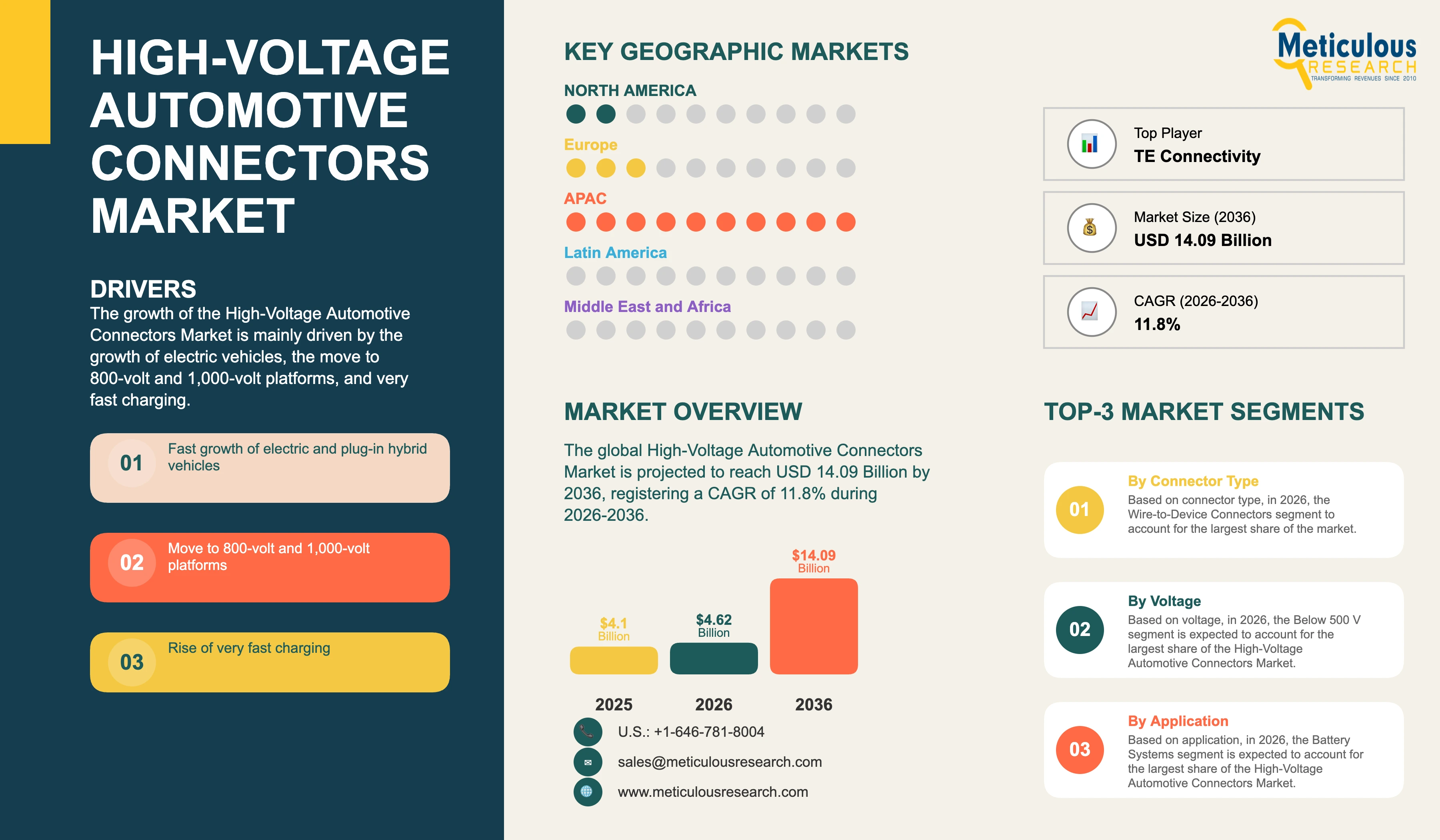
The global high-voltage automotive connectors market was valued at USD 4.10 billion in 2025. This market is expected to reach USD 14.09 billion by 2036 from an estimated USD 4.62 billion in 2026, registering a CAGR of 11.8% during the forecast period (2026-2036).
- Published
- Nov 2026
- Pages
- 258
- Format
- PDF + Excel
- Report ID
- MRAUTO - 1042858
- Base year
- 2025
- 2025 · BASELINE
- $4.10B
- 2036
- $14.09B
- CAGR 2026–2036
- 11.8%
2025 baseline · 2026–2036 forecast at 11.8% CAGR · hover a bar for the value
Key highlights
BYD launched its Super e-Platform on March 17, 2025, the first mass-produced passenger car platform with a full 1,000-volt high-voltage architecture covering the battery, motor, power supply, and air conditioning, according to BYD. The platform supports charging at up to 1,000 kW with a current of 1,000 amps and first went on sale in the Han L and Tang L.
Most electric vehicles still use 400-volt systems, and only a few models, mainly premium vehicles, use 800-volt architectures, according to S&P Global Mobility. The move to 800-volt and 1,000-volt platforms by Hyundai, Kia, Porsche, BYD, Xpeng, Li Auto, Zeekr, and other vehicle makers is raising the value and technical requirements of high-voltage connectors.
Global electric car sales grew by 20% to more than 20 million units in 2025, accounting for one in four new cars sold, according to the IEA. Electric trucks also reached 9% of all truck sales worldwide in 2025, according to the IEA, which is creating demand for larger high-voltage connectors that carry higher currents.
TE Connectivity, one of the largest suppliers of automotive connectors, reported record net sales of USD 17.3 billion in fiscal 2025, and its Transportation segment delivered content growth from the electrified powertrain despite a challenging vehicle market, according to TE Connectivity.
Chinese connector makers, such as AVIC Jonhon, Luxshare, Suzhou Recodeal, and Sichuan Yonggui, have gained a large share of the high-voltage connector market in China by supplying Chinese electric vehicle makers, and they are now expanding abroad as Chinese vehicle makers build plants in Europe, Southeast Asia, and Latin America.
Leading suppliers include TE Connectivity, Amphenol, Aptiv, Yazaki, Sumitomo Electric, Rosenberger, JAE, KOSTAL, Phoenix Contact, and HUBER+SUHNER, together with Chinese suppliers. Many of these companies also make high-voltage cables and harnesses, which allows them to offer complete high-voltage connection systems. Several of these suppliers have opened new plants in Mexico, Eastern Europe, and Southeast Asia to serve electric vehicle programs close to vehicle plants and to reduce tariff and shipping risks.
By connector type, wire-to-device connectors account for the largest share of 52.0% in 2026, while busbar and board-level connectors register the highest CAGR.
By voltage, below 500 v accounts for the largest share in 2026, while above 900 v registers the highest CAGR.
By application, battery systems account for the largest share in 2026, while charging systems register the highest CAGR.
By vehicle type, passenger cars account for the larger share of 84.0% in 2026, while commercial vehicles register the higher CAGR.
By geography, Asia-Pacific accounts for the largest share of 63.0% in 2026, while Europe registers the highest CAGR of 13.3%.
Report summary
| Particulars | Details |
|---|---|
| Base Year | 2025 |
| Estimated Year | 2026 |
| Forecast Period | 2026-2036 |
| Market Size in 2025 | USD 4.10 billion |
| Market Size in 2026 | USD 4.62 billion |
| Market Size by 2036 | USD 14.09 billion |
| CAGR (2026-2036) | 11.8% |
| Format | PDF, Excel & Cloud Portal · 258 pages |
| Largest Segment by Connector Type (2026) | Wire-to-Device Connectors (52.0%) |
| Largest Segment by Vehicle Type (2026) | Passenger Cars (84.0%) |
| Largest Region (2026) | Asia-Pacific (63.0%) |
| Fastest-Growing Region | Europe (CAGR 13.3%) |
| Companies Profiled | 14 companies and other companies |
| Segments Covered | Connector Type, Voltage, Application, Vehicle Type, Geography |
| Countries Covered | U.S., Canada, Germany, France, U.K., Italy, Spain, Sweden, Norway, Netherlands, Belgium, Czech Republic, Slovakia, Poland, Hungary, Rest of Europe, China, Japan, South Korea, India, Thailand, Indonesia, Malaysia, Vietnam, Taiwan, Australia, Rest of Asia-Pacific, Mexico, Brazil, Argentina, Chile, Colombia, Rest of Latin America, Turkey, Saudi Arabia, U.A.E., Israel, Morocco, South Africa, Rest of Middle East & Africa |
Report overview
Segments covered: connector type, voltage, application, vehicle type.
High-voltage automotive connectors are sealed, shielded, and touch-safe connectors that join high-voltage cables, busbars, and devices in electric and hybrid vehicles, such as the battery pack, inverter, motor, onboard charger, DC-DC converter, charging inlet, electric compressor, and electric heater. They are designed to carry currents of tens to hundreds of amps at voltages of up to 1,000 volts or more, while protecting people from electric shock and keeping out water, dust, and electrical noise.
The growth of this market is mainly driven by the fast growth of electric and plug-in hybrid vehicle production, the move from 400-volt to 800-volt and 1,000-volt vehicle platforms, the rise of very fast charging, which needs connectors that can carry higher currents, the electrification of trucks and buses, and the growing number of high-voltage devices in each vehicle, such as electric heat pumps and heaters. In addition, the shift to integrated electric drive units and busbar connections is creating demand for new types of connectors. However, strong price pressure from vehicle makers, high copper and silver prices, and the slower growth of electric vehicle sales in some regions are expected to restrain the growth of this market to some extent.
High-voltage automotive connectors are used to make safe and reliable electrical connections between high-voltage components in electric and hybrid vehicles. Unlike standard 12-volt connectors, they must carry high currents with low resistance and little heat, provide high insulation and creepage distances to prevent arcing, block electromagnetic noise with shielding, keep out water and dust under harsh conditions, and prevent people from touching live parts. Most high-voltage connectors also include a high-voltage interlock loop, a small signal circuit that tells the vehicle to switch off the high voltage before the connector is opened.
This report covers the global high-voltage automotive connectors market, including wire-to-device connectors, wire-to-wire connectors, busbar and board-level connectors, and service disconnects and interlock connectors used in passenger cars and commercial vehicles with high-voltage systems. The market is valued at the selling price of connectors sold to harness makers, component makers, and vehicle makers. Connectors used inside the vehicle's high-voltage system are included, as are vehicle-side charging inlets. The market is analyzed by connector type, voltage, application, vehicle type, and geography. Charging station plugs and cables, low-voltage connectors, and high-voltage cables sold without connectors are not included.
Each battery electric vehicle uses a large number of high-voltage connectors across its power system. A typical battery electric vehicle has connectors at the battery pack, the high-voltage junction box or power distribution unit, the inverter and motor, the onboard charger, the DC-DC converter, the charging inlet, the electric air conditioning compressor, and the electric heater or heat pump. Plug-in hybrid and range-extended vehicles use fewer and smaller connectors, while hybrid electric vehicles use only a few. The number and value of high-voltage connectors per vehicle depend on the voltage, power level, and layout of the vehicle's high-voltage system.
The operating voltage of vehicle high-voltage systems is rising across new electric platforms. Most electric vehicles use 400-volt systems, but more vehicle makers are moving to 800-volt systems, which allow faster charging and lower currents for the same power, and BYD has launched a 1,000-volt platform. Higher voltages need connectors with larger insulation distances and better materials, while very fast charging at 350 kW to 1,000 kW needs connectors and inlets that can carry 500 to 1,000 amps, sometimes with liquid cooling or temperature sensors. These changes are raising the technical requirements and the value of high-voltage connectors.
The market is served by global connector makers, such as TE Connectivity, Amphenol, Aptiv, Yazaki, Sumitomo Electric, Rosenberger, JAE, KOSTAL, Phoenix Contact, and HUBER+SUHNER, and by Chinese connector makers, such as AVIC Jonhon, Luxshare, Suzhou Recodeal, and Sichuan Yonggui. Global suppliers have strong positions with European, North American, Japanese, and Korean vehicle makers, while Chinese suppliers have gained a large share in China by offering competitive prices, fast development, and close support to Chinese electric vehicle makers.
High-voltage connector design is also changing as vehicle makers integrate more components into single units. Integrated electric drive units that combine the motor, inverter, and gearbox reduce the number of cable connections, while the use of busbars instead of cables inside battery packs and power distribution units is creating demand for busbar connectors and board-level connectors. At the same time, vehicle makers are trying to standardize connectors across platforms to cut cost, which favors suppliers with broad product families and global production.
In 2026, wire-to-device connectors account for the largest share of the market by connector type, while busbar and board-level connectors are the fastest-growing connector type. Connectors rated below 500 V account for the largest share by voltage, while connectors rated above 900 V are the fastest-growing voltage segment. Battery systems account for the largest share by application, while charging systems are the fastest-growing application. Passenger cars account for the larger share by vehicle type, while commercial vehicles are the faster-growing vehicle type. Asia-Pacific accounts for the largest share of the market, while Europe is the fastest-growing region.
Market growth over the forecast period will depend mainly on the pace of electric vehicle adoption, the speed of the move to 800-volt and higher platforms, the electrification of trucks and buses, and the rollout of very fast charging. Price competition, especially from Chinese suppliers, and the integration of components that reduce the number of connectors per vehicle will also shape the value of the market. Overall, the growth of electric vehicles and higher voltages is expected to drive strong growth.
Passenger cars are expected to account for the larger share of 84.0% of the market in 2026, while commercial vehicles are projected to register the higher CAGR, driven by the electrification of trucks and buses and megawatt charging.
Asia-Pacific is expected to account for the largest share of 63.0% of the market in 2026, mainly due to China's position as the largest electric vehicle producer, fast adoption of 800-volt and 1,000-volt platforms, and large Chinese connector makers.
Europe is projected to register the highest CAGR of 13.3% during the forecast period, driven by strong electric vehicle sales growth, EU emission rules, new 800-volt platforms, truck electrification, and new electric vehicle plants.
The report profiles 14 companies, including TE Connectivity, Amphenol, Aptiv, Yazaki, Sumitomo Electric, Rosenberger, JAE, KOSTAL, Phoenix Contact, HUBER+SUHNER, AVIC Jonhon, Luxshare, Suzhou Recodeal, and Sichuan Yonggui.
800-volt and higher platforms allow faster charging and lower currents, but they need connectors with larger insulation distances, better materials, and improved shielding, which raises connector value per vehicle.
Integration of the motor, inverter, and gearbox and of chargers and converters reduces cable connections, but it increases demand for busbar, board-level, and direct-mount connectors, shifting value between connector types.
Report infographic
Market dynamics
17 factors across 5 forcesFast growth of electric and plug-in hybrid vehicles
The main driver of this market is the growth of electric and plug-in hybrid vehicle production. Every battery electric vehicle needs many high-voltage connectors to link the battery, inverter, motor, charger, converter, charging inlet, and thermal systems, while plug-in hybrid and range-extended vehicles also need a significant number. High-voltage connectors are not needed in conventional combustion engine vehicles, so each new electric vehicle adds new demand.
Global electric car sales grew by 20% to more than 20 million units in 2025, accounting for one in four new cars sold worldwide, according to the IEA, and the IEA expects sales to keep rising in 2026. China accounts for most electric vehicle production, but sales are also growing in Europe and emerging markets. As electric vehicles take a larger share of new vehicle sales over the forecast period, demand for high-voltage connectors is expected to grow at a strong pace.
Move to 800-volt and 1,000-volt platforms
Vehicle makers are moving from 400-volt to 800-volt and higher electrical systems to allow faster charging, reduce cable weight, and improve efficiency. Porsche, Hyundai, Kia, and several Chinese vehicle makers, such as Xpeng, Li Auto, and Zeekr, have launched 800-volt vehicles, and BYD launched its 1,000-volt Super e-Platform in March 2025. Most electric vehicles still use 400-volt systems, according to S&P Global Mobility, which leaves a large opportunity as more platforms move to higher voltages.
Higher-voltage systems need connectors with larger insulation and creepage distances, better insulating materials, and improved sealing and shielding. These connectors are more complex and more valuable than 400-volt connectors. Connectors rated above 900 V are the fastest-growing voltage segment in this market, and connectors rated from 500 V to 900 V are also growing quickly, which raises the average value of connectors in each vehicle.
Rise of very fast charging
Vehicle makers and charging companies are rolling out faster charging to reduce charging times and make electric vehicles more convenient. Charging power of 350 kW is common in new fast chargers, and BYD's Super e-Platform supports charging at up to 1,000 kW with a current of 1,000 amps. Faster charging requires vehicle-side charging inlets and internal connectors that can carry much higher currents without overheating, which often requires larger contacts, better contact materials, temperature sensors, and in some cases liquid cooling.
These requirements increase the value of charging inlets and charging system connectors. Charging systems are the fastest-growing application in this market. The adoption of new charging standards, such as the North American Charging Standard in the U.S. and the Megawatt Charging System for trucks, is also creating demand for new inlet designs, as vehicle makers update their vehicles for new connectors and higher power.
Electrification of trucks and buses
Trucks and buses are being electrified, especially in China and Europe, driven by emission rules, low-emission zones, and falling battery costs. Electric trucks reached 9% of all truck sales worldwide in 2025, according to the IEA. Electric trucks and buses have very large battery packs and powerful motors, which need larger high-voltage connectors that carry higher currents. Megawatt charging for trucks requires connectors that can carry more than 1,000 amps.
Commercial vehicles also have longer cable runs and more demanding operating conditions, such as vibration, temperature changes, and exposure to water and dirt, which need durable connectors. As truck and bus electrification grows, demand for high-voltage connectors for commercial vehicles is expected to grow faster than demand for passenger car connectors. Commercial vehicles are the faster-growing vehicle type in this market.
More high-voltage devices in each vehicle
Electric vehicles are adding more high-voltage devices to improve comfort, efficiency, and range. Electric heat pumps, high-voltage heaters, electric compressors, battery heaters, and in some cases high-voltage power steering and active suspension use the high-voltage system. Vehicles with dual motors or three motors need more inverter and motor connections, and some vehicles have separate high-voltage distribution units in the front and rear. Each of these devices needs high-voltage connectors. Vehicle makers are also adding vehicle-to-load and vehicle-to-grid functions, which need additional high-voltage outlets and connectors. As vehicles become more complex, the number and value of high-voltage connectors per vehicle are expected to rise, partly offsetting the effect of component integration and helping the market grow faster than electric vehicle production.
Table of contents
12 chapters · 179 sections · 258 pages · click to expandSegmental analysis
| Segment | Largest share (2026) | Fastest growth (2026–2036) |
|---|---|---|
| By Connector Type | Wire-to-device connectors | Busbar and board-level connectors |
| By Voltage | Below 500 V | Above 900 V |
| By Application | Battery systems | Charging systems |
| By Vehicle Type | — | Rapid growth of this |
| Other segments | Below 500 v | Above 900 v |
By Connector Type
- High-Voltage Automotive Connectors Market Analysis by Connector Type
- The wire-to-device connectors segment is expected to account for the largest share of 52.0% of the global high-voltage automotive connectors market.
- The large share of this segment is mainly due to the large number of high-voltage devices in each electric vehicle that must be connected to cables, including the battery pack, inverter, motor, onboard charger, DC-DC converter, electric compressor, and electric heater, the high value of these connectors, which must provide sealing, shielding, and touch protection at the device interface, the inclusion of vehicle charging inlets in this segment, and the long use of cable-based high-voltage systems in most electric vehicle platforms.
- TE Connectivity, Amphenol, Aptiv, Rosenberger, and AVIC Jonhon are among the leading suppliers.
- However, the busbar and board-level connectors segment is projected to register the highest CAGR during the forecast period.
- The rapid growth of this segment is driven by the integration of high-voltage components into combined electric drive units and power electronics boxes, the use of busbars instead of cables inside battery packs and power distribution units, the need for compact connectors with high current density, and the move to 800-volt and 1,000-volt platforms that use more integrated designs.
- As more vehicle makers adopt integrated drive units and busbar-based battery packs, demand for these connectors is expected to grow quickly.
By Voltage
- High-Voltage Automotive Connectors Market Analysis by Voltage
- The below 500 V segment is expected to account for the largest share of the global high-voltage automotive connectors market.
- The large share of this segment is mainly due to the use of 400-volt electrical systems in most battery electric vehicles currently produced, the use of lower-voltage systems in nearly all plug-in hybrid, range-extended, and hybrid electric vehicles, the large number of lower-cost electric vehicles in China that use 400-volt systems, and the long production history and wide availability of connectors in this range.
- Most electric vehicles still use 400-volt systems, according to S&P Global Mobility, which supports the large share of this segment.
- However, the above 900 V segment is projected to register the highest CAGR during the forecast period.
- The rapid growth of this segment is driven by the launch of 1, 000-volt platforms, such as BYD's Super e-Platform, the need for higher system voltages to support charging at up to 1,000 kW, the use of connectors with higher voltage ratings in 800-volt systems to provide safety margins, and the electrification of trucks and buses, which often use higher-voltage systems.
- As more vehicle makers launch platforms above 800 volts, demand for connectors in this range is expected to grow very quickly from a small base.
By Application
- High-Voltage Automotive Connectors Market Analysis by Application
- The battery systems segment is expected to account for the largest share of the global high-voltage automotive connectors market.
- The large share of this segment is mainly due to the many high-voltage connections at the battery pack, including the main power output connectors, connections between battery modules, service disconnects, and connections to the high-voltage junction box, the high current and safety requirements of battery connectors, which increase their value, the large size of battery packs in electric vehicles, and the need for sealing and fire resistance at the battery interface.
- Battery systems also include high-voltage interlock and safety connectors that are required in every electric vehicle.
- However, the charging systems segment is projected to register the highest CAGR during the forecast period.
- The rapid growth of this segment is driven by the rollout of very fast charging at 350 kW to 1,000 kW, the need for high-current charging inlets and internal charging connectors that can carry 500 to 1,000 amps, the use of liquid cooling and temperature sensors in high-power inlets, the adoption of new charging standards, such as the North American Charging Standard and the Megawatt Charging System for trucks, and the addition of bidirectional charging for vehicle-to-load and vehicle-to-grid functions.
By Vehicle Type
- High-Voltage Automotive Connectors Market Analysis by Vehicle Type
- The passenger cars segment is expected to account for the larger share of 84.0% of the global high-voltage automotive connectors market.
- The large share of this segment is mainly due to the very large number of electric and plug-in hybrid passenger cars produced each year, with global electric car sales exceeding 20 million units in 2025 according to the IEA, the large number of high-voltage connectors in each electric car, the move to 800-volt and 1,000-volt platforms in new passenger cars, and the strong growth of electric passenger cars in China, Europe, and emerging markets.
- Passenger cars also adopt new connector technologies earlier than commercial vehicles.
- However, the commercial vehicles segment is projected to register the higher CAGR during the forecast period.
- The rapid growth of this segment is driven by the electrification of trucks and buses, with electric truck sales growing quickly in China and Europe according to the IEA, the larger and higher-value connectors needed for the large battery packs and powerful motors of electric trucks and buses, the need for megawatt charging connectors that can carry more than 1,000 amps, and emission rules and low-emission zones in China and Europe that are pushing fleet operators to adopt electric trucks and buses.
Other segments
- The below 500 v segment is expected to account for the largest share of the high-voltage automotive connectors market, while the above 900 v segment is projected to register the highest CAGR during the forecast period.
- The battery systems segment is expected to account for the largest share of the high-voltage automotive connectors market, while the charging systems segment is projected to register the highest CAGR during the forecast period.
Geographic analysis
Asia-Pacific
Largest shareIn 2026, Asia-Pacific is expected to account for the largest share of 63.0% of the global high-voltage automotive connectors market. The large share of this region is mainly due to China's position as the largest producer and market for electric vehicles, accounting for most global electric vehicle production, the fast adoption of 800-volt and 1,000-volt platforms by Chinese vehicle makers, such as BYD, Xpeng, Li Auto, and Zeekr, the presence of large Chinese connector makers, such as AVIC Jonhon, Luxshare, Suzhou Recodeal, and Sichuan Yonggui, and the strong presence of global suppliers, such as TE Connectivity, Amphenol, Aptiv, and Yazaki, in China. Japan and South Korea also have large electric vehicle and connector industries, led by Hyundai, Kia, and Toyota, as well as JAE, Yazaki, and Sumitomo Electric.
Europe
Fastest growthEurope is projected to register the highest CAGR of 13.3% during the forecast period. The rapid growth of this region is mainly driven by the strong growth of electric vehicle sales in Europe, which rose by more than 30% in 2025 to 4.2 million units according to the IEA, the European Union's carbon dioxide emission rules for new cars and vans, the launch of 800-volt platforms by European vehicle makers, the electrification of trucks and buses driven by EU emission rules for heavy vehicles, and the construction of new electric vehicle and battery plants by Chinese and European companies in Hungary, Spain, and other countries. Europe is also home to leading connector makers, such as Rosenberger, KOSTAL, Phoenix Contact, and HUBER+SUHNER.
North America
North America accounts for a significant share of the market, supported by electric vehicle production by Tesla, GM, Hyundai, and other vehicle makers, the adoption of the North American Charging Standard, which requires new vehicle inlets, and the presence of TE Connectivity, Amphenol, and Aptiv. However, the end of federal electric vehicle tax credits in 2025 has slowed electric vehicle growth in the U.S., which is expected to limit the growth of the region compared with Europe and Asia-Pacific. Mexico is an important production location for high-voltage connectors and harnesses serving North American vehicle plants.
Latin America
Latin America and the Middle East & Africa account for small shares of the market, but they are expected to grow as electric vehicle sales rise in Brazil, Mexico, Turkey, and the Gulf countries, and as Chinese vehicle makers, such as BYD, build plants in Brazil, Turkey, and other countries. Electric car sales in many countries across Latin America, Asia-Pacific, and the Middle East have now reached a sales share of more than 10%, according to the IEA. Local production of electric vehicles in these regions is expected to create new demand for high-voltage connectors over the forecast period. In the Gulf countries, new electric vehicle assembly projects and government fleet programs are expected to add demand, while South Africa and Morocco are building electric vehicle supply chains to serve export markets in Europe and Africa.
Competitive landscape
The global high-voltage automotive connectors market includes large global connector makers, harness makers that also make connectors, and Chinese connector makers. The market is moderately concentrated, with the top global suppliers holding a large share outside China, while Chinese suppliers hold a large share of the Chinese market. Suppliers compete for new vehicle platforms, which are awarded years before production starts, so engineering capability and relationships with vehicle makers are critical.
TE Connectivity is one of the largest suppliers of high-voltage connectors and reported record net sales of USD 17.3 billion in fiscal 2025. Amphenol and Aptiv are also major global suppliers, and Yazaki and Sumitomo Electric supply high-voltage connectors together with high-voltage harnesses. Rosenberger, KOSTAL, Phoenix Contact, HUBER+SUHNER, and JAE are important suppliers in Europe and Japan. AVIC Jonhon, Luxshare, Suzhou Recodeal, and Sichuan Yonggui are leading Chinese suppliers that have grown quickly with Chinese electric vehicle makers.
Companies in this market compete on product performance at high voltages and currents, safety and reliability, compact and lightweight design, price, engineering support for new platforms, global production close to vehicle plants, and the breadth of product families. Key strategies include developing connectors for 800-volt and 1,000-volt platforms, high-current charging inlets, busbar and board-level connectors, expanding production in China, Europe, Mexico, and Southeast Asia, and offering complete high-voltage connection systems with cables and harnesses.
Recent competitive activity in the high-voltage connector market has focused on higher voltages and charging power. BYD's launch of its 1,000-volt Super e-Platform in March 2025 has pushed suppliers to develop connectors for higher voltages and currents, while Chinese connector makers are expanding abroad with Chinese vehicle makers. Global suppliers continue to launch new 800-volt connector families and high-current charging inlets.
We expect competition to increase over the forecast period as Chinese suppliers expand outside China, as vehicle makers push for lower prices and standard parts, and as integration changes the types of connectors needed. Suppliers with strong engineering capabilities, broad product families, and low-cost global production are expected to strengthen their positions, while smaller suppliers may struggle to keep up with investment needs.
Some of the key players operating in the high-voltage automotive connectors market are TE Connectivity plc, Amphenol Corporation, Aptiv PLC, Yazaki Corporation, Sumitomo Electric Industries, Ltd., Rosenberger Hochfrequenztechnik GmbH & Co. KG, Japan Aviation Electronics Industry, Ltd. (JAE), KOSTAL Kontakt Systeme GmbH, Phoenix Contact E-Mobility GmbH, HUBER+SUHNER AG, AVIC Jonhon Optronic Technology Co., Ltd., Luxshare Precision Industry Co., Ltd., Suzhou Recodeal Interconnect System Co., Ltd., and Sichuan Yonggui Science and Technology Co., Ltd., among others.
- —
BYD launched its 1,000-volt Super e-Platform with charging at up to 1,000 kW in March 2025, TE Connectivity reported record sales with content growth from electrified powertrains in fiscal 2025, and Chinese connector makers are expanding abroad.
- KOSTAL
- Phoenix Contact
- HUBER+SUHNER
- JAE
Expert perspectives
High-voltage connectors are a small but critical part of every electric vehicle, and the market for them is growing quickly as electric vehicle production rises. The move to 800-volt and 1,000-volt platforms, very fast charging, and electric trucks and buses is raising the technical requirements and value of connectors, while Chinese suppliers and integration are changing the competitive landscape.
Over the forecast period, the market is expected to grow at a CAGR of 11.8%, from USD 4.62 billion in 2026 to USD 14.09 billion in 2036. Growth will be driven by the growth of electric and plug-in hybrid vehicles, the move to higher-voltage platforms, the rise of very fast charging, the electrification of trucks and buses, and the addition of more high-voltage devices in each vehicle.
Among the market segments, wire-to-device connectors are the largest connector type, while busbar and board-level connectors grow fastest. Connectors rated below 500 V are the largest voltage segment, while connectors rated above 900 V grow fastest. Battery systems are the largest application, while charging systems grow fastest. Passenger cars are the larger vehicle type, while commercial vehicles grow faster. Asia-Pacific is the largest region, while Europe is the fastest-growing region at a CAGR of 13.3%.
In our view, the speed of the move to 800-volt and 1,000-volt platforms will be a key factor shaping the value of this market. Higher-voltage connectors are more valuable than 400-volt connectors, and the faster vehicle makers move to higher voltages, the faster market value will grow. China is leading this move, and European vehicle makers are following, while North America is slower due to slower electric vehicle growth.
We also see strong price competition, especially from Chinese suppliers, as a key risk for global connector makers. Chinese suppliers have gained a large share in China and are expanding abroad. Global suppliers will need to cut costs through automation, design, and local production, while using their engineering skills and relationships with global vehicle makers to win new platforms. The integration of components will also shift demand from cable connectors to busbar and board-level connectors. Suppliers that offer both types, along with design support, will be better able to keep their content per vehicle as designs change over time.
Overall, we believe the high-voltage automotive connectors market will grow strongly over the forecast period, with busbar and board-level connectors, connectors rated above 900 V, charging systems, commercial vehicles, and Europe providing the fastest growth. Companies with strong high-voltage engineering skills, broad product families, competitive costs, and global production will be best positioned to capture this growth.
Customer perspectives
“Our new platform runs at close to 1,000 volts and charges at very high power. We need connectors and inlets that carry high current without overheating, and we need them at a good price.”
“We are moving our next electric platforms to 800 volts and integrating the inverter and motor. That means fewer cables but more busbar and direct-mount connectors.”
“Our electric trucks need much larger connectors than cars, and megawatt charging will push currents even higher. Reliability under vibration is critical for our customers.”
Frequently asked questions
The global high-voltage automotive connectors market was valued at USD 4.10 billion in 2025, up from USD 3.42 billion in 2024, and is estimated at USD 4.62 billion in 2026. The market includes connectors used in the high-voltage systems of electric and hybrid vehicles, including vehicle charging inlets.
The global high-voltage automotive connectors market is expected to reach USD 14.09 billion by 2036, driven by the growth of electric vehicles, the move to 800-volt and 1,000-volt platforms, very fast charging, and the electrification of trucks and buses.
The market is expected to register a CAGR of 11.8% from 2026 to 2036, with the fastest growth in busbar and board-level connectors, connectors rated above 900 V, charging systems, commercial vehicles, and Europe.
Market growth is mainly driven by the fast growth of electric and plug-in hybrid vehicles, the move to 800-volt and 1,000-volt platforms, the rise of very fast charging, the electrification of trucks and buses, and more high-voltage devices in each vehicle.
Price pressure from vehicle makers and Chinese suppliers and high raw material costs and slower electric vehicle growth in some regions restrain growth, while safety and thermal management at higher power and the lack of standardization are key challenges.
Key growth opportunities include liquid-cooled and high-current charging inlets, connectors for 800-volt and 1,000-volt platforms, busbar and board-level connectors for integrated systems, and expansion with Chinese vehicle makers abroad and local production.
Wire-to-device connectors are expected to account for the largest share of 52.0% of the market in 2026, while busbar and board-level connectors are projected to register the highest CAGR, driven by component integration.
In 2026, the below 500 v segment is expected to account for the largest share of the high-voltage automotive connectors market, while the above 900 v segment is projected to register the highest CAGR during the forecast period.
In 2026, the battery systems segment is expected to account for the largest share of the high-voltage automotive connectors market, while the charging systems segment is projected to register the highest CAGR during the forecast period.
Passenger cars are expected to account for the larger share of 84.0% of the market in 2026, while commercial vehicles are projected to register the higher CAGR, driven by the electrification of trucks and buses and megawatt charging.
Asia-Pacific is expected to account for the largest share of 63.0% of the market in 2026, mainly due to China's position as the largest electric vehicle producer, fast adoption of 800-volt and 1,000-volt platforms, and large Chinese connector makers.
Europe is projected to register the highest CAGR of 13.3% during the forecast period, driven by strong electric vehicle sales growth, EU emission rules, new 800-volt platforms, truck electrification, and new electric vehicle plants.
The report profiles 14 companies, including TE Connectivity, Amphenol, Aptiv, Yazaki, Sumitomo Electric, Rosenberger, JAE, KOSTAL, Phoenix Contact, HUBER+SUHNER, AVIC Jonhon, Luxshare, Suzhou Recodeal, and Sichuan Yonggui.
BYD launched its 1,000-volt Super e-Platform with charging at up to 1,000 kW in March 2025, TE Connectivity reported record sales with content growth from electrified powertrains in fiscal 2025, and Chinese connector makers are expanding abroad.
800-volt and higher platforms allow faster charging and lower currents, but they need connectors with larger insulation distances, better materials, and improved shielding, which raises connector value per vehicle.
Integration of the motor, inverter, and gearbox and of chargers and converters reduces cable connections, but it increases demand for busbar, board-level, and direct-mount connectors, shifting value between connector types.
Cite this report
Meticulous Research. (2026). High-Voltage Automotive Connectors Market - Global Opportunity Analysis and Industry Forecast (2026-2036) (Report No. MRAUTO - 1042858). Meticulous Market Research Pvt. Ltd. https://www.meticulousresearch.com/product/high-voltage-automotive-connectors-market-7541