Automotive Busbars Market (2026-2036)
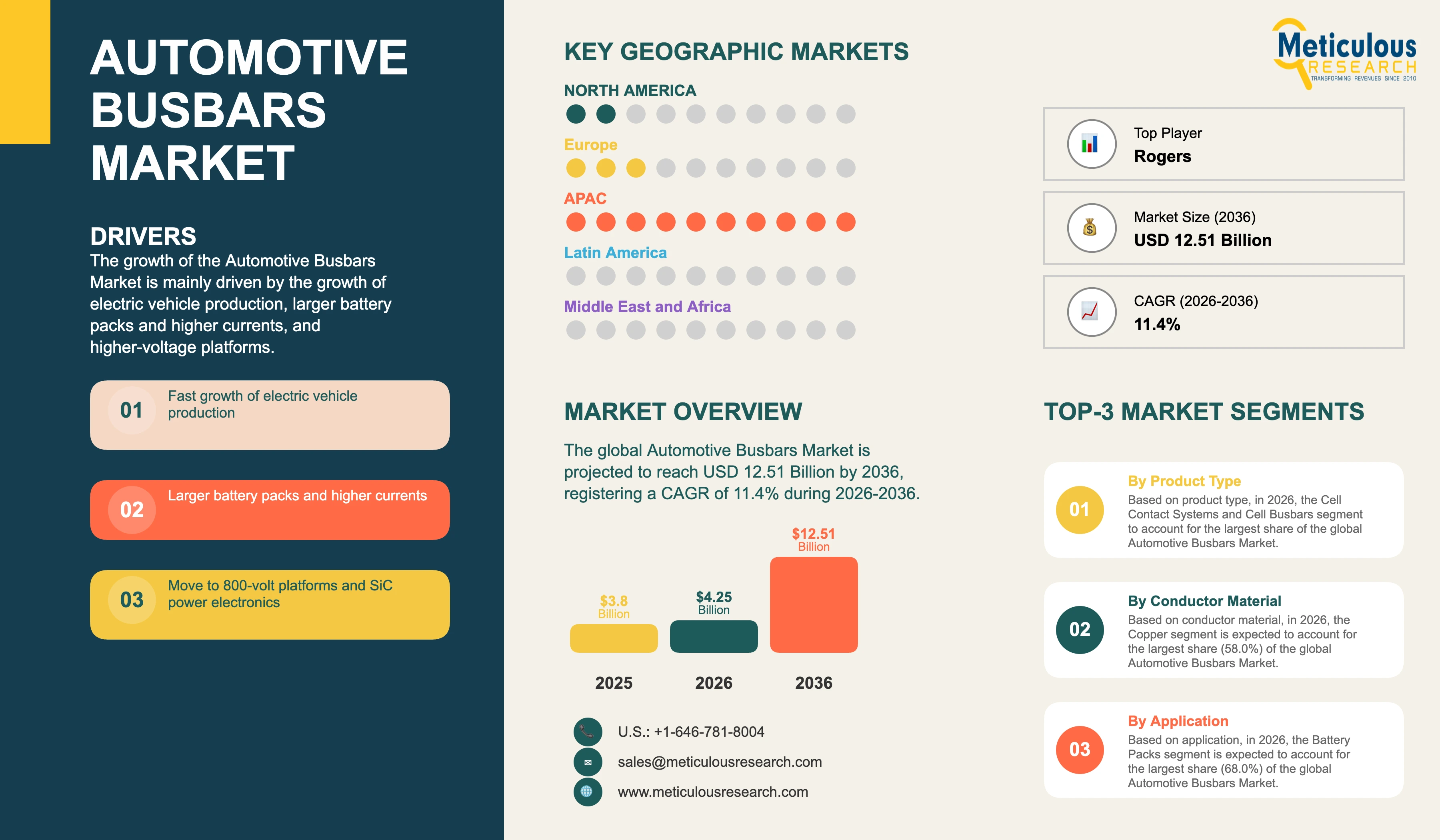
The global automotive busbars market was valued at USD 3.80 billion in 2025. This market is expected to reach USD 12.51 billion by 2036 from an estimated USD 4.25 billion in 2026, registering a CAGR of 11.4% during the forecast period (2026-2036).
- Published
- Nov 2026
- Pages
- 260
- Format
- PDF + Excel
- Report ID
- MRAUTO - 1042859
- Base year
- 2025
- 2025 · BASELINE
- $3.80B
- 2036
- $12.51B
- CAGR 2026–2036
- 11.4%
2025 baseline · 2026–2036 forecast at 11.4% CAGR · hover a bar for the value
Key highlights
Global electric car sales grew by 20% to more than 20 million units in 2025, accounting for one in four new cars sold worldwide, according to the IEA, and the IEA expects sales to reach about 23 million in 2026. Every battery electric and plug-in hybrid vehicle uses busbars to connect battery cells and to carry current between the battery pack, power electronics, and power distribution unit.
BYD launched its Super e-Platform in March 2025, the first mass-produced passenger car platform with a full 1,000-volt architecture, supporting charging at up to 1,000 kW with a current of 1,000 amps, according to BYD. Higher voltages and charging currents require busbars with better insulation, higher current capacity, and improved thermal performance.
Cell contact systems, which combine cell busbars, a plastic carrier, and a printed or flat flexible circuit for voltage and temperature sensing, have become the standard way to connect cells in many battery packs. Rogers offers its ROLINX Hybrid product, a one-piece busbar that combines power and signal lines with integrated connectors that plug into the battery management system, according to Rogers.
Chinese suppliers have become major producers of cell contact systems and battery busbars. Suzhou Xidian New Energy listed on the Shanghai Stock Exchange in January 2024 and supplies customers such as CATL and BYD, while Shenzhen Uniconn Technology listed on the ChiNext board in November 2024 and focuses on 800-volt connections, aluminum replacing copper, and integrated cell contact systems, according to company and exchange information.
Aluminum busbars are gaining share because they are lighter and cheaper than copper, especially as copper prices have reached record levels. Suppliers are developing copper-aluminum composite busbars and new welding methods that allow aluminum busbars to be joined reliably to copper terminals and cell tabs, which is opening new uses in battery packs.
Leading suppliers include Rogers, Mersen, Methode Electronics, ENNOVI, Amphenol, Auto-Kabel, Gebauer & Griller, and Storm Power Components, together with Chinese suppliers, such as Suzhou Xidian New Energy, Shenzhen Uniconn Technology, Shenzhen Deren Electronic, Shenglan Technology, and Everwin Precision.
By product type, cell contact systems and cell busbars account for the largest share of 50.0% in 2026, while flexible busbars register the highest CAGR.
By conductor material, copper accounts for the largest share in 2026, while aluminum registers the highest CAGR.
By application, battery packs account for the largest share of 68.0% in 2026, while power electronics register the highest CAGR.
By propulsion type, battery electric vehicles account for the largest share in 2026 and also register the highest CAGR.
By geography, Asia-Pacific accounts for the largest share of 66.0% in 2026, while Europe registers the highest CAGR of 13.9%.
Report summary
| Particulars | Details |
|---|---|
| Base Year | 2025 |
| Estimated Year | 2026 |
| Forecast Period | 2026-2036 |
| Market Size in 2025 | USD 3.80 billion |
| Market Size in 2026 | USD 4.25 billion |
| Market Size by 2036 | USD 12.51 billion |
| CAGR (2026-2036) | 11.4% |
| Format | PDF, Excel & Cloud Portal · 260 pages |
| Largest Segment by Product Type (2026) | Cell Contact Systems and Cell Busbars (50.0%) |
| Largest Segment by Application (2026) | Battery Packs (68.0%) |
| Largest Region (2026) | Asia-Pacific (66.0%) |
| Fastest-Growing Region | Europe (CAGR 13.9%) |
| Companies Profiled | 13 companies and other companies |
| Segments Covered | Product Type, Conductor Material, Application, Propulsion Type, Geography |
| Countries Covered | U.S., Canada, Germany, France, U.K., Italy, Spain, Sweden, Hungary, Poland, Czech Republic, Slovakia, Netherlands, Belgium, Norway, Rest of Europe, China, Japan, South Korea, India, Thailand, Indonesia, Malaysia, Vietnam, Taiwan, Australia, Rest of Asia-Pacific, Mexico, Brazil, Argentina, Chile, Colombia, Rest of Latin America, Turkey, Morocco, Saudi Arabia, U.A.E., Israel, South Africa, Rest of Middle East & Africa |
Report overview
Segments covered: product type, conductor material, application, propulsion type.
Automotive busbars are flat or shaped strips of copper or aluminum, often insulated, that carry high currents between battery cells, battery modules, power electronics, and power distribution units in electric and hybrid vehicles. They replace round cables in many high-current connections because they carry more current in less space, are easier to assemble with robots, and handle heat and vibration better. The market includes cell contact systems that connect and monitor battery cells, rigid, laminated, and flexible busbars, and the insulation and fixing parts sold with them.
The growth of this market is mainly driven by the fast growth of electric vehicle production, the larger battery packs and higher currents of new electric vehicles, the move to 800-volt and 1,000-volt platforms and silicon carbide power electronics, the shift from cables to busbars in battery packs and power distribution units to save space and cost, and the move to cell-to-pack and cell-to-body battery designs that use more busbar content per pack. In addition, the use of aluminum busbars and integrated cell contact systems is lowering costs and supporting wider use. However, high and volatile copper prices, strong price pressure in the Chinese battery supply chain, and the technical difficulty of joining copper and aluminum are expected to restrain the growth of this market to some extent.
Busbars are rigid or flexible conductors, usually made of copper or aluminum, that distribute high currents within an electrical system. In electric and hybrid vehicles, busbars connect battery cells into modules and packs, link modules to the battery's main terminals, carry current inside the high-voltage junction box or power distribution unit, and connect power modules, capacitors, and terminals inside inverters, onboard chargers, and DC-DC converters. Compared with round cables, busbars offer lower resistance and inductance, better heat dissipation, a more compact layout, and easier automated assembly, which makes them well suited to the high currents and tight spaces of electric vehicles.
This report covers the global automotive busbars market, including cell contact systems and cell busbars, rigid interconnect busbars, laminated busbars, and flexible busbars used in passenger cars and commercial vehicles with high-voltage systems. The market is valued at the selling price of busbars and cell contact systems sold to battery makers, power electronics makers, harness and component makers, and vehicle makers. The market is analyzed by product type, conductor material, application, propulsion type, and geography. Busbars used in charging stations, stationary energy storage, and industrial equipment are not included, nor are high-voltage cables and connectors sold separately.
Battery packs account for most automotive busbar demand by value and by volume. A battery pack may contain hundreds or thousands of cells, and each cell must be connected to its neighbors in series and parallel. Cell busbars, usually thin aluminum or copper plates laser-welded or ultrasonically welded to cell terminals, make these connections. In most modern packs, cell busbars are assembled into cell contact systems that also include a plastic carrier and a flexible printed circuit or flat cable that measures cell voltages and temperatures for the battery management system. Larger rigid busbars then connect modules and carry current to the pack terminals.
Power electronics are the second major application for busbars in electric vehicles. Inverters, onboard chargers, and DC-DC converters use laminated busbars, which stack copper or aluminum layers with thin insulating films, to connect power modules and capacitors with very low inductance. Low inductance is especially important for silicon carbide power modules, which switch very quickly. Power distribution units and junction boxes use rigid busbars to carry current from the battery to the various high-voltage loads, and flexible busbars made of laminated thin copper or aluminum foils or braids are used where parts move or expand with heat.
The market includes specialist busbar makers, such as Rogers, Mersen, Methode Electronics, ENNOVI, Storm Power Components, Auto-Kabel, and Gebauer & Griller, connector makers that also make busbars, such as Amphenol, and Chinese suppliers of cell contact systems and battery busbars, such as Suzhou Xidian New Energy, Shenzhen Uniconn Technology, Shenzhen Deren Electronic, Shenglan Technology, and Everwin Precision. Chinese suppliers hold a large share of the cell contact system market because China produces most of the world's electric vehicle batteries and because battery makers, such as CATL and BYD, work closely with local suppliers.
Battery and vehicle design trends are increasing the busbar content of each new vehicle. Cell-to-pack and cell-to-body designs remove module housings and connect cells directly into large packs, which requires larger and more integrated cell contact systems. Larger cells, such as BYD's Blade cells and large cylindrical cells, change the number and size of cell connections. The move to 800-volt and 1,000-volt systems needs busbars with better insulation, and the move to integrated electric drive units and power electronics boxes is replacing internal cables with busbars, which increases busbar content in each vehicle.
In 2026, cell contact systems and cell busbars account for the largest share of the market by product type, while flexible busbars are the fastest-growing product type. Copper accounts for the largest share by conductor material, while aluminum is the fastest-growing conductor material. Battery packs account for the largest share by application, while power electronics are the fastest-growing application. Battery electric vehicles are the largest propulsion type and are also the fastest-growing propulsion type. Asia-Pacific accounts for the largest share of the market, while Europe is the fastest-growing region.
Market growth over the forecast period will depend mainly on electric vehicle production, the size of battery packs, the pace of the move to higher-voltage platforms, and the adoption of new battery and power electronics designs that use more busbars. Copper and aluminum prices will also affect market value, as metal accounts for a large share of busbar cost. Price competition in China, where most cell contact systems are made, will continue to put pressure on prices even as volumes grow strongly.
Battery packs are expected to account for the largest share of 68.0% of the market in 2026, while power electronics are projected to register the highest CAGR, driven by silicon carbide inverters and chargers on 800-volt platforms.
Asia-Pacific is expected to account for the largest share of 66.0% of the market in 2026, mainly due to China's dominance in electric vehicle and battery production and the large number of Chinese suppliers of cell contact systems and busbars.
Europe is projected to register the highest CAGR of 13.9% during the forecast period, driven by strong electric vehicle sales growth, EU emission rules, new battery plants, and the launch of 800-volt platforms by European vehicle makers.
The report profiles 13 companies, including Rogers, Mersen, Methode Electronics, ENNOVI, Amphenol, Auto-Kabel, Gebauer & Griller, Storm Power Components, Suzhou Xidian New Energy, Shenzhen Uniconn Technology, Shenzhen Deren Electronic, Shenglan Technology, and Everwin Precision.
Cell contact systems combine cell busbars, a plastic carrier, and a flexible sensing circuit in one assembly that connects battery cells and monitors their voltage and temperature. They are the largest product type, as every battery pack needs them.
Aluminum busbars are lighter and cheaper than copper, which helps cut cost and extend range as copper prices stay high. New copper-aluminum composites and welding methods are making reliable aluminum connections possible in more applications.
Report infographic
Market dynamics
17 factors across 5 forcesFast growth of electric vehicle production
The main driver of this market is the growth of electric vehicle production. Every battery electric, plug-in hybrid, and range-extended vehicle needs busbars and cell contact systems in its battery pack and busbars in its power electronics and power distribution units, while combustion engine vehicles use few or none. Each new electric vehicle therefore adds new demand for busbars, and battery electric vehicles, with their large packs, use much more busbar content than hybrids.
Global electric car sales grew by 20% to more than 20 million units in 2025, accounting for one in four new cars sold worldwide, according to the IEA, and are expected to reach about 23 million in 2026. China produces most of these vehicles and most of the batteries, but production is also growing in Europe, Korea, Japan, and Southeast Asia. As electric vehicles take a larger share of new vehicle sales, busbar demand is expected to grow much faster than vehicle production.
Larger battery packs and higher currents
Electric vehicle battery packs are getting larger as vehicle makers seek longer driving ranges, and charging currents are rising as vehicle makers offer faster charging. Larger packs need more cell connections and more busbar material, while higher currents need busbars with larger cross-sections and better cooling. BYD's Super e-Platform supports charging at up to 1,000 kW with a current of 1,000 amps, according to BYD, which requires busbars that can carry very high currents without overheating.
Electric trucks and buses, which are growing quickly in China and Europe, use very large battery packs with high currents, which require large busbars. These trends increase the amount of copper and aluminum in busbars and the value of busbars in each vehicle. Busbars are also preferred over cables for very high currents because they can be cooled more easily and take up less space, which is critical in tightly packed battery packs.
Move to 800-volt and 1,000-volt platforms and silicon carbide power electronics
Vehicle makers are moving from 400-volt to 800-volt and 1,000-volt systems to allow faster charging and higher efficiency, and they are adopting silicon carbide power modules in inverters and chargers. Higher-voltage systems need busbars with better insulation and creepage distances, while silicon carbide modules switch much faster than silicon modules and need laminated busbars with very low inductance to avoid voltage spikes and losses.
These requirements increase the technical complexity and value of busbars in power electronics. Laminated busbars from suppliers such as Rogers, Mersen, and Storm Power Components are designed for these applications, and many power electronics makers are redesigning their products around new busbar layouts. Power electronics are the fastest-growing application in this market, as more vehicle makers adopt 800-volt silicon carbide inverters and chargers.
Shift from cables to busbars for easier assembly and lower cost
Vehicle makers and battery makers are replacing round cables with busbars in many high-current connections inside battery packs, power distribution units, and integrated drive units. Busbars can be placed and fixed by robots, which allows automated assembly and reduces labor costs and assembly errors. They also take up less space, carry more current for the same cross-section, and can be shaped to fit tight spaces, which helps designers make more compact packs and electronics.
Integrated busbar assemblies that combine several conductors, insulation, and fixing points in one part are replacing several cables and connectors. This trend increases busbar content per vehicle while reducing cable and connector content. As vehicle makers push for lower costs and higher automation in battery and electronics production, the use of busbars instead of cables is expected to keep growing over the forecast period.
Cell-to-pack and cell-to-body battery designs
Battery makers and vehicle makers are moving from traditional module-based packs to cell-to-pack and cell-to-body designs, in which cells are placed directly in the pack or vehicle structure without separate module housings. These designs increase energy density and reduce cost, but they require large integrated cell contact systems that connect hundreds of cells and monitor their voltage and temperature in a single assembly. CATL, BYD, and other battery makers have launched cell-to-pack designs, and BYD's Blade battery uses long cells placed directly in the pack. Cell contact systems for these designs are larger and more complex than module-level systems, and suppliers that can make them in high volume with consistent quality, such as Suzhou Xidian New Energy, Shenzhen Uniconn Technology, and other Chinese suppliers, are growing quickly. This trend is a major reason why cell contact systems account for the largest share of the market and continue to grow at a strong pace.
Table of contents
12 chapters · 174 sections · 260 pages · click to expandSegmental analysis
| Segment | Largest share (2026) | Fastest growth (2026–2036) |
|---|---|---|
| By Product Type | Copper | Aluminum |
By Product Type
- The copper segment is expected to account for the largest share of the automotive busbars market, while the aluminum segment is projected to register the highest CAGR during the forecast period.
- The battery electric vehicles segment is expected to account for the largest share of the automotive busbars market, and it is also projected to register the highest CAGR during the forecast period.
Geographic analysis
Asia-Pacific
Largest shareIn 2026, Asia-Pacific is expected to account for the largest share of 66.0% of the global automotive busbars market. The large share of this region is mainly due to China's position as the largest producer of electric vehicles and electric vehicle batteries, the presence of the world's largest battery makers, such as CATL and BYD, and Korean and Japanese battery makers, such as LG Energy Solution, Samsung SDI, SK On, and Panasonic, the large number of Chinese suppliers of cell contact systems and busbars, such as Suzhou Xidian New Energy, Shenzhen Uniconn Technology, Shenzhen Deren Electronic, Shenglan Technology, and Everwin Precision, and the fast adoption of 800-volt and 1,000-volt platforms by Chinese vehicle makers. Japan and South Korea also have large electric vehicle and battery industries that use busbars from local and global suppliers.
Europe
Fastest growthEurope is projected to register the highest CAGR of 13.9% during the forecast period. The rapid growth of this region is mainly driven by strong electric vehicle sales growth, with sales rising by more than 30% in 2025 to 4.2 million units according to the IEA, the European Union's carbon dioxide emission rules for new cars and vans, the construction of new battery plants by CATL, BYD, Gotion, LG Energy Solution, Samsung SDI, SK On, and European companies in Hungary, Germany, Spain, Poland, and other countries, and the launch of 800-volt platforms by European vehicle makers. Europe is also home to leading busbar makers, such as Mersen, Auto-Kabel, Gebauer & Griller, and Rogers' European operations, which supply local battery and power electronics makers.
North America
North America accounts for a significant share of the market, supported by electric vehicle and battery production by Tesla, GM, Hyundai, LG Energy Solution, Panasonic, Samsung SDI, and SK On, and by the presence of busbar suppliers, such as Methode Electronics, Storm Power Components, Amphenol, and Rogers. However, the end of federal electric vehicle tax credits in 2025 and the delay of some battery plant projects have slowed electric vehicle and battery growth in the U.S., which is expected to limit the region's growth compared with Europe. Mexico is an important location for power electronics and harness production for North American vehicles.
Latin America
Latin America and the Middle East & Africa account for small shares of the market, but they are expected to grow as electric vehicle production starts in Brazil, Mexico, Turkey, and Morocco, and as Chinese vehicle makers, such as BYD, build plants in Brazil and Turkey. Electric car sales in many countries across Latin America, Asia-Pacific, and the Middle East have now reached a sales share of more than 10%, according to the IEA. Battery and electric vehicle assembly in these regions is expected to create new demand for busbars and cell contact systems over the forecast period. Morocco is attracting investment from Chinese battery material and cell makers to serve Europe, and Turkey is building electric vehicle and battery capacity, which could support local busbar production in the longer term.
Competitive landscape
The global automotive busbars market includes specialist busbar makers, connector and interconnect companies, and Chinese suppliers of cell contact systems and battery busbars. The market is fragmented, with many suppliers serving different applications and regions. Chinese suppliers hold a large share of the cell contact system market due to China's dominance in battery production, while global specialists hold strong positions in laminated busbars for power electronics and in European and North American markets.
Rogers, through its ROLINX product line, Mersen, and Storm Power Components are leading suppliers of laminated busbars for power electronics, and Rogers also offers cell connection busbars such as ROLINX Hybrid. Methode Electronics, ENNOVI, and Amphenol supply busbars and power distribution products to vehicle makers and battery makers, while Auto-Kabel and Gebauer & Griller supply insulated high-voltage busbars and aluminum conductors. Suzhou Xidian New Energy, Shenzhen Uniconn Technology, Shenzhen Deren Electronic, Shenglan Technology, and Everwin Precision are leading Chinese suppliers of cell contact systems and battery busbars.
Companies in this market compete on cost, quality and reliability, current capacity and thermal performance, insulation performance at high voltages, the ability to design integrated assemblies, automated production capacity, and proximity to battery and vehicle plants. Key strategies include developing aluminum and copper-aluminum busbars, integrated cell contact systems, low-inductance laminated busbars for silicon carbide power electronics, and flexible high-voltage busbars, and expanding production in Europe, Southeast Asia, and North America.
Recent competitive activity in the automotive busbars market has focused on capacity expansion and listings in China. Suzhou Xidian New Energy listed on the Shanghai Stock Exchange in January 2024 and Shenzhen Uniconn Technology listed on the ChiNext board in November 2024, raising funds to expand production. Global suppliers are launching new busbar products for 800-volt platforms and silicon carbide power electronics.
We expect competition to increase over the forecast period as Chinese suppliers follow Chinese battery makers to Europe and Southeast Asia, as battery makers push for lower prices, and as new materials and designs change the types of busbars needed. Suppliers with strong engineering capabilities, automated production, and local plants near battery and vehicle production are expected to strengthen their positions.
Some of the key players operating in the automotive busbars market are Rogers Corporation, Mersen S.A., Methode Electronics, Inc., ENNOVI, Amphenol Corporation, Auto-Kabel Management GmbH, Gebauer & Griller Kabelwerke Gesellschaft m.b.H., Storm Power Components, Suzhou Xidian New Energy Electric Technology Co., Ltd., Shenzhen Uniconn Technology Co., Ltd., Shenzhen Deren Electronic Co., Ltd., Shenglan Technology Co., Ltd., and Shenzhen Everwin Precision Technology Co., Ltd., among others.
- —
Suzhou Xidian New Energy listed in Shanghai in January 2024 and Shenzhen Uniconn Technology listed on ChiNext in November 2024 to fund expansion, while BYD's 1,000-volt Super e-Platform launched in March 2025 is raising busbar current and insulation requirements.
- Rogers Corporation
- Mersen S.A.
- Methode Electronics, Inc.
- ENNOVI
- Amphenol Corporation
- Auto-Kabel Management GmbH
- Gebauer & Griller Kabelwerke Gesellschaft m.b.H
- Storm Power Components
- Shenzhen Uniconn Technology Co., Ltd.
- Shenzhen Deren Electronic Co., Ltd.
- Shenglan Technology Co., Ltd.
- Shenzhen Everwin Precision Technology Co., Ltd.
Expert perspectives
Busbars are a small but fast-growing part of the electric vehicle supply chain. As electric vehicle production grows, battery packs get larger, voltages and currents rise, and vehicle makers replace cables with busbars, the amount and value of busbars in each vehicle are increasing. Cell contact systems for battery packs and laminated busbars for power electronics are the most important products, and Chinese suppliers have become major players.
Over the forecast period, the market is expected to grow at a CAGR of 11.4%, from USD 4.25 billion in 2026 to USD 12.51 billion in 2036. Growth will be driven by the growth of electric vehicle production, larger battery packs and higher currents, the move to 800-volt and 1,000-volt platforms and silicon carbide power electronics, the shift from cables to busbars, and cell-to-pack battery designs.
Among the market segments, cell contact systems and cell busbars are the largest product type, while flexible busbars grow fastest. Copper is the largest conductor material, while aluminum grows fastest. Battery packs are the largest application, while power electronics grow fastest. Battery electric vehicles are both the largest and the fastest-growing propulsion type. Asia-Pacific is the largest region, while Europe is the fastest-growing region at a CAGR of 13.9%.
In our view, the shift from copper to aluminum will be one of the most important factors shaping this market. Aluminum busbars are lighter and cheaper, but they need new joining methods and careful design. Suppliers that master aluminum and copper-aluminum busbars will gain an advantage, while the shift may reduce the value of busbars per vehicle even as volumes grow, partly offsetting growth in market value.
We also see the localization of battery production in Europe and other regions as a key opportunity and challenge. New battery plants in Europe will need local suppliers of cell contact systems and busbars, and Chinese suppliers are expected to follow Chinese battery makers abroad, increasing competition for European and North American suppliers. Suppliers that can combine low costs with local production and engineering support will be best placed to win this business. Partnerships between Chinese and European suppliers may also become more common as both sides look to serve new plants quickly and at lower cost.
Overall, we believe the automotive busbars market will grow strongly over the forecast period, with flexible busbars, aluminum busbars, power electronics, battery electric vehicles, and Europe providing the fastest growth. Companies with strong engineering skills in high-current and high-voltage connections, automated low-cost production, and plants close to battery and vehicle makers will be best positioned to capture this growth.
Customer perspectives
“Our cell-to-pack designs need large cell contact systems that connect hundreds of cells and monitor each one. We buy them in very high volumes and expect price cuts every year.”
“Our 800-volt silicon carbide inverter needs a laminated busbar with very low inductance. The busbar design is now as important as the power module itself.”
“We are replacing heavy high-voltage cables with flexible and aluminum busbars in our next platform to save weight, cost, and space.”
Frequently asked questions
The global automotive busbars market was valued at USD 3.80 billion in 2025, up from USD 3.30 billion in 2024, and is estimated at USD 4.25 billion in 2026. The market includes cell contact systems and cell busbars, rigid, laminated, and flexible busbars used in electric and hybrid vehicles.
The global automotive busbars market is expected to reach USD 12.51 billion by 2036, driven by the growth of electric vehicle production, larger battery packs and higher currents, higher-voltage platforms, and the shift from cables to busbars.
The market is expected to register a CAGR of 11.4% from 2026 to 2036, with the fastest growth in flexible busbars, aluminum busbars, power electronics, battery electric vehicles, and Europe.
Market growth is mainly driven by the fast growth of electric vehicle production, larger battery packs and higher currents, the move to 800-volt and 1,000-volt platforms and silicon carbide power electronics, the shift from cables to busbars, and cell-to-pack battery designs.
High and volatile copper prices and strong price pressure in the battery supply chain restrain growth, while joining, corrosion, and reliability issues and thermal management and insulation at higher voltages and currents are key challenges.
Key growth opportunities include aluminum and copper-aluminum composite busbars, laminated busbars for silicon carbide power electronics, flexible and insulated high-voltage busbars replacing cables, and the localization of battery production in Europe and other regions.
Cell contact systems and cell busbars are expected to account for the largest share of 50.0% of the market in 2026, while flexible busbars are projected to register the highest CAGR, driven by the replacement of high-voltage cables.
In 2026, the copper segment is expected to account for the largest share of the automotive busbars market, while the aluminum segment is projected to register the highest CAGR during the forecast period.
Battery packs are expected to account for the largest share of 68.0% of the market in 2026, while power electronics are projected to register the highest CAGR, driven by silicon carbide inverters and chargers on 800-volt platforms.
In 2026, the battery electric vehicles segment is expected to account for the largest share of the automotive busbars market, and it is also projected to register the highest CAGR during the forecast period.
Asia-Pacific is expected to account for the largest share of 66.0% of the market in 2026, mainly due to China's dominance in electric vehicle and battery production and the large number of Chinese suppliers of cell contact systems and busbars.
Europe is projected to register the highest CAGR of 13.9% during the forecast period, driven by strong electric vehicle sales growth, EU emission rules, new battery plants, and the launch of 800-volt platforms by European vehicle makers.
The report profiles 13 companies, including Rogers, Mersen, Methode Electronics, ENNOVI, Amphenol, Auto-Kabel, Gebauer & Griller, Storm Power Components, Suzhou Xidian New Energy, Shenzhen Uniconn Technology, Shenzhen Deren Electronic, Shenglan Technology, and Everwin Precision.
Suzhou Xidian New Energy listed in Shanghai in January 2024 and Shenzhen Uniconn Technology listed on ChiNext in November 2024 to fund expansion, while BYD's 1,000-volt Super e-Platform launched in March 2025 is raising busbar current and insulation requirements.
Cell contact systems combine cell busbars, a plastic carrier, and a flexible sensing circuit in one assembly that connects battery cells and monitors their voltage and temperature. They are the largest product type, as every battery pack needs them.
Aluminum busbars are lighter and cheaper than copper, which helps cut cost and extend range as copper prices stay high. New copper-aluminum composites and welding methods are making reliable aluminum connections possible in more applications.
Cite this report
Meticulous Research. (2026). Automotive Busbars Market - Global Opportunity Analysis and Industry Forecast (2026-2036) (Report No. MRAUTO - 1042859). Meticulous Market Research Pvt. Ltd. https://www.meticulousresearch.com/product/automotive-busbars-market-7542