Healthcare Data Monetization Market (2026-2036)
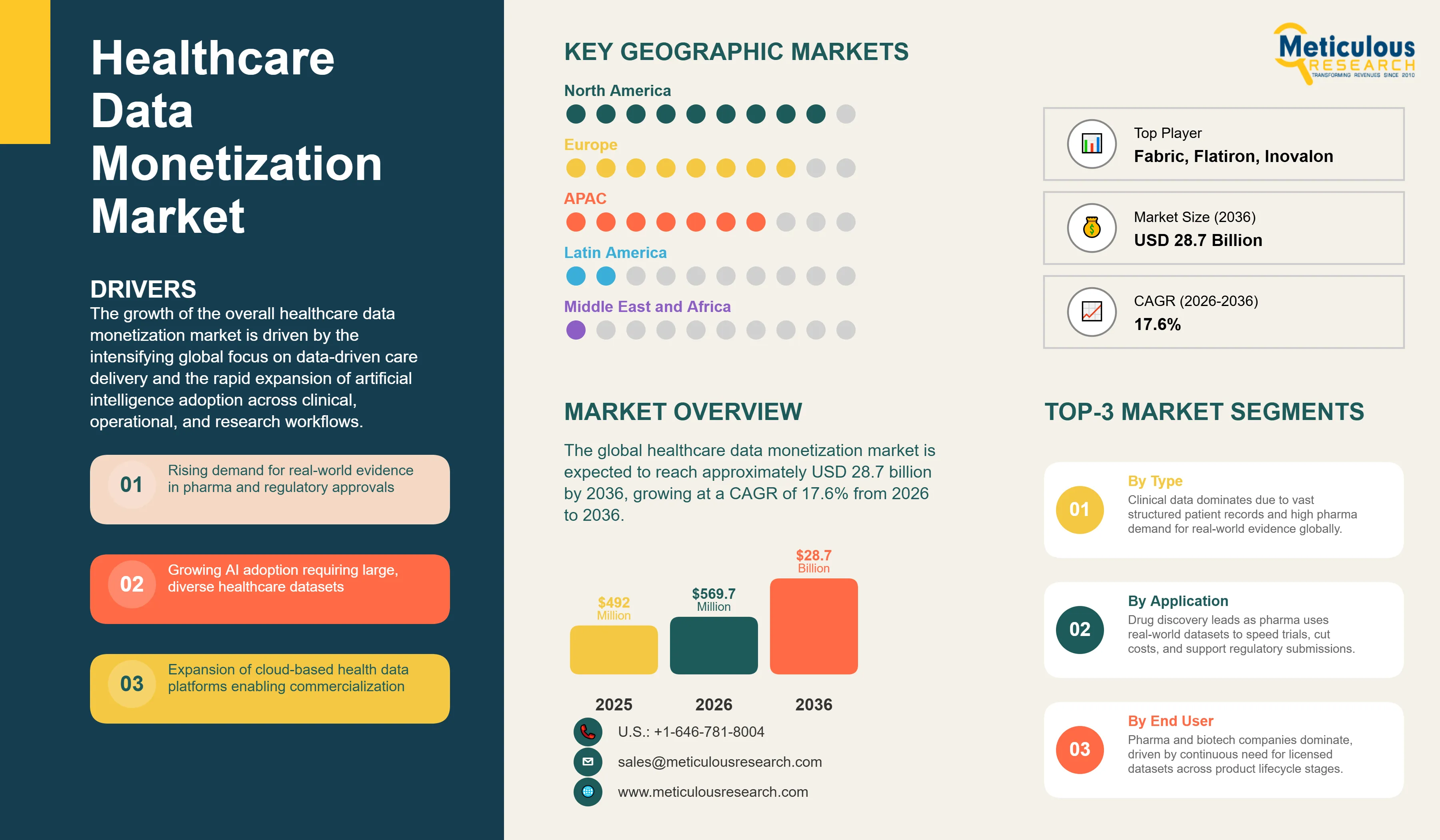
The global healthcare data monetization market was valued at USD 492.0 million in 2025. The market is expected to reach approximately USD 28.7 billion by 2036 from USD 569.7 million in 2026, growing at a CAGR of 17.6% from 2026 to 2036.
- Published
- Feb 2026
- Pages
- 287
- Format
- PDF + Excel
- Report ID
- MR-1791
- Base year
- 2025
- 2025 · BASELINE
- $492.0M
- 2036
- $28.70B
- CAGR 2026–2036
- 17.6%
2025 baseline · 2026–2036 forecast at 17.6% CAGR · hover a bar for the value
Key highlights
In terms of revenue, the global healthcare data monetization market is projected to reach USD 28.7 billion by 2036.
The market is expected to grow at a CAGR of 17.6% from 2026 to 2036.
North America dominates the global healthcare data monetization market with the largest market share in 2026, driven by the presence of a mature health information technology infrastructure, high electronic health record adoption rates, and a well-established regulatory framework that supports compliant data sharing across the United States and Canada.
Asia-Pacific is expected to witness the fastest growth during the forecast period, supported by rapid digitization of healthcare systems, government-backed national health data initiatives, and significant investments in health technology across China, India, Japan, and Southeast Asia.
By data type, the clinical data segment holds the largest market share in 2026, owing to the breadth and depth of structured and unstructured clinical records generated across hospitals, ambulatory care settings, and specialty practices globally.
By monetization model, the external monetization segment holds the largest market share in 2026, driven by the high commercial demand for licensed health datasets and data-as-a-service offerings from pharmaceutical, biotechnology, and insurance organizations.
By application, the drug discovery and development segment holds the largest share of the overall market in 2026, as pharmaceutical companies increasingly rely on real-world clinical datasets to accelerate candidate identification, reduce trial costs, and support regulatory submissions.
By end user, the pharmaceutical and biotechnology companies segment holds the largest share of the overall market in 2026.
Report summary
| Particulars | Details |
|---|---|
| Market Size by 2036 | USD 28.7 Billion |
| Market Size in 2026 | USD 569.7 Million |
| Market Size in 2025 | USD 492.0 Million |
| Market Growth Rate (2026-2036) | CAGR of 17.6% |
| Format | PDF, Excel & Cloud Portal · 287 pages |
| Dominating Region | North America |
| Fastest Growing Region | Asia-Pacific |
| Base Year | 2025 |
| Forecast Period | 2026 to 2036 |
| Segments Covered | Data Type, Monetization Model, Application, End User, and Region |
| Regions Covered | North America, Europe, Asia-Pacific, Latin America, and Middle East & Africa |
Report overview
Segments covered: data type, monetization model, application, end user.
The growth of the overall healthcare data monetization market is driven by the intensifying global focus on data-driven care delivery and the rapid expansion of artificial intelligence adoption across clinical, operational, and research workflows. As healthcare organizations seek to unlock the commercial and strategic value embedded in their data assets, data monetization has become essential for sustaining competitive advantage, improving patient outcomes, and driving revenue diversification. The rapid expansion of real-world evidence programs, the growing demand for high-quality health datasets among pharmaceutical companies, and the increasing integration of digital health technologies continue to fuel significant growth of this market across all major geographic regions.
Healthcare data monetization refers to the process through which healthcare organizations extract measurable economic and strategic value from the data assets they generate, collect, and manage across clinical, operational, and administrative workflows. This encompasses a broad range of activities, from licensing de-identified patient datasets to external stakeholders and building proprietary data-as-a-service platforms, to leveraging internal analytics to improve care quality, reduce costs, and support evidence-based decision-making. The market is defined by a growing ecosystem of technology enablers including cloud-native data platforms, federated learning frameworks, advanced de-identification and privacy-enhancing computation tools, and AI-powered analytics engines that significantly enhance the speed, scale, and security of healthcare data commercialization. These capabilities are indispensable for healthcare enterprises seeking to optimize their data infrastructure while meeting stringent compliance requirements under regulations such as HIPAA, GDPR, and emerging national health data protection frameworks.
The market includes a diverse range of solutions, from foundational data aggregation and normalization platforms to sophisticated real-world data marketplaces and population health intelligence services. These solutions are increasingly integrated with advanced components such as natural language processing, large language models, and blockchain-based data provenance tools to enable high-fidelity data extraction, seamless interoperability, and auditability across complex multi-stakeholder environments. The ability to deliver reliable, high-resolution health intelligence while maintaining patient privacy and regulatory compliance has made healthcare data monetization platforms the preferred choice for institutions where data accuracy, ethical governance, and commercial viability are equally critical.
The global healthcare sector is under mounting pressure to demonstrate value-based outcomes while managing rising operational costs and increasing patient complexity. This environment has accelerated the adoption of data monetization strategies, with healthcare systems, payers, and technology companies investing in scalable platforms that can transform raw clinical and administrative data into actionable insights and commercially viable products. At the same time, the rapid growth of precision medicine, digital therapeutics, and AI-assisted diagnostics is deepening the need for high-quality, longitudinal health datasets that only structured monetization frameworks can reliably supply at scale.
Report infographic
Market dynamics
5 factors across 4 forcesAccelerating Demand for Real-World Evidence and AI-Driven Health Intelligence
A key driver of the healthcare data monetization market is the intensifying demand for real-world evidence across pharmaceutical development, regulatory submissions, and health technology assessments. Global pharmaceutical and biotechnology companies are channeling significant investment into acquiring high-quality, longitudinal patient datasets to support drug development pipelines, label expansions, and post-market surveillance studies. The U.S. Food and Drug Administration's Real-World Evidence Program and the European Medicines Agency's expanding guidance on data-driven regulatory submissions have created strong institutional incentives for healthcare organizations to structure and commercialize their clinical data assets. As AI-driven diagnostic and therapeutic tools proliferate, the demand for large, diverse, and well-annotated health datasets to train, validate, and continuously improve these models is expected to grow substantially, reinforcing the commercial case for structured healthcare data monetization through 2036.
Table of contents
11 chapters · 116 sections · 287 pages · click to expandSegmental analysis
| Segment | Largest share (2026) | Fastest growth (2026–2036) |
|---|---|---|
| By Data Type | Clinical Data | Patient-generated data |
| By Monetization Model | External Monetization | — |
| By Application | Drug Discovery and Development | Precision medicine |
| By End-User | Pharmaceutical and Biotechnology Companies | — |
By Data Type
- The clinical data segment accounts for the largest share of the overall healthcare data monetization market in 2026.
- This dominance is primarily attributed to the sheer volume and commercial depth of clinical records generated across inpatient, outpatient, and specialty care settings globally, combined with the high willingness to pay demonstrated by pharmaceutical, biotechnology, and research organizations for structured, longitudinal clinical datasets.
- Clinical data encompassing diagnosis histories, treatment pathways, laboratory results, medical imaging records, and procedure documentation provides the richest source of real-world evidence available to drug developers, health economists, and clinical researchers.
- Large health systems such as those operating integrated delivery networks in the United States, the National Health Service in the United Kingdom, and hospital federations across Germany and France generate billions of clinical data points annually, a significant share of which is now being structured for external licensing and analytical services through partnerships with specialized data companies.
- However, the patient-generated data segment is expected to grow at the fastest CAGR during the forecast period, driven by the explosive growth of wearable health devices, remote patient monitoring platforms, and consumer health applications that are continuously generating high-frequency behavioral, physiological, and lifestyle data.
- Companies such as Apple, Garmin, and Fitbit, alongside dedicated remote monitoring providers, are producing datasets with commercial value in chronic disease management, clinical trial recruitment, and population wellness programs, creating a new and rapidly expanding frontier for healthcare data monetization.
By Monetization Model
- The external monetization segment holds the largest share of the overall market in 2026.
- This is primarily driven by the significant commercial demand from pharmaceutical companies, medical device manufacturers, health insurers, and health technology firms for licensed datasets, data-as-a-service subscriptions, and research data partnerships that can directly support their core business activities.
- Data providers operating in this segment — including IQVIA, Definitive Healthcare, and Komodo Health — have built scalable commercial models around the recurring demand for specialty-level patient journeys, treatment pattern analyses, provider network intelligence, and competitive benchmarking datasets.
- The established commercial infrastructure for data licensing agreements, data use agreements, and research collaboration frameworks in North America and Europe further supports the dominance of this segment.
- The internal monetization segment is expected to witness steady growth through 2036, fueled by the increasing ability of healthcare organizations to leverage their own data assets for revenue cycle optimization, operational efficiency, workforce planning, and value-based care performance improvement.
- Health systems investing in enterprise data warehouses, clinical analytics platforms, and AI-enabled decision support tools are increasingly quantifying the financial return of internal data utilization, establishing monetization as a core pillar of institutional data strategy.
By Application
- The drug discovery and development segment commands the largest share of the global healthcare data monetization market in 2026.
- This leadership reflects the pharmaceutical industry's sustained and growing reliance on real-world clinical and genomic datasets to identify disease targets, model patient populations, support trial design, and generate evidence for regulatory submissions.
- The cost and time associated with bringing a new drug to market continue to incentivize pharmaceutical companies to integrate real-world data early in the development cycle, with data monetization partnerships providing access to patient-level datasets that would be otherwise inaccessible.
- Leading data providers including IQVIA, Flatiron Health, and Veeva Systems have developed specialized platforms and data products specifically designed to serve the drug development workflow, from early-stage epidemiology through late-stage outcomes research.
- The precision medicine segment is poised for the fastest growth through 2036, driven by the rapid advancement of genomic medicine, multi-omics research, and biomarker-driven therapeutic development.
- The commercial demand for linked genomic, clinical, and longitudinal health datasets required to support precision medicine programs is expanding significantly, with both academic medical centers and commercial genomics platforms developing structured monetization models to supply this growing market.
By End-User
- The pharmaceutical and biotechnology companies segment holds the largest share of the global healthcare data monetization market in 2026.
- This dominance is driven by the segment's high and sustained demand for external health data products across the full product development lifecycle, from target identification and patient stratification to post-market surveillance and health economics evidence generation.
- Pharmaceutical companies are among the most commercially sophisticated consumers of health data, with established procurement frameworks for data licensing, long-term data partnership agreements, and dedicated real-world evidence teams.
- The depth and diversity of their data requirements — spanning therapeutic areas, geographies, and patient demographics — make them the primary revenue driver for the large-scale data marketplaces and real-world data platform providers that anchor the commercial healthcare data ecosystem.
- However, the healthcare providers segment is expected to witness meaningful growth through 2036, as hospital systems, integrated delivery networks, and outpatient care organizations increasingly recognize and act upon the commercial value of their data assets.
- The growing availability of managed data monetization services and cloud-based data partnership platforms is reducing the technical and legal complexity of external data commercialization for provider organizations, opening new revenue streams that supplement traditional clinical reimbursement income.
Geographic analysis
North America
Largest shareNorth America holds the largest share of the global healthcare data monetization market in 2026. This leadership is primarily attributed to the region's mature health information technology ecosystem, with near-universal adoption of electronic health records across hospital and ambulatory settings in the United States providing an exceptionally large and well-structured base of commercially viable health data. The presence of the world's most commercially active pharmaceutical and biotechnology sector, combined with a robust network of specialized health data companies including IQVIA, Optum, Inovalon, Komodo Health, and Datavant, creates a concentrated and highly liquid market for health data products and services. The U.S. regulatory environment, while rigorous, provides established compliance pathways under HIPAA that have allowed a sophisticated commercial data ecosystem to develop over two decades. Federal interoperability mandates, including those arising from the 21st Century Cures Act and ONC rules, are further expanding the volume and accessibility of structured health data, providing new commercial opportunities for monetization across the provider and payer landscape.
Europe
Europe accounts for a significant share of the global healthcare data monetization market. The growth of this market is primarily driven by expanding real-world evidence programs within the European pharmaceutical sector and the establishment of large-scale national health data initiatives in the United Kingdom, France, Germany, and the Nordic countries. The European Health Data Space initiative, which aims to create a unified framework for secondary use of health data across EU member states, is expected to substantially expand the commercially available health data asset base in the region over the forecast period. Countries such as Finland and Denmark, which operate mature national health registries with decades of longitudinal patient data, are increasingly participating in structured data commercialization partnerships with pharmaceutical and research organizations.
Asia-Pacific
Fastest growthAsia-Pacific is positioned as the fastest-growing regional market through 2036. Rapid digitization of healthcare delivery in China, India, Japan, and South Korea is generating enormous volumes of electronic health data, while national health data infrastructure programs in these countries are creating the regulatory and technical foundations for structured data commercialization at scale. China's national health information platform and India's Ayushman Bharat Digital Mission are among the most consequential public health data initiatives globally, with the potential to create data assets of significant commercial value as governance frameworks for secondary use continue to mature.
Competitive landscape
- IQVIA Holdings Inc.
- Optum Inc. (UnitedHealth Group)
- Oracle Health (formerly Cerner Corporation)
- Merative (formerly IBM Watson Health)
Frequently asked questions
The global healthcare data monetization market is expected to grow from USD 569.7 million in 2026 to USD 28.7 billion by 2036.
Cite this report
Meticulous Research. (2026). Healthcare Data Monetization Market - Global Opportunity Analysis and Industry Forecast (2026-2036) (Report No. MR-1791). Meticulous Market Research Pvt. Ltd. https://www.meticulousresearch.com/product/healthcare-data-monetization-market-6474