Hair Restoration Market (2026-2036)
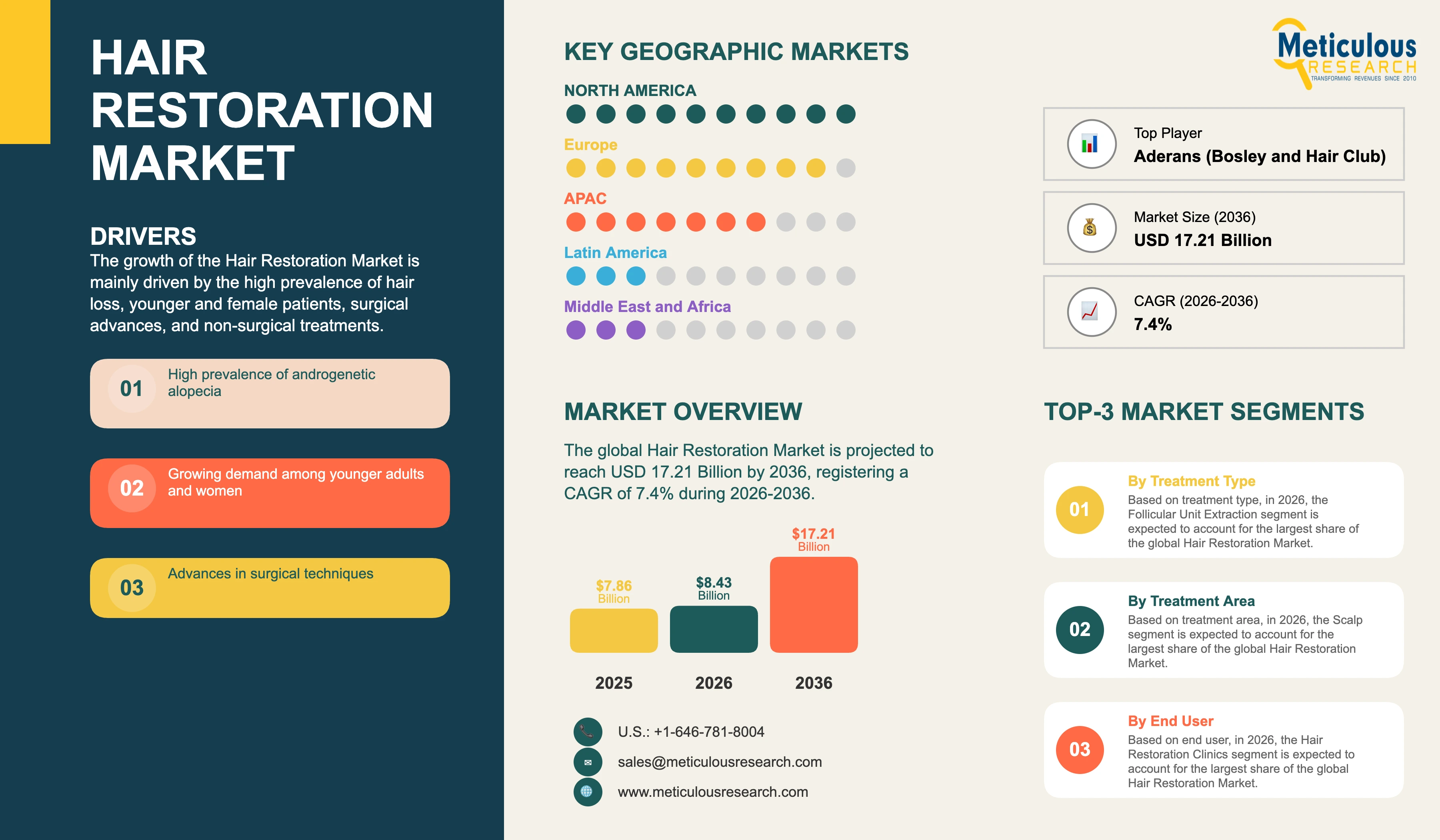
The global hair restoration market was valued at USD 7.86 billion in 2025. This market is expected to reach USD 17.21 billion by 2036 from an estimated USD 8.43 billion in 2026, registering a CAGR of 7.4% during the forecast period (2026-2036).
- Published
- Nov 2026
- Pages
- 265
- Format
- PDF + Excel
- Report ID
- MRHC - 1042625
- Base year
- 2025
- 2025 · BASELINE
- $7.86B
- 2036
- $17.21B
- CAGR 2026–2036
- 7.4%
2025 baseline · 2026–2036 forecast at 7.4% CAGR · hover a bar for the value
Key highlights
On October 19, 2026, Veradermics announced positive topline results from its Phase 3 Study 304 of VDPHL01, an extended-release oral minoxidil tablet, in 536 men with mild-to-moderate pattern hair loss, with both dosing regimens meeting the trial's co-primary endpoints and no treatment-related serious adverse events reported through six months, according to Practical Dermatology and the company.
In April 2026, Veradermics reported positive results from Part A of its Phase 2/3 Study 302 of VDPHL01 in more than 500 men, and the company said the drug could become the first FDA-approved oral pill for pattern hair loss in nearly 30 years, with results from its female pattern hair loss Study 306 expected in the first half of 2027, according to Veradermics and BioPharma Dive.
The International Society of Hair Restoration Surgery's 2025 Practice Census reported that 95% of first-time hair restoration surgery patients in 2024 were aged 20 to 35, that the number of female surgical patients increased 16.5% from 2021, and that the number of non-surgical patients increased 30% since 2021, according to ISHRS.
The ISHRS 2025 Practice Census also reported that the share of men seeking non-scalp hair restoration procedures, such as beard and eyebrow transplants, rose to 18% in 2024 from 13% in 2021, and that repair cases due to previous black market hair transplants rose to 10% from 6% in 2021, according to ISHRS.
In October 2025, Pelage Pharmaceuticals raised USD 120 million in a Series B financing co-led by ARCH Venture Partners and GV to advance PP405, a topical treatment designed to reactivate dormant hair follicle stem cells, into Phase 3 trials in 2026, according to the company and Fierce Biotech.
ISHRS reported that its members performed an average of 15 hair restoration surgeries per month in 2024 and that 67% of members reported that patients usually needed only one procedure to achieve the desired result, which reflects improvements in surgical techniques and planning. ISHRS has more than 1,200 members in 80 countries.
By treatment type, follicular unit extraction accounts for the largest share of 52.0% in 2026, while medical therapies register the highest CAGR.
By treatment area, scalp accounts for the largest share in 2026, while eyebrows, beard, and facial hair registers the highest CAGR.
By gender, male accounts for the larger share in 2026, while female registers the higher CAGR.
By end user, hair restoration clinics account for the largest share of 58.0% in 2026, while telehealth platforms and other end users register the highest CAGR.
By geography, North America accounts for the largest share of 32.0% in 2026, while Asia-Pacific registers the highest CAGR of 9.4%.
Report summary
| Particulars | Details |
|---|---|
| Forecast Period | 2026-2036 |
| Base Year | 2025 |
| Estimated Year | 2026 |
| CAGR (Value) | 7.4% |
| Format | PDF, Excel & Cloud Portal · 265 pages |
| Market Size (Value) in 2025 | USD 7.86 billion |
| Market Size (Value) in 2026 | USD 8.43 billion |
| Market Size (Value) by 2036 | USD 17.21 billion |
| Largest Segment by Treatment Type (2026) | Follicular Unit Extraction (52.0%) |
| Largest Segment by End User (2026) | Hair Restoration Clinics (58.0%) |
| Largest Region (2026) | North America (32.0%) |
| Fastest-Growing Region | Asia-Pacific (CAGR 9.4%) |
| Segments Covered | Treatment Type, Treatment Area, Gender, End User, Geography |
| Countries Covered | U.S., Canada, Germany, U.K., France, Italy, Spain, Netherlands, Switzerland, Belgium, Sweden, Denmark, Norway, Finland, Austria, Poland, Ireland, Rest of Europe, China, Japan, India, South Korea, Australia, Indonesia, Thailand, Singapore, Malaysia, Vietnam, Philippines, Taiwan, New Zealand, Rest of Asia-Pacific, Brazil, Mexico, Argentina, Colombia, Chile, Peru, Rest of Latin America, Turkey, Saudi Arabia, U.A.E., Israel, South Africa, Egypt, Rest of Middle East & Africa |
| Key Companies | 14 companies and other companies |
Report overview
Segments covered: treatment type, treatment area, gender, end user.
The growth of this market is mainly driven by the high prevalence of androgenetic alopecia among men and women, the growing number of younger adults seeking permanent solutions for hair loss, the rising number of women undergoing hair restoration, advances in follicular unit extraction and robotic and automated harvesting technologies, the growing popularity of non-surgical treatments such as platelet-rich plasma therapy and low-level laser therapy, the strong pipeline of new medical therapies, and the growth of medical tourism for hair transplants. However, factors such as the high cost of hair transplant procedures, which are rarely covered by insurance, the variable results and side effects of some medical therapies, the shortage of skilled hair restoration surgeons, and the growth of unlicensed black market clinics are expected to restrain the growth of this market to some extent.
Hair restoration includes surgical and non-surgical treatments that aim to restore hair growth, increase hair density, or slow hair loss. The most common cause of hair loss is androgenetic alopecia, also known as male or female pattern hair loss, a hereditary condition in which hair follicles gradually shrink under the influence of hormones. Pattern hair loss affects an estimated 50 million men in the U.S. alone, according to Veradermics, and a large share of women also experience thinning hair, particularly after menopause. Other causes include alopecia areata, scarring alopecias, trauma, burns, and hair loss after medical treatments.
This report covers the global hair restoration market, including surgical procedures, such as follicular unit extraction and follicular unit transplantation, and non-surgical treatments, such as platelet-rich plasma therapy, low-level laser therapy, medical therapies prescribed or dispensed by physicians, and other treatments such as scalp micropigmentation and exosome therapies. The market is analyzed by treatment type, treatment area, gender, end user, and geography. The market is measured on a revenue basis, including procedure fees charged by clinics and the value of devices and medical therapies used in clinical and telehealth settings. Over-the-counter hair care products sold through retail channels and wigs and hair systems are not included.
Hair transplant surgery has improved significantly over the past two decades as techniques, tools, and surgeon training have advanced. Follicular unit extraction, in which individual follicular units are harvested from the back of the scalp and implanted in thinning areas, has become the most common technique because it leaves no linear scar and allows faster recovery. ISHRS members performed an average of 15 hair restoration surgeries per month in 2024, and 67% reported that patients usually needed only one procedure to achieve the desired result. Robotic and motorized harvesting systems, such as Venus Concept's ARTAS system, help surgeons improve consistency and efficiency.
Non-surgical treatments are also growing quickly as more patients seek earlier and less invasive help for hair loss. ISHRS reported that the number of non-surgical patients treated by its members increased 30% since 2021, as more people seek help for early hair loss or combine surgery with medical and regenerative treatments. Platelet-rich plasma injections, low-level laser devices, and prescription medications such as finasteride and oral minoxidil are commonly used to slow hair loss and support the results of transplants. Telehealth platforms have made prescription hair loss treatments easier to access, particularly for younger men.
The hair restoration market is benefiting from important changes in the age and gender of patients seeking treatment. According to the ISHRS 2025 Practice Census, 95% of first-time surgical patients in 2024 were aged 20 to 35, the number of female surgical patients rose 16.5% from 2021, and non-scalp procedures, such as beard, eyebrow, and body hair transplants, grew among both men and women. ISHRS members also reported that 90% of patients chose surgery to become or feel more attractive, and 44% planned to tell others about their procedure, reflecting growing social acceptance.
The pipeline of new medical therapies is one of the most important developments in the market. Veradermics reported positive Phase 3 results for VDPHL01, an extended-release oral minoxidil tablet, in October 2026, and Pelage Pharmaceuticals is advancing PP405, a topical treatment designed to reactivate dormant hair follicle stem cells, into Phase 3 trials. Other companies, such as Cosmo Pharmaceuticals and Kintor Pharmaceutical, are developing topical antiandrogen therapies. If approved, these therapies could bring the first new hair loss drugs to the U.S. market in nearly 30 years.
In 2026, follicular unit extraction accounts for the largest share of the market by treatment type, while medical therapies are the fastest-growing treatment type. The scalp is the largest treatment area, while eyebrows, beard, and facial hair is the fastest-growing treatment area. Male patients account for the larger share by gender, while female patients are the faster-growing group. Hair restoration clinics are the largest end user, while telehealth platforms and other end users are the fastest-growing end user. North America accounts for the largest share of the market, while Asia-Pacific is the fastest-growing region.
Over the forecast period, the hair restoration market is expected to grow steadily, supported by the large and underserved population with hair loss, younger and female patients, technological advances in surgery, new medical therapies, and the expansion of treatment options in Asia-Pacific and other emerging regions.
North America is expected to account for the largest share of 32.0% of the market in 2026, mainly due to high demand, high procedure prices, experienced surgeons, telehealth platforms, and companies developing new medical therapies.
Asia-Pacific is projected to register the highest CAGR of 9.4% during the forecast period, driven by rising incomes, growing interest in appearance, large populations, and expanding numbers of hair restoration clinics.
The report profiles 14 companies, including Aderans (Bosley and Hair Club), Venus Concept, Kenvue, Organon, Hims & Hers Health, Veradermics, Pelage Pharmaceuticals, Cosmo Pharmaceuticals, Kintor Pharmaceutical, Lexington International (HairMax), Capillus, Theradome, Regen Lab, and Arthrex.
Follicular unit extraction is a hair transplant technique in which individual groups of one to four hairs are removed from the donor area, usually the back of the scalp, and implanted in thinning areas. It leaves no linear scar and allows faster recovery than strip surgery, and it is the most common hair transplant technique worldwide.
New therapies, such as Veradermics' extended-release oral minoxidil and Pelage's PP405, could offer better efficacy and fewer side effects than existing drugs. If approved, they could bring many more men and women into treatment, increase clinic consultations, and support combination treatment with surgery.
Report infographic
Market dynamics
18 factors across 5 forcesHigh prevalence of androgenetic alopecia
Androgenetic alopecia is the most common form of hair loss and affects a large share of men and women worldwide. Pattern hair loss affects an estimated 50 million men and, together with women, about 80 million people in the U.S., according to Veradermics, and the condition becomes more common with age. Many people with hair loss experience reduced self-confidence and are willing to pay for effective treatment, which creates a large and durable source of demand for hair restoration.
Despite the large number of people affected, only a small share currently receive professional treatment, which leaves significant room for market growth. Rising awareness of effective surgical and non-surgical options, supported by online information, social media, and telehealth, is encouraging more people to seek treatment earlier. Because androgenetic alopecia is progressive, many patients use medical therapies for many years and may undergo more than one procedure, which supports recurring revenue for clinics and manufacturers.
Growing demand among younger adults and women
Younger adults are increasingly seeking permanent solutions for hair loss rather than waiting until middle age. According to the ISHRS 2025 Practice Census, 95% of first-time hair restoration surgery patients in 2024 were aged 20 to 35, and more than half of male and female surgical patients were between 30 and 49 years of age. Younger patients are often influenced by social media, video calls, and greater public discussion of hair transplants by celebrities and athletes, which has reduced the stigma associated with hair restoration.
Women are also an important and growing patient group for both surgical and non-surgical hair restoration treatments. ISHRS reported that the number of female hair restoration surgical patients treated in 2024 increased 16.5% from 2021, and the share of women seeking non-scalp procedures, such as eyebrow transplants, rose to 21%. Female pattern hair loss, hair thinning after menopause, and hairline concerns are driving demand for both surgical and non-surgical treatments.
Advances in surgical techniques and technologies
Advances in follicular unit extraction, motorized and robotic harvesting devices, implantation tools, and treatment planning software have improved the speed, consistency, and natural appearance of hair transplants. These advances allow surgeons to harvest and implant larger numbers of grafts in a single session and reduce scarring and recovery time. Venus Concept's ARTAS system, for example, uses robotics and imaging to assist surgeons in harvesting follicular units.
Improved results and shorter recovery times have made hair transplants more attractive to patients who previously avoided surgery. ISHRS reported that 67% of its members said patients usually needed only one procedure to achieve the desired result, which improves patient satisfaction and encourages referrals. Training programs and fellowship opportunities offered by professional societies also help surgeons adopt new techniques and improve outcomes.
Growing adoption of non-surgical treatments
Non-surgical treatments, such as platelet-rich plasma therapy, low-level laser therapy, and medical therapies, are increasingly used to treat early hair loss, maintain results after transplant surgery, and treat patients who are not suitable candidates for surgery. ISHRS reported that the number of non-surgical patients treated by its members increased 30% since 2021. These treatments are typically less expensive than surgery and require repeat sessions or ongoing use, which supports recurring revenue for clinics.
Many clinics now offer combination treatment plans that use medical therapies and platelet-rich plasma to preserve existing hair alongside surgery to restore density. This comprehensive approach increases patient lifetime value, improves long-term results, and supports market growth, as patients often continue medical and regenerative treatments for many years after surgery. Home-use laser devices cleared by the FDA also allow patients to continue treatment between clinic visits.
Growth of medical tourism for hair transplants
Medical tourism for hair transplants has grown significantly, particularly to Turkey, which has become one of the world's leading destinations for hair restoration surgery, as well as to Thailand, India, Mexico, and other countries offering lower prices. Package deals that include surgery, accommodation, and transportation make hair transplants affordable for patients from Europe, the Middle East, and other regions. Medical tourism has expanded the overall number of procedures performed globally and increased awareness of hair restoration among middle-income consumers. Clinics in destination countries are also investing in modern facilities, international marketing, and multilingual patient services to attract foreign patients. Lower prices, short waiting times, and experienced teams have made these destinations attractive, although patients must carefully check the qualifications of providers to avoid unlicensed clinics.
Table of contents
12 chapters · 164 sections · 265 pages · click to expandSegmental analysis
| Segment | Largest share (2026) | Fastest growth (2026–2036) |
|---|---|---|
| By Treatment Type | Hair restoration clinics | Telehealth platforms and other end users |
By Treatment Type
- The hair restoration clinics segment is expected to account for the largest share of 58.0% of the hair restoration market, while the telehealth platforms and other end users segment is projected to register the highest CAGR during the forecast period.
- The male segment is expected to account for the larger share of the hair restoration market, while the female segment is projected to register the higher CAGR during the forecast period.
Geographic analysis
North America
Largest shareIn 2026, North America is expected to account for the largest share of 32.0% of the global hair restoration market. The large share of this region is mainly due to the high prevalence of hair loss and strong demand for hair restoration in the U.S. and Canada, high disposable incomes and high procedure prices, the large number of experienced hair restoration surgeons and clinics, the early adoption of robotic systems and new technologies, the strong presence of telehealth platforms that prescribe hair loss treatments, and the location of companies developing new medical therapies, such as Veradermics and Pelage. The U.S. is also expected to be the first market for new hair loss drugs, if they are approved by the FDA.
Asia-Pacific
Fastest growthAsia-Pacific is projected to register the highest CAGR of 9.4% during the forecast period. The rapid growth of this region is mainly driven by rising disposable incomes, growing interest in personal appearance among younger consumers, the large populations of China and India, the increasing number of hair restoration clinics, the popularity of medical tourism in Thailand and India, and growing awareness of both surgical and non-surgical treatment options. South Korea and Japan have advanced aesthetic medicine sectors, while China has a fast-growing hair transplant industry serving younger consumers. Kintor Pharmaceutical is developing a topical antiandrogen therapy for hair loss in China.
Europe
Europe accounts for a significant share of the market, with strong demand in Germany, the U.K., and Italy, supported by high awareness of hair restoration, a large number of qualified surgeons in Germany, the U.K., Spain, Italy, and France, and the large number of European patients who travel to Turkey for hair transplants. Europe also has well-established markets for medical therapies and platelet-rich plasma treatments, and regulators and professional bodies are working to address the risks of unlicensed providers and cross-border treatments.
Latin America
Latin America and the Middle East & Africa account for smaller shares of the market but offer strong growth potential. In Latin America, Brazil, Mexico, Colombia, and Argentina have growing hair restoration sectors with an increasing number of trained surgeons, and Mexico also attracts medical tourists from North America. Rising incomes and growing awareness are expected to support strong demand in these regions over the forecast period. Regional differences in disposable income, procedure prices, regulations, the availability of skilled surgeons, and cultural attitudes toward hair loss shape the demand for hair restoration around the world. Medical tourism also moves a significant share of procedures across borders, particularly from Europe and the Middle East, which benefits destination countries such as Turkey, Thailand, India, and Mexico and supports investment in their clinic sectors.
Middle East & Africa
In the Middle East & Africa, Turkey is one of the world's leading destinations for hair transplant surgery, attracting large numbers of patients from Europe, the Middle East, and other regions, while Saudi Arabia, the U.A.E., and Israel have strong demand for hair restoration supported by high incomes.
Competitive landscape
The global hair restoration market is highly fragmented, with thousands of independent clinics and surgeons worldwide and no single company holding a large share of the market. The top players, including clinic chains, device manufacturers, pharmaceutical companies, and telehealth platforms, are estimated to account for less than 20% of the market in 2025.
Aderans operates the Bosley and Hair Club networks of hair restoration clinics in North America, and Venus Concept offers the ARTAS robotic hair restoration system used by clinics worldwide. Kenvue markets Rogaine minoxidil products, while Organon markets Propecia, the only FDA-approved oral treatment for male pattern hair loss. Hims & Hers Health offers telehealth-based hair loss treatment programs, and Lexington International, Capillus, and Theradome offer low-level laser devices for home use. Regen Lab and Arthrex offer platelet-rich plasma preparation systems used in hair restoration. Veradermics, Pelage Pharmaceuticals, Cosmo Pharmaceuticals, and Kintor Pharmaceutical are developing new medical therapies for pattern hair loss.
Companies in this market compete on clinical results, safety, technology, surgeon expertise, patient experience, pricing, marketing, and online reputation. Key strategies include investing in robotic and automated technologies, building strong online reputations, expanding clinic networks, offering combination treatment plans, developing new medical therapies, partnering with telehealth platforms, and targeting younger, female, and non-scalp patients.
Recent competitive activity in the hair restoration market has focused mainly on the development of new medical therapies. Veradermics reported positive Phase 2/3 results in April 2026 and positive Phase 3 results in October 2026 for VDPHL01, and Pelage raised USD 120 million in October 2025 to advance PP405 into Phase 3 trials. These developments have increased investor interest in the hair loss field and could significantly change the competitive landscape if new therapies are approved.
We expect competition among clinics to remain intense, particularly in medical tourism destinations where low prices attract patients from abroad. Over the forecast period, pharmaceutical companies with new therapies, telehealth platforms, and clinic chains with strong brands and technologies are expected to gain share.
Some of the key players operating in the hair restoration market are Aderans Company Limited (Bosley and Hair Club), Venus Concept Inc., Kenvue Inc., Organon & Co., Hims & Hers Health, Inc., Veradermics, Inc., Pelage Pharmaceuticals, Inc., Cosmo Pharmaceuticals N.V., Kintor Pharmaceutical Limited, Lexington International, LLC (HairMax), Capillus, LLC, Theradome, Inc., Regen Lab SA, and Arthrex, Inc., among others. Partnerships between pharmaceutical companies and telehealth platforms are also expected to shape how new therapies reach patients. Clinic reputation remains a key competitive factor.
- —
Veradermics reported positive Phase 3 results for its extended-release oral minoxidil VDPHL01 in October 2026, Pelage Pharmaceuticals raised USD 120 million to advance PP405 into Phase 3 trials, and ISHRS reported strong growth in younger, female, and non-scalp patients in its 2025 Practice Census.
- Aderans Company Limited (Bosley and Hair Club)
- Venus Concept Inc.
- Kenvue Inc.
- Organon & Co.
- Hims & Hers Health, Inc.
- Veradermics, Inc.
- Pelage Pharmaceuticals, Inc.
- Cosmo Pharmaceuticals N.V.
- Kintor Pharmaceutical Limited
- Lexington International, LLC (HairMax)
- Capillus, LLC
- Theradome, Inc.
- Regen Lab SA
- Arthrex, Inc.
Expert perspectives
The hair restoration market is entering an important period of change in technology, patient demographics, and treatment options. Hair transplant surgery has become more effective, more accessible, and more socially accepted, and younger adults and women are seeking treatment in growing numbers. At the same time, the pipeline of new medical therapies is the strongest in decades, with Veradermics' VDPHL01 reporting positive Phase 3 results in 2026 and Pelage's PP405 entering Phase 3 trials.
Over the forecast period, the market is expected to grow at a CAGR of 7.4%, from USD 8.43 billion in 2026 to USD 17.21 billion in 2036. Growth will be supported by the high prevalence of hair loss, younger and female patients, advances in surgical technology, the growth of non-surgical and regenerative treatments, telehealth, new medical therapies, and expansion in Asia-Pacific and the Middle East.
Among the market segments, follicular unit extraction is the largest treatment type, while medical therapies grow fastest. The scalp is the largest treatment area, while eyebrows, beard, and facial hair grow fastest, and hair restoration clinics are the largest end user, while telehealth platforms and other end users grow fastest. Male patients account for the larger share by gender, while female patients grow faster. North America is the largest region, and Asia-Pacific is the fastest-growing region at a CAGR of 9.4%.
In our view, the most important factor for the market over the forecast period will be the approval and launch of new medical therapies. An effective oral non-hormonal therapy for both men and women could bring millions of new patients into treatment, increase demand for consultations, and support combination treatment with surgery. However, approval timelines, pricing, and long-term safety data will determine how quickly these therapies are adopted.
We also expect the surgical segment to continue growing steadily, supported by follicular unit extraction, robotic technologies, and medical tourism. The industry will need to address the growth of black market clinics and the shortage of skilled surgeons to maintain patient confidence. Clinics that offer comprehensive treatment plans combining surgery, medical therapies, and regenerative treatments will be best positioned to benefit from these changes.
Overall, we believe the hair restoration market will grow steadily over the forecast period, with medical therapies, telehealth platforms, female patients, non-scalp procedures, and Asia-Pacific providing the fastest growth. Companies that combine strong clinical results with trusted brands and accessible pricing will be best positioned to capture this growth. We also expect the female and non-scalp segments to become increasingly important sources of growth, as social acceptance of hair restoration continues to increase among women and as fashion trends support demand for fuller beards and eyebrows.
Customer perspectives
Hair Restoration Surgeon - U.S.
Most of my new surgical patients are in their twenties and early thirties, and almost all of them ask for FUE. Many also start on medication to protect the hair they still have.
Dermatologist - U.K.
We see more women with thinning hair than ever before, and they want treatments that are effective and safe for long-term use. New options would make a big difference.
“International patients come to us for a complete package, and demand for beard and eyebrow transplants has grown every year.”
Frequently asked questions
The global hair restoration market was valued at USD 7.86 billion in 2025, up from USD 7.32 billion in 2024, and is estimated at USD 8.43 billion in 2026. The market includes surgical procedures, non-surgical treatments, and medical therapies used in clinical and telehealth settings.
The global hair restoration market is expected to reach USD 17.21 billion by 2036, supported by the high prevalence of hair loss, younger and female patients, surgical advances, new medical therapies, telehealth, and expansion in Asia-Pacific.
The market is expected to register a CAGR of 7.4% from 2026 to 2036.
Market growth is mainly driven by the high prevalence of androgenetic alopecia, growing demand among younger adults and women, advances in surgical techniques and technologies, the growing adoption of non-surgical treatments, and the growth of medical tourism for hair transplants.
The high cost of treatment and limited insurance coverage and the variable results and side effects of treatments restrain growth, while the growth of black market clinics and the shortage of skilled surgeons are key challenges.
Key growth opportunities include new medical therapies in late-stage development, body hair, beard, and eyebrow restoration, telehealth and direct-to-consumer treatment models, and expansion in Asia-Pacific and the Middle East.
Follicular unit extraction is expected to account for the largest share of 52.0% of the market in 2026, while medical therapies are projected to register the highest CAGR.
The scalp is expected to account for the largest share of the market in 2026, while eyebrows, beard, and facial hair are projected to register the highest CAGR.
In 2026, the hair restoration clinics segment is expected to account for the largest share of 58.0% of the hair restoration market, while the telehealth platforms and other end users segment is projected to register the highest CAGR during the forecast period.
In 2026, the male segment is expected to account for the larger share of the hair restoration market, while the female segment is projected to register the higher CAGR during the forecast period.
North America is expected to account for the largest share of 32.0% of the market in 2026, mainly due to high demand, high procedure prices, experienced surgeons, telehealth platforms, and companies developing new medical therapies.
Asia-Pacific is projected to register the highest CAGR of 9.4% during the forecast period, driven by rising incomes, growing interest in appearance, large populations, and expanding numbers of hair restoration clinics.
The report profiles 14 companies, including Aderans (Bosley and Hair Club), Venus Concept, Kenvue, Organon, Hims & Hers Health, Veradermics, Pelage Pharmaceuticals, Cosmo Pharmaceuticals, Kintor Pharmaceutical, Lexington International (HairMax), Capillus, Theradome, Regen Lab, and Arthrex.
Veradermics reported positive Phase 3 results for its extended-release oral minoxidil VDPHL01 in October 2026, Pelage Pharmaceuticals raised USD 120 million to advance PP405 into Phase 3 trials, and ISHRS reported strong growth in younger, female, and non-scalp patients in its 2025 Practice Census.
Follicular unit extraction is a hair transplant technique in which individual groups of one to four hairs are removed from the donor area, usually the back of the scalp, and implanted in thinning areas. It leaves no linear scar and allows faster recovery than strip surgery, and it is the most common hair transplant technique worldwide.
New therapies, such as Veradermics' extended-release oral minoxidil and Pelage's PP405, could offer better efficacy and fewer side effects than existing drugs. If approved, they could bring many more men and women into treatment, increase clinic consultations, and support combination treatment with surgery.
Cite this report
Meticulous Research. (2026). Hair Restoration Market - Global Opportunity Analysis and Industry Forecast (2026-2036) (Report No. MRHC - 1042625). Meticulous Market Research Pvt. Ltd. https://www.meticulousresearch.com/product/hair-restoration-market-7308