GWAS Services Market (2026-2036)
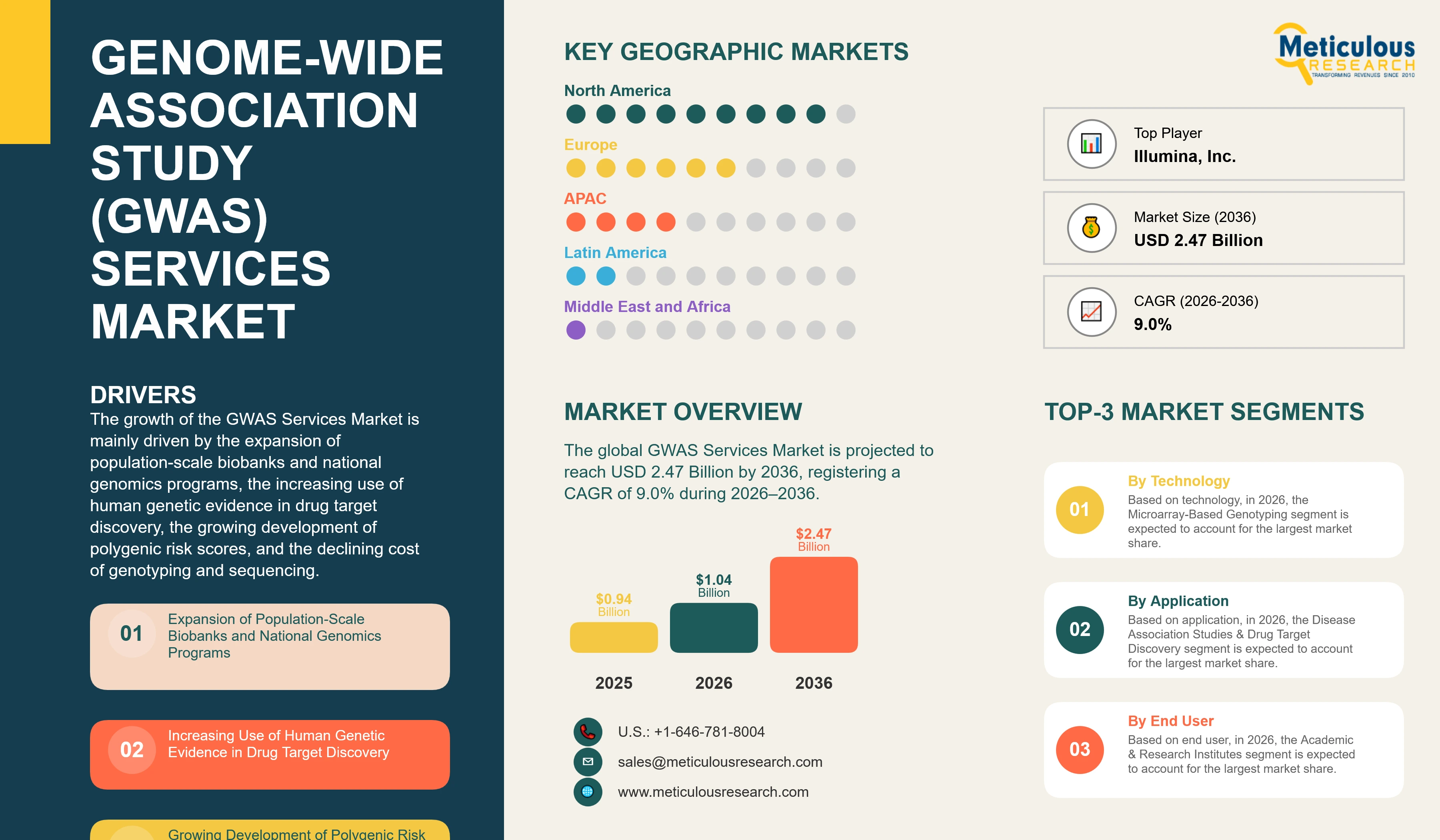
The global Genome-Wide Association Study (GWAS) Services Market was valued at USD 0.94 billion in 2025. This market is expected to reach USD 2.47 billion by 2036 from an estimated USD 1.04 billion in 2026, registering a CAGR of 9.0% during the forecast period (2026-2036).
- Published
- Oct 2026
- Pages
- 317
- Format
- PDF + Excel
- Report ID
- MR-2344
- Base year
- 2025
- 2025 · BASELINE
- $940.0M
- 2036
- $2.47B
- CAGR 2026–2036
- 9.0%
2025 baseline · 2026–2036 forecast at 9.0% CAGR · hover a bar for the value
Key highlights
The global GWAS Services Market is projected to reach USD 2.47 billion by 2036, driven by population-scale biobanks, genetics-guided drug discovery, polygenic risk scores, and lower-cost genotyping and sequencing.
North America is expected to account for the largest market share in 2026, while Asia-Pacific is projected to register the fastest growth during the forecast period. In June 2026, the All of Us Research Program of the U.S. National Institutes of Health (NIH) expanded its dataset to more than 747,000 participants, including 535,000 whole-genome sequences, nearly 482,000 linked electronic health records, and more than 1.3 billion genetic variants, with more than 86% of participants from communities historically underrepresented in health research.
Europe is home to some of the largest genotyping programs. Our Future Health, the largest health research program in the U.K., has recruited more than 2 million consented participants and made genotype array data for 755,000 participants available to researchers, with imputed genotype data covering more than 159 million genetic variants first released in December 2025 and genetic ancestry data released in May 2026; Eurofins Genomics was selected to perform genotyping for up to 5 million participants in a dedicated U.K. laboratory.
By service type, Genotyping Services are expected to account for the largest market share in 2026, whereas Statistical & Bioinformatics Analysis Services are projected to witness the fastest growth through 2036, driven by fine-mapping, polygenic risk score development, Mendelian randomization, and multiomic integration.
Ownership of large consumer genetic datasets is changing. In 2025, TTAM Research Institute, a nonprofit led by 23andMe co-founder Anne Wojcicki, received bankruptcy court approval to acquire substantially all assets of 23andMe, including its Personal Genome Service and Research Services businesses, for USD 305 million, topping an earlier USD 256 million proposal from Regeneron Pharmaceuticals.
Report summary
| Particulars | Details |
|---|---|
| Forecast Period | 2026-2036 |
| Base Year | 2025 |
| Estimated Year | 2026 |
| CAGR (Value) | 9.0% |
| Format | PDF, Excel & Cloud Portal · 317 pages |
| Market Size (Value) in 2026 | USD 1.04 Billion |
| Market Size (Value) in 2036 | USD 2.47 Billion |
| Segments Covered | By Service Type: Genotyping Services (Array-Based Genotyping, Low-Pass Sequencing with Imputation, Whole-Genome & Whole-Exome Sequencing), Imputation & Quality Control Services, Statistical & Bioinformatics Analysis Services (Association Testing, Fine-Mapping & Functional Annotation, Polygenic Risk Score Development, Mendelian Randomization & Multiomic Integration), Study Design & Consulting Services. By Technology: Microarray-Based Genotyping, Sequencing-Based Genotyping, Other Technologies. By Application: Disease Association Studies & Drug Target Discovery, Pharmacogenomics, Polygenic Risk Score Development, Population & Ancestry Studies, Agricultural Genomics (Plant Breeding, Animal Breeding), Other Applications. By End User: Academic & Research Institutes, Pharmaceutical & Biotechnology Companies, Biobanks & Population Health Programs, Agricultural & Animal Breeding Companies, Other End Users. |
| Countries Covered | North America: U.S., Canada. Europe: U.K., Germany, France, Finland, Netherlands, Denmark, Sweden, Rest of Europe. Asia-Pacific: China, Japan, South Korea, Taiwan, Singapore, India, Australia, Rest of Asia-Pacific. Latin America: Brazil, Argentina, Mexico, Rest of Latin America. Middle East & Africa: Saudi Arabia, UAE, Qatar, Rest of Middle East & Africa. |
| Key Companies | Illumina, Inc., Thermo Fisher Scientific Inc., Eurofins Scientific SE (Eurofins Genomics), LGC Limited (Biosearch Technologies), Novogene Co., Ltd., Azenta, Inc., and Macrogen, Inc. |
Report overview
Segments covered: service type, technology, application, end user.
The growth of this market is mainly driven by the expansion of population-scale biobanks and national genomics programs, the increasing use of human genetic evidence to identify and validate drug targets, the growing development of polygenic risk scores for disease risk prediction, and the declining cost of genotyping and low-pass sequencing with imputation. In addition, the growing emphasis on genetic diversity in research cohorts, the integration of GWAS with electronic health records and multiomic data, the use of genomic selection in plant and animal breeding, and the adoption of cloud-based analysis and artificial intelligence (AI) are further supporting the growth of this market.
The Genome-Wide Association Study (GWAS) Services Market, also referred to as the genetic association study services market, genome-wide genotyping and analysis services market, or GWAS outsourcing market, comprises the services used to design, perform, and analyze studies that test genetic variants across the genome for association with diseases, traits, and drug responses. GWAS services include genotyping using high-density microarrays, low-pass whole-genome sequencing with imputation, and whole-genome and whole-exome sequencing; sample processing and quality control; genotype imputation using reference panels; statistical association testing; and post-GWAS analysis, including fine-mapping, functional annotation, polygenic risk score (PRS) development, Mendelian randomization, and the integration of genetic data with clinical and multiomic data. Services are delivered by genomics service laboratories, contract research organizations, bioinformatics companies, technology providers, and academic genotyping centers. The market ecosystem extends from genotyping and sequencing platform providers to service laboratories, biobanks and population health programs, pharmaceutical and biotechnology companies, academic research institutions, and agricultural breeding companies.
The market is experiencing steady growth as GWAS has become one of the most productive approaches in human genetics. By comparing the genomes of large numbers of people with and without a disease or trait, GWAS identifies genetic loci that influence disease risk, providing insights into disease biology and potential drug targets. Because GWAS power increases with sample size, the field has shifted toward very large studies involving hundreds of thousands to millions of participants, driving demand for high-throughput, low-cost genotyping and analysis. Drug targets supported by human genetic evidence are more likely to succeed in clinical development, encouraging pharmaceutical companies to invest in large genetic studies and partnerships with biobanks.
Population-scale biobanks and national programs are the most important source of demand. Our Future Health, the largest health research program in the U.K., has recruited more than 2 million consented participants and made genotype array data for 755,000 participants available to researchers, with imputed genotype data covering more than 159 million genetic variants first released in December 2025 and genetic ancestry data released in May 2026; Eurofins Genomics was selected to perform genotyping for up to 5 million participants in a dedicated U.K. laboratory. In June 2026, the All of Us Research Program of the U.S. National Institutes of Health (NIH) expanded its dataset to more than 747,000 participants, including 535,000 whole-genome sequences, nearly 482,000 linked electronic health records, and more than 1.3 billion genetic variants, with more than 86% of participants from communities historically underrepresented in health research. The U.S. Department of Veterans Affairs Million Veteran Program has enrolled more than one million veterans and has published a study of the genetic architecture of 2,068 traits across diverse ancestries. These programs create large, linked genetic and health datasets that are analyzed by academic and pharmaceutical researchers, generating demand for genotyping, imputation, and analysis services.
The technology used for GWAS is evolving. High-density genotyping arrays, such as the Illumina Infinium and Thermo Fisher Scientific Axiom biobank arrays, remain the most cost-effective method for genotyping very large cohorts, with Our Future Health genotype array data covering 686,416 variants imputed to more than 159 million variants. At the same time, the declining cost of sequencing is making low-pass whole-genome sequencing with imputation and full whole-genome sequencing increasingly competitive, as reflected in the 535,000 whole-genome sequences in the All of Us dataset. Sequencing-based approaches capture rare variants and structural variants that arrays miss, supporting more comprehensive association studies.
The scope of GWAS is also expanding beyond discovery. PRS developed from GWAS results are being evaluated for disease risk prediction and targeted screening, pharmacogenomic GWAS identify genetic factors that influence drug response and adverse events, and post-GWAS methods such as fine-mapping and Mendelian randomization help identify causal genes and evaluate drug targets. GWAS methods are also widely used in agriculture, where genomic selection and association studies support plant and animal breeding. In addition, the analysis of diverse populations is a growing priority, as most historical GWAS were performed in people of European ancestry, limiting the applicability of results to other populations.
The competitive landscape includes genotyping and sequencing technology providers, genomics service laboratories, and bioinformatics providers. Illumina and Thermo Fisher Scientific supply the leading genotyping array platforms, while service providers such as Eurofins Genomics, LGC Biosearch Technologies, Novogene, Azenta Life Sciences, and Macrogen offer genotyping and sequencing services. The ownership of large genetic datasets is also changing. In 2025, TTAM Research Institute, a nonprofit led by 23andMe co-founder Anne Wojcicki, received bankruptcy court approval to acquire substantially all assets of 23andMe, including its Personal Genome Service and Research Services businesses, for USD 305 million, topping an earlier USD 256 million proposal from Regeneron Pharmaceuticals.
At the same time, the market faces challenges related to data privacy and governance, funding constraints, and the complexity of analyzing very large datasets. NIH funding for the All of Us Research Program was about USD 158 million in fiscal year 2025, roughly 71% lower than in fiscal year 2023, illustrating the impact of public funding constraints on large genomics programs. As a result, service providers that can deliver low cost per sample, high data quality, secure data handling, and advanced analysis are expected to capture the largest share of growth over the forecast period.
Report infographic
Market dynamics
15 factors across 5 forcesExpansion of Population-Scale Biobanks and National Genomics Programs
The expansion of population-scale biobanks and national genomics programs is a major factor driving the GWAS Services Market, as these programs generate the large, linked genetic and health datasets needed for powerful association studies. Our Future Health, the largest health research program in the U.K., has recruited more than 2 million consented participants and made genotype array data for 755,000 participants available to researchers, with imputed genotype data covering more than 159 million genetic variants first released in December 2025 and genetic ancestry data released in May 2026; Eurofins Genomics was selected to perform genotyping for up to 5 million participants in a dedicated U.K. laboratory. In June 2026, the All of Us Research Program of the U.S. National Institutes of Health (NIH) expanded its dataset to more than 747,000 participants, including 535,000 whole-genome sequences, nearly 482,000 linked electronic health records, and more than 1.3 billion genetic variants, with more than 86% of participants from communities historically underrepresented in health research.
Programs of this scale require high-throughput genotyping and sequencing laboratories, standardized quality control, and imputation using large reference panels, which are often provided by specialized service providers. As additional countries launch or expand national genomics programs, demand for large-scale genotyping and analysis services is expected to grow steadily over the forecast period.
Increasing Use of Human Genetic Evidence in Drug Target Discovery
The increasing use of human genetic evidence in drug target discovery is significantly accelerating market growth. Drug targets supported by genetic associations are more likely to succeed in clinical trials, and pharmaceutical companies are investing in large GWAS, biobank partnerships, and genetic data assets to identify and prioritize targets. The interest of Regeneron Pharmaceuticals in acquiring 23andMe, with a USD 256 million proposal, illustrates the value that pharmaceutical companies place on large genetic datasets linked to phenotype information. As drug developers seek genetic support for more programs, demand for GWAS, fine-mapping, and Mendelian randomization analysis is expected to increase.
Growing Development of Polygenic Risk Scores
The growing development of PRS is creating new demand for GWAS services. PRS combine the effects of many genetic variants identified by GWAS to estimate an individual risk of developing common diseases such as coronary artery disease, type 2 diabetes, and breast cancer. Large biobanks provide the data needed to develop and validate these scores, and health systems are evaluating their use for targeted screening and prevention. Our Future Health, for example, aims to use genetic data alongside health information to help predict disease risk. As PRS move toward clinical use, demand for large GWAS, multi-ancestry analysis, and validation studies is expected to grow.
Declining Cost of Genotyping and Sequencing
The declining cost of genotyping arrays, low-pass sequencing with imputation, and whole-genome sequencing is making very large GWAS more affordable. High-density arrays allow hundreds of thousands of variants to be genotyped at low cost per sample, and imputation expands the number of analyzed variants to more than 150 million, as reflected in the Our Future Health imputed dataset. At the same time, lower sequencing costs are enabling sequencing-based GWAS that capture rare variants. These cost reductions are expanding the number and size of GWAS performed, supporting demand for services.
Table of contents
12 chapters · 150 sections · 317 pages · click to expandSegmental analysis
| Segment | Largest share (2026) | Fastest growth (2026–2036) |
|---|---|---|
| By Service Type | Genotyping Services | Statistical & Bioinformatics Analysis Services |
| By Technology | Microarray-Based Genotyping | Sequencing-Based Genotyping |
| By Application | Disease Association Studies & Drug Target Discovery | Polygenic Risk Score Development |
| By End User | Academic & Research Institutes | Pharmaceutical & Biotechnology Companies |
By Service Type
- Genome-Wide Association Study (GWAS) Services Market Analysis by Service Type
- Genotyping services are further segmented into Array-Based Genotyping, Low-Pass Sequencing with Imputation, and Whole-Genome & Whole-Exome Sequencing.
- Statistical & bioinformatics analysis services are further segmented into Association Testing, Fine-Mapping & Functional Annotation, Polygenic Risk Score Development, and Mendelian Randomization & Multiomic Integration.
- The Genotyping Services segment is expected to account for the largest share of the global GWAS Services Market.
- The large share of this segment is mainly due to the large number of samples processed in population-scale programs and pharmaceutical studies, including the genotyping of up to 5 million Our Future Health participants by Eurofins Genomics, and the need for genotyping or sequencing in every GWAS.
- However, the Statistical & Bioinformatics Analysis Services segment is projected to register the highest CAGR during the forecast period.
- The rapid growth of this segment is attributed to the increasing complexity of GWAS datasets, the growing demand for fine-mapping, PRS development, and Mendelian randomization, and the integration of GWAS with electronic health records and multiomic data.
By Technology
- Genome-Wide Association Study (GWAS) Services Market Analysis by Technology
- The Microarray-Based Genotyping segment is expected to account for the largest market share, due to the low cost per sample of high-density arrays, their established use in the largest biobanks, and the availability of biobank-optimized arrays such as the Illumina Infinium and Thermo Fisher Scientific Axiom arrays.
- However, the Sequencing-Based Genotyping segment is projected to register the highest CAGR during the forecast period, owing to declining sequencing costs, the ability of sequencing to capture rare and structural variants, and the growing use of whole-genome sequencing in programs such as All of Us, which includes 535,000 whole-genome sequences.
By Application
- Genome-Wide Association Study (GWAS) Services Market Analysis by Application
- Agricultural genomics is further segmented into Plant Breeding and Animal Breeding.
- The Disease Association Studies & Drug Target Discovery segment is expected to account for the largest market share, due to the extensive use of GWAS to identify genetic risk factors for common and complex diseases and to support drug target identification and validation in pharmaceutical research.
- However, the Polygenic Risk Score Development segment is projected to register the highest CAGR during the forecast period, driven by the use of large biobanks to develop and validate risk scores, the evaluation of PRS for targeted screening and prevention, and the growing emphasis on multi-ancestry scores that perform well across populations.
By End User
- Genome-Wide Association Study (GWAS) Services Market Analysis by End User
- The Academic & Research Institutes segment is expected to account for the largest market share, as universities and research institutes conduct a large share of GWAS and analyze data from public biobanks.
- However, the Pharmaceutical & Biotechnology Companies segment is projected to register the highest CAGR during the forecast period, driven by the use of human genetic evidence in target discovery, investment in biobank partnerships and genetic data assets, and the growing use of pharmacogenomic studies in clinical development.
- The Biobanks & Population Health Programs segment is also expected to account for a significant share, supported by programs such as Our Future Health and All of Us.
Geographic analysis
North America
Largest shareIn 2026, North America is expected to account for the largest share of the global GWAS Services Market. The large share of this region is mainly attributed to the presence of large genomics programs, pharmaceutical and biotechnology companies, leading research institutions, and technology and service providers, including Illumina, Thermo Fisher Scientific, and Azenta Life Sciences. In June 2026, the All of Us Research Program of the U.S. National Institutes of Health (NIH) expanded its dataset to more than 747,000 participants, including 535,000 whole-genome sequences, nearly 482,000 linked electronic health records, and more than 1.3 billion genetic variants, with more than 86% of participants from communities historically underrepresented in health research. The Million Veteran Program has enrolled more than one million veterans, and large consumer genetic datasets, including those of 23andMe, now owned by TTAM Research Institute, also support genetic research. However, the reduction in NIH funding for All of Us, to about USD 158 million in fiscal year 2025, may moderate the growth of publicly funded programs. Canada is expected to contribute to regional growth, supported by academic genetics research and provincial genomics initiatives.
Europe
Europe is expected to account for a significant share of the market, supported by some of the largest biobanks and genotyping programs in the world. The U.K. is expected to account for the largest share within the region, as Our Future Health has recruited more than 2 million participants and made genotype data available for 755,000, with Eurofins Genomics genotyping up to 5 million participants in a dedicated U.K. laboratory, and UK Biobank continues to be one of the most widely used resources for GWAS. Finland, through the FinnGen study, and Iceland, through deCODE genetics, are also important centers of GWAS research, while Germany, France, the Netherlands, Denmark, Sweden, and Estonia are expected to contribute, supported by national biobanks and genomics programs.
Asia-Pacific
Fastest growthAsia-Pacific is projected to register the highest CAGR during the forecast period. The growth of this region is driven by the expansion of national biobanks and precision medicine programs, the large and genetically diverse population, and the growing need for population-specific genetic data, as most existing GWAS have focused on European-ancestry populations. China is expected to account for the largest share within Asia-Pacific, supported by large research cohorts and a strong genomics services industry, including Novogene, while Japan, through BioBank Japan, South Korea, home to Macrogen, Taiwan, Singapore, and India are expected to see strong growth. Agricultural genotyping for plant and animal breeding is also an important source of demand in the region.
Latin America
Latin America and the Middle East & Africa are expected to account for smaller shares of the market. In Latin America, demand is supported by agricultural genomics in Brazil and Argentina and by growing efforts to study admixed populations, while in the Middle East, national genome programs in Saudi Arabia, the UAE, and Qatar are expected to create demand for GWAS services, and research in Africa is increasingly important for understanding human genetic diversity.
Competitive landscape
The global GWAS Services Market is moderately fragmented, with genotyping and sequencing technology providers, large genomics service laboratories, contract research organizations, bioinformatics companies, and academic genotyping centers competing for projects. Market participants compete primarily on cost per sample, throughput and capacity for very large cohorts, data quality, turnaround time, coverage of diverse populations, imputation and analysis capabilities, data security, and the ability to support regulatory and consent requirements.
Leading companies are investing in high-throughput genotyping and sequencing laboratories, biobank-optimized arrays, low-pass sequencing and imputation workflows, cloud-based analysis, and partnerships with national biobanks and pharmaceutical companies. Recent examples include the genotyping of Our Future Health participants by Eurofins Genomics in a dedicated U.K. laboratory, the release of imputed genotype data by Our Future Health in December 2025 and genetic ancestry data in May 2026, the expansion of the All of Us dataset in June 2026, and the acquisition of 23andMe assets by TTAM Research Institute in 2025.
The report provides a comprehensive competitive assessment of the leading companies operating in the global GWAS Services Market. The key players profiled in the report include Illumina, Inc. (U.S.), Thermo Fisher Scientific Inc. (U.S.), Eurofins Scientific SE (Eurofins Genomics) (Luxembourg), LGC Limited (Biosearch Technologies) (U.K.), Novogene Co., Ltd. (China), Azenta, Inc. (U.S.), and Macrogen, Inc. (South Korea).
- Illumina, Inc.
- Thermo Fisher Scientific Inc.
- Eurofins Scientific SE · Eurofins Genomics
- LGC Limited · Biosearch Technologies
- Novogene Co., Ltd.
- Azenta, Inc.
- Macrogen, Inc
Expert perspectives
The GWAS Services Market is entering a period in which analysis and interpretation, rather than genotyping alone, are becoming the main sources of value. With genotype data available for 755,000 Our Future Health participants, more than 747,000 participants in All of Us, and more than one million veterans enrolled in the Million Veteran Program, the challenge is no longer generating genetic data at scale but turning associations into causal genes, drug targets, and clinically useful risk predictions. The binding constraint is shifting from the cost of genotyping to the ability to analyze very large, diverse, and linked datasets securely and to demonstrate clinical and commercial value.
Three structural changes are expected to shape competitive positions through 2036. First, sequencing-based approaches are gradually replacing arrays for many studies, increasing demand for sequencing, imputation, and rare variant analysis. Second, biobanks are moving analysis into secure cloud-based research environments, changing how service providers deliver analysis. Third, the emphasis on genetic diversity is expanding demand in Asia-Pacific, Latin America, the Middle East, and Africa.
For companies planning entry or expansion, the most defensible positions over the forecast period are likely to be found in post-GWAS analysis, fine-mapping, and PRS development, multi-ancestry genotyping and imputation, sequencing-based GWAS for rare variant discovery, and agricultural genotyping services. For established providers, the principal risks are public funding constraints, data privacy and consent requirements, and price competition in genotyping services.
Overall, the market is expected to grow steadily, with genotyping services, microarrays, disease association studies, and academic research providing the core of demand and analysis services, sequencing-based genotyping, PRS development, pharmaceutical customers, and Asia-Pacific providing the fastest growth.
Customer perspectives
Insights gathered during primary interviews with statistical geneticists, biobank leaders, and pharmaceutical genetics heads operating in this market highlight where procurement priorities are shifting. The following perspectives reflect recurring themes raised across these discussions.
“This reflects the growing value of post-GWAS analysis.”
“This indicates the importance of scale and data governance for biobank programs.”
“This points to the importance of genetic diversity in future GWAS.”
Frequently asked questions
The global GWAS Services Market is estimated at USD 1.04 billion in 2026.
Cite this report
Meticulous Research. (2026). GWAS Services Market - Global Opportunity Analysis And Industry Forecast (2026-2036) (Report No. MR-2344). Meticulous Market Research Pvt. Ltd. https://www.meticulousresearch.com/product/gwas-services-market-7027