Functional Genomics Market (2026-2036)
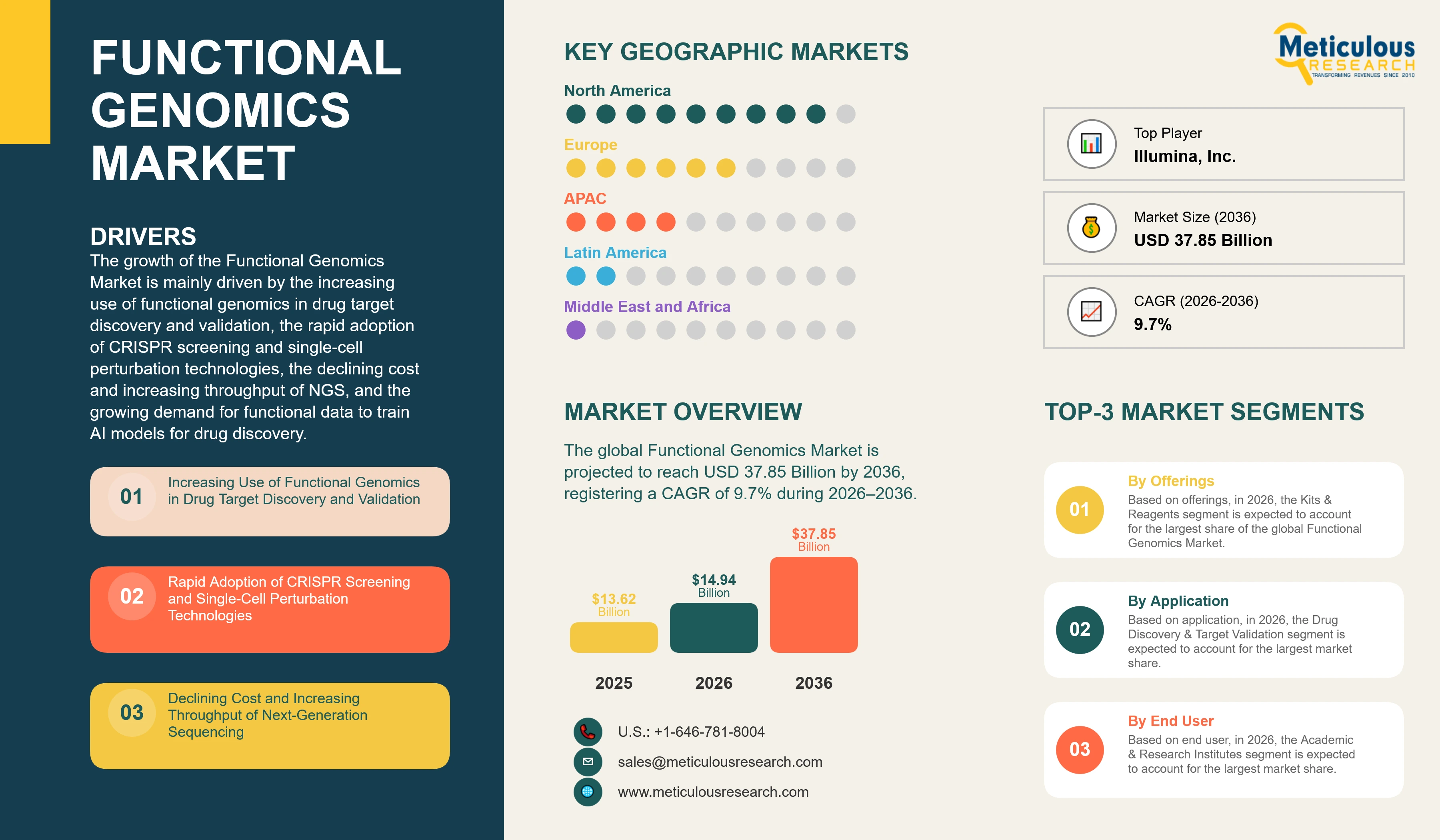
The global Functional Genomics Market was valued at USD 13.62 billion in 2025. This market is expected to reach USD 37.85 billion by 2036 from an estimated USD 14.94 billion in 2026, registering a CAGR of 9.7% during the forecast period (2026-2036).
- Published
- Oct 2026
- Pages
- 378
- Format
- PDF + Excel
- Report ID
- MR-2342
- Base year
- 2025
- 2025 · BASELINE
- $13.62B
- 2036
- $37.85B
- CAGR 2026–2036
- 9.7%
2025 baseline · 2026–2036 forecast at 9.7% CAGR · hover a bar for the value
Key highlights
The global Functional Genomics Market is projected to reach USD 37.85 billion by 2036, driven by drug target discovery, CRISPR screening, single-cell perturbation studies, and AI-enabled drug discovery.
North America is expected to account for the largest market share in 2026, while Asia-Pacific is projected to register the fastest growth during the forecast period. The National Human Genome Research Institute (NHGRI) of the U.S. National Institutes of Health launched the Molecular Phenotypes of Null Alleles in Cells (MorPhiC) program with USD 42.5 million over an initial five years, beginning with a pilot phase covering 1,000 protein-coding genes, as part of a long-term goal of establishing the function of every human gene.
By technology, Next-Generation Sequencing is expected to account for the largest market share in 2026, whereas CRISPR-Based Technologies are projected to witness the fastest growth through 2036. In January 2026, Illumina launched the Billion Cell Atlas, a dataset of 1 billion single cells from more than 200 disease-relevant cell lines with genome-wide CRISPR perturbations across all 20,000 human genes, as the first tranche of a planned 5 billion cell atlas over three years, with AstraZeneca, Merck, and Eli Lilly as founding participants and about 20 petabytes of single-cell transcriptomic data expected within a year.
Single-cell functional genomics is consolidating around scalable technologies. In November 2025, QIAGEN agreed to acquire Parse Biosciences, a provider of the instrument-free Evercode single-cell platform based on split-pool combinatorial barcoding, for about USD 225 million upfront plus up to USD 55 million in milestones, expecting Parse to add about USD 40 million in sales in 2026; Parse operates a GigaLab service with capacity of 2.5 billion cells per year.
By offering, Kits & Reagents are expected to account for the largest market share in 2026, while Services are projected to grow the fastest, as pharmaceutical companies and research institutions outsource large-scale screening and single-cell studies.
Report summary
| Particulars | Details |
|---|---|
| Forecast Period | 2026-2036 |
| Base Year | 2025 |
| Estimated Year | 2026 |
| CAGR (Value) | 9.7% |
| Format | PDF, Excel & Cloud Portal · 378 pages |
| Market Size (Value) in 2026 | USD 14.94 Billion |
| Market Size (Value) in 2036 | USD 37.85 Billion |
| Segments Covered | By Offering: Kits & Reagents (NGS Library Preparation & Sequencing Reagents, CRISPR Reagents & Libraries, RNAi Reagents & Libraries, Single-Cell Kits, PCR & qPCR Reagents, Other Kits & Reagents), Instruments (Sequencers, PCR Systems, Single-Cell Instruments, Microarray Systems, Other Instruments), Software & Bioinformatics, Services. By Technology: Next-Generation Sequencing, PCR & qPCR, Microarrays, CRISPR-Based Technologies, RNA Interference, Other Technologies. By Technique: Gene Expression Profiling, Genetic Perturbation Screening, Epigenomic Profiling, Single-Cell Functional Genomics, Other Techniques. By Application: Drug Discovery & Target Validation, Disease Mechanism Research, Biomarker Discovery, Cell & Gene Therapy Development, Agricultural & Synthetic Biology Research, Other Applications. By End User: Academic & Research Institutes, Pharmaceutical & Biotechnology Companies, Contract Research Organizations, Other End Users. |
| Countries Covered | North America: U.S., Canada. Europe: Germany, U.K., France, Switzerland, Netherlands, Sweden, Denmark, Rest of Europe. Asia-Pacific: China, Japan, South Korea, India, Australia, Singapore, Rest of Asia-Pacific. Latin America: Brazil, Mexico, Rest of Latin America. Middle East & Africa: Saudi Arabia, UAE, Qatar, Rest of Middle East & Africa. |
| Key Companies | Illumina, Inc., Thermo Fisher Scientific Inc., Agilent Technologies, Inc., QIAGEN N.V., Bio-Rad Laboratories, Inc., 10x Genomics, Inc., Revvity, Inc., Merck KGaA, Danaher Corporation (Integrated DNA Technologies), Takara Bio Inc., and GenScript Biotech Corporation. |
Report overview
Segments covered: offering, technology, technique, application, end user.
The growth of this market is mainly driven by the increasing use of functional genomics to identify and validate drug targets, the rapid adoption of CRISPR-based genetic screening and single-cell perturbation technologies, the declining cost and increasing throughput of next-generation sequencing (NGS), and the growing demand for large functional datasets to train artificial intelligence (AI) models for drug discovery. In addition, government initiatives to determine the function of every human gene, the growth of cell and gene therapy development, and the expansion of transcriptomic and epigenomic research in oncology, immunology, and neuroscience are further supporting the growth of this market.
The Functional Genomics Market, also referred to as the gene function analysis market, functional genomic screening market, or genome function research market, comprises the kits and reagents, instruments, software, and services used to determine how genes and genetic variants affect the function of cells and organisms. Functional genomics studies gene expression, gene regulation, and the effects of turning genes on and off, using technologies such as RNA sequencing, single-cell sequencing, epigenomic profiling, quantitative PCR (qPCR), microarrays, CRISPR-based gene editing and screening, and RNA interference (RNAi). The market includes library preparation and sequencing reagents, CRISPR guide RNA libraries, nucleases, and screening reagents, RNAi libraries, single-cell and epigenomic kits, qPCR and microarray reagents, sequencers, PCR systems, and single-cell instruments, bioinformatics software, and functional genomics services. The market ecosystem extends from technology and reagent providers to service companies, academic and government research institutions, pharmaceutical and biotechnology companies, and contract research organizations.
The market is experiencing strong growth as researchers seek to move from identifying genetic variants to understanding what they do. Genome sequencing has identified millions of genetic variants associated with disease, but the function of many genes and most non-coding variants remains unknown. Functional genomics addresses this gap by measuring how genes are expressed and regulated and by systematically perturbing genes to observe their effects on cells. The National Human Genome Research Institute (NHGRI) of the U.S. National Institutes of Health launched the Molecular Phenotypes of Null Alleles in Cells (MorPhiC) program with USD 42.5 million over an initial five years, beginning with a pilot phase covering 1,000 protein-coding genes, as part of a long-term goal of establishing the function of every human gene. Programs such as this, together with consortia studying the impact of genomic variation on function, are creating large public resources and driving demand for screening, sequencing, and analysis technologies.
Pharmaceutical companies are a major source of demand, as functional genomics helps identify and validate drug targets, understand disease mechanisms, and predict drug response. The combination of CRISPR perturbations with single-cell RNA sequencing, often referred to as Perturb-seq, allows researchers to measure the effects of thousands of genetic changes on gene expression in individual cells. In January 2026, Illumina launched the Billion Cell Atlas, a dataset of 1 billion single cells from more than 200 disease-relevant cell lines with genome-wide CRISPR perturbations across all 20,000 human genes, as the first tranche of a planned 5 billion cell atlas over three years, with AstraZeneca, Merck, and Eli Lilly as founding participants and about 20 petabytes of single-cell transcriptomic data expected within a year. Merck plans to use the data to train AI and machine learning foundation models and to build virtual cell models, illustrating how functional genomics data are becoming a key input for AI-driven drug discovery.
The single-cell segment of the market is growing rapidly and consolidating around technologies that can analyze millions to billions of cells. In November 2025, QIAGEN agreed to acquire Parse Biosciences, a provider of the instrument-free Evercode single-cell platform based on split-pool combinatorial barcoding, for about USD 225 million upfront plus up to USD 55 million in milestones, expecting Parse to add about USD 40 million in sales in 2026; Parse operates a GigaLab service with capacity of 2.5 billion cells per year. In August 2025, 10x Genomics agreed to acquire Scale Biosciences to integrate combinatorial indexing and quantum barcoding technologies into its Chromium platform, with the aim of dramatically scaling the number of cells and samples that can be analyzed to support AI-driven research. 10x Genomics reported revenue of USD 301.9 million in the first half of 2026 and launched its Atera in situ spatial biology platform in April 2026, reflecting the continued expansion of single-cell and spatial functional genomics.
CRISPR-based tools continue to expand the capabilities of functional genomics. Pooled and arrayed CRISPR knockout, interference (CRISPRi), and activation (CRISPRa) screens allow researchers to study gene function at genome scale, while base editing and prime editing enable the functional analysis of specific genetic variants. Suppliers such as Thermo Fisher Scientific, Merck KGaA, Revvity, Integrated DNA Technologies (Danaher), GenScript, Takara Bio, and Synthego provide CRISPR reagents and libraries. Synthego, a CRISPR solutions provider, was acquired by funds managed by Perceptive Advisors in July 2025 and continues to operate under its own brand.
Beyond drug discovery, functional genomics is widely used in disease research and biomarker discovery. Transcriptomic and epigenomic profiling help researchers understand how gene regulation changes in cancer, autoimmune and inflammatory diseases, neurological disorders, and rare genetic diseases, while qPCR remains a standard method for validating gene expression changes in research and translational studies. In cell and gene therapy development, CRISPR screens are used to identify genes that improve the function and persistence of engineered immune cells, and transcriptomic analysis supports the characterization of therapeutic cell products. Functional genomics is also applied in agricultural and synthetic biology research to engineer crops and microbial production strains with improved traits.
At the same time, the market faces challenges related to the cost of large-scale studies, the complexity of data analysis, and constraints on academic research funding. Genome-wide single-cell perturbation studies generate petabytes of data, requiring advanced computing infrastructure and bioinformatics expertise. As a result, providers that can offer scalable workflows, lower cost per cell or per screen, and integrated data analysis are expected to capture the largest share of growth over the forecast period.
Report infographic
Market dynamics
15 factors across 5 forcesIncreasing Use of Functional Genomics in Drug Target Discovery and Validation
The increasing use of functional genomics in drug target discovery and validation is a major factor driving the Functional Genomics Market, as pharmaceutical companies seek stronger evidence that modulating a target will affect disease before investing in drug development. Functional genomics screens identify genes that are essential for disease processes, reveal mechanisms of drug resistance, and validate targets suggested by human genetics. The founding participation of AstraZeneca, Merck, and Eli Lilly in the Illumina Billion Cell Atlas, which is designed to validate genetic drug targets and characterize drug and disease mechanisms, reflects the importance of functional genomics to pharmaceutical research.
As drug developers seek to improve the success rates of clinical programs, demand for genome-scale screening, single-cell perturbation studies, and transcriptomic profiling is growing across discovery and preclinical development. These trends are increasing demand for CRISPR libraries, sequencing reagents, and functional genomics services.
Rapid Adoption of CRISPR Screening and Single-Cell Perturbation Technologies
The rapid adoption of CRISPR screening and single-cell perturbation technologies is significantly accelerating market growth. CRISPR-based screens allow researchers to knock out, repress, or activate genes at genome scale, and the combination of CRISPR perturbations with single-cell sequencing allows the effects of each perturbation to be measured across thousands of genes in individual cells. In January 2026, Illumina launched the Billion Cell Atlas, a dataset of 1 billion single cells from more than 200 disease-relevant cell lines with genome-wide CRISPR perturbations across all 20,000 human genes, as the first tranche of a planned 5 billion cell atlas over three years, with AstraZeneca, Merck, and Eli Lilly as founding participants and about 20 petabytes of single-cell transcriptomic data expected within a year.
These approaches generate far richer data than traditional screens, but require large numbers of cells, guide RNA libraries, and sequencing capacity. As Perturb-seq and related methods are adopted by pharmaceutical companies and research institutions, demand for CRISPR reagents, single-cell kits, and sequencing is expected to grow strongly over the forecast period.
Declining Cost and Increasing Throughput of Next-Generation Sequencing
The declining cost and increasing throughput of NGS are making large-scale functional genomics studies more affordable. RNA sequencing, single-cell sequencing, and epigenomic profiling all rely on NGS, and higher-throughput sequencers and scalable library preparation methods allow millions to billions of cells to be analyzed. Parse Biosciences operates a GigaLab service with capacity of 2.5 billion cells per year, and the Illumina Single Cell 3’ RNA prep platform captures millions of cells per experiment. These advances are expanding the scale of functional genomics studies and driving demand for sequencing reagents and services.
Growing Demand for Functional Data to Train AI Models for Drug Discovery
The growing use of AI in drug discovery is creating strong demand for large, high-quality functional genomics datasets. AI models that predict how cells respond to genetic and chemical perturbations, sometimes described as virtual cell models, require training data from large perturbation experiments. The Illumina Billion Cell Atlas is designed in part to train AI models at scale, Merck plans to use its data to build AI and machine learning foundation models, and Scale Biosciences co-founder Garry Nolan has described scalable single-cell data as necessary to drive AI-powered breakthroughs in medicine. This driver is expected to support demand for large-scale perturbation studies and data generation services.
Table of contents
13 chapters · 164 sections · 378 pages · click to expandSegmental analysis
| Segment | Largest share (2026) | Fastest growth (2026–2036) |
|---|---|---|
| By Offering | Kits & Reagents | Services |
| By Technology | Next-Generation Sequencing | CRISPR-Based Technologies |
| By Technique | Gene Expression Profiling | Single-Cell Functional Genomics |
| By Application | Drug Discovery & Target Validation | Cell & Gene Therapy Development |
| By End User | Academic & Research Institutes | Pharmaceutical & Biotechnology Companies |
By Offering
- Functional Genomics Market Analysis by Offering
- Kits & reagents are further segmented into NGS Library Preparation & Sequencing Reagents, CRISPR Reagents & Libraries, RNAi Reagents & Libraries, Single-Cell Kits, PCR & qPCR Reagents, and Other Kits & Reagents.
- Instruments are further segmented into Sequencers, PCR Systems, Single-Cell Instruments, Microarray Systems, and Other Instruments.
- The Kits & Reagents segment is expected to account for the largest share of the global Functional Genomics Market.
- The large share of this segment is mainly due to the recurring use of sequencing reagents, CRISPR and RNAi libraries, single-cell kits, and PCR reagents in every functional genomics experiment, and the large installed base of sequencers and PCR systems in research and pharmaceutical laboratories.
- However, the Services segment is projected to register the highest CAGR during the forecast period.
- The rapid growth of this segment is attributed to the increasing outsourcing of large-scale CRISPR screening and single-cell studies, the emergence of high-capacity services such as the Parse Biosciences GigaLab with capacity of 2.5 billion cells per year, and the launch of functional genomics data products such as the Illumina Billion Cell Atlas.
- The Software & Bioinformatics segment is also expected to record strong growth, driven by the increasing size of functional datasets and the use of AI for data analysis, while the Instruments segment is expected to grow steadily with the adoption of higher-throughput sequencers and single-cell platforms.
By Technology
- Functional Genomics Market Analysis by Technology
- The Next-Generation Sequencing segment is expected to account for the largest market share, due to the central role of RNA sequencing, single-cell sequencing, and epigenomic profiling in functional genomics, and the use of sequencing as the readout for most large-scale CRISPR and perturbation screens.
- However, the CRISPR-Based Technologies segment is projected to register the highest CAGR during the forecast period, owing to the rapid adoption of genome-wide CRISPR knockout, interference, and activation screens, the growth of single-cell perturbation studies such as the genome-wide perturbations of the Illumina Billion Cell Atlas, and the use of base editing and prime editing for variant-to-function studies.
- The RNA Interference and Microarrays segments are expected to grow more slowly, as researchers increasingly shift to CRISPR and sequencing-based methods.
By Technique
- Functional Genomics Market Analysis by Technique
- The Gene Expression Profiling segment is expected to account for the largest market share, due to the wide use of RNA sequencing and qPCR across research, drug discovery, and biomarker studies.
- However, the Single-Cell Functional Genomics segment is projected to register the highest CAGR during the forecast period, driven by the scaling of single-cell studies to millions and billions of cells, the integration of single-cell readouts with CRISPR perturbations, and acquisitions such as those of Parse Biosciences by QIAGEN and Scale Biosciences by 10x Genomics.
By Application
- Functional Genomics Market Analysis by Application
- The Drug Discovery & Target Validation segment is expected to account for the largest market share, due to the extensive use of functional genomics by pharmaceutical companies to identify and validate targets and understand drug mechanisms, as reflected in the participation of AstraZeneca, Merck, and Eli Lilly in the Billion Cell Atlas.
- However, the Cell & Gene Therapy Development segment is projected to register the highest CAGR during the forecast period, supported by the use of CRISPR screens to optimize engineered cell therapies and the growth of the cell and gene therapy pipeline.
By End User
- Functional Genomics Market Analysis by End User
- The Academic & Research Institutes segment is expected to account for the largest market share, as universities, research institutes, and government-funded programs such as MorPhiC conduct a large share of functional genomics research.
- However, the Pharmaceutical & Biotechnology Companies segment is projected to register the highest CAGR during the forecast period, driven by the use of functional genomics in target discovery, AI-driven drug discovery, and cell and gene therapy development, while constraints on academic funding are expected to moderate growth in the academic segment.
Geographic analysis
North America
Largest shareIn 2026, North America is expected to account for the largest share of the global Functional Genomics Market. The large share of this region is mainly attributed to strong public and private research funding, the presence of leading research institutions and genome centers, the concentration of pharmaceutical and biotechnology companies, and the presence of leading technology providers, including Illumina, Thermo Fisher Scientific, Agilent Technologies, Bio-Rad Laboratories, 10x Genomics, and Integrated DNA Technologies. The National Human Genome Research Institute (NHGRI) of the U.S. National Institutes of Health launched the Molecular Phenotypes of Null Alleles in Cells (MorPhiC) program with USD 42.5 million over an initial five years, beginning with a pilot phase covering 1,000 protein-coding genes, as part of a long-term goal of establishing the function of every human gene. The Illumina Billion Cell Atlas, developed with AstraZeneca, Merck, and Eli Lilly, further reflects the strength of the U.S. ecosystem. However, constraints on U.S. academic research funding reported by life science tools companies in 2026 may moderate near-term growth. Canada is expected to contribute to regional growth, supported by academic genomics research and a growing AI-driven drug discovery sector.
Europe
Europe is expected to account for a significant share of the market, supported by strong academic research, large pharmaceutical companies, and the presence of technology providers such as QIAGEN and Merck KGaA in Germany. The U.K. is an important market, with major genome research centers and pharmaceutical research and development, including AstraZeneca, a founding participant in the Billion Cell Atlas. Switzerland, France, the Netherlands, Sweden, and Denmark are also expected to contribute significantly, supported by pharmaceutical research and development and academic research institutions.
Asia-Pacific
Fastest growthAsia-Pacific is projected to register the highest CAGR during the forecast period. The growth of this region is driven by expanding research and development investment, growing biopharmaceutical industries, national precision medicine programs, and the presence of genomics service providers and reagent suppliers. China is expected to account for the largest share within Asia-Pacific, supported by large investments in life science research and a strong genomics services industry, while Japan, home to Takara Bio, is an important market for gene expression and gene editing tools. South Korea, Singapore, Australia, and India are expected to see strong growth, supported by biotechnology research and contract research services.
Latin America
Latin America and the Middle East & Africa are expected to account for smaller shares of the market. In Latin America, demand is supported by academic research and agricultural genomics in Brazil and Mexico, while in the Middle East, national genomic medicine programs in Saudi Arabia, the UAE, and Qatar are expected to create demand for functional genomics research.
Competitive landscape
The global Functional Genomics Market is moderately consolidated, with a group of large life science tools companies offering sequencing, PCR, and reagent portfolios, alongside specialized providers of CRISPR reagents, single-cell technologies, bioinformatics software, and services. Market participants compete primarily on throughput, cost per sample or per cell, data quality, breadth of reagent and library portfolios, integration of workflows from sample to analysis, software and AI capabilities, and global support.
Leading companies are pursuing acquisitions, developing scalable single-cell and screening technologies, launching data products, and investing in bioinformatics and AI. Recent examples include the agreement by 10x Genomics to acquire Scale Biosciences in August 2025, the acquisition of Synthego by funds managed by Perceptive Advisors in July 2025, the agreement by QIAGEN to acquire Parse Biosciences in November 2025, the launch of the Illumina Billion Cell Atlas in January 2026, and the launch of the 10x Genomics Atera platform in April 2026.
The report provides a comprehensive competitive assessment of the leading companies operating in the global Functional Genomics Market. The key players profiled in the report include Illumina, Inc. (U.S.), Thermo Fisher Scientific Inc. (U.S.), Agilent Technologies, Inc. (U.S.), QIAGEN N.V. (Netherlands), Bio-Rad Laboratories, Inc. (U.S.), 10x Genomics, Inc. (U.S.), Revvity, Inc. (U.S.), Merck KGaA (Germany), Danaher Corporation (Integrated DNA Technologies) (U.S.), Takara Bio Inc. (Japan), and GenScript Biotech Corporation (China).
- Illumina, Inc.
- Thermo Fisher Scientific Inc.
- Agilent Technologies, Inc.
- QIAGEN N.V.
- Bio-Rad Laboratories, Inc.
- 10x Genomics, Inc.
- Revvity, Inc.
- Merck KGaA
- Danaher Corporation (Integrated DNA Technologies)
- Takara Bio Inc.
- GenScript Biotech Corporation
Expert perspectives
The Functional Genomics Market is entering a period in which the scale of perturbation data, rather than the ability to perform individual experiments, is becoming the main source of competitive advantage. With a billion-cell genome-wide CRISPR perturbation atlas built with three major pharmaceutical companies, single-cell services capable of analyzing billions of cells per year, and pharmaceutical companies using functional data to train AI foundation models, functional genomics is moving from hypothesis-driven experiments toward systematic, data-driven drug discovery. The binding constraint is shifting from the cost of generating data to the ability to analyze, interpret, and act on petabyte-scale datasets.
Three structural changes are expected to shape competitive positions through 2036. First, single-cell technologies are consolidating within larger platform companies, including 10x Genomics and QIAGEN, favoring scalable, low-cost methods. Second, CRISPR-based screening is replacing RNAi and expanding into variant-to-function and cell therapy applications. Third, functional genomics is becoming a data business, with providers offering data products and services in addition to reagents and instruments.
For companies planning entry or expansion, the most defensible positions over the forecast period are likely to be found in large-scale perturbation services and data products, AI-enabled analysis software, variant-to-function assays for precision medicine, and CRISPR tools for cell and gene therapy development. For established providers, the principal risks are constrained academic funding, the complexity of data analysis, and challenges in translating screening results to human biology.
Overall, the market is expected to grow strongly, with kits and reagents, NGS, gene expression profiling, and pharmaceutical drug discovery providing the core of demand and services, CRISPR technologies, single-cell functional genomics, cell and gene therapy, and Asia-Pacific providing the fastest growth.
Customer perspectives
Insights gathered during primary interviews with functional genomics heads, single-cell core directors, and computational biologists operating in this market highlight where procurement priorities are shifting. The following perspectives reflect recurring themes raised across these discussions.
“This reflects the role of perturbation studies in target selection.”
“This indicates the importance of scalability in single-cell purchasing.”
“This points to the growing value of functional genomics data for AI.”
Frequently asked questions
The global Functional Genomics Market is estimated at USD 14.94 billion in 2026.
Cite this report
Meticulous Research. (2026). Functional Genomics Market - Global Opportunity Analysis And Industry Forecast (2026-2036) (Report No. MR-2342). Meticulous Market Research Pvt. Ltd. https://www.meticulousresearch.com/product/functional-genomics-market-7025