
Engineering Plastics Market (2026-2036)
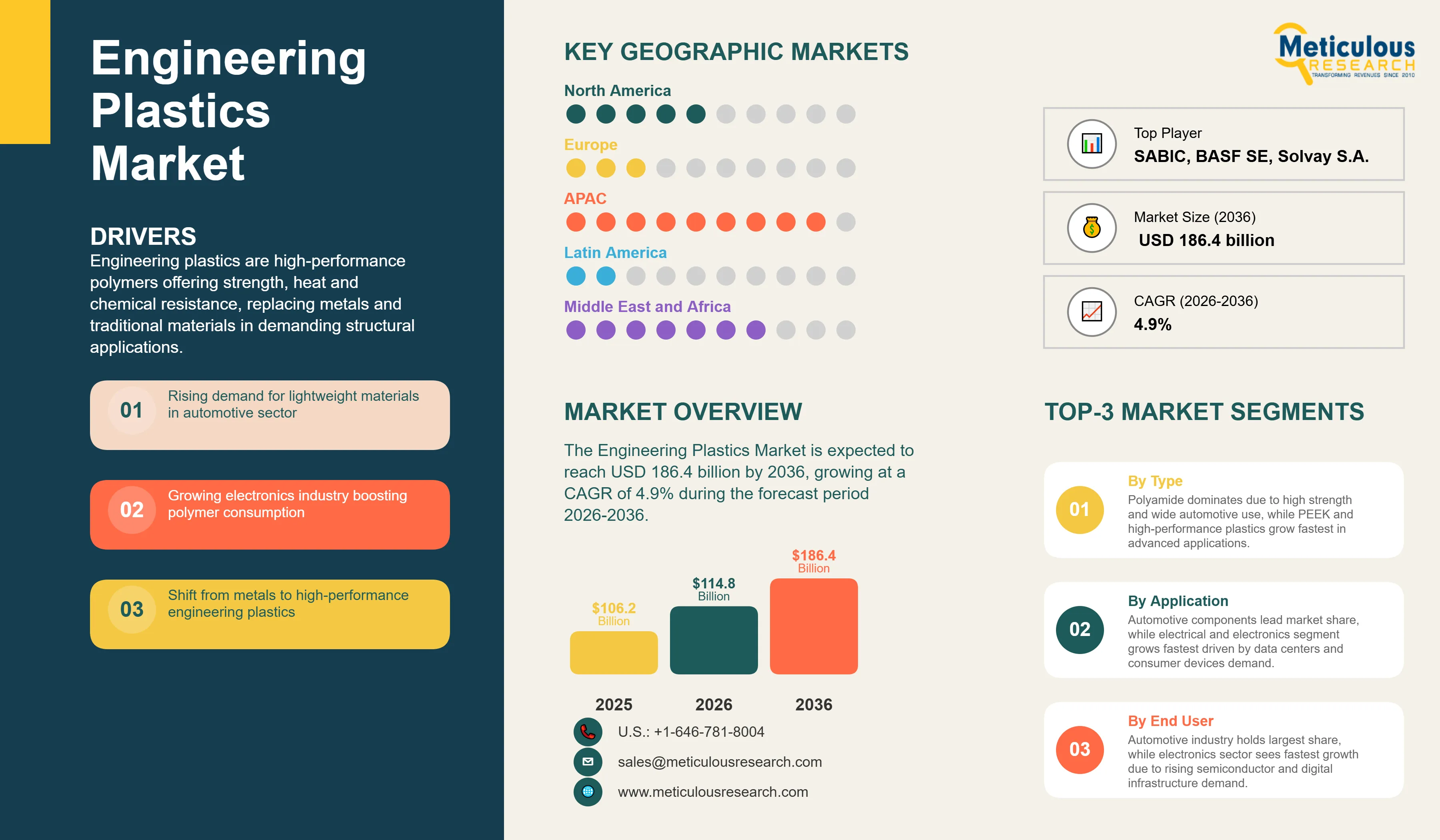
The Engineering Plastics Market was valued at USD 106.2 billion in 2025. This market is expected to reach USD 186.4 billion by 2036 from an estimated USD 114.8 billion in 2026, growing at a CAGR of 4.9% during the forecast period 2026-2036.
- Published
- May 2026
- Pages
- 310
- Format
- PDF + Excel
- Report ID
- MRAUTO - 1041956
- Base year
- 2025
- 2025 · BASELINE
- $106.2B
- 2036
- $186.4B
- CAGR 2026–2036
- 4.9%
2025 baseline · 2026–2036 forecast at 4.9% CAGR · hover a bar for the value
Key highlights
The global engineering plastics market is projected to reach USD 186.4 billion by 2036.
The market is expected to grow at a CAGR of 4.9% during the forecast period 2026-2036.
The global market for engineering plastics was valued at USD 106.2 billion in 2025 and is estimated to reach USD 114.8 billion in 2026.
Asia-Pacific is expected to dominate the global engineering plastics market with the largest market share in 2026, while the Middle East and Africa is projected to register the highest CAGR during the forecast period.
By polymer type, the polyamide (nylon) segment is expected to hold the largest share of the market in 2026, while the PEEK and high-performance plastics segment is projected to register the highest CAGR during the forecast period.
By application, the automotive components segment is expected to hold the largest share in 2026, while the electrical and electronics segment is projected to register the highest CAGR during the forecast period.
By end-use industry, the automotive segment is expected to hold the largest share in 2026, while the electrical and electronics segment is projected to register the highest CAGR during the forecast period.
By processing method, the injection molding segment is expected to hold the largest share in 2026, while the 3D printing segment is projected to register the highest CAGR during the forecast period.
By reinforcement type, the glass fiber reinforced segment is expected to hold the largest share in 2026, while the carbon fiber reinforced segment is projected to register the highest CAGR during the forecast period.
Report summary
| Particulars | Details |
|---|---|
| Market Size by 2036 | USD 186.4 Billion |
| Market Size in 2026 | USD 114.8 Billion |
| Market Size in 2025 | USD 106.2 Billion |
| Revenue Growth Rate (2026-2036) | CAGR of 4.9% |
| Format | PDF, Excel & Cloud Portal · 310 pages |
| Dominating Polymer Type | Polyamide (PA/Nylon) |
| Fastest Growing Polymer Type | PEEK and High-Performance Plastics |
| Dominating Application | Automotive Components |
| Fastest Growing Application | Electrical and Electronics |
| Dominating End-Use Industry | Automotive |
| Fastest Growing End-Use Industry | Electrical & Electronics |
| Dominating Processing Method | Injection Molding |
| Fastest Growing Processing Method | 3D Printing (Additive Manufacturing) |
| Dominating Reinforcement Type | Glass Fiber Reinforced |
| Fastest Growing Reinforcement Type | Carbon Fiber Reinforced |
| Dominating Geography | Asia-Pacific |
| Fastest Growing Geography | Middle East & Africa |
| Base Year | 2025 |
| Forecast Period | 2026 to 2036 |
Report overview
Segments covered: polymer type, application, end-use industry.
Engineering plastics are high-performance polymer materials that deliver mechanical strength, thermal resistance, chemical stability, and dimensional precision that commodity plastics cannot provide, making them the materials of choice wherever performance matters more than cost in automotive, electronics, medical, and industrial applications globally
Based on polymer type, the global engineering plastics market is segmented into polyamide (PA6, PA66, and other polyamides), polycarbonate, polyoxymethylene (acetal), ABS, PBT, PET, fluoropolymers (PTFE and PVDF), PEEK, and other engineering plastics. In 2026, the polyamide segment is expected to account for the largest share of the global engineering plastics market. Polyamide is the most broadly and heavily used engineering plastic globally, with PA6 and PA66 grades consumed in very large volumes across automotive under-the-hood components, gear systems, bearing cages, electrical connectors, and industrial components. The automotive sector's strong adoption of glass-fiber-reinforced PA66 for engine covers, air intake manifolds, cooling system components, and structural brackets makes polyamide the dominant engineering plastic by volume across the industry's largest end-use sector. According to BASF's 2025 portfolio communications, polyamide remains the highest-volume engineering plastic in its Ultramid range, and Ascend Performance Materials, one of the world's largest integrated PA66 producers, has invested in capacity expansion to serve growing EV and automotive demand.
However, the PEEK and high-performance plastics segment is projected to register the highest CAGR during the forecast period. The expansion of PEEK and related high-performance polymers into medical device, semiconductor equipment, and EV powertrain applications is growing faster than the broader engineering plastics market. According to Victrex's 2025 half-year results, its medical and electronics segments grew at above-average rates, driven by PEEK implant adoption and semiconductor equipment applications
Report infographic
Market dynamics
7 factors across 3 forcesIncreasing Demand for Lightweight Materials in Automotive and Aerospace
Lightweighting through engineering plastic substitution for metal parts remains one of the most commercially active drivers of engineering plastics demand, amplified by the EV transition that creates a particularly strong incentive for every kilogram of weight reduction because reduced vehicle mass directly extends battery range. According to the IEA's Global EV Outlook 2025, global EV sales reached approximately 17 million units in 2024, and the automotive engineering plastics demand from this growing EV fleet adds a fast-growing incremental demand layer above the established ICE vehicle engineering plastics base. OICA's 2025 data showing global vehicle production at approximately 96 million units in 2025 confirms the sustained scale of baseline automotive engineering plastics demand. In aerospace, the ongoing fleet renewal programs of Boeing and Airbus with their composite and high-performance polymer-intensive airframe designs continue to drive demand for PEEK, PEI, and specialty engineering polymers in structural and functional aircraft components
Growth in Electrical & Electronics Industry
The electronics industry is a major and growing consumer of engineering plastics, particularly polycarbonate, ABS, PBT, and high-performance polyamides, across applications from consumer device housings to connector systems for telecommunications infrastructure. According to the Semiconductor Industry Association's 2025 Global Semiconductor Sales report, global semiconductor sales grew to approximately USD 630 billion in 2024, representing a major recovery and growth cycle that is driving investment in electronics manufacturing equipment, printed circuit boards, and electronic assemblies that each consume engineering plastics. The expansion of data center infrastructure to support AI workloads, with the major hyperscale operators continuing their unprecedented capital expenditure in 2025, is driving growing demand for polycarbonate and engineering polymer housings, frames, and structural components in server and networking equipment
Table of contents
13 chapters · 180 sections · 310 pages · click to expandSegmental analysis
| Segment | Largest share (2026) | Fastest growth (2026–2036) |
|---|---|---|
| By Application | Automotive Components | Electrical and electronics |
| By Processing Method | Injection Molding | 3D printing |
By Application
- Automotive Components to Hold the Largest Share
- The automotive components segment is expected to account for the largest share of the global engineering plastics market.
- The automotive industry is by far the largest single end-use application for engineering plastics globally, consuming polyamide, polycarbonate, PBT, ABS, POM, and other engineering polymers across thousands of individual part applications in every vehicle.
- According to OICA's 2025 data, global motor vehicle production reached approximately 96 million units in 2025, and at an estimated average of 15 to 20 kilograms of engineering plastics per vehicle across the full range from economy to premium models, this represents several million tonnes of annual consumption.
- However, the electrical and electronics segment is projected to register the highest CAGR during the forecast period.
- The growth of data center infrastructure, AI computing equipment, 5G telecommunications, consumer electronics, and EV charging stations is driving above-average growth in engineering plastics demand for electronic component housings, connector systems, and thermal management structures.
- According to the Semiconductor Industry Association's 2025 report, the USD 630 billion global semiconductor market in 2024 underpins a large and growing electronics manufacturing base that requires engineering plastic materials throughout the supply chain
By Processing Method
- Injection Molding to Hold the Largest Share
- The injection molding segment is expected to account for the largest share of the global engineering plastics market.
- Injection molding is the dominant processing method for engineering plastics by volume, enabling the high-volume, high-precision production of complex three-dimensional engineering plastic parts that is the standard manufacturing approach across automotive, electronics, and consumer goods industries.
- The very large installed base of injection molding machines globally and the economics of high-volume precision part production make this the most widely used processing method for engineering polymers.
- However, the 3D printing segment is projected to register the highest CAGR during the forecast period.
- The growing qualification of engineering polymer additive manufacturing for production-grade end-use parts in medical, aerospace, and industrial applications is driving strong growth in engineering plastic filaments and powders for 3D printing from a currently small but rapidly growing base
Geographic analysis
Asia-Pacific
Largest shareIn 2026, Asia-Pacific is expected to account for the largest share of the global engineering plastics market. The region's dominance reflects China's position as the world's largest vehicle producing country, the world's largest electronics manufacturing base, and the home of the world's largest engineering plastics consumption. According to OICA's 2025 preliminary data, China produced approximately 31 million vehicles in 2024, sustaining its position as the world's single largest automotive engineering plastics market. China is also the world's largest EV market, with the China Passenger Car Association reporting over 12 million new energy vehicle sales in 2024, generating very large and growing demand for EV-specific engineering plastic grades. Japan, South Korea, and Taiwan are home to leading electronics and semiconductor manufacturers including Samsung, SK Hynix, TSMC, Sony, and Toyota that are major engineering plastics consumers, and India's rapidly growing automotive and electronics industries are adding significant incremental demand as Indian vehicle production and domestic electronics manufacturing scale up. India remains one of the world’s major automotive manufacturing bases, with SIAM reporting strong production volumes in 2025 and the sector continuing to support growing demand for automotive engineering plastics.
Middle East & Africa
Fastest growthHowever, the Middle East and Africa region is expected to grow at the fastest CAGR during the forecast period. The rapid industrialization and infrastructure development underway across the Gulf Cooperation Council states under national Vision programs, combined with the development of downstream plastics processing industries in Saudi Arabia and the UAE that are supported by petrochemical feedstock advantages, is generating above-average engineering plastics demand growth. Saudi Arabia's ambitious plans to develop domestic manufacturing industries and automotive assembly operations under Vision 2030 are creating new engineering plastics consumption alongside the established construction, oil and gas, and consumer goods sectors. Sub-Saharan Africa and North Africa are experiencing growing industrialization and domestic manufacturing investment that is progressively expanding engineering plastics consumption from a relatively low current base.
North America
North America is a large and technologically sophisticated engineering plastics market, with the United States being a major consumer across automotive, medical device, electronics, and industrial applications. The U.S. automotive sector's production of approximately 10.4 million vehicles in 2024 according to OICA 2025 data sustains large polyamide, polycarbonate, and PBT consumption. The strong U.S. medical device industry, supported by the world's largest healthcare spending base, is a premium consumer of PEEK, polycarbonate, and medical-grade engineering polymers.
Europe
Europe is characterized by very high engineering plastics quality standards, strong sustainability regulation driving bio-based and recycled content demand, and world-leading companies including BASF, Covestro, Lanxess, and Solvay that both manufacture and consume engineering plastics at very large scale. Germany's automotive industry, which despite structural challenges remains the largest single engineering plastics consuming industry in Europe, sustains the majority of European polyamide and technical polymer demand
Competitive landscape
- BASF SE · Germany
- SABIC · Saudi Arabia
- Covestro AG · Germany
- DuPont de Nemours Inc. (U.S.)
- DSM Engineering Materials/Envalior · Netherlands/Germany
- Celanese Corporation (U.S.)
- Lanxess AG · Germany
- Mitsubishi Chemical Group Corporation · Japan
- Solvay S.A. · Belgium
- Arkema S.A. · France
- Toray Industries Inc. · Japan
- LG Chem Ltd. · South Korea
- Teijin Limited · Japan
- RTP Company (U.S.)
- Ascend Performance Materials (U.S.)
Frequently asked questions
The global engineering plastics market is expected to reach USD 186.4 billion by 2036 from an estimated USD 114.8 billion in 2026, at a CAGR of 4.9% during the forecast period 2026-2036.
Cite this report
Meticulous Research. (2026). Engineering Plastics Market - Global Opportunity Analysis and Industry Forecast (2026-2036) (Report No. MRAUTO - 1041956). Meticulous Market Research Pvt. Ltd. https://www.meticulousresearch.com/product/engineering-plastics-market-6639