Electrical Steel Coatings Market (2026-2036)
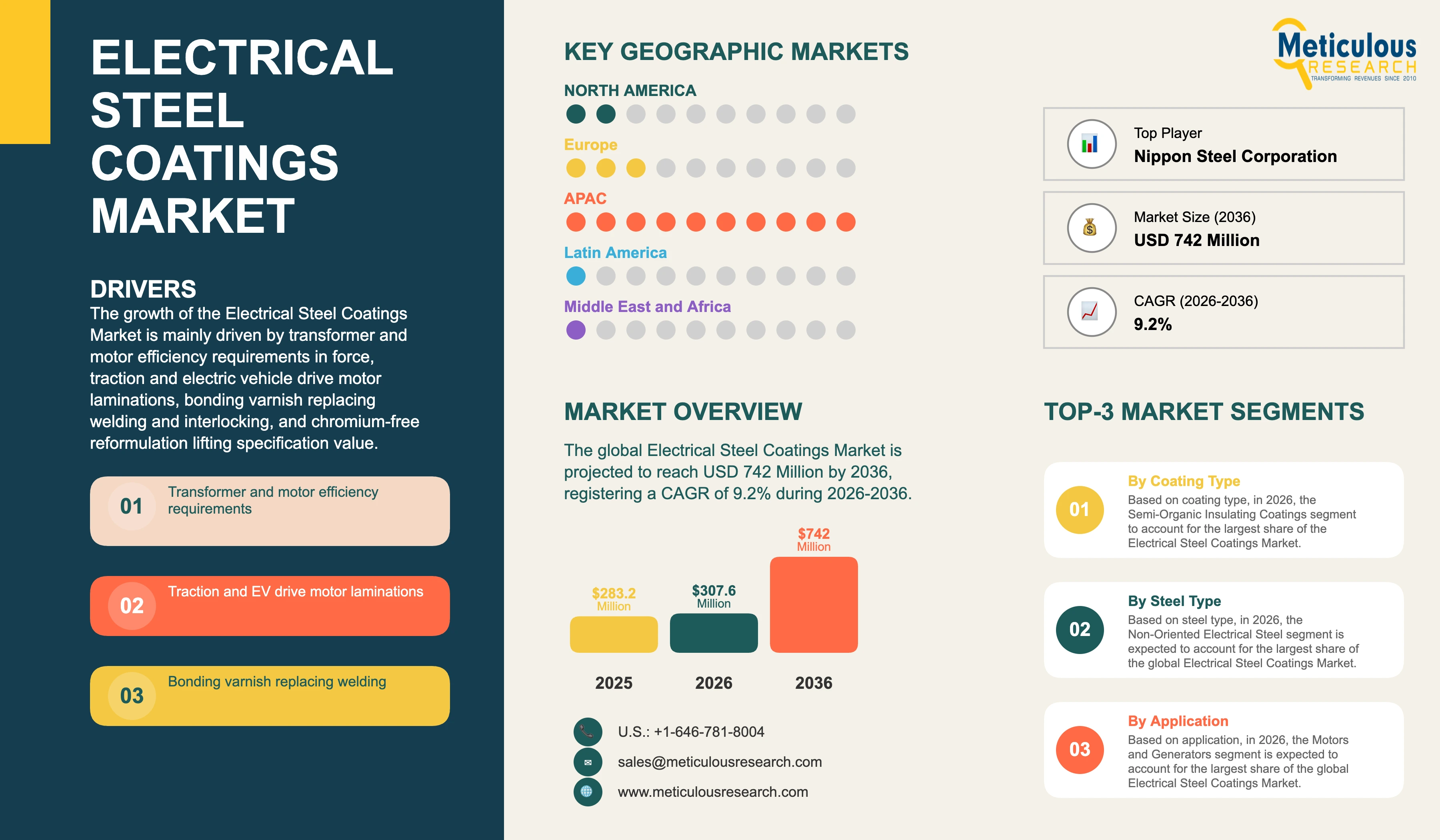
The electrical steel coatings market is valued at USD 307.6 million in 2026 and is projected to reach USD 742.0 million by 2036, at a CAGR of 9.2% during the forecast period. The market was valued at USD 283.2 million in 2025 and at USD 262.5 million in 2024.
- Published
- Nov 2026
- Pages
- 273
- Format
- PDF + Excel
- Report ID
- MRCHM - 1042767
- Base year
- 2025
- 2024 · HISTORICAL
- $262.5M
- 2036
- $742.0M
- CAGR 2026–2036
- 9.2%
2024–2025 baseline · 2026–2036 forecast at 9.2% CAGR · hover a bar for the value
Key highlights
This market measures insulating, tension and bonding coatings applied to electrical steel sheet, strip and laminations, taken at the coating material supplier gate on a tonne basis as supplied.
Excluded are the electrical steel substrate itself, winding insulation and impregnating resins, rolling and punching lubricants, core assembly adhesives applied outside the lamination face, and coatings on soft magnetic composites and amorphous ribbon.
Coating classes are set out in EN 10342 and the relevant parts of the IEC 60404 series, with insulation measured under EN 60404-11 and continuous temperature resistance under IEC 60404-12.
ArcelorMittal specifies C3 coatings at below 1 micron to 4 microns per side, C5 coatings at 1 micron to 4 microns and C6 coatings at 4 microns to 10 microns, with insulation resistance from 2 ohm square centimetres per side to above 3,000.
Coating below 1 micron is specified where weldability governs and about 3 microns where interlaminar insulation governs, which places the coating decision inside the core joining method rather than inside the magnetic specification.
Conventional grain-oriented coatings run about 4 microns thick at about 4 grams per square metre per side, and because the layer is non-magnetic the stacking factor of a conventional build sits near 96%.
A thinner chromium-free grain-oriented coating of about 3 microns raises that stacking factor to between 97% and 98%, so every micron removed from the coating returns magnetic material to the stack.
Measured tension from a conventional coating is about 1.2 megapascals, while a chromium-free grain-oriented coating has been measured at about 8 megapascals, with the tension depending on coating thickness.
Published work records 6.9 megapascals of applied tension improving core loss by less than 3% on conventional grain-oriented steel and by 10% to 14% on high-permeability steel.
Laser scribing of high-permeability steel reaches 0.85 watt per kilogram at 1.7 tesla on 0.23 millimetre material, 5% to 8% below unscribed steel, which is the scale against which any coating contribution to core loss is judged.
Grain-oriented tension coatings have traditionally carried 0.2% to 4.5% by weight of chromic anhydride or chromate compounds, and chromium trioxide is subject to authorisation under the European chemicals regime.
BASF SE, through its Chemetall surface treatment business, describes its electrical steel coatings as VOC-free and non-chrome for C3 and C5 requirements on non-grain-oriented strip below two millimetres thick.
Bonding varnish turns the coating into a structural joint, with voestalpine specifying quick bonding of one system at 240 degrees Celsius and 3 megapascals for 2 minutes in a closed heating press.
A lower-temperature system bakes at 130 degrees Celsius for 240 minutes at 1 megapascal, with coating applied at 3 microns to 5 microns per side.
Regulation (EU) 2019/1783 moved transformer requirements to Tier 2 from 1 July 2021, with minimum peak efficiency for liquid-immersed large power transformers rising to 99.797% at 200 megavolt amperes and above against 99.737% at Tier 1.
Regulation (EU) 2019/1781 required IE3 for three-phase motors from 0.75 kilowatt to 1, 000 kilowatts from 1 July 2021 and IE4 for 75 kilowatt to 200 kilowatt motors from 1 July 2023.
Non-oriented electrical steel is expected to hold the largest steel type share of this market in 2026 at 68.0% and to grow at 9.6%, against 8.2% for grain-oriented steel on 29.0%.
Bonding varnish is expected to record the highest coating type CAGR in this market at 15.4% from a 17.0% share in 2026, while organic varnish coatings grow slowest at 7.0%.
Report summary
| Particulars | Details |
|---|---|
| Base Year | 2025 |
| Actual Years | 2024-2025 |
| Forecast Period | 2026-2036 |
| Market Size in 2024 | USD 262.5 million |
| Market Size in 2025 | USD 283.2 million |
| Market Size in 2026 | USD 307.6 million |
| Market Size in 2036 | USD 742.0 million |
| Value CAGR (2026-2036) | 9.2% |
| Format | PDF, Excel & Cloud Portal · 273 pages |
| Volume in 2025 | 33.50 kilotons |
| Volume in 2026 | 35.80 kilotons |
| Volume in 2036 | 66.00 kilotons |
| Volume CAGR (2026-2036) | 6.3% |
| Average Selling Price, 2026 | USD 8,590 per tonne |
| Average Selling Price, 2036 | USD 11,240 per tonne |
| Units | Value in USD million; volume in kilotons of coating material as supplied; price in USD per tonne |
| Measurement Basis | Insulating, tension and bonding coatings applied to electrical steel sheet, strip and laminations, taken at the coating material supplier gate on a tonne basis as supplied, whether formulated in-house by a steel producer or bought in |
| Historical Value Growth | Value grew at 8.3% a year between 2024 and 2026 on volume growth of 7.0% a year and price growth of 1.2% a year; the forecast of 9.2% carries volume growth of 6.3% and price growth of 2.7%, with the price acceleration reflecting the share taken by bonding varnish and high-build semi-organic systems |
| Price Increase Note | The average selling price rises on mix rather than on repricing, because bonding varnish and high-build semi-organic coatings are priced well above thin organic core plate varnish, so a shift of share toward them lifts the blended figure without either product repricing |
| Coating Class Basis | Coating classes are set out in EN 10342 and the relevant parts of the IEC 60404 series, with insulation measured under EN 60404-11 and continuous temperature resistance under IEC 60404-12; ArcelorMittal specifies C3 synthetic resin coatings at below 1 micron to 4 microns per side, C5 pigmented coatings at 1 micron to 4 microns and C6 pigmented coatings at 4 microns to 10 microns, with typical insulation resistance from 2 ohm square centimetres per side to above 3,000 |
| Specification Trade-Off Basis | Coating below 1 micron is specified where weldability governs and about 3 microns where interlaminar insulation governs; continuous temperature resistance is 180 degrees Celsius for C3 and C6 coatings with intermittent ratings of 600 degrees and 540 degrees respectively, and a pigmented C5 variant is specified where stress relief annealing follows punching |
| Stacking Factor Basis | Conventional grain-oriented coatings run about 4 microns thick at about 4 grams per square metre per side and the coating is non-magnetic, so the stacking factor of a conventional build sits near 96%; a thinner chromium-free coating of about 3 microns raises that figure to between 97% and 98% |
| Tension Coating Basis | Measured tension from a conventional coating is about 1.2 megapascals and a chromium-free grain-oriented coating has been measured at about 8 megapascals, with tension depending on coating thickness; published work records 6.9 megapascals improving core loss by less than 3% on conventional grain-oriented steel and by 10% to 14% on high-permeability steel, and 45 megapascals on chemically polished material reaching 0.6 watt per kilogram, with the mechanism attributed to domain size reduction below about 10 megapascals |
| Loss Comparison Basis | Laser scribing takes high-permeability 0.23 millimetre steel to 0.85 watt per kilogram at 1.7 tesla, 5% to 8% below unscribed material, and surface roughness work has recorded 30% to 40% lower losses, which sets the scale against which any coating contribution to core loss is judged |
| Chromium Position Basis | Grain-oriented tension coatings have traditionally carried 0.2% to 4.5% by weight of chromic anhydride or chromate compounds and chromium trioxide is subject to authorisation under the European chemicals regime; BASF SE markets VOC-free and non-chrome coatings for C3 and C5 requirements on non-grain-oriented strip below two millimetres thick, and JFE Steel Corporation holds granted claims on a silicon-compound chromium-free coating at 50% to 99% silica by coating weight, with film thickness of 0.01 micron to 10 microns, baking at 150 degrees to 350 degrees Celsius and stress relief annealing at 700 degrees to 900 degrees Celsius |
| Bonding Process Basis | voestalpine specifies quick bonding of one system at 240 degrees Celsius and 3 megapascals for 2 minutes in a closed heating press within a window from 220 degrees for 5 minutes to 260 degrees for 1 minute, a conventional cycle for the same system at 3 megapascals applied cold then 200 degrees Celsius for 120 minutes, and a lower-temperature system at 1 megapascal and 130 degrees Celsius for 240 minutes with a stack heating rate of 0.5 to 1 kelvin per minute; coating is applied at 3 microns to 5 microns per side with a maximum burr height of 0.03 millimetre, and adhesion requirements are agreed project by project |
| Transformer Regulation Basis | Regulation (EU) 2019/1783, adopted 1 October 2019 and published in the Official Journal of 25 October 2019, amended Regulation (EU) No 548/2014 and took transformer requirements to Tier 2 from 1 July 2021; minimum peak efficiency for liquid-immersed large power transformers rises to 99.797% at 200 megavolt amperes and above against 99.737% at Tier 1, with relief to Tier 1 levels where replacement or installation would be disproportionately costly or technically infeasible |
| Motor Regulation Basis | Regulation (EU) 2019/1781 required IE3 for three-phase motors from 0.75 kilowatt to 1,000 kilowatts and IE2 for the 0.12 kilowatt to 0.75 kilowatt band from 1 July 2021, and IE4 for two, four and six pole motors from 75 kilowatts to 200 kilowatts from 1 July 2023, with variable speed drives from 0.12 kilowatt to 1,000 kilowatts held to maximum losses at the IE2 level from 1 July 2021 |
| Capacity Basis | Nippon Steel committed 104 billion yen across Kyushu Works Yawata and Setouchi Works Hirohata for an electrical steel capacity increase of about 40%, scheduled to take full effect in the first half of 2023, citing high-grade non-oriented steel for motor cores and low-loss grain-oriented steel for transformer cores |
| Corporate Development Note | The sale of thyssenkrupp Electrical Steel India Private Ltd. at Nashik, with about 500 employees producing grain-oriented steel for transformers and large generators, to a joint venture of JSW Steel Limited and JFE Steel Corporation completed on 30 January 2025 for about 440 million euros; the merger of Axalta Coating Systems Ltd. with Akzo Nobel N.V. to form Axanzo was approved by shareholders of both companies on 5 August 2026, with the companies operating independently until closing expected in early 2027 |
| Overlap Note | Winding insulation, impregnating resins and wire enamels are not counted here, and coatings on soft magnetic composites and amorphous ribbon fall outside this title, so any sizing reconciliation against electrical insulation titles has to be made on the lamination coating boundary |
| Exclusions | The electrical steel substrate; winding insulation, impregnating resins, varnishes and wire enamels; rolling, punching and stamping lubricants; core assembly adhesives applied outside the lamination face; coatings on soft magnetic composites, amorphous and nanocrystalline ribbon and sintered cores; transformer tank and enclosure coatings |
| Segments: Coating Type | Inorganic Phosphate and Tension Coatings; Semi-Organic Insulating Coatings; Organic Varnish Coatings; Bonding Varnish; Other Coatings |
| Segments: Steel Type | Non-Oriented Electrical Steel; Grain-Oriented Electrical Steel; Other Soft Magnetic Laminations |
| Segments: Application | Motors and Generators; Transformers; Traction and Electric Vehicle Drive Motors; Home Appliances and Compressors; Other Applications |
| Segments: Application Route | Applied on the Steel Mill Coating Line; Applied at the Lamination or Stamping Stage |
| Largest Segment by Coating Type, 2026 | Semi-Organic Insulating Coatings, at 31.0% |
| Fastest-Growing Segment by Coating Type | Bonding Varnish, at 15.4% |
| Slowest-Growing Segment by Coating Type | Organic Varnish Coatings, at 7.0% |
| Largest Segment by Steel Type, 2026 | Non-Oriented Electrical Steel, at 68.0% |
| Fastest-Growing Principal Grade | Non-Oriented Electrical Steel, at 9.6% |
| Largest Segment by Application, 2026 | Motors and Generators, at 31.0% |
| Fastest-Growing Segment by Application | Traction and Electric Vehicle Drive Motors, at 13.8% |
| Slowest-Growing Segment by Application | Home Appliances and Compressors, at 6.4% |
| Largest Segment by Application Route, 2026 | Applied on the Steel Mill Coating Line, at 84.0% |
| Fastest-Growing Segment by Application Route | Applied at the Lamination or Stamping Stage, at 12.0% |
| Largest Region, 2026 | Asia-Pacific, at 61.0% |
| Fastest-Growing Region | Middle East & Africa, at 10.2% |
| Fastest-Growing Country | India, at 12.4% |
| Slowest-Growing Country | Japan, at 6.6% |
| Regions Covered | Asia-Pacific; Europe; North America; Latin America; Middle East & Africa |
| Countries Covered | China; Japan; India; South Korea; Germany; France; Italy; U.K.; U.S.; Canada; Mexico; Brazil |
| Key Players | Nippon Steel Corporation; JFE Holdings, Inc.; POSCO Holdings Inc.; ArcelorMittal S.A.; thyssenkrupp AG; voestalpine AG; BASF SE; Axalta Coating Systems Ltd.; ALTANA AG; Von Roll Holding AG |
| Supply Structure Note | Electrical steel producers formulate or specify the coating and apply it on their own annealing lines, selling it inside the price of the strip, and hold the grain-oriented tension coating position almost entirely; coating chemistry suppliers compete on the non-oriented classes, on bonding varnish and at the lamination stage |
| Top Five Share, 2026 | 48.0% |
| Profiled Companies Share, 2026 | 63.0% |
| Currency | USD |
Report overview
Market value is measured in in USD million; volume in kilotons of coating material as supplied; price in USD per tonne. Segments covered: coating type, steel type, application, application route.
In volume terms, the market is estimated at 35.80 kilotons of coating material as supplied in 2026, rising to 66.00 kilotons by 2036, at a CAGR of 6.3%. The average selling price is estimated at USD 8,590 per tonne in 2026 and USD 11,240 per tonne in 2036, the increase reflecting a mix shift toward bonding varnish and high-build semi-organic systems rather than any repricing of conventional core plate varnish.
The growth of this market is mainly driven by transformer efficiency requirements that have applied at Tier 2 level since 1 July 2021, motor efficiency requirements that moved to IE3 from 1 July 2021 and to IE4 for 75 kW to 200 kW motors from 1 July 2023, traction and electric vehicle drive motor laminations growing at 13.8%, and bonding varnish growing at 15.4%. However, factors such as the direct conflict between coating thickness and lamination stacking factor, a core loss contribution that is small against steel grade and domain refinement, chromate chemistry in tension coatings facing restriction, and coating value capped at a few grams per square metre of a commodity steel are expected to restrain the growth of this market to some extent.
Among applications, motors and generators are expected to hold the largest share of this market in 2026, while traction and electric vehicle drive motors are expected to record the highest CAGR during the forecast period. Geographically, Asia-Pacific is expected to account for the largest share of this market in 2026, while the Middle East & Africa is expected to register the highest CAGR during the forecast period.
Electrical steel reaches a motor or a transformer as a stack of punched laminations rather than as a solid block, and the coating on each lamination face is what stops eddy currents crossing from one sheet to the next. That function is measured as interlaminar resistance, and it is the reason a coating exists at all.
Interlaminar resistance is quoted per side and is measured under EN 60404-11, with the coating classes of EN 10342 and the IEC 60404 series giving the core maker a common language for comparing films that differ by an order of magnitude in thickness.
The coating carries three further duties that the magnetic specification does not describe. It lubricates the punch and extends tool life, it survives or is destroyed by the joining method the core maker uses, and on grain-oriented material it applies tension to the sheet.
ArcelorMittal publishes the trade-off plainly for its non-oriented grades. A C3 coating below 1 micron is specified where welding governs, about 3 microns where interlaminar insulation governs, and a C6 coating at 4 microns to 10 microns where pressure and insulation govern in medium and large machines, with typical insulation resistance running from 2 to above 3,000 ohm square centimetres per side across that range.
Temperature resistance separates the classes further, with continuous ratings of 180 degrees Celsius for C3 and C6 coatings and intermittent ratings of 600 degrees and 540 degrees respectively, and a pigmented C5 variant specified for stress relief annealing after punching.
Each micron of coating is magnetically dead, and the stacking factor of a conventional grain-oriented build sits near 96% against 97% to 98% for a thinner chromium-free coating. A transformer core built to a fixed window therefore contains less steel when the coating is thicker, which is the cost side of the insulation decision.
Tension coating is the one place where the coating acts on the magnetic property itself. Cooling from the coating bake leaves the film in tension against the steel, that tension refines the domain structure, and core loss falls as a result.
The size of that effect depends on the steel rather than on the coating. Published work records 6.9 megapascals improving conventional grain-oriented loss by under 3% while improving high-permeability steel by 10% to 14%, with the mechanism attributed to domain size reduction below about 10 megapascals and to saturation above it.
Conventional coatings deliver about 1.2 megapascals of measured tension at about 4 microns and 4 grams per square metre per side, a chromium-free system has been measured near 8 megapascals, and the 45 megapascals that reaches 0.6 watt per kilogram was applied to chemically polished laboratory material rather than to commercial strip.
Laser scribing sets the comparison. High-permeability 0.23 millimetre steel reaches 0.85 watt per kilogram at 1.7 tesla after scribing, 5% to 8% below unscribed material, and surface roughness work has recorded 30% to 40% lower losses, so the coating is one contributor among several rather than the governing one.
Chromium sits at the centre of the grain-oriented position. Tension coatings have traditionally contained 0.2% to 4.5% by weight of chromic anhydride or chromate compounds, chromium trioxide is subject to authorisation under the European chemicals regime, and the replacement chemistries are phosphate and colloidal silica systems that are also thinner.
BASF SE markets a VOC-free and non-chrome coating for C3 and C5 requirements on non-grain-oriented strip under two millimetres, and JFE Steel Corporation holds granted claims on a chromium-free coating built from silicon compounds at 50% to 99% silica by coating weight, baked at 150 degrees to 350 degrees Celsius and surviving stress relief annealing at 700 degrees to 900 degrees.
Bonding varnish is the fastest-moving part of this market because it replaces a mechanical joint rather than an insulating layer. Welding and interlocking short-circuit laminations locally and introduce stress at the point of joining, while a bonded stack is held across the full face.
voestalpine publishes the processing window for two systems, with quick bonding at 240 degrees Celsius and 3 megapascals for 2 minutes against a conventional cycle of 200 degrees for 120 minutes on the same varnish, and a lower-temperature varnish bonded at 130 degrees for 240 minutes at 1 megapascal, applied at 3 microns to 5 microns per side with a maximum burr height of 0.03 millimetre.
Regulation drives the volume at both ends of the market. Regulation (EU) 2019/1783 took transformer requirements to Tier 2 from 1 July 2021, lifting minimum peak efficiency for liquid-immersed large power transformers of 200 megavolt amperes and above to 99.797%, with relief available where replacement would be disproportionately costly or technically infeasible.
Regulation (EU) 2019/1781 required IE3 for three-phase motors from 0.75 kilowatt to 1,000 kilowatts from 1 July 2021, IE2 for the 0.12 kilowatt to 0.75 kilowatt band, and IE4 for two, four and six pole motors between 75 kilowatts and 200 kilowatts from 1 July 2023, with variable speed drives held to IE2 loss levels from the same date.
Bonding has consequences beyond the joint. A bonded stack conducts heat better across the lamination faces than a welded one and loses only a little stacking factor to the varnish, while a maximum burr height of 0.03 millimetre is specified because a burr defeats both the bond line and the insulation at the same point.
Capacity has followed. Nippon Steel committed 104 billion yen across Kyushu Works Yawata and Setouchi Works Hirohata for an electrical steel capacity increase of about 40%, scheduled to take full effect in the first half of 2023, citing high-grade non-oriented steel for motor cores and low-loss grain-oriented steel for transformer cores.
Report infographic
Market dynamics
17 factors across 5 forcesTransformer and Motor Efficiency Requirements in Force
Tier 2 of the European transformer requirements has applied since 1 July 2021 under Regulation (EU) 2019/1783, taking minimum peak efficiency for liquid-immersed large power transformers of 200 megavolt amperes and above to 99.797% against 99.737% at Tier 1 and tightening the no-load loss limits that core material has to deliver.
Motor requirements moved in the same direction under Regulation (EU) 2019/1781, with IE3 required for three-phase motors from 0.75 kilowatt to 1,000 kilowatts from 1 July 2021 and IE4 required for two, four and six pole motors from 75 kilowatts to 200 kilowatts from 1 July 2023.
Those requirements pull lamination specification toward thinner gauges and higher-grade steel, both of which raise the coated area per tonne of core and the insulation performance the coating has to deliver at a reduced thickness.
Traction and Electric Vehicle Drive Motor Laminations
A traction motor runs at far higher electrical frequency than an industrial induction motor, so eddy current loss carries more weight in the loss budget and the laminations are thinner, which multiplies the number of coated faces in a given core mass.
Nippon Steel committed 104 billion yen across two works for an electrical steel capacity increase of about 40%, citing tighter automobile carbon dioxide and fuel economy rules raising demand for high-grade non-oriented steel used in motor cores.
Traction and electric vehicle drive motors record the highest application CAGR in this market at 13.8% from a 23.0% share in 2026, against 8.6% for industrial motors and generators on the largest share at 31.0%.
Bonding Varnish Replacing Welding and Interlocking
A welded or interlocked stack carries local short circuits between laminations and stress at the joint, while a bonded stack is held across the full lamination face, which keeps the insulation intact where the joint would otherwise defeat it.
voestalpine publishes bonding at 240 degrees Celsius and 3 megapascals for 2 minutes for a rapid system and 130 degrees Celsius for 240 minutes at 1 megapascal for a lower-temperature system, applied at 3 microns to 5 microns per side, which places the whole joint inside the coating line rather than inside the assembly shop.
Bonding varnish records the highest coating type CAGR in this market at 15.4% from a 17.0% share in 2026, and application at the lamination or stamping stage grows at 12.0% against 8.7% for application on the steel mill coating line.
Chromium-Free Reformulation Lifting Specification Value
Grain-oriented tension coatings have traditionally contained 0.2% to 4.5% by weight of chromic anhydride or chromate compounds, and chromium trioxide is subject to authorisation under the European chemicals regime, which puts a reformulation requirement on the highest-value coating in this market.
BASF SE markets a VOC-free and non-chrome coating meeting C3 and C5 requirements on non-grain-oriented strip, and JFE Steel Corporation holds granted claims on a silicon-compound coating at 50% to 99% silica by coating weight that survives stress relief annealing at 700 degrees to 900 degrees Celsius.
Other coatings, covering chromium-free inorganic and specialty systems outside the three conventional classes, grow at 9.2% in this market, and the chromium-free grain-oriented films carry the additional advantage of being thinner at the same insulation level.
Table of contents
12 chapters · 132 sections · 273 pages · click to expandSegmental analysis
| Segment | Largest share (2026) | Fastest growth (2026–2036) |
|---|---|---|
| By Coating Type | Semi-organic insulating coatings | Bonding varnish |
| By Steel Type | Non-oriented electrical steel | Non-oriented steel |
| By Application | Motors and generators | Traction and electric vehicle drive motors |
| By Application Route | Application on the steel mill coating line | — |
By Coating Type
- Electrical Steel Coatings Market Analysis by Coating Type
- This market is segmented into inorganic phosphate and tension coatings, semi-organic insulating coatings, organic varnish coatings, bonding varnish, and other coatings.
- Semi-organic insulating coatings are expected to account for the largest share of this market in 2026.
- The position reflects the span of the class, which covers the filled organic and inorganic systems specified where insulation, weldability and resistance to annealing all have to be met at once, and those are the conditions in the great majority of motor and generator cores.
- The class also carries the coatings specified for stress relief annealing after punching, which organic films cannot survive, and the high-build systems used in medium and large machines where pressure and temperature resistance govern.
- That combination of duties leaves the segment as the default specification across industrial lamination volumes rather than a choice made for a particular application.
- Bonding varnish is expected to record the highest CAGR during the forecast period, at 15.4%.
- Growth comes from the replacement of welding and interlocking on thin-gauge cores, where heat distortion and lost active area make a mechanical joint increasingly difficult, and from the published processing windows that allow a stack to be bonded either rapidly under press or slowly at low temperature for large cores.
- Inorganic phosphate and tension coatings grow at 7.6% and organic varnish coatings slowest at 7.0%, the latter held back by the welding and annealing limits of unfilled organic films.
- Other coatings, covering chromium-free inorganic and specialty systems outside the three conventional classes, grow at 9.2%.
By Steel Type
- Electrical Steel Coatings Market Analysis by Steel Type
- This market is segmented into non-oriented electrical steel, grain-oriented electrical steel, and other soft magnetic laminations.
- Non-oriented electrical steel is expected to hold the largest share of this market in 2026.
- Motor and generator cores consume far more tonnage than transformer cores, the laminations are thinner so the coated area per tonne is higher, and every one of those faces requires an insulating film whether the core is welded, interlocked or bonded.
- Non-oriented steel is also expected to record the highest CAGR among the two principal grades, at 9.6%, carried by motor efficiency requirements that moved to IE3 in 2021 and to IE4 for the 75 kilowatt to 200 kilowatt band in 2023 and by traction motor gauges below those used in industrial machines.
- Grain-oriented steel grows at 8.2% on the second-largest share, with the coating carrying the additional tension duty that no non-oriented coating performs and commanding the highest price per tonne of any coating in this market, and other soft magnetic laminations grow at 9.8% from a small base.
By Application
- Electrical Steel Coatings Market Analysis by Application
- This market is segmented into motors and generators, transformers, traction and electric vehicle drive motors, home appliances and compressors, and other applications.
- Motors and generators are expected to account for the largest share of this market in 2026, reflecting the breadth of industrial motor production across pumps, fans, compressors and machine drives and the regulatory floor now applying across that range.
- Traction and electric vehicle drive motors are expected to record the highest CAGR during the forecast period, at 13.8%.
- Higher electrical frequency raises the weight of eddy current loss in the loss budget, which drives gauge down and the number of coated faces up, and the same cores are the ones moving to bonded stacks.
- Transformers grow at 7.4% on the second-largest share, with demand tied to the new build and replacement cycle rather than to the installed fleet and with the coating value per tonne of core the highest of any application because tension coating is specified there.
- Home appliances and compressors grow slowest at 6.4% on mature designs bought to a cost target, and other applications grow at 8.8%.
By Application Route
- Electrical Steel Coatings Market Analysis by Application Route
- This market is segmented into coating applied on the steel mill coating line and coating applied at the lamination or stamping stage.
- Application on the steel mill coating line is expected to hold the largest share of this market in 2026.
- Coating is applied continuously to strip at the end of the annealing line, cured in a tunnel oven and shipped as a finished specification, which is the lowest-cost route and the one that almost all standard insulation classes follow.
- Mill-line application also fixes the specification at the coil, so a stamper taking standard material accepts the insulation class the steel producer selected rather than the one the joining method would favour.
- Application at the lamination or stamping stage is expected to record the higher CAGR during the forecast period, at 12.0%.
- That route reaches the cut edge a mill-applied coating cannot cover, carries bonding varnish and insulation repair after stress relief annealing, and allows the coating to be matched to the joining method rather than inherited from the coil.
Geographic analysis
Asia-Pacific
Largest shareAsia-Pacific is expected to account for the largest share of this market in 2026, at 61.0%. Electrical steel capacity and lamination stamping are concentrated in the region, with the Japanese and Korean producers holding the grain-oriented and high-grade non-oriented positions and Chinese capacity supplying the motor and appliance volumes. China holds the largest country position, carried by appliance, industrial motor and electric vehicle motor production and by the largest electrical steel output of any country. Japan supplies the highest grades and is expected to record the lowest country CAGR in this market at 6.6%, reflecting flat domestic core production against an export position held on grade rather than on volume. India is expected to register the highest country CAGR in this market at 12.4%, on grid transformer build, motor manufacturing and the transfer of grain-oriented capacity into local ownership following the completion of the sale of the Nashik electrical steel business to a joint venture of JSW Steel Limited and JFE Steel Corporation on 30 January 2025 for about 440 million euros.
Europe
Europe is expected to hold the second-largest regional share in 2026, at 18.0%, and to grow at 8.4%. Both the transformer and motor efficiency requirements that set the specification floor in this market originate in the region, and the chromium position that is reshaping tension coatings is a European regulatory position rather than a global one. Germany anchors the European position on motor and generator lamination production, and the bonding varnish processing windows published in the region are setting the practice that core makers elsewhere adopt. France, Italy and the U.K. follow on motor, appliance and transformer manufacturing.
North America
North America is expected to account for 13.0% of this market in 2026 and to grow at 8.0%, with the U.S. holding most of that position on transformer core production, grid replacement demand and industrial motor manufacturing, and Canada following on a smaller lamination base.
Middle East & Africa
The Middle East & Africa is expected to register the highest regional CAGR in this market at 10.2% from a 3.5% share in 2026, carried by transformer and grid build rather than by motor manufacturing.
Latin America
Latin America grows at 7.6% on 4.5%, with Brazil holding the regional motor and transformer base and Mexico supplying motor laminations into North American assembly.
Competitive landscape
Supply in this market is held by two groups that sell to different buyers. Electrical steel producers formulate or specify the coating and apply it on their own annealing lines, selling it inside the price of the strip, while coating chemistry suppliers sell the formulated product to those producers and directly to lamination stampers and core makers.
The steel producers hold the grain-oriented position almost entirely, because tension coating is developed against a specific steel, gauge and anneal cycle and the magnetic result is attributed to the combination. Nippon Steel Corporation, JFE Holdings, Inc., POSCO Holdings Inc., ArcelorMittal S.A., thyssenkrupp AG and voestalpine AG each carry coating technology as part of an electrical steel specification rather than as a product sold separately.
The chemistry suppliers compete on the non-oriented classes, on bonding varnish and on the lamination stage, where BASF SE markets VOC-free and non-chrome coatings for C3 and C5 requirements, Axalta Coating Systems Ltd. supplies C3, C5 and C6 coatings together with self-bonding varnish and bonding enamels, and ALTANA AG and Von Roll Holding AG supply insulating and bonding systems into lamination and winding insulation.
Ownership has moved in both groups. The sale of the Nashik grain-oriented business of thyssenkrupp AG to a joint venture of JSW Steel Limited and JFE Steel Corporation completed on 30 January 2025 for about 440 million euros, covering a site with about 500 employees, and the merger of Axalta Coating Systems Ltd. with Akzo Nobel N.V. to form Axanzo was approved by shareholders of both companies on 5 August 2026 with closing expected in early 2027.
Competitive position in the bonding segment rests on published processing windows and on adhesion agreed project by project, which favours suppliers able to support a core maker through qualification rather than those selling on datasheet values.
Some of the key players operating in the electrical steel coatings market are Nippon Steel Corporation, JFE Holdings, Inc., POSCO Holdings Inc., ArcelorMittal S.A., thyssenkrupp AG, voestalpine AG, BASF SE, Axalta Coating Systems Ltd., ALTANA AG, and Von Roll Holding AG, among others.
- Nippon Steel Corporation
- JFE Holdings, Inc.
- POSCO Holdings Inc.
- ArcelorMittal S.A.
- BASF SE
- Axalta Coating Systems Ltd.
- ALTANA AG
- Von Roll Holding AG
Expert perspectives
The named demand driver for this title is core loss and stacking performance, and those two requirements point in opposite directions on the same variable. Insulation and tension both improve with coating thickness, while every micron of coating is magnetically dead, so a conventional grain-oriented build sits near 96% stacking factor against 97% to 98% for a thinner chromium-free film.
The core loss half of the argument is also smaller than it appears. Measured tension from a conventional commercial coating is about 1.2 megapascals, and published work records 6.9 megapascals improving conventional grain-oriented loss by under 3%, while laser scribing takes high-permeability steel to 0.85 watt per kilogram at 1.7 tesla, 5% to 8% below unscribed material.
What the coating does unambiguously is stop current crossing between laminations, and the published insulation range of 2 to above 3,000 ohm square centimetres per side across the coating classes is the specification that actually governs the purchase. The thickness is chosen against the joining method, with below 1 micron where welding governs and about 3 microns where insulation governs.
That is why the growth in this market is in the joint rather than in the insulation. Bonding varnish at 15.4% and lamination-stage application at 12.0% both reflect the coating absorbing a mechanical operation, and the published windows of 240 degrees Celsius at 3 megapascals for 2 minutes or 130 degrees Celsius for 240 minutes show a chemistry being specified as a structural joint.
The chromium position is the second structural change. Conventional tension coatings carry 0.2% to 4.5% by weight of chromate compounds, chromium trioxide is subject to authorisation in Europe, and the replacement films are thinner and have been measured at higher tension, so regulation and stacking factor push the same way while conventional practice pushes the other.
A supplier positioning here should treat the non-oriented classes, bonding varnish and the lamination stage as the addressable market and treat grain-oriented tension coating as a co-development with a steelmaker. Selling core loss improvement against grade and scribing will not hold, while selling a thinner film at equal insulation, a qualified chromium-free tension coating or a bonded joint that replaces welding will.
Customer perspectives
A transformer core maker buys a coating as part of a steel specification rather than as a product, and decides when the grade is selected, because coating and steel are qualified together.
That buyer judges the result in watts per kilogram at a stated flux density and frequency, and a coating claim that cannot be separated from grade and scribing contributions carries no weight in the comparison.
A motor lamination stamper buys punchability and tool life first, since a coating that abrades the die costs more in tooling and downtime than it saves in loss, and a C3 coating with built-in lubrication removes the need for a separate punching lubricant.
That buyer also needs the coating to match the joining method, because a film that survives welding is not the film that survives stress relief annealing at 700 degrees to 900 degrees Celsius.
A core maker moving to bonded stacks buys a processing window rather than a coating, and needs the bonding temperature, time and pressure to fit the press and oven capacity already installed.
An electric vehicle drive unit buyer carries a frequency and gauge specification that makes interlaminar insulation more valuable per micron than it is in an industrial motor, and is the one buyer prepared to pay for coating performance as a separable attribute.
A compressor or appliance manufacturer buys to a cost target on a mature design, treats the coating as a commodity within the strip price, and changes specification only when the joining method or the efficiency floor changes.
A steelmaker buying coating chemistry for its own line judges line speed, cure window and consistency across coil widths first, because a chemistry that slows the line costs more than the coating is worth.
Every buyer in this market has access to the insulation class system, so a coating is specified by class and thickness rather than by brand, and the supplier argument has to be made on what sits outside that classification.
What distinguishes the buyers that pay a premium is whether they are solving a joining problem or an insulation problem, and the ones solving a joining problem are the segment growing fastest in this market.
Frequently asked questions
The market is valued at USD 307.6 million in 2026 and is projected to reach USD 742.0 million by 2036, at a CAGR of 9.2%. It was valued at USD 283.2 million in 2025 and USD 262.5 million in 2024.
Insulating, tension and bonding coatings applied to electrical steel sheet, strip and laminations, taken at the coating material supplier gate on a tonne basis as supplied, whether formulated in-house by a steel producer or bought in. The steel substrate, winding insulation and impregnating resins, punching lubricants and coatings on soft magnetic composites and amorphous ribbon are excluded.
It stops eddy currents crossing between laminations, which is measured as interlaminar resistance. It also lubricates the punch and extends tool life, has to be compatible with the joining method, and on grain-oriented material it applies tension to the sheet that lowers core loss.
Through EN 10342 and the relevant parts of the IEC 60404 series, with insulation measured under EN 60404-11 and continuous temperature resistance under IEC 60404-12. ArcelorMittal specifies C3 coatings at below 1 micron to 4 microns per side, C5 at 1 micron to 4 microns and C6 at 4 microns to 10 microns.
Because insulation and tension both improve with coating thickness while the coating itself is magnetically dead. A conventional grain-oriented build sits near 96% stacking factor, and a thinner chromium-free coating of about 3 microns raises that to between 97% and 98%.
Less than the mechanism suggests. Measured tension from a conventional coating is about 1.2 megapascals, and 6.9 megapascals improves conventional grain-oriented loss by under 3% and high-permeability steel by 10% to 14%, while laser scribing takes high-permeability steel to 0.85 watt per kilogram at 1.7 tesla.
Grain-oriented tension coatings have traditionally carried 0.2% to 4.5% by weight of chromic anhydride or chromate compounds, and chromium trioxide is subject to authorisation under the European chemicals regime. Replacement phosphate and colloidal silica films are also thinner at the same insulation level.
It is a coating cured under heat and pressure that holds a lamination stack across the full face, replacing welding and interlocking. Bonding varnish records the highest coating type CAGR in this market at 15.4% from a 17.0% share in 2026.
Regulation (EU) 2019/1783 took transformer requirements to Tier 2 from 1 July 2021, raising minimum peak efficiency for liquid-immersed large power transformers of 200 megavolt amperes and above to 99.797%. Regulation (EU) 2019/1781 required IE3 for three-phase motors from 1 July 2021 and IE4 for 75 kilowatts to 200 kilowatts from 1 July 2023.
Non-oriented electrical steel holds the largest steel type share in 2026 at 68.0% and grows at 9.6%, against 8.2% for grain-oriented steel on 29.0%. Motors and generators hold the largest application share at 31.0%, while traction and electric vehicle drive motors grow fastest at 13.8%.
Mill-line coating is continuous, is the lowest-cost route and holds 84.0% of this market in 2026. Coating at the lamination or stamping stage reaches the cut edge a mill coating cannot cover, carries bonding varnish and insulation repair, and grows at 12.0% from a 16.0% share.
On mix rather than on repricing. As bonding varnish and high-build semi-organic coatings take share, the blended price rises from USD 8,590 per tonne to USD 11,240 per tonne, with volume growing at 6.3% against value growth of 9.2%.
Asia-Pacific holds 61.0% of this market in 2026 and grows at 9.8%, followed by Europe at 18.0% and North America at 13.0%. The Middle East and Africa grows fastest among regions at 10.2%, and India fastest among countries at 12.4% while Japan grows slowest at 6.6%.
Electrical steel producers apply the coating on their own lines and hold the grain-oriented tension coating position almost entirely, while coating chemistry suppliers compete on non-oriented classes, bonding varnish and the lamination stage. Key players include Nippon Steel Corporation, JFE Holdings, Inc., POSCO Holdings Inc., ArcelorMittal S.A., thyssenkrupp AG, voestalpine AG, BASF SE, Axalta Coating Systems Ltd., ALTANA AG, and Von Roll Holding AG.
The sale of thyssenkrupp Electrical Steel India Private Ltd. at Nashik to a joint venture of JSW Steel Limited and JFE Steel Corporation completed on 30 January 2025 for about 440 million euros. The merger of Axalta Coating Systems Ltd. with Akzo Nobel N.V. to form Axanzo was approved by shareholders on 5 August 2026, with closing expected in early 2027.
By treating the non-oriented classes, bonding varnish and the lamination stage as the addressable market and grain-oriented tension coating as a co-development with a steelmaker. A thinner film at equal insulation, a qualified chromium-free tension coating or a bonded joint that replaces welding will hold, while selling core loss improvement will not.
Cite this report
Meticulous Research. (2026). Electrical Steel Coatings Market - Global Opportunity Analysis and Industry Forecast (2026-2036) (Report No. MRCHM - 1042767). Meticulous Market Research Pvt. Ltd. https://www.meticulousresearch.com/product/electrical-steel-coatings-market-7450