
e-SUVs Market (2025-2032)
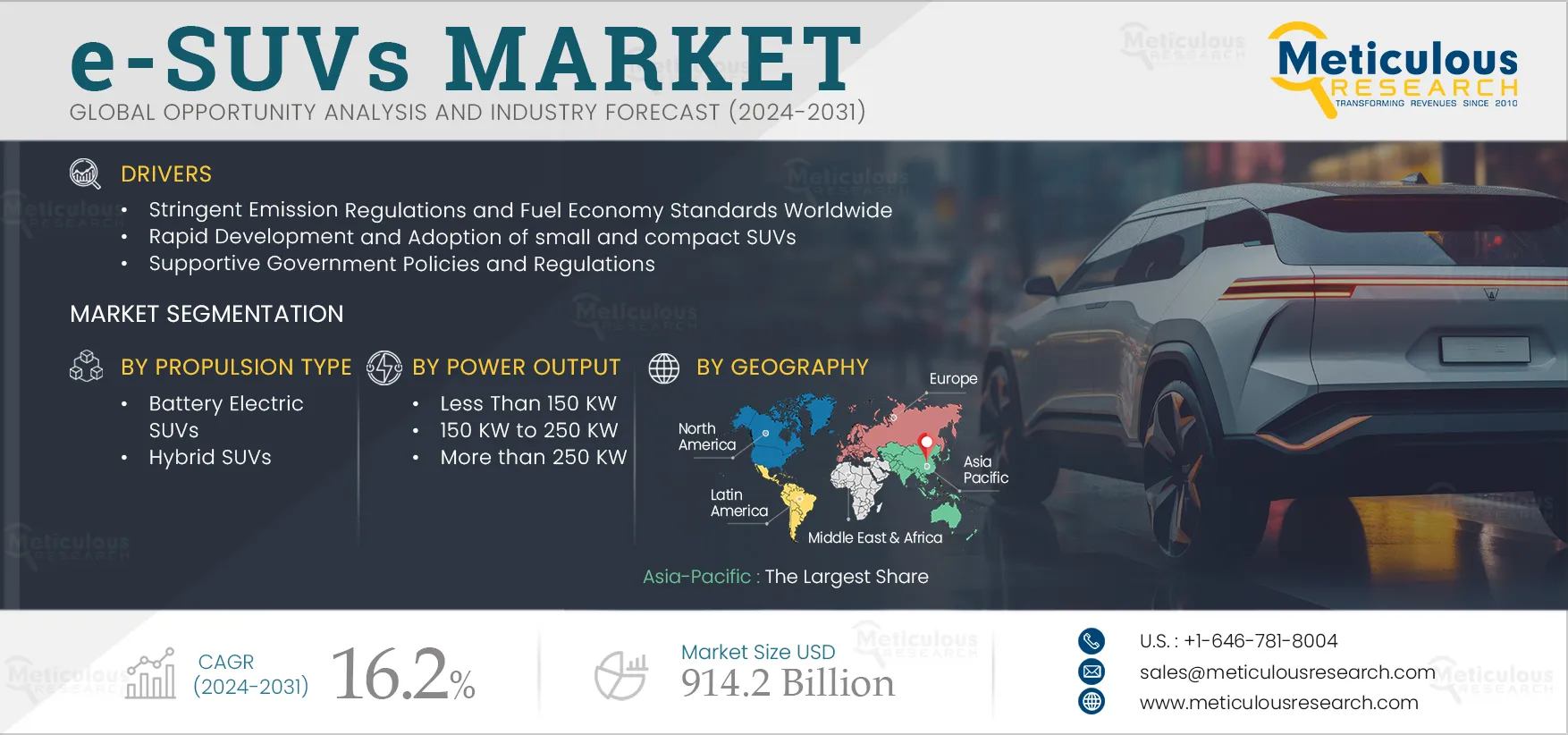
The e-SUVs Market is expected to reach $914.2 billion by 2032, at a CAGR of 16.2% from 2025 to 2032.
- Published
- Jan 2025
- Pages
- 200
- Format
- PDF + Excel
- Report ID
- MRAUTO - 1041275
- Base year
- 2024
- 2032 · FORECAST
- $914.2B
- 2032
- $914.2B
- CAGR 2025–2032
- 16.2%
2024 baseline · 2025–2032 forecast at 16.2% CAGR · hover a bar for the value
Key highlights
By Propulsion Type: In 2025, the Battery Electric SUV Segment to Dominate the e-SUVs Market
By Size: In 2025, the Mid-size SUVs Segment to Dominate the e-SUVs Market
By Power Output: In 2025, the 150 KW to 250 KW Segment to Dominate the e-SUVs Market
Report summary
| Particulars | Details |
|---|---|
| Number of Pages | 200 |
| Format | |
| Forecast Period | 2025–2032 |
| Base Year | 2024 |
| CAGR | 16.2% |
| Market Size (Value) | USD 914.2 Billion by 2032 |
| Segments Covered | By Propulsion Type · Battery Electric SUVs · Hybrid SUVs · By Size · Compact SUVs · Mid-size SUVs · Full-size SUVs · By Power Output · Less Than 150 KW · 150 KW to 250 KW · More than 250 KW |
| Countries Covered | North America (U.S., Canada), Europe (Germany, U.K., France, Italy, Spain, Switzerland, Netherlands, and the Rest of Europe), Asia-Pacific (China, Japan, India, South Korea, Singapore, Malaysia, and the Rest of Asia-Pacific), Latin America (Brazil, Mexico, and Rest of Latin America), and Middle East & Africa (UAE, Israel, and Rest of Middle East & Africa). |
| Key Companies | Tesla Inc. (U.S.), Toyota Motor Corporation (Japan), Honda Motor Co., Ltd. (Japan), BYD Company Ltd. (China), Ford Motor Company (U.S.), Hyundai Motor Company (South Korea), Mercedes-Benz (Germany), Nissan Motor Corporation (Japan), Volkswagen AG (Germany), AB Volvo (Sweden), Kia Corporation (South Korea), and BMW (Germany). |
Report overview
Segments covered: propulsion, size, power output. Regions: North America, Europe, Asia-Pacific, Latin America.
The e-SUVs market is driven due to factors such as the global adoption and development of small and compact e-SUVs, government policies & regulations that support the industry, and stringent emission and fuel economy standards. Furthermore, increased investment in e-SUVs by prominent automobile OEMs is projected to open up new market opportunities. However, the high price of e-SUVs may restrain the market growth. The absence of infrastructure for charging in developing countries presents a challenge to the growth of the market.
Report infographic
Market dynamics
3 factors across 2 forcesRapid Development and Adoption of Small and Compact e-SUVs
A compact e-SUV is a small e-SUV that falls between a mid-size and a sub-compact SUV. Compact e-SUVs are said to be among the most popular cars, as they are small yet athletic.
Compact e-SUVs, with their space efficiency, maneuverability, fuel efficiency, versatility, safety features, and stylish design, offer a comprehensive driving experience.
Furthermore, the market is being driven by the focus of several automobile manufacturers on the development of small and compact SUVs. A significant example is Kia Corporation (South Korea), which, in May 2025, launched the company's first compact electric sports utility vehicle. This move, built on its dedicated EV platform, is a testament to the potential of the compact SUV market, even in the face of a global EVs market slowdown.
Supportive Government Policies and Regulations
Across the globe, governments are enacting laws and policies to encourage the use of electric vehicles. To entice customers to buy electric vehicles, financial incentives are being provided, such as tax credits and rebates.
To promote a sustainable and environment-friendly future, many companies in the automotive industry are leveraging government policies and regulations and investing heavily in the manufacturing & development of electric vehicles. For instance, in 2021, the U.S. federal government announced tax credits for the purchase of electric vehicles. Additionally, there were discussions about expanding and extending these tax credits to further incentivize EV adoption. These factors are expected to drive the growth of the e-SUVs market during the forecast period.
Table of contents
11 chapters · 97 sections · 200 pages · click to expandSegmental analysis
| Segment | Largest share (2025) | Fastest growth (2025–2032) |
|---|---|---|
| By Propulsion Type | Battery Electric SUV | Hybrid SUVs |
| By Size | Mid-size SUVs | Compact SUV |
| By Power Output | 150 KW to 250 KW | — |
By Propulsion Type
- The Battery Electric SUV Segment to Dominate the e-SUVs Market
- The battery-electric SUVs segment is expected to account for the largest share of over 64% of the global e-SUVs market.
- The large market share of this segment is attributed to increasingly stringent automotive emission regulations across the world, consumer demand for fuel-efficient vehicles, the global shift toward eco-friendly transportation solutions, and the increasing installation of charging infrastructure.
- However, the hybrid SUVs segment is expected to record the highest CAGR during the forecast period.
- The growth of this segment is driven by increasing investments by automotive OEMs for hybridization of vehicle powertrains, better fuel efficiency, lower running costs in comparison to diesel or petrol-running vehicles, reduced emissions, and improved performance.
By Size
- The Mid-size SUVs Segment to Dominate the e-SUVs Market
- The mid-size SUVs segment is expected to account for the largest share of over 42% of the global e-SUVs market.
- A mid-size SUV is a vehicle that falls in the middle of a compact SUV and a full-size SUV.
- The large share of this segment is due to their better handling, higher fuel efficiency, and more suitable for city driving and parking than full-size SUVs.
- However, the compact SUV segment is expected to grow at the highest CAGR during the forecast period.
- The growth of this segment is due to a host of factors such as fuel efficiency, advanced safety features, rising consumer preference towards compact SUVs, and the growing focus of automotive manufacturers to launch compact electric SUVs with advanced capabilities.
By Power Output
- The 150 KW to 250 KW Segment to Dominate the e-SUVs Market
- The 150 KW to 250 KW segment is expected to account for the largest share of over 53% of the global e-SUVs market.
- The large share of this segment is attributed to the increasing adoption of electric SUVs, increasing investments by government authorities in the development of EV charging infrastructure, and favorable policies, incentives, and subsidies introduced by several state governments.
Geographic analysis
Asia-Pacific
Largest shareIn 2025, Asia-Pacific is expected to account for the largest share of over 56% of the e-SUVs market. The large share of this region is attributed to government subsidies, tax incentives, and regulations to support the development and adoption of EVs, rising focus to reduce greenhouse gas emissions, growing demand for automobiles, and rising consumer preference for fuel-efficient mobility solutions. Moreover, the Asia-Pacific region is expected to record the highest CAGR of over 19% during the forecast period. The growth of this market is driven by the increasing number of initiatives and investments made to support the infrastructure needed for charging electric vehicles, as well as the growing attention given by major players to technological improvements in new products and the expansion of production capacity.
Competitive landscape
- July 2025
The Malaysian government announced offering individuals MYR 2,500 (USD 530) in yearly income tax relief through 2027 for the installation, rental, and purchase of EV charging equipment or subscription fees to encourage the growth of the EV charging network in Malaysia.
- January 2025
The Biden-Harris Administration announced USD 623 million in grants to assist develop an electric vehicle (EV) charging network across the U.S.
- May 2024
The Ministry of Energy and Infrastructure launched the ‘Global EV Market’ to transform the UAE into a global market for electric vehicles. The project supports the shift to green mobility and aims to increase the share of EVs to 50% of total vehicles on the UAE roads by 2050.
- July 2025
Mercedes-Benz India introduced the EQA electric SUV or e-SUV. The electric version of the GLA, which will be available in a single and fully loaded variant called EQA 250+, is claimed to have a range of up to 560 km per charge. The EQA is the German automaker’s smallest electric SUV.
- June 2025
Skywell (China), the prominent EV manufacturer, launched its model, BE11 electric SUV, in the U.K.
- June 2025
The Hyundai Motor Company (South Korea) launched the Inster e-SUV in South Korea, with a claimed range of 355 km per charge.
- April 2025
BMW (Germany) launched the iX electric SUV in India, with xDrive50 technology, a dual-battery system, a 635km range, 515 bhp, and fast-charging capabilities. Available in two models and color options.
- Tesla Inc. (U.S.)
- Toyota Motor Corporation · Japan
- Honda Motor Co., Ltd. · Japan
- BYD Company Ltd. · China
- Ford Motor Company (U.S.)
- Hyundai Motor Company · South Korea
- Mercedes-Benz · Germany
- Nissan Motor Corporation · Japan
- Volkswagen AG (Germany), AB Volvo · Sweden
- Kia Corporation · South Korea
- BMW · Germany
Frequently asked questions
The e-SUVs market study focuses on the market assessment and opportunity analysis through the sales of e-SUVs across different regions and countries across different market segmentations; this study is also focused on competitive analysis for e-SUVs based on an extensive assessment of the leading players’ product portfolios, geographic presence, and key growth strategies.
Cite this report
Meticulous Research. (2025). e-SUVs Market - Global Opportunity Analysis and Industry Forecast (2025-2032) (Report No. MRAUTO - 1041275). Meticulous Market Research Pvt. Ltd. https://www.meticulousresearch.com/product/e-suvs-market-5958