
Disinfection Robots Market (2024-2031)
The Disinfection Robots Market is expected to reach $4.09 billion by 2031 at a CAGR of 19.6% from 2024 to 2031.
- Published
- Jul 2024
- Pages
- 180
- Format
- PDF + Excel
- Report ID
- MR-547
- Base year
- 2023
- 2031 · FORECAST
- $4.09B
- 2031
- $4.09B
- CAGR 2024–2031
- 19.6%
2023 baseline · 2024–2031 forecast at 19.6% CAGR · hover a bar for the value
Key highlights
By Type: The Ultraviolet Disinfection Robots Segment to Dominate the Disinfection Robots Market in 2024
By Technology: The Fully Autonomous Disinfection Robots Segment to Dominate the Disinfection Robots Market in 2024
By End User: The Healthcare Settings Segment to Dominate the Disinfection Robots Market in 2024
Report summary
| Particulars | Details |
|---|---|
| Number of Pages | 180 |
| Format | |
| Forecast Period | 2024-2031 |
| Base Year | 2023 |
| CAGR | 19.6% |
| Estimated Market Size (Value) | $4.09 Billion by 2031 |
| Segments Covered | By Type · Ultraviolet Disinfection Robots · Spraying Disinfection Robots · Combined System Disinfection Robots · By Technology · Fully Autonomous Disinfection Robots · Semi-autonomous Disinfection Robots · By End User · Healthcare Settings · Transportation · Industrial Manufacturing & Storage Facilities · Hospitality Industry · Other End Users · (Note: Other end users include private & government offices, schools, universities, & training institutes, grocery stores, supermarkets, and retail food spaces.) |
| Countries Covered | North America (U.S. and Canada), Europe (Germany, France, U.K., Italy, Spain, Switzerland, Belgium, Denmark, and Rest of Europe), Asia-Pacific (China, Japan, India, South Korea, Singapore, and Rest of Asia-Pacific), Latin America (Brazil, Mexico, and Rest of Latin America), and the Middle East & Africa |
| Key Companies Profiled | UVD Robots (a subsidiary of Blue Ocen Robotics) (Denmark), Tru-D SmartUVC (a subsidiary of PDI Inc) (U.S.), Xenex Disinfection Services Inc. (U.S.), Badger Technologies, LLC (a subsidiary of Jabil Inc.) (U.S.), Skytron, LLC (U.S.), SESTO Robotics (Singapore), Siemens AG (Germany), Nevoa Inc. (U.S.), Omron Corporation (Japan), Finsen Technologies Ltd. (U.K.), Fetch Robotics, Inc, (a subsidiary of Zebra Technologies Corp) (U.S.), Taimi Robotics Technology Co. Ltd. (China), and Akara Robotics Ltd. (Ireland) |
Report overview
Segments covered: type, technology, end user. Regions: North America, Europe, Asia-Pacific, Latin America.
The growth of this market is primarily driven by the high incidence of hospital-acquired infections, the increased focus on infection control due to infectious disease outbreaks, the growing emphasis on reducing reimbursement payment cuts due to hospital-acquired infections, and the need for consistent disinfection results, reduced human intervention, and higher safety of cleaning staff compared to manual disinfection. Furthermore, technological advancements in robotics are expected to generate opportunities for market expansion.
Report infographic
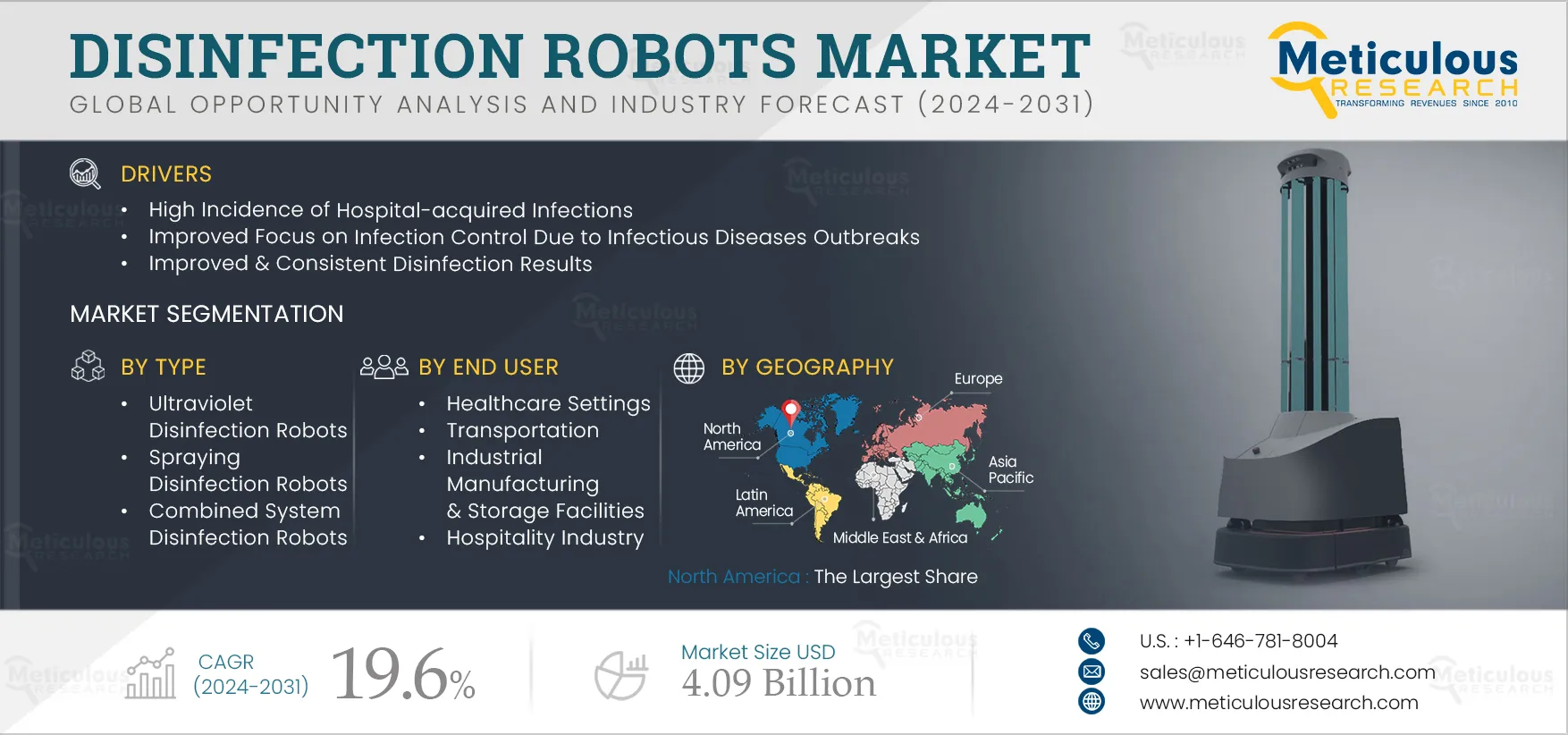
Market dynamics
4 factors across 3 forcesHigh Incidence of Hospital-acquired Infections
Hospital-acquired infections (HAI) are infections acquired in healthcare facilities as a result of extended patient stays, poor hygiene, contaminated rooms or instruments, and congested waiting rooms. Clostridium infections, surgical site infections, pneumonia linked to ventilators, central line-associated bloodstream infections, and catheter-associated urinary tract infections are among the most common HAIs.
According to the World Health Organization report published in March 2022, 8.9 million cases of HAIs are registered every year in Europe’s acute and long-term care facilities. These infections not only pose a significant threat to patient health and life but also increase the burden of healthcare costs due to extended hospital stays.
Need for Reduced Human Intervention and Higher Safety of Cleaning Staff
Disinfection robots offer several advantages over manual disinfection. Manual disinfection is time-consuming and requires a larger workforce. On the contrary, robots can complete cleaning tasks faster and with less manpower.
Manual cleaning and disinfection are often inadequate and result in residual contamination. Studies have shown that only 50% of hospital ward surfaces can be adequately decontaminated through manual cleaning and disinfection practices. Disinfection robots can efficiently kill microorganisms on surfaces, ensuring quality disinfection and validation of the disinfection process with reproducible and documented results.
Robotic disinfection does not require human intervention and is standardized. Therefore, human workers are not exposed to harmful UV radiation, harmful chemicals, and pathogens during the sanitization process.
Table of contents
11 chapters · 99 sections · 180 pages · click to expandSegmental analysis
| Segment | Largest share (2024) | Fastest growth (2024–2031) |
|---|---|---|
| By Type | Ultraviolet Disinfection Robots | — |
| By Technology | Fully Autonomous Disinfection Robots | — |
| By End User | Healthcare Settings | — |
By Type
- The ultraviolet disinfection robots segment is expected to account for the largest share of 72.1% of the disinfection robots market.
- The use of UV-C disinfection robots is becoming increasingly prevalent in hospitals, airports, and shopping centers, among other places.
- During the COVID-19 pandemic, conventional surface disinfectants were in scarce supply, which boosted the production of ultraviolet disinfection robots.
- Their acceptance has increased as they are a simple solution for instant disinfection automation and provide cost savings by decreasing workforce requirements.
- This segment’s large share is attributed to the increasing awareness about hospital-acquired infections, the efficacy of UV-C irradiation in disinfecting surfaces, and the increased need for disinfection and sanitation since the COVID-19 pandemic.
- The key players operating in this market are collaborating to improve accessibility to robotic disinfection products.
- For instance, in January 2022, UVD Robots (a subsidiary of Blue Ocen Robotics) (Denmark) collaborated with Ecolab Inc. (U.S.) to distribute its UV-C disinfection robots in the global market.
By Technology
- The fully autonomous disinfection robots segment is expected to account for the larger share of the disinfection robots market.
- The segment’s large share is attributed to the advantages of fully autonomous disinfection robots over semi-autonomous disinfection robots, such as the integration of advanced software and algorithms for decision-making that reduce workforce requirements.
- Moreover, fully autonomous robots can screen an area for objects for more efficient cleaning and disinfection.
By End User
- The healthcare settings segment is expected to account for the largest share of the disinfection robots market.
- The segment’s large share is attributed to hospitals’ increasing focus on reducing the burden of HAIs.
- According to a 2022 article by GE Healthcare (U.S.), the direct medical costs related to HAIs in the U.S. crossed $28 billion every year, and indirect costs related to lost productivity and early death were estimated at $12.4 billion.
- HAIs can be contracted in hospitals, long-term care facilities, outpatient surgery centers, dialysis centers, or even a doctor’s office.
- HAIs can have detrimental effects, including emotional stress, escalated financial or medical bills, extended hospital stays, and even mortality.
Geographic analysis
North America
Largest shareIn 2024, North America is expected to account for the largest share of 41.4% of the disinfection robots market. North America’s large share can be attributed to the high incidence of HAIs and government policies to promote advancements in the region’s healthcare system. Hospitals, airports, and other crowded public spaces need to maintain a safe and clean atmosphere due to the high prevalence of infectious diseases. According to the CDC, about one in every 31 hospital patients in the U.S. has at least one infection linked to healthcare. North America to Dominate the Disinfection Robots Market in 2024
Asia-Pacific
Fastest growthFurthermore, Asia-Pacific is expected to record the highest CAGR of 16.7% during the forecast period. The growth of this regional market is driven by the rising incidence of infectious diseases, the increasing number of manufacturing plants, the growth of the pharmaceutical industry, and the increasing number of healthcare facilities in the region. According to the India Brand Equity Foundation (IBEF), the Indian Pharmaceutical Industry is the 3rd largest pharmaceutical producer by volume in the world and has the highest number of pharmaceutical manufacturing facilities that comply with the U.S. Food and Drug Administration (FDA). Thus, growth in the region’s pharmaceutical industry is expected to increase the demand for disinfection robots in APAC.
Competitive landscape
- June 2023
Shimadzu Corporation (Japan) signed an agreement with Shyld AI (U.S.) for the development of a new ultraviolet disinfection robot. Under this agreement, the companies will combine Shimadzu’s optical technology for UV Irradiation with Shyld AI’s Human Sensors technology to develop ‘UV Shoot,’ a UV disinfection system.
- January 2022
UBTECH Robotics (China) launched ADIBOT-A, an automated UV disinfectant robot. The robot emits UV rays to decontaminate surfaces in indoor environments. The robot features multiple depth sensors and AI algorithms that help build a 3D diagram of the entire cleaning space.
- PDI Inc
- Xenex Disinfection Services Inc.
- Badger Technologies, LLC
- Jabil Inc.
- Skytron, LLC
- Siemens AG
- Nevoa Inc.
- Omron Corporation
- Finsen Technologies Ltd.
- Fetch Robotics, Inc
- Zebra Technologies Corp
- Taimi Robotics Technology Co. Ltd.
- Akara Robotics Ltd.
Frequently asked questions
The disinfection robots market report covers qualitative and quantitative analyses of the disinfection robots market. This report includes an analysis of the disinfection robots market by type, technology, and end user at the regional and country levels. The report also provides insights into factors affecting market growth, along with a regulatory analysis, a value chain analysis, a pricing analysis, and Porter’s five forces analysis for the disinfection robots market.
Cite this report
Meticulous Research. (2024). Disinfection Robots Market - Global Opportunity Analysis and Industry Forecast (2024-2031) (Report No. MR-547). Meticulous Market Research Pvt. Ltd. https://www.meticulousresearch.com/product/disinfection-robots-market-5234