Aerospace Surface Treatment Services Market (2026-2036)
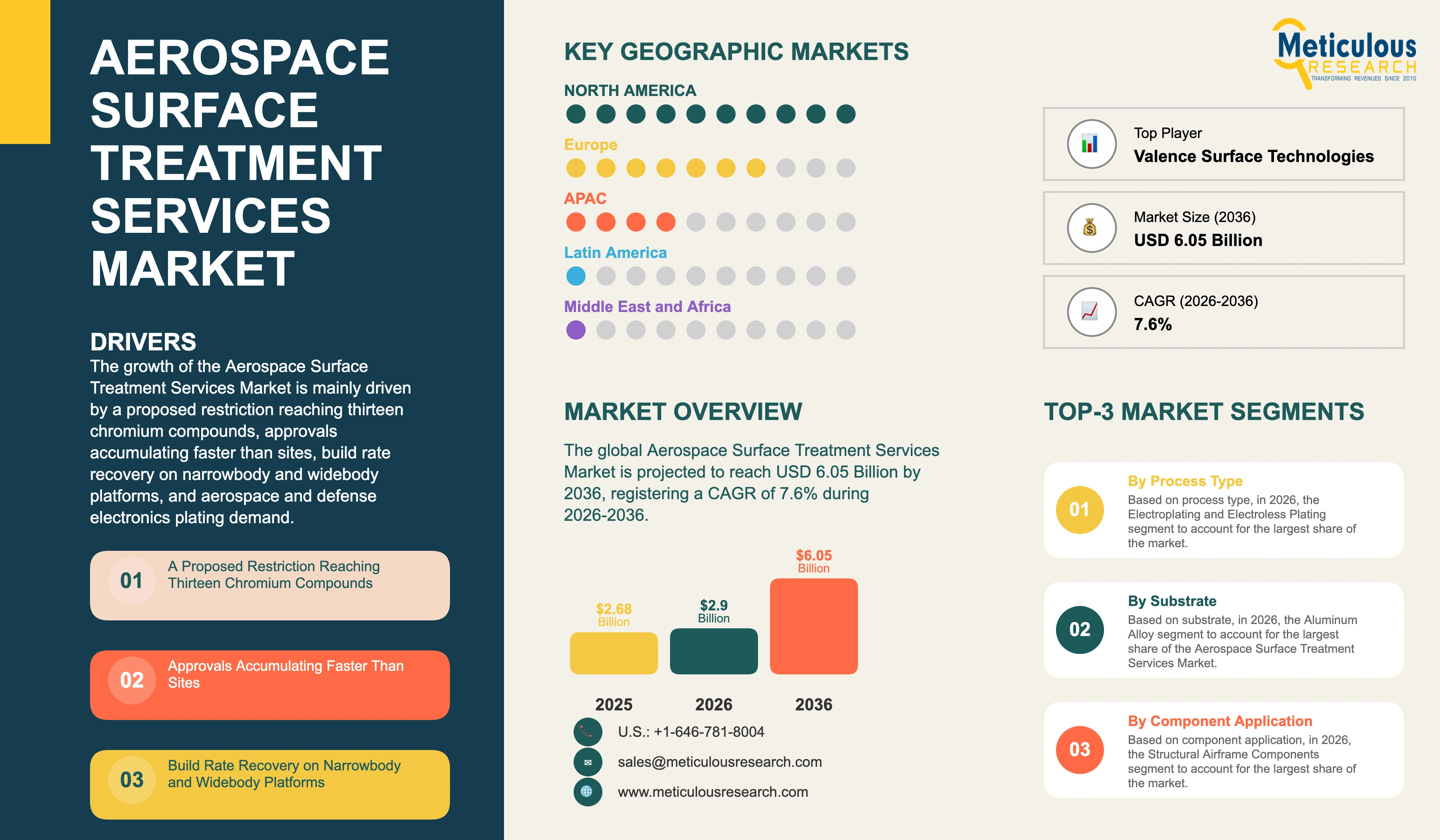
The global Aerospace Surface Treatment Services Market was valued at USD 2.68 billion in 2025. This market is expected to reach USD 6.05 billion by 2036 from an estimated USD 2.90 billion in 2026, registering a CAGR of 7.6% during the forecast period (2026-2036).
- Published
- Nov 2026
- Pages
- 265
- Format
- PDF + Excel
- Report ID
- MRAD - 1042839
- Base year
- 2025
- 2025 · BASELINE
- $2.68B
- 2036
- $6.05B
- CAGR 2026–2036
- 7.6%
2025 baseline · 2026–2036 forecast at 7.6% CAGR · hover a bar for the value
Key highlights
The global Aerospace Surface Treatment Services Market is projected to reach USD 6.05 billion by 2036, driven by a proposed restriction reaching thirteen chromium compounds, approvals accumulating faster than sites, build rate recovery on narrowbody and widebody platforms, and aerospace and defense electronics plating demand.
North America is expected to account for the largest market share in 2026 and is also projected to register the fastest growth during the forecast period, supported by the concentration of airframe and engine manufacture in the region together with the largest base of independent accredited finishing capacity.
By process type, Electroplating and Electroless Plating are expected to account for the largest market share, whereas Thin Film and Vapor Deposition are projected to witness the fastest growth through 2036.
By substrate, Aluminum Alloy are expected to account for the largest market share, whereas Titanium Alloy are projected to witness the fastest growth through 2036.
By component application, Structural Airframe Components are expected to account for the largest market share, whereas Electronics and Connector Hardware are projected to witness the fastest growth through 2036.
A 60-day public consultation on a proposed European restriction of hexavalent chromium covering thirteen compounds opened on 17 June 2026 and ran to 17 August 2026, with a final committee opinion expected afterward.
That proposal applies to substances currently under the authorization regime and names aerospace, automotive, surface treatment, electronics and medical devices among the industries most affected, many of which rely on chromium-based electroplating, primers and anti-corrosion coatings.
Valence Surface Technologies operates 12 locations holding over 5, 000 unique industry approvals and processes more than one million parts a month, with every site accredited under the principal special process program.
That platform has completed 12 add-on acquisitions since inception, including Foresight Finishing announced on 3 November 2025, its second acquisition in about three months.
Foresight Finishing brought gold, silver, nickel, tin and palladium plating by vibratory, rack, selective and barrel methods from a single facility in Tempe, Arizona employing about 110 people, acquired for approvals described as difficult to obtain.
Vapor deposition is being bought as a chromium and cadmium alternative, with the acquisition of Cametoid Technologies adding the largest provider of ion vapor deposition surface treatment in North American aerospace and defense, operating six deposition chambers.
Surface treatment demand is tracking the rate recovery directly, with fourth quarter 2025 commercial aerospace growth at Curtiss-Wright reflecting higher original equipment sales of sensor products and surface treatment services on both narrowbody and widebody platforms.
Curtiss-Wright recorded Aerospace and Industrial segment sales of USD 977 million in 2025, up 5% at a 17.0% operating margin, with company commercial aerospace sales of USD 430 million, up 14% and up 22% in the fourth quarter.
Report summary
| Particulars | Details |
|---|---|
| Forecast Period | 2026-2036 |
| Base Year | 2025 |
| Estimated Year | 2026 |
| CAGR (Value) | 7.6% |
| Format | PDF, Excel & Cloud Portal · 265 pages |
| CAGR (Volume) | 4.6% |
| Market Size (Value) in 2026 | USD 2.90 billion |
| Market Size (Value) in 2036 | USD 6.05 billion |
| Market Size (Volume) in 2026 | 16.25 million process lots |
| Market Size (Volume) in 2036 | 25.50 million process lots |
| Average Selling Price, 2026 | USD 178 per process lot |
| Average Selling Price, 2036 | USD 237 per process lot |
| Segments Covered | By Process Type: Electroplating and Electroless Plating, Anodizing, Chemical Conversion Coating and Passivation, Organic Finishing and Primer Application, Surface Enhancement and Shot Peening, Chemical Milling and Etching, Thin Film and Vapor Deposition. By Substrate: Aluminum Alloy, Titanium Alloy, Steel and Stainless Steel, Nickel-Base Superalloy, Other Substrates. By Component Application: Structural Airframe Components, Landing Gear and Actuation Components, Engine and Propulsion Components, Fasteners and Small Hardware, Electronics and Connector Hardware. By Buyer: Tier One and Tier Two Suppliers, Airframe and Engine Original Equipment Manufacturers, Maintenance, Repair and Overhaul Providers, Tier Three Suppliers and Machine Shops, Other Buyers. |
| Countries Covered | U.S.; Canada; France; Germany; U.K.; Italy; China; India; Japan; South Korea; Mexico; Brazil |
| Key Companies | Valence Surface Technologies, LLC, Curtiss-Wright Corporation, Aalberts N.V., Bodycote plc, and OC Oerlikon Corporation AG |
Report overview
Segments covered: process type, substrate, component application, buyer.
In volume terms, the market is estimated at 16.25 million process lots in 2026 and is expected to reach 25.50 million process lots by 2036, registering a CAGR of 4.6% during the forecast period. The average selling price is estimated at USD 178 per process lot in 2026 and USD 237 per process lot in 2036.
The growth of this market is mainly driven by a proposed European restriction covering thirteen hexavalent chromium compounds that names aerospace and surface treatment among the industries most affected, customer approvals accumulating faster than sites with one platform holding over 5,000 unique industry approvals across 12 locations, build rate recovery on narrowbody and widebody platforms, and qualification difficulty that protects installed positions. However, factors such as chemical and effluent permitting on finishing lines, line capacity added in whole qualified tanks, approvals tied to the tank rather than to the company, and replacement processes that require full requalification before they can be used are expected to restrain the growth of this market to some extent.
Among component applications, Structural Airframe Components are expected to account for the largest market share in 2026, while Electronics and Connector Hardware are projected to register the highest CAGR during the forecast period. Geographically, North America is expected to account for the largest share of this market in 2026 and is also expected to register the highest CAGR during the forecast period.
The Aerospace Surface Treatment Services Market comprises surface treatment and finishing performed as outsourced services on aerospace components, taken at the processor gate with volume expressed as process lots. The market includes Electroplating and Electroless Plating, Anodizing, Chemical Conversion Coating and Passivation, Organic Finishing and Primer Application, Surface Enhancement and Shot Peening, Chemical Milling and Etching, and Thin Film and Vapor Deposition, performed on aluminum alloy, titanium alloy, steel and nickel-base superalloy, for structural airframe components, landing gear and actuation components, engine and propulsion components, fasteners and small hardware, and electronics and connector hardware, bought by tier one and tier two suppliers, airframe and engine original equipment manufacturers, maintenance, repair and overhaul providers, and tier three suppliers and machine shops. Thermal spray coating, heat treatment and thermal processing, nondestructive testing, finishing performed in-house by component manufacturers, process chemicals and plating equipment sold as capital, and the components themselves fall outside the scope.
A finished aerospace component carries corrosion protection, wear resistance, paint adhesion and electrical properties created in a tank or a chamber rather than on a machine, and none of those properties can be inspected back out of the part afterward. The process is therefore approved rather than the product, and the approval names the line, the chemistry and the specification. One platform illustrates the density that results, holding over 5,000 unique industry approvals across just 12 locations while processing more than one million parts a month.
Chemistry rather than capacity is what is changing in this market. A 60-day public consultation on a proposed European restriction of hexavalent chromium covering thirteen compounds opened on 17 June 2026 and ran to 17 August 2026, applying to substances currently under the authorization regime, with a final committee opinion expected afterward. Aerospace, automotive, surface treatment, electronics and medical devices are named among the industries most affected, many of them relying on chromium-based electroplating, primers and anti-corrosion coatings.
Moving away from those chemistries is not a substitution but a requalification. A chromate conversion coating replaced by a trivalent or chromium-free system has to be requalified against the original corrosion, adhesion and electrical requirements on each substrate and each part number, and the approval that attaches to the new line is separate from the one it replaces. The processor carries that qualification work while continuing to run the incumbent process, which is why the transition appears as cost before it appears as revenue.
Vapor deposition is being bought rather than developed as the route around wet plating. The acquisition of Cametoid Technologies added the largest provider of ion vapor deposition surface treatment in North American aerospace and defense, operating six deposition chambers, to a platform that had already completed 12 add-on acquisitions since inception. Thin Film and Vapor Deposition is projected to be the fastest-growing process type in this market at 10.8% as a result.
Consolidation is being driven by approvals rather than by tonnage. Foresight Finishing, announced on 3 November 2025 as the second acquisition in about three months, brought gold, silver, nickel, tin and palladium plating by vibratory, rack, selective and barrel methods from a single facility in Tempe, Arizona employing about 110 people, and was acquired for approvals described as difficult to obtain. A finishing house with scarce approvals is therefore worth more to an acquirer than its tank capacity alone would suggest.
Demand is tracking the build rate recovery without a lag, because finishing is among the last operations before a component ships. Fourth quarter 2025 commercial aerospace growth at Curtiss-Wright reflected higher original equipment sales of sensor products and surface treatment services on both narrowbody and widebody platforms, on Aerospace and Industrial segment sales of USD 977 million for the year, up 5% at a 17.0% operating margin, and company commercial aerospace sales of USD 430 million, up 14%. Value grows ahead of volume throughout the forecast period at 7.6% against 4.6%, as the mix moves toward vapor deposition and precious metal work.
North America is expected to account for the largest share of this market in 2026, supported by the largest base of independent accredited finishing capacity and by consolidation of that base through acquisition rather than construction.
Europe is projected to grow at 7.0% and holds the second largest regional position in this market in 2026. The region is where the regulatory change bears most directly, with a 60-day consultation on a proposed restriction covering thirteen hexavalent chromium compounds opening on 17 June 2026 and running to 17 August 2026, naming aerospace and surface treatment among the industries most affected. France, Germany, the United Kingdom and Italy carry most regional demand, and qualification of chromium-free and trivalent alternatives is more advanced here than in regions without an equivalent deadline.
The Middle East & Africa region is projected to grow at 8.6% from the smallest regional base, concentrated in maintenance, repair and overhaul operations at the Gulf hub carriers where selective and brush plating restores worn surfaces, and in capability established alongside defense procurement, with effluent treatment and water consumption favoring vapor deposition over wet plating where specifications permit. Latin America is projected to grow at 8.4%, with Mexico accounting for most regional volume through anodizing, conversion coating and plating capacity built alongside the machining clusters in Querétaro and Chihuahua, and Brazilian demand following regional jet manufacture.
Some of the key players operating in the aerospace surface treatment services market are Valence Surface Technologies, LLC, Curtiss-Wright Corporation, Aalberts N.V., Bodycote plc, and OC Oerlikon Corporation AG, among others.
Key strategies include acquiring independent finishing houses for their approval portfolios, with 12 add-on transactions completed at one platform since inception including Foresight Finishing in November 2025; buying rather than building vapor deposition capability, as in the acquisition of six existing ion vapor deposition chambers; qualifying chromium-free and trivalent alternatives ahead of restriction so as to hold the only approved route for part numbers that transition; extending into aerospace and defense electronics plating; and locating finishing capacity inside machining clusters in Asia-Pacific and Mexico.
Report infographic
Market dynamics
20 factors across 5 forcesA Proposed Restriction Reaching Thirteen Chromium Compounds
A 60-day public consultation on a proposed European restriction of hexavalent chromium covering thirteen compounds opened on 17 June 2026 and ran to 17 August 2026, applying to substances currently under the authorization regime, with a final committee opinion expected at a forthcoming committee meeting. Aerospace, automotive, surface treatment, electronics and medical devices are named among the industries most affected, many relying on chromium-based electroplating, primers and anti-corrosion coatings. A restriction replacing case-by-case authorization changes the planning horizon for every finishing line running chromate chemistry, and the replacement has to be qualified before the incumbent process is withdrawn rather than afterward. Processors that hold both the incumbent approval and a qualified alternative are the only ones able to serve a part number through the transition, which concentrates the work rather than redistributing it.
Approvals Accumulating Faster Than Sites
Valence Surface Technologies holds over 5,000 unique industry approvals across 12 locations and processes more than one million parts a month, with every site accredited under the principal special process program. That is several hundred approvals per site, each naming a line, a chemistry and a specification, and each requiring maintenance whether or not it is currently running work. Approval density rather than tank count determines how much of a customer part list a finishing house can serve, and it cannot be replicated by installing equipment. Tier One and Tier Two Suppliers hold the largest buyer share of this market in 2026 precisely because a single approved house covering many of their part numbers is cheaper for them than qualifying several.
Build Rate Recovery on Narrowbody and Widebody Platforms
Fourth quarter 2025 commercial aerospace growth at Curtiss-Wright reflected higher original equipment sales of sensor products and surface treatment services on both narrowbody and widebody platforms, with company commercial aerospace sales of USD 430 million for the year, up 14% and up 22% in the fourth quarter, on Aerospace and Industrial segment sales of USD 977 million at a 17.0% operating margin. The Federal Aviation Administration raised the Boeing 737 MAX production cap from 38 to 42 aircraft a month in October 2025. Finishing is among the last operations before a component ships, so it records a rate increase without the lag that upstream processing carries. That makes this market a nearer-term read on build rates than heat treatment or machining, and it is why fourth quarter growth outpaced the full year.
Qualification Difficulty Protecting Installed Positions
Foresight Finishing was acquired for approvals described as difficult to obtain, bringing gold, silver, nickel, tin and palladium plating by vibratory, rack, selective and barrel methods from a single facility employing about 110 people. The difficulty of the approval, not the scarcity of the equipment, was the stated rationale. Where an approval is hard to obtain, the incumbent holds the part number for as long as the program runs and a customer facing a price increase has no near-term alternative. That is what sustains price per process lot rising from USD 178 in 2026 to USD 237 in 2036 against modest growth in lots processed.
Aerospace and Defense Electronics Plating Demand
Precious metal finishing for aerospace and defense electronics has been pulled into the same platforms that serve airframe and engine work, with gold, silver, nickel, tin and palladium plating acquired in November 2025 to add a regional presence in the aerospace and defense electronics segment. Connector shells, housings and backplanes require plated finishes for conductivity and corrosion resistance that structural finishing lines are not approved to apply. Electronics and Connector Hardware is projected to be the fastest-growing component application in this market at 10.2%. Defense electronics content per platform is rising faster than airframe content, and the finishing attached to it carries a higher value per lot than structural anodizing.
Table of contents
12 chapters · 140 sections · 265 pages · click to expandSegmental analysis
| Segment | Largest share (2026) | Fastest growth (2026–2036) |
|---|---|---|
| By Process Type | Electroplating and Electroless Plating | Thin Film and Vapor Deposition |
| By Substrate | Aluminum Alloy | Titanium Alloy |
| By Component Application | Structural Airframe Components | Electronics and Connector Hardware |
| By Buyer | Tier One and Tier Two Suppliers | Maintenance, Repair and Overhaul Providers |
| Other segments | Aluminum Alloy | Thin Film and Vapor Deposition |
By Process Type
- Electroplating and Electroless Plating are expected to account for the largest share of the global Aerospace Surface Treatment Services Market.
- The large share of this segment is mainly due to the breadth of functional requirements it satisfies across corrosion protection, wear resistance and electrical performance, and the value per lot that cadmium, zinc-nickel, hard chrome and electroless nickel work carries relative to simpler conversion treatments.
- However, Thin Film and Vapor Deposition are projected to register the highest CAGR during the forecast period.
- The rapid growth of this segment is attributed to its use as the route around aqueous chemistry and effluent as a restriction covering thirteen hexavalent chromium compounds advances, together with the scarcity of deposition chamber capacity that is being acquired rather than installed.
- Electroplating and Electroless Plating are expected to account for the largest market share in 2026.
- Titanium Alloy are projected to register the highest CAGR during the forecast period, owing to rising titanium content on and around composite primary structure, where parts attaching to carbon fiber must be titanium for galvanic compatibility and then require their own distinct treatment and approval set.
- Electronics and Connector Hardware are projected to register the highest CAGR during the forecast period, owing to defense electronics content per platform rising faster than airframe content, and the gold, silver, nickel, tin and palladium finishes connector and housing hardware requires, which carry a higher value per lot than structural anodizing.
- Maintenance, Repair and Overhaul Providers are projected to register the highest CAGR during the forecast period, owing to growth in the installed fleet and in shop visit volumes, together with selective and brush plating that restores worn surfaces in place and carries approvals distinct from original equipment work.
By Substrate
- Aluminum Alloy are expected to account for the largest market share.
- The large share of this segment is mainly due to the proportion of airframe structure, skins and fittings produced in aluminum, all of which require conversion coating, anodizing and primer treatment for corrosion protection before assembly.
- However, Titanium Alloy are projected to register the highest CAGR during the forecast period.
- The rapid growth of this segment is attributed to rising titanium content on and around composite primary structure, where parts attaching to carbon fiber must be titanium for galvanic compatibility and then require their own distinct treatment and approval set.
By Component Application
- Structural Airframe Components are expected to account for the largest market share.
- The large share of this segment is mainly due to the surface area and part count of frames, ribs, spars, skins and fittings requiring corrosion protection and paint adhesion before assembly, which exceeds any other application in lots processed.
- However, Electronics and Connector Hardware are projected to register the highest CAGR during the forecast period.
- The rapid growth of this segment is attributed to defense electronics content per platform rising faster than airframe content, and the gold, silver, nickel, tin and palladium finishes connector and housing hardware requires, which carry a higher value per lot than structural anodizing.
By Buyer
- Tier One and Tier Two Suppliers are expected to account for the largest market share.
- The large share of this segment is mainly due to the volume of components they manufacture combined with the economy of placing many part numbers with one house holding several hundred approvals rather than qualifying several suppliers.
- However, Maintenance, Repair and Overhaul Providers are projected to register the highest CAGR during the forecast period.
- The rapid growth of this segment is attributed to growth in the installed fleet and in shop visit volumes, together with selective and brush plating that restores worn surfaces in place and carries approvals distinct from original equipment work.
Other segments
- Thin Film and Vapor Deposition are projected to register the highest CAGR during the forecast period, owing to its use as the route around aqueous chemistry and effluent as a restriction covering thirteen hexavalent chromium compounds advances, together with the scarcity of deposition chamber capacity that is being acquired rather than installed.
- Aluminum Alloy are expected to account for the largest market share in 2026.
- Structural Airframe Components are expected to account for the largest market share in 2026.
- Tier One and Tier Two Suppliers are expected to account for the largest market share in 2026.
Geographic analysis
North America
Largest shareNorth America is expected to account for the largest share of this market in 2026 and is projected to grow at 7.2%. The United States holds the largest base of independent accredited finishing capacity, including a platform operating 12 locations with over 5,000 unique industry approvals and processing more than one million parts a month, and consolidation of that base is advancing through acquisition rather than construction, with 12 add-on transactions completed since inception and two within about three months during 2025. Surface treatment services supplied to original equipment manufacturers on both narrowbody and widebody platforms contributed to fourth quarter 2025 commercial aerospace growth at Curtiss-Wright. Canadian capability includes ion vapor deposition treatment serving regional aerospace and defense work. Mexico accounts for most regional volume, with anodizing, conversion coating and plating capacity built alongside the machining clusters in Querétaro and Chihuahua that supply North American assembly. Because a component travels to an approved line and returns, finishing located inside a machining cluster removes freight and days from the cycle, which is why regional finishing capacity follows regional machining rather than leading it. Brazilian demand follows regional jet manufacture and its supplier base.
Europe
Europe is projected to grow at 7.0% and holds the second largest regional position in this market in 2026. The region is where the regulatory change bears most directly, with a 60-day consultation on a proposed restriction covering thirteen hexavalent chromium compounds opening on 17 June 2026 and running to 17 August 2026, applying to substances currently under the authorization regime and naming aerospace and surface treatment among the industries most affected. France, Germany, the United Kingdom and Italy carry most regional demand across airframe, engine and systems work packages. Qualification of chromium-free and trivalent alternatives is consequently more advanced here than in regions without an equivalent deadline.
Asia-Pacific
Fastest growthAsia-Pacific is projected to be the fastest-growing region in this market at 9.6%. India is projected to be the fastest-growing country at 12.0%, with work packages transferring into the region creating first finishing approvals rather than reassessing established ones, so accreditation and capability arrive together with the tanks. China holds the largest regional volume across domestic programs and work package manufacture. Japan is projected to be the slowest-growing country at 5.2%, where the finishing base is long established and load tracks the platforms already supplied. South Korean capacity serves aerostructures, engine components and defense programs. Asia-Pacific is projected to register the highest CAGR at 9.6%, as work package transfer creates first finishing approvals rather than reassessing established ones, with India projected to be the fastest-growing country at 12.0%.
Latin America
Latin America is projected to grow at 8.4%.
Middle East & Africa
The Middle East & Africa region is projected to grow at 8.6% from the smallest regional base in this market. Demand is concentrated in maintenance, repair and overhaul operations at the Gulf hub carriers, where selective and brush plating restores worn surfaces on components removed at shop visit, and in finishing capability established alongside defense procurement programs. Effluent treatment and water consumption weigh more heavily on new lines in arid markets, which favors vapor deposition over wet plating where the specification permits it.
Competitive landscape
The global Aerospace Surface Treatment Services Market is fragmented, with competition among independent aerospace finishing platforms, international surface technology groups and regional accredited plating and anodizing houses. Market participants compete primarily on breadth of customer approvals by process and specification, accreditation at every operating site, proximity to component manufacturing clusters, qualification of chromium-free and vapor deposition alternatives, and turnaround against compressed schedules.
acquiring independent finishing houses for their approval portfolios, buying rather than building vapor deposition capability, qualifying chromium-free and trivalent alternatives ahead of restriction, and extending into aerospace and defense electronics plating
The report provides a comprehensive competitive assessment of the leading companies operating in the global Aerospace Surface Treatment Services Market. The key players profiled in the report include Valence Surface Technologies, LLC (U.S.), Curtiss-Wright Corporation (U.S.), Aalberts N.V. (Netherlands), Bodycote plc (U.K.), and OC Oerlikon Corporation AG (Switzerland).
- Valence Surface Technologies, LLC
- Curtiss-Wright Corporation
- Aalberts N.V.
- Bodycote plc
- OC Oerlikon Corporation AG
Expert perspectives
Over 5,000 unique industry approvals across 12 locations is the number that describes this market properly, because it is several hundred approvals per site and none of them can be installed. Approval density rather than tank capacity determines how much of a customer part list a finishing house can serve, which is why twelve add-on acquisitions at one platform were made for approval portfolios and why Foresight Finishing was bought for approvals described as difficult to obtain rather than for its 110 employees.
The chromium transition will be paid for before it is earned from, and processors should plan on that sequence. A restriction covering thirteen hexavalent chromium compounds was consulted on between 17 June and 17 August 2026 with a committee opinion to follow, and every chromate process replaced has to be requalified per substrate and per part number while the incumbent line keeps running. The customer also controls the timetable, since the change needs its acceptance. Processors that complete qualification first hold the only approved route for the part numbers that move, which is the return on carrying that cost early.
Finishing is the nearest-term read on build rate in the supply chain and the most exposed to other people schedules, and both follow from sitting last. Fourth quarter commercial aerospace growth at Curtiss-Wright on surface treatment services across narrowbody and widebody platforms outpaced the full year, where upstream processing recorded its recovery later. The same position means every delay upstream arrives as compressed turnaround, which caps price realization on structural work even where approvals are scarce. The pricing power sits in vapor deposition at 10.8% growth and in electronics finishing at 10.2%, not in structural anodizing.
Customer perspectives
“We place work with one house because they hold approvals on several hundred of our part numbers. Qualifying a second supplier is not one approval, it is one per part number and per specification, and the cost of that exercise is far more than any price difference we would win. So the relationship is sticky whether we like it or not.”
“The chromium question is a requalification program, not a chemical swap. We have to prove the replacement against the original corrosion and adhesion requirements on every substrate and every part number, and we are running the old line the whole time. Our customers decide when they accept the change, so we are spending ahead of revenue we cannot schedule.”
“Finishing is the last thing that happens before a part ships, which means every delay anywhere else lands on the finishing line as a shorter window. Our processors are measured on turnaround that includes problems they did not cause. It is also why we want the tanks close to the machining, because days spent in transit are days we do not have.”
Frequently asked questions
The global Aerospace Surface Treatment Services Market is estimated at USD 2.90 billion in 2026.
Cite this report
Meticulous Research. (2026). Aerospace Surface Treatment Services Market - Global Opportunity Analysis and Industry Forecast (2026-2036) (Report No. MRAD - 1042839). Meticulous Market Research Pvt. Ltd. https://www.meticulousresearch.com/product/aerospace-surface-treatment-services-market-7522