Automated Drilling and Fastening Systems Market (2026-2036)
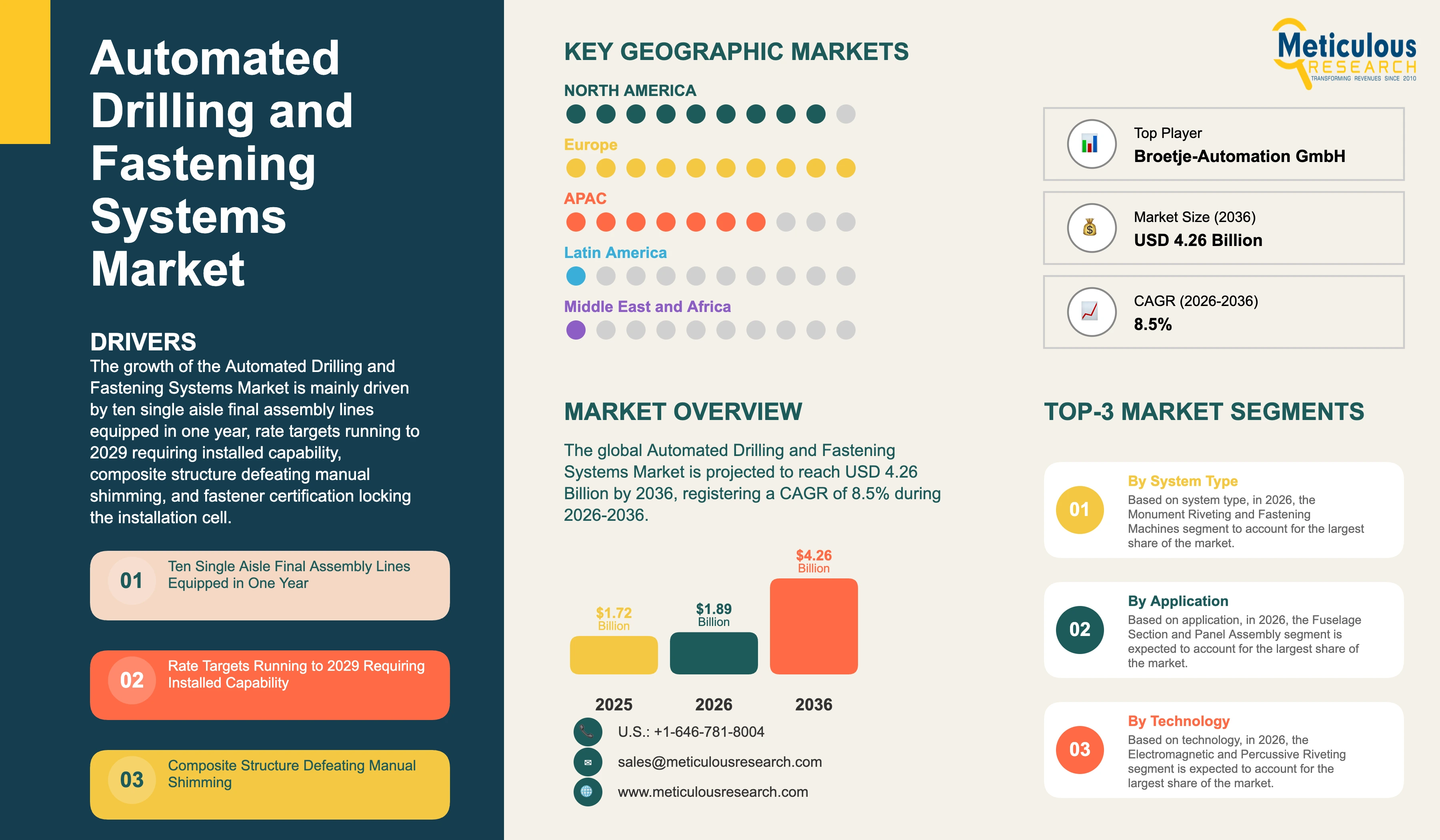
The global Automated Drilling and Fastening Systems Market was valued at USD 1.72 billion in 2025. This market is expected to reach USD 4.26 billion by 2036 from an estimated USD 1.89 billion in 2026, registering a CAGR of 8.5% during the forecast period (2026-2036).
- Published
- Nov 2026
- Pages
- 261
- Format
- PDF + Excel
- Report ID
- MRAD - 1042841
- Base year
- 2025
- 2025 · BASELINE
- $1.72B
- 2036
- $4.26B
- CAGR 2026–2036
- 8.5%
2025 baseline · 2026–2036 forecast at 8.5% CAGR · hover a bar for the value
Key highlights
The global Automated Drilling and Fastening Systems Market is projected to reach USD 4.26 billion by 2036, driven by ten single aisle final assembly lines equipped in one year, rate targets running to 2029, composite structure defeating manual shimming, and fastener certification locking the installation cell.
Europe is expected to account for the largest market share in 2026 and is also projected to register the fastest growth during the forecast period, supported by the concentration of final assembly line investment and automation engineering capability across the European airframe and equipment supply base.
By system type, Monument Riveting and Fastening Machines are expected to account for the largest market share, whereas Flex-Track and Crawler Portable Systems are projected to witness the fastest growth through 2036.
By application, Fuselage Section and Panel Assembly are expected to account for the largest market share, whereas Final Assembly and Join are projected to witness the fastest growth through 2036.
By technology, Electromagnetic and Percussive Riveting are expected to account for the largest market share, whereas Automated Shimming and Surface Preparation are projected to witness the fastest growth through 2036.
Airbus inaugurated a second modernized A320 Family final assembly line at the Jean-Luc Lagardere facility in Toulouse on 15 June 2026, alongside the first line opened in July 2023 inside the former A380 building.
That opening completed a plan for ten A320 Family final assembly lines worldwide in 2026, comprising four in Hamburg, two in Mobile, two in Tianjin and two in Toulouse.
The new line integrates digital controls, automated logistics and robotics to optimize workflows and workstation ergonomics, with the workforce across both Lagardere lines expected to reach nearly 1,500 from about 700 on the first line.
Rate targets extend to the end of the decade, with 70 to 75 A320 family aircraft a month by the end of 2027 and stabilization at rate 75 afterward, 12 A350 and 13 A220 aircraft a month in 2028 and 5 A330 aircraft a month in 2029.
The A320 Family backlog stood at 7, 499 aircraft at the end of May 2026, including 5,615 A321neo aircraft, and the Federal Aviation Administration raised the Boeing 737 production cap from 38 to 42 aircraft a month in October 2025.
A publicly funded research project on shim-free assembly of thin-walled aircraft structures completed in 2026, bringing together Broetje-Automation, 3D.aero, Boeing, KEBA Industrial Automation, the Institute for Production Management and Technology and WZL Aachen under the German aviation research program.
That work targeted the manual shimming of large composite parts, which causes iterative correction loops, time-consuming coordination and heavy documentation, lengthening throughput times and tying up skilled specialists.
The resulting process uses an edge device digital twin of machine and component, measurement of actual deviations, a deformation model and new six-axis manipulators for real-time stress-free forming, with targeted material removal to final contour replacing manual shims.
Report summary
| Particulars | Details |
|---|---|
| Forecast Period | 2026-2036 |
| Base Year | 2025 |
| Estimated Year | 2026 |
| CAGR (Value) | 8.5% |
| Format | PDF, Excel & Cloud Portal · 261 pages |
| CAGR (Volume) | 5.7% |
| Market Size (Value) in 2026 | USD 1.89 billion |
| Market Size (Value) in 2036 | USD 4.26 billion |
| Market Size (Volume) in 2026 | 580 systems delivered |
| Market Size (Volume) in 2036 | 1,010 systems |
| Average Selling Price, 2026 | USD 3.26 million per system |
| Average Selling Price, 2036 | USD 4.22 million per system |
| Segments Covered | By System Type: Monument Riveting and Fastening Machines, Robotic Drilling and Fastening Cells, Gantry Drilling and Countersinking Machines, Flex-Track and Crawler Portable Systems, End Effectors, Tooling and Process Heads. By Application: Fuselage Section and Panel Assembly, Wing Assembly, Final Assembly and Join, Empennage and Control Surface Assembly, Component and Subassembly. By Technology: Electromagnetic and Percussive Riveting, Automated Bolt and Blind Fastener Installation, One-Sided and Single-Side Fastening, Measurement, Metrology and Adaptive Control, Automated Shimming and Surface Preparation. By End User: Airframe Integrators, Tier One Aerostructures Suppliers, Defense and Military Platform Manufacturers, Maintenance, Repair and Overhaul and Retrofit, Other End Users. |
| Countries Covered | France; Germany; U.K.; Spain; U.S.; Canada; China; Japan; India; South Korea; Mexico; Brazil |
| Key Companies | Broetje-Automation GmbH, Electroimpact, Inc., M.Torres Diseños Industriales, S.A.U., Advanced Integration Technology, Inc., and KUKA AG |
Report overview
Segments covered: system type, application, technology, end user.
In volume terms, the market is estimated at 580 systems delivered in 2026 and is expected to reach 1,010 systems by 2036, registering a CAGR of 5.7% during the forecast period. The average selling price is estimated at USD 3.26 million per system in 2026 and USD 4.22 million per system in 2036.
The growth of this market is mainly driven by ten single aisle final assembly lines operating worldwide in 2026 after the inauguration of a second Toulouse line on 15 June 2026, rate targets running to 2029 that require installed capability before the rate arrives, composite structure that defeats manual shimming, and fastener certification that locks the installation cell. However, factors such as capital committed against rate targets that have been revised inside the procurement cycle, requalification of any change to an approved cell, installed lines built around manual stations, and integration risk carried by the equipment supplier rather than the customer are expected to restrain the growth of this market to some extent.
Among technologys, Electromagnetic and Percussive Riveting are expected to account for the largest market share in 2026, while Automated Shimming and Surface Preparation are projected to register the highest CAGR during the forecast period. Geographically, Europe is expected to account for the largest share of this market in 2026 and is also expected to register the highest CAGR during the forecast period.
The Automated Drilling and Fastening Systems Market comprises capital equipment and integrated cells that drill, countersink and install fasteners in aircraft structure, taken at the equipment supplier gate with volume expressed as systems delivered. The market includes Monument Riveting and Fastening Machines, Robotic Drilling and Fastening Cells, Gantry Drilling and Countersinking Machines, Flex-Track and Crawler Portable Systems, and End Effectors, Tooling and Process Heads, applied to fuselage section and panel assembly, wing assembly, final assembly and join, and empennage and control surface assembly, bought by airframe integrators, tier one aerostructures suppliers, defense and military platform manufacturers, and maintenance, repair and overhaul and retrofit operations. Automated fiber placement and layup equipment, machining centers sold for metal removal, assembly jigs and tooling without integrated drilling or fastening capability, the fasteners installed by these systems, and standalone measurement equipment fall outside the scope.
Assembly capability has to exist before the rate it serves arrives, which puts this market a step ahead of the delivery figures it ultimately depends on. Airbus inaugurated a second modernized A320 Family final assembly line at the Jean-Luc Lagardere facility in Toulouse on 15 June 2026, completing a plan for ten A320 Family final assembly lines worldwide in 2026, four in Hamburg, two in Mobile, two in Tianjin and two in Toulouse. Equipping those lines is contracted years before the aircraft they build are delivered.
The rates those lines are sized for are published and run to the end of the decade, at 70 to 75 A320 family aircraft a month by the end of 2027 and stabilization at rate 75 afterward, 12 A350 and 13 A220 aircraft a month in 2028 and 5 A330 aircraft a month in 2029, against an A320 Family backlog of 7,499 aircraft at the end of May 2026 including 5,615 A321neo. The Federal Aviation Administration raised the Boeing 737 production cap from 38 to 42 aircraft a month in October 2025.
New lines are being specified around automation rather than retrofitted with it. The second Toulouse line integrates digital controls, automated logistics and robotics to optimize workflows and workstation ergonomics, and the workforce across both Lagardere lines is expected to reach nearly 1,500 against about 700 on the first line alone. Automation and headcount are rising together on these lines, which indicates capability being added to reach rate rather than to displace labor.
Composite structure is what has moved automation from a cost argument to a capability requirement. Manual shimming of large thin-walled composite parts causes iterative correction loops, time-consuming coordination and heavy documentation, lengthening throughput times and tying up skilled specialists, while the hard-to-predict deformation of those parts makes consistent process quality difficult to hold. Neither problem is solved by working faster.
A publicly funded research project on shim-free assembly of thin-walled aircraft structures completed in 2026, bringing together Broetje-Automation, 3D.aero, Boeing, KEBA Industrial Automation, the Institute for Production Management and Technology and WZL Aachen under the German aviation research program. The resulting process pairs an edge device digital twin of machine and component with measurement of actual deviations, a deformation model and new six-axis manipulators for real-time stress-free forming, replacing manual shims with targeted material removal to final contour. Automated Shimming and Surface Preparation is accordingly projected to be the fastest-growing technology in this market at 12.6%.
Qualification protects the installed position once a cell is running. A fastener certified for automated installation cannot be substituted without requalifying the cell, and any change to the machine, the process head or the program reopens the approval on the joints it produces. Equipment suppliers therefore hold the aftermarket, the upgrades and the spares for the life of the line, and value grows ahead of volume throughout the forecast period at 8.5% against 5.7% as systems carry more measurement, adaptive control and data capability than the machines they replace.
Defense and Military Platform Manufacturers are projected to be the fastest-growing end user in this market at 10.6%. GKN Aerospace is expanding F-35 canopy capacity at Garden Grove for completion in the second half of 2027, and Boeing recorded 131 defense, space and security deliveries in 2025. Defense assembly equipment also carries export control requirements that restrict which suppliers may bid, which protects pricing relative to commercial work.
An assembly machine installed for a program stays in service for decades, and any change to it reopens the qualification of the joints it produces. Spares, process head replacement, control system upgrades and recertification therefore accrue to the original supplier rather than being contestable. Suppliers that price the installed base as a service relationship rather than as warranty obligations convert a capital sale into recurring revenue over the life of the line.
Europe is expected to account for the largest share of this market in 2026, holding both the final assembly line investment with four A320 Family lines in Hamburg and two in Toulouse, and the automation engineering and equipment supply base.
Europe is expected to account for the largest share of this market in 2026 and is projected to grow at 8.0%. Four A320 Family final assembly lines in Hamburg and two in Toulouse sit among the ten operating worldwide in 2026, with the second Toulouse line inaugurated on 15 June 2026 integrating digital controls, automated logistics and robotics. Germany and Spain carry the equipment supply base, and the shim-free assembly process completed in 2026 under the German aviation research program was developed by a consortium of equipment suppliers, an airframer, a controls supplier and two research institutes.
The Middle East & Africa region is projected to grow at 9.2% from the smallest regional base, with assembly capability established alongside defense procurement and aircraft orders under offset commitments, so equipment is specified within a program package and new facilities are automated from commissioning. Latin America is projected to grow at 8.6%, with Mexico taking a growing share through aerostructures and subassembly capacity alongside the Querétaro and Chihuahua clusters, and Brazil holding the larger established position through regional jet assembly supported by Embraer targeting about 100 deliveries a year within two years against 78 in 2025.
Some of the key players operating in the automated drilling and fastening systems market are Broetje-Automation GmbH, Electroimpact, Inc., M.Torres Diseños Industriales, S.A.U., Advanced Integration Technology, Inc., and KUKA AG, among others.
Key strategies include developing automated shimming and adaptive forming capability through collaborative research programs such as the shim-free assembly project completed in 2026; extending flex-track and crawler portable ranges to reach lines laid out for manual stations; building digital twin, measurement and adaptive control capability into machines rather than adding inspection afterward; pricing installed base support as a service relationship across equipment lives measured in decades; and positioning for defense work where export control restricts the bidder field.
Report infographic
Market dynamics
17 factors across 4 forcesTen Single Aisle Final Assembly Lines Equipped in One Year
Airbus inaugurated a second modernized A320 Family final assembly line at the Jean-Luc Lagardere facility in Toulouse on 15 June 2026, alongside the first line opened in July 2023 inside the former A380 building, completing a plan for ten A320 Family final assembly lines worldwide in 2026 comprising four in Hamburg, two in Mobile, two in Tianjin and two in Toulouse. Each line requires drilling, fastening and join capability specified, built, installed and qualified before it can accept work, and that equipment is contracted years ahead of the aircraft it will build. Airframe Integrators hold the largest end user share of this market in 2026 for that reason, and the concentration of those lines in Europe and North America is what places those two regions ahead of Asia-Pacific.
Rate Targets Running to 2029 Requiring Installed Capability
Published targets run to 70 to 75 A320 family aircraft a month by the end of 2027 and stabilization at rate 75 afterward, 12 A350 and 13 A220 aircraft a month in 2028 and 5 A330 aircraft a month in 2029, with the Federal Aviation Administration having raised the Boeing 737 production cap from 38 to 42 aircraft a month in October 2025 and 787 production stabilized at seven a month and moving to eight. Capability has to be installed and qualified before the rate it serves arrives, so equipment demand leads delivery growth rather than following it. An A320 Family backlog of 7,499 aircraft at the end of May 2026 including 5,615 A321neo gives buyers the confidence to commit that capital against a schedule they can see.
Composite Structure Defeating Manual Shimming
Manual shimming of large thin-walled composite parts causes iterative correction loops, time-consuming coordination and heavy documentation requirements, lengthening throughput times and tying up skilled specialists, while the hard-to-predict deformation of those parts makes consistently high process quality difficult to achieve. A publicly funded project on shim-free assembly completed in 2026 with Broetje-Automation, 3D.aero, Boeing, KEBA Industrial Automation and two research institutes addressing exactly that problem. The resolution requires measurement, a deformation model and manipulators able to form the part stress-free in real time, none of which can be delivered manually. Automated Shimming and Surface Preparation is projected to be the fastest-growing technology in this market at 12.6%, because composite content makes the capability a requirement rather than an efficiency.
Fastener Certification Locking the Installation Cell
A fastener certified for automated installation is approved against the cell that installs it, so changing the machine, the process head or the program reopens the approval on every joint it produces. Blind fasteners and one-sided installation methods are growing fastest among fastener types precisely because automated cells can place them where a solid rivet cannot be bucked. That interdependence gives the equipment supplier the aftermarket, the upgrades and the spares for the life of the line, since a customer cannot substitute a competing machine without requalifying the joints. Price per system rises from USD 3.26 million in 2026 to USD 4.22 million in 2036 partly on that retained position.
Skilled Assembly Labor Released by Automation
Manual shimming and hand drilling tie up skilled specialists on work that does not require their judgment, at a time when skilled labor shortages are named as a continuing concern across commercial and defense aerospace. The second Toulouse line is expected to carry a workforce of nearly 1,500 across both Lagardere lines against about 700 on the first alone, with digital controls, automated logistics and robotics designed in. Automation on these lines is being added to reach rate rather than to reduce headcount, which is a different commercial case from the one usually made for factory automation. It also means the investment survives labor cost scrutiny, because the alternative is not cheaper labor but unachievable rate.
Table of contents
12 chapters · 138 sections · 261 pages · click to expandSegmental analysis
| Segment | Largest share (2026) | Fastest growth (2026–2036) |
|---|---|---|
| By System Type | Monument Riveting and Fastening Machines | Flex-Track and Crawler Portable Systems |
| By Application | Fuselage Section and Panel Assembly | Final Assembly and Join |
| By Technology | Electromagnetic and Percussive Riveting | Automated Shimming and Surface Preparation |
| By End User | Airframe Integrators | Defense and Military Platform Manufacturers |
| Other segments | Fuselage Section and Panel Assembly | Automated Shimming and Surface Preparation |
By System Type
- Monument Riveting and Fastening Machines are expected to account for the largest share of the global Automated Drilling and Fastening Systems Market.
- The large share of this segment is mainly due to the value per unit of a fixed machine sized for wing panels and fuselage sections, which carries the structure, the drives, the process heads and the foundation in a single installation and is specified whenever a new line is built.
- However, Flex-Track and Crawler Portable Systems are projected to register the highest CAGR during the forecast period.
- The rapid growth of this segment is attributed to their ability to clamp to the structure itself rather than requiring a monument and a foundation, which allows automation to be introduced into lines designed around manual stations where rate is rising on an existing platform.
- Monument Riveting and Fastening Machines are expected to account for the largest market share in 2026.
- Flex-Track and Crawler Portable Systems are projected to register the highest CAGR during the forecast period, owing to their ability to clamp to the structure itself rather than requiring a monument and a foundation, which allows automation to be introduced into lines designed around manual stations where rate is rising on an existing platform.
- Final Assembly and Join are projected to register the highest CAGR during the forecast period, owing to the equipping of ten A320 Family final assembly lines worldwide in 2026 and the automation of join operations that were previously manual, where measurement and adaptive control are required to bring large sections together.
- Defense and Military Platform Manufacturers are projected to register the highest CAGR during the forecast period, owing to defense platform rate expansion and capacity additions such as F-35 canopy work completing in the second half of 2027, together with export control requirements that restrict which suppliers may bid and therefore support pricing.
By Application
- Fuselage Section and Panel Assembly are expected to account for the largest market share.
- The large share of this segment is mainly due to the number of fastened joints in barrel sections, panels and frames relative to any other assembly stage, and the suitability of that work to fixed machines operating on repeatable geometry.
- However, Final Assembly and Join are projected to register the highest CAGR during the forecast period.
- The rapid growth of this segment is attributed to the equipping of ten A320 Family final assembly lines worldwide in 2026 and the automation of join operations that were previously manual, where measurement and adaptive control are required to bring large sections together.
By Technology
- Electromagnetic and Percussive Riveting are expected to account for the largest market share.
- The large share of this segment is mainly due to the volume of solid rivets installed in metallic airframe structure and the maturity of the process on fixed machines, which makes it the installed base against which other technologies are added.
- However, Automated Shimming and Surface Preparation are projected to register the highest CAGR during the forecast period.
- The rapid growth of this segment is attributed to the inability of manual shimming to hold process quality on large thin-walled composite parts, where iterative correction loops and hard-to-predict deformation lengthen throughput, and the completion of a publicly funded shim-free assembly process in 2026.
By End User
- Airframe Integrators are expected to account for the largest market share.
- The large share of this segment is mainly due to the scale of final assembly line investment, with ten A320 Family lines operating worldwide in 2026 and each requiring drilling, fastening and join capability installed and qualified before it can accept work.
- However, Defense and Military Platform Manufacturers are projected to register the highest CAGR during the forecast period.
- The rapid growth of this segment is attributed to defense platform rate expansion and capacity additions such as F-35 canopy work completing in the second half of 2027, together with export control requirements that restrict which suppliers may bid and therefore support pricing.
Other segments
- Fuselage Section and Panel Assembly are expected to account for the largest market share in 2026.
- Electromagnetic and Percussive Riveting are expected to account for the largest market share in 2026.
- Automated Shimming and Surface Preparation are projected to register the highest CAGR during the forecast period, owing to the inability of manual shimming to hold process quality on large thin-walled composite parts, where iterative correction loops and hard-to-predict deformation lengthen throughput, and the completion of a publicly funded shim-free assembly process in 2026.
- Airframe Integrators are expected to account for the largest market share in 2026.
Geographic analysis
Asia-Pacific
Fastest growthAsia-Pacific is projected to be the fastest-growing region in this market at 9.8%, with China the fastest-growing country at 11.8% on two A320 Family final assembly lines in Tianjin alongside domestic programs. Lines built now are specified around automation from the outset rather than retrofitted, which favors suppliers able to deliver complete cells with process qualification rather than individual machines. China is projected to be the fastest-growing country at 11.8%, with two A320 Family final assembly lines in Tianjin among the ten operating worldwide alongside domestic programs, and lines built now specified around automation from the outset rather than retrofitted. India is adding aerostructures capacity that requires drilling and fastening capability at the subassembly stage. Japan is projected to be the slowest-growing country at 5.8%, where widebody work packages are long established and installed equipment already serves them. Asia-Pacific is projected to register the highest CAGR at 9.8%, with China projected to be the fastest-growing country at 11.8% on two A320 Family final assembly lines in Tianjin alongside domestic programs, where lines are specified around automation from the outset. Asia-Pacific Assembly Line Build-Out Geographic Analysis
Europe
Largest shareEurope is expected to account for the largest share of this market in 2026 and is projected to grow at 8.0%. The region holds both the final assembly line investment and the automation engineering capability, with four A320 Family lines in Hamburg and two in Toulouse among the ten operating worldwide in 2026 and the second Toulouse line inaugurated on 15 June 2026 integrating digital controls, automated logistics and robotics. Germany and Spain carry the equipment supply base, and the shim-free assembly process completed in 2026 under the German aviation research program was developed by a consortium spanning equipment suppliers, an airframer, a controls supplier and two research institutes. France holds the assembly demand and the United Kingdom the aerostructures capability being automated.
North America
North America is projected to grow at 7.8% and holds the second largest regional position in this market in 2026. The United States carries Boeing final assembly, two A320 Family lines in Mobile and a large defense platform base, with the Federal Aviation Administration having raised the 737 production cap from 38 to 42 aircraft a month in October 2025 and 787 production stabilized at seven a month and moving to eight. Defense work including F-35 canopy capacity expanding at Garden Grove for completion in the second half of 2027 adds demand that carries export control restrictions on who may supply it. Canadian demand follows regional jet and business aviation assembly. Mexico accounts for a growing share through aerostructures and subassembly capacity built alongside the machining and finishing clusters in Querétaro and Chihuahua, where drilling and fastening capability is installed as part of new work package transfer rather than retrofitted.
Latin America
Latin America is projected to grow at 8.6%. Brazil holds the larger established position through regional jet assembly, and Embraer targeting about 100 deliveries a year within two years against 78 in 2025 supports line investment directly.
Middle East & Africa
The Middle East & Africa region is projected to grow at 9.2% from the smallest regional base in this market. Assembly and subassembly capability is being established alongside defense procurement and aircraft orders under offset commitments, so equipment is specified as part of a program package rather than bought competitively. Because those facilities are new, they are equipped with automated capability from commissioning rather than acquiring it later, which raises the automation content per facility above the regional average.
Competitive landscape
The global Automated Drilling and Fastening Systems Market is consolidated, with competition among specialist aerospace assembly automation suppliers, machine tool and robotics groups with aerospace divisions and factory integration contractors. Market participants compete primarily on demonstrated hole quality and fastener installation performance on customer structure, ability to carry fixed price integration risk, measurement and adaptive control capability, installed base and aftermarket support, and delivery against line commissioning dates.
developing automated shimming and adaptive forming capability through collaborative research programs, extending portable and flex-track ranges for retrofit, building digital twin and process data capability into machines, and pricing installed base support as a service relationship
The report provides a comprehensive competitive assessment of the leading companies operating in the global Automated Drilling and Fastening Systems Market. The key players profiled in the report include Broetje-Automation GmbH (Germany), Electroimpact, Inc. (U.S.), M.Torres Diseños Industriales, S.A.U. (Spain), Advanced Integration Technology, Inc. (U.S.), and KUKA AG (Germany).
- Broetje-Automation GmbH
- Electroimpact, Inc.
- M.Torres Diseños Industriales
- S.A.U
- Advanced Integration Technology, Inc.
- KUKA AG
Expert perspectives
Equipment demand in this market leads aircraft deliveries rather than following them, and the clearest evidence is that ten A320 Family final assembly lines were operating worldwide in 2026 while the rate they are sized for arrives at the end of 2027. Four in Hamburg, two in Mobile, two in Tianjin and two in Toulouse all had to be specified, built, installed and qualified first. A supplier planning against delivery statistics is reading a lagging indicator; the leading one is line commissioning dates, and those are published.
Composite structure converted automation from an efficiency into a requirement, and that distinction changes how the capability should be sold. Manual shimming of large thin-walled parts produces iterative correction loops, heavy documentation and unpredictable deformation, none of which a faster manual process resolves. The shim-free process completed in 2026 under the German aviation research program required an edge device digital twin, deviation measurement, a deformation model and new six-axis manipulators working together. Automated Shimming and Surface Preparation growing at 12.6% is the market pricing that necessity.
Qualification gives this market its aftermarket and takes away its ability to improve the installed base. A joint is approved against a specific machine, process head and program, so the supplier holds the spares, upgrades and recertification for decades while customers resist changes that would reopen approvals. New capability consequently reaches the industry on new lines, which is why Flex-Track and Crawler Portable Systems growing at 11.4% matter more than their value suggests: portable capability is the only route into a line that already exists.
Customer perspectives
“The line has to be able to build at rate before the rate is announced, not after, so our equipment decisions sit two or three years ahead of the delivery numbers everyone quotes. What we buy is qualified capability on our own structure. A machine that performs to its own specification and not to our hole quality is of no use to us.”
“Our building was laid out for people and hand tools twenty years ago. We cannot put a monument machine in without rebuilding the station and stopping production to do it, so the portable systems that clamp onto the part are the only automation we can actually introduce. That is a constraint of the building, not the technology.”
“Once a cell is qualified, the joints it produces are approved against that exact configuration. Customers will not let us upgrade controls or change a process head without reopening that, so our improvements only reach new installations. We support machines older than the engineers maintaining them, and we cannot walk away from any of it.”
Frequently asked questions
The global Automated Drilling and Fastening Systems Market is estimated at USD 1.89 billion in 2026.
Cite this report
Meticulous Research. (2026). Automated Drilling and Fastening Systems Market - Global Opportunity Analysis and Industry Forecast (2026-2036) (Report No. MRAD - 1042841). Meticulous Market Research Pvt. Ltd. https://www.meticulousresearch.com/product/automated-drilling-and-fastening-systems-market-7524