Aerostructures Manufacturing Services Market (2026-2036)
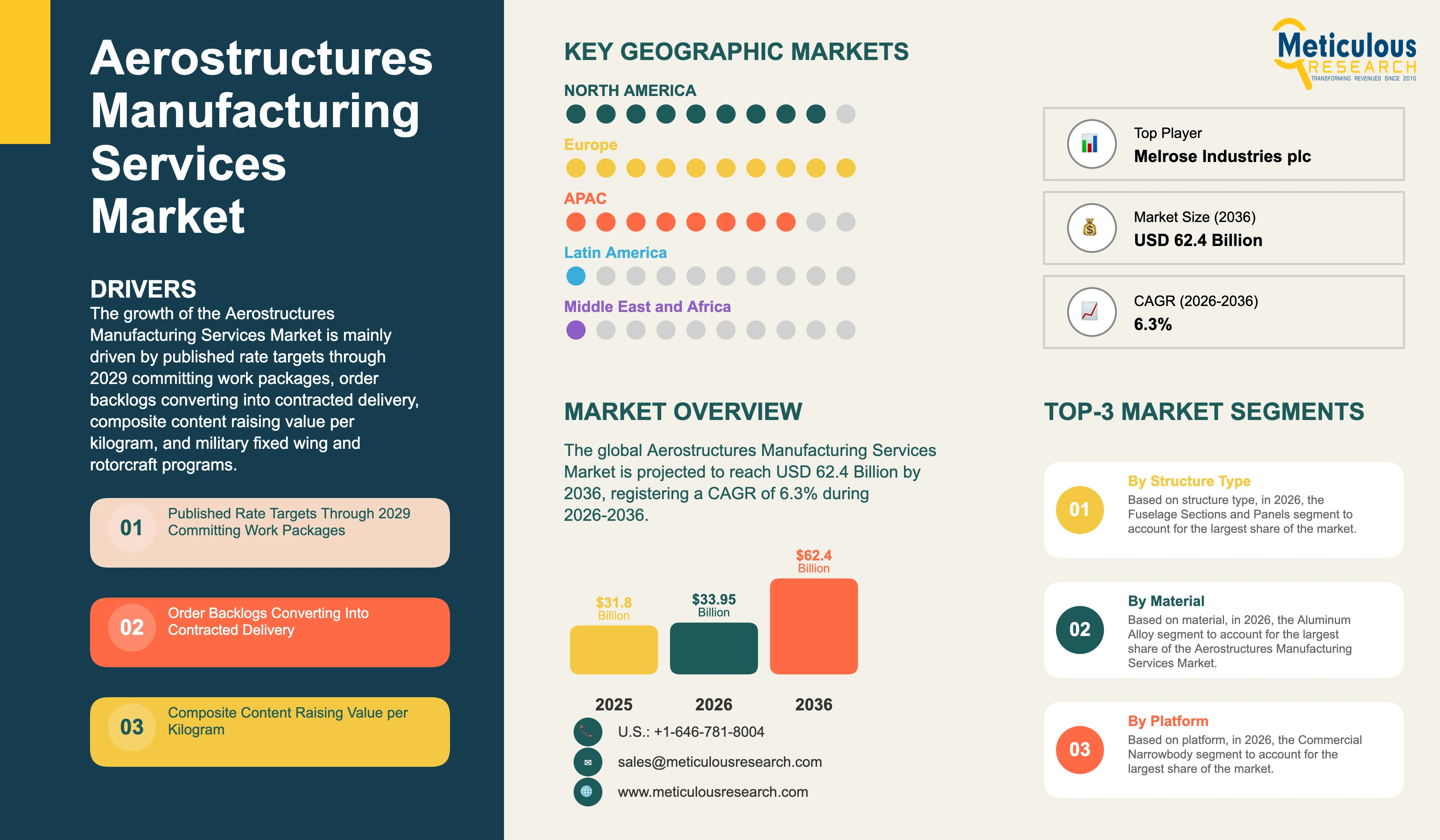
The global Aerostructures Manufacturing Services Market was valued at USD 31.80 billion in 2025. This market is expected to reach USD 62.40 billion by 2036 from an estimated USD 33.95 billion in 2026, registering a CAGR of 6.3% during the forecast period (2026-2036).
- Published
- Nov 2026
- Pages
- 266
- Format
- PDF + Excel
- Report ID
- MRAD - 1042840
- Base year
- 2025
- 2025 · BASELINE
- $31.80B
- 2036
- $62.40B
- CAGR 2026–2036
- 6.3%
2025 baseline · 2026–2036 forecast at 6.3% CAGR · hover a bar for the value
Key highlights
The global Aerostructures Manufacturing Services Market is projected to reach USD 62.40 billion by 2036, driven by published rate targets through 2029 committing work packages, order backlogs converting into contracted delivery, composite content raising value per kilogram, and military fixed wing and rotorcraft programs.
Europe is expected to account for the largest market share in 2026 and is also projected to register the fastest growth during the forecast period, supported by the concentration of independent aerostructures capability across the European supply base serving Airbus, Leonardo and the regional engine and systems primes.
By structure type, Fuselage Sections and Panels are expected to account for the largest market share, whereas Nacelles and Pylons are projected to witness the fastest growth through 2036.
By material, Aluminum Alloy are expected to account for the largest market share, whereas Carbon Fiber Composite are projected to witness the fastest growth through 2036.
By platform, Commercial Narrowbody are expected to account for the largest market share, whereas Military Fixed Wing and Rotorcraft are projected to witness the fastest growth through 2036.
Senior completed the divestment of its Aerostructures business to Sullivan Street Partners on 31 December 2025 for total estimated consideration of GBP 116.8 million, comprising GBP 95.7 million of initial proceeds and GBP 21.1 million of estimated adjustments and contingent consideration.
That divested business had grown revenue 15% to GBP 312.5 million in 2025 against GBP 272.4 million and returned reported operating profit of GBP 6.2 million after a GBP 6.5 million loss in 2024, and the sale produced a GBP 42.2 million loss on disposal.
GKN Aerospace reported Airframes revenue of GBP 1, 957 million in 2025, up 3% on a like-for-like basis at an adjusted operating margin of 8.0%, against Engines revenue of GBP 1,632 million at a 31.9% margin.
Boeing completed the acquisition of Spirit AeroSystems on 8 December 2025, taking approximately 15,000 employees across five sites in house, with Belfast operations running as Short Brothers, a Boeing Company.
Warburg Pincus and Berkshire Partners completed the acquisition of Triumph Group on 24 July 2025, moving another major structures and components supplier into private ownership.
Published rate targets now extend to the end of the decade, with Airbus targeting 70 to 75 A320 family aircraft a month by the end of 2027, 12 A350 aircraft a month in 2028, 13 A220 aircraft a month in 2028 and 5 A330 aircraft a month in 2029.
Boeing delivered 600 commercial airplanes in 2025 against 348 in 2024, with 787 production stabilized at seven a month and moving to eight, and the Federal Aviation Administration agreed to lift the 737 production cap from 38 to 42 a month.
Supply chains are described as stabilizing with a few remaining hotspots being managed accordingly, and suppliers have selectively insourced critical capabilities to protect continuity.
Report summary
| Particulars | Details |
|---|---|
| Forecast Period | 2026-2036 |
| Base Year | 2025 |
| Estimated Year | 2026 |
| CAGR (Value) | 6.3% |
| Format | PDF, Excel & Cloud Portal · 266 pages |
| CAGR (Volume) | 4.2% |
| Market Size (Value) in 2026 | USD 33.95 billion |
| Market Size (Value) in 2036 | USD 62.40 billion |
| Market Size (Volume) in 2026 | 52.00 kilotons of structure delivered |
| Market Size (Volume) in 2036 | 78.40 kilotons |
| Average Selling Price, 2026 | USD 653 per kilogram |
| Average Selling Price, 2036 | USD 796 per kilogram |
| Segments Covered | By Structure Type: Fuselage Sections and Panels, Wing and Wing Components, Empennage and Control Surfaces, Nacelles and Pylons, Doors, Fairings and Secondary Structure. By Material: Aluminum Alloy, Carbon Fiber Composite, Titanium Alloy, Steel and Other Metals, Hybrid and Other Materials. By Platform: Commercial Narrowbody, Commercial Widebody, Military Fixed Wing and Rotorcraft, Regional and Business Aviation, Other Platforms. By Work Package Type: Build to Print Detail Parts and Subassemblies, Major Assembly and Integration, Build to Specification Design and Build, Spares and Aftermarket Structure. |
| Countries Covered | France; Germany; U.K.; Spain; Italy; U.S.; Canada; Japan; China; India; South Korea; Mexico; Brazil |
| Key Companies | Melrose Industries plc, Leonardo S.p.A., Triumph Group, Inc., Aernnova Aerospace S.A., Magellan Aerospace Corporation, Korea Aerospace Industries, Ltd., and Ducommun Incorporated |
Report overview
Segments covered: structure type, material, platform, work package type.
In volume terms, the market is estimated at 52.00 kilotons of structure delivered in 2026 and is expected to reach 78.40 kilotons by 2036, registering a CAGR of 4.2% during the forecast period. The average selling price is estimated at USD 653 per kilogram in 2026 and USD 796 per kilogram in 2036.
The growth of this market is mainly driven by published rate targets running to 2029 that commit work packages, order backlogs converting into contracted delivery, composite content raising value per kilogram, and military fixed wing and rotorcraft programs. However, factors such as operating margins that have left listed owners unable to earn a return, capacity changing hands at well under half of annual revenue, airframers insourcing critical capability, and rate targets revised inside the capacity investment cycle are expected to restrain the growth of this market to some extent.
Among platforms, Commercial Narrowbody are expected to account for the largest market share in 2026, while Military Fixed Wing and Rotorcraft are projected to register the highest CAGR during the forecast period. Geographically, Europe is expected to account for the largest share of this market in 2026 and is also expected to register the highest CAGR during the forecast period.
The Aerostructures Manufacturing Services Market comprises airframe structure manufactured by suppliers for airframe and platform integrators, taken at the supplier gate with volume expressed as delivered structural weight. The market includes Fuselage Sections and Panels, Wing and Wing Components, Empennage and Control Surfaces, Nacelles and Pylons, and Doors, Fairings and Secondary Structure, produced in aluminum alloy, carbon fiber composite and titanium alloy, for commercial narrowbody, commercial widebody, military fixed wing and rotorcraft, and regional and business aviation platforms, supplied as build to print detail parts and subassemblies, major assembly and integration, build to specification design and build, and spares and aftermarket structure. Structure manufactured inside airframe integrators for their own aircraft, including the former Spirit AeroSystems operations absorbed by Boeing and Airbus, together with engines and nacelle systems supplied by propulsion manufacturers, interiors, systems and equipment, raw material and prepreg supply, and standalone machining, finishing and special process services fall outside the scope.
Demand in this market is contracted further ahead than in almost any other industrial activity. Airbus targets 70 to 75 A320 family aircraft a month by the end of 2027, 12 A350 aircraft a month in 2028, 13 A220 aircraft a month in 2028 and 5 A330 aircraft a month in 2029, Boeing delivered 600 commercial airplanes in 2025 against 348 in 2024 with 787 production stabilized at seven a month and moving to eight, and the Federal Aviation Administration agreed to lift the 737 production cap from 38 to 42 a month. Each of those figures translates into shipset quantities a structures supplier can plan against.
What that visibility has not produced is a return. GKN Aerospace reported Airframes revenue of GBP 1,957 million in 2025, up 3% on a like-for-like basis at an adjusted operating margin of 8.0%, against Engines revenue of GBP 1,632 million at 31.9% on the same balance sheet. Senior grew the revenue of its Aerostructures business 15% to GBP 312.5 million while reported operating profit reached GBP 6.2 million, recovering from a GBP 6.5 million loss the year before. Growth at the top line has not converted into margin anywhere in the independent structures base.
The clearest measure of what that business is worth came with the exit. Senior completed the divestment of Aerostructures to Sullivan Street Partners on 31 December 2025 for total estimated consideration of GBP 116.8 million, comprising GBP 95.7 million of initial proceeds and GBP 21.1 million of estimated adjustments and contingent consideration, and booked a GBP 42.2 million loss on disposal. A business delivering GBP 312.5 million of revenue changed hands for a little over a third of one year of sales.
Ownership across the sector has moved accordingly. Warburg Pincus and Berkshire Partners completed the acquisition of Triumph Group on 24 July 2025, and Boeing completed the acquisition of Spirit AeroSystems on 8 December 2025, taking approximately 15,000 employees across five sites in house with Belfast operations running as Short Brothers, a Boeing Company. Public markets, private capital and the airframers themselves have each taken a different view of how this capability should be held.
Where airframers absorb their suppliers, the work leaves this market rather than changing hands inside it. The Spirit operations now inside Boeing and Airbus are captive manufacture and sit outside the scope measured here, which is why the addressable base grows more slowly than aircraft deliveries. Suppliers have also selectively insourced critical capabilities to protect continuity, with supply chains described as stabilizing while a few remaining hotspots are managed accordingly.
Value rather than weight is where the growth sits. Carbon Fiber Composite is projected to be the fastest-growing material in this market at 8.4% as composite wing and fuselage content rises, and value grows ahead of delivered weight throughout the forecast period at 6.3% against 4.2%, lifting realization from USD 653 per kilogram in 2026 to USD 796 in 2036. A supplier that measures its business in tonnage shipped is measuring the part of it that is growing most slowly.
GKN Aerospace launched a USD 8.5 million program with the United States Air Force Research Laboratory to industrialize titanium additive manufacturing for large aerostructures. A near-net additive preform removes the majority of the material and the machining hours from a large titanium part, which changes the cost structure of a work package rather than improving its execution. For suppliers competing on build to print pricing, that is one of the few available routes to a structural cost advantage.
Spares and Aftermarket Structure is projected to grow at 8.0%, the fastest of the work package types. The tooling, the approvals and the process qualification already exist for any platform a supplier builds for production, so incremental spares volume carries little additional fixed cost and is priced outside long-term agreement escalation. For a business earning single-digit margins on original equipment work, that mix shift is the most accessible margin improvement available.
Europe is expected to account for the largest share of this market in 2026, supported by the deepest base of independent aerostructures capability serving Airbus, Leonardo and the regional engine and systems primes across France, Germany, the United Kingdom, Spain and Italy.
Europe is expected to account for the largest share of this market in 2026 and is projected to grow at 5.8%. France, Germany, the United Kingdom, Spain and Italy carry most regional volume across the Airbus, Leonardo and regional prime supply base. Ownership changed materially during the period, with Senior completing the divestment of Aerostructures to Sullivan Street Partners on 31 December 2025 and GKN Aerospace reporting Airframes revenue of GBP 1,957 million at an 8.0% adjusted operating margin. Investment is being targeted at single aisle rate readiness, with machining and inspection capability added at Filton while group capital expenditure fell to GBP 94 million from GBP 123 million.
The Middle East & Africa region is projected to grow at 7.4% from the smallest regional base, with structures capability established alongside defense procurement and aircraft orders under offset commitments rather than won competitively, so regional work is contracted before capacity is built. Latin America is projected to grow at 6.6%, with Brazil holding the larger established position through regional jet manufacture, supported by Embraer targeting about 100 deliveries a year within two years against 78 in 2025, and Mexico taking a growing share through detail part and subassembly capacity alongside the Querétaro and Chihuahua clusters.
Some of the key players operating in the aerostructures manufacturing services market are Melrose Industries plc, Leonardo S.p.A., Triumph Group, Inc., Aernnova Aerospace S.A., Magellan Aerospace Corporation, Korea Aerospace Industries, Ltd., and Ducommun Incorporated, among others.
Key strategies include separating structures assets from higher-returning divisions, as Senior did on 31 December 2025; recapitalising divested businesses under private ownership, as with the Triumph Group acquisition completed on 24 July 2025; targeting capacity investment at contracted single aisle rates rather than across the footprint; moving up from build to print into design and build scope where the supplier contributes intellectual property; placing detail part capacity in Asia-Pacific and Mexico; and growing spares and aftermarket structure on tooling and approvals that already exist.
Report infographic
Market dynamics
17 factors across 4 forcesPublished Rate Targets Through 2029 Committing Work Packages
Airbus targets 70 to 75 A320 family aircraft a month by the end of 2027, 12 A350 aircraft a month in 2028, 13 A220 aircraft a month in 2028 and 5 A330 aircraft a month in 2029, while Boeing 787 production has stabilized at seven a month and is moving to eight and the Federal Aviation Administration agreed to lift the 737 production cap from 38 to 42 a month. Embraer is targeting about 100 deliveries a year within two years against 78 in 2025. Structures suppliers hold work packages against those rates for the life of the platform, so each published target converts into a shipset quantity and a committed delivery schedule rather than a sales opportunity. That visibility is what allows capacity and tooling investment to be planned across a decade, and it is the reason Commercial Narrowbody holds the largest platform share of this market in 2026.
Order Backlogs Converting Into Contracted Delivery
Airbus delivered 793 commercial aircraft in 2025 against 766 and closed the year with a record backlog of 8,754 aircraft including a record widebody backlog of 1,124, while Boeing delivered 600 commercial airplanes against 348 in 2024. Backlogs of that depth mean the aircraft are sold and the delivery slots contracted before the structure is built. A structures supplier therefore carries volume risk only to the extent that rates move, not to the extent that demand does. That distinction supports the long-term agreements and tooling investment the work requires, and it makes the forecast in this market a function of announced rates rather than of traffic or order intake.
Composite Content Raising Value per Kilogram
Carbon fiber structure carries a higher value per kilogram than the aluminum it replaces, because the material, the tooling and the automated fiber placement or infusion process cost more per unit of weight delivered. Composite wing and fuselage content continues to rise across widebody programs and on new narrowbody and regional derivatives. Carbon Fiber Composite is projected to be the fastest-growing material in this market at 8.4%, and realization rises from USD 653 per kilogram in 2026 to USD 796 in 2036 while delivered weight grows at only 4.2%. The shift also raises the capital intensity of the work, which favors suppliers able to fund automated layup capacity over those competing on metallic fabrication.
Military Fixed Wing and Rotorcraft Programs
Defense structures work carries national sourcing and offset requirements that commercial work does not, and it is being expanded alongside European and allied procurement growth, with GKN Aerospace expanding F-35 canopy capacity at Garden Grove for completion in the second half of 2027. Boeing recorded 131 defense, space and security deliveries in 2025. Military Fixed Wing and Rotorcraft is projected to be the fastest-growing platform in this market at 8.2%. Defense programs also price differently from commercial build to print work, since the sourcing restrictions limit who may compete, which makes them the more profitable part of a mixed structures order book.
Spares and Aftermarket Structure on an Ageing Fleet
Operators keeping aircraft in service longer consume replacement panels, doors, control surfaces and secondary structure, and that demand follows the installed fleet rather than new build. Spares orders arrive without the long-term agreement pricing that original equipment work carries. Spares and Aftermarket Structure is projected to be the fastest-growing work package type in this market at 8.0%. Because the tooling and the approvals already exist for platforms in production, the incremental margin on spares is materially better than on the build to print work that dominates volume, which makes it the most attractive growth available to an incumbent supplier.
Table of contents
12 chapters · 140 sections · 266 pages · click to expandSegmental analysis
| Segment | Largest share (2026) | Fastest growth (2026–2036) |
|---|---|---|
| By Structure Type | Fuselage Sections and Panels | Nacelles and Pylons |
| By Material | Aluminum Alloy | Carbon Fiber Composite |
| By Platform | Commercial Narrowbody | Military Fixed Wing and Rotorcraft |
| By Work Package Type | Build to Print Detail Parts and Subassemblies | Spares and Aftermarket Structure |
| Other segments | Aluminum Alloy | — |
By Structure Type
- Aerostructures Manufacturing Services Market Analysis by Structure Type
- Fuselage Sections and Panels are expected to account for the largest share of the global Aerostructures Manufacturing Services Market.
- The large share of this segment is mainly due to the proportion of total airframe weight and value carried in barrel sections, panels, frames and floor structure, and the scale of the work packages involved, which concentrates them with the largest suppliers.
- However, Nacelles and Pylons are projected to register the highest CAGR during the forecast period.
- The rapid growth of this segment is attributed to engine deliveries supporting record narrowbody and widebody rates together with new engine programs that bring fresh nacelle and thrust reverser work, and the higher systems content a nacelle carries relative to primary structure.
- Fuselage Sections and Panels are expected to account for the largest market share in 2026.
- Nacelles and Pylons are projected to register the highest CAGR during the forecast period, owing to engine deliveries supporting record narrowbody and widebody rates together with new engine programs that bring fresh nacelle and thrust reverser work, and the higher systems content a nacelle carries relative to primary structure.
- Carbon Fiber Composite are projected to register the highest CAGR during the forecast period, owing to rising composite wing and fuselage content across widebody programs and new derivatives, together with a value per kilogram above the aluminum it replaces because material, tooling and automated layup processing all cost more per unit of weight delivered.
- Military Fixed Wing and Rotorcraft are projected to register the highest CAGR during the forecast period, owing to national sourcing and offset requirements that limit who may compete and therefore price differently from commercial build to print work, alongside capacity expansion such as F-35 canopy work completing in the second half of 2027.
- Spares and Aftermarket Structure are projected to register the highest CAGR during the forecast period, owing to operators keeping aircraft in service longer and consuming replacement panels, doors, control surfaces and secondary structure, on tooling and approvals that already exist and outside long-term agreement pricing.
By Material
- Aerostructures Manufacturing Services Market Analysis by Material
- Aluminum Alloy are expected to account for the largest market share.
- The large share of this segment is mainly due to the installed base of metallic narrowbody and regional programs in production, where aluminum remains the primary structural material and the supply base and tooling are already qualified.
- However, Carbon Fiber Composite are projected to register the highest CAGR during the forecast period.
- The rapid growth of this segment is attributed to rising composite wing and fuselage content across widebody programs and new derivatives, together with a value per kilogram above the aluminum it replaces because material, tooling and automated layup processing all cost more per unit of weight delivered.
By Platform
- Aerostructures Manufacturing Services Market Analysis by Platform
- Commercial Narrowbody are expected to account for the largest market share.
- The large share of this segment is mainly due to single aisle delivery rates and the published targets attached to them, including 70 to 75 A320 family aircraft a month by the end of 2027 and a 737 production cap lifted from 38 to 42 a month.
- However, Military Fixed Wing and Rotorcraft are projected to register the highest CAGR during the forecast period.
- The rapid growth of this segment is attributed to national sourcing and offset requirements that limit who may compete and therefore price differently from commercial build to print work, alongside capacity expansion such as F-35 canopy work completing in the second half of 2027.
By Work Package Type
- Aerostructures Manufacturing Services Market Analysis by Work Package Type
- Build to Print Detail Parts and Subassemblies are expected to account for the largest market share.
- The large share of this segment is mainly due to the number of individual parts and subassemblies in an airframe relative to major assemblies, and the breadth of the supplier base able to produce them to a customer-owned design.
- However, Spares and Aftermarket Structure are projected to register the highest CAGR during the forecast period.
- The rapid growth of this segment is attributed to operators keeping aircraft in service longer and consuming replacement panels, doors, control surfaces and secondary structure, on tooling and approvals that already exist and outside long-term agreement pricing.
Other segments
- Aluminum Alloy are expected to account for the largest market share in 2026.
- Commercial Narrowbody are expected to account for the largest market share in 2026.
- Build to Print Detail Parts and Subassemblies are expected to account for the largest market share in 2026.
Geographic analysis
Asia-Pacific
Fastest growthAsia-Pacific is projected to be the fastest-growing region in this market at 7.8%, with India the fastest-growing country at 11.2%. Work packages are transferring into the region on cost and on offset commitments attached to aircraft and defense orders, and new entrants there are taking build to print detail part and subassembly work first before moving up to major assembly. Established suppliers are responding by placing their own capacity in the region rather than defending the work from existing plants. India is projected to be the fastest-growing country at 11.2%, with work packages transferring into the region on cost and on offset commitments attached to aircraft and defense orders, taking build to print detail part and subassembly work first before moving up to major assembly. Japan holds the largest regional volume through established widebody work packages, and is projected to be the slowest-growing country in the region as that content tracks the platforms already supplied. South Korean and Chinese capability is expanding on both commercial work packages and domestic programs. Asia-Pacific is projected to register the highest CAGR at 7.8%, as work packages transfer into the region on cost and on offset commitments attached to aircraft and defense orders, with India projected to be the fastest-growing country at 11.2%. Asia-Pacific and India Work Package Transfer Geographic Analysis
Europe
Largest shareEurope is expected to account for the largest share of this market in 2026 and is projected to grow at 5.8%. The region holds the deepest base of independent aerostructures capability serving Airbus, Leonardo and the regional engine and systems primes, with France, Germany, the United Kingdom, Spain and Italy carrying most regional volume. Ownership of that capability changed materially during the period, with Senior completing the divestment of its Aerostructures business to Sullivan Street Partners on 31 December 2025 and GKN Aerospace reporting Airframes revenue of GBP 1,957 million at an 8.0% adjusted operating margin. Investment is being targeted at single aisle rate readiness rather than spread, with machining and inspection capability added at Filton while group capital expenditure fell.
North America
North America is projected to grow at 5.6% and holds the second largest regional position in this market in 2026. The United States carries Boeing final assembly and the supplier base around it, and the regional merchant base contracted during the period as Boeing completed the acquisition of Spirit AeroSystems on 8 December 2025, taking approximately 15,000 employees across five sites in house. Warburg Pincus and Berkshire Partners completed the acquisition of Triumph Group on 24 July 2025. Canadian capability serves regional jet, business aviation and defense structures work. Mexico accounts for a growing share of regional volume through detail part and subassembly capacity built alongside the machining and finishing clusters in Querétaro and Chihuahua, while Brazil holds the larger established position through regional jet manufacture and the supplier base around it. Embraer targeting about 100 deliveries a year within two years against 78 in 2025 supports regional structures demand directly.
Latin America
Latin America is projected to grow at 6.6%.
Middle East & Africa
The Middle East & Africa region is projected to grow at 7.4% from the smallest regional base in this market. Structures capability is being established alongside defense procurement and aircraft orders under offset commitments rather than won competitively, so regional work is contracted before the capacity is built. Because those arrangements attach to specific platforms, regional volume follows procurement decisions rather than commercial rate changes and contributes little contestable capacity to the wider market.
Competitive landscape
The global Aerostructures Manufacturing Services Market is moderately consolidated, with competition among integrated aerostructures groups, platform integrators with structures divisions and independent detail part and subassembly suppliers. Market participants compete primarily on work package scope from detail parts through major assembly, composite and metallic process capability, delivery performance against contracted rates, cost position for build to print work, and ability to fund tooling and automation.
separating structures assets from higher-returning divisions, recapitalising divested businesses under private ownership, targeting capacity investment at contracted single aisle rates, moving up from build to print into design and build scope, and placing detail part capacity in Asia-Pacific and Mexico
The report provides a comprehensive competitive assessment of the leading companies operating in the global Aerostructures Manufacturing Services Market. The key players profiled in the report include Melrose Industries plc (U.K.), Leonardo S.p.A. (Italy), Triumph Group, Inc. (U.S.), Aernnova Aerospace S.A. (Spain), Magellan Aerospace Corporation (Canada), Korea Aerospace Industries, Ltd. (South Korea), and Ducommun Incorporated (U.S.).
- Melrose Industries plc
- Leonardo S.p.A
- Triumph Group, Inc.
- Aernnova Aerospace S.A.
- Magellan Aerospace Corporation
- Korea Aerospace Industries, Ltd.
- Ducommun Incorporated
Expert perspectives
A structures business growing revenue 15% to GBP 312.5 million changed hands for total estimated consideration of GBP 116.8 million on 31 December 2025, and the seller booked a GBP 42.2 million loss on disposal. Qualified fastener and process capacity in the same supply chain has transacted at several times annual sales over the same period. That gap is the central fact of this market: aerostructures carries the volume, the capital intensity and the schedule risk of the airframe while capturing the least value per unit of revenue, and the valuation reflects it precisely.
The 8.0% Airframes margin against 31.9% on Engines inside one group explains every ownership change of the past two years. Listed owners cannot hold capital-intensive work at single-digit returns beside divisions earning four times as much, so Senior exited, Triumph went to private capital on 24 July 2025, and Boeing took approximately 15,000 Spirit AeroSystems employees in house on 8 December 2025. Each transaction is a different answer to the same question, and the one thing none of them did was leave the business where it was.
Volume growth and value growth have separated in this market and suppliers should be managed on the second. Delivered weight grows at 4.2% while value grows at 6.3%, lifting realization from USD 653 per kilogram to USD 796, and the increase sits in composite content at 8.4%, military work at 8.2% and spares at 8.0%. Build to print detail parts hold the largest volume share on a customer-owned design with no intellectual property contribution, which is the work most exposed to transfer toward India at 11.2% growth. Capacity added against tonnage will be added in the part of the market that is growing slowest and is least defensible.
Customer perspectives
“We know what rate we need in 2028 and our suppliers know it too, so the conversation is never about whether the demand is there. It is about whether they can fund the tooling and the automation to meet it on the margins they earn from us. Where we concluded the answer was no, we bought the capability instead of waiting.”
“Our revenue grew and our margin stayed in single digits, which is the whole story of this sector. As a listed business we were competing for capital against divisions earning four times the return, and we lost that argument every year. Under private ownership we can spend on composite capacity without explaining the earnings effect every quarter.”
“Build to print is the bulk of what we do and the customer owns the drawing, the specification and often the tooling. There is nothing in it that is ours, so every renewal is a cost comparison against a shop in a cheaper country. The work we are trying to win now is design and build, because that is the only place we can hold a price.”
Frequently asked questions
The global Aerostructures Manufacturing Services Market is estimated at USD 33.95 billion in 2026.
Cite this report
Meticulous Research. (2026). Aerostructures Manufacturing Services Market - Global Opportunity Analysis and Industry Forecast (2026-2036) (Report No. MRAD - 1042840). Meticulous Market Research Pvt. Ltd. https://www.meticulousresearch.com/product/aerostructures-manufacturing-services-market-7523