Data Lakehouse Market (2026-2036)
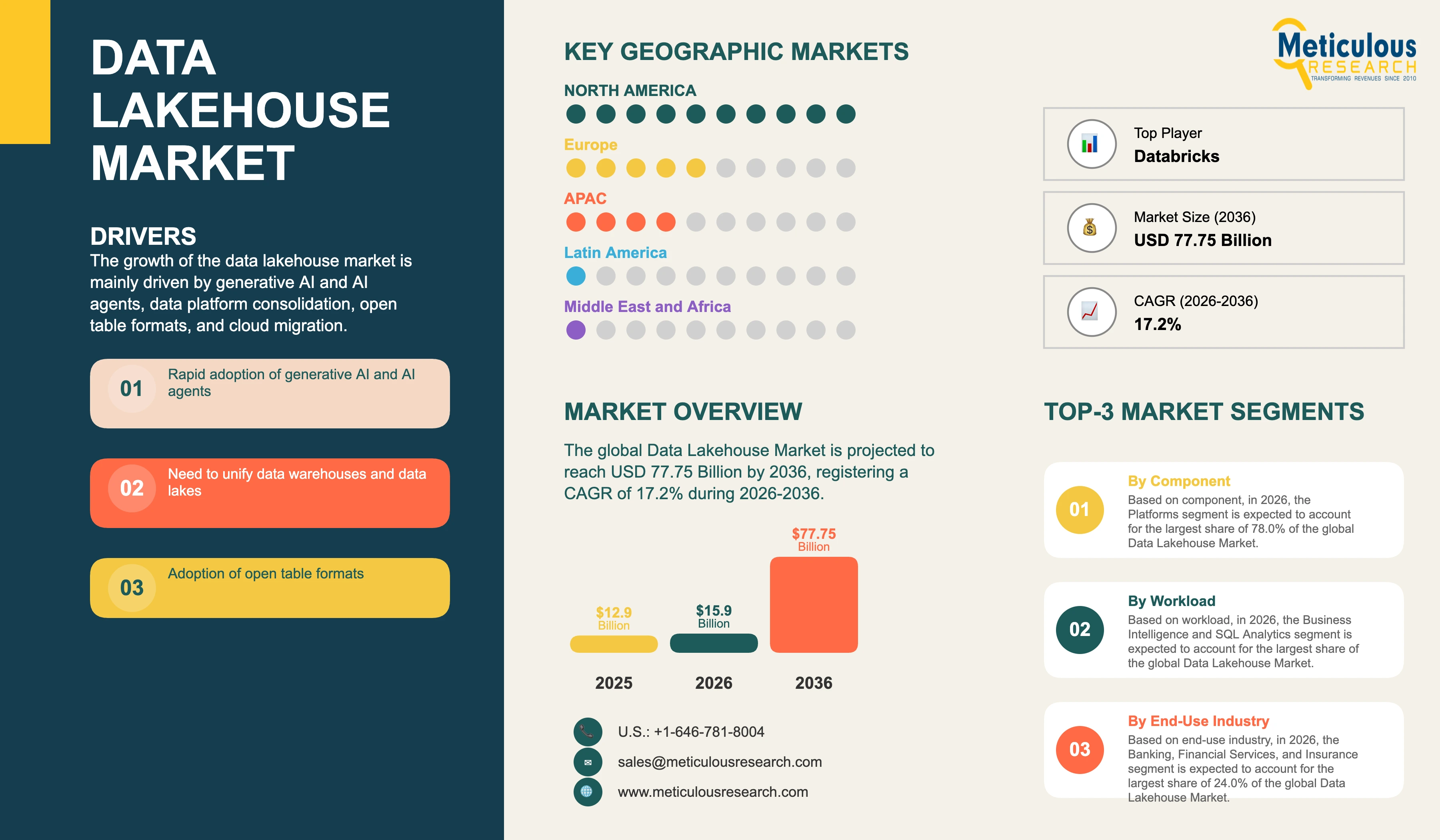
The global data lakehouse market was valued at USD 12.90 billion in 2025. This market is expected to reach USD 77.75 billion by 2036 from an estimated USD 15.90 billion in 2026, registering a CAGR of 17.2% during the forecast period (2026-2036).
- Published
- Nov 2026
- Pages
- 240
- Format
- PDF + Excel
- Report ID
- MRICT - 1042618
- Base year
- 2025
- 2025 · BASELINE
- $12.90B
- 2036
- $77.75B
- CAGR 2026–2036
- 17.2%
2025 baseline · 2026–2036 forecast at 17.2% CAGR · hover a bar for the value
Key highlights
On August 13, 2026, Databricks announced that it had surpassed a USD 7 billion revenue run-rate, growing more than 80% year over year in its second quarter, that its Lakehouse data warehousing product had surpassed a USD 1.5 billion revenue run-rate, growing more than 100%, and that it had closed a USD 5 billion funding round at a USD 190 billion valuation, according to Databricks.
In February 2026, Databricks reported that it had crossed a USD 5.4 billion revenue run-rate with more than 65% year-over-year growth, a USD 1.4 billion revenue run-rate for its AI products, a net retention rate above 140%, and more than 800 customers consuming at over USD 1 million per year, while completing investments of more than USD 7 billion at a USD 134 billion valuation, according to the company.
Snowflake reported fiscal 2026 product revenue of USD 4.472 billion, up 29%, with fourth-quarter product revenue of USD 1.23 billion, up 30%, remaining performance obligations of USD 9.77 billion, up 42%, and guided to fiscal 2027 product revenue of about USD 5.66 billion, up 27%, while executives said that it supports Apache Iceberg as a first-class construct, according to Snowflake and MarketBeat.
Microsoft made the interoperability between OneLake and Snowflake generally available, allowing joint customers to read Iceberg data managed by either Snowflake or Microsoft Fabric in both directions and to store Snowflake-managed Iceberg tables natively in OneLake, according to Microsoft.
Databricks said in August 2026 that more than 1, 000 customers were consuming at over a USD 1 million revenue run-rate and more than 100 at over USD 10 million, and that its Lakebase serverless Postgres database built for AI agents had exceeded a USD 100 million revenue run-rate, according to the company.
ClickHouse made support for reading Apache Iceberg tables from Microsoft OneLake generally available in 2026, allowing customers to query Iceberg tables in OneLake directly with no data duplication, which illustrates the growing use of open table formats across multiple engines, according to ClickHouse.
By component, platforms account for the larger share of 78.0% in 2026 and also register the higher CAGR.
By deployment mode, cloud accounts for the larger share in 2026 and also registers the higher CAGR.
By workload, business intelligence and SQL analytics account for the largest share in 2026, while generative AI and Agent applications register the highest CAGR.
By end-use industry, banking, financial services, and insurance accounts for the largest share of 24.0% in 2026, while healthcare and life sciences register the highest CAGR.
By geography, North America accounts for the largest share of 50.0% in 2026, while Asia-Pacific registers the highest CAGR of 20.8%.
Report summary
| Particulars | Details |
|---|---|
| Base Year | 2025 |
| Estimated Year | 2026 |
| Forecast Period | 2026-2036 |
| Market Size in 2025 | USD 12.90 billion |
| Market Size in 2026 | USD 15.90 billion |
| Market Size by 2036 | USD 77.75 billion |
| CAGR (2026-2036) | 17.2% |
| Format | PDF, Excel & Cloud Portal · 240 pages |
| Largest Segment by Component (2026) | Platforms (78.0%) |
| Largest Segment by End-Use Industry (2026) | Banking, Financial Services, and Insurance (24.0%) |
| Largest Region (2026) | North America (50.0%) |
| Fastest-Growing Region | Asia-Pacific (CAGR 20.8%) |
| Companies Profiled | 14 companies and other companies |
| Segments Covered | Component, Deployment Mode, Workload, End-Use Industry, Geography |
| Countries Covered | U.S., Canada, Germany, U.K., France, Italy, Spain, Netherlands, Switzerland, Belgium, Sweden, Denmark, Norway, Finland, Austria, Poland, Ireland, Rest of Europe, China, Japan, India, South Korea, Australia, Indonesia, Thailand, Singapore, Malaysia, Vietnam, Philippines, Taiwan, New Zealand, Rest of Asia-Pacific, Brazil, Mexico, Argentina, Colombia, Chile, Peru, Rest of Latin America, Saudi Arabia, U.A.E., Israel, South Africa, Turkey, Egypt, Rest of Middle East & Africa |
Report overview
Segments covered: component, deployment mode, workload, end-use industry.
The growth of this market is mainly driven by the rapid adoption of generative AI and AI agents, which require large volumes of governed and well-organized enterprise data, the need to unify data warehouses and data lakes on a single platform to reduce cost and complexity, the rapid adoption of open table formats, such as Apache Iceberg and Delta Lake, which allow multiple engines to work on the same data, the continued migration of data and analytics workloads to the cloud, and the growing importance of data governance and real-time analytics. However, factors such as the complexity of migrating from legacy data warehouses and data lakes, the high and unpredictable cost of cloud data platforms as usage grows, the shortage of skilled data engineers, and data privacy and sovereignty requirements are expected to restrain the growth of this market to some extent. Nevertheless, the strategic importance of data for AI is expected to support sustained investment in lakehouse platforms.
A data lakehouse is a data management architecture that combines the low-cost, flexible storage of a data lake with the data management, performance, and governance features of a data warehouse. In a lakehouse, data is stored in open file formats, such as Apache Parquet, in low-cost cloud object storage, and organized using open table formats, such as Apache Iceberg, Delta Lake, and Apache Hudi, which add database features such as transactions, schema enforcement, and time travel. Multiple processing engines can then use the same data for business intelligence, SQL analytics, data engineering, data science, machine learning, and AI applications, without copying it into separate systems.
This report covers the global data lakehouse market, including lakehouse platforms, such as managed lakehouse services, query and processing engines, catalogs, and governance tools built around open table formats, and related professional and managed services. The market is analyzed by component, deployment mode, workload, end-use industry, and geography. The market is measured on a revenue basis. Revenue from cloud infrastructure that is not part of lakehouse services, such as general-purpose compute and storage, and from traditional data warehouses that do not support lakehouse architectures is not included.
The lakehouse architecture has become the leading approach for enterprise data platforms over the past few years. Before lakehouses, most organizations used data warehouses for structured business reporting and data lakes for large volumes of raw and unstructured data, which created duplicate data, complex pipelines, and inconsistent governance. Lakehouses allow organizations to manage all their data on a single platform. Databricks, which popularized the lakehouse concept, surpassed a USD 7 billion revenue run-rate in 2026, and its Lakehouse data warehousing product surpassed a USD 1.5 billion run-rate, growing more than 100% year over year.
Open table formats are central to the data lakehouse market and to the competitive strategies of all major vendors. Apache Iceberg and Delta Lake have become widely supported by data platforms, cloud providers, and query engines. Snowflake supports Iceberg as a first-class construct, Microsoft Fabric's OneLake can read and write both Delta Lake and Iceberg, Google offers Iceberg managed tables in BigQuery, and Amazon Web Services offers Iceberg-based S3 Tables. In 2026, Microsoft and Snowflake made bidirectional Iceberg interoperability between OneLake and Snowflake generally available. These developments allow customers to store data once and use multiple engines, which reduces lock-in and increases competition among vendors.
Generative AI is the most important new driver of the data lakehouse market and of enterprise data strategies. AI applications and agents need access to large volumes of trustworthy, well-governed enterprise data, and lakehouses provide a single foundation for structured and unstructured data, governance, and AI development. Databricks reported a USD 1.4 billion revenue run-rate for its AI products in early 2026, and vendors are adding AI agents, natural language query tools, vector search, and operational databases, such as Databricks' Lakebase, to their lakehouse platforms.
The market is led by Databricks, Snowflake, and the major cloud providers, including Microsoft, Google, and Amazon Web Services, followed by Oracle, Cloudera, Teradata, IBM, SAP, and specialized vendors such as Dremio, Starburst, Onehouse, and ClickHouse. Competition is intense, and vendors are expanding into adjacent areas, such as operational databases, data integration, governance, business intelligence, and AI development, to become the central platform for enterprise data and AI.
In 2026, platforms account for the largest share of the market by component and are also the faster-growing component. Cloud deployment accounts for the larger share by deployment mode and is also the faster-growing mode. Business intelligence and SQL analytics is the largest workload, while generative AI and agent applications are the fastest-growing workload. Banking, financial services, and insurance is the largest end-use industry, while healthcare and life sciences is the fastest-growing industry. North America accounts for the largest share of the market, while Asia-Pacific is the fastest-growing region.
Over the forecast period, the data lakehouse market is expected to grow rapidly, supported by AI adoption, the replacement of legacy data warehouses and data lakes, open table formats, cloud migration, and the growing need for governed, real-time data. However, competition and pricing pressure are expected to increase as open formats make it easier for customers to switch engines. Customers are also placing greater emphasis on unified governance across data and AI assets, which has made catalogs an important point of competition.
North America is expected to account for the largest share of 50.0% of the market in 2026, mainly due to early adoption of cloud data platforms and AI, many large enterprises and digital-native companies, high IT spending, and the presence of leading vendors.
Asia-Pacific is projected to register the highest CAGR of 20.8% during the forecast period, driven by accelerating cloud adoption, strong AI investment, the growth of digital services, and the expansion of global vendors in the region.
The report profiles 14 companies, including Databricks, Snowflake, Microsoft, Google, Amazon Web Services, Oracle, Cloudera, Teradata, IBM, SAP, Dremio, Starburst, Onehouse, and ClickHouse.
A data lakehouse is a data architecture that combines the low-cost, flexible storage of a data lake with the data management, performance, and governance features of a data warehouse. Data is stored in open formats in cloud object storage and can be used by multiple engines for analytics, data engineering, machine learning, and AI.
Open table formats, such as Apache Iceberg and Delta Lake, add database features to files stored in object storage and allow multiple engines to work on the same data. They reduce vendor lock-in, avoid costly data copies, and make it easier for organizations to adopt lakehouse architectures.
In 2026, the cloud segment is expected to account for the larger share of the data lakehouse market, and it is also projected to register the higher CAGR during the forecast period.
Report infographic
Market dynamics
18 factors across 5 forcesRapid adoption of generative AI and AI agents
The rapid adoption of generative AI and AI agents is the most important driver of the data lakehouse market. AI applications and agents need access to large volumes of high-quality enterprise data, including structured data from business systems and unstructured data from documents, images, and logs, as well as strong governance to ensure that data is used securely and appropriately. Lakehouses provide a single platform where organizations can store, govern, and prepare all their data for AI, and build, deploy, and monitor AI applications.
Lakehouse vendors are rapidly expanding their AI capabilities to capture this demand from enterprise customers. Databricks reported a USD 1.4 billion revenue run-rate for its AI products in early 2026 and is investing in its Genie, Agent Bricks, Lakebase, and Unity AI Gateway products, while Snowflake reported that more than 9,100 accounts were using its AI capabilities. As organizations move from AI experiments to production, demand for lakehouse platforms that support AI workloads is expected to grow strongly. Generative AI and agent applications are the fastest-growing workload in the market.
Need to unify data warehouses and data lakes
Many organizations operate separate data warehouses and data lakes, which creates duplicate data, complex and costly data pipelines, inconsistent governance, and delays in delivering data to users. The lakehouse architecture allows organizations to consolidate these systems on a single platform, using low-cost object storage and open formats, which reduces cost and complexity and improves data consistency. Many organizations are also replacing legacy on-premises data warehouses and Hadoop-based data lakes with cloud lakehouses.
Databricks' Lakehouse data warehousing product grew more than 100% year over year to a USD 1.5 billion revenue run-rate in 2026, which shows that customers are increasingly using lakehouses for workloads that previously ran on traditional data warehouses. The consolidation of data platforms is expected to continue to drive demand over the forecast period, particularly as large enterprises modernize their data estates and retire legacy systems.
Adoption of open table formats
Open table formats, such as Apache Iceberg, Delta Lake, and Apache Hudi, allow organizations to store data once in open formats and use multiple processing engines, such as Spark, SQL engines, and AI tools, on the same data. This reduces vendor lock-in, avoids costly data copies, and gives organizations more flexibility in choosing tools. Major vendors now support open table formats, including Snowflake, Microsoft, Google, Amazon Web Services, Databricks, Dremio, Starburst, and ClickHouse.
Interoperability between lakehouse platforms, cloud services, and query engines is improving rapidly. In 2026, Microsoft and Snowflake made bidirectional Iceberg interoperability between OneLake and Snowflake generally available, and ClickHouse made Iceberg reading from OneLake generally available. Open catalogs, such as Apache Polaris and Unity Catalog, are also making it easier to manage and govern open tables across engines. The adoption of open table formats is encouraging organizations to adopt lakehouse architectures and is expected to support strong market growth.
Continued migration of data workloads to the cloud
Organizations continue to migrate data and analytics workloads from on-premises systems to the cloud to gain scalability, flexibility, access to new AI and analytics capabilities, and lower infrastructure management costs. Cloud lakehouses can scale storage and compute independently and allow organizations to pay for the resources they use. Snowflake reported that its remaining performance obligations grew 42% to USD 9.77 billion, which reflects strong multi-year customer commitments to cloud data platforms.
Cloud migration is particularly strong in financial services, retail, healthcare, and manufacturing, where organizations are modernizing their data platforms to support digital services and AI. Cloud deployment is the larger and faster-growing deployment mode in the market. Cloud providers are also offering migration programs and credits to accelerate the move of legacy data warehouses to cloud lakehouses.
Growing importance of data governance and real-time analytics
Organizations face growing requirements to govern their data, protect sensitive information, comply with data privacy regulations, and ensure that AI applications use data appropriately. Lakehouse platforms provide unified governance through catalogs, such as Databricks' Unity Catalog and Snowflake's Horizon Catalog, which manage access controls, data lineage, and auditing across all data and AI assets. At the same time, organizations increasingly need real-time analytics for applications such as fraud detection, personalization, and operational monitoring, and lakehouse vendors are adding streaming and low-latency capabilities to meet these needs. Unified governance and real-time capabilities are making lakehouses suitable for a broader range of critical workloads.
Table of contents
12 chapters · 168 sections · 240 pages · click to expandSegmental analysis
| Segment | Largest share (2026) | Fastest growth (2026–2036) |
|---|---|---|
| By Component | Platforms | — |
| By Deployment Mode | — | — |
| By Workload | Business intelligence and SQL analytics | Generative AI and agent applications |
| By End-Use Industry | Banking, financial services, and insurance | Healthcare and life sciences |
| Other segments | Banking, financial services, and insurance | Healthcare and life sciences |
By Component
- Data Lakehouse Market Analysis by Component
- The platforms segment is expected to account for the largest share of 78.0% of the global data lakehouse market.
- The large share of this segment is mainly due to the central role of lakehouse platforms in storing, processing, governing, and analyzing enterprise data, the consumption-based pricing models of leading vendors, which generate large and growing recurring revenues as data volumes and workloads increase, the rapid growth of leading platforms, such as Databricks and Snowflake, and the expansion of platforms into AI, operational databases, and governance.
- The platforms segment is also projected to register the higher CAGR during the forecast period, driven by AI adoption, the replacement of legacy systems, and the growth of data volumes and workloads.
- Platforms include managed lakehouse services, query and processing engines, data catalogs and governance tools, data integration and pipeline tools built for the lakehouse, and AI development tools.
- Leading platforms include the Databricks Data Intelligence Platform, Snowflake, Microsoft Fabric, Google BigQuery and BigLake, Amazon Web Services' S3 Tables, Lake Formation, Athena, and Redshift, Oracle, Cloudera, IBM watsonx.data, Dremio, Starburst, Onehouse, and ClickHouse.
- The services segment includes consulting, implementation, migration, integration, training, and managed services provided by vendors, systems integrators, and consulting firms.
- Services are important for large organizations migrating from legacy data warehouses and data lakes, implementing governance, and building AI applications on the lakehouse.
- Large systems integrators have built dedicated lakehouse practices in partnership with Databricks, Snowflake, Microsoft, and other vendors, and demand for migration and AI implementation services is expected to grow steadily over the forecast period.
- Training services are also in strong demand as organizations build internal data engineering skills.
By Deployment Mode
- Data Lakehouse Market Analysis by Deployment Mode
- The cloud segment is expected to account for the larger share of the global data lakehouse market.
- The large share of this segment is mainly due to the cloud-native design of most lakehouse platforms, which separate storage and compute and use low-cost cloud object storage, the ability to scale resources on demand and pay for usage, the rapid adoption of managed lakehouse services from Databricks, Snowflake, Microsoft, Google, and Amazon Web Services, and the access cloud platforms provide to new AI capabilities.
- The cloud segment is also projected to register the higher CAGR during the forecast period, driven by continued cloud migration, AI adoption, and the expansion of cloud regions and sovereign cloud offerings.
- The hybrid and on-premises segment includes lakehouse platforms deployed in customers' own data centers or in hybrid models that combine on-premises and cloud resources.
- This segment remains important for organizations with strict security, regulatory, or data sovereignty requirements, such as government agencies, financial institutions, and healthcare providers, and for organizations with large existing on-premises data estates.
- Vendors such as Cloudera, IBM, Dremio, and Starburst offer hybrid and on-premises lakehouse options that use open table formats and object storage.
- Vendors that support consistent governance across cloud and on-premises environments are expected to benefit from this trend.
By Workload
- Data Lakehouse Market Analysis by Workload
- The business intelligence and SQL analytics segment is expected to account for the largest share of the global data lakehouse market.
- The large share of this segment is mainly due to the widespread use of SQL analytics, reporting, and dashboards across organizations, the migration of traditional data warehouse workloads to lakehouse platforms, the strong performance improvements of lakehouse SQL engines, and the large number of business users who rely on analytics.
- The rapid growth of Databricks' Lakehouse data warehousing product in 2026 shows the strong demand for SQL analytics on lakehouse platforms.
- However, the generative AI and agent applications segment is projected to register the highest CAGR during the forecast period.
- The rapid growth of this segment is driven by the rapid adoption of generative AI and AI agents in enterprises, the need to ground AI applications in governed enterprise data, the expansion of lakehouse vendors into AI development tools, vector search, model serving, and operational databases for agents, such as Databricks' Lakebase, and the growing use of natural language interfaces that allow users to query data.
- Databricks and Snowflake have both reported rapid growth in the use of their AI products by enterprise customers.
- The data engineering and ETL segment includes the ingestion, transformation, and preparation of data, which is a core workload on lakehouse platforms and accounts for a large share of compute consumption.
- The data science and machine learning segment includes the development and training of machine learning models using lakehouse data, while the real-time and streaming analytics segment includes the processing of streaming data for use cases such as fraud detection and personalization.
- The data governance and sharing segment includes catalogs, access controls, lineage, and secure data sharing, which are becoming more important as organizations expand their use of data and AI.
- However, business intelligence and SQL analytics will remain the largest workload, as organizations continue to rely on reporting and dashboards for decision-making and as more data warehouse workloads move to the lakehouse.
By End-Use Industry
- Data Lakehouse Market Analysis by End-Use Industry
- The banking, financial services, and insurance segment is expected to account for the largest share of 24.0% of the global data lakehouse market.
- The large share of this segment is mainly due to the large volumes of transaction, customer, and market data managed by financial institutions, the importance of data and analytics for risk management, fraud detection, regulatory reporting, and personalized services, the large investments of banks and insurers in data platform modernization and AI, and the strict governance and security requirements that lakehouse platforms help address.
- Financial institutions are among the largest customers of leading lakehouse vendors.
- However, the healthcare and life sciences segment is projected to register the highest CAGR during the forecast period.
- The rapid growth of this segment is driven by the growing volumes of clinical, genomic, imaging, and real-world data, the adoption of AI in drug discovery, clinical development, and patient care, the need to integrate data from many sources while protecting patient privacy, and the modernization of data platforms by healthcare providers, insurers, and pharmaceutical companies.
- The IT and telecommunications segment includes technology companies and telecommunications operators that manage large volumes of network, customer, and usage data, while the retail and consumer goods segment uses lakehouses for customer analytics, personalization, demand forecasting, and supply chain optimization.
- The manufacturing, media and entertainment, government and public sector, and other industries segments are also adopting lakehouses as they digitize operations and adopt AI.
- Manufacturers, for example, are using lakehouses to combine sensor, production, and supply chain data for AI-driven quality control and predictive maintenance, while media companies use them for audience analytics and content recommendations.
- Public sector organizations are also adopting lakehouses to improve data sharing between agencies and support digital services for citizens.
Other segments
- The banking, financial services, and insurance segment is expected to account for the largest share of 24.0% of the data lakehouse market, while the healthcare and life sciences segment is projected to register the highest CAGR during the forecast period.
Geographic analysis
North America
Largest shareIn 2026, North America is expected to account for the largest share of 50.0% of the global data lakehouse market. The large share of this region is mainly due to the early and widespread adoption of cloud data platforms and AI in the U.S. and Canada, the large number of large enterprises and digital-native companies with advanced data and AI programs, high IT spending, and the presence of leading lakehouse vendors and cloud providers, such as Databricks, Snowflake, Microsoft, Google, Amazon Web Services, Oracle, and many specialized vendors. More than 60% of the Fortune 500 use the Databricks platform, according to Databricks, which reflects the high level of adoption among large U.S. enterprises. North America is also the leading market for enterprise AI deployment, which is driving demand for AI workloads on lakehouse platforms.
Asia-Pacific
Fastest growthAsia-Pacific is projected to register the highest CAGR of 20.8% during the forecast period. The rapid growth of this region is mainly driven by accelerating cloud adoption and digital transformation in India, Japan, Australia, South Korea, Singapore, and Southeast Asia, strong investment in AI by governments and enterprises, the rapid growth of digital banking, e-commerce, telecommunications, and digital government services, and the expansion of cloud regions and local teams by global lakehouse vendors and cloud providers. India's large technology services sector is also an important source of lakehouse skills and implementation capacity. In China, local cloud providers and data platform vendors are developing lakehouse offerings for the domestic market.
Europe
Europe accounts for a significant share of the market, supported by strong demand from financial services, retail, manufacturing, telecommunications, and public sector organizations in the U.K., Germany, France, the Netherlands, and the Nordic countries, and by investments in AI and data platform modernization. Data protection and sovereignty requirements, such as the General Data Protection Regulation, influence deployment choices in Europe, and vendors are expanding their European cloud regions and sovereign cloud offerings to meet these requirements. Governance capabilities are particularly important for European customers.
Latin America
Latin America and the Middle East & Africa account for smaller shares of the market but are growing quickly. In Latin America, banks, retailers, and telecommunications operators in Brazil, Mexico, Colombia, and Chile are modernizing their data platforms and adopting AI.
Middle East & Africa
In the Middle East & Africa, national digital transformation and AI strategies in Saudi Arabia and the U.A.E., new cloud data center investments in the Gulf region, and growing digital economies in Israel and South Africa are driving demand for lakehouse platforms. Expanding cloud infrastructure and AI investment are expected to support strong growth in these regions over the forecast period. Regional differences in cloud adoption, AI investment, IT spending, data sovereignty regulations, and the availability of skilled data engineers shape the demand for data lakehouse platforms around the world. Regions with rapid digital growth and strong AI investment are expected to grow fastest, while mature markets continue to grow through the modernization of legacy data platforms and AI adoption.
Competitive landscape
The global data lakehouse market is moderately consolidated, with the top five players estimated to account for about 65% of the market in 2025. The market is led by Databricks, Snowflake, Microsoft, Google, and Amazon Web Services, followed by Oracle, Cloudera, Teradata, IBM, SAP, and specialized vendors such as Dremio, Starburst, Onehouse, and ClickHouse.
Databricks is the leading lakehouse vendor, with a revenue run-rate of more than USD 7 billion in 2026 and a platform that includes its Lakehouse data warehousing product, Unity Catalog, Lakeflow, Genie, Agent Bricks, and Lakebase. Snowflake reported fiscal 2026 product revenue of USD 4.472 billion and supports Apache Iceberg through its Horizon Catalog. Microsoft offers Fabric and OneLake, which support both Delta Lake and Iceberg, Google offers BigQuery and BigLake with Iceberg managed tables, and Amazon Web Services offers S3 Tables, Lake Formation, Athena, Redshift, and EMR. Oracle, Cloudera, Teradata, IBM watsonx.data, and SAP offer lakehouse capabilities for their enterprise customers, while Dremio, Starburst, Onehouse, and ClickHouse offer open lakehouse engines and services.
Companies in this market compete on performance, scalability, AI capabilities, governance, support for open formats and interoperability, ease of use, ecosystem integration, and total cost of ownership. Key strategies include expanding AI and agent capabilities, adding operational databases, improving open format interoperability, building partner ecosystems, offering migration programs, and expanding into new regions and industries.
Recent competitive activity in the data lakehouse market has included large funding rounds, product launches, and partnerships. Databricks raised more than USD 7 billion at a USD 134 billion valuation in early 2026 and USD 5 billion at a USD 190 billion valuation in August 2026, launched Lakebase, and extended its partnership with Microsoft. Microsoft and Snowflake made bidirectional Iceberg interoperability generally available, and Snowflake guided to 27% product revenue growth for fiscal 2027.
We expect competition to intensify as open table formats reduce switching costs and vendors expand into AI, operational data, and governance. The ability to support AI agents with governed data is expected to become a key differentiator for vendors over the forecast period.
Some of the key players operating in the data lakehouse market are Databricks, Inc., Snowflake Inc., Microsoft Corporation, Google LLC, Amazon Web Services, Inc., Oracle Corporation, Cloudera, Inc., Teradata Corporation, IBM Corporation, SAP SE, Dremio Corporation, Starburst Data, Inc., Onehouse, Inc., and ClickHouse, Inc., among others. Partnerships with systems integrators, application vendors, and cloud marketplaces will also shape competition and influence which platforms customers select.
- —
Databricks surpassed a USD 7 billion revenue run-rate and raised USD 5 billion at a USD 190 billion valuation in August 2026, Snowflake reported fiscal 2026 product revenue of USD 4.472 billion, and Microsoft and Snowflake made bidirectional Iceberg interoperability generally available.
- Dremio
- Starburst
- Onehouse
- ClickHouse
Expert perspectives
The data lakehouse has become the leading architecture for enterprise data platforms, and the market is growing rapidly as organizations prepare their data for AI. Databricks' growth to a USD 7 billion revenue run-rate in 2026, Snowflake's 29% product revenue growth in fiscal 2026, and the broad adoption of open table formats by Microsoft, Google, Amazon Web Services, and others show the scale and momentum of the market.
Over the forecast period, the market is expected to grow at a CAGR of 17.2%, from USD 15.90 billion in 2026 to USD 77.75 billion in 2036. Growth will be supported by generative AI and AI agents, the consolidation of data warehouses and data lakes, open table formats, cloud migration, data governance, and real-time analytics.
Among the market segments, platforms are the largest and faster-growing component, and cloud is the larger and faster-growing deployment mode. Business intelligence and SQL analytics is the largest workload, while generative AI and agent applications grow fastest, and banking, financial services, and insurance is the largest end-use industry, while healthcare and life sciences grows fastest. North America is the largest region, and Asia-Pacific is the fastest-growing region at a CAGR of 20.8%.
In our view, the most important factor for the market over the forecast period will be the role of the lakehouse as the data foundation for AI agents. Vendors that combine governed analytical and operational data, AI development tools, and natural language interfaces on a single platform will capture the largest share of AI-related data spending. The convergence of analytics and operational databases, as shown by Databricks' Lakebase, is an important development to watch.
We also expect open table formats to reshape competition in the data lakehouse market over the next decade. By allowing customers to store data once and use multiple engines, open formats will reduce lock-in and increase pricing pressure on basic storage and query capabilities, while shifting competition toward performance, governance, AI capabilities, and ecosystem strength. Catalogs that govern data across engines are likely to become a key point of control in the market.
Overall, we believe the data lakehouse market will grow rapidly over the forecast period, with generative AI and agent applications, cloud deployment, healthcare and life sciences, and Asia-Pacific providing the fastest growth. Vendors that combine open, interoperable platforms with strong AI capabilities and cost efficiency will be best positioned to capture this growth. We also expect healthcare, life sciences, and other regulated industries to accelerate their adoption of lakehouses as governance capabilities mature, regulations become clearer, and AI use cases prove their value.
Customer perspectives
Chief Data Officer - Global Bank, U.S.
We are consolidating our data warehouse and data lake onto one governed platform, because our AI programs need a single source of trusted data.
“Our clinical and research data is growing very quickly, and open table formats let us use different tools on the same data without copying it.”
“We built our platform in the cloud from the start, and we are now adding AI agents that use the same governed data.”
Frequently asked questions
The global data lakehouse market was valued at USD 12.90 billion in 2025, up from USD 9.80 billion in 2024, and is estimated at USD 15.90 billion in 2026. The market includes lakehouse platforms and related professional and managed services.
The global data lakehouse market is expected to reach USD 77.75 billion by 2036, supported by generative AI and AI agents, the consolidation of data warehouses and data lakes, open table formats, cloud migration, and data governance.
The market is expected to register a CAGR of 17.2% from 2026 to 2036.
Market growth is mainly driven by the rapid adoption of generative AI and AI agents, the need to unify data warehouses and data lakes, the adoption of open table formats, the continued migration of data workloads to the cloud, and the growing importance of data governance and real-time analytics.
The complexity of migrating from legacy systems and the high and unpredictable cost of cloud data platforms restrain growth, while intense competition and the commoditization of open formats and the shortage of skilled data engineers are key challenges.
Key growth opportunities include AI agents and operational data in the lakehouse, the modernization of legacy data warehouses and Hadoop platforms, expansion in Asia-Pacific and regulated industries, and data sharing, marketplaces, and industry data products.
Platforms are expected to account for the largest share of 78.0% of the market in 2026 and are also projected to register the higher CAGR.
Business intelligence and SQL analytics is expected to account for the largest share of the market in 2026, while generative AI and agent applications are projected to register the highest CAGR.
In 2026, the banking, financial services, and insurance segment is expected to account for the largest share of 24.0% of the data lakehouse market, while the healthcare and life sciences segment is projected to register the highest CAGR during the forecast period.
In 2026, the cloud segment is expected to account for the larger share of the data lakehouse market, and it is also projected to register the higher CAGR during the forecast period.
North America is expected to account for the largest share of 50.0% of the market in 2026, mainly due to early adoption of cloud data platforms and AI, many large enterprises and digital-native companies, high IT spending, and the presence of leading vendors.
Asia-Pacific is projected to register the highest CAGR of 20.8% during the forecast period, driven by accelerating cloud adoption, strong AI investment, the growth of digital services, and the expansion of global vendors in the region.
The report profiles 14 companies, including Databricks, Snowflake, Microsoft, Google, Amazon Web Services, Oracle, Cloudera, Teradata, IBM, SAP, Dremio, Starburst, Onehouse, and ClickHouse.
Databricks surpassed a USD 7 billion revenue run-rate and raised USD 5 billion at a USD 190 billion valuation in August 2026, Snowflake reported fiscal 2026 product revenue of USD 4.472 billion, and Microsoft and Snowflake made bidirectional Iceberg interoperability generally available.
A data lakehouse is a data architecture that combines the low-cost, flexible storage of a data lake with the data management, performance, and governance features of a data warehouse. Data is stored in open formats in cloud object storage and can be used by multiple engines for analytics, data engineering, machine learning, and AI.
Open table formats, such as Apache Iceberg and Delta Lake, add database features to files stored in object storage and allow multiple engines to work on the same data. They reduce vendor lock-in, avoid costly data copies, and make it easier for organizations to adopt lakehouse architectures.
Cite this report
Meticulous Research. (2026). Data Lakehouse Market - Global Opportunity Analysis and Industry Forecast (2026-2036) (Report No. MRICT - 1042618). Meticulous Market Research Pvt. Ltd. https://www.meticulousresearch.com/product/data-lakehouse-market-7301