Battery Testing & Inspection Systems Market (2026-2036)
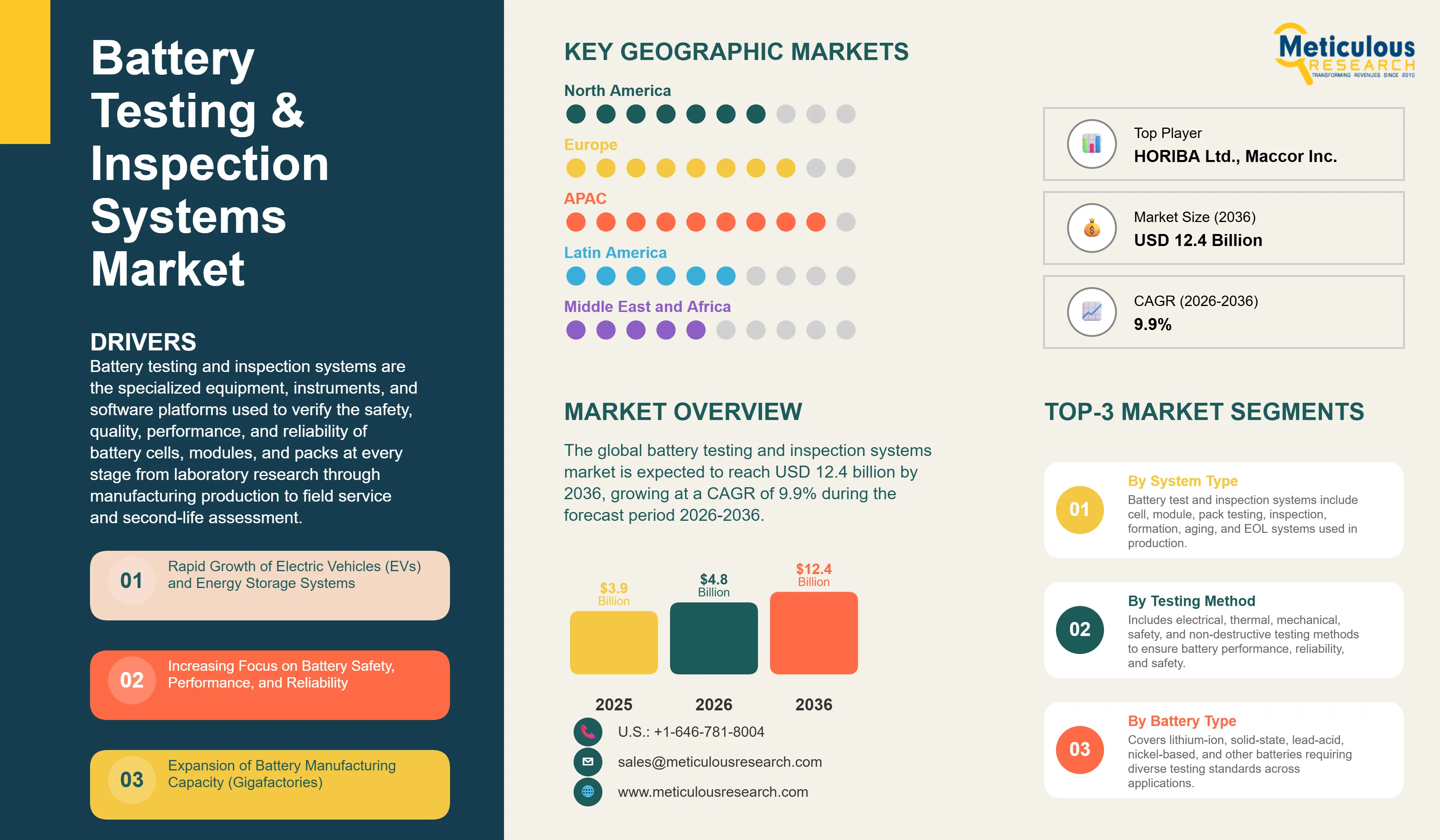
The global battery testing and inspection systems market was valued at USD 3.9 billion in 2025. This market is expected to reach USD 12.4 billion by 2036 from an estimated USD 4.8 billion in 2026, growing at a CAGR of 9.9% during the forecast period 2026-2036.
- Published
- May 2026
- Pages
- 290
- Format
- PDF + Excel
- Report ID
- MRAUTO - 1041954
- Base year
- 2025
- 2025 · BASELINE
- $3.90B
- 2036
- $12.40B
- CAGR 2026–2036
- 9.9%
2025 baseline · 2026–2036 forecast at 9.9% CAGR · hover a bar for the value
Key highlights
The global battery testing and inspection systems market is projected to reach USD 12.4 billion by 2036.
The market is expected to grow at a CAGR of 9.9% during the forecast period 2026-2036.
The global market for battery testing and inspection systems was valued at USD 3.9 billion in 2025 and is estimated to reach USD 4.8 billion in 2026.
Asia-Pacific is expected to dominate the global battery testing and inspection systems market with the largest market share in 2026, while Europe is projected to register the highest CAGR during the forecast period.
By system type, the battery test systems segment is expected to hold the largest share of the market in 2026, while the end-of-line testing systems segment is projected to register the highest CAGR during the forecast period.
By testing method, the electrical testing segment is expected to hold the largest share in 2026, while the non-destructive testing segment is projected to register the highest CAGR during the forecast period.
By battery type, the lithium-ion batteries segment is expected to hold the largest share in 2026, while the solid-state batteries segment is projected to register the highest CAGR during the forecast period.
By application, the automotive segment is expected to hold the largest share in 2026, while the energy storage systems segment is projected to register the highest CAGR during the forecast period.
By end user, the battery manufacturers segment is expected to hold the largest share in 2026, while the automotive OEMs segment is projected to register the highest CAGR during the forecast period.
By automation level, the semi-automated systems segment is expected to hold the largest share in 2026, while the fully automated systems segment is projected to register the highest CAGR during the forecast period.
Report summary
| Particulars | Details |
|---|---|
| Market Size by 2036 | USD 12.4 Billion |
| Market Size in 2026 | USD 4.8 Billion |
| Market Size in 2025 | USD 3.9 Billion |
| Revenue Growth Rate (2026-2036) | CAGR of 9.9% |
| Format | PDF, Excel & Cloud Portal · 290 pages |
| Dominating System Type | Battery Test Systems |
| Fastest Growing System Type | Inline Inspection Systems (EOL Testing) |
| Dominating Testing Method | Electrical Testing |
| Fastest Growing Testing Method | Non-Destructive Testing (NDT) |
| Dominating Battery Type | Lithium-Ion Batteries |
| Fastest Growing Battery Type | Solid-State Batteries |
| Dominating Application | Automotive |
| Fastest Growing Application | Energy Storage Systems (ESS) |
| Dominating End User | Battery Manufacturers |
| Fastest Growing End User | Automotive OEMs |
| Dominating Automation Level | Semi-Automated Systems |
| Fastest Growing Automation Level | Fully Automated Systems |
| Dominating Geography | Asia-Pacific |
| Fastest Growing Geography | Europe |
| Base Year | 2025 |
| Forecast Period | 2026 to 2036 |
Report overview
Segments covered: system type, testing method, battery type, application, end user.
According to the IEA's Global EV Outlook 2025, global EV sales reached 17-18 million in 2024, and the associated battery manufacturing industry is scaling at an extraordinary pace, with BloombergNEF's 2024 Battery Market Outlook projecting that global lithium-ion battery manufacturing capacity will reach over 6,000 GWh annually by 2030, more than six times the 2022 capacity. Every gigawatt-hour of battery production requires substantial investment in testing and inspection systems throughout the manufacturing process.
Battery testing and inspection systems are the specialized equipment, instruments, and software platforms used to verify the safety, quality, performance, and reliability of battery cells, modules, and packs at every stage from laboratory research through manufacturing production to field service and second-life assessment. A single lithium-ion battery cell destined for an electric vehicle must pass dozens of test steps before it is approved for assembly into a module: capacity measurement, internal resistance testing, formation cycling where the cell is charged and discharged to activate its electrochemical structure, X-ray inspection for internal defects, dimensional checking, and final end-of-line electrical verification before shipment. At module and pack level, additional tests verify that the individual cells are balanced, that the battery management system operates correctly, and that the completed assembly is electrically and thermally safe under a range of operating conditions including overcharge, over-discharge, and high temperature.
The market is growing rapidly because battery manufacturing is one of the fastest-scaling industrial sectors in the world. According to BloombergNEF and supporting market research, global lithium‑ion battery manufacturing capacity exceeded 2,500 GWh in 2025, with a pipeline under construction or planned in the several‑thousand‑gigawatt‑hour range, representing an extraordinary expansion of production infrastructure that each carries very significant testing‑equipment investment requirements. In parallel, global EV sales reached 21 million units in 2025 and are projected to reach around 22.7 million in 2026, further reinforcing demand for battery‑capacity and diagnostic‑test infrastructure. According to the IEA's Critical Minerals Market Review 2024, the cost of battery quality failures is a major driver of testing investment: a recalled EV battery pack carrying hundreds of cells can cost tens of thousands of dollars to replace, and a safety-critical battery failure in the field carries reputational, regulatory, and liability risks that dwarf the cost of the testing systems that could have prevented it. The combination of rapidly scaling production volumes, very high per-unit value, and severe consequences of quality failures creates a compelling investment case for comprehensive testing and inspection at every production step.
Two emerging opportunities are broadening the market beyond its primary gigafactory focus. The development of solid-state batteries, which offer potentially superior energy density and safety compared with liquid-electrolyte lithium-ion cells, requires fundamentally different testing approaches because conventional electrochemical characterization methods must be adapted for solid-state electrolytes, and new non-destructive inspection techniques are needed to detect the solid-solid interface defects that are the primary failure mode of these cells. The second-life battery market, where EV battery packs that have degraded below automotive performance thresholds are repurposed for stationary energy storage applications, is creating growing demand for battery diagnostic and grading systems that can rapidly assess the remaining capacity, power capability, and health of a used battery pack.
Report infographic
Market dynamics
7 factors across 3 forcesExpansion of Battery Manufacturing Capacity (Gigafactories)
The global battery manufacturing scale-up is the single most powerful demand driver for battery testing and inspection systems, as each new production facility represents a defined and large procurement program for testing equipment. According to BloombergNEF’s Battery Market Outlook 2024, global announced battery manufacturing capacity reached the multi‑thousand‑gigawatt‑hour range by 2024, driven by EV demand growth and government incentives for domestic battery production in the U.S. under the IRA, in Europe under the EU’s Net Zero Industry Act, and in China under its national energy‑security and NEV‑development programs. The U.S. Inflation Reduction Act's Section 45X advanced manufacturing tax credits for battery cells and modules manufactured domestically have triggered a wave of cell manufacturing investment in the U.S., with Panasonic, LG Energy Solution, Samsung SDI, and others building or expanding U.S. facilities that each require substantial formation cycling, electrical testing, and inspection system investments. Formation cycling equipment alone, which is used to charge and discharge newly assembled battery cells through their first activation cycles and accounts for a very large share of total gigafactory floor space and capital investment, represents a major procurement category within the testing systems market.
Increasing Focus on Battery Safety, Performance, and Reliability
Battery safety failures in electric vehicles and consumer electronics have been high-profile, costly, and commercially damaging events that have created very strong financial and regulatory motivation across the entire battery supply chain to invest in comprehensive testing that prevents defective batteries from reaching consumers. Multiple EV battery fire incidents and recalls have reinforced the industry's awareness that battery safety testing investment is not optional. According to the National Highway Traffic Safety Administration's recall database, battery-related EV recalls have been among the most costly in the automotive industry in recent years, with individual recall programs affecting hundreds of thousands of vehicles and costing hundreds of millions of dollars in replacement and remediation costs that in every case significantly exceeded the testing investment that could have prevented the underlying defect from entering production.
Table of contents
14 chapters · 175 sections · 290 pages · click to expandSegmental analysis
| Segment | Largest share (2026) | Fastest growth (2026–2036) |
|---|---|---|
| By System Type | Battery Test Systems | End-of-line testing systems |
| By Testing Method | Electrical Testing | Non-destructive testing |
| By Application | Automotive | Energy storage systems |
By System Type
- Battery Test Systems to Dominate
- The battery test systems segment is expected to account for the largest share of the global battery testing and inspection systems market.
- Electrical characterization systems for capacity measurement, internal resistance testing, and charge-discharge cycling are required at every level of battery assembly from individual cells through to complete packs, and the very large installed base of these systems at battery manufacturers, automotive OEMs, and research institutions makes this the dominant segment by revenue.
- Arbin Instruments, Bitrode, and Maccor are leading suppliers of cell and module level test systems, while Keysight Technologies and Chroma ATE serve both R&D and production testing markets with high-performance electrical characterization systems.
- However, the end-of-line testing systems segment is projected to register the highest CAGR during the forecast period.
- The scaling of gigafactory production volumes to millions of cells per day is creating strong demand for high-throughput EOL testing systems that can verify every completed cell or pack against final quality specifications at production line speeds.
- The requirement for 100% EOL testing of EV battery cells in automotive-grade production, combined with the scale of production at new gigafactories, is generating large procurement programs for EOL testing infrastructure that is growing faster than the broader testing systems market.
By Testing Method
- Electrical Testing to Hold the Largest Share
- The electrical testing segment is expected to account for the largest share of the global battery testing and inspection systems market.
- Electrical characterization tests are the most fundamental and universally applied battery test category, required from early cell development through to production end-of-line and field service assessment.
- Every battery cell and pack must pass electrical performance tests as the primary verification of its fitness for use, making electrical testing the core revenue category in the market.
- However, the non-destructive testing segment is projected to register the highest CAGR during the forecast period.
- The growing adoption of X-ray, CT, and ultrasonic inspection for 100% inline inspection of automotive-grade battery cells, driven by both regulatory requirements and the industry's experience with internal defect-related safety incidents, is creating rapidly growing demand for NDT equipment in gigafactory production lines.
- The German automotive industry's VDA standard requiring 100% X-ray inspection of EV battery cells represents an important adoption trigger that is pulling NDT investment into mainstream battery production.
By Application
- Automotive to Hold the Largest Share
- The automotive segment is expected to account for the largest share of the global battery testing and inspection systems market.
- EV battery manufacturing for passenger cars and commercial vehicles is by far the largest single driver of battery testing equipment investment, reflecting the very high per-pack value of automotive batteries, the very stringent safety and performance requirements of automotive applications, and the enormous scale of EV battery production ramp-up currently underway globally.
- According to the IEA, global EV sales reached 17-18 million in 2024 and are projected to grow substantially, with each vehicle requiring a thoroughly tested battery pack.
- However, the energy storage systems segment is projected to register the highest CAGR during the forecast period.
- Grid-scale and residential battery storage is growing very rapidly as the cost of battery systems falls and as renewable energy penetration creates growing demand for energy storage to manage supply variability.
- According to BloombergNEF's Energy Storage Market Outlook 2024, global energy storage installations are expected to grow sixfold from 2023 to 2030.
- Each storage system deployment requires battery testing for commissioning, performance verification, and ongoing health monitoring, creating growing demand for energy storage-specific testing systems alongside the large automotive testing market.
Geographic analysis
Asia-Pacific
Largest shareIn 2026, Asia-Pacific is expected to account for the largest share of the global battery testing and inspection systems market. The region's dominance reflects the extraordinary concentration of global battery cell manufacturing in China, South Korea, and Japan. China's State Grid and BYD are also leading developers of grid-scale energy storage, adding further battery testing equipment demand from the storage sector. South Korea's LG Energy Solution, Samsung SDI, and SK On are the world's third, fourth, and fifth-largest EV battery manufacturers respectively according to SNE Research, with major manufacturing facilities in South Korea and internationally that represent significant ongoing testing equipment investment programs. Japan hosts Panasonic and the Panasonic-Tesla collaborative battery manufacturing, alongside leading precision testing equipment manufacturers including Hioki E.E. Corporation and Advantest Corporation, which serve both domestic and global battery manufacturing customers. However, the European battery testing and inspection systems market is expected to grow at the fastest CAGR during the forecast period.
Europe
Europe's battery testing market growth is being driven by two powerful converging forces: the very large wave of gigafactory construction underway across the continent, and the EU Battery Regulation's comprehensive testing and data transparency requirements that mandate systematic testing documentation across the entire battery lifecycle. Northvolt's gigafactory in Sweden, CATL's plant under construction in Hungary, ACC's facilities in France and Germany, and the anticipated Volkswagen and Mercedes-Benz in-house cell manufacturing facilities collectively represent billions of euros of capital investment that each requires substantial testing equipment procurement programs. The EU Battery Regulation's battery passport requirement, which mandates comprehensive performance and safety data for every EV battery placed on the EU market, is creating additional systematic testing infrastructure investment beyond what pure production quality assurance would require. TUV Rheinland, headquartered in Germany, and Intertek have both cited growing battery certification demand in their recent financial communications as the EU Battery Regulation creates new mandatory third-party verification requirements.
North America
North America is a rapidly growing battery testing market, accelerating significantly following the Inflation Reduction Act's domestic battery manufacturing incentives that have triggered a wave of U.S. cell manufacturing investments. Keysight Technologies and Arbin Instruments, both headquartered in the United States, are leading global battery testing equipment suppliers with strong domestic and international customer bases. The U.S. Department of Energy's national laboratory network, including Argonne National Laboratory and the National Renewable Energy Laboratory, maintains significant battery testing infrastructure for research and development that generates ongoing equipment procurement.
Latin America
Latin America and the Middle East and Africa are earlier-stage markets for battery testing equipment, primarily driven by the testing requirements of imported EV batteries and growing energy storage deployments rather than domestic cell manufacturing.
Competitive landscape
- Keysight Technologies Inc. (U.S.)
- Chroma ATE Inc. · Taiwan
- Hioki E.E. Corporation · Japan
- HORIBA Ltd. · Japan
- AVL List GmbH · Austria
- Arbin Instruments (U.S.)
- Bitrode Corporation (U.S.)
- National Instruments/NI (U.S.)
- AMETEK Inc. (U.S.)
- Maccor Inc. (U.S.)
- TUV Rheinland Group · Germany
- Intertek Group plc (UK)
- FEV Group GmbH · Germany
- Advantest Corporation · Japan
- Kistler Group · Switzerland
Frequently asked questions
The global battery testing and inspection systems market is expected to reach USD 12.4 billion by 2036 from an estimated USD 4.8 billion in 2026, at a CAGR of 9.9% during the forecast period 2026-2036.
Cite this report
Meticulous Research. (2026). Battery Testing & Inspection Systems Market - Global Opportunity Analysis and Industry Forecast (2026-2036) (Report No. MRAUTO - 1041954). Meticulous Market Research Pvt. Ltd. https://www.meticulousresearch.com/product/battery-testing-and-inspection-systems-market-6637