Automotive Ultrasonic Sensors Market (2026-2036)
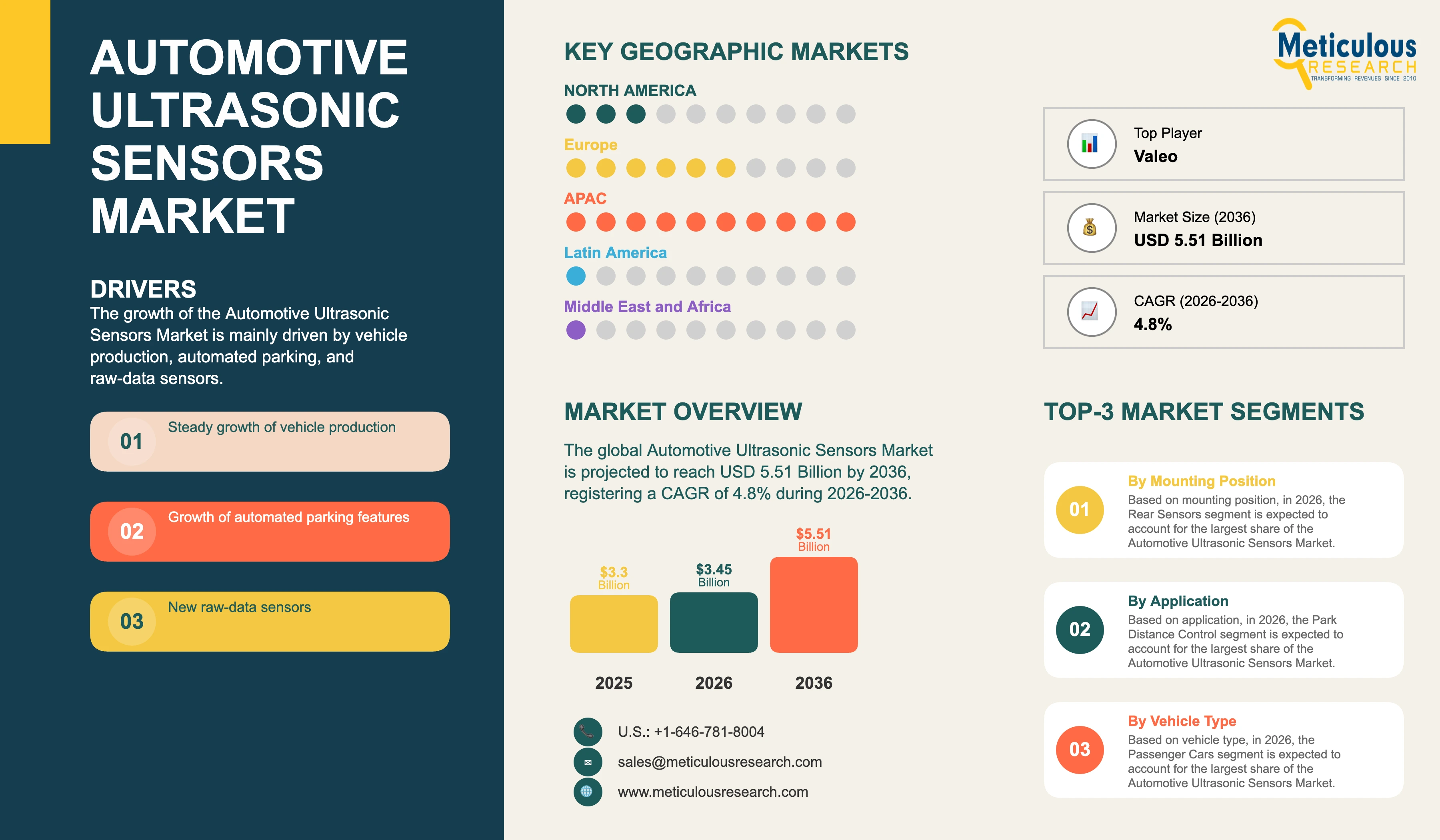
The global automotive ultrasonic sensors market was valued at USD 3.30 billion in 2025. This market is expected to reach USD 5.51 billion by 2036 from an estimated USD 3.45 billion in 2026, registering a CAGR of 4.8% during the forecast period (2026-2036).
- Published
- Nov 2026
- Pages
- 268
- Format
- PDF + Excel
- Report ID
- MRAUTO - 1042885
- Base year
- 2025
- 2025 · BASELINE
- $3.30B
- 2036
- $5.51B
- CAGR 2026–2036
- 4.8%
2025 baseline · 2026–2036 forecast at 4.8% CAGR · hover a bar for the value
Key highlights
Bosch presented TB193 and TB293, the new generation of its ultrasonic chipsets for close-range perception, at Auto China 2026 in Beijing, according to Bosch. The chipsets capture and process raw, unfiltered sensor data at the source to support AI-based parking and driving functions, reduce power consumption by up to 50%, and reduce wiring complexity. Bosch is offering the chips directly to customers for the first time, together with an open sensor interface called VASI.
Valeo, which developed the world's first ultrasonic sensors for parking assistance in the early 1990s at its site in Bietigheim, Germany, has produced more than 2 billion ultrasonic sensors, according to Valeo. Its Valeo Smart Safety 360 system, which can manage 12 ultrasonic sensors and one to four surround-view cameras for hands-free parking, was selected by a European premium vehicle maker for production starting in 2026.
Bosch is developing a wet road detection system that uses its existing generation-7 ultrasonic parking sensors and AI to estimate the depth of water on the road to within 0.1 mm, showing how ultrasonic sensors are being used for new functions beyond parking, although the system is still at the prototype stage.
Tesla removed ultrasonic sensors from its Model 3 and Model Y vehicles in 2022 and replaced them with camera-based sensing, showing the competition that ultrasonic sensors face from cameras. Most other vehicle makers continue to use ultrasonic sensors because of their low cost and reliable close-range detection.
Global electric car sales topped 20 million units in 2025, according to the IEA. Many electric vehicles, especially Chinese models, offer automated parking with 12 ultrasonic sensors as standard, which increases sensor content per vehicle.
Leading suppliers include Valeo, Bosch, AUMOVIO, Denso, Murata Manufacturing, Hyundai Mobis, Huizhou Desay SV, Tung Thih Electronic, Steelmate, and BESTAR. Automated parking assistance is the fastest-growing application, and side sensors are the fastest-growing mounting position. Digital bus and raw-data sensors are the fastest-growing interface type, as vehicle makers move to central computers.
By mounting position, rear sensors account for the largest share of 42.0% in 2026, while side sensors register the highest CAGR.
By application, park distance control accounts for the largest share in 2026, while automated parking assistance registers the highest CAGR.
By interface type, conventional sensors account for the larger share in 2026, while digital bus and raw-data sensors register the higher CAGR.
By vehicle type, passenger cars account for the larger share of 92.0% in 2026, while commercial vehicles register the higher CAGR.
By geography, Asia-Pacific accounts for the largest share of 50.0% in 2026, while Asia-Pacific registers the highest CAGR of 5.8%.
Report summary
| Particulars | Details |
|---|---|
| Base Year | 2025 |
| Estimated Year | 2026 |
| Forecast Period | 2026-2036 |
| Market Size in 2025 | USD 3.30 billion |
| Market Size in 2026 | USD 3.45 billion |
| Market Size by 2036 | USD 5.51 billion |
| CAGR (2026-2036) | 4.8% |
| Format | PDF, Excel & Cloud Portal · 268 pages |
| Largest Segment by Mounting Position (2026) | Rear Sensors (42.0%) |
| Largest Segment by Vehicle Type (2026) | Passenger Cars (92.0%) |
| Largest Region (2026) | Asia-Pacific (50.0%) |
| Fastest-Growing Region | Asia-Pacific (CAGR 5.8%) |
| Companies Profiled | 10 companies and other companies |
| Segments Covered | Mounting Position, Application, Interface Type, Vehicle Type, Geography |
| Countries Covered | U.S., Canada, Germany, France, U.K., Spain, Italy, Sweden, Czech Republic, Poland, Slovakia, Hungary, Romania, Netherlands, Belgium, Rest of Europe, China, Japan, South Korea, India, Thailand, Indonesia, Malaysia, Vietnam, Philippines, Taiwan, Singapore, Australia, Rest of Asia-Pacific, Mexico, Brazil, Argentina, Chile, Colombia, Rest of Latin America, Turkey, Morocco, South Africa, Saudi Arabia, UAE, Israel, Rest of Middle East & Africa |
Report overview
Segments covered: mounting position, application, interface type, vehicle type.
Automotive ultrasonic sensors send out high-frequency sound pulses and measure the echoes from nearby objects to detect obstacles at close range, typically up to about five meters. They are mounted in the front and rear bumpers and, increasingly, on the sides of the vehicle, and they are used mainly for park distance control, which warns drivers of obstacles when parking, and for automated parking assistance, which allows the vehicle to find a parking space and park itself. They are also used for blind spot detection at low speeds, door opening protection, and other close-range functions.
The growth of this market is mainly driven by steady growth of global vehicle production, especially in Asia-Pacific, the spread of parking sensors to more vehicles in emerging markets, the growing use of automated parking and remote parking features, which require 12 or more sensors per vehicle, the move to new sensor generations that provide raw data for AI-based perception, and the low cost and reliability of ultrasonic sensors compared with other sensors for close-range detection. In addition, the growth of SUVs and larger vehicles, which have larger blind zones, supports demand. However, competition from camera-based and radar-based close-range sensing, strong price pressure, and the removal of ultrasonic sensors by some vehicle makers are expected to restrain the growth of this market to some extent.
Ultrasonic sensors have been used for parking assistance for more than 30 years and are one of the most common driver assistance sensors. Each sensor contains a small transducer that sends out sound pulses at around 40 to 50 kHz, above the range of human hearing, and listens for echoes. By measuring the time it takes for the echo to return, the sensor calculates the distance to nearby objects. Several sensors working together can locate obstacles around the vehicle, measure parking spaces, and guide the vehicle into a space. Ultrasonic sensors are low-cost, small, reliable, and work well at very short distances, where cameras and radar can struggle.
This report covers the global automotive ultrasonic sensors market, including rear, front, and side ultrasonic sensors used for park distance control, automated parking assistance, and other applications, conventional sensors and digital bus and raw-data sensors, for passenger cars and commercial vehicles. The market is valued at the selling price of ultrasonic sensors supplied to vehicle makers and parking system suppliers, including sensors sold as part of parking systems valued at an estimated sensor price. The market is analyzed by mounting position, interface type, application, vehicle type, and geography. Parking control units, cameras, radar, and aftermarket parking sensor kits are not included.
The number of ultrasonic sensors per vehicle depends on the parking features offered. Basic rear park distance control uses four rear sensors, front and rear park distance control uses eight sensors, and automated parking systems use 12 sensors, including side sensors that measure parking spaces as the vehicle passes. Many vehicles in Europe, China, Japan, and South Korea now offer front and rear sensors as standard, and automated parking is spreading quickly, especially in China, which increases the average number of sensors per vehicle.
Ultrasonic sensor technology is also changing, after many years of gradual improvement. New sensor generations use digital interfaces, such as DSI3, which allow several sensors to share one wire and send more data to the control unit. The latest designs, such as Bosch's TB193 and TB293 chipsets, capture raw sensor data and send it to central computers, where AI algorithms can use the full detail of the signal to classify objects and improve detection, according to Bosch. Bosch's open VASI interface is intended to give vehicle makers more freedom to choose sensor suppliers.
The market is led by large automotive suppliers, such as Valeo, Bosch, AUMOVIO, Denso, and Hyundai Mobis, which supply ultrasonic sensors and complete parking systems, together with component makers, such as Murata Manufacturing, which supplies ultrasonic transducers, and Chinese suppliers, such as Huizhou Desay SV, Tung Thih Electronic, Steelmate, and BESTAR. Chinese suppliers have grown quickly with Chinese vehicle makers and offer low-cost sensors. Valeo, which developed the first ultrasonic parking sensors, has produced more than 2 billion sensors, according to Valeo.
Ultrasonic sensors face growing competition from cameras and radar for close-range sensing in new vehicles. Surround-view cameras provide images for parking, and some vehicle makers use camera-based systems to replace ultrasonic sensors, as Tesla did in 2022. Corner radars and short-range 4D imaging radars can also detect obstacles at low speeds. However, ultrasonic sensors remain the lowest-cost way to measure very short distances accurately, and most vehicle makers use them together with cameras for automated parking. New raw-data sensors are designed to improve their performance in sensor fusion systems. As a result, the market is shifting from basic warning functions toward sensors that support automated driving at low speeds.
In 2026, rear sensors account for the largest share of the market by mounting position, while side sensors are the fastest-growing mounting position. Park distance control accounts for the largest share by application, while automated parking assistance is the fastest-growing application. Conventional sensors account for the largest share by interface type, while digital bus and raw-data sensors are the fastest-growing interface type. Passenger cars account for the largest share by vehicle type, while commercial vehicles are the fastest-growing vehicle type. Asia-Pacific accounts for the largest share of the market and is also the fastest-growing region.
Market growth over the forecast period will depend on vehicle production, the number of sensors per vehicle, the adoption of automated parking, the balance between ultrasonic sensors and camera- and radar-based alternatives, and price trends. Strong price pressure and competition from other sensors will limit growth in market value, while the spread of automated parking and new raw-data sensors will support it. Overall, the market is expected to grow steadily but more slowly than other driver assistance sensor markets through 2036.
Passenger cars are expected to account for the largest share of 92.0% of the market in 2026, while commercial vehicles are projected to register the highest CAGR, driven by parking sensors in vans, trucks, and buses.
Asia-Pacific is expected to account for the largest share of 50.0% of the market in 2026, mainly due to China's large vehicle production and fast adoption of automated parking with 12 ultrasonic sensors.
Asia-Pacific is also projected to register the highest CAGR of 5.8% during the forecast period, driven by automated parking in China and the spread of parking sensors in India and Southeast Asia.
The report profiles 10 companies, including Valeo, Bosch, AUMOVIO, Denso, Murata Manufacturing, Hyundai Mobis, Huizhou Desay SV, Tung Thih Electronic, Steelmate, and BESTAR.
Some vehicle makers, such as Tesla, have replaced ultrasonic sensors with cameras, but most continue to use them because of their low cost and accurate short-range detection, often together with cameras in automated parking.
Basic rear parking uses four sensors, front and rear parking uses eight, and automated parking systems typically use 12 sensors, including side sensors that measure parking spaces as the vehicle drives past.
Report infographic
Market dynamics
17 factors across 5 forcesSteady growth of vehicle production
Ultrasonic sensors are fitted to a large share of new vehicles, so demand is closely linked to vehicle production. Global vehicle production is expected to grow steadily over the forecast period, led by China, India, and Southeast Asia, while production in Europe and North America is expected to grow more slowly. Each new vehicle with parking sensors uses between four and 12 or more ultrasonic sensors, so growth in vehicle production directly increases sensor demand.
The growth of SUVs and larger vehicles also supports demand, as these vehicles have larger blind zones around the bumpers and are harder to park, which makes parking sensors more valuable to drivers. Vehicle makers increasingly fit front and rear sensors as standard on SUVs, even on lower trim levels. As vehicle production in Asia-Pacific grows and more vehicles are fitted with parking sensors, demand for ultrasonic sensors is expected to grow steadily.
Spread of parking sensors in emerging markets
In emerging markets, such as India, Southeast Asia, Latin America, and parts of the Middle East and Africa, many vehicles still do not have parking sensors or have only rear sensors. As incomes rise, traffic increases, and parking spaces in cities become tighter, consumers increasingly want parking sensors, and vehicle makers are adding them to more models, including entry-level cars. Safety rating programs, such as Bharat NCAP and ASEAN NCAP, also encourage vehicle makers to add more safety and driver assistance features.
The spread of parking sensors in these markets creates strong volume growth for ultrasonic sensor suppliers, although prices are lower than in mature markets. Suppliers with low-cost designs and local production in India and Southeast Asia are well placed to benefit, as vehicle makers in these markets want to add parking features at minimal cost. Asia-Pacific is the fastest-growing region in this market, supported by vehicle production growth and rising sensor adoption in China, India, and Southeast Asia.
Growth of automated parking features
Automated parking systems, which find a parking space and steer, brake, and accelerate the vehicle into it, are spreading from premium vehicles to mainstream models, especially in China, where many electric vehicles offer automated and remote parking as standard. These systems use 12 ultrasonic sensors, including side sensors that measure parking spaces as the vehicle passes, together with surround-view cameras, which increases sensor content per vehicle compared with basic park distance control.
Remote parking, which allows the driver to park the vehicle from outside using a smartphone, and memory parking, which allows the vehicle to park itself in a familiar location, also rely on ultrasonic sensors. Valeo's Smart Safety 360 system, which manages 12 ultrasonic sensors for hands-free parking, was selected by a European premium vehicle maker for production starting in 2026, according to Valeo. Automated parking assistance is the fastest-growing application in this market.
New raw-data sensors for AI-based perception
New ultrasonic sensor generations capture raw sensor data and send it to central computers, where AI algorithms can use the full detail of the signal to detect and classify objects more accurately. Bosch's TB193 and TB293 chipsets, presented at Auto China 2026, capture and process raw data at the source, reduce power consumption by up to 50%, and reduce wiring complexity, according to Bosch. This approach improves the performance of ultrasonic sensors in sensor fusion systems with cameras and radar.
Raw-data sensors also allow new functions, such as classifying objects as curbs, poles, or pedestrians, and detecting road conditions. Bosch is developing a wet road detection system that uses its generation-7 ultrasonic sensors and AI to estimate water depth on the road. Digital bus and raw-data sensors are the fastest-growing interface type in this market, as they help ultrasonic sensors remain competitive with camera- and radar-based alternatives.
Low cost and reliability for close-range detection
Ultrasonic sensors are among the lowest-cost sensors in a vehicle and have proven their reliability over more than 30 years of use. They measure distances accurately at very short range, down to a few centimeters, where cameras can struggle to judge distance and where radar can have blind zones. They also detect objects that are hard for cameras to see, such as glass walls, thin poles, and low curbs, and they work in darkness. For these reasons, most vehicle makers continue to use ultrasonic sensors together with cameras for parking and low-speed maneuvering, even as cameras and radar improve. The low cost of ultrasonic sensors also makes them attractive for entry-level vehicles in emerging markets, where vehicle makers want to add parking assistance at minimal cost. Ultrasonic sensors are also being used for new close-range functions, such as door opening protection, which warns occupants or stops a door from opening into an obstacle, and low-speed blind spot detection, which increases the number of sensors per vehicle and supports steady market growth.
Table of contents
12 chapters · 181 sections · 268 pages · click to expandSegmental analysis
| Segment | Largest share (2026) | Fastest growth (2026–2036) |
|---|---|---|
| By Mounting Position | Park distance control | Automated parking assistance |
By Mounting Position
- The park distance control segment is expected to account for the largest share of the automotive ultrasonic sensors market, while the automated parking assistance segment is projected to register the highest CAGR during the forecast period.
- The conventional sensors segment is expected to account for the larger share of the automotive ultrasonic sensors market, while the digital bus and raw-data sensors segment is projected to register the higher CAGR during the forecast period.
Geographic analysis
Asia-Pacific
Largest shareIn 2026, Asia-Pacific is expected to account for the largest share of 50.0% of the global automotive ultrasonic sensors market. The large share of this region is mainly due to China's position as the largest vehicle producer in the world, the fast adoption of automated and remote parking with 12 ultrasonic sensors by Chinese vehicle makers, the large vehicle production of Japan, South Korea, and India, and the presence of leading suppliers, such as Denso, Murata Manufacturing, Hyundai Mobis, Huizhou Desay SV, Tung Thih Electronic, Steelmate, and BESTAR, together with the large Asian operations of Valeo, Bosch, and AUMOVIO. China is also a major production center for ultrasonic sensors exported to other regions. Japan and South Korea are important markets for sensor development and production, supported by Denso, Murata, and Hyundai Mobis. Asia-Pacific is also projected to register the highest CAGR of 5.8% during the forecast period. The rapid growth of this region is mainly driven by continued growth of vehicle production and automated parking adoption in China, the spread of parking sensors to more vehicles in India and Southeast Asia, where many vehicles still lack sensors, Bharat NCAP and ASEAN NCAP safety ratings, and the growth of vehicle production in Indonesia, Thailand, and Vietnam. Chinese suppliers are growing quickly with local vehicle makers and expanding abroad.
Europe
Europe accounts for a significant share of the market, supported by the high share of vehicles with front and rear parking sensors, the production of premium vehicles with automated parking, tight parking spaces in European cities, and the presence of leading suppliers, such as Valeo and Bosch, which developed early ultrasonic parking systems in Germany. Germany is the largest market in the region, supported by premium vehicle production and high sensor content, followed by France, the U.K., Spain, Italy, and Central and Eastern European countries, which are important locations for vehicle and sensor production. European vehicle makers continue to fit ultrasonic sensors to most new models, and automated parking is common in premium vehicles. Tight parking spaces, narrow streets, and high parking costs in many European cities make parking sensors highly valued by drivers.
North America
North America accounts for a significant share of the market, supported by the large production of SUVs and pickup trucks, which have large blind zones and are often fitted with parking sensors, and the growth of automated parking features. However, Tesla's removal of ultrasonic sensors from its Model 3 and Model Y vehicles has reduced demand from one of the region's largest electric vehicle makers. The U.S. is the largest market in the region, while Mexico is an important production location for sensors and parking systems.
Latin America
Latin America and the Middle East & Africa account for smaller shares, with growth supported by rising parking sensor adoption and vehicle production in Brazil, Mexico, Argentina, Turkey, and Morocco. Growing imports of Chinese vehicles with automated parking are also raising consumer expectations in these markets.
Competitive landscape
The global automotive ultrasonic sensors market includes large automotive suppliers that offer ultrasonic sensors and complete parking systems, component makers that supply ultrasonic transducers and chips, and Chinese sensor suppliers. The market is relatively concentrated among a few large global suppliers for vehicle makers in Europe, Japan, and North America, while Chinese suppliers have gained a large share with Chinese vehicle makers through low costs and fast development.
Valeo is a global leader in ultrasonic sensors and parking systems, with production in Europe, Asia, and the Americas, and has produced more than 2 billion ultrasonic sensors, according to Valeo. Bosch is also a leading supplier, with its generation-7 ultrasonic sensors and new TB193 and TB293 chipsets. AUMOVIO, Denso, and Hyundai Mobis supply ultrasonic sensors and parking systems, Murata Manufacturing supplies ultrasonic transducers, and Huizhou Desay SV, Tung Thih Electronic, Steelmate, and BESTAR are leading Chinese suppliers.
Companies in this market compete mainly on detection performance, reliability, cost, size, design integration, interface technology, and the ability to offer complete parking systems with software. Key strategies in this market include developing raw-data sensors and chipsets for AI-based processing, offering open interfaces, developing hidden and paint-compatible sensors, supplying complete automated parking systems, and expanding low-cost production in China, India, and other growth markets.
Recent competitive activity in this market has mainly focused on new sensor generations, chipsets, and complete parking systems. Bosch presented its TB193 and TB293 ultrasonic chipsets and open VASI interface at Auto China 2026 and is offering its ultrasonic chips directly to customers for the first time, according to Bosch, and a European premium vehicle maker selected Valeo's Smart Safety 360 system, which manages 12 ultrasonic sensors, for production starting in 2026, according to Valeo.
We expect competition to increase over the forecast period as Chinese suppliers expand abroad, as open interfaces and separate chip sales allow new companies to enter the market, and as cameras and radar compete for close-range sensing. Suppliers with raw-data sensor technology, complete parking system offerings, low-cost production, and strong software capabilities are expected to strengthen their positions, while consolidation among smaller suppliers is likely, especially among Chinese suppliers competing mainly on price.
Some of the key players operating in the automotive ultrasonic sensors market are Valeo SE, Robert Bosch GmbH, AUMOVIO SE, Denso Corporation, Murata Manufacturing Co., Ltd., Hyundai Mobis Co., Ltd., Huizhou Desay SV Automotive Co., Ltd., Tung Thih Electronic Co., Ltd., Steelmate Co., Ltd., and BESTAR Holdings, among others.
- —
Bosch presented its TB193 and TB293 raw-data ultrasonic chipsets and open VASI interface at Auto China 2026, and a European premium vehicle maker selected Valeo's Smart Safety 360 system with 12 ultrasonic sensors for production from 2026.
- Valeo SE
- Robert Bosch GmbH
- AUMOVIO SE
- Denso Corporation
- Murata Manufacturing Co., Ltd.
- Hyundai Mobis Co., Ltd.
- Huizhou Desay SV Automotive Co., Ltd.
- Tung Thih Electronic Co., Ltd.
- Steelmate Co., Ltd.
- BESTAR Holdings
Expert perspectives
Automotive ultrasonic sensors are a mature but steadily growing market with a long production history. While they face competition from cameras and radar for close-range sensing, their low cost, reliability, and accurate short-range detection keep them in use in most vehicles, and the spread of automated parking is increasing the number of sensors per vehicle.
Over the forecast period, the market is expected to grow at a CAGR of 4.8%, from USD 3.45 billion in 2026 to USD 5.51 billion in 2036. Growth will be driven by steady vehicle production growth, the spread of parking sensors in emerging markets, the growth of automated parking features, new raw-data sensors for AI-based perception, and the low cost and reliability of ultrasonic sensors for close-range detection.
Among the market segments, rear sensors are the largest mounting position, while side sensors grow fastest. Park distance control is the largest application, while automated parking assistance grows fastest. Conventional sensors are the largest interface type, while digital bus and raw-data sensors grow fastest. Passenger cars are the largest vehicle type, while commercial vehicles grow fastest. Asia-Pacific is both the largest and the fastest-growing region, at a CAGR of 5.8%.
In our view, the move to raw-data sensors will largely decide the long-term role of ultrasonic sensors. By sending detailed signal data to central computers for AI-based processing and sensor fusion, raw-data sensors can improve detection and support new functions, which helps them compete with cameras and radar and keeps them relevant in future software-defined vehicles. Suppliers that lead in raw-data sensors and open interfaces will be best placed to keep ultrasonic sensors in future vehicle architectures.
We also see automated parking and emerging markets as the main sources of volume growth over the forecast period. Automated parking increases sensor content per vehicle, while emerging markets add new vehicles with parking sensors. However, the camera-only approach used by some vehicle makers remains a risk, and suppliers must keep reducing costs and improving performance. On balance, we expect most vehicle makers to keep ultrasonic sensors as part of their parking systems through the forecast period, while reducing sensor counts on some lower-priced models to save cost.
Overall, we believe that the automotive ultrasonic sensors market will grow steadily over the forecast period, with side sensors, automated parking assistance, raw-data sensors, commercial vehicles, and Asia-Pacific providing the fastest growth. Companies with raw-data sensor technology, complete parking systems, low-cost production, and strong software will be best positioned to capture this growth, while competition from cameras and radar and strong price pressure remain the main risks.
Customer perspectives
Customers in the automotive ultrasonic sensors market are mainly vehicle makers and parking system suppliers, which buy ultrasonic sensors for passenger cars and commercial vehicles. They focus on detection performance, reliability in dirt, snow, and noise, cost, size, design integration with bumpers, interface technology, and support for automated parking and sensor fusion. Vehicle makers increasingly ask for raw-data sensors for centralized architectures, hidden or paint-compatible sensors, and complete 12-sensor systems for automated parking. They also value suppliers that can support production in several regions and provide software for new close-range functions. Commercial vehicle customers focus on durability and wide coverage around large vehicles. Many want sensors that can be reused across platforms and regions to reduce cost.
This comment explains why automated parking assistance is the fastest-growing application and why Asia-Pacific is the fastest-growing region, led by China.
This comment explains why digital bus and raw-data sensors are the fastest-growing interface type, while rear sensors account for 42.0% of the market, supported by their use in almost every vehicle with parking sensors.
This comment explains why commercial vehicles are the fastest-growing vehicle type, while passenger cars account for 92.0% of the market, supported by their much larger production volumes.
“Our customers expect automated and remote parking on every model. That means 12 ultrasonic sensors working with the surround-view cameras.”
“We are moving to central computers, so we want ultrasonic sensors that send raw data. Our AI can then classify curbs, poles, and people much better.”
“Low-speed bumps in tight streets were costing us a lot in repairs. Parking sensors all around the van have cut those costs sharply.”
Frequently asked questions
The global automotive ultrasonic sensors market was valued at USD 3.30 billion in 2025, up from USD 3.15 billion in 2024, and is estimated at USD 3.45 billion in 2026. The market includes rear, front, and side ultrasonic sensors for passenger cars and commercial vehicles.
The global automotive ultrasonic sensors market is expected to reach USD 5.51 billion by 2036, driven by vehicle production, parking sensor adoption in emerging markets, automated parking, and raw-data sensors.
The market is expected to register a CAGR of 4.8% from 2026 to 2036, with the fastest growth in side sensors, automated parking assistance, raw-data sensors, commercial vehicles, and Asia-Pacific.
Market growth is mainly driven by steady vehicle production growth, the spread of parking sensors in emerging markets, the growth of automated parking features, new raw-data sensors for AI-based perception, and the low cost and reliability of ultrasonic sensors for close-range detection.
Competition from camera- and radar-based sensing and strong price pressure restrain growth, while performance limitations in dirt, snow, and noise and integration into vehicle design and centralized architectures are key challenges.
Key growth opportunities include automated and remote parking systems, raw-data ultrasonic sensors and chipsets, new close-range functions, and growth in emerging markets and commercial vehicles.
Rear sensors are expected to account for the largest share of 42.0% of the market in 2026, while side sensors are projected to register the highest CAGR, driven by automated parking and door opening protection.
In 2026, the park distance control segment is expected to account for the largest share of the automotive ultrasonic sensors market, while the automated parking assistance segment is projected to register the highest CAGR during the forecast period.
In 2026, the conventional sensors segment is expected to account for the larger share of the automotive ultrasonic sensors market, while the digital bus and raw-data sensors segment is projected to register the higher CAGR during the forecast period.
Passenger cars are expected to account for the largest share of 92.0% of the market in 2026, while commercial vehicles are projected to register the highest CAGR, driven by parking sensors in vans, trucks, and buses.
Asia-Pacific is expected to account for the largest share of 50.0% of the market in 2026, mainly due to China's large vehicle production and fast adoption of automated parking with 12 ultrasonic sensors.
Asia-Pacific is also projected to register the highest CAGR of 5.8% during the forecast period, driven by automated parking in China and the spread of parking sensors in India and Southeast Asia.
The report profiles 10 companies, including Valeo, Bosch, AUMOVIO, Denso, Murata Manufacturing, Hyundai Mobis, Huizhou Desay SV, Tung Thih Electronic, Steelmate, and BESTAR.
Bosch presented its TB193 and TB293 raw-data ultrasonic chipsets and open VASI interface at Auto China 2026, and a European premium vehicle maker selected Valeo's Smart Safety 360 system with 12 ultrasonic sensors for production from 2026.
Some vehicle makers, such as Tesla, have replaced ultrasonic sensors with cameras, but most continue to use them because of their low cost and accurate short-range detection, often together with cameras in automated parking.
Basic rear parking uses four sensors, front and rear parking uses eight, and automated parking systems typically use 12 sensors, including side sensors that measure parking spaces as the vehicle drives past.
Cite this report
Meticulous Research. (2026). Automotive Ultrasonic Sensors Market - Global Opportunity Analysis and Industry Forecast (2026-2036) (Report No. MRAUTO - 1042885). Meticulous Market Research Pvt. Ltd. https://www.meticulousresearch.com/product/automotive-ultrasonic-sensors-market-7568