Automotive Pressure Sensors Market (2026-2036)
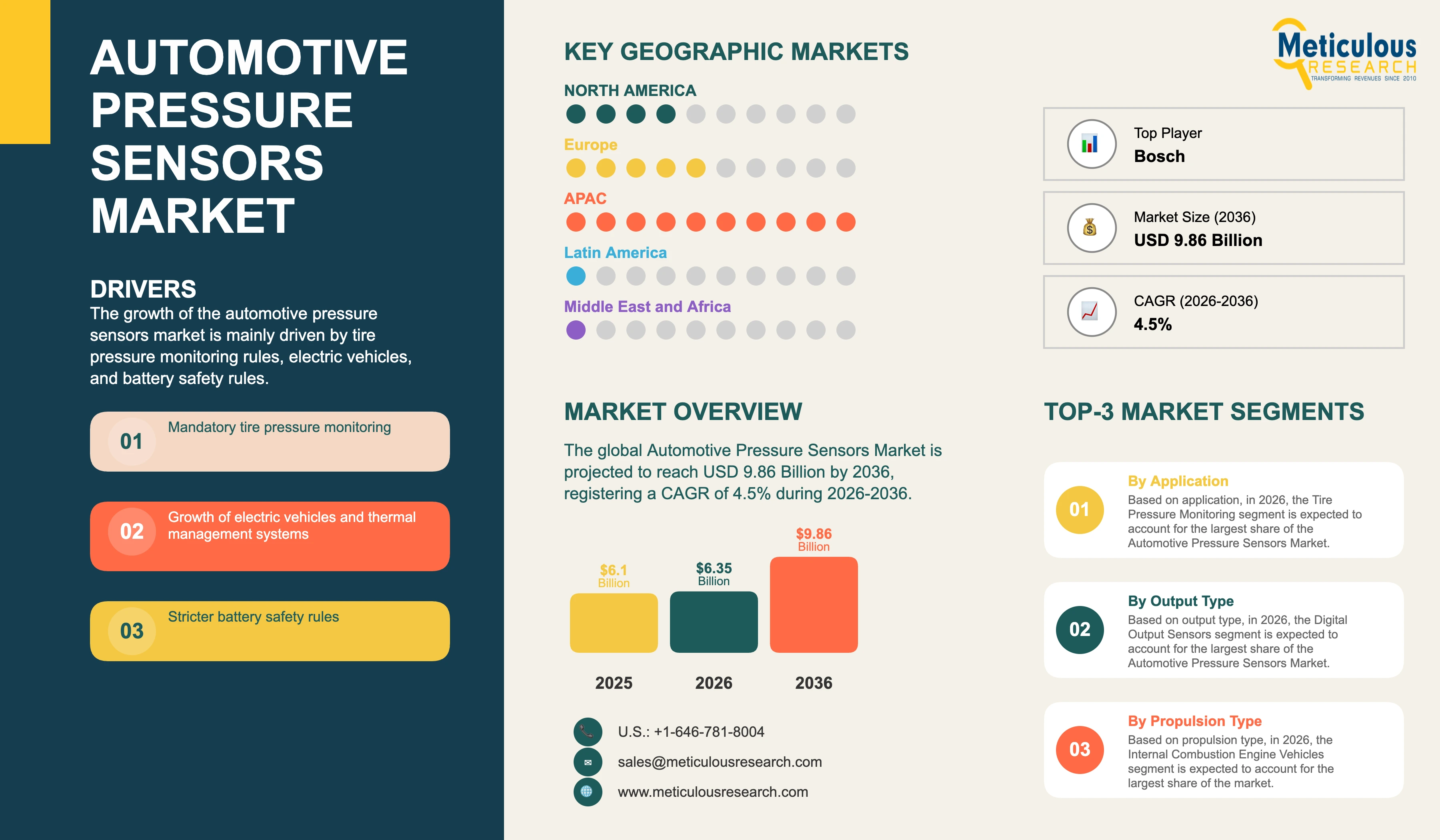
The global automotive pressure sensors market was valued at USD 6.10 billion in 2025. This market is expected to reach USD 9.86 billion by 2036 from an estimated USD 6.35 billion in 2026, registering a CAGR of 4.5% during the forecast period (2026-2036).
- Published
- Nov 2026
- Pages
- 259
- Format
- PDF + Excel
- Report ID
- MRAUTO - 1042888
- Base year
- 2025
- 2024 · HISTORICAL
- $3.93B
- 2036
- $9.86B
- CAGR 2026–2036
- 4.5%
2024–2025 baseline · 2026–2036 forecast at 4.5% CAGR · hover a bar for the value
Key highlights
China's updated battery safety standard GB 38031-2025 took effect on July 1, 2026, together with the vehicle safety standard GB 18384-2025, according to the MIIT. The battery standard requires that traction batteries must not catch fire or explode even after thermal runaway, which pushes vehicle makers to improve early detection of battery cell failures, including through pack pressure sensors that detect the gas released when a cell fails.
Infineon offers the XENSIV KP497 smart barometric pressure sensor for battery management systems, which measures absolute pressure from 20 kPa to 250 kPa and can detect the rapid pressure changes associated with thermal runaway in high-voltage battery packs, according to Infineon. The sensor also includes an accelerometer and a low-power autonomous mode for monitoring while the vehicle is parked.
Sensata Technologies reported 2025 revenue of USD 3.70 billion, down 6% from USD 3.93 billion in 2024, mainly due to divestitures and product lifecycle actions, according to Sensata. The company reorganized into three reporting segments, with Automotive accounting for about 57% of revenue. Sensata is a leading supplier of tire pressure monitoring and other automotive pressure sensors.
Melexis reported 2025 sales of EUR 839.6 million, with automotive applications accounting for 88% of the total, according to Melexis. Pressure sensors were among the company's outperforming product lines in the third quarter of 2025, according to Melexis.
NXP's MEMS sensor products, including automotive safety pressure sensors for airbag crash detection and battery pressure monitoring sensors, were transitioned to STMicroelectronics as of February 2, 2026, according to NXP, which strengthens STMicroelectronics' position in automotive pressure sensing.
Leading suppliers include Bosch, Sensata Technologies, Infineon Technologies, STMicroelectronics, Denso, TE Connectivity, Melexis, Amphenol, AUMOVIO, and Baolong. Battery pack and EV systems is the fastest-growing application, and digital output sensors are the fastest-growing output type, as vehicle makers move to digital interfaces such as SENT and PSI5. Infineon also supplies SP49 sensor chips for tire pressure monitoring modules, which combine a pressure sensor, microcontroller, and wireless transmitter, according to Infineon.
By application, tire pressure monitoring accounts for the largest share of 36.0% in 2026, while battery pack and EV systems register the highest CAGR.
By output type, digital output sensors account for the larger share in 2026 and also register the higher CAGR.
By propulsion type, internal combustion engine vehicles account for the largest share in 2026, while battery electric vehicles register the highest CAGR.
By vehicle type, passenger cars account for the larger share of 80.0% in 2026, while commercial vehicles register the higher CAGR.
By geography, Asia-Pacific accounts for the largest share of 47.0% in 2026, while Asia-Pacific registers the highest CAGR of 5.4%.
Report summary
| Particulars | Details |
|---|---|
| Base Year | 2025 |
| Estimated Year | 2026 |
| Forecast Period | 2026-2036 |
| Market Size in 2025 | USD 6.10 billion |
| Market Size in 2026 | USD 6.35 billion |
| Market Size by 2036 | USD 9.86 billion |
| CAGR (2026-2036) | 4.5% |
| Format | PDF, Excel & Cloud Portal · 259 pages |
| Largest Segment by Application (2026) | Tire Pressure Monitoring (36.0%) |
| Largest Segment by Vehicle Type (2026) | Passenger Cars (80.0%) |
| Largest Region (2026) | Asia-Pacific (47.0%) |
| Fastest-Growing Region | Asia-Pacific (CAGR 5.4%) |
| Companies Profiled | 10 companies and other companies |
| Segments Covered | Application, Output Type, Propulsion Type, Vehicle Type, Geography |
| Countries Covered | U.S., Canada, Mexico, Germany, France, U.K., Spain, Italy, Sweden, Czech Republic, Poland, Slovakia, Hungary, Romania, Rest of Europe, China, Japan, South Korea, India, Thailand, Indonesia, Malaysia, Vietnam, Taiwan, Australia, Rest of Asia-Pacific, Brazil, Argentina, Chile, Colombia, Rest of Latin America, Turkey, Morocco, South Africa, Saudi Arabia, UAE, Israel, Rest of Middle East & Africa |
Report overview
Segments covered: application, output type, propulsion type, vehicle type.
Automotive pressure sensors measure the pressure of air, fluids, and gases in a vehicle and convert it into an electrical signal for the vehicle's control units. They are used to monitor tire pressure, control the engine and exhaust aftertreatment, operate brakes and stability control, run air conditioning and heat pump systems, detect side impacts for airbag deployment, and, in electric vehicles, detect the sudden pressure rise inside a battery pack that signals a battery cell failure, as well as to monitor coolant and refrigerant circuits.
The growth of this market is mainly driven by mandatory tire pressure monitoring in major vehicle markets and its extension to trucks and buses, the growth of electric vehicles, which use pressure sensors in battery packs, heat pumps, and thermal management systems, stricter battery safety rules, such as China's GB 38031-2025, the move to brake-by-wire and electronic braking systems, and steady growth of vehicle production in Asia-Pacific. In addition, the shift to digital sensor outputs and smart sensors with built-in diagnostics adds value per sensor. However, the decline of internal combustion engine vehicles, which use many engine and exhaust pressure sensors, and strong price pressure are expected to restrain the growth of this market to some extent.
Pressure sensors are among the most widely used sensors in vehicles, and a typical modern vehicle contains between 10 and 30 of them, depending on its powertrain, safety features, and comfort systems. Most automotive pressure sensors use MEMS technology, in which a thin silicon membrane bends under pressure and changes the electrical resistance or capacitance of elements on its surface. A signal processing chip, usually an application-specific integrated circuit, converts this change into a calibrated output signal. Other technologies, such as ceramic and thick-film sensors, are used for very high pressures, such as fuel injection and brake systems, where strong membranes are needed to withstand pressures of hundreds or thousands of bar.
This report covers the global automotive pressure sensors market, including pressure sensors used for tire pressure monitoring, powertrain and exhaust, braking and chassis, thermal management and HVAC, battery pack and EV systems, and safety and other applications, in analog and digital output versions, for internal combustion engine vehicles, battery electric vehicles, and hybrid vehicles, and for passenger cars and commercial vehicles. The market is valued at the selling price of pressure sensors and tire pressure monitoring sensor modules supplied to vehicle makers and their system suppliers for original equipment fitment. The market is analyzed by application, output type, propulsion type, vehicle type, and geography. Aftermarket replacement sensors and complete control units are not included.
The types of pressure sensors used in a vehicle depend strongly on its powertrain. Internal combustion engine vehicles use manifold absolute pressure sensors, barometric pressure sensors, fuel rail and fuel tank pressure sensors, oil pressure sensors, and exhaust differential pressure sensors for particulate filters, while battery electric vehicles do not need most of these sensors. However, battery electric vehicles add pressure sensors in the battery pack to detect cell failures, in the refrigerant circuits of heat pumps and battery cooling systems, and in coolant loops. Both types of vehicles use pressure sensors for tire pressure monitoring, brakes, air conditioning, and side impact detection.
Tire pressure monitoring systems are the largest single use of pressure sensors in vehicles. Direct tire pressure monitoring systems place a sensor module inside each wheel, which measures pressure and temperature and sends the data by radio to the vehicle. These systems are mandatory for new passenger cars in the U.S., the EU, China, South Korea, and several other countries, and the EU General Safety Regulation has extended tire pressure monitoring requirements to buses and trucks. Because each vehicle needs four or more sensor modules, which include a pressure sensor chip, a radio transmitter, a battery, and a valve, tire pressure monitoring accounts for a large share of market value.
The automotive pressure sensors market is led by a mix of large automotive suppliers, semiconductor companies, and sensor specialists. Bosch supplies a broad range of automotive pressure sensors for engines, brakes, airbags, and thermal management. Sensata Technologies is a leading supplier of tire pressure monitoring sensors and high-pressure sensors for brakes and powertrains. Infineon Technologies supplies XENSIV pressure sensors for engine control, battery management, and tire pressure monitoring, STMicroelectronics took over NXP's MEMS sensor products in February 2026, Denso supplies pressure sensors to Japanese vehicle makers, TE Connectivity, Melexis, and Amphenol supply sensors for many applications, AUMOVIO supplies tire pressure monitoring systems, and Baolong is a leading Chinese supplier of tire pressure monitoring sensors.
The market is going through a gradual change as vehicles move from internal combustion engines to electric powertrains. Demand for engine and exhaust pressure sensors is expected to decline slowly over the forecast period, while demand for sensors used in battery packs, heat pumps, thermal management, and electronic brakes grows quickly. Battery safety rules, such as China's GB 38031-2025, which took effect in July 2026, are making battery pack pressure sensors a standard part of electric vehicle safety systems. At the same time, vehicle makers are moving from analog sensor outputs to digital interfaces, which allow sensors to send more information, including self-diagnosis and temperature data.
In 2026, tire pressure monitoring accounts for the largest share of the market by application, while battery pack and EV systems is the fastest-growing application. Digital output sensors account for the largest share by output type and are also the fastest-growing output type. Internal combustion engine vehicles account for the largest share by propulsion type, while battery electric vehicles are the fastest-growing propulsion type. Passenger cars account for the largest share by vehicle type, while commercial vehicles are the fastest-growing vehicle type. Asia-Pacific accounts for the largest share of the market and is also the fastest-growing region.
Market growth over the forecast period will depend on vehicle production, the share of electric vehicles in new vehicle sales, the pace of decline in internal combustion engine vehicles, the extension of tire pressure monitoring and battery safety rules, the adoption of brake-by-wire and heat pumps, and price trends. The decline of engine and exhaust sensors and strong price pressure will limit growth in market value, while battery safety, thermal management, and tire pressure monitoring in commercial vehicles will support it. Overall, the market is expected to grow steadily, slightly faster than vehicle production, through 2036.
Passenger cars are expected to account for the largest share of 80.0% of the market in 2026, while commercial vehicles are projected to register the higher CAGR, driven by tire pressure monitoring rules for buses and trucks and air brake systems.
Asia-Pacific is expected to account for the largest share of 47.0% of the market in 2026, mainly due to China's large vehicle production, mandatory tire pressure monitoring, and leadership in electric vehicle production.
Asia-Pacific is also projected to register the highest CAGR of 5.4% during the forecast period, driven by electric vehicle growth and battery safety rules in China and vehicle production growth in India and Southeast Asia.
The report profiles 10 companies, including Bosch, Sensata Technologies, Infineon Technologies, STMicroelectronics, Denso, TE Connectivity, Melexis, Amphenol, AUMOVIO, and Baolong.
When a battery cell fails, it releases gas that quickly raises the pressure inside the battery pack. Pressure sensors detect this rise within seconds, often before temperatures rise across the pack, giving early warning to protect occupants.
Electric vehicles do not need most engine and exhaust pressure sensors, but they add sensors in battery packs, heat pumps, thermal management systems, and electronic brakes, which shifts demand toward these new applications.
In 2026, the digital output sensors segment is expected to account for the larger share of the automotive pressure sensors market, and it is also projected to register the higher CAGR during the forecast period.
Report infographic
Market dynamics
17 factors across 5 forcesMandatory tire pressure monitoring and its extension to commercial vehicles
Tire pressure monitoring is mandatory for new passenger cars in the U.S. under FMVSS 138, in the EU, in China under GB 26149, in South Korea, and in several other countries, which makes it one of the largest and most stable uses of pressure sensors. Most of these markets use direct systems with a sensor module in each wheel, which measures tire pressure and temperature and warns the driver of under-inflation. Under-inflated tires increase fuel and energy use, tire wear, and the risk of tire failure, which is why governments require these systems. More countries in Asia, Latin America, and the Middle East are considering or adopting similar rules.
The EU General Safety Regulation has extended tire pressure monitoring requirements from passenger cars to buses and trucks, which adds sensor modules to vehicles with six or more wheels and higher-value sensors designed for heavy loads. Electric vehicles also benefit from tire pressure monitoring, as correct tire pressure helps maximize driving range. As vehicle production grows and rules spread to more countries and vehicle types, demand for tire pressure monitoring sensors continues to grow. Tire pressure monitoring is the largest application in this market, supported by these legal requirements and by the use of four or more sensors per vehicle.
Growth of electric vehicles and thermal management systems
Global electric car sales topped 20 million units in 2025, according to the IEA, and electric vehicles are expected to account for a growing share of new vehicle sales over the forecast period. Electric vehicles need precise thermal management to keep batteries, motors, and power electronics at the right temperature and to heat the cabin efficiently. Many electric vehicles use heat pumps, which move heat using refrigerant circuits that need pressure and temperature sensors to operate safely and efficiently. Heat pumps using CO2 refrigerant, known as R744, run at much higher pressures than conventional air conditioning and need high-pressure sensors.
Electric vehicles also use pressure sensors in battery cooling circuits, coolant loops, and battery packs. As a result, although electric vehicles do not need engine and exhaust pressure sensors, they add pressure sensors in new applications, and the value of these sensors per vehicle is growing. Battery electric vehicles are the fastest-growing propulsion type in this market, and thermal management and HVAC is a fast-growing application, supported by the spread of heat pumps and more complex thermal management systems in electric vehicles.
Stricter battery safety rules and thermal runaway detection
When a lithium-ion battery cell fails and goes into thermal runaway, it releases hot gas, which causes a sudden rise in pressure inside the battery pack before temperatures rise across the pack. Pressure sensors inside the battery pack can detect this pressure rise within seconds, which gives the battery management system early warning to alert occupants, cut power, and activate safety measures. China's GB 38031-2025, which took effect on July 1, 2026, requires that traction batteries must not catch fire or explode even after thermal runaway, which pushes vehicle makers to improve early detection and protection systems.
Several sensor suppliers are now launching pressure sensors designed specifically for battery pack monitoring. Infineon's XENSIV KP497 measures absolute pressure from 20 kPa to 250 kPa and can detect the rapid pressure changes associated with thermal runaway in high-voltage battery packs, according to Infineon, while NXP's battery pressure monitoring sensors are now part of STMicroelectronics' portfolio. As battery safety rules tighten in China and other regions, pack pressure sensors are becoming standard in electric vehicles, which makes battery pack and EV systems the fastest-growing application in this market.
Move to brake-by-wire and electronic braking systems
Vehicle makers are moving from hydraulic brakes with vacuum boosters to electronic braking systems, such as integrated brake systems and brake-by-wire, which use electric motors and electronic control to build brake pressure. These systems need precise pressure sensors to measure brake pressure and control braking force, and they often use several sensors for safety and redundancy. Electronic braking systems are especially important for electric vehicles, which combine friction braking with energy recovery through the electric motor, and for automated driving, which needs brakes that can be controlled by computers.
Stability control systems, which are mandatory in most major markets, also use pressure sensors to control brake pressure at each wheel. As electronic braking and brake-by-wire spread from premium vehicles to mainstream models over the forecast period, demand for high-precision, safety-rated brake pressure sensors is expected to grow. Commercial vehicles with air brakes also use pressure sensors to monitor and control air brake systems. Braking and chassis is a large and steadily growing application in this market, supported by these trends.
Steady growth of vehicle production in Asia-Pacific
Pressure sensors are fitted to every vehicle, so demand is closely linked to vehicle production. Global vehicle production is expected to grow steadily over the forecast period, led by China, India, and Southeast Asia, while production in Europe and North America is expected to grow more slowly. China is the largest vehicle producer in the world and also leads in electric vehicle production, which adds demand for battery pack, heat pump, and thermal management pressure sensors. India is one of the fastest-growing vehicle markets, and stronger safety and emission rules are adding more sensors per vehicle, including sensors for exhaust aftertreatment under tighter emission standards. Southeast Asian countries, such as Thailand, Indonesia, and Vietnam, are growing as vehicle production hubs, including for Chinese electric vehicle makers that are building plants in the region. Chinese suppliers, such as Baolong, are also growing quickly with Chinese vehicle makers. Asia-Pacific is the largest and fastest-growing region in this market, supported by vehicle production growth, electric vehicle adoption, and the wider use of tire pressure monitoring and electronic braking in the region's vehicles.
Table of contents
12 chapters · 183 sections · 259 pages · click to expandSegmental analysis
| Segment | Largest share (2026) | Fastest growth (2026–2036) |
|---|---|---|
| By Application | Tire pressure monitoring | Battery pack and EV systems |
| By Output Type | — | Rapid growth of this |
| By Propulsion Type | Internal combustion engine vehicles | Battery electric vehicles |
| By Vehicle Type | Passenger cars | Rapid growth of this |
| Other segments | Internal combustion engine vehicles | Battery electric vehicles |
By Application
- Automotive Pressure Sensors Analysis by Application
- The tire pressure monitoring segment is expected to account for the largest share of 36.0% of the global automotive pressure sensors market.
- The large share of this segment is mainly due to mandatory tire pressure monitoring for new passenger cars in the U.S., the EU, China, South Korea, and other countries, the use of four or more sensor modules per vehicle, the higher value of tire pressure monitoring sensor modules, which include a pressure sensor chip, radio transmitter, battery, and valve, and the extension of tire pressure monitoring requirements to buses and trucks in the EU.
- Sensata Technologies, AUMOVIO, Baolong, and Infineon Technologies are among the leading suppliers of tire pressure monitoring sensors and sensor chips.
- However, the battery pack and EV systems segment is projected to register the highest CAGR during the forecast period.
- The rapid growth of this segment is driven by the rapid growth of electric vehicle production, China's GB 38031-2025 battery safety standard, which took effect in July 2026 and requires that batteries must not catch fire or explode after thermal runaway, the growing use of pack pressure sensors for early detection of cell failures, and new sensors, such as Infineon's XENSIV KP497, designed for battery management systems.
- Thermal management and HVAC is also growing quickly, supported by heat pumps in electric vehicles.
By Output Type
- Automotive Pressure Sensors Analysis by Output Type
- The digital output sensors segment is expected to account for the larger share of the global automotive pressure sensors market.
- The large share of this segment is mainly due to the use of digital interfaces, such as SENT and PSI5, in sensors for brakes, airbags, and engine control, the use of digital radio communication in tire pressure monitoring sensors, the need for diagnostic data to meet functional safety requirements, and the better accuracy and protection against electrical noise provided by digital interfaces.
- Bosch, Infineon Technologies, Melexis, and STMicroelectronics are among the leading suppliers of digital output pressure sensors.
- The digital output sensors segment is also projected to register the higher CAGR during the forecast period.
- The rapid growth of this segment is driven by the move to electronic braking and brake-by-wire systems, which need safety-rated sensors with diagnostics, the growth of battery pack pressure sensors with digital interfaces and low-power monitoring, the move to zonal vehicle architectures, and the replacement of analog sensors in new vehicle platforms.
- Analog output sensors will remain in use in many engine and air conditioning applications but will grow slowly.
By Propulsion Type
- Automotive Pressure Sensors Analysis by Propulsion Type
- The internal combustion engine vehicles segment is expected to account for the largest share of the global automotive pressure sensors market.
- The large share of this segment is mainly due to the large share of internal combustion engine vehicles in global vehicle production, the large number of pressure sensors used in engines and exhaust systems, such as manifold absolute pressure, fuel rail, oil, and exhaust differential pressure sensors, the use of tire pressure monitoring, brake, and air conditioning sensors in these vehicles, and stricter emission standards in India and other emerging markets.
- Bosch, Sensata Technologies, Denso, and TE Connectivity are among the leading suppliers of engine and exhaust pressure sensors.
- However, the battery electric vehicles segment is projected to register the highest CAGR during the forecast period.
- The rapid growth of this segment is driven by the rapid growth of electric vehicle sales, which topped 20 million units in 2025 according to the IEA, the use of pressure sensors in battery packs for thermal runaway detection, in heat pumps and thermal management systems, and in electronic braking systems, and stricter battery safety rules in China.
- Hybrid vehicles are also growing, as they use both engine sensors and some electric vehicle sensors.
By Vehicle Type
- Automotive Pressure Sensors Analysis by Vehicle Type
- The passenger cars segment is expected to account for the largest share of 80.0% of the global automotive pressure sensors market.
- The large share of this segment is mainly due to the very large number of passenger cars produced each year, mandatory tire pressure monitoring and stability control in passenger cars in most major markets, the use of many pressure sensors in passenger car engines, brakes, air conditioning, and airbag systems, and the fast growth of electric passenger cars with battery pack and heat pump sensors.
- Bosch, Sensata Technologies, and Infineon Technologies supply pressure sensors used across many passenger car platforms.
- However, the commercial vehicles segment is projected to register the higher CAGR during the forecast period.
- The rapid growth of this segment is driven by the extension of tire pressure monitoring requirements to buses and trucks in the EU, the use of pressure sensors in air brake systems, the higher number of wheels and sensors per vehicle, stricter emission standards for heavy vehicles, which add exhaust aftertreatment sensors, and the growth of electric buses and trucks, which use battery pack and thermal management sensors.
Other segments
- The internal combustion engine vehicles segment is expected to account for the largest share of the automotive pressure sensors market, while the battery electric vehicles segment is projected to register the highest CAGR during the forecast period.
Geographic analysis
Asia-Pacific
Largest shareIn 2026, Asia-Pacific is expected to account for the largest share of 47.0% of the global automotive pressure sensors market. The large share of this region is mainly due to China's position as the largest vehicle producer in the world, mandatory tire pressure monitoring for new passenger cars in China and South Korea, China's leadership in electric vehicle production, which adds battery pack, heat pump, and thermal management sensors, the large vehicle production of Japan, South Korea, and India, and the presence of pressure sensor suppliers, such as Denso and Baolong. China is the largest market in the region, followed by Japan, India, and South Korea. Asia-Pacific is also projected to register the highest CAGR of 5.4% during the forecast period. The rapid growth of this region is mainly driven by continued growth of electric vehicle production in China, China's GB 38031-2025 battery safety standard, which is increasing the use of pack pressure sensors, the growth of vehicle production and stricter safety and emission rules in India, and the growth of vehicle production in Southeast Asia, including new plants built by Chinese electric vehicle makers. India is expected to be one of the fastest-growing countries in the region.
Europe
Europe accounts for a significant share of the market, supported by mandatory tire pressure monitoring for passenger cars and its extension to buses and trucks under the EU General Safety Regulation, the fast spread of heat pumps in European electric vehicles, strict emission standards that require exhaust pressure sensors, and the presence of leading suppliers, such as Bosch, Infineon Technologies, Melexis, and STMicroelectronics, which design and produce sensors in Germany, Belgium, Italy, and France. Germany is the largest market in the region, followed by France, Spain, and the Czech Republic. Eastern European countries, such as Poland, Slovakia, Hungary, and Romania, are important production hubs for vehicles and sensors supplied across the region. The region's growth is limited by slower vehicle production and the decline of diesel engines, which used many exhaust pressure sensors, although electric vehicle sensors are offsetting part of this decline.
North America
North America accounts for a significant share of the market, supported by mandatory tire pressure monitoring under FMVSS 138, which has been in place for many years, the large production of SUVs and pickup trucks with many pressure sensors, the strong market for heavy trucks with air brakes and exhaust aftertreatment, and the presence of suppliers, such as Sensata Technologies, TE Connectivity, and Amphenol. The U.S. is the largest market in the region, followed by Mexico and Canada. Mexico is also an important production base for sensors and vehicles supplied to the U.S. market.
Latin America
Latin America and the Middle East and Africa account for smaller shares but are growing as vehicle production and safety rules expand, with Brazil and Turkey among the larger markets. Brazil's large production of flex-fuel vehicles keeps demand for engine pressure sensors strong, while Turkey and Morocco are important export bases for vehicles built for European vehicle makers.
Competitive landscape
The global automotive pressure sensors market includes large automotive suppliers that offer pressure sensors along with complete systems, semiconductor companies that supply MEMS pressure sensor chips and sensors, sensor specialists that supply high-pressure and harsh-media sensors, and suppliers of tire pressure monitoring systems. The market is moderately concentrated, with a few large global suppliers serving vehicle makers in Europe, Japan, South Korea, and North America, while Chinese suppliers have grown with Chinese vehicle makers, especially in tire pressure monitoring.
Bosch supplies a broad range of automotive pressure sensors for engines, brakes, airbags, and thermal management. Sensata Technologies, with 2025 revenue of USD 3.70 billion, is a leading supplier of tire pressure monitoring sensors and high-pressure sensors for brakes and powertrains. Infineon Technologies supplies XENSIV pressure sensors, including the KP497 for battery management and SP49 sensor chips for tire pressure monitoring, STMicroelectronics took over NXP's MEMS sensor products in February 2026, Denso supplies sensors to Japanese vehicle makers, TE Connectivity, Melexis, and Amphenol supply sensors for many applications, AUMOVIO supplies tire pressure monitoring systems, and Baolong is a leading Chinese tire pressure monitoring supplier.
Companies in this market compete mainly on accuracy, reliability in harsh media and temperatures, size, power use, functional safety, digital interface support, price, product range, and the ability to supply at large scale across regions. Key strategies in this market include launching pressure sensors for battery packs, heat pumps, and electronic brakes, adding digital interfaces and diagnostics, combining pressure and temperature sensing, expanding production in low-cost regions, and refocusing portfolios through acquisitions and divestitures to concentrate on growth applications.
Recent competitive activity in this market has mainly focused on sensors for electric vehicle safety and on portfolio changes. Infineon introduced the XENSIV KP497 smart pressure sensor for battery management systems, which can detect rapid pressure changes linked to thermal runaway, according to Infineon. NXP's MEMS sensor products were transitioned to STMicroelectronics as of February 2, 2026, according to NXP, and Sensata reorganized into three reporting segments in 2025, with Automotive accounting for about 57% of revenue, according to Sensata.
We expect competition to increase over the forecast period as Chinese suppliers expand abroad, as suppliers shift their portfolios from engine sensors to electric vehicle sensors, and as battery safety and thermal management become key battlegrounds. Suppliers with broad product ranges, strong MEMS and packaging technology, digital and safety-rated sensors, and strong positions with electric vehicle makers are expected to strengthen their positions, while suppliers focused mainly on engine and exhaust sensors may face declining demand.
Some of the key players operating in the automotive pressure sensors market are Robert Bosch GmbH, Sensata Technologies Holding plc, Infineon Technologies AG, STMicroelectronics N.V., Denso Corporation, TE Connectivity plc, Melexis NV, Amphenol Corporation, AUMOVIO SE, and Shanghai Baolong Automotive Corporation, among others.
- —
China's GB 38031-2025 battery safety standard took effect in July 2026, Infineon introduced the XENSIV KP497 pressure sensor for battery management, and NXP's MEMS sensor products were transitioned to STMicroelectronics in February 2026.
- Robert Bosch GmbH
- Sensata Technologies Holding plc
- Infineon Technologies AG
- STMicroelectronics N.V.
- Denso Corporation
- TE Connectivity plc
- Melexis NV
- Amphenol Corporation
- AUMOVIO SE
- Shanghai Baolong Automotive Corporation
Expert perspectives
Automotive pressure sensors are a mature, high-volume market that is going through a gradual but important change as vehicles move from internal combustion engines to electric powertrains. While tire pressure monitoring and engine sensors remain large parts of the market, the fastest growth comes from new electric vehicle applications, such as battery pack safety, heat pumps, thermal management, and electronic braking, which are changing the mix of sensors in each vehicle.
Over the forecast period, the market is expected to grow at a CAGR of 4.5%, from USD 6.35 billion in 2026 to USD 9.86 billion in 2036. Growth will be driven by mandatory tire pressure monitoring and its extension to commercial vehicles, the growth of electric vehicles and thermal management systems, stricter battery safety rules, the move to brake-by-wire and electronic braking, and steady vehicle production growth in Asia-Pacific. The decline of internal combustion engine vehicles and strong price pressure will limit growth to some extent.
Among the market segments, tire pressure monitoring is the largest application, while battery pack and EV systems grows fastest. Digital output sensors are the largest output type and also grow fastest. Internal combustion engine vehicles are the largest propulsion type, while battery electric vehicles grow fastest. Passenger cars are the largest vehicle type, while commercial vehicles grow fastest. Asia-Pacific is the largest region and is also the fastest-growing region, led by China.
In our view, battery safety is the most important new source of growth for this market. China's GB 38031-2025 has turned early detection of thermal runaway from an optional feature into a practical requirement, and pack pressure sensors are one of the fastest and lowest-cost ways to detect a failing cell. We expect battery pack pressure sensors to become standard in electric vehicles worldwide over the forecast period, which will create a large new market for suppliers with suitable low-power, fast-response sensors.
We also see the shift from engine sensors to electric vehicle sensors as the main strategic challenge for suppliers. The value lost from engine and exhaust sensors will only partly be replaced by new sensors in electric vehicles, and the pace of the shift varies by region. Suppliers that manage their portfolios well, by keeping engine sensor production efficient while investing early in battery, thermal management, and brake sensors, will gain share, while others may lose ground.
Overall, we believe that the automotive pressure sensors market will grow steadily over the forecast period, with battery pack and EV systems, digital output sensors, battery electric vehicles, commercial vehicles, and Asia-Pacific providing the fastest growth. Companies with broad portfolios, strong positions in electric vehicle applications, digital and safety-rated sensor technology, and low-cost production will be best positioned to capture this growth.
Customer perspectives
Customers in the automotive pressure sensors market are mainly vehicle makers and their system suppliers, including brake system suppliers, engine control suppliers, thermal management and HVAC suppliers, battery pack and battery management system suppliers, airbag system suppliers, and tire pressure monitoring system suppliers. They focus on accuracy, reliability in harsh media and temperatures, size, power use, functional safety and diagnostics, digital interface support, price, and long-term supply. Electric vehicle makers place growing importance on sensors for battery safety and thermal management, while buyers of tire pressure monitoring and engine sensors focus strongly on price and supply security. Customers also want suppliers that can support them across regions and through long vehicle production periods.
This comment explains why battery pack and EV systems is the fastest-growing application and why battery electric vehicles are the fastest-growing propulsion type, led by electric vehicle makers in China.
This comment explains why tire pressure monitoring accounts for 36.0% of the market, supported by legal requirements in major markets and the use of four or more sensors per vehicle.
This comment explains why commercial vehicles are the fastest-growing vehicle type, while passenger cars account for 80.0% of the market, supported by their much larger production volumes.
“Since the new battery standard took effect, every pack we build has pressure sensors that can spot a failing cell within seconds. Early warning is now part of our safety design.”
“Tire pressure monitoring is fitted on every car we build, and now we need it on our trucks and buses too. Sensor cost and battery life drive most of our sourcing decisions.”
“Monitoring tire pressure across the fleet has cut breakdowns and fuel use. Our new electric buses also rely on pressure sensors for battery safety and heating.”
Frequently asked questions
The global automotive pressure sensors market was valued at USD 6.10 billion in 2025, up from USD 5.85 billion in 2024, and is estimated at USD 6.35 billion in 2026. The market includes pressure sensors and tire pressure monitoring sensor modules for passenger cars and commercial vehicles.
The global automotive pressure sensors market is expected to reach USD 9.86 billion by 2036, driven by tire pressure monitoring rules, electric vehicles and thermal management, battery safety rules, and electronic braking.
The market is expected to register a CAGR of 4.5% from 2026 to 2036, with the fastest growth in battery pack and EV systems, digital output sensors, battery electric vehicles, commercial vehicles, and Asia-Pacific.
Market growth is mainly driven by mandatory tire pressure monitoring and its extension to commercial vehicles, the growth of electric vehicles and thermal management systems, stricter battery safety rules, the move to brake-by-wire and electronic braking, and vehicle production growth in Asia-Pacific.
The decline of internal combustion engine vehicles and strong price pressure restrain growth, while meeting requirements for harsh media and wide pressure ranges and managing the shift of product portfolios from engines to electric vehicles are key challenges.
Key growth opportunities include battery pack pressure sensors for thermal runaway detection, high-pressure sensors for heat pumps and thermal management, digital and smart pressure sensors, and tire pressure monitoring for commercial vehicles and emerging markets.
Tire pressure monitoring is expected to account for the largest share of 36.0% of the market in 2026, while battery pack and EV systems is projected to register the highest CAGR, driven by battery safety rules and electric vehicle growth.
In 2026, the digital output sensors segment is expected to account for the larger share of the automotive pressure sensors market, and it is also projected to register the higher CAGR during the forecast period.
In 2026, the internal combustion engine vehicles segment is expected to account for the largest share of the automotive pressure sensors market, while the battery electric vehicles segment is projected to register the highest CAGR during the forecast period.
Passenger cars are expected to account for the largest share of 80.0% of the market in 2026, while commercial vehicles are projected to register the higher CAGR, driven by tire pressure monitoring rules for buses and trucks and air brake systems.
Asia-Pacific is expected to account for the largest share of 47.0% of the market in 2026, mainly due to China's large vehicle production, mandatory tire pressure monitoring, and leadership in electric vehicle production.
Asia-Pacific is also projected to register the highest CAGR of 5.4% during the forecast period, driven by electric vehicle growth and battery safety rules in China and vehicle production growth in India and Southeast Asia.
The report profiles 10 companies, including Bosch, Sensata Technologies, Infineon Technologies, STMicroelectronics, Denso, TE Connectivity, Melexis, Amphenol, AUMOVIO, and Baolong.
China's GB 38031-2025 battery safety standard took effect in July 2026, Infineon introduced the XENSIV KP497 pressure sensor for battery management, and NXP's MEMS sensor products were transitioned to STMicroelectronics in February 2026.
When a battery cell fails, it releases gas that quickly raises the pressure inside the battery pack. Pressure sensors detect this rise within seconds, often before temperatures rise across the pack, giving early warning to protect occupants.
Electric vehicles do not need most engine and exhaust pressure sensors, but they add sensors in battery packs, heat pumps, thermal management systems, and electronic brakes, which shifts demand toward these new applications.
Cite this report
Meticulous Research. (2026). Automotive Pressure Sensors Market - Global Opportunity Analysis and Industry Forecast (2026-2036) (Report No. MRAUTO - 1042888). Meticulous Market Research Pvt. Ltd. https://www.meticulousresearch.com/product/automotive-pressure-sensors-market-7571