Automotive Current Sensors Market (2026-2036)
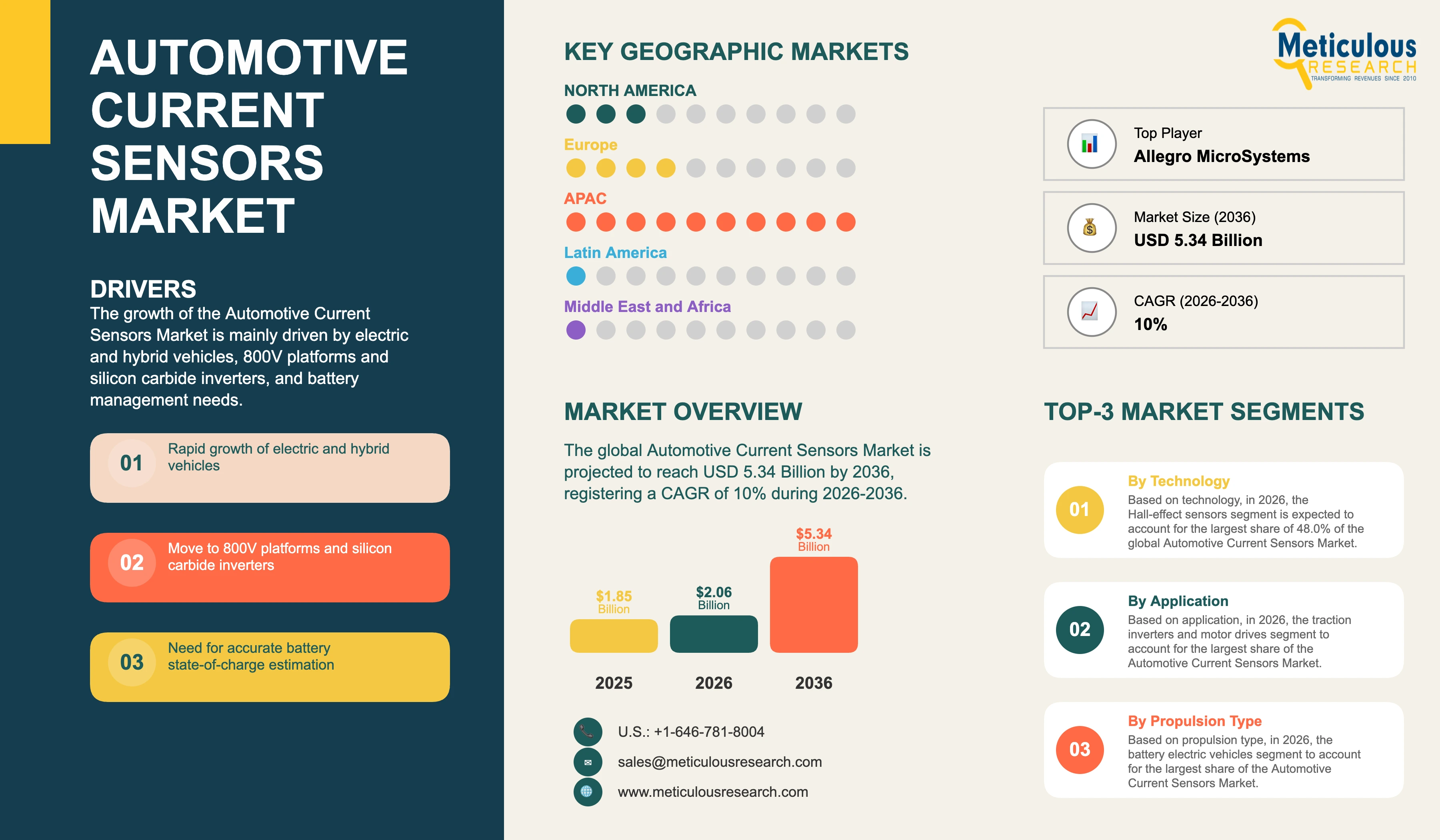
The global automotive current sensors market was valued at USD 1.85 billion in 2025. This market is expected to reach USD 5.34 billion by 2036 from an estimated USD 2.06 billion in 2026, registering a CAGR of 10.0% during the forecast period (2026-2036).
- Published
- Nov 2026
- Pages
- 261
- Format
- PDF + Excel
- Report ID
- MRAUTO - 1042889
- Base year
- 2025
- 2025 · BASELINE
- $1.85B
- 2036
- $5.34B
- CAGR 2026–2036
- 10.0%
2025 baseline · 2026–2036 forecast at 10.0% CAGR · hover a bar for the value
Key highlights
Allegro MicroSystems reported fiscal 2026 sales of USD 890 million, up 23% year-over-year, for the year ended March 27, 2026, according to Allegro MicroSystems. Automotive sales reached USD 628.6 million, or about 70.6% of the total, and sales to xEV and ADAS applications grew 30% to USD 349 million, driven by content expansion and share gains in magnetic current and position sensors and power ICs.
Allegro MicroSystems' first-quarter fiscal 2027 sales reached USD 259 million, up 27% year-over-year, for the quarter ended June 26, 2026, led by data center demand and continued strength in xEV and ADAS, according to Allegro MicroSystems. Data center sales reached 17% of total sales, showing how high-speed current sensors are also growing outside automotive.
LEM reported 2025/26 automotive sales of CHF 78.6 million, down 8.9% year-over-year, for the year ended March 31, 2026, according to LEM. In the first half of 2026/27, its automotive sales grew 4.3% to CHF 42.4 million, according to LEM. LEM has noted that the average current-sensing content per inverter is expected to decline gradually and that price pressure remains high.
Melexis reported 2025 sales of EUR 839.6 million, with automotive applications accounting for 88% of the total, according to Melexis. In 2025, the company upgraded its smart current, voltage, and temperature sensor for battery management to enable more precise temperature measurement in safety-critical applications, according to Melexis.
Global electric car sales topped 20 million units in 2025, according to the IEA. A battery electric vehicle typically uses several current sensors in the traction inverter, battery management system, onboard charger, and DC-DC converter, which makes electric vehicle growth the main driver of this market.
Leading suppliers include Allegro MicroSystems, Infineon Technologies, Melexis, LEM, TDK, Asahi Kasei Microdevices, Isabellenhütte, Texas Instruments, and FORVIA HELLA. Battery management systems is the fastest-growing application, and magnetoresistive sensors are the fastest-growing technology, as vehicle makers seek higher accuracy and faster response. Infineon's XENSIV TLE4972, its first automotive current sensor, is a coreless Hall-effect sensor that supports measurement ranges up to 2 kA for traction inverters and chargers, according to Infineon.
By technology, hall-effect sensors account for the largest share of 48.0% in 2026, while magnetoresistive sensors register the highest CAGR.
By application, traction inverters and motor drives account for the largest share in 2026, while battery management systems register the highest CAGR.
By propulsion type, battery electric vehicles account for the largest share in 2026 and also register the highest CAGR.
By vehicle type, passenger cars account for the larger share of 86.0% in 2026, while commercial vehicles register the higher CAGR.
By geography, Asia-Pacific accounts for the largest share of 55.0% in 2026, while Europe registers the highest CAGR of 13.2%.
Report summary
| Particulars | Details |
|---|---|
| Forecast Period | 2026-2036 |
| Base Year | 2025 |
| Estimated Year | 2026 |
| CAGR (Value) | 10.0% |
| Format | PDF, Excel & Cloud Portal · 261 pages |
| Market Size (Value) in 2025 | USD 1.85 billion |
| Market Size (Value) in 2026 | USD 2.06 billion |
| Market Size (Value) by 2036 | USD 5.34 billion |
| Largest Segment by Technology (2026) | Hall-Effect Sensors (48.0%) |
| Largest Segment by Vehicle Type (2026) | Passenger Cars (86.0%) |
| Largest Region (2026) | Asia-Pacific (55.0%) |
| Fastest-Growing Region | Europe (CAGR 13.2%) |
| Companies Profiled | 9 companies and other companies |
| Segments Covered | Technology, Application, Propulsion Type, Vehicle Type, Geography |
| Countries Covered | U.S., Canada, Mexico, Germany, France, U.K., Spain, Italy, Sweden, Czech Republic, Poland, Slovakia, Hungary, Netherlands, Belgium, Rest of Europe, China, Japan, South Korea, India, Thailand, Indonesia, Malaysia, Vietnam, Taiwan, Australia, Rest of Asia-Pacific, Brazil, Argentina, Chile, Colombia, Rest of Latin America, Turkey, Morocco, South Africa, Saudi Arabia, UAE, Israel, Rest of Middle East & Africa |
Report overview
Segments covered: technology, application, propulsion type, vehicle type.
Automotive current sensors measure the electric current flowing through a circuit and send this measurement to the vehicle's control units. They are used in traction inverters to control electric motors, in battery management systems to measure the current flowing in and out of the high-voltage battery, in onboard chargers and DC-DC converters, in 12V and 48V battery monitoring, and in other systems, such as electric power steering, electric compressors, and electronic fuses. They use magnetic technologies, such as Hall-effect, magnetoresistive, and fluxgate sensing, or precision shunt resistors.
The growth of this market is mainly driven by the rapid growth of electric and hybrid vehicle production, which use many more current sensors than conventional vehicles, the move to 800V platforms and silicon carbide inverters that need faster and more accurate current sensing, stricter functional safety requirements for battery and powertrain systems, the growing use of high-precision current measurement to improve battery state-of-charge estimation and driving range, and the electrification of auxiliary systems, such as power steering, compressors, and pumps. In addition, the replacement of mechanical fuses with electronic fuses and smart power distribution adds current sensing to more circuits. However, strong price pressure, the integration of current sensing into power modules and chips, and changes in electric vehicle demand in some regions are expected to restrain the growth of this market to some extent.
Current sensors have been used in vehicles for many years to monitor the 12V battery and to control electric motors in power steering and other systems, but their importance has grown sharply with vehicle electrification. In electric and hybrid vehicles, the traction inverter must measure the current in each motor phase thousands of times per second to control motor torque precisely and protect the power semiconductors. The battery management system must measure the current flowing in and out of the high-voltage battery accurately to calculate its state of charge and state of health, which determines the driving range shown to the driver. Onboard chargers and DC-DC converters also use current sensors for control and protection.
This report covers the global automotive current sensors market, including Hall-effect, shunt-based, magnetoresistive, and fluxgate and closed-loop current sensors used in traction inverters and motor drives, battery management systems, 12V and 48V battery monitoring, onboard chargers and DC-DC converters, and other applications, for battery electric vehicles, hybrid and plug-in hybrid vehicles, and internal combustion engine vehicles, and for passenger cars and commercial vehicles. The market is valued at the selling price of current sensor ICs, current sensor modules, and battery sensors supplied to vehicle makers and their system suppliers. The market is analyzed by technology, application, propulsion type, vehicle type, and geography. Simple shunt resistors sold without measurement electronics and current sensors used in charging stations are not included.
Vehicle makers choose between several current sensing technologies, each with its own balance of cost, accuracy, and size. Hall-effect sensors measure the magnetic field created by the current and are widely used in inverters and chargers, often in coreless designs that sit next to a busbar, such as Infineon's XENSIV TLE4972, which can measure currents up to 2 kA. Shunt-based sensors measure the small voltage drop across a precision resistor and offer high accuracy, which makes them popular in battery management systems and 12V battery sensors. Magnetoresistive sensors use materials whose resistance changes with magnetic fields and offer higher sensitivity and faster response, while fluxgate and closed-loop sensors offer the highest accuracy for demanding uses.
The number and value of current sensors per vehicle depend strongly on the powertrain. A conventional vehicle uses current sensors mainly for 12V battery monitoring and electric power steering, while a battery electric vehicle adds two or three phase-current sensors per motor in each traction inverter, one or more high-voltage battery current sensors, and current sensors in the onboard charger and DC-DC converter. Vehicles with two or three electric motors need even more sensors. As a result, the value of current sensors in a battery electric vehicle is several times higher than in a conventional vehicle, which makes the shift to electric vehicles the main factor behind market growth.
The market is led by semiconductor companies and specialized current sensor makers. Allegro MicroSystems is a leading supplier of magnetic current sensor ICs, with automotive sales of USD 628.6 million in fiscal 2026, according to Allegro MicroSystems. Infineon Technologies supplies XENSIV coreless current sensors, Melexis supplies Hall-effect current sensors and smart battery sensors, LEM supplies current sensor modules for inverters and batteries, TDK supplies Hall-effect and magnetoresistive current sensors, Asahi Kasei Microdevices supplies current sensors for inverters and chargers, Isabellenhütte supplies shunt-based battery sensors, Texas Instruments supplies Hall-effect current sensors and shunt amplifiers, and FORVIA HELLA supplies intelligent battery sensors.
The market is also changing as electric powertrains become more integrated and efficient. Silicon carbide inverters switch faster than older silicon designs, which requires current sensors with faster response and better protection against electrical noise. Vehicle makers are also integrating inverters, motors, and gearboxes into compact electric drive units and integrating onboard chargers and DC-DC converters into one unit, which changes where and how current sensors are mounted. At the same time, some suppliers integrate current sensing directly into power modules or gate driver chips, which could reduce demand for separate sensors in some designs.
In 2026, Hall-effect sensors account for the largest share of the market by technology, while magnetoresistive sensors are the fastest-growing technology. Traction inverters and motor drives accounts for the largest share by application, while battery management systems is the fastest-growing application. Battery electric vehicles account for the largest share by propulsion type and are also the fastest-growing propulsion type. Passenger cars account for the largest share by vehicle type, while commercial vehicles are the fastest-growing vehicle type. Asia-Pacific accounts for the largest share of the market, while Europe is the fastest-growing region.
Market growth over the forecast period will depend on electric vehicle production, the mix of battery electric and hybrid vehicles, the pace of the move to 800V platforms and silicon carbide inverters, functional safety requirements, the integration of current sensing into power modules, and price trends. Strong price pressure and integration will limit value growth per sensor, while the growth of electric vehicles and new applications will support strong unit growth. Overall, the market is expected to grow much faster than vehicle production through 2036, driven by vehicle electrification.
Passenger cars are expected to account for the largest share of 86.0% of the market in 2026, while commercial vehicles are projected to register the higher CAGR, driven by electric buses, vans, and trucks.
Asia-Pacific is expected to account for the largest share of 55.0% of the market in 2026, mainly due to China's leading position in electric vehicle production and the large hybrid vehicle production of Japan and China.
Europe is projected to register the highest CAGR of 13.2% during the forecast period, driven by the EU's CO2 emission targets, new electric vehicle models, and the growth of electric buses and trucks.
The report profiles 9 companies, including Allegro MicroSystems, Infineon Technologies, Melexis, LEM, TDK, Asahi Kasei Microdevices, Isabellenhütte, Texas Instruments, and FORVIA HELLA.
A battery electric vehicle typically uses two or three phase-current sensors per motor in the traction inverter, one or more battery current sensors, and sensors in the onboard charger and DC-DC converter, far more than a conventional vehicle.
Magnetoresistive sensors offer higher sensitivity, faster response, and lower noise than many Hall-effect sensors, which makes them well suited for fast-switching silicon carbide and gallium nitride power electronics and high-accuracy battery management.
Report infographic
Market dynamics
17 factors across 5 forcesRapid growth of electric and hybrid vehicles
Global electric car sales topped 20 million units in 2025, according to the IEA, and electric and hybrid vehicles are expected to account for a growing share of new vehicle sales over the forecast period, supported by emission rules in China and Europe and falling battery costs. Each battery electric vehicle uses several current sensors in the traction inverter, battery management system, onboard charger, and DC-DC converter, and hybrid vehicles use current sensors in their inverters and batteries. The value of current sensors in an electric vehicle is several times higher than in a conventional vehicle, so the shift to electric vehicles directly increases market value.
Allegro MicroSystems' sales to xEV and ADAS applications grew 30% to USD 349 million in fiscal 2026, driven by content expansion and share gains, according to Allegro MicroSystems, showing the strong link between electric vehicle growth and current sensor demand. Battery electric vehicles are the largest propulsion type in this market and are also the fastest-growing propulsion type, while hybrid and plug-in hybrid vehicles provide steady growth as many vehicle makers expand their hybrid ranges, especially in Japan, China, Europe, and North America.
Move to 800V platforms and silicon carbide inverters
Vehicle makers are moving from 400V to 800V battery platforms, which allow faster charging and higher efficiency, and from silicon to silicon carbide power semiconductors in inverters, onboard chargers, and DC-DC converters. Silicon carbide devices switch much faster than silicon devices, which creates fast-changing currents and strong electrical noise. Current sensors used with silicon carbide must respond faster, provide higher bandwidth, offer better isolation at higher voltages, and resist interference from noise and stray magnetic fields, while detecting overcurrent within microseconds to protect the power devices.
These requirements are pushing vehicle makers toward higher-performance current sensors, such as coreless Hall-effect sensors with fast overcurrent detection and magnetoresistive sensors with higher bandwidth. Infineon's XENSIV TLE4972, for example, includes two fast overcurrent detection outputs and is designed for automotive inverters, according to Infineon. The move to 800V platforms and silicon carbide inverters increases the value of each current sensor and supports the growth of magnetoresistive sensors, which are the fastest-growing technology in this market.
Need for accurate battery state-of-charge estimation
Driving range is one of the most important factors for electric vehicle buyers, and accurate measurement of the current flowing in and out of the battery is essential to calculate the battery's state of charge and state of health. Small errors in current measurement add up over time and lead to wrong range estimates, which forces vehicle makers to keep larger safety margins and reduces usable battery capacity. High-precision current sensors allow vehicle makers to use more of the battery's capacity safely and give drivers more reliable range information.
Battery management systems therefore use high-precision shunt-based or fluxgate sensors, often combined with Hall-effect sensors for redundancy and safety, and smart battery sensors that measure current, voltage, and temperature together. Melexis upgraded its smart current, voltage, and temperature sensor in 2025 to enable more precise temperature measurement in safety-critical applications, according to Melexis. Battery management systems is the fastest-growing application in this market, supported by larger battery packs, higher accuracy needs, and stricter battery safety rules.
Stricter functional safety requirements
Traction inverters, battery management systems, and electronic fuses are safety-critical systems, and vehicle makers must develop them under ISO 26262 with high safety levels, often ASIL C or ASIL D. Current sensors in these systems must detect faults, report diagnostic information, and in many cases provide redundant measurements, for example by using two sensors with different technologies to measure the same current. This increases the number of current sensors per system and the value of each sensor, as safety-rated sensors with diagnostics sell at higher prices.
Battery safety rules, such as China's GB 38031-2025, which took effect in July 2026, also increase the focus on accurate monitoring of battery current to detect abnormal conditions early. Suppliers that offer safety-rated current sensors with built-in diagnostics and documentation that supports ISO 26262 can win business in safety-critical applications. Infineon's TLE4972 and TLE4971 sensors, for example, were developed according to ISO 26262 as safety elements out of context for safety requirements up to ASIL B, according to Infineon.
Electrification of auxiliary systems and electronic fuses
Vehicles are replacing mechanical and engine-driven systems with electric ones, such as electric power steering, electric air conditioning compressors, electric water and oil pumps, and electric brake boosters, all of which use electric motors with current sensors for control and protection. 48V systems, which are used in mild hybrid vehicles and some electric vehicles to power high-load auxiliary systems, also need current sensing. In addition, vehicle makers are replacing mechanical fuses and relays with electronic fuses and smart power distribution units in zonal vehicle architectures, which measure current in each circuit to detect faults and switch off power quickly. These changes add current sensing to many more circuits in each vehicle, including in conventional and hybrid vehicles. The 12V battery sensor, which measures battery current, voltage, and temperature to manage charging and start-stop systems, is also standard in many vehicles today. As zonal architectures spread over the forecast period, the number of current measurement points per vehicle is expected to grow, which supports steady growth in other applications in this market, even though much of this sensing is built into power switching chips rather than separate sensors.
Table of contents
12 chapters · 180 sections · 261 pages · click to expandSegmental analysis
| Segment | Largest share (2026) | Fastest growth (2026–2036) |
|---|---|---|
| By Technology | Traction inverters and motor drives | Battery management systems |
By Technology
- The traction inverters and motor drives segment is expected to account for the largest share of the automotive current sensors market, while the battery management systems segment is projected to register the highest CAGR during the forecast period.
- The battery electric vehicles segment is expected to account for the largest share of the automotive current sensors market, and it is also projected to register the highest CAGR during the forecast period.
Geographic analysis
Asia-Pacific
Largest shareIn 2026, Asia-Pacific is expected to account for the largest share of 55.0% of the global automotive current sensors market. The large share of this region is mainly due to China's position as the largest producer of electric vehicles in the world, the large production of hybrid vehicles in Japan and China, the large vehicle production of South Korea and India, the presence of major battery, inverter, and electric drive makers in China, Japan, and South Korea, and the presence of current sensor suppliers, such as TDK and Asahi Kasei Microdevices in Japan. China is the largest market in the region, followed by Japan and South Korea.
Europe
Fastest growthHowever, Europe is projected to register the highest CAGR of 13.2% during the forecast period. The rapid growth of this region is mainly driven by the EU's strict CO2 emission targets for new cars and vans, which require a fast increase in electric vehicle sales through 2035, the launch of many new and lower-priced electric vehicle models by European vehicle makers, the growth of battery and electric drive production in Europe, the fast growth of electric buses and trucks, and the presence of leading current sensor suppliers, such as Infineon Technologies, Melexis, LEM, and Isabellenhütte. Germany is the largest market in the region, followed by France and Spain. Eastern European countries, such as Poland, Hungary, Slovakia, and the Czech Republic, are becoming important production hubs for batteries, electric drives, and electric vehicles, which adds to current sensor demand in those countries.
North America
North America accounts for a significant share of the market, supported by the production of electric and hybrid vehicles by U.S. vehicle makers and foreign vehicle makers with U.S. plants, the large production of pickup trucks and SUVs with electric power steering and 12V battery sensors, the growth of hybrid vehicles, and the presence of suppliers, such as Allegro MicroSystems and Texas Instruments. The U.S. is the largest market in the region, followed by Mexico and Canada. However, the end of federal tax credits for electric vehicle purchases in 2025 and changes in vehicle makers' electric vehicle plans are expected to limit growth compared with other regions over the next few years, while hybrid vehicles provide steady demand.
Latin America
Latin America and the Middle East and Africa account for smaller shares of the market but are expected to grow as electric and hybrid vehicles spread, supported by imports of Chinese electric vehicles and new local production. Brazil is the largest market in Latin America, supported by hybrid vehicle production and growing imports of electric vehicles, while Mexico serves as a production base for vehicles and electronic modules exported to the U.S. In the Middle East and Africa, Turkey and Morocco are important vehicle production hubs supplying Europe, and Saudi Arabia and the UAE are investing in electric vehicle production and charging infrastructure as part of their economic diversification plans.
Middle East & Africa
Israel has a strong base of automotive electronics and power electronics developers, which adds some demand for current sensors in development and pilot production.
Competitive landscape
The global automotive current sensors market includes semiconductor companies that supply current sensor ICs, specialized companies that supply current sensor modules and high-precision sensors, makers of precision shunt resistors and battery sensors, and automotive suppliers that supply intelligent battery sensors. The market is moderately concentrated, with a few large suppliers holding strong positions in Hall-effect sensor ICs and inverter modules, while competition is increasing from Chinese suppliers and from power semiconductor suppliers that integrate current sensing into their products.
Allegro MicroSystems is a leading supplier of magnetic current sensor ICs, with fiscal 2026 automotive sales of USD 628.6 million and xEV and ADAS sales of USD 349 million, according to Allegro MicroSystems. Infineon Technologies supplies XENSIV coreless current sensors, such as the TLE4972 and TLE4971, Melexis supplies Hall-effect current sensors and smart battery sensors, LEM supplies current sensor modules and ICs for inverters and batteries, TDK supplies Hall-effect and magnetoresistive sensors, Asahi Kasei Microdevices supplies current sensors for inverters and chargers, Isabellenhütte supplies shunt-based battery sensors, Texas Instruments supplies Hall-effect sensors and shunt amplifiers, and FORVIA HELLA supplies intelligent battery sensors.
Companies in this market compete mainly on accuracy, bandwidth and response time, isolation, resistance to stray fields and noise, temperature stability, functional safety level, size, price, and the ability to supply at large scale. Key strategies in this market include launching coreless and magnetoresistive current sensors for silicon carbide inverters, offering high-precision and safety-rated battery sensors, expanding into data center and industrial markets to balance automotive demand, acquiring technology companies, and working closely with power module and electric drive suppliers to design sensors into integrated systems.
Recent competitive activity in this market has mainly focused on electric vehicle applications and on diversification into other markets. Allegro MicroSystems reported 30% growth in xEV and ADAS sales in fiscal 2026 and record data center sales in the first quarter of fiscal 2027, according to Allegro MicroSystems. LEM reported a 4.3% increase in automotive sales in the first half of 2026/27, while its overall growth was led by data center-related demand, according to LEM, and Melexis upgraded its smart current, voltage, and temperature sensor for battery management in 2025, according to Melexis.
We expect competition to increase over the forecast period as Chinese suppliers expand their automotive current sensor ranges, as power semiconductor suppliers integrate current sensing into modules and chips, and as vehicle makers push for lower prices and fewer sensors per inverter. Suppliers with strong technology in coreless, magnetoresistive, and high-precision sensing, functional safety capabilities, large production capacity, and close relationships with electric vehicle makers and power electronics suppliers are expected to strengthen their positions.
Some of the key players operating in the automotive current sensors market are Allegro MicroSystems, Inc., Infineon Technologies AG, Melexis NV, LEM Holding SA, TDK Corporation, Asahi Kasei Microdevices Corporation, Isabellenhütte Heusler GmbH & Co. KG, Texas Instruments Incorporated, and FORVIA HELLA, among others.
- —
Allegro MicroSystems reported 30% growth in xEV and ADAS sales in fiscal 2026, LEM reported automotive sales growth of 4.3% in the first half of 2026/27, and Melexis upgraded its smart battery current sensor in 2025.
- Allegro MicroSystems, Inc.
- Infineon Technologies AG
- Melexis NV
- LEM Holding SA
- TDK Corporation
- Asahi Kasei Microdevices Corporation
- Isabellenhütte Heusler GmbH & Co. KG
- Texas Instruments Incorporated
- FORVIA HELLA
Expert perspectives
Automotive current sensors have become one of the components most directly linked to vehicle electrification. While current sensors were once used mainly for 12V battery monitoring and power steering, every electric and hybrid vehicle now needs several high-performance current sensors in its inverter, battery, charger, and converter, which makes this one of the fastest-growing automotive sensor markets. The shift to faster silicon carbide power electronics and stricter battery safety rules is also raising the performance needed from each sensor.
Over the forecast period, the market is expected to grow at a CAGR of 10.0%, from USD 2.06 billion in 2026 to USD 5.34 billion in 2036. Growth will be driven by the rapid growth of electric and hybrid vehicles, the move to 800V platforms and silicon carbide inverters, the need for accurate battery state-of-charge estimation, stricter functional safety requirements, and the electrification of auxiliary systems and electronic fuses. Strong price pressure, declining content per inverter, and changes in electric vehicle demand in some regions will limit growth to some extent.
Among the market segments, Hall-effect sensors are the largest technology, while magnetoresistive sensors grow fastest. Traction inverters and motor drives is the largest application, while battery management systems grows fastest. Battery electric vehicles are the largest propulsion type and also grow fastest. Passenger cars are the largest vehicle type, while commercial vehicles grow fastest. Asia-Pacific is the largest region, led by China, while Europe is the fastest-growing region, supported by the EU's emission targets.
In our view, the battery management system will become the most valuable application for current sensors over the forecast period. Accurate current measurement directly affects usable battery capacity, range estimates, and battery safety, which gives vehicle makers strong reasons to invest in high-precision and redundant sensing. Suppliers with high-precision shunt, fluxgate, and magnetoresistive technology and smart battery sensor designs are well placed to benefit, while inverter current sensing faces stronger price pressure and content reduction.
We also see integration as the main long-term risk for separate current sensor suppliers. As power semiconductor suppliers add current sensing to gate drivers, power modules, and electronic fuses, some current sensor sockets may disappear. Suppliers that work closely with power electronics and electric drive suppliers, offer sensors designed for integration, and diversify into data center, industrial, and energy storage markets, as Allegro MicroSystems and LEM are doing, will be better protected against these changes.
Overall, we believe that the automotive current sensors market will grow strongly over the forecast period, with magnetoresistive sensors, battery management systems, battery electric vehicles, commercial vehicles, and Europe providing the fastest growth. Companies with strong magnetic and shunt-based sensing technology, functional safety capabilities, large-scale production, and close relationships with electric vehicle and power electronics makers will be best positioned to capture this growth.
Customer perspectives
“Because every percent of current measurement error costs us usable range, we now use a high-precision shunt sensor with a magnetic sensor as backup in every battery pack.”
“Our silicon carbide inverters switch so fast that older sensors cannot keep up. We need small coreless sensors that respond in microseconds and ignore the noise around them.”
“Our electric buses run all day on large batteries and high currents. Reliable current sensing is key to safe operation and to knowing exactly how much range is left.”
Frequently asked questions
The global automotive current sensors market was valued at USD 1.85 billion in 2025, up from USD 1.65 billion in 2024, and is estimated at USD 2.06 billion in 2026. The market includes Hall-effect, shunt-based, magnetoresistive, and fluxgate current sensors for passenger cars and commercial vehicles.
The global automotive current sensors market is expected to reach USD 5.34 billion by 2036, driven by electric and hybrid vehicles, 800V platforms and silicon carbide inverters, battery management needs, and functional safety requirements.
The market is expected to register a CAGR of 10.0% from 2026 to 2036, with the fastest growth in magnetoresistive sensors, battery management systems, battery electric vehicles, commercial vehicles, and Europe.
Market growth is mainly driven by the rapid growth of electric and hybrid vehicles, the move to 800V platforms and silicon carbide inverters, the need for accurate battery state-of-charge estimation, stricter functional safety requirements, and the electrification of auxiliary systems and electronic fuses.
Strong price pressure and declining content per inverter and changes in electric vehicle demand in some regions restrain growth, while accuracy under temperature, stray fields, and noise and the integration of current sensing into power modules and chips are key challenges.
Key growth opportunities include high-precision current sensors for battery management, magnetoresistive sensors for silicon carbide and gallium nitride power electronics, current sensing for zonal architectures and electronic fuses, and electric commercial vehicles and emerging markets.
Hall-effect sensors are expected to account for the largest share of 48.0% of the market in 2026, while magnetoresistive sensors are projected to register the highest CAGR, driven by fast-switching silicon carbide power electronics.
In 2026, the traction inverters and motor drives segment is expected to account for the largest share of the automotive current sensors market, while the battery management systems segment is projected to register the highest CAGR during the forecast period.
In 2026, the battery electric vehicles segment is expected to account for the largest share of the automotive current sensors market, and it is also projected to register the highest CAGR during the forecast period.
Passenger cars are expected to account for the largest share of 86.0% of the market in 2026, while commercial vehicles are projected to register the higher CAGR, driven by electric buses, vans, and trucks.
Asia-Pacific is expected to account for the largest share of 55.0% of the market in 2026, mainly due to China's leading position in electric vehicle production and the large hybrid vehicle production of Japan and China.
Europe is projected to register the highest CAGR of 13.2% during the forecast period, driven by the EU's CO2 emission targets, new electric vehicle models, and the growth of electric buses and trucks.
The report profiles 9 companies, including Allegro MicroSystems, Infineon Technologies, Melexis, LEM, TDK, Asahi Kasei Microdevices, Isabellenhütte, Texas Instruments, and FORVIA HELLA.
Allegro MicroSystems reported 30% growth in xEV and ADAS sales in fiscal 2026, LEM reported automotive sales growth of 4.3% in the first half of 2026/27, and Melexis upgraded its smart battery current sensor in 2025.
A battery electric vehicle typically uses two or three phase-current sensors per motor in the traction inverter, one or more battery current sensors, and sensors in the onboard charger and DC-DC converter, far more than a conventional vehicle.
Magnetoresistive sensors offer higher sensitivity, faster response, and lower noise than many Hall-effect sensors, which makes them well suited for fast-switching silicon carbide and gallium nitride power electronics and high-accuracy battery management.
Cite this report
Meticulous Research. (2026). Automotive Current Sensors Market - Global Opportunity Analysis and Industry Forecast (2026-2036) (Report No. MRAUTO - 1042889). Meticulous Market Research Pvt. Ltd. https://www.meticulousresearch.com/product/automotive-current-sensors-market-7572