Automotive Shock Absorbers Market (2026-2036)
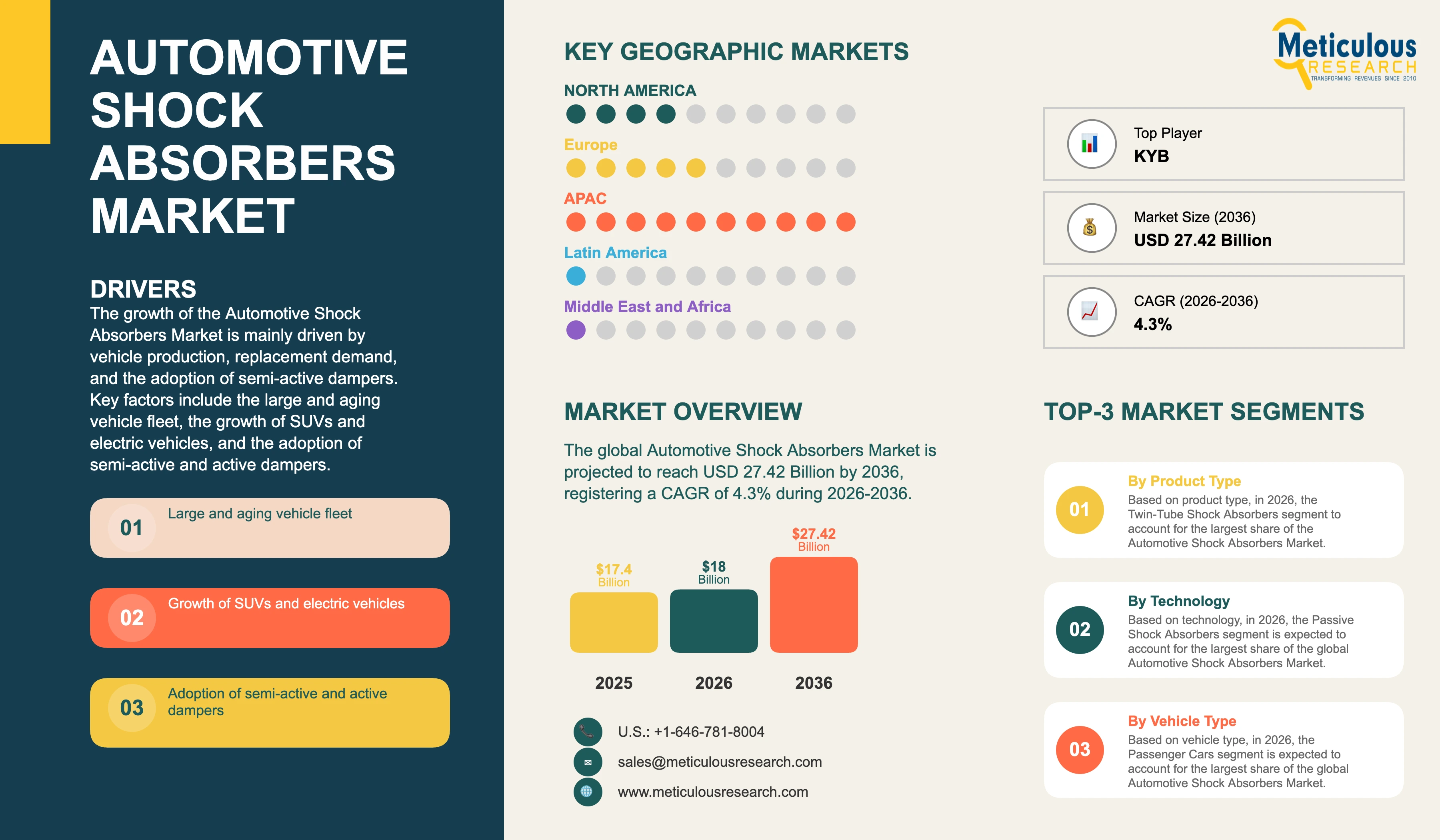
The global automotive shock absorbers market was valued at USD 17.40 billion in 2025. This market is expected to reach USD 27.42 billion by 2036 from an estimated USD 18.00 billion in 2026, registering a CAGR of 4.3% during the forecast period (2026-2036).
- Published
- Nov 2026
- Pages
- 254
- Format
- PDF + Excel
- Report ID
- MRAUTO - 1042871
- Base year
- 2025
- 2025 · BASELINE
- $17.40B
- 2036
- $27.42B
- CAGR 2026–2036
- 4.3%
2025 baseline · 2026–2036 forecast at 4.3% CAGR · hover a bar for the value
Key highlights
KYB Corporation, one of the world's largest shock absorber makers, reported consolidated net sales of ¥438.3 billion for the fiscal year ended March 2025, according to KYB. Its automotive components business, which includes shock absorbers for vehicle makers and the aftermarket, accounts for most of the company's sales. KYB supplies shock absorbers to vehicle makers in Japan, China, Europe, the Americas, and Southeast Asia and sells replacement dampers under its own brand.
Tenneco's Monroe Ride Solutions launched its CVSA2 semi-active damping system for Chinese vehicle makers in April 2025, with production in Changzhou, China, according to Tenneco. Monroe has since added new passive valve technology and a steel-tube version of CVSA2 to reach more vehicle segments.
Tenneco's DRiV aftermarket business expanded its Monroe air suspension line for the aftermarket in 2026, according to Tenneco, reflecting growing replacement demand for advanced suspension parts as vehicles with air suspension and electronic dampers age. Aftermarket demand also benefits from the large and aging global vehicle fleet.
Global electric car sales grew by 20% to more than 20 million units in 2025, according to the IEA. Electric vehicles are heavier and quieter than combustion engine vehicles, so they need dampers with higher load capacity and better noise control, and many new electric models in China use semi-active dampers as standard.
Global light vehicle production exceeded 90 million units in 2025 for the first time since 2018, according to Autoliv, supporting demand for shock absorbers fitted to new vehicles. Each passenger car normally uses four shock absorbers or struts, and two-wheelers use front forks and rear shock absorbers.
Leading suppliers include KYB, ZF (Sachs), Tenneco (Monroe), Astemo (Showa), HL Mando, thyssenkrupp Bilstein, Marelli, BWI Group, Gabriel India, Endurance Technologies, and Nanyang Cijan. Semi-active dampers are now spreading from premium models to mid-priced electric vehicles in China, which increases damper value per vehicle. Two-wheelers, led by India and Southeast Asia, are the fastest-growing vehicle type, as riders move to premium motorcycles with better front and rear suspension.
By product type, twin-tube shock absorbers account for the largest share of 62.0% in 2026, while mono-tube shock absorbers register the highest CAGR.
By technology, passive shock absorbers account for the largest share in 2026, while active shock absorbers register the highest CAGR.
By vehicle type, passenger cars account for the largest share of 68.0% in 2026, while two-wheelers register the highest CAGR.
By sales channel, OEM accounts for the larger share in 2026, while aftermarket registers the higher CAGR.
By geography, Asia-Pacific accounts for the largest share of 46.0% in 2026, while Asia-Pacific registers the highest CAGR of 5.5%.
Report summary
| Particulars | Details |
|---|---|
| Base Year | 2025 |
| Estimated Year | 2026 |
| Forecast Period | 2026-2036 |
| Market Size in 2025 | USD 17.40 billion |
| Market Size in 2026 | USD 18.00 billion |
| Market Size by 2036 | USD 27.42 billion |
| CAGR (2026-2036) | 4.3% |
| Format | PDF, Excel & Cloud Portal · 254 pages |
| Largest Segment by Product Type (2026) | Twin-Tube Shock Absorbers (62.0%) |
| Largest Segment by Vehicle Type (2026) | Passenger Cars (68.0%) |
| Largest Region (2026) | Asia-Pacific (46.0%) |
| Fastest-Growing Region | Asia-Pacific (CAGR 5.5%) |
| Companies Profiled | 11 companies and other companies |
| Segments Covered | Product Type, Technology, Vehicle Type, Sales Channel, Geography |
| Countries Covered | U.S., Canada, Germany, France, U.K., Italy, Spain, Poland, Czech Republic, Netherlands, Sweden, Rest of Europe, China, Japan, India, South Korea, Thailand, Indonesia, Vietnam, Malaysia, Philippines, Taiwan, Australia, Rest of Asia-Pacific, Mexico, Brazil, Argentina, Colombia, Chile, Rest of Latin America, Turkey, South Africa, Saudi Arabia, UAE, Iran, Egypt, Rest of Middle East & Africa |
Report overview
Segments covered: product type, technology, vehicle type, sales channel.
Automotive shock absorbers, also called dampers, are hydraulic or gas-charged parts of the suspension system that control the movement of springs and keep the tires in contact with the road. They include twin-tube and mono-tube shock absorbers, struts, and electronically controlled dampers used in passenger cars, commercial vehicles, and two-wheelers, and they are sold both to vehicle makers for new vehicles and in the aftermarket as replacement parts.
The growth of this market is mainly driven by steady growth of global vehicle and two-wheeler production, especially in Asia-Pacific, the large and aging global vehicle fleet, which creates steady replacement demand, the growth of SUVs and heavier electric vehicles, which need stronger and better-tuned dampers, the fast adoption of semi-active and active dampers, especially in China, and rising customer expectations for ride comfort and handling. In addition, poor road conditions in many emerging markets increase the wear of shock absorbers and the need for replacement. However, strong price pressure, low-cost competition, and the longer life of modern dampers are expected to restrain the growth of this market to some extent.
Shock absorbers control the up-and-down movement of a vehicle's springs by turning the energy of the movement into heat in hydraulic oil. Without them, a vehicle would bounce after every bump, the tires would lose contact with the road, and braking and handling would suffer. Shock absorbers are therefore important for safety as well as comfort, as worn dampers increase stopping distances and reduce stability in corners and in wet conditions. Worn dampers also increase tire wear and the wear of other suspension parts.
This report covers the global automotive shock absorbers market, including twin-tube, mono-tube, and other shock absorbers and struts, passive, semi-active, and active dampers, and shock absorbers for passenger cars, light commercial vehicles, heavy commercial vehicles, and two-wheelers. The market is valued at the selling price of shock absorbers and struts sold to vehicle makers and in the aftermarket. The market is analyzed by product type, technology, vehicle type, sales channel, and geography. Springs, air springs, control arms, and other suspension parts are not included, and air suspension systems are covered in a separate report.
Twin-tube shock absorbers use an inner working tube and an outer reserve tube and are the most common design, as they are cheaper to make and give a comfortable ride. Mono-tube shock absorbers use a single tube with a gas chamber separated from the oil by a floating piston, which gives better heat control and more consistent performance, so they are used on performance cars, SUVs, and many electric vehicles. Two-wheelers use telescopic front forks and rear shock absorbers, often in a mono-shock layout on newer motorcycles.
As vehicle makers look for better ride comfort, damper technology is moving beyond passive designs toward electronic control. Passive dampers have fixed valve settings chosen during vehicle development, while semi-active dampers use electronically controlled valves that adjust damping force many times each second based on road and driving conditions. Active systems go further and can push or pull the wheel to control body movement. Semi-active dampers were once used mainly on premium vehicles but are now spreading to mainstream models, especially in China, where vehicle makers use them to improve the ride of their electric vehicles. Some systems also use cameras to read the road ahead and prepare the dampers before the wheels reach a bump.
The market is served by global suppliers, such as KYB, ZF through its Sachs brand, Tenneco through its Monroe brand, Astemo through its Showa brand, HL Mando, thyssenkrupp Bilstein, Marelli, and BWI Group, together with strong regional suppliers, such as Gabriel India and Endurance Technologies in India and Nanyang Cijan and other suppliers in China. Many of these companies supply both vehicle makers and the aftermarket, where strong brands, such as Monroe, Sachs, KYB, and Bilstein, are important for sales to workshops and car owners.
The aftermarket is a large part of this market because shock absorbers wear out over time and are normally replaced every few years, depending on road conditions and driving style. The global vehicle fleet is large and getting older in many countries, which supports steady replacement demand. In emerging markets, poor roads lead to faster wear and more frequent replacement, while in developed markets, regular vehicle inspections and the growing number of vehicles with advanced dampers support aftermarket sales.
In 2026, twin-tube shock absorbers account for the largest share of the market by product type, while mono-tube shock absorbers are the fastest-growing product type. Passive shock absorbers account for the largest share by technology, while active shock absorbers are the fastest-growing technology. Passenger cars account for the largest share by vehicle type, while two-wheelers are the fastest-growing vehicle type. The OEM channel accounts for the largest share by sales channel, while the aftermarket is the fastest-growing channel. Asia-Pacific accounts for the largest share of the market and is also the fastest-growing region.
Market growth over the forecast period will depend on global vehicle and two-wheeler production, the size and age of the vehicle fleet, the pace of electric vehicle adoption, and the adoption of semi-active and active dampers. Price pressure from vehicle makers and low-cost suppliers will also shape the market. Overall, the move to higher-value dampers and growing replacement demand are expected to support steady growth in market value.
Passenger cars are expected to account for the largest share of 68.0% of the market in 2026, while two-wheelers are projected to register the highest CAGR, driven by premium motorcycles and electric two-wheelers in Asia.
Asia-Pacific is expected to account for the largest share of 46.0% of the market in 2026, mainly due to China's large vehicle production, the large two-wheeler production of India and Southeast Asia, and fast adoption of semi-active dampers in China.
Asia-Pacific is also projected to register the highest CAGR of 5.5% during the forecast period, driven by vehicle and electric vehicle growth in China, vehicle and two-wheeler growth in India, and rising aftermarket demand.
The report profiles 11 companies, including KYB, ZF (Sachs), Tenneco (Monroe), Astemo (Showa), HL Mando, thyssenkrupp Bilstein, Marelli, BWI Group, Gabriel India, Endurance Technologies, and Nanyang Cijan.
Passive shock absorbers have fixed valve settings, while semi-active shock absorbers use electronically controlled valves that adjust damping force many times each second based on road and driving conditions, improving both comfort and handling.
Replacement intervals depend on road conditions, vehicle use, and damper design, and shock absorbers wear faster on poor roads. Regular inspection is recommended, as worn dampers increase stopping distances and reduce vehicle stability.
Report infographic
Market dynamics
17 factors across 5 forcesGrowth of global vehicle and two-wheeler production
Every vehicle needs shock absorbers, so demand from vehicle makers is closely linked to vehicle production. Global light vehicle production exceeded 90 million units in 2025, according to Autoliv, and production is expected to grow steadily over the forecast period, led by China, India, and Southeast Asia. Each passenger car normally uses four shock absorbers or struts, while trucks and buses use larger dampers, and commercial vehicles also use cab and seat dampers.
Two-wheeler production is also a large source of demand, especially in India, China, Indonesia, Vietnam, and other Asian countries, where motorcycles and scooters are the main form of personal transport. India is one of the largest two-wheeler markets in the world, and rising incomes are increasing demand for higher-quality motorcycles with better suspension, such as mono-shock rear suspension and upside-down front forks. Suppliers such as Endurance Technologies, Gabriel India, KYB, and Showa supply two-wheeler suspension in these markets.
Large and aging vehicle fleet supporting replacement demand
Shock absorbers wear out with use and are among the most commonly replaced suspension parts. The global vehicle fleet is very large and is getting older in many countries, as vehicles last longer and high new vehicle prices lead owners to keep their vehicles for more years. Older vehicles need more frequent replacement of shock absorbers, struts, and related parts, which supports steady demand in the aftermarket.
Replacement demand is especially strong in emerging markets with poor road conditions, where shock absorbers wear out faster, and in markets with regular vehicle inspections that check damper condition. Suppliers with strong aftermarket brands, such as Monroe, Sachs, KYB, Bilstein, and Gabriel, benefit from this demand. The aftermarket is the fastest-growing sales channel in this market, supported by the growing fleet and rising replacement of advanced dampers.
Growth of SUVs and electric vehicles
SUVs and pickup trucks are heavier and have a higher center of gravity than smaller cars, so they need larger and stronger shock absorbers to control body movement. The share of SUVs in global vehicle sales has grown steadily, which has increased the size and value of shock absorbers per vehicle. Many SUVs also use mono-tube dampers or electronically controlled dampers to improve handling.
Electric vehicles add further demand for better dampers, for two main reasons. Battery packs make electric vehicles heavier, which requires dampers with higher load capacity, and the quiet operation of electric vehicles makes damper noise more noticeable, which requires better noise control. Global electric car sales grew by 20% to more than 20 million units in 2025, according to the IEA, and many new electric models use mono-tube or semi-active dampers. This is increasing the value of shock absorbers per vehicle.
Fast adoption of semi-active and active dampers
Semi-active dampers, which adjust damping force electronically, improve both ride comfort and handling and allow drivers to choose different driving modes. They were once used mainly on premium vehicles, but their cost has fallen and they are now being fitted to mainstream vehicles, especially in China, where vehicle makers use them to differentiate their electric vehicles. Monroe launched its CVSA2 semi-active damping system for Chinese vehicle makers in April 2025, with production in Changzhou, according to Tenneco.
Semi-active and active dampers are several times more valuable than passive dampers, so their growing use increases market value even when vehicle production grows slowly. They also work with cameras and sensors that read the road ahead and with integrated chassis control software. Active shock absorbers are the fastest-growing technology in this market, although from a small base, and semi-active dampers are expected to account for a growing share of the market.
Rising customer expectations for ride comfort and handling
Ride comfort and handling are major factors in how customers judge vehicles, and vehicle makers are investing in better suspension to improve customer satisfaction and to stand out from competitors. In China, ride comfort has become a key selling point for electric vehicles, and many mid-priced models now offer electronically controlled dampers and air suspension. Vehicle makers in other markets are responding with better damper tuning and more advanced damper technologies. In two-wheelers, customers in India and Southeast Asia are moving to premium motorcycles with better suspension, such as upside-down front forks and adjustable rear shock absorbers, which increases the value of suspension parts per vehicle. Rising expectations also support the aftermarket, as owners of older vehicles replace worn dampers with higher-performance products to restore ride quality and safety.
Table of contents
12 chapters · 181 sections · 254 pages · click to expandSegmental analysis
| Segment | Largest share (2026) | Fastest growth (2026–2036) |
|---|---|---|
| By Product Type | Passive shock absorbers | Active shock absorbers |
By Product Type
- The passive shock absorbers segment is expected to account for the largest share of the automotive shock absorbers market, while the active shock absorbers segment is projected to register the highest CAGR during the forecast period.
- The OEM segment is expected to account for the larger share of the automotive shock absorbers market, while the aftermarket segment is projected to register the higher CAGR during the forecast period.
Geographic analysis
Asia-Pacific
Largest shareIn 2026, Asia-Pacific is expected to account for the largest share of 46.0% of the global automotive shock absorbers market. The large share of this region is mainly due to China's position as the largest vehicle producer in the world, the very large two-wheeler production of India, China, Indonesia, and Vietnam, the fast adoption of semi-active dampers and air suspension by Chinese electric vehicle makers, and the presence of leading suppliers, such as KYB, Astemo (Showa), HL Mando, Gabriel India, Endurance Technologies, and Nanyang Cijan, as well as the large Asian operations of ZF and Tenneco. India is one of the fastest-growing markets, supported by its large two-wheeler and passenger car production. Japan and South Korea are also large markets, supported by the domestic and export production of Toyota, Honda, Hyundai, and other vehicle makers. Asia-Pacific is also projected to register the highest CAGR of 5.5% during the forecast period. The rapid growth of this region is mainly driven by continued growth of vehicle and electric vehicle production in China, the fast growth of vehicle and two-wheeler production in India, the move to premium motorcycles and electric two-wheelers in India and Southeast Asia, the growth of vehicle production in Indonesia, Vietnam, and Thailand, and growing aftermarket demand from the large and aging vehicle and two-wheeler fleets in the region. Suppliers are expanding local production and engineering, such as Monroe's CVSA2 production in Changzhou, according to Tenneco.
Europe
Europe accounts for a significant share of the market, supported by the production of premium vehicles and electric vehicles that use mono-tube, semi-active, and active dampers, regular vehicle inspections that support replacement demand, and the presence of leading suppliers, such as ZF (Sachs), thyssenkrupp Bilstein, Tenneco, and Marelli. Germany, France, Spain, Italy, and Poland are the largest markets in the region, and the U.K. is a large aftermarket. However, slow growth of vehicle production in Western Europe and the longer life of modern dampers are expected to limit growth in the region compared with Asia-Pacific. Central and Eastern European countries, such as Poland and the Czech Republic, are important production locations for dampers supplied to vehicle plants across Europe.
North America
North America accounts for a large share of the market, supported by the production of large pickup trucks and SUVs, which use large and valuable dampers, a large and aging vehicle fleet, which supports strong aftermarket demand, and the presence of Tenneco (Monroe), KYB, BWI Group, and other suppliers, with strong aftermarket distribution through large parts retailers and distributors. The U.S. is the largest market in the region, while Mexico is an important production base.
Latin America
Latin America and the Middle East & Africa account for smaller shares, with growth supported by vehicle production in Brazil, Argentina, and Turkey and by strong replacement demand on poor roads. Brazil is the largest market in Latin America, supported by large vehicle and two-wheeler production and a large aftermarket.
Competitive landscape
The global automotive shock absorbers market includes large global suppliers with strong OEM and aftermarket businesses, specialist suppliers of performance and electronic dampers, two-wheeler suspension specialists, and many regional suppliers, especially in China and India. The OEM market for passenger car dampers is concentrated among a few large suppliers in each region, while the aftermarket is more fragmented, with strong global brands competing with many low-cost local suppliers.
KYB is one of the largest shock absorber makers in the world, with consolidated net sales of ¥438.3 billion for the fiscal year ended March 2025, according to KYB. ZF supplies dampers under the Sachs brand, Tenneco under the Monroe brand, and Astemo under the Showa brand. HL Mando, thyssenkrupp Bilstein, Marelli, and BWI Group are also major suppliers, while Gabriel India and Endurance Technologies lead in India and Nanyang Cijan is a leading supplier in China, where many smaller local suppliers also serve domestic vehicle makers and the aftermarket.
Companies in this market compete on ride and handling performance, durability, cost, engineering support, local production close to vehicle plants, aftermarket brand strength and distribution, and the ability to offer semi-active and active dampers. Key strategies include developing lower-cost semi-active dampers, expanding production in China, India, and Southeast Asia, developing dampers for electric vehicles and two-wheelers, expanding aftermarket product ranges and online sales, and improving passive valve technologies.
Recent competitive activity has focused on electronic dampers, new passive valve technologies, and the aftermarket. Tenneco launched its Monroe CVSA2 semi-active damping system for Chinese vehicle makers in April 2025 with production in Changzhou, introduced its DCx passive valve technology and a steel-tube version of CVSA2 in 2026, and expanded its Monroe air suspension line for the aftermarket in 2026, according to Tenneco.
We expect competition to increase over the forecast period as Chinese suppliers expand abroad, as electronic dampers move to mainstream vehicles, and as vehicle makers push for lower prices. Suppliers with strong technology, low-cost production, local presence in Asia-Pacific, and strong aftermarket brands are expected to strengthen their positions, while further consolidation among smaller suppliers is likely, especially in China and in the aftermarket, where scale matters more.
Some of the key players operating in the automotive shock absorbers market are KYB Corporation, ZF Friedrichshafen AG, Tenneco Inc., Astemo, Ltd., HL Mando Corporation, thyssenkrupp Bilstein GmbH, Marelli Holdings Co., Ltd., BWI Group, Gabriel India Limited, Endurance Technologies Limited, and Nanyang Cijan Auto Shock Absorber Co., Ltd., among others.
- —
Tenneco launched its Monroe CVSA2 semi-active damping system for Chinese vehicle makers in April 2025, introduced DCx passive valve technology and a steel-tube CVSA2 variant in 2026, and expanded its Monroe air suspension line for the aftermarket.
- KYB Corporation
- ZF Friedrichshafen AG
- Tenneco Inc.
- Astemo, Ltd.
- HL Mando Corporation
- Marelli Holdings Co., Ltd.
- BWI Group
- Gabriel India Limited
- Endurance Technologies Limited
- Nanyang Cijan Auto Shock Absorber Co., Ltd.
Expert perspectives
Automotive shock absorbers are a mature but steadily growing market, supported by vehicle and two-wheeler production, a large and aging vehicle fleet, and the move to higher-value dampers. While passive twin-tube dampers still account for most of the market, the growth of SUVs, electric vehicles, and semi-active dampers is increasing the value of shock absorbers per vehicle, especially in China.
Over the forecast period, the market is expected to grow at a CAGR of 4.3%, from USD 18.00 billion in 2026 to USD 27.42 billion in 2036. Growth will be driven by vehicle and two-wheeler production growth, replacement demand from the aging vehicle fleet, the growth of SUVs and electric vehicles, the adoption of semi-active and active dampers, and rising customer expectations for ride comfort and handling.
Among the market segments, twin-tube shock absorbers are the largest product type, while mono-tube shock absorbers grow fastest. Passive dampers are the largest technology, while active dampers grow fastest. Passenger cars are the largest vehicle type, while two-wheelers grow fastest. The OEM channel is the largest sales channel, while the aftermarket grows fastest. Asia-Pacific is both the largest and the fastest-growing region, at a CAGR of 5.5%.
In our view, the spread of semi-active dampers to mainstream vehicles will be the most important change in this market. Chinese electric vehicle makers have shown that customers value better ride comfort, and lower-cost electronic dampers will allow vehicle makers in other markets to follow. Suppliers that can offer semi-active dampers at low cost with local production and engineering in China will gain the most from this shift. In addition, lower-cost passive valve technologies, which offer part of the benefit of electronic dampers, are also likely to win business in price-sensitive vehicle segments and emerging markets.
We also see the aftermarket and two-wheelers as important and often overlooked sources of growth. The aging vehicle fleet, poor roads in emerging markets, and the growing number of vehicles with advanced dampers will support steady replacement demand, while premium motorcycles and electric two-wheelers in India and Southeast Asia will increase suspension value per two-wheeler. Suppliers with strong brands and distribution in these markets will benefit.
Overall, we believe the automotive shock absorbers market will grow steadily over the forecast period, with mono-tube dampers, active and semi-active dampers, two-wheelers, the aftermarket, and Asia-Pacific providing the fastest growth. Companies with strong electronic damper technology and tuning skills, low-cost production, aftermarket brands, and local presence in Asia-Pacific will be best positioned to capture this growth, while price pressure and Chinese competition will remain the main risks for global suppliers.
Customer perspectives
Customers in the automotive shock absorbers market include vehicle makers and two-wheeler makers, which buy shock absorbers and struts for new vehicles, and aftermarket customers, such as parts distributors, workshops, fleet operators, and car owners, which buy replacement dampers. Vehicle makers focus on ride comfort, handling, durability, noise, weight, cost, and engineering support for tuning dampers to each vehicle model, and they increasingly ask for semi-active dampers for electric vehicles. Aftermarket customers focus on product availability, fit, brand reputation, price, and ease of installation, and they value suppliers that offer wide product ranges, fast delivery, and complete suspension kits. Fleet operators also look for dampers that last longer on poor roads and reduce vehicle downtime. Many also want suppliers to provide technical training and support for fitting electronic dampers.
This comment explains why semi-active and active dampers are growing much faster than passive dampers and why Asia-Pacific is the fastest-growing region.
This comment explains why two-wheelers are the fastest-growing vehicle type and why mono-tube designs are growing faster than twin-tube designs.
This comment explains why the aftermarket is the fastest-growing sales channel and why passenger cars account for 68.0% of the market.
“Ride comfort is now one of the first things our customers test. Semi-active dampers used to be only for premium cars, but now we fit them to mid-priced models.”
“Our customers want motorcycles that look and ride like premium models. We are adding upside-down forks and mono-shock rear suspension to more of our range.”
“Vehicles are staying on the road longer, so we replace a lot of shocks and struts. More customers now come in with electronic dampers that need replacing.”
Frequently asked questions
The global automotive shock absorbers market was valued at USD 17.40 billion in 2025, up from USD 16.90 billion in 2024, and is estimated at USD 18.00 billion in 2026. The market includes shock absorbers and struts for passenger cars, commercial vehicles, and two-wheelers, sold to vehicle makers and in the aftermarket.
The global automotive shock absorbers market is expected to reach USD 27.42 billion by 2036, driven by vehicle and two-wheeler production, replacement demand, electric vehicles, and semi-active dampers.
The market is expected to register a CAGR of 4.3% from 2026 to 2036, with the fastest growth in mono-tube dampers, active dampers, two-wheelers, the aftermarket, and Asia-Pacific.
Market growth is mainly driven by vehicle and two-wheeler production growth, replacement demand from the large and aging vehicle fleet, the growth of SUVs and electric vehicles, the fast adoption of semi-active and active dampers, and rising expectations for ride comfort.
Strong price pressure and low-cost competition and the longer life of modern dampers restrain growth, while the rising complexity and cost of electronic dampers and competition from Chinese suppliers and air suspension are key challenges.
Key growth opportunities include semi-active dampers for mainstream vehicles, dampers for electric vehicles, two-wheeler suspension in Asia, and aftermarket growth through online sales and advanced products.
Twin-tube shock absorbers are expected to account for the largest share of 62.0% of the market in 2026, while mono-tube shock absorbers are projected to register the highest CAGR, driven by SUVs, electric vehicles, and premium two-wheelers.
In 2026, the passive shock absorbers segment is expected to account for the largest share of the automotive shock absorbers market, while the active shock absorbers segment is projected to register the highest CAGR during the forecast period.
Passenger cars are expected to account for the largest share of 68.0% of the market in 2026, while two-wheelers are projected to register the highest CAGR, driven by premium motorcycles and electric two-wheelers in Asia.
In 2026, the OEM segment is expected to account for the larger share of the automotive shock absorbers market, while the aftermarket segment is projected to register the higher CAGR during the forecast period.
Asia-Pacific is expected to account for the largest share of 46.0% of the market in 2026, mainly due to China's large vehicle production, the large two-wheeler production of India and Southeast Asia, and fast adoption of semi-active dampers in China.
Asia-Pacific is also projected to register the highest CAGR of 5.5% during the forecast period, driven by vehicle and electric vehicle growth in China, vehicle and two-wheeler growth in India, and rising aftermarket demand.
The report profiles 11 companies, including KYB, ZF (Sachs), Tenneco (Monroe), Astemo (Showa), HL Mando, thyssenkrupp Bilstein, Marelli, BWI Group, Gabriel India, Endurance Technologies, and Nanyang Cijan.
Tenneco launched its Monroe CVSA2 semi-active damping system for Chinese vehicle makers in April 2025, introduced DCx passive valve technology and a steel-tube CVSA2 variant in 2026, and expanded its Monroe air suspension line for the aftermarket.
Passive shock absorbers have fixed valve settings, while semi-active shock absorbers use electronically controlled valves that adjust damping force many times each second based on road and driving conditions, improving both comfort and handling.
Replacement intervals depend on road conditions, vehicle use, and damper design, and shock absorbers wear faster on poor roads. Regular inspection is recommended, as worn dampers increase stopping distances and reduce vehicle stability.
Cite this report
Meticulous Research. (2026). Automotive Shock Absorbers Market - Global Opportunity Analysis and Industry Forecast (2026-2036) (Report No. MRAUTO - 1042871). Meticulous Market Research Pvt. Ltd. https://www.meticulousresearch.com/product/automotive-shock-absorbers-market-7554