Automotive Sealing Systems Market (2026-2036)
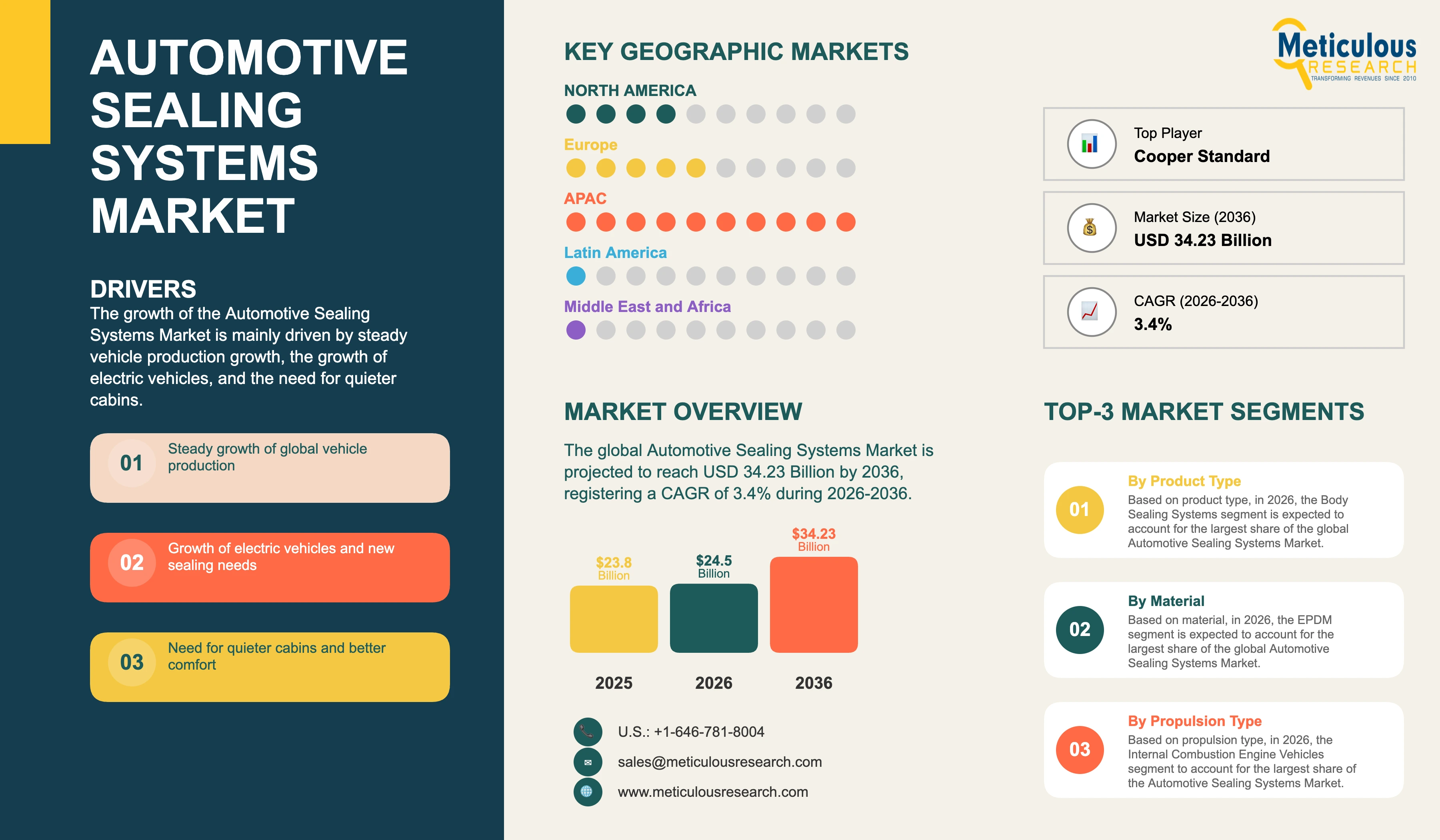
The global automotive sealing systems market was valued at USD 23.80 billion in 2025. This market is expected to reach USD 34.23 billion by 2036 from an estimated USD 24.50 billion in 2026, registering a CAGR of 3.4% during the forecast period (2026-2036).
- Published
- Nov 2026
- Pages
- 265
- Format
- PDF + Excel
- Report ID
- MRAUTO - 1042862
- Base year
- 2025
- 2025 · BASELINE
- $23.80B
- 2036
- $34.23B
- CAGR 2026–2036
- 3.4%
2025 baseline · 2026–2036 forecast at 3.4% CAGR · hover a bar for the value
Key highlights
Cooper Standard, one of the world's largest suppliers of automotive body sealing systems, reported 2025 sales of USD 2.74 billion, up 0.4% from 2024, and guided 2026 sales of USD 2.7 billion to USD 2.9 billion, according to the company. About 74% of the company's new business awards were tied to electric and hybrid vehicle programs, and more than half were won with Chinese vehicle makers, according to Yahoo Finance.
Freudenberg Sealing Technologies developed a new elastomer sealing material for battery cells in April 2025 as an alternative to thermoplastic and FKM seals that contain PFAS, according to Freudenberg. The material performs better than thermoplastics in the event of thermal runaway, which is critical for electric vehicle battery safety.
Global electric car sales grew by 20% to more than 20 million units in 2025, accounting for one in four new cars sold, according to the IEA. Electric vehicles need new seals for battery housings, cell modules, cooling plates, electric motors, inverters, and charging inlets, which is shifting demand away from engine and transmission gaskets.
Vehicle makers are adding frameless doors, flush door handles, flush glass, and large panoramic glass roofs, which require more complex and higher-value body seals. Quieter electric vehicle cabins also make wind and road noise more noticeable, which increases demand for multi-layer and more effective door and window seals.
The European Union is considering broad restrictions on PFAS, which include many fluorinated sealing materials, such as FKM and PTFE. Seal makers are developing alternative materials to prepare for these rules, which could require major changes in high-temperature and chemical-resistant seals.
Leading suppliers include Cooper Standard, Toyoda Gosei, Hutchinson, Henniges Automotive, Nishikawa Rubber, Kinugawa Rubber, Anhui Zhongding, SaarGummi, and Standard Profil in body sealing, and Freudenberg Sealing Technologies, ElringKlinger, NOK, Trelleborg, and Dana in dynamic seals, gaskets, and electric vehicle seals. Body seal makers are also working with vehicle makers early in design to balance noise, water tightness, appearance, and door closing effort in each new model.
By product type, body sealing systems account for the largest share of 54.0% in 2026, while battery and thermal management seals register the highest CAGR.
By material, EPDM accounts for the largest share in 2026, while thermoplastic elastomers register the highest CAGR.
By propulsion type, internal combustion engine vehicles account for the largest share of 54.0% in 2026, while battery electric vehicles register the highest CAGR.
By sales channel, OEM accounts for the larger share in 2026 and also registers the higher CAGR.
By geography, Asia-Pacific accounts for the largest share of 47.0% in 2026, while Asia-Pacific registers the highest CAGR of 4.4%.
Report summary
| Particulars | Details |
|---|---|
| Base Year | 2025 |
| Estimated Year | 2026 |
| Forecast Period | 2026-2036 |
| Market Size in 2025 | USD 23.80 billion |
| Market Size in 2026 | USD 24.50 billion |
| Market Size by 2036 | USD 34.23 billion |
| CAGR (2026-2036) | 3.4% |
| Format | PDF, Excel & Cloud Portal · 265 pages |
| Largest Segment by Product Type (2026) | Body Sealing Systems (54.0%) |
| Largest Segment by Propulsion Type (2026) | Internal Combustion Engine Vehicles (54.0%) |
| Largest Region (2026) | Asia-Pacific (47.0%) |
| Fastest-Growing Region | Asia-Pacific (CAGR 4.4%) |
| Companies Profiled | 14 companies and other companies |
| Segments Covered | Product Type, Material, Propulsion Type, Sales Channel, Geography |
| Countries Covered | U.S., Canada, Germany, France, Spain, Italy, U.K., Sweden, Czech Republic, Slovakia, Poland, Hungary, Romania, Serbia, Belgium, Rest of Europe, China, Japan, India, South Korea, Thailand, Indonesia, Malaysia, Vietnam, Taiwan, Australia, Rest of Asia-Pacific, Mexico, Brazil, Argentina, Colombia, Chile, Rest of Latin America, Turkey, Morocco, South Africa, Saudi Arabia, Egypt, Iran, Rest of Middle East & Africa |
Report overview
Segments covered: product type, material, propulsion type, sales channel.
Automotive sealing systems are the rubber, plastic, and metal parts that keep water, dust, noise, air, and fluids in or out of vehicle systems. They include body sealing systems, such as door, window, trunk, and sunroof weatherstrips, dynamic seals, such as shaft seals and O-rings, gaskets for engines, transmissions, and other housings, and seals for battery packs, electric drives, and thermal management systems in electric vehicles.
The growth of this market is mainly driven by steady growth of global vehicle production, especially in Asia-Pacific, the growth of electric vehicles, which need new seals for battery packs, electric motors, power electronics, and thermal management systems, the need for quieter vehicle cabins, which increases the use of advanced body seals, the shift to frameless doors, flush glass, and larger glass roofs, and stricter requirements for leak tightness and durability. In addition, the move to thermoplastic elastomers and lighter seal designs is supporting the use of new materials. However, the loss of engine and transmission seals and gaskets in electric vehicles, rising raw material and energy costs, and pressure to replace fluorinated materials are expected to restrain the growth of this market to some extent.
Automotive sealing systems protect vehicle occupants and components from water, dust, noise, air, and fluid leaks. Body sealing systems are extruded or molded rubber and thermoplastic profiles fitted around doors, windows, trunks, hoods, and sunroofs. They keep rain and dust out of the cabin, reduce wind and road noise, and allow doors and windows to close smoothly. Dynamic seals, such as radial shaft seals, O-rings, and piston seals, seal moving shafts and parts in engines, transmissions, steering systems, pumps, and electric motors. Gaskets seal fixed joints between housings, such as cylinder heads, oil pans, and transmission cases. Electric vehicles add new seals for battery packs, cooling systems, and power electronics.
This report covers the global automotive sealing systems market, including body sealing systems, dynamic seals, gaskets, and battery and thermal management seals used in passenger cars and commercial vehicles. The market is valued at the selling price of seals and sealing systems sold to vehicle makers, tier-1 suppliers, and the aftermarket. The market is analyzed by product type, material, propulsion type, sales channel, and geography. Fluid hoses, fuel and brake lines, anti-vibration mounts, and sealing materials sold as raw materials are not included.
Body sealing systems account for the largest part of the automotive sealing market by value. A typical passenger car uses 20 to 40 meters of body seals, including primary and secondary door seals, glass run channels, belt line seals, trunk and hood seals, and sunroof seals. These seals are designed specifically for each vehicle model and must meet strict requirements for water tightness, noise reduction, door closing effort, appearance, and durability over many years of temperature changes, sunlight, and use. Body seal makers work closely with vehicle makers from the early stages of vehicle design.
Seals for engines, transmissions, and other systems are smaller but highly engineered parts. Cylinder head gaskets, valve stem seals, crankshaft seals, and transmission seals must withstand high temperatures, pressures, and contact with oil, fuel, and coolant. These seals are often made from high-performance materials, such as fluoroelastomers, silicone, and multi-layer steel. Seal makers also supply seals for steering systems, brake systems, air conditioning systems, and fuel systems, many of which are needed in both combustion engine and electric vehicles.
The market includes body sealing specialists, such as Cooper Standard, Toyoda Gosei, Hutchinson, Henniges Automotive, Nishikawa Rubber, Kinugawa Rubber, Anhui Zhongding, SaarGummi, and Standard Profil, and makers of dynamic seals and gaskets, such as Freudenberg Sealing Technologies, ElringKlinger, NOK, Trelleborg, and Dana. Chinese suppliers, such as Anhui Zhongding, have grown quickly with Chinese vehicle production and are expanding abroad, while global suppliers are increasing their focus on Chinese vehicle makers.
Electric vehicles are changing the sealing market in several important ways for suppliers. They do not need many engine and transmission gaskets and seals, but they need large seals for battery pack housings, which must keep water and dust out for the life of the vehicle and may need to vent gases in a thermal runaway event. They also need seals for cell modules, cooling plates, coolant connectors, electric motors, inverters, and charging inlets. Electric vehicles are also much quieter than combustion engine vehicles, which makes body seals more important for cabin comfort.
In 2026, body sealing systems account for the largest share of the market by product type, while battery and thermal management seals are the fastest-growing product type. EPDM accounts for the largest share by material, while thermoplastic elastomers are the fastest-growing material. Internal combustion engine vehicles account for the largest share by propulsion type, while battery electric vehicles are the fastest-growing propulsion type. The OEM channel accounts for the larger share by sales channel and is also the faster-growing channel. Asia-Pacific accounts for the largest share of the market and is also the fastest-growing region.
Market growth over the forecast period will depend on global vehicle production, the pace of electric vehicle adoption, vehicle design trends, such as frameless doors and glass roofs, and regulations on materials, such as PFAS. Raw material and energy prices will also affect the market, as rubber compounds and processing are major cost factors. Overall, steady vehicle production growth and higher-value seals for electric vehicles and premium body designs are expected to support moderate growth.
Internal combustion engine vehicles are expected to account for the largest share of 54.0% of the market in 2026, while battery electric vehicles are projected to register the highest CAGR, driven by new battery and thermal management seals.
Asia-Pacific is expected to account for the largest share of 47.0% of the market in 2026, mainly due to China's large vehicle and electric vehicle production and the presence of leading Japanese and Chinese seal makers.
Asia-Pacific is also projected to register the highest CAGR of 4.4% during the forecast period, driven by vehicle and electric vehicle growth in China, India, and Southeast Asia and new vehicle designs by Chinese vehicle makers.
The report profiles 14 companies, including Cooper Standard, Toyoda Gosei, Hutchinson, Henniges Automotive, Nishikawa Rubber, Kinugawa Rubber, Anhui Zhongding, SaarGummi, Standard Profil, Freudenberg Sealing Technologies, ElringKlinger, NOK, Trelleborg, and Dana.
Electric vehicles need fewer engine and transmission seals and gaskets but many new seals for battery packs, electric motors, power electronics, and thermal management systems, and better body seals for quiet cabins.
Possible European Union restrictions on PFAS could affect fluorinated sealing materials, such as FKM and PTFE, which are used in high-temperature and chemical-resistant seals, so seal makers are developing alternative materials.
In 2026, the OEM segment is expected to account for the larger share of the automotive sealing systems market, and it is also projected to register the higher CAGR during the forecast period.
Report infographic
Market dynamics
17 factors across 5 forcesSteady growth of global vehicle production
Demand for sealing systems is closely linked to vehicle production, as every vehicle needs body seals, dynamic seals, and gaskets. Global vehicle production is expected to grow steadily over the forecast period, led by China, India, and Southeast Asia, while production in Europe and North America is expected to grow more slowly. Body seals in particular are used in every vehicle regardless of powertrain, which provides stable demand as the industry shifts to electric vehicles.
The growth of vehicle production in Asia-Pacific is especially important for seal makers. Chinese vehicle makers are growing quickly at home and abroad, and they are increasingly working with global seal makers as well as local suppliers. Cooper Standard said that more than half of its new business awards were won with Chinese vehicle makers, according to Yahoo Finance, which shows the importance of these customers for seal makers.
Growth of electric vehicles and new sealing needs
Electric vehicles need many new seals that are not used in combustion engine vehicles. Battery pack housings need large perimeter seals that keep water and dust out for the life of the vehicle, often 15 years or more, and that can be opened for service and repair. Cell modules, cooling plates, coolant connectors, and high-voltage connectors also need seals. Electric motors need shaft seals that work at very high speeds, and inverters and onboard chargers need housing seals. Some battery seals must also resist fire and help contain thermal runaway.
Global electric car sales grew by 20% to more than 20 million units in 2025, according to the IEA, and Cooper Standard said about 74% of its new awards were tied to electric and hybrid vehicle programs, according to Yahoo Finance. Battery and thermal management seals are the fastest-growing product type in this market, and battery electric vehicles are the fastest-growing propulsion type.
Need for quieter cabins and better comfort
Vehicle buyers expect quiet and comfortable cabins, and vehicle makers compete on noise levels. In electric vehicles, the absence of engine noise makes wind noise and road noise much more noticeable, which increases the importance of body seals. Vehicle makers are using more advanced door seals, such as multi-layer primary and secondary seals, and better glass run channels and belt line seals to reduce noise.
These advanced seals are more complex and more valuable than standard seals, which increases the value of body sealing systems per vehicle. Seal makers are developing new seal designs and materials that reduce noise while keeping door closing effort low, which is important for customer satisfaction. This trend supports growth in body sealing systems even as the number of vehicles grows only moderately.
New vehicle design trends
Vehicle designs are changing in ways that require more complex and higher-value body seals. Frameless doors, which are common on electric vehicles and premium vehicles, need special seals to keep water out when the window is lowered. Flush door handles and flush glass require precise seals to keep a smooth surface, and large panoramic glass roofs need long and complex seals. Some vehicle makers are also using new door designs, such as rear-hinged doors or doors without a B-pillar.
These design trends increase the length, complexity, and value of body seals in each vehicle. Seal makers with strong engineering capabilities can help vehicle makers design these features and win new business. As more vehicles adopt these design features, the value of body sealing systems per vehicle is expected to rise.
Stricter requirements for durability and leak tightness
Vehicle makers are asking for seals that last longer, resist harsher conditions, and provide better leak tightness. Vehicles are expected to last 15 years or more, and seals must keep their performance over this time despite temperature changes, sunlight, ozone, and chemicals. Electric vehicle battery seals must provide very high levels of water and dust protection, and seals for high-voltage systems must also prevent electrical leakage. Thermal management systems in electric vehicles use new coolants and refrigerants that require compatible seal materials. These stricter requirements are leading to higher-performance materials, such as silicone and special fluoroelastomers, more complex seal designs, and more testing, which increases the value of seals. Seal makers with strong materials and testing capabilities, such as Freudenberg Sealing Technologies, ElringKlinger, NOK, and Trelleborg, are well placed to meet these requirements and to support vehicle makers on new platforms.
Table of contents
12 chapters · 178 sections · 265 pages · click to expandSegmental analysis
| Segment | Largest share (2026) | Fastest growth (2026–2036) |
|---|---|---|
| By Product Type | Body sealing systems | Battery and thermal management seals |
| By Material | EPDM | Thermoplastic elastomers |
| By Propulsion Type | Internal combustion engine vehicles | Battery electric vehicles |
| By Sales Channel | — | Rapid growth of this |
| Other segments | EPDM | Thermoplastic elastomers |
By Product Type
- Automotive Sealing Systems Market Analysis by Product Type
- The body sealing systems segment is expected to account for the largest share of 54.0% of the global automotive sealing systems market.
- The large share of this segment is mainly due to the use of 20 to 40 meters of body seals in every vehicle, including door seals, glass run channels, belt line seals, trunk, hood, and sunroof seals, the use of body seals in all vehicles regardless of powertrain, the growing need for quieter cabins, especially in electric vehicles, and the use of more complex and higher-value seals for frameless doors, flush glass, and large glass roofs.
- Cooper Standard, Toyoda Gosei, Hutchinson, Henniges Automotive, Nishikawa Rubber, Kinugawa Rubber, Anhui Zhongding, SaarGummi, and Standard Profil are among the leading suppliers of body sealing systems.
- However, the battery and thermal management seals segment is projected to register the highest CAGR during the forecast period.
- The rapid growth of this segment is driven by the fast growth of electric vehicle production, the need for large perimeter seals for battery pack housings, the use of seals for cell modules, cooling plates, and coolant connectors, the need for fire-resistant and venting seals to help contain thermal runaway, and the growth of thermal management systems that use new coolants and refrigerants.
- Freudenberg Sealing Technologies, ElringKlinger, NOK, Trelleborg, and Dana are among the leading suppliers of battery and thermal management seals.
By Material
- Automotive Sealing Systems Market Analysis by Material
- The EPDM segment is expected to account for the largest share of the global automotive sealing systems market.
- The large share of this segment is mainly due to the wide use of EPDM rubber in body sealing systems, which make up the largest part of the market, the excellent resistance of EPDM to weather, ozone, sunlight, and temperature changes, its good sealing and noise reduction properties, and its low cost compared with other high-performance materials.
- EPDM is also used in coolant seals and some battery seals, and seal makers have long experience in processing EPDM through extrusion and molding.
- However, the thermoplastic elastomers segment is projected to register the highest CAGR during the forecast period.
- The rapid growth of this segment is driven by the lighter weight of thermoplastic elastomers compared with EPDM, their recyclability, which supports vehicle makers' sustainability targets, their lower energy use in processing, as they do not need curing, and their growing use in glass run channels, belt line seals, and multi-material body seals.
- Vehicle makers are also asking for lighter seals to improve electric vehicle range.
By Propulsion Type
- Automotive Sealing Systems Market Analysis by Propulsion Type
- The internal combustion engine vehicles segment is expected to account for the largest share of 54.0% of the global automotive sealing systems market.
- The large share of this segment is mainly due to the large number of combustion engine vehicles still produced each year, the many engine, transmission, exhaust, and fuel system seals and gaskets used in these vehicles, in addition to body seals, and the continued production of combustion engine vehicles in emerging markets, such as India, Southeast Asia, Latin America, and the Middle East.
- Combustion engine vehicles also make up most of the global vehicle fleet, which drives aftermarket demand for replacement seals and gaskets.
- However, the battery electric vehicles segment is projected to register the highest CAGR during the forecast period.
- The rapid growth of this segment is driven by the fast growth of battery electric vehicle production, with global electric car sales exceeding 20 million units in 2025 according to the IEA, the need for new seals for battery packs, electric motors, power electronics, and thermal management systems, the higher importance of body seals for cabin noise in quiet electric vehicles, and the use of frameless doors and glass roofs in many electric vehicles.
By Sales Channel
- Automotive Sealing Systems Market Analysis by Sales Channel
- The OEM segment is expected to account for the larger share of the global automotive sealing systems market.
- The large share of this segment is mainly due to the large number of seals fitted to new vehicles produced each year, the fact that body sealing systems are designed specifically for each vehicle model and supplied mainly to vehicle makers, the supply of seals and gaskets to tier-1 suppliers of engines, transmissions, motors, batteries, and thermal systems, and the long-term supply contracts between seal makers and vehicle makers.
- Body seals are rarely replaced during the life of a vehicle, which keeps most demand in the OEM channel.
- The OEM segment is also projected to register the higher CAGR during the forecast period.
- The rapid growth of this segment is driven by the growth of vehicle production in Asia-Pacific, the fast growth of electric vehicles, which need new battery and thermal management seals, the use of more complex body seals in new vehicle designs, and the launch of new vehicle platforms by Chinese and other vehicle makers.
- Aftermarket demand for replacement gaskets and seals is expected to grow more slowly, as electric vehicles need fewer replacement engine gaskets and seals.
Other segments
- The EPDM segment is expected to account for the largest share of the automotive sealing systems market, while the thermoplastic elastomers segment is projected to register the highest CAGR during the forecast period.
Geographic analysis
Asia-Pacific
Largest shareIn 2026, Asia-Pacific is expected to account for the largest share of 47.0% of the global automotive sealing systems market. The large share of this region is mainly due to China's position as the largest vehicle producer in the world, China's leadership in electric vehicle production, which needs new battery and thermal management seals, the large vehicle production of Japan, India, South Korea, and Thailand, the presence of leading Japanese seal makers, such as Toyoda Gosei, Nishikawa Rubber, Kinugawa Rubber, and NOK, and the fast growth of Chinese seal makers, such as Anhui Zhongding. Global seal makers, such as Cooper Standard and Freudenberg Sealing Technologies, also have large operations in the region. Asia-Pacific is also projected to register the highest CAGR of 4.4% during the forecast period. The rapid growth of this region is mainly driven by continued growth of vehicle and electric vehicle production in China, the fast growth of vehicle production in India, the growth of vehicle production in Indonesia, Vietnam, Thailand, and Malaysia, including by Chinese electric vehicle makers, and the adoption of new vehicle designs, such as frameless doors and glass roofs, by Chinese vehicle makers. Cooper Standard said that more than half of its new business awards were won with Chinese vehicle makers, according to Yahoo Finance.
Europe
Europe accounts for a significant share of the market, supported by the production of premium and electric vehicles with complex body seals, the presence of leading seal makers, such as Freudenberg Sealing Technologies, ElringKlinger, Hutchinson, Trelleborg, and SaarGummi, and strict requirements for quality, durability, and sustainability. European regulators are also considering restrictions on PFAS that could change the materials used in seals. However, slow growth of vehicle production in Western Europe and the decline of combustion engine production are expected to limit growth in the region, and seal makers are restructuring plants built for engine gaskets. Many European seal makers are moving body seal production to Eastern Europe, Morocco, and Turkey to cut labor costs while staying close to European vehicle plants. European vehicle makers are also among the first to ask for recycled content and carbon footprint data for seals.
North America
North America accounts for a large share of the market, supported by the production of large pickup trucks and SUVs, which use many body seals, the presence of Cooper Standard, Henniges Automotive, Dana, and other suppliers, and a large and aging vehicle fleet that drives aftermarket demand for replacement seals and gaskets. Mexico is an important production location for body seals that serve North American vehicle plants.
Latin America
Latin America and the Middle East & Africa account for smaller shares, with growth supported by vehicle production in Brazil, Argentina, Turkey, and Morocco and new plants built by Chinese vehicle makers in Brazil and Turkey. Cooper Standard is a leading body seal supplier in North America and has improved its margins through lean manufacturing and restructuring, according to the company. Body seal makers in Mexico also benefit from trade rules that favor regional production for vehicles sold in the U.S.
Competitive landscape
The global automotive sealing systems market includes body sealing specialists, makers of dynamic seals and gaskets, and diversified rubber and plastics companies. The body sealing market is moderately concentrated, with a small number of large global suppliers and regional suppliers in China, Japan, and Europe. The dynamic seals and gaskets market is led by a few large technology-focused suppliers with strong materials capabilities.
Cooper Standard, Toyoda Gosei, Hutchinson, Henniges Automotive, Nishikawa Rubber, and Kinugawa Rubber are among the leading body sealing suppliers, while Anhui Zhongding, SaarGummi, and Standard Profil are important regional suppliers. Freudenberg Sealing Technologies, ElringKlinger, NOK, Trelleborg, and Dana are leading suppliers of dynamic seals, gaskets, and electric vehicle seals. Cooper Standard reported 2025 sales of USD 2.74 billion, according to the company.
Companies in this market compete on seal performance, such as water tightness, noise reduction, durability, and door closing effort, materials expertise, engineering support for new vehicle designs, cost, global production close to vehicle plants, and the ability to supply seals for electric vehicles. Key strategies include developing battery and thermal management seals, PFAS-free and sustainable materials, and thermoplastic elastomer seals, expanding with Chinese vehicle makers, and cutting costs through automation and lean manufacturing.
Recent competitive activity in the global automotive sealing systems market has mainly focused on electric vehicle programs and new materials. Cooper Standard said that about 74% of its new awards were tied to electric and hybrid vehicle programs, according to Yahoo Finance, and Freudenberg Sealing Technologies launched a new elastomer material for battery cells as an alternative to PFAS-containing seals in April 2025.
We expect competition to increase over the forecast period as Chinese seal makers expand abroad, as vehicle makers push for lower prices, and as the shift to electric vehicles changes sealing demand. Suppliers with strong materials and engineering capabilities, global production networks, and strong relationships with Chinese and global vehicle makers are expected to strengthen their positions, while further consolidation among smaller suppliers is likely, especially in Europe, where several body seal makers have faced financial pressure from high energy and labor costs.
Some of the key players operating in the automotive sealing systems market are Cooper-Standard Holdings Inc., Toyoda Gosei Co., Ltd., Hutchinson SA, Henniges Automotive Holdings, Inc., Nishikawa Rubber Co., Ltd., Kinugawa Rubber Industrial Co., Ltd., Anhui Zhongding Sealing Parts Co., Ltd., SaarGummi Group, Standard Profil, Freudenberg Sealing Technologies GmbH & Co. KG, ElringKlinger AG, NOK Corporation, Trelleborg AB, and Dana Incorporated, among others.
- —
Cooper Standard reported 2025 sales of USD 2.74 billion with most new awards tied to electric and hybrid programs, and Freudenberg Sealing Technologies launched a new elastomer material for battery cells as an alternative to PFAS-containing seals in April 2025.
- Cooper-Standard Holdings Inc.
- Toyoda Gosei Co., Ltd.
- Hutchinson SA
- Henniges Automotive Holdings, Inc.
- Nishikawa Rubber Co., Ltd.
- Kinugawa Rubber Industrial Co., Ltd.
- Anhui Zhongding Sealing Parts Co., Ltd.
- SaarGummi Group
- Standard Profil
- Freudenberg Sealing Technologies GmbH & Co. KG
- ElringKlinger AG
- NOK Corporation
- Trelleborg AB
- Dana Incorporated
Expert perspectives
Automotive sealing systems are essential for vehicle comfort, safety, and durability, and the market is closely linked to vehicle production. The shift to electric vehicles is reducing demand for engine and transmission gaskets and seals, but it is creating new demand for battery, electric drive, and thermal management seals and increasing the importance of body seals for cabin noise. New vehicle designs and material regulations are also changing the market.
Over the forecast period, the market is expected to grow at a CAGR of 3.4%, from USD 24.50 billion in 2026 to USD 34.23 billion in 2036. Growth will be driven by steady vehicle production growth, the growth of electric vehicles, the need for quieter cabins, new vehicle design trends, and stricter requirements for durability and leak tightness.
Among the market segments, body sealing systems are the largest product type, while battery and thermal management seals grow fastest. EPDM is the largest material, while thermoplastic elastomers grow fastest. Internal combustion engine vehicles are the largest propulsion type, while battery electric vehicles grow fastest. The OEM channel is both the larger and the faster-growing sales channel. Asia-Pacific is both the largest and the fastest-growing region, at a CAGR of 4.4%.
In our view, the shift to electric vehicles will have different effects on different parts of the market. Body seal makers are well placed, as body seals are needed in all vehicles and are becoming more important in quiet electric vehicles, while gasket and engine seal makers face declining demand and must move quickly into battery and thermal management seals. Seal makers that win business on new electric vehicle platforms, especially with Chinese vehicle makers, are expected to gain share.
We also see possible PFAS restrictions in the European Union as an important factor that could change the materials used in high-performance seals. Seal makers that develop PFAS-free alternatives early will have an advantage. Price pressure and rising costs will remain challenges, which favors suppliers with scale, automation, and strong materials capabilities. We expect body seal makers that win business with Chinese vehicle makers to grow faster than the market, as shown by Cooper Standard's recent new business awards. Gasket makers, by contrast, will need to show that they can replace lost engine volume with electric vehicle products.
Overall, we believe the automotive sealing systems market will grow steadily over the forecast period, with battery and thermal management seals, thermoplastic elastomers, battery electric vehicles, the OEM channel, and Asia-Pacific providing the fastest growth. Companies with strong materials and engineering capabilities, global production networks, and strong positions in electric vehicle programs will be best positioned to capture this growth.
Customer perspectives
“Our cars are very quiet, so customers notice every bit of wind noise. We need better door and window seals, especially for our frameless doors and glass roofs.”
“The battery housing seal must stay tight for 15 years and still let us open the pack for service. We also want materials without PFAS.”
“We want lighter seals that we can recycle, so we are moving more glass run channels to thermoplastic elastomers. But combustion engine trucks still make up most of our volume.”
Frequently asked questions
The global automotive sealing systems market was valued at USD 23.80 billion in 2025, up from USD 23.30 billion in 2024, and is estimated at USD 24.50 billion in 2026. The market includes body sealing systems, dynamic seals, gaskets, and battery and thermal management seals.
The global automotive sealing systems market is expected to reach USD 34.23 billion by 2036, driven by steady vehicle production growth, the growth of electric vehicles, the need for quieter cabins, and new vehicle design trends.
The market is expected to register a CAGR of 3.4% from 2026 to 2036, with the fastest growth in battery and thermal management seals, thermoplastic elastomers, battery electric vehicles, the OEM channel, and Asia-Pacific.
Market growth is mainly driven by steady vehicle production growth, the growth of electric vehicles and new sealing needs, the need for quieter cabins, new vehicle design trends, such as frameless doors and glass roofs, and stricter durability and leak tightness requirements.
The loss of engine and transmission seals and gaskets in electric vehicles and rising raw material and energy costs restrain growth, while meeting battery safety and durability requirements and price pressure from low-cost suppliers are key challenges.
Key growth opportunities include battery pack and thermal management seals, PFAS-free and sustainable sealing materials, thermoplastic elastomers and lighter seal designs, and growth with Chinese vehicle makers at home and abroad.
Body sealing systems are expected to account for the largest share of 54.0% of the market in 2026, while battery and thermal management seals are projected to register the highest CAGR, driven by electric vehicle growth.
In 2026, the EPDM segment is expected to account for the largest share of the automotive sealing systems market, while the thermoplastic elastomers segment is projected to register the highest CAGR during the forecast period.
Internal combustion engine vehicles are expected to account for the largest share of 54.0% of the market in 2026, while battery electric vehicles are projected to register the highest CAGR, driven by new battery and thermal management seals.
In 2026, the OEM segment is expected to account for the larger share of the automotive sealing systems market, and it is also projected to register the higher CAGR during the forecast period.
Asia-Pacific is expected to account for the largest share of 47.0% of the market in 2026, mainly due to China's large vehicle and electric vehicle production and the presence of leading Japanese and Chinese seal makers.
Asia-Pacific is also projected to register the highest CAGR of 4.4% during the forecast period, driven by vehicle and electric vehicle growth in China, India, and Southeast Asia and new vehicle designs by Chinese vehicle makers.
The report profiles 14 companies, including Cooper Standard, Toyoda Gosei, Hutchinson, Henniges Automotive, Nishikawa Rubber, Kinugawa Rubber, Anhui Zhongding, SaarGummi, Standard Profil, Freudenberg Sealing Technologies, ElringKlinger, NOK, Trelleborg, and Dana.
Cooper Standard reported 2025 sales of USD 2.74 billion with most new awards tied to electric and hybrid programs, and Freudenberg Sealing Technologies launched a new elastomer material for battery cells as an alternative to PFAS-containing seals in April 2025.
Electric vehicles need fewer engine and transmission seals and gaskets but many new seals for battery packs, electric motors, power electronics, and thermal management systems, and better body seals for quiet cabins.
Possible European Union restrictions on PFAS could affect fluorinated sealing materials, such as FKM and PTFE, which are used in high-temperature and chemical-resistant seals, so seal makers are developing alternative materials.
Cite this report
Meticulous Research. (2026). Automotive Sealing Systems Market - Global Opportunity Analysis and Industry Forecast (2026-2036) (Report No. MRAUTO - 1042862). Meticulous Market Research Pvt. Ltd. https://www.meticulousresearch.com/product/automotive-sealing-systems-market-7545