Automotive Recycled Plastics Market (2026-2036)
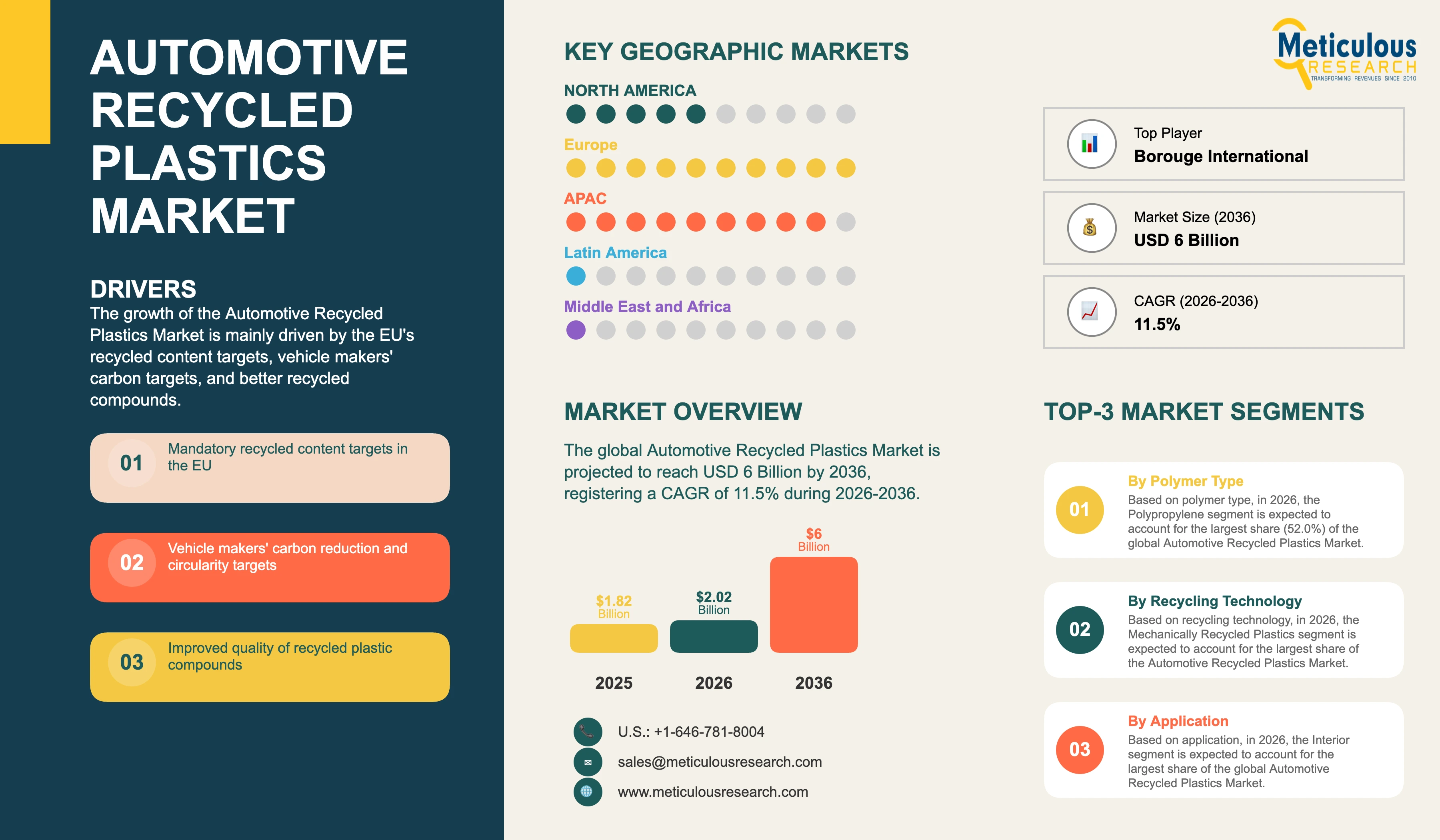
The global automotive recycled plastics market was valued at USD 1.82 billion in 2025. This market is expected to reach USD 6.00 billion by 2036 from an estimated USD 2.02 billion in 2026, registering a CAGR of 11.5% during the forecast period (2026-2036).
- Published
- Nov 2026
- Pages
- 258
- Format
- PDF + Excel
- Report ID
- MRAUTO - 1042891
- Base year
- 2025
- 2025 · BASELINE
- $1.82B
- 2036
- $6.00B
- CAGR 2026–2036
- 11.5%
2025 baseline · 2026–2036 forecast at 11.5% CAGR · hover a bar for the value
Key highlights
The EU's End-of-Life Vehicles Regulation entered into force on August 13, 2026, according to the European Commission. It sets mandatory targets for recycled plastic content in new vehicles of 15% from 2032 and 25% from 2036, and requires that 20% of the recycled plastic used to meet the targets come from end-of-life vehicles or from parts removed from vehicles during use. The rules also apply to vehicles imported into the EU.
Borouge International, formed in March 2026 by combining Borouge, Borealis, and NOVA Chemicals, launched Borcycle GE2331SY in May 2026, according to Borouge International. The compound combines 40% post-consumer recycled polypropylene with 20% glass fiber for structural interior parts, such as center console and dashboard carriers, and supports compliance with recycled content rules.
Borealis's Borcycle GD3600SY, a glass-fiber-reinforced polypropylene compound with 65% post-consumer recycled content, is used in the center console carrier of the Peugeot 3008, produced with Plastivaloire and Stellantis, according to Borealis. It was the first use of a compound with such high recycled content in a large automotive interior part in series production.
The European Commission states that the ELV Regulation also allows it to set recycled content targets for steel and aluminum from 2033 and requires that, from mid-2031, only roadworthy vehicles may be exported outside the EU, which helps keep recyclable materials, including plastics, within the EU.
Vehicle makers increasingly publish recycled content targets for their new models and work with plastic suppliers, recyclers, and parts makers to qualify recycled grades for interior, exterior, and under-the-hood parts, especially in Europe, where the ELV Regulation creates binding requirements.
Leading suppliers include Borouge International, LyondellBasell, SABIC, Covestro, Celanese, Domo Chemicals, Envalior, and Kingfa Sci & Tech. Chemically recycled plastics are the fastest-growing recycling technology, and exterior parts are the fastest-growing application, as vehicle makers use recycled polypropylene in bumpers and other large exterior parts. Engineering plastics producers, such as Celanese, Domo Chemicals, and Envalior, offer recycled-content polyamide and other engineering grades for under-the-hood and structural parts. Kingfa Sci & Tech is a leading supplier in China.
By polymer type, polypropylene accounts for the largest share of 52.0% in 2026, while polyamide registers the highest CAGR.
By recycling technology, mechanically recycled plastics account for the larger share in 2026, while chemically recycled plastics register the higher CAGR.
By application, interior accounts for the largest share in 2026, while exterior registers the highest CAGR.
By vehicle type, passenger cars account for the larger share of 86.0% in 2026 and also register the higher CAGR.
By geography, Europe accounts for the largest share of 38.0% in 2026, while Europe registers the highest CAGR of 13.8%.
Report summary
| Particulars | Details |
|---|---|
| Base Year | 2025 |
| Estimated Year | 2026 |
| Forecast Period | 2026-2036 |
| Market Size in 2025 | USD 1.82 billion |
| Market Size in 2026 | USD 2.02 billion |
| Market Size by 2036 | USD 6.00 billion |
| CAGR (2026-2036) | 11.5% |
| Format | PDF, Excel & Cloud Portal · 258 pages |
| Largest Segment by Polymer Type (2026) | Polypropylene (52.0%) |
| Largest Segment by Vehicle Type (2026) | Passenger Cars (86.0%) |
| Largest Region (2026) | Europe (38.0%) |
| Fastest-Growing Region | Europe (CAGR 13.8%) |
| Companies Profiled | 8 companies and other companies |
| Segments Covered | Polymer Type, Recycling Technology, Application, Vehicle Type, Geography |
| Countries Covered | U.S., Canada, Mexico, Germany, France, U.K., Spain, Italy, Sweden, Czech Republic, Poland, Slovakia, Hungary, Netherlands, Belgium, Austria, Rest of Europe, China, Japan, South Korea, India, Thailand, Indonesia, Malaysia, Vietnam, Taiwan, Australia, Rest of Asia-Pacific, Brazil, Argentina, Chile, Colombia, Rest of Latin America, Turkey, Morocco, South Africa, Saudi Arabia, UAE, Israel, Rest of Middle East & Africa |
Report overview
Segments covered: polymer type, recycling technology, application, vehicle type.
Automotive recycled plastics are plastics made from post-consumer or post-industrial waste, such as used packaging, old car parts, carpets, fishing nets, and production scrap, that are processed back into resins and compounds suitable for vehicle parts. They are used in interior parts, such as door panels, center consoles, and carpets, exterior parts, such as bumpers, wheel arch liners, and underbody shields, and under-the-hood parts, such as air ducts, fan shrouds, and battery covers. They are produced mainly by mechanical recycling, which sorts, cleans, and melts plastic waste, and increasingly by chemical recycling, which breaks plastics down into raw materials for new polymers.
The growth of this market is mainly driven by the EU's new End-of-Life Vehicles Regulation, which sets the first mandatory targets for recycled plastic content in new vehicles, vehicle makers' carbon reduction and circularity targets, the lower carbon footprint of recycled plastics compared with virgin plastics, improvements in sorting and compounding that allow recycled plastics to meet automotive quality standards, and the growth of chemical recycling, which produces recycled plastics with the same properties as virgin materials. In addition, the growing use of closed-loop recycling, in which plastics from old vehicles are recycled into new vehicle parts, supports demand. However, limited supply of high-quality recycled plastics, higher costs compared with virgin plastics in some periods, and strict automotive quality and odor requirements are expected to restrain the growth of this market to some extent.
A typical modern passenger car contains roughly 150 to 250 kilograms of plastics, used in bumpers, dashboards, door panels, seats, carpets, lighting, under-the-hood parts, and many small components. Most of these plastics are still made from virgin materials, and only a small share comes from recycled sources. At the same time, large amounts of plastic from end-of-life vehicles are not recycled but end up in shredder residue, which is landfilled or burned. Vehicle makers, recyclers, and plastic suppliers are now working to close this gap, driven by new regulations, carbon reduction targets, and customer expectations for more sustainable vehicles.
This report covers the global automotive recycled plastics market, including recycled polypropylene, polyethylene terephthalate, polyamide, ABS and PC blends, polyethylene, and other recycled polymers, produced by mechanical and chemical recycling, and used in interior, exterior, under-the-hood, and other applications, in passenger cars and commercial vehicles. The market is valued at the selling price of recycled plastic resins and the recycled portion of compounds supplied to parts makers and vehicle makers for new vehicle parts. The market is analyzed by polymer type, recycling technology, application, vehicle type, and geography. Bio-based plastics, recycled plastics used in aftermarket parts, and plastics recycling services are not included.
Polypropylene is the most widely used plastic in vehicles and the main recycled plastic in this market. It is used in bumpers, door panels, dashboards, wheel arch liners, and battery covers, often as a compound with talc, glass fiber, or rubber. Recycled polypropylene from packaging and old car parts can be compounded with additives and reinforcements to meet automotive requirements for strength, impact resistance, and appearance. Recycled PET from bottles is widely used in carpets, seat fabrics, headliners, and insulation, while recycled polyamide from carpets, fishing nets, and airbags is used in under-the-hood parts and engineering components.
Meeting the strict quality requirements of the automotive industry with recycled plastics remains a real technical challenge. Vehicle parts must meet strict standards for mechanical performance, heat resistance, appearance, odor, and emissions inside the vehicle, and the quality of recycled plastics can vary from batch to batch depending on the waste source. Plastic suppliers and recyclers use advanced sorting, washing, odor removal, and compounding to produce consistent grades, and vehicle makers test and approve each grade for specific parts. Post-consumer recycled plastics are harder to qualify than post-industrial scrap but count toward the EU's recycled content targets.
The EU's End-of-Life Vehicles Regulation, which entered into force on August 13, 2026, is the single most important change for this market. It sets mandatory targets for recycled plastic content in new vehicles of 15% from 2032 and 25% from 2036, with 20% of the recycled plastic to come from end-of-life vehicles or used parts, according to the European Commission. Because the rules apply to all vehicles sold in the EU, including imports, they affect vehicle makers worldwide and are expected to drive large investments in automotive plastics recycling, sorting of plastics from end-of-life vehicles, and qualification of recycled grades.
The market includes large polymer producers that offer recycled and recycled-content grades, such as Borouge International, LyondellBasell, SABIC, and Covestro, engineering plastics producers, such as Celanese, Domo Chemicals, and Envalior, which offer recycled polyamide and other engineering grades, and compounders and recyclers, such as Kingfa Sci & Tech in China. Many of these companies are investing in mechanical recycling plants, chemical recycling projects, and partnerships with waste management companies and vehicle dismantlers to secure supply of plastic waste.
In 2026, polypropylene accounts for the largest share of the market by polymer type, while polyamide is the fastest-growing polymer type. Mechanically recycled plastics account for the largest share by recycling technology, while chemically recycled plastics are the fastest-growing recycling technology. Interior accounts for the largest share by application, while exterior is the fastest-growing application. Passenger cars account for the largest share by vehicle type and are also the fastest-growing vehicle type. Europe accounts for the largest share of the market and is also the fastest-growing region, driven by the ELV Regulation.
Market growth over the forecast period will depend on how vehicle makers meet the EU's recycled content targets, the pace of investment in sorting and recycling capacity, the cost of recycled plastics compared with virgin plastics, the development of chemical recycling, and the adoption of similar rules or voluntary targets in other regions. Limited supply of high-quality recycled plastics may constrain growth in the near term, while binding targets from 2032 will support strong growth later in the forecast period. Overall, the market is expected to grow much faster than vehicle production through 2036.
Passenger cars are expected to account for the largest share of 86.0% of the market in 2026 and are also projected to register the higher CAGR, driven by the EU's recycled content targets for new passenger cars.
Europe is expected to account for the largest share of 38.0% of the market in 2026, mainly due to the EU's End-of-Life Vehicles Regulation and the strong sustainability targets of European vehicle makers.
Europe is also projected to register the highest CAGR of 13.8% during the forecast period, driven by preparation for the EU's 15% target from 2032 and 25% target from 2036.
The report profiles 8 companies, including Borouge International, LyondellBasell, SABIC, Covestro, Celanese, Domo Chemicals, Envalior, and Kingfa Sci & Tech.
It requires new vehicles to contain at least 15% recycled plastic from 2032 and 25% from 2036, with 20% of that recycled plastic coming from end-of-life vehicles or used parts, and it applies to imported vehicles sold in the EU.
Mechanical recycling sorts, cleans, and melts plastic waste into new resin, while chemical recycling breaks plastics down into basic chemicals to make new polymers with the same properties as virgin plastics. Chemical recycling can handle mixed waste but costs more.
Report infographic
Market dynamics
17 factors across 5 forcesMandatory recycled content targets in the EU
The EU's End-of-Life Vehicles Regulation, which entered into force on August 13, 2026, sets the first mandatory targets for recycled plastic content in vehicles: 15% from 2032 and 25% from 2036, with 20% of the recycled plastic to come from end-of-life vehicles or parts removed from vehicles during use, according to the European Commission. The targets apply to new vehicle types and to vehicles imported into the EU, which means that vehicle makers from China, Japan, South Korea, the U.S., and other countries must also meet them for vehicles sold in Europe.
Because vehicle development takes several years, vehicle makers must start qualifying recycled grades and redesigning parts now to meet the targets for vehicles sold from 2032. This creates strong demand for recycled plastics in new vehicle programs over the forecast period, even before the targets become binding. The closed-loop requirement also drives investment in dismantling and sorting of plastics from end-of-life vehicles. Europe is the largest and fastest-growing region in this market, driven mainly by these targets.
Vehicle makers' carbon reduction and circularity targets
Most large vehicle makers have set targets to reduce carbon emissions across their supply chains and to increase the use of recycled and renewable materials in their vehicles. As electric vehicles reduce emissions during driving, the emissions from producing materials, including plastics, steel, aluminum, and batteries, become a larger share of each vehicle's total carbon footprint. Recycled plastics typically have a much lower carbon footprint than virgin plastics, which makes them an important tool for meeting these targets.
Vehicle makers increasingly publish recycled content figures for new models and use them in marketing, especially for electric vehicles, where buyers often value sustainability. Many vehicle makers set internal recycled content targets that go beyond regulatory requirements and ask their parts makers and plastic suppliers to provide recycled grades. This supports demand for recycled plastics in all regions, not only in Europe, and encourages suppliers to develop recycled grades for a wider range of parts.
Improved quality of recycled plastic compounds
Plastic suppliers and recyclers have improved the quality of recycled plastics through better sorting technologies, such as near-infrared sorting, washing and odor removal processes, and compounding with additives and reinforcements. These improvements allow recycled plastics to meet automotive requirements for strength, heat resistance, appearance, odor, and emissions in more parts, including visible interior parts and structural parts. Borealis's Borcycle GD3600SY, which contains 65% post-consumer recycled content and is used in the center console carrier of the Peugeot 3008, is an example, according to Borealis.
Borouge International launched Borcycle GE2331SY in May 2026, which combines 40% post-consumer recycled polypropylene with 20% glass fiber for structural interior parts, such as center console and dashboard carriers, according to Borouge International. As recycled grades reach performance close to virgin grades, vehicle makers can use them in more applications, which increases demand. Better quality also reduces the risk for vehicle makers and parts makers when switching to recycled plastics.
Growth of chemical recycling
Chemical recycling breaks plastic waste down into basic chemicals or oils, which can be used to produce new polymers with the same properties as virgin plastics. This allows plastic waste that is hard to recycle mechanically, such as mixed or contaminated plastics from shredder residue, to be turned into high-quality plastics suitable for demanding automotive parts, including visible and safety-related parts. Chemically recycled plastics are usually allocated to products through mass balance systems, which are certified by schemes such as ISCC PLUS.
Large polymer producers, such as LyondellBasell, SABIC, and Borouge International, are investing in chemical recycling and offer recycled-content grades based on chemical recycling for automotive use. Chemical recycling of polyamide, PET, and other engineering plastics is also developing. Chemically recycled plastics are the fastest-growing recycling technology in this market, although their share will depend on how chemical recycling is counted toward regulatory targets and on the cost and scale of new plants.
Closed-loop recycling from end-of-life vehicles
Vehicle makers, dismantlers, recyclers, and plastic suppliers are developing closed-loop systems in which plastics from end-of-life vehicles, such as bumpers, dashboards, and fuel tanks, are collected, sorted, and recycled into new vehicle parts. The EU's ELV Regulation requires that 20% of the recycled plastic used to meet its targets come from end-of-life vehicles or used parts, which creates a direct market for automotive plastic waste. Closed-loop recycling also gives vehicle makers better control over the quality and traceability of recycled plastics, as the waste comes from known automotive grades. Several vehicle makers have started pilot projects to recover bumpers and other large plastic parts from dismantlers and recycle them into new bumpers and interior parts. Advances in automated dismantling and post-shredder sorting are making it easier to recover plastics from vehicles at scale. As these systems grow over the forecast period, they are expected to provide a growing supply of recycled polypropylene and other plastics for new vehicles, support the use of recycled plastics in exterior parts, such as bumpers, and help vehicle makers meet both regulatory targets and their own circularity goals in Europe and other regions.
Table of contents
12 chapters · 181 sections · 258 pages · click to expandSegmental analysis
| Segment | Largest share (2026) | Fastest growth (2026–2036) |
|---|---|---|
| By Polymer Type | Polypropylene | Polyamide |
By Polymer Type
- The mechanically recycled plastics segment is expected to account for the larger share of the automotive recycled plastics market, while the chemically recycled plastics segment is projected to register the higher CAGR during the forecast period.
- The interior segment is expected to account for the largest share of the automotive recycled plastics market, while the exterior segment is projected to register the highest CAGR during the forecast period.
Geographic analysis
Europe
Largest shareIn 2026, Europe is expected to account for the largest share of 38.0% of the global automotive recycled plastics market. The large share of this region is mainly due to the EU's End-of-Life Vehicles Regulation, which sets mandatory recycled plastic content targets for new vehicles, the strong sustainability targets of European vehicle makers, the advanced plastic collection and recycling infrastructure in many European countries, and the presence of leading suppliers, such as Borouge International, LyondellBasell, SABIC, Covestro, Domo Chemicals, and Envalior, with recycling and compounding plants in Europe. Germany is the largest market in the region, followed by France, Spain, and Italy. Europe is also projected to register the highest CAGR of 13.8% during the forecast period. The rapid growth of this region is mainly driven by vehicle makers' preparation for the EU's 15% recycled plastic content target from 2032 and 25% target from 2036, the closed-loop requirement that 20% of the recycled plastic come from end-of-life vehicles or used parts, large investments in sorting and recycling capacity, and the application of the targets to imported vehicles, which brings Chinese and other foreign vehicle makers into the market. Eastern European countries, such as Poland, the Czech Republic, Slovakia, and Hungary, are important production hubs for vehicles and plastic parts, and new recycling plants are being built close to these hubs to supply parts makers.
Asia-Pacific
Asia-Pacific accounts for a significant share of the market, supported by the large vehicle production of China, Japan, South Korea, and India, China's circular economy policies, the use of recycled plastics by Japanese and Korean vehicle makers, which have long recycling programs, and the need for Chinese, Japanese, and Korean vehicle makers to meet the EU's targets for vehicles they export to Europe. China is the largest market in the region, followed by Japan and South Korea. Kingfa Sci & Tech and other Chinese compounders supply recycled plastics to Chinese vehicle makers, and growth in the region is expected to accelerate as vehicle makers apply recycled content standards globally.
North America
North America accounts for a significant share of the market, supported by vehicle makers' sustainability targets, the large use of plastics in pickup trucks and SUVs, the presence of suppliers, such as LyondellBasell, SABIC, and Celanese, and growing interest in recycled content in other industries, which supports recycling investment. The U.S. is the largest market in the region, followed by Mexico and Canada. However, growth is expected to be slower than in Europe because of the lack of binding recycled content targets for vehicles, although U.S. vehicle makers that export to Europe or follow global material standards are increasing their use of recycled plastics.
Latin America
Latin America and the Middle East and Africa account for smaller shares, with Brazil the largest market in Latin America, where recycled polypropylene compounds are already used in some locally produced vehicles, such as the Fiat Strada, which uses a Borcycle compound approved by Stellantis, according to Borealis.
Competitive landscape
The global automotive recycled plastics market includes large polymer producers that offer recycled and recycled-content grades, engineering plastics producers that offer recycled polyamide and other engineering grades, and compounders and recyclers that produce recycled compounds for parts makers. The market is fragmented, with many regional recyclers and compounders alongside large global polymer producers, but it is consolidating as large producers invest in recycling and acquire recyclers to secure supply and meet growing demand from vehicle makers.
Borouge International, formed in March 2026 by combining Borouge, Borealis, and NOVA Chemicals, offers the Borcycle range of recycled polyolefin compounds for automotive use, according to Borouge International. LyondellBasell offers its CirculenRecover recycled-content grades, SABIC offers TRUCIRCLE recycled and circular grades, Covestro offers recycled-content polycarbonate, Celanese offers ECO-R recycled engineering plastics, Domo Chemicals offers recycled polyamide grades, Envalior offers recycled Akulon polyamide, and Kingfa Sci & Tech is a leading Chinese supplier of recycled modified plastics for vehicles.
Companies in this market compete mainly on recycled content level, mechanical performance, consistency, odor and emission performance, certification and traceability, supply security, price, and technical support for qualification with vehicle makers. Key strategies in this market include launching high-recycled-content compounds, investing in mechanical and chemical recycling capacity, acquiring recyclers, forming closed-loop partnerships with vehicle makers and dismantlers, and offering certified mass balance grades based on chemical recycling.
Recent competitive activity in this market has mainly focused on new recycled grades and changes in industry structure. Borouge International launched Borcycle GE2331SY, with 40% post-consumer recycled polypropylene and 20% glass fiber, in May 2026, according to Borouge International. The company itself was formed in March 2026 by XRG, ADNOC's international investment arm, and OMV, according to Borouge International. Borealis's Borcycle GD3600SY, with 65% post-consumer recycled content, is used in the Peugeot 3008, according to Borealis.
We expect competition to increase over the forecast period as more polymer producers, recyclers, and compounders invest in automotive-grade recycled plastics to serve demand created by the EU's ELV Regulation. Suppliers with secure supply of plastic waste, advanced sorting and recycling technology, qualified grades for many parts, traceability systems, and close partnerships with vehicle makers are expected to strengthen their positions, while smaller recyclers may struggle to meet automotive quality and certification requirements.
Some of the key players operating in the automotive recycled plastics market are Borouge International, LyondellBasell Industries N.V., SABIC, Covestro AG, Celanese Corporation, Domo Chemicals, Envalior, and Kingfa Sci & Tech Co., Ltd., among others.
- —
The EU's ELV Regulation entered into force in August 2026, Borouge International was formed in March 2026 and launched its Borcycle GE2331SY recycled compound in May 2026.
- Borouge International
- Borealis
- NOVA Chemicals
Expert perspectives
Automotive recycled plastics are moving from a voluntary sustainability initiative to a regulated requirement. The EU's End-of-Life Vehicles Regulation, which sets mandatory recycled plastic content targets of 15% from 2032 and 25% from 2036, will force vehicle makers selling in Europe to multiply their use of recycled plastics, and its closed-loop requirement will create a new market for plastics from end-of-life vehicles.
Over the forecast period, the market is expected to grow at a CAGR of 11.5%, from USD 2.02 billion in 2026 to USD 6.00 billion in 2036. Growth will be driven by mandatory recycled content targets in the EU, vehicle makers' carbon reduction and circularity targets, improved quality of recycled compounds, the growth of chemical recycling, and closed-loop recycling from end-of-life vehicles. Limited supply of high-quality recycled plastics and cost compared with virgin plastics will limit growth to some extent.
Among the market segments, polypropylene is the largest polymer type, while polyamide grows fastest. Mechanically recycled plastics are the largest recycling technology, while chemically recycled plastics grow fastest. Interior is the largest application, while exterior grows fastest. Passenger cars are the largest vehicle type and also grow fastest. Europe is the largest region and is also the fastest-growing region, driven by the ELV Regulation.
In our view, supply of high-quality recycled plastics, not demand, will be the main constraint on this market over the next several years. The EU's targets create clear long-term demand, but building enough sorting, recycling, and compounding capacity to meet them, especially for closed-loop plastics from end-of-life vehicles, will take large investments and time. Suppliers that secure plastic waste supply and build capacity early will have a strong advantage, as late movers may find the best waste sources already tied up in long-term contracts.
We also see a growing split between mechanically and chemically recycled plastics. Mechanical recycling will remain the main source of recycled plastics because of its lower cost, while chemical recycling will fill the gap for demanding and visible parts. How the EU counts chemically recycled plastics toward its targets will be an important factor for investment decisions over the next few years, and clear rules would likely speed up investment in new chemical recycling plants.
Overall, we believe that the automotive recycled plastics market will grow strongly over the forecast period, with polyamide, chemically recycled plastics, exterior parts, passenger cars, and Europe providing the fastest growth. Companies with secure waste supply, advanced recycling technology, qualified automotive grades, and close partnerships with vehicle makers will be best positioned to capture this growth over the next decade.
Customer perspectives
Customers in the automotive recycled plastics market are mainly parts makers, such as interior, exterior, and under-the-hood parts suppliers, which buy recycled resins and compounds, and vehicle makers, which specify recycled content targets and approve recycled grades for their parts. They focus on recycled content level, mechanical performance, appearance, odor and emissions, consistency from batch to batch, traceability and certification, supply security, and price compared with virgin plastics. Vehicle makers selling in Europe place the highest value on recycled grades that count toward the EU's targets, especially closed-loop plastics from end-of-life vehicles, while parts makers seek grades that can be processed on existing equipment without loss of quality. Customers also increasingly ask suppliers for carbon footprint data for each recycled grade.
This comment explains why Europe is the largest and fastest-growing region and why exterior is the fastest-growing application, as vehicle makers prepare for the EU's targets.
This comment explains why securing supply is a key challenge, while polypropylene accounts for 52.0% of the market, supported by its wide use in vehicle interiors and exteriors.
This comment explains how the EU's rules affect vehicle makers worldwide, while passenger cars account for 86.0% of the market and are also the fastest-growing vehicle type.
“The new EU rules mean every vehicle we sell from 2032 must contain 15% recycled plastic. We are qualifying recycled grades for bumpers and large interior parts now.”
“Finding enough recycled polypropylene with consistent quality and low odor is our biggest problem. We sign long-term contracts with suppliers who can guarantee supply.”
“Our cars sold in Europe must meet the recycled content targets, so we apply the same recycled grades across our global platforms to keep things simple.”
Frequently asked questions
The global automotive recycled plastics market was valued at USD 1.82 billion in 2025, up from USD 1.64 billion in 2024, and is estimated at USD 2.02 billion in 2026. The market includes mechanically and chemically recycled plastics used in new vehicle parts.
The global automotive recycled plastics market is expected to reach USD 6.00 billion by 2036, driven by the EU's mandatory recycled content targets, vehicle makers' carbon targets, better recycled compounds, and chemical recycling.
The market is expected to register a CAGR of 11.5% from 2026 to 2036, with the fastest growth in polyamide, chemically recycled plastics, exterior parts, passenger cars, and Europe, where binding targets apply.
Market growth is mainly driven by mandatory recycled content targets in the EU, vehicle makers' carbon reduction and circularity targets, improved quality of recycled plastic compounds, the growth of chemical recycling, and closed-loop recycling from end-of-life vehicles.
Limited supply of high-quality recycled plastics and cost compared with virgin plastics restrain growth, while meeting automotive quality, odor, and emission standards and traceability and verification of recycled content are key challenges.
Key growth opportunities include closed-loop supply partnerships with vehicle makers, recycled engineering plastics for demanding applications, recycled plastics in exterior and visible parts, and the expansion of recycled content rules beyond Europe.
Polypropylene is expected to account for the largest share of 52.0% of the market in 2026, while polyamide is projected to register the highest CAGR, driven by under-the-hood and structural parts.
In 2026, the mechanically recycled plastics segment is expected to account for the larger share of the automotive recycled plastics market, while the chemically recycled plastics segment is projected to register the higher CAGR during the forecast period.
In 2026, the interior segment is expected to account for the largest share of the automotive recycled plastics market, while the exterior segment is projected to register the highest CAGR during the forecast period.
Passenger cars are expected to account for the largest share of 86.0% of the market in 2026 and are also projected to register the higher CAGR, driven by the EU's recycled content targets for new passenger cars.
Europe is expected to account for the largest share of 38.0% of the market in 2026, mainly due to the EU's End-of-Life Vehicles Regulation and the strong sustainability targets of European vehicle makers.
Europe is also projected to register the highest CAGR of 13.8% during the forecast period, driven by preparation for the EU's 15% target from 2032 and 25% target from 2036.
The report profiles 8 companies, including Borouge International, LyondellBasell, SABIC, Covestro, Celanese, Domo Chemicals, Envalior, and Kingfa Sci & Tech.
The EU's ELV Regulation entered into force in August 2026, Borouge International was formed in March 2026 and launched its Borcycle GE2331SY recycled compound in May 2026.
It requires new vehicles to contain at least 15% recycled plastic from 2032 and 25% from 2036, with 20% of that recycled plastic coming from end-of-life vehicles or used parts, and it applies to imported vehicles sold in the EU.
Mechanical recycling sorts, cleans, and melts plastic waste into new resin, while chemical recycling breaks plastics down into basic chemicals to make new polymers with the same properties as virgin plastics. Chemical recycling can handle mixed waste but costs more.
Cite this report
Meticulous Research. (2026). Automotive Recycled Plastics Market - Global Opportunity Analysis and Industry Forecast (2026-2036) (Report No. MRAUTO - 1042891). Meticulous Market Research Pvt. Ltd. https://www.meticulousresearch.com/product/automotive-recycled-plastics-market-7574