Automotive Magnesium Castings Market (2026-2036)
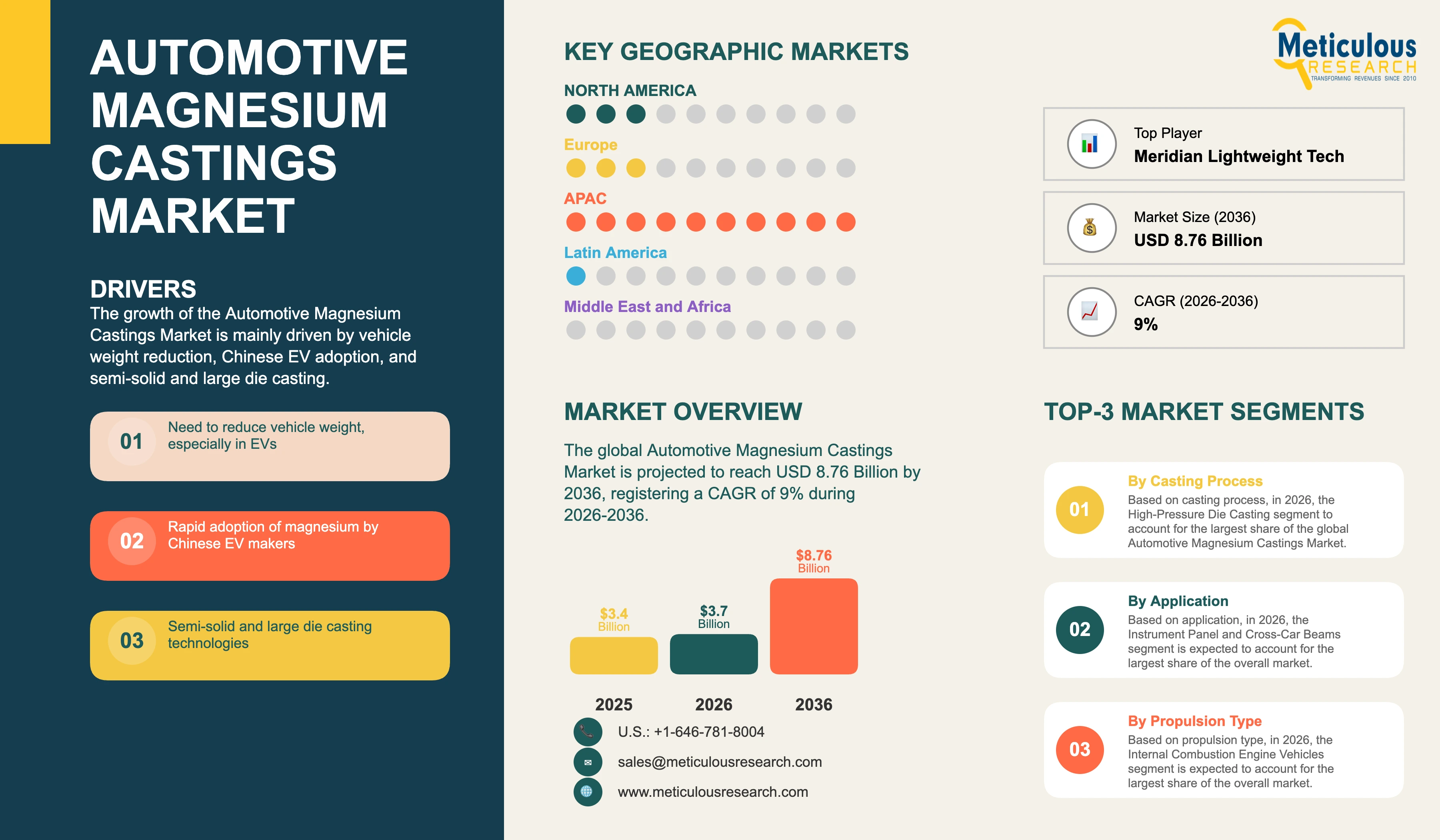
The global automotive magnesium castings market was valued at USD 3.40 billion in 2025. This market is expected to reach USD 8.76 billion by 2036 from an estimated USD 3.70 billion in 2026, registering a CAGR of 9.0% during the forecast period (2026-2036).
- Published
- Nov 2026
- Pages
- 266
- Format
- PDF + Excel
- Report ID
- MRAUTO - 1042893
- Base year
- 2025
- 2025 · BASELINE
- $3.40B
- 2036
- $8.76B
- CAGR 2026–2036
- 9.0%
2025 baseline · 2026–2036 forecast at 9.0% CAGR · hover a bar for the value
Key highlights
China produced about 950 thousand tons of the world's roughly 1.1 million tons of primary magnesium in 2025, or about 86% of the total, according to the U.S. Geological Survey. The USGS also estimates that about 69% of primary magnesium consumed in the U.S. in 2025 went into castings, mainly for the automotive industry, showing the importance of vehicles as a market for magnesium.
Chinese vehicle makers and casting suppliers are moving magnesium from small interior parts into large structural and electric drive parts. Deli Tech and Li Auto produced a one-piece magnesium alloy rear floor sample on a Bühler 9,200-ton die casting machine in September 2026, and Guangdong Hongtu and SAIC-GM-Wuling trial-produced a magnesium electric drive housing on a 4,000-ton machine, according to the companies.
Semi-solid magnesium casting has moved from trial production into mass production at several suppliers in China. A semi-solid magnesium alloy instrument panel cross-car beam entered mass production for Seres' AITO models, and Chongqing Boao has set up a magnesium alloy division with new die casting plants in Anhui and Chongqing covering machines from 650 to 7,000 tons, according to the companies.
Leapmotor issued a call for suppliers of magnesium alloy electric drive castings in March 2026, according to Leapmotor, showing that mainstream Chinese electric vehicle makers are adopting magnesium for powertrain parts. Dongguan Eontec, known as Yian Technology, operates magnesium die casting lines from 650 to 4,200 tons and is engaging customers on a 6,100-ton machine, according to the company.
Meridian Lightweight Technologies, which has been die casting magnesium since 1981, describes itself as the world's largest producer of magnesium components and the leading supplier of magnesium die cast components and assemblies to the global automotive market, according to Meridian.
Leading suppliers include Meridian Lightweight Technologies, Dongguan Eontec, Guangdong Hongtu Technology, Baowu Magnesium Technology, Spartan Light Metal Products, Dynacast, and Pace Industries. Semi-solid casting is the fastest-growing casting process, and body and structural components is the fastest-growing application, as magnesium moves into larger parts.
By casting process, high-pressure die casting accounts for the largest share of 74.0% in 2026, while semi-solid casting registers the highest CAGR.
By application, instrument panel and cross-car beams account for the largest share in 2026, while body and structural components register the highest CAGR.
By propulsion type, internal combustion engine vehicles account for the largest share in 2026, while battery electric vehicles register the highest CAGR.
By vehicle type, passenger cars account for the larger share of 91.0% in 2026 and also register the higher CAGR.
By geography, Asia-Pacific accounts for the largest share of 58.0% in 2026, while Asia-Pacific registers the highest CAGR of 10.5%.
Report summary
| Particulars | Details |
|---|---|
| Base Year | 2025 |
| Estimated Year | 2026 |
| Forecast Period | 2026-2036 |
| Market Size in 2025 | USD 3.40 billion |
| Market Size in 2026 | USD 3.70 billion |
| Market Size by 2036 | USD 8.76 billion |
| CAGR (2026-2036) | 9.0% |
| Format | PDF, Excel & Cloud Portal · 266 pages |
| Largest Segment by Casting Process (2026) | High-Pressure Die Casting (74.0%) |
| Largest Segment by Vehicle Type (2026) | Passenger Cars (91.0%) |
| Largest Region (2026) | Asia-Pacific (58.0%) |
| Fastest-Growing Region | Asia-Pacific (CAGR 10.5%) |
| Companies Profiled | 7 companies and other companies |
| Segments Covered | Casting Process, Application, Propulsion Type, Vehicle Type, Geography |
| Countries Covered | U.S., Canada, Mexico, Germany, France, U.K., Spain, Italy, Sweden, Czech Republic, Poland, Slovakia, Hungary, Austria, Rest of Europe, China, Japan, South Korea, India, Thailand, Indonesia, Malaysia, Vietnam, Taiwan, Australia, Rest of Asia-Pacific, Brazil, Argentina, Chile, Colombia, Rest of Latin America, Turkey, Morocco, South Africa, Saudi Arabia, UAE, Israel, Rest of Middle East & Africa |
Report overview
Segments covered: casting process, application, propulsion type, vehicle type.
Automotive magnesium castings are vehicle parts made by injecting or pouring molten magnesium alloy into molds. Magnesium is the lightest structural metal, about one-third lighter than aluminum and three-quarters lighter than steel, which makes magnesium castings attractive for reducing vehicle weight. They are used in instrument panel cross-car beams, steering wheel frames, seat frames, transmission and electric drive housings, display and center console housings, and, increasingly, larger body and structural parts, such as rear floors, shock towers, and door inner frames.
The growth of this market is mainly driven by the need to reduce vehicle weight, especially in electric vehicles, where heavy batteries reduce driving range, the fast growth of electric vehicle production in China, where vehicle makers are actively replacing aluminum and steel parts with magnesium, the development of semi-solid casting and large die casting machines that allow larger and higher-quality magnesium parts, the falling price of magnesium compared with aluminum, and government policies in China that promote the use of magnesium in vehicles. In addition, the ability to combine many parts into one magnesium casting reduces assembly costs. However, concentration of primary magnesium supply in China, concerns about corrosion and fire risk during production, and the higher cost of magnesium parts compared with steel in some uses are expected to restrain the growth of this market to some extent.
Magnesium has been used in vehicles for many decades, from the engine and transmission parts of early Volkswagen Beetles to modern instrument panel beams and steering wheel frames. Today, most automotive magnesium castings are made by high-pressure die casting, in which molten magnesium alloy, such as AZ91D or AM60B, is injected into steel dies at high speed and pressure. Magnesium flows well into thin sections and fills complex shapes, which allows designers to combine many steel parts into one lightweight casting. Magnesium castings also absorb vibration well and can be machined quickly, which makes them suitable for housings and structural parts.
This report covers the global automotive magnesium castings market, including magnesium castings made by high-pressure die casting, semi-solid casting, and other casting processes, used in instrument panel and cross-car beams, powertrain and electric drive housings, seat frames and interior structures, steering and wheel components, body and structural components, and display housings and other applications, for internal combustion engine vehicles, battery electric vehicles, and hybrid vehicles, and for passenger cars and commercial vehicles. The market is valued at the selling price of finished magnesium castings supplied to vehicle makers and system suppliers. The market is analyzed by casting process, application, propulsion type, vehicle type, and geography. Magnesium alloy ingots, wrought magnesium products, and magnesium used as an alloying element in aluminum are not included.
The amount of magnesium used per vehicle varies widely by vehicle maker, vehicle segment, and region. Most vehicles today use only a few kilograms of magnesium, mainly in steering wheel frames, instrument panel beams, seat frames, and small housings, while some vehicles use 10 kilograms or more. China's Technology Roadmap for Energy-Saving and New Energy Vehicles sets targets for increasing magnesium use per vehicle, and Chinese vehicle makers are now testing and adopting magnesium in much larger parts, such as rear floors, electric drive housings, and door frames. This shift could increase magnesium use per vehicle sharply over the forecast period.
Semi-solid casting is one of the most important technical changes in the market. In semi-solid casting, including thixomolding and rheocasting, magnesium is injected in a partly solid state rather than as a fully liquid metal, which reduces porosity, improves strength and dimensional accuracy, and allows thinner walls. Semi-solid casting also reduces the fire risk associated with handling molten magnesium. A semi-solid magnesium instrument panel cross-car beam has entered mass production for Seres' AITO models, according to the companies, and several Chinese suppliers are building semi-solid casting lines.
The market includes specialized magnesium die casters and general die casting companies with magnesium capabilities. Meridian Lightweight Technologies, owned by China's Wanfeng Auto Holding, is the largest global supplier, with plants in North America, Europe, and China. In China, Dongguan Eontec, Guangdong Hongtu Technology, Baowu Magnesium Technology, and other companies are expanding magnesium die casting capacity for Chinese electric vehicle makers. In North America, Spartan Light Metal Products and Pace Industries produce magnesium castings, and Dynacast produces small precision magnesium and zinc die castings.
The global supply of primary magnesium is highly concentrated in a single country, which shapes this market. China produced about 86% of the world's primary magnesium in 2025, according to the U.S. Geological Survey, and the U.S. had no primary production after its only smelter in Utah stopped in 2022, with its operator filing for bankruptcy in 2025, according to the USGS. This concentration gives Chinese casting suppliers an advantage in material cost and supply, while casting suppliers in other regions depend on imports and recycled magnesium. Supply concentration is a concern for vehicle makers in Europe and North America, which have experienced magnesium shortages and price spikes in the past.
In 2026, high-pressure die casting accounts for the largest share of the market by casting process, while semi-solid casting is the fastest-growing casting process. Instrument panel and cross-car beams account for the largest share by application, while body and structural components is the fastest-growing application. Internal combustion engine vehicles account for the largest share by propulsion type, while battery electric vehicles are the fastest-growing propulsion type. Passenger cars account for the largest share by vehicle type and are also the fastest-growing vehicle type. Asia-Pacific accounts for the largest share of the market and is also the fastest-growing region.
Market growth over the forecast period will depend on electric vehicle production, the adoption of magnesium in large structural and electric drive parts, the development of semi-solid and large die casting technologies, magnesium prices compared with aluminum, corrosion protection and joining technologies, and supply security for primary magnesium. The concentration of growth in China and supply risks outside China will shape regional growth. Overall, the market is expected to grow much faster than vehicle production through 2036, driven by rising magnesium content per vehicle.
Passenger cars are expected to account for the largest share of 91.0% of the market in 2026 and are also projected to register the higher CAGR, driven by electric passenger cars and larger magnesium parts.
Asia-Pacific is expected to account for the largest share of 58.0% of the market in 2026, mainly due to China's dominance in primary magnesium supply and the rapid adoption of magnesium by Chinese electric vehicle makers.
Asia-Pacific is also projected to register the highest CAGR of 10.5% during the forecast period, driven by electric vehicle production in China and large investments in semi-solid and large die casting capacity.
The report profiles 7 companies, including Meridian Lightweight Technologies, Dongguan Eontec, Guangdong Hongtu Technology, Baowu Magnesium Technology, Spartan Light Metal Products, Dynacast, and Pace Industries.
Magnesium is the lightest structural metal, about one-third lighter than aluminum, and it can be cast into thin, complex shapes that combine many parts into one, which reduces weight and assembly costs.
Semi-solid casting injects magnesium in a partly solid state rather than as a fully molten metal, which reduces porosity, improves strength and accuracy, and lowers fire risk, allowing magnesium to be used in structural parts.
Report infographic
Market dynamics
17 factors across 5 forcesNeed to reduce vehicle weight, especially in electric vehicles
Electric vehicles are much heavier than comparable conventional vehicles because of their large batteries, and every kilogram of weight reduces driving range or requires a larger battery. Vehicle makers therefore look for ways to reduce weight in the body, interior, and powertrain. Magnesium is the lightest structural metal, about one-third lighter than aluminum and three-quarters lighter than steel, which makes it one of the most effective materials for weight reduction. Replacing a steel instrument panel beam with a magnesium casting, for example, can reduce weight by several kilograms.
Global electric car sales topped 20 million units in 2025, according to the IEA, and electric vehicles are expected to account for a growing share of new vehicle sales over the forecast period. Conventional vehicles also need weight reduction to meet fuel economy and carbon dioxide emission standards in many markets. Battery electric vehicles are the fastest-growing propulsion type in this market, supported by the strong need to reduce weight and the willingness of electric vehicle makers to adopt new materials.
Rapid adoption of magnesium by Chinese electric vehicle makers
Chinese electric vehicle makers are adopting magnesium faster than vehicle makers in other regions, supported by China's dominant position in magnesium production, lower magnesium prices, government policies that promote magnesium use, and the willingness of Chinese vehicle makers to adopt new technologies quickly. Chinese casting suppliers report orders and trial production for magnesium instrument panel beams, seat frames, display housings, electric drive housings, and large structural parts from vehicle makers such as Seres, Li Auto, Leapmotor, SAIC-GM-Wuling, and others, according to the companies.
Leapmotor issued a call for suppliers of magnesium alloy electric drive castings in March 2026, and Deli Tech and Li Auto produced a one-piece magnesium rear floor sample in September 2026, according to the companies. This rapid adoption is creating large new demand for magnesium castings in China and is pushing casting suppliers to build new capacity. Asia-Pacific is the largest and fastest-growing region in this market, driven mainly by China.
Development of semi-solid and large die casting technologies
Traditional high-pressure magnesium die castings can contain porosity that limits their strength and prevents heat treatment, which has restricted their use in structural parts. Semi-solid casting, in which magnesium is injected in a partly solid state, reduces porosity, improves strength and accuracy, and reduces fire risk, which allows magnesium to be used in more demanding parts. At the same time, large die casting machines of 4,000 tons or more allow large magnesium parts, such as rear floors and electric drive housings, to be cast in one piece.
Chinese casting suppliers are investing heavily in semi-solid and large die casting technologies to serve electric vehicle makers. Chongqing Boao is building new magnesium die casting plants with more than 20 lines from 650 to 7,000 tons and semi-solid forming technology, and Dongguan Eontec is engaging customers on a 6,100-ton machine, according to the companies. Semi-solid casting is the fastest-growing casting process in this market, and body and structural components is the fastest-growing application, supported by these technologies.
Favorable price of magnesium compared with aluminum
The use of magnesium depends strongly on its price compared with aluminum, which is its main competitor in lightweight castings. Because magnesium is about one-third lighter than aluminum, a magnesium part needs less metal by weight, so magnesium becomes cost-competitive when its price per ton is not much higher than aluminum's. Magnesium prices fell in recent years, and the ratio of magnesium to aluminum prices has been at a level that makes magnesium attractive for many parts in China, according to Chinese industry sources.
European magnesium prices also fell in 2025, with the annual average estimated at about 13% below 2024, according to the USGS. Lower and more stable magnesium prices encourage vehicle makers to replace aluminum and steel parts with magnesium, especially in China. If the price relationship remains favorable, magnesium use is expected to grow strongly, while price spikes, such as those seen in 2021, could slow adoption.
Part consolidation and lower assembly costs
Magnesium's ability to flow into thin, complex shapes allows designers to combine many stamped steel parts, brackets, and fasteners into one magnesium casting. For example, a magnesium instrument panel cross-car beam can replace a steel assembly made from dozens of stamped and welded parts, and a magnesium seat frame can replace a multi-part steel frame. This part consolidation reduces tooling, assembly, and logistics costs, which can offset the higher material cost of magnesium. Magnesium castings also have good dimensional stability, which improves the fit of interior parts and reduces noise and vibration. Large one-piece magnesium castings for rear floors and other body structures extend this benefit to body construction, in a similar way to large aluminum castings that many vehicle makers already use. Vehicle makers that adopt one-piece casting strategies for body structures may choose magnesium for some parts to achieve further weight savings beyond aluminum. As vehicle makers seek to simplify vehicle production and reduce costs, especially in electric vehicles, part consolidation through magnesium castings is expected to support steady market growth over the forecast period, especially in instrument panel beams, seat frames, and electric drive housings.
Table of contents
12 chapters · 177 sections · 266 pages · click to expandSegmental analysis
| Segment | Largest share (2026) | Fastest growth (2026–2036) |
|---|---|---|
| By Casting Process | Instrument panel and cross-car beams | Body and structural components |
By Casting Process
- The instrument panel and cross-car beams segment is expected to account for the largest share of the automotive magnesium castings market, while the body and structural components segment is projected to register the highest CAGR during the forecast period.
- The internal combustion engine vehicles segment is expected to account for the largest share of the automotive magnesium castings market, while the battery electric vehicles segment is projected to register the highest CAGR during the forecast period.
Geographic analysis
Asia-Pacific
Largest shareIn 2026, Asia-Pacific is expected to account for the largest share of 58.0% of the global automotive magnesium castings market. The large share of this region is mainly due to China's dominant position in primary magnesium production, which gives Chinese casting suppliers an advantage in material cost and supply, China's position as the largest producer of vehicles and electric vehicles in the world, the rapid adoption of magnesium by Chinese electric vehicle makers, government policies that promote magnesium use in vehicles, and the presence of large magnesium casting suppliers, such as Dongguan Eontec, Guangdong Hongtu Technology, and Baowu Magnesium Technology. China is the largest market in the region, followed by Japan and South Korea. Asia-Pacific is also projected to register the highest CAGR of 10.5% during the forecast period. The rapid growth of this region is mainly driven by the continued growth of electric vehicle production in China, the adoption of magnesium in large structural and electric drive parts, large investments in semi-solid and large die casting capacity by Chinese suppliers, and the expansion of Chinese vehicle makers' production to Southeast Asia. Japan and South Korea are also expected to grow as their vehicle makers seek weight reduction for electric vehicles, and India offers long-term potential as vehicle production rises. Southeast Asian countries, such as Thailand and Indonesia, may also see new magnesium casting capacity as Chinese vehicle makers and suppliers build plants there to serve local and export markets.
North America
North America accounts for a significant share of the market, supported by the long use of magnesium cross-car beams, steering wheel frames, and seat frames in North American vehicles, especially pickup trucks and SUVs, and the presence of magnesium casting suppliers, such as Meridian Lightweight Technologies, which has its roots in Ontario, Canada, Spartan Light Metal Products, and Pace Industries. The U.S. is the largest market in the region, followed by Canada and Mexico. However, the lack of primary magnesium production in the U.S. since 2022 and dependence on imports, according to the USGS, create supply risks that may limit growth.
Europe
Europe accounts for a significant share of the market, supported by the use of magnesium in premium vehicles produced by German vehicle makers, such as instrument panel structures, which the BMW Group has used since its 5 Series launched in 2016, according to the BMW Group, and the presence of magnesium casting plants, including Meridian's European operations. Germany is the largest market in the region, followed by France and the Czech Republic. However, Europe's dependence on Chinese magnesium and the experience of the 2021 supply crisis make European vehicle makers cautious, which limits growth compared with Asia-Pacific.
Latin America
Latin America and the Middle East and Africa account for small shares of the market. Brazil and Mexico use magnesium mainly in steering wheel frames and other small parts, while Turkey and Morocco produce vehicles for Europe with the same magnesium parts used in European models.
Competitive landscape
The global automotive magnesium castings market includes specialized magnesium die casting companies, general die casting companies with magnesium capabilities, and magnesium producers that also make castings. The market is moderately concentrated, with Meridian Lightweight Technologies holding a leading global position, while many Chinese suppliers are rapidly expanding capacity to serve Chinese electric vehicle makers. Competition is shifting toward suppliers that can produce large, high-quality structural castings with semi-solid and large die casting technologies.
Meridian Lightweight Technologies, owned by Wanfeng Auto Holding, describes itself as the world's largest producer of magnesium components, with magnesium die casting experience since 1981, according to Meridian. Dongguan Eontec operates magnesium die casting lines from 650 to 4,200 tons, according to the company. Guangdong Hongtu Technology produces magnesium electric drive housings and other castings, Baowu Magnesium Technology produces magnesium alloys and castings in China, Spartan Light Metal Products and Pace Industries produce magnesium castings in North America, and Dynacast produces small precision magnesium and zinc die castings.
Companies in this market compete mainly on casting quality, size and complexity of parts, alloy and process technology, corrosion protection and finishing capabilities, magnesium supply security, cost, production capacity, and relationships with vehicle makers. Key strategies in this market include investing in large die casting machines and semi-solid casting, developing high-strength and heat-resistant alloys, offering machining, coating, and assembly services, securing magnesium supply through integration with magnesium producers, and expanding production close to vehicle makers.
Recent competitive activity in this market has mainly focused on new capacity and large structural castings in China. Chongqing Boao established a magnesium alloy division with new plants in Anhui and Chongqing covering die casting machines from 650 to 7,000 tons, Deli Tech and Li Auto produced a one-piece magnesium rear floor sample on a 9,200-ton machine in September 2026, and Guangdong Hongtu and SAIC-GM-Wuling trial-produced a magnesium electric drive housing, according to the companies. Leapmotor issued a call for magnesium electric drive casting suppliers in March 2026.
We expect competition to increase over the forecast period as Chinese suppliers expand capacity and move into large structural castings, as aluminum die casters add magnesium capabilities, and as Chinese suppliers expand abroad. Suppliers with semi-solid and large die casting technology, advanced alloys, corrosion protection capabilities, secure magnesium supply, and strong relationships with electric vehicle makers are expected to strengthen their positions, while smaller suppliers focused on small parts may face strong price competition.
Some of the key players operating in the automotive magnesium castings market are Meridian Lightweight Technologies Inc., Dongguan Eontec Co., Ltd., Guangdong Hongtu Technology (Holdings) Co., Ltd., Baowu Magnesium Technology Co., Ltd., Spartan Light Metal Products, Dynacast International, and Pace Industries, among others.
- —
Deli Tech and Li Auto produced a one-piece magnesium rear floor in September 2026, Leapmotor sought magnesium electric drive casting suppliers in March 2026, and semi-solid magnesium cross-car beams entered mass production in China.
- Meridian Lightweight Technologies Inc.
- Dongguan Eontec Co., Ltd.
- Guangdong Hongtu Technology (Holdings) Co., Ltd.
- Baowu Magnesium Technology Co., Ltd.
- Spartan Light Metal Products
- Dynacast International
- Pace Industries
Expert perspectives
Automotive magnesium castings are entering a period of strong growth after decades of limited use in small interior parts. The need to reduce weight in electric vehicles, the rapid adoption of magnesium by Chinese vehicle makers, and new semi-solid and large die casting technologies are moving magnesium into larger and more valuable parts, such as electric drive housings and body structures.
Over the forecast period, the market is expected to grow at a CAGR of 9.0%, from USD 3.70 billion in 2026 to USD 8.76 billion in 2036. Growth will be driven by the need to reduce vehicle weight, the rapid adoption of magnesium by Chinese electric vehicle makers, semi-solid and large die casting technologies, the favorable price of magnesium compared with aluminum, and part consolidation. Supply concentration in China and higher costs compared with steel will limit growth to some extent.
Among the market segments, high-pressure die casting is the largest casting process, while semi-solid casting grows fastest. Instrument panel and cross-car beams is the largest application, while body and structural components grows fastest. Internal combustion engine vehicles are the largest propulsion type, while battery electric vehicles grow fastest. Passenger cars are the largest vehicle type and also grow fastest. Asia-Pacific is the largest region and is also the fastest-growing region, led by China.
In our view, China will drive most of the growth in this market. China's control of primary magnesium supply, its leadership in electric vehicles, and the willingness of Chinese vehicle makers to adopt new materials quickly give it a clear advantage. We expect Chinese vehicle makers to lead the use of magnesium in large structural and electric drive parts, while vehicle makers in other regions follow more slowly because of supply concerns and the need for long validation programs.
We also see supply security as the key issue for growth outside China. Without new primary magnesium production in North America and Europe or much greater use of recycled magnesium, vehicle makers in these regions will remain cautious. Investments in recycling, low-carbon magnesium, and new primary projects could change this balance over the forecast period, and vehicle makers' growing interest in local and low-carbon supply may help such projects move forward.
Overall, we believe that the automotive magnesium castings market will grow strongly over the forecast period from 2026 to 2036, with semi-solid casting, body and structural components, battery electric vehicles, passenger cars, and Asia-Pacific providing the fastest growth. Companies with semi-solid and large die casting technology, advanced alloys, corrosion protection capabilities, and secure magnesium supply will be best positioned to capture this growth.
Customer perspectives
“Switching our cross-car beam and seat frames to magnesium saved several kilograms per car. Now we are testing one-piece magnesium rear floors to cut even more weight.”
“A magnesium housing is about a third lighter than aluminum and damps vibration well. Semi-solid casting gives us the strength we need for electric drive housings.”
“Magnesium makes sense for weight, but almost all primary supply comes from China. We need recycled magnesium and more suppliers before we use much more of it.”
Frequently asked questions
The global automotive magnesium castings market was valued at USD 3.40 billion in 2025, up from USD 3.15 billion in 2024, and is estimated at USD 3.70 billion in 2026. The market includes high-pressure die castings, semi-solid castings, and other magnesium castings for vehicles.
The global automotive magnesium castings market is expected to reach USD 8.76 billion by 2036, driven by vehicle weight reduction, adoption by Chinese electric vehicle makers, semi-solid and large die casting, and part consolidation.
The market is expected to register a CAGR of 9.0% from 2026 to 2036, with the fastest growth in semi-solid casting, body and structural components, battery electric vehicles, passenger cars, and Asia-Pacific.
Market growth is mainly driven by the need to reduce vehicle weight, especially in electric vehicles, the rapid adoption of magnesium by Chinese electric vehicle makers, semi-solid and large die casting technologies, the favorable price of magnesium compared with aluminum, and part consolidation.
Concentration of primary magnesium supply in China and higher costs compared with steel restrain growth, while corrosion protection and joining with other metals and fire risk in production are key challenges.
Key growth opportunities include large structural magnesium castings for electric vehicle bodies, magnesium electric drive housings, recycled and low-carbon magnesium, and the expansion of magnesium castings outside China.
High-pressure die casting is expected to account for the largest share of 74.0% of the market in 2026, while semi-solid casting is projected to register the highest CAGR, driven by stronger, lower-porosity structural parts.
In 2026, the instrument panel and cross-car beams segment is expected to account for the largest share of the automotive magnesium castings market, while the body and structural components segment is projected to register the highest CAGR during the forecast period.
In 2026, the internal combustion engine vehicles segment is expected to account for the largest share of the automotive magnesium castings market, while the battery electric vehicles segment is projected to register the highest CAGR during the forecast period.
Passenger cars are expected to account for the largest share of 91.0% of the market in 2026 and are also projected to register the higher CAGR, driven by electric passenger cars and larger magnesium parts.
Asia-Pacific is expected to account for the largest share of 58.0% of the market in 2026, mainly due to China's dominance in primary magnesium supply and the rapid adoption of magnesium by Chinese electric vehicle makers.
Asia-Pacific is also projected to register the highest CAGR of 10.5% during the forecast period, driven by electric vehicle production in China and large investments in semi-solid and large die casting capacity.
The report profiles 7 companies, including Meridian Lightweight Technologies, Dongguan Eontec, Guangdong Hongtu Technology, Baowu Magnesium Technology, Spartan Light Metal Products, Dynacast, and Pace Industries.
Deli Tech and Li Auto produced a one-piece magnesium rear floor in September 2026, Leapmotor sought magnesium electric drive casting suppliers in March 2026, and semi-solid magnesium cross-car beams entered mass production in China.
Magnesium is the lightest structural metal, about one-third lighter than aluminum, and it can be cast into thin, complex shapes that combine many parts into one, which reduces weight and assembly costs.
Semi-solid casting injects magnesium in a partly solid state rather than as a fully molten metal, which reduces porosity, improves strength and accuracy, and lowers fire risk, allowing magnesium to be used in structural parts.
Cite this report
Meticulous Research. (2026). Automotive Magnesium Castings Market - Global Opportunity Analysis and Industry Forecast (2026-2036) (Report No. MRAUTO - 1042893). Meticulous Market Research Pvt. Ltd. https://www.meticulousresearch.com/product/automotive-magnesium-castings-market-7576