Automotive Inertial Measurement Units Market (2026-2036)
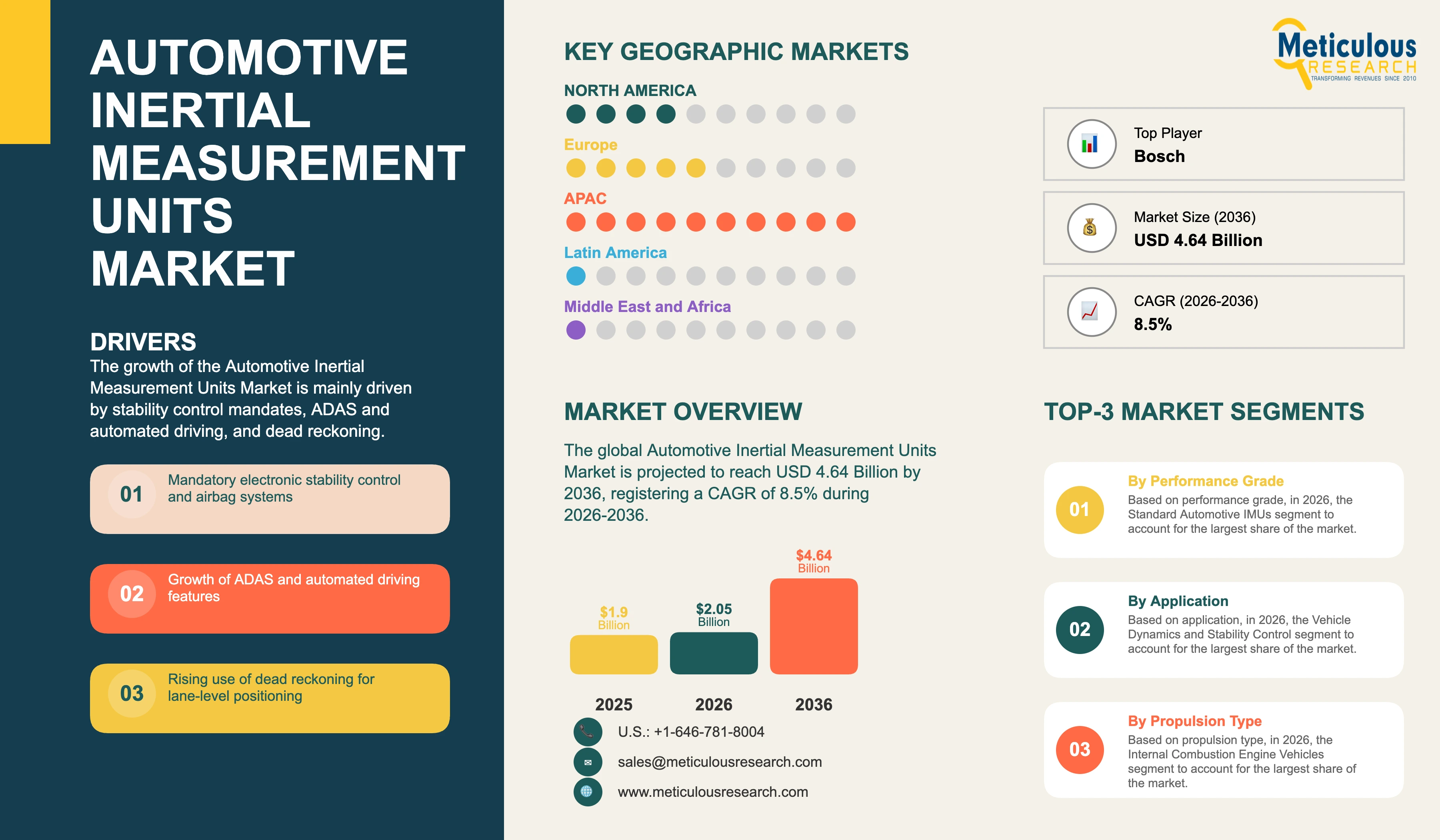
The global automotive inertial measurement units market was valued at USD 1.90 billion in 2025. This market is expected to reach USD 4.64 billion by 2036 from an estimated USD 2.05 billion in 2026, registering a CAGR of 8.5% during the forecast period (2026-2036).
- Published
- Nov 2026
- Pages
- 264
- Format
- PDF + Excel
- Report ID
- MRAUTO - 1042886
- Base year
- 2025
- 2025 · BASELINE
- $1.90B
- 2036
- $4.64B
- CAGR 2026–2036
- 8.5%
2025 baseline · 2026–2036 forecast at 8.5% CAGR · hover a bar for the value
Key highlights
STMicroelectronics launched the ASM330LHHG1 automotive IMU in June 2026, according to STMicroelectronics. The AEC-Q100-qualified device combines a 3-axis accelerometer and 3-axis gyroscope with a 6-channel synchronized output that improves dead reckoning accuracy between satellite updates and during satellite signal outages. It operates from -40°C to 125°C, comes in a 2.5 mm x 3.0 mm package, and is already in production.
STMicroelectronics also introduced the ASM330LHHXG1 automotive IMU with in-sensor AI, which draws less than 800 µA with both sensors running and targets navigation assistance, telematics, theft prevention, and motion-activated functions, according to STMicroelectronics. The company's ASM330LHBG1 IMU is ASIL B-ready when used with a certified software library for safety-related functions.
Bosch offers the SMU300, a 6-channel high-performance IMU designed for automated driving and precise localization, developed according to ISO 26262 for safety targets up to ASIL D, according to Bosch. Bosch also supplies the SMI970 combined inertial sensor for electronic stability control, rollover sensing, and ADAS, and the SMI980 low-noise inertial sensor for inertial navigation and autonomous vehicles.
Bosch states that when surround sensors cannot provide enough detail for exact localization or when the satellite connection is disrupted, the IMU calculates the vehicle's relative change in position so that the automated driving system can stay active. This explains why high-performance IMUs are becoming a standard part of the localization stack for L2+ and L3 driving functions.
Global electric car sales topped 20 million units in 2025, according to the IEA. Electric vehicles, especially Chinese models, often offer advanced driver assistance and navigate-on-autopilot functions as standard, which increases the use of high-performance IMUs per vehicle compared with many conventional vehicles.
Leading suppliers include Bosch, STMicroelectronics, Murata Manufacturing, TDK InvenSense, Analog Devices, Seiko Epson, and ACEINNA. ADAS and automated driving localization is the fastest-growing application, and high-performance IMUs are the fastest-growing performance grade, as vehicle makers add hands-off and eyes-off driving features that need precise, safety-rated motion data. Murata Manufacturing, TDK InvenSense, and Analog Devices also supply automotive-grade inertial sensors for safety and navigation uses.
By performance grade, standard automotive IMUs account for the larger share of 68.0% in 2026, while high-performance IMUs register the higher CAGR.
By application, vehicle dynamics and stability control accounts for the largest share in 2026, while ADAS and automated driving localization registers the highest CAGR.
By propulsion type, internal combustion engine vehicles account for the largest share in 2026, while battery electric vehicles register the highest CAGR.
By vehicle type, passenger cars account for the larger share of 88.0% in 2026, while commercial vehicles register the higher CAGR.
By geography, Asia-Pacific accounts for the largest share of 48.0% in 2026, while Asia-Pacific registers the highest CAGR of 9.6%.
Report summary
| Particulars | Details |
|---|---|
| Base Year | 2025 |
| Estimated Year | 2026 |
| Forecast Period | 2026-2036 |
| Market Size in 2025 | USD 1.90 billion |
| Market Size in 2026 | USD 2.05 billion |
| Market Size by 2036 | USD 4.64 billion |
| CAGR (2026-2036) | 8.5% |
| Format | PDF, Excel & Cloud Portal · 264 pages |
| Largest Segment by Performance Grade (2026) | Standard Automotive IMUs (68.0%) |
| Largest Segment by Vehicle Type (2026) | Passenger Cars (88.0%) |
| Largest Region (2026) | Asia-Pacific (48.0%) |
| Fastest-Growing Region | Asia-Pacific (CAGR 9.6%) |
| Companies Profiled | 7 companies and other companies |
| Segments Covered | Performance Grade, Application, Propulsion Type, Vehicle Type, Geography |
| Countries Covered | U.S., Canada, Mexico, Germany, France, U.K., Spain, Italy, Sweden, Czech Republic, Poland, Slovakia, Hungary, Netherlands, Rest of Europe, China, Japan, South Korea, India, Thailand, Indonesia, Malaysia, Vietnam, Taiwan, Australia, Rest of Asia-Pacific, Brazil, Argentina, Chile, Colombia, Rest of Latin America, Turkey, Morocco, South Africa, Saudi Arabia, UAE, Israel, Rest of Middle East & Africa |
Report overview
Segments covered: performance grade, application, propulsion type, vehicle type.
An automotive inertial measurement unit (IMU) combines accelerometers and gyroscopes, usually built as MEMS chips, to measure the acceleration and rotation of a vehicle along several axes. Vehicles use these sensors to keep the car stable through electronic stability control, to decide when to fire airbags and detect rollovers, to estimate position when satellite signals are lost in tunnels and cities, and, in newer vehicles, to give the automated driving computer a precise and safe measure of vehicle motion for localization and path planning.
The growth of this market is mainly driven by the mandatory fitment of electronic stability control in most major vehicle markets, the rapid growth of ADAS and automated driving features that need high-performance IMUs for precise localization, the growing use of dead reckoning to support lane-level satellite positioning, the growth of electric vehicles, which often carry more advanced driver assistance and navigation features, and the move toward central computers that use one high-quality motion sensor for several vehicle functions. In addition, connected car services, such as telematics, crash detection, and theft alerts, are adding inertial sensors to more vehicle modules. However, strong price pressure on standard sensors, the long and costly safety qualification of new IMUs, and the slow rollout of higher levels of automated driving are expected to restrain the growth of this market to some extent.
Inertial sensors have been used in vehicles since the 1990s, first in airbag control units to detect crashes and then in electronic stability control systems, which use yaw rate sensors and accelerometers to detect skidding and brake individual wheels to keep the car on its intended path. Over time, single-axis gyroscopes and accelerometers have been combined into multi-axis IMUs that measure acceleration along three axes and rotation around three axes in one small package. Most automotive IMUs today are made with MEMS technology, which etches tiny moving structures into silicon and allows the sensors to be produced in very large volumes at low cost, with the accuracy and temperature range that vehicles need.
This report covers the global automotive inertial measurement units market, including standard automotive IMUs and combined inertial sensors used for vehicle dynamics and stability control, airbag and rollover sensing, navigation and dead reckoning, and telematics, and high-performance IMUs used for ADAS and automated driving localization. The market is valued at the selling price of IMUs and combined inertial sensors supplied to vehicle makers and their system suppliers, such as brake, airbag, navigation, telematics, and automated driving computer suppliers. The market is analyzed by performance grade, application, propulsion type, vehicle type, and geography. Single-axis accelerometers used only for crash detection in satellite sensors, GNSS receivers, and complete navigation systems are not included.
A single vehicle can contain several inertial sensors placed in different control units across the vehicle. The brake control unit or a separate sensor cluster carries the inertial sensor used for electronic stability control, the airbag control unit carries sensors for crash and rollover detection, and the navigation unit or telematics control unit often carries a 6-axis IMU for dead reckoning and crash detection. Vehicles with advanced driver assistance and automated driving features add a high-performance IMU, usually inside the central ADAS computer or a dedicated localization unit, which is fused with satellite positioning, cameras, radar, and high-definition maps to estimate the exact position and heading of the vehicle.
The performance and safety requirements for automotive IMUs differ sharply from one application to another. Sensors for stability control and airbags must meet high functional safety levels, often up to ASIL D under ISO 26262, and must work reliably through strong vibration, but they do not need very low drift over long periods. Sensors for navigation and dead reckoning must keep their bias and noise low so that position errors grow slowly while satellite signals are lost. High-performance IMUs for automated driving must combine both: very low noise and drift for precise localization and high safety ratings because the driving system relies on them when a human is not supervising. These different needs create a clear split between standard and high-performance products.
The market is led by large semiconductor and sensor companies with strong MEMS manufacturing capabilities. Bosch is the largest supplier of automotive inertial sensors, with a broad range from the SMI970 for stability control to the SMU300 for automated driving, according to Bosch. STMicroelectronics supplies a broad family of automotive IMUs, including the ASM330 series, Murata Manufacturing supplies high-stability inertial sensors used in safety and ADAS applications, TDK InvenSense and Analog Devices supply automotive-grade motion sensors, Seiko Epson supplies automotive gyroscope sensors, and ACEINNA supplies inertial navigation systems for ADAS and automated driving.
The market is also changing as vehicle electronics move from many separate control units to a few central computers. Vehicle makers increasingly want one high-quality IMU that can serve several functions, such as stability control, navigation, and automated driving, instead of separate sensors in each control unit. At the same time, high-performance IMUs are becoming more affordable, which allows them to move from premium vehicles with hands-off driving into mainstream vehicles with navigate-on-autopilot features in China and highway assist features in other markets. This shift raises the average value of inertial sensors per vehicle, even as prices of standard sensors continue to fall.
In 2026, standard automotive IMUs account for the largest share of the market by performance grade, while high-performance IMUs are the fastest-growing grade. Vehicle dynamics and stability control accounts for the largest share by application, while ADAS and automated driving localization is the fastest-growing application. Internal combustion engine vehicles account for the largest share by propulsion type, while battery electric vehicles are the fastest-growing propulsion type. Passenger cars account for the largest share by vehicle type, while commercial vehicles are the fastest-growing vehicle type. Asia-Pacific accounts for the largest share of the market and is also the fastest-growing region.
Market growth over the forecast period will depend on vehicle production, the adoption of L2+ and L3 driving features, the share of vehicles with lane-level navigation and telematics, the pace of central computing architectures, and price trends for standard and high-performance sensors. Strong price competition in standard IMUs will limit value growth in that segment, while the spread of high-performance IMUs for automated driving will add more value per vehicle. Overall, the market is expected to grow faster than vehicle production through 2036, as each vehicle carries more and better inertial sensing.
Passenger cars are expected to account for the largest share of 88.0% of the market in 2026, while commercial vehicles are projected to register the higher CAGR, driven by stability control rules, fleet telematics, and automated trucking.
Asia-Pacific is expected to account for the largest share of 48.0% of the market in 2026, mainly due to China's large vehicle production and the fast adoption of navigate-on-autopilot features by Chinese electric vehicle makers.
Asia-Pacific is also projected to register the highest CAGR of 9.6% during the forecast period, driven by high-performance IMUs in China and the spread of stability control in India and Southeast Asia.
The report profiles 7 companies, including Bosch, STMicroelectronics, Murata Manufacturing, TDK InvenSense, Analog Devices, Seiko Epson, and ACEINNA.
High-performance IMUs measure vehicle motion with very low noise and drift, so the driving system can keep track of its position and heading when cameras are blinded or satellite signals are lost, and can continue safely if another sensor fails.
A GNSS receiver measures absolute position from satellite signals, while an IMU measures acceleration and rotation. Combining both gives continuous, accurate positioning, as the IMU fills gaps when satellite signals are blocked.
Report infographic
Market dynamics
17 factors across 5 forcesMandatory electronic stability control and airbag systems
Electronic stability control is mandatory for new passenger cars in the U.S., the EU, China, Japan, South Korea, Australia, and many other markets, and it is spreading to more vehicles in India, Southeast Asia, and Latin America through national rules and safety rating programs, such as Bharat NCAP and Latin NCAP. Every stability control system needs an inertial sensor that measures yaw rate and lateral acceleration, and many systems now also measure roll rate and vertical acceleration for rollover protection and hill-hold functions. Airbag systems, which are fitted to almost every new vehicle, also use inertial sensors to detect crashes and rollovers.
Because these safety systems are fitted to almost every new vehicle, they create a large and steady base of demand for automotive inertial sensors that grows with vehicle production. As stability control spreads to entry-level vehicles in emerging markets and to commercial vehicles, such as trucks and buses, where rules are being extended, demand for combined inertial sensors continues to grow. Vehicle dynamics and stability control is the largest application in this market, supported by this broad legal requirement and by the high safety ratings that these sensors must meet under ISO 26262.
Growth of ADAS and automated driving features
Vehicle makers are quickly adding L2+ driving features, such as hands-off highway driving and navigate-on-autopilot, and are starting to offer L3 eyes-off driving in some markets under rules such as UN R157. These features need to know the exact position, heading, and motion of the vehicle at all times, including when cameras are blinded by glare or when satellite signals are blocked. High-performance IMUs provide this motion data with very low noise and drift, and they allow the driving system to continue safely for a short time if other sensors fail, which is a key requirement for systems that operate without human supervision.
Bosch states that when surround sensors and satellite signals are not enough for exact localization, the IMU calculates the vehicle's change in position so that the automated driving system can stay active, according to Bosch. Bosch's SMU300 and SMI980 sensors, and similar products from other suppliers, are designed for this use and are developed for safety targets up to ASIL D. ADAS and automated driving localization is the fastest-growing application in this market, and high-performance IMUs are the fastest-growing performance grade, as these driving features spread from premium vehicles to mainstream models.
Rising use of dead reckoning for lane-level positioning
Navigation, lane guidance, and connected services increasingly need lane-level positioning, which multi-band satellite receivers can now provide in open sky. However, satellite signals are often blocked or reflected in tunnels, parking garages, and city streets between tall buildings. Dead reckoning uses IMU data, together with wheel speed, to estimate the vehicle's position during these outages and to smooth position updates between satellite fixes. STMicroelectronics' ASM330LHHG1, launched in June 2026, uses a 6-channel synchronized output and built-in temperature compensation to improve dead reckoning accuracy for navigation and satellite positioning fusion, according to STMicroelectronics.
As more vehicles use lane-level navigation, high-precision positioning for driver assistance, and connected services that depend on accurate location, such as usage-based insurance and fleet tracking, the use of IMUs for dead reckoning is growing. Navigation and telematics units that once used single gyroscopes now use 6-axis IMUs to improve accuracy, which adds value per vehicle. Navigation and dead reckoning is a major and steadily growing application in this market, supported by the spread of multi-band satellite receivers and higher accuracy expectations from drivers and vehicle makers.
Growth of electric vehicles
Global electric car sales topped 20 million units in 2025, according to the IEA, and electric vehicles are expected to account for a growing share of new vehicle sales over the forecast period. Electric vehicles, especially those from Chinese makers, often include advanced driver assistance, automated parking, and navigate-on-autopilot features as standard, along with connected services and over-the-air updates. These features need more and better inertial sensing than basic stability control alone, which raises the value of IMUs per electric vehicle compared with many entry-level conventional vehicles.
Electric vehicle platforms are also often designed from the start with central computers and zonal architectures, which makes it easier to add a high-performance IMU that serves several functions. In addition, electric vehicles use inertial sensors for new functions, such as torque vectoring between individual electric motors and precise traction control. Battery electric vehicles are the fastest-growing propulsion type in this market, driven by these higher sensor needs and by the rapid growth of electric vehicle production in China, Europe, and other markets.
Move to central computers and shared motion sensing
Vehicle makers are moving from many separate control units to a few central computers and zonal controllers, which changes how inertial sensors are used. Instead of placing a separate inertial sensor in the brake unit, the airbag unit, the navigation unit, and the driver assistance computer, vehicle makers increasingly want one or two high-quality IMUs that share their data across several functions. This approach reduces wiring and the number of parts, but it requires sensors with both high performance and high safety ratings, which increases the value of each sensor. Suppliers are responding with safety-rated, high-performance IMUs and with redundant sensor designs that can serve both safety and localization functions. The shift also favors suppliers that can provide software, calibration, and sensor fusion support along with the sensor itself, as vehicle makers want complete motion sensing solutions that fit into their central computing platforms. As central computing architectures spread from premium electric vehicles to mainstream models over the forecast period, this trend is expected to support steady growth in the value of IMUs per vehicle and in demand for high-performance IMUs in particular.
Table of contents
12 chapters · 168 sections · 264 pages · click to expandSegmental analysis
| Segment | Largest share (2026) | Fastest growth (2026–2036) |
|---|---|---|
| By Performance Grade | Vehicle dynamics and stability control | ADAS and automated driving localization |
By Performance Grade
- The vehicle dynamics and stability control segment is expected to account for the largest share of the automotive inertial measurement units market, while the ADAS and automated driving localization segment is projected to register the highest CAGR during the forecast period.
- The internal combustion engine vehicles segment is expected to account for the largest share of the automotive inertial measurement units market, while the battery electric vehicles segment is projected to register the highest CAGR during the forecast period.
Geographic analysis
Asia-Pacific
Largest shareIn 2026, Asia-Pacific is expected to account for the largest share of 48.0% of the global automotive inertial measurement units market. The large share of this region is mainly due to China's position as the largest vehicle producer in the world, the fast adoption of navigate-on-autopilot and other advanced driver assistance features by Chinese electric vehicle makers, the large vehicle production of Japan, South Korea, and India, the mandatory fitment of stability control in China, Japan, South Korea, and Australia, and the presence of MEMS makers and sensor module suppliers in Japan, China, and Taiwan. China is the largest market in the region, followed by Japan and South Korea. Asia-Pacific is also projected to register the highest CAGR of 9.6% during the forecast period. The rapid growth of this region is mainly driven by the continued spread of high-performance IMUs for navigate-on-autopilot features in China, the growth of electric vehicle production in China and other countries in the region, the spread of stability control and more airbags in India and Southeast Asia, supported by Bharat NCAP and ASEAN NCAP, and the growth of lane-level navigation and connected services. India is expected to be one of the fastest-growing countries, supported by rising vehicle production and stronger safety rules. Southeast Asian countries, such as Thailand, Indonesia, and Vietnam, are also adding stability control and driver assistance to more locally built vehicles, and Chinese vehicle makers are building plants in the region, which brings their sensor-rich electric vehicle designs to new markets.
Europe
Europe accounts for a significant share of the market, supported by mandatory stability control and the EU General Safety Regulation, the production of premium vehicles with hands-off and eyes-off driving features, early approvals of L3 driving under UN R157 in Germany, and the presence of leading inertial sensor suppliers, such as Bosch and STMicroelectronics, which design and produce MEMS sensors in Germany, Italy, and France. Germany is the largest market in the region, followed by France, Spain, and the Czech Republic. The region's growth is supported by Euro NCAP requirements that reward advanced driver assistance features, although slower vehicle production limits growth.
North America
North America accounts for a significant share of the market, supported by the large production of SUVs and pickup trucks with stability control, rollover protection, and advanced driver assistance, the early adoption of hands-off highway driving by U.S. vehicle makers, and automated trucking and robotaxi projects in the U.S., which use high-performance IMUs. The U.S. is the largest market in the region, followed by Mexico and Canada. Mexico is also an important production base for vehicles and electronic modules supplied to the U.S. market.
Latin America
Latin America and the Middle East and Africa account for smaller shares but are growing as stability control and airbag rules spread to more countries. Brazil is the largest market in Latin America, while Turkey, Morocco, and South Africa are important vehicle production hubs in the Middle East and Africa, supplying vehicles to Europe and local markets with the same safety systems used in European models.
Competitive landscape
The global automotive inertial measurement units market includes large semiconductor and MEMS sensor companies that supply standard and high-performance automotive IMUs and combined inertial sensors, along with specialized companies that supply inertial navigation systems for ADAS and automated driving. The market is fairly concentrated, as automotive inertial sensors need large MEMS production capacity, strong functional safety processes, and long records of reliable supply to vehicle makers and system suppliers. Bosch holds a leading position, especially in sensors for stability control and airbags, while several other suppliers compete strongly in navigation, telematics, and ADAS applications.
Bosch is the leading supplier of automotive inertial sensors, with products such as the SMI970 for stability control, rollover sensing, and ADAS, the SMI980 for inertial navigation and autonomous vehicles, and the SMU300 high-performance IMU for automated driving, according to Bosch. STMicroelectronics supplies the ASM330 family of automotive IMUs, including the ASM330LHHG1, ASM330LHHXG1, and ASIL B-ready ASM330LHBG1. Murata Manufacturing supplies high-stability inertial sensors for safety and ADAS, TDK InvenSense and Analog Devices supply automotive-grade motion sensors, Seiko Epson supplies automotive gyroscope sensors, and ACEINNA supplies inertial navigation systems for ADAS.
Companies in this market compete mainly on sensor accuracy, noise, drift, temperature stability, functional safety level, reliability, size, power use, price, and the quality of software and calibration support. Key strategies in this market include launching high-performance, safety-rated IMUs for automated driving, adding synchronized outputs and in-sensor processing, expanding MEMS production capacity, partnering with satellite receiver makers and positioning software developers, and offering long product support periods and complete reference designs to vehicle makers and system suppliers that are moving to central computing architectures.
Recent competitive activity in this market has mainly focused on new automotive IMU products for dead reckoning, always-on functions, and automated driving. STMicroelectronics launched the ASM330LHHG1 IMU for dead reckoning and positioning in June 2026 and introduced the ASM330LHHXG1 IMU with in-sensor AI for always-aware applications, according to STMicroelectronics. Bosch has expanded its high-performance range with the SMU300 and SMI980 sensors for automated driving and precise localization, developed according to ISO 26262 for safety targets up to ASIL D, according to Bosch.
We expect competition to increase over the forecast period as more suppliers launch high-performance, safety-rated IMUs, as Chinese MEMS makers develop automotive-grade sensors for Chinese vehicle makers, and as vehicle makers consolidate inertial sensing into central computers, which reduces the number of sensor sockets but raises the value of each one. Suppliers with strong MEMS technology, ASIL D development processes, sensor fusion and calibration support, and large production capacity are expected to strengthen their positions, while smaller suppliers may focus on navigation, telematics, and niche applications.
Some of the key players operating in the automotive inertial measurement units market are Robert Bosch GmbH, STMicroelectronics N.V., Murata Manufacturing Co., Ltd., TDK Corporation (InvenSense), Analog Devices, Inc., Seiko Epson Corporation, and ACEINNA, Inc., among others.
- —
STMicroelectronics launched the ASM330LHHG1 automotive IMU for dead reckoning in June 2026 and introduced the ASM330LHHXG1 with in-sensor AI, while Bosch offers the SMU300 and SMI980 high-performance IMUs for automated driving.
- Robert Bosch GmbH
- STMicroelectronics N.V.
- Murata Manufacturing Co., Ltd.
- TDK Corporation (InvenSense)
- Analog Devices, Inc.
- Seiko Epson Corporation
- ACEINNA, Inc.
Expert perspectives
Automotive inertial measurement units are moving from low-cost safety components into a key part of the localization and safety stack for automated driving. While standard inertial sensors for stability control and airbags remain the largest part of the market, the fastest value growth comes from high-performance, safety-rated IMUs that give automated driving systems precise motion data when other sensors cannot. This shift is changing how vehicle makers select, mount, and calibrate inertial sensors.
Over the forecast period, the market is expected to grow at a CAGR of 8.5%, from USD 2.05 billion in 2026 to USD 4.64 billion in 2036. Growth will be driven by mandatory stability control and airbag systems, the growth of ADAS and automated driving features, the rising use of dead reckoning for lane-level positioning, the growth of electric vehicles, and the move to central computers with shared motion sensing. Price pressure on standard sensors and the slow rollout of higher levels of automated driving will limit growth to some extent.
Among the market segments, standard automotive IMUs are the largest performance grade, while high-performance IMUs grow fastest. Vehicle dynamics and stability control is the largest application, while ADAS and automated driving localization grows fastest. Internal combustion engine vehicles are the largest propulsion type, while battery electric vehicles grow fastest. Passenger cars are the largest vehicle type, while commercial vehicles grow fastest. Asia-Pacific is the largest region and is also the fastest-growing region, led by China.
In our view, the pace of L2+ and L3 adoption will largely decide the value growth of this market. Every vehicle with hands-off or eyes-off driving needs a high-performance IMU, and these sensors sell at several times the price of standard sensors. China's fast rollout of navigate-on-autopilot features on mainstream electric vehicles shows how quickly demand can grow once these features become affordable, and we expect similar growth in other regions as costs fall and rules allow wider use of automated driving.
We also see integrated satellite and inertial positioning as a major long-term opportunity. As multi-band satellite receivers spread and vehicle makers expect lane-level accuracy everywhere, IMUs with synchronized outputs and low drift become essential for dead reckoning in tunnels, garages, and cities. Suppliers that work closely with satellite receiver makers and positioning software developers, or that offer complete inertial navigation solutions, can capture more value than suppliers that sell sensors alone.
Overall, we believe that the automotive inertial measurement units market will grow steadily over the forecast period, with high-performance IMUs, ADAS and automated driving localization, battery electric vehicles, commercial vehicles, and Asia-Pacific providing the fastest growth. Companies with strong MEMS technology, high functional safety capabilities, sensor fusion and calibration support, and the ability to supply at large scale at competitive prices will be best positioned to capture this growth.
Customer perspectives
Customers in the automotive inertial measurement units market are mainly vehicle makers and their system suppliers, including brake and stability control suppliers, airbag control unit suppliers, navigation and telematics unit makers, and suppliers of central ADAS computers. They focus on sensor accuracy, noise and drift, temperature stability, functional safety level, reliability under vibration, size, power use, price, long-term supply, and support for calibration and sensor fusion. Vehicle makers developing automated driving features place the highest value on safety-rated, high-performance sensors, while buyers of standard sensors for stability control and telematics focus strongly on price and supply security. Customers increasingly want one sensor family that can serve several applications and vehicle platforms, which simplifies qualification and reduces cost across their vehicle ranges.
This comment explains why ADAS and automated driving localization is the fastest-growing application and why high-performance IMUs are the fastest-growing performance grade, led by electric vehicle makers in China.
This comment explains the move to central computers with shared motion sensing, while standard automotive IMUs account for 68.0% of the market, supported by their use in stability control and airbags in almost every new vehicle.
This comment explains why commercial vehicles are the fastest-growing vehicle type, while passenger cars account for 88.0% of the market, supported by their much larger production volumes.
“Our navigate-on-autopilot system has to keep driving safely in tunnels and city canyons. The high-performance IMU is what holds the position steady when the satellites drop out.”
“As we move stability control and localization onto a central computer, we want one safety-rated motion sensor that can serve both, with long-term supply and full ASIL documentation.”
“Our trucks now carry stability control, collision warning, and telematics with crash detection. All of them depend on good motion sensing, and it has cut our accident costs.”
Frequently asked questions
The global automotive inertial measurement units market was valued at USD 1.90 billion in 2025, up from USD 1.78 billion in 2024, and is estimated at USD 2.05 billion in 2026. The market includes standard and high-performance IMUs and combined inertial sensors for passenger cars and commercial vehicles.
The global automotive inertial measurement units market is expected to reach USD 4.64 billion by 2036, driven by mandatory stability control, the growth of ADAS and automated driving, dead reckoning for lane-level positioning, and electric vehicles.
The market is expected to register a CAGR of 8.5% from 2026 to 2036, with the fastest growth in high-performance IMUs, ADAS and automated driving localization, battery electric vehicles, commercial vehicles, and Asia-Pacific.
Market growth is mainly driven by mandatory electronic stability control and airbag systems, the growth of ADAS and automated driving features, the rising use of dead reckoning for lane-level positioning, the growth of electric vehicles, and the move to central computers with shared motion sensing.
Strong price pressure on standard inertial sensors and the slow rollout of higher levels of automated driving restrain growth, while long and costly safety qualification and meeting performance needs in harsh vehicle conditions are key challenges.
Key growth opportunities include high-performance IMUs for L2+ and L3 driving, integrated satellite positioning and inertial navigation, smart sensors with in-sensor processing, and growth in emerging markets and commercial vehicles.
Standard automotive IMUs are expected to account for the largest share of 68.0% of the market in 2026, while high-performance IMUs are projected to register the higher CAGR, driven by hands-off and eyes-off driving features.
In 2026, the vehicle dynamics and stability control segment is expected to account for the largest share of the automotive inertial measurement units market, while the ADAS and automated driving localization segment is projected to register the highest CAGR during the forecast period.
In 2026, the internal combustion engine vehicles segment is expected to account for the largest share of the automotive inertial measurement units market, while the battery electric vehicles segment is projected to register the highest CAGR during the forecast period.
Passenger cars are expected to account for the largest share of 88.0% of the market in 2026, while commercial vehicles are projected to register the higher CAGR, driven by stability control rules, fleet telematics, and automated trucking.
Asia-Pacific is expected to account for the largest share of 48.0% of the market in 2026, mainly due to China's large vehicle production and the fast adoption of navigate-on-autopilot features by Chinese electric vehicle makers.
Asia-Pacific is also projected to register the highest CAGR of 9.6% during the forecast period, driven by high-performance IMUs in China and the spread of stability control in India and Southeast Asia.
The report profiles 7 companies, including Bosch, STMicroelectronics, Murata Manufacturing, TDK InvenSense, Analog Devices, Seiko Epson, and ACEINNA.
STMicroelectronics launched the ASM330LHHG1 automotive IMU for dead reckoning in June 2026 and introduced the ASM330LHHXG1 with in-sensor AI, while Bosch offers the SMU300 and SMI980 high-performance IMUs for automated driving.
High-performance IMUs measure vehicle motion with very low noise and drift, so the driving system can keep track of its position and heading when cameras are blinded or satellite signals are lost, and can continue safely if another sensor fails.
A GNSS receiver measures absolute position from satellite signals, while an IMU measures acceleration and rotation. Combining both gives continuous, accurate positioning, as the IMU fills gaps when satellite signals are blocked.
Cite this report
Meticulous Research. (2026). Automotive Inertial Measurement Units Market - Global Opportunity Analysis and Industry Forecast (2026-2036) (Report No. MRAUTO - 1042886). Meticulous Market Research Pvt. Ltd. https://www.meticulousresearch.com/product/automotive-inertial-measurement-units-market-7569