Automotive Gearboxes Market (2026-2036)
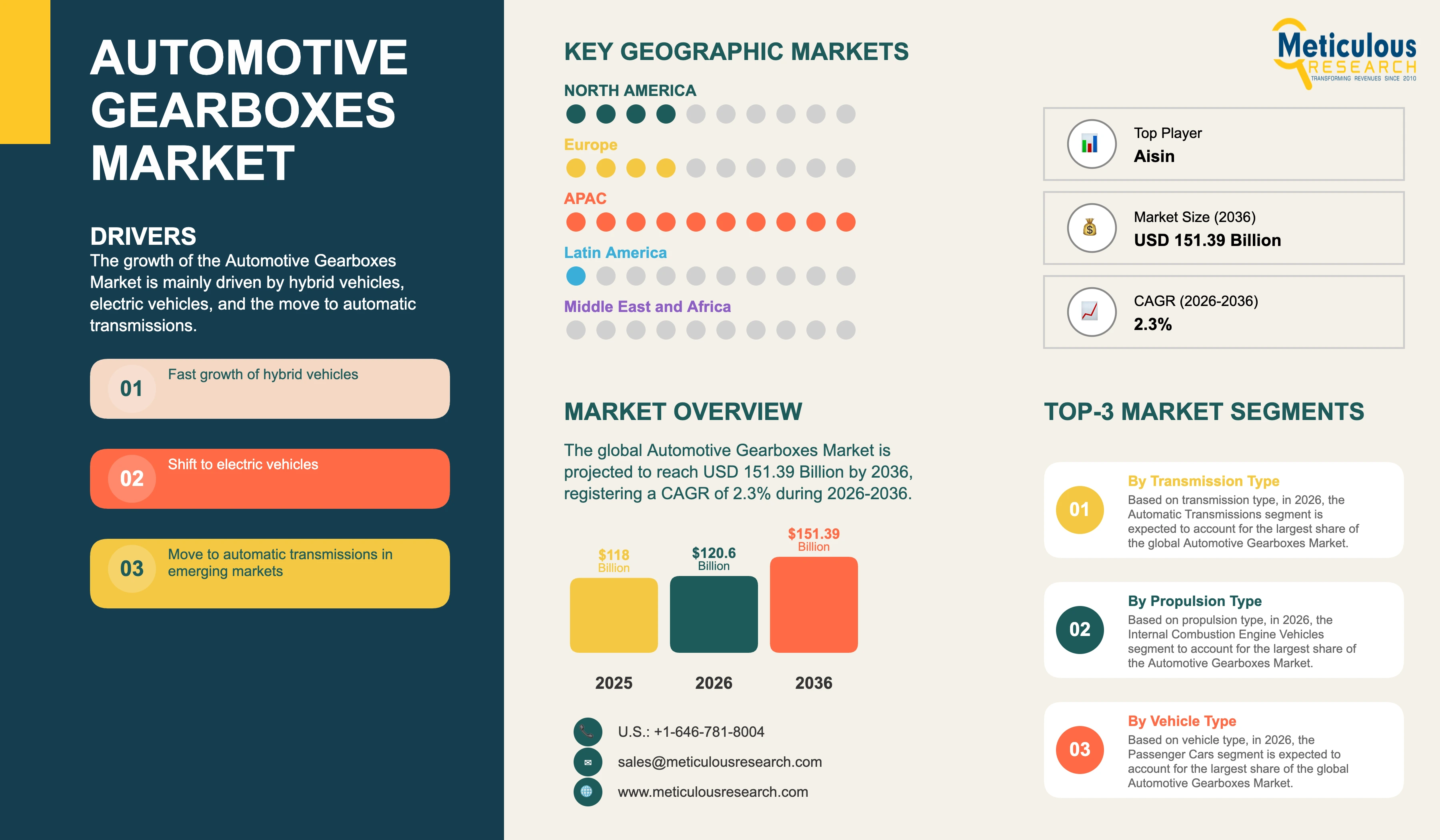
The global automotive gearboxes market was valued at USD 118.00 billion in 2025. This market is expected to reach USD 151.39 billion by 2036 from an estimated USD 120.60 billion in 2026, registering a CAGR of 2.3% during the forecast period (2026-2036).
- Published
- Nov 2026
- Pages
- 266
- Format
- PDF + Excel
- Report ID
- MRAUTO - 1042873
- Base year
- 2025
- 2025 · BASELINE
- $118.0B
- 2036
- $151.4B
- CAGR 2026–2036
- 2.3%
2025 baseline · 2026–2036 forecast at 2.3% CAGR · hover a bar for the value
Key highlights
Aisin Corporation, one of the world's largest automatic transmission makers, reported revenue of ¥4,896.1 billion for the fiscal year ended March 2025, down 0.3% from the previous year, mainly due to lower sales of powertrain units, according to Aisin. In the first half of the following fiscal year, its revenue rose 5.1% to about ¥2.5 trillion, supported by higher powertrain unit sales, including hybrid transmissions.
ZF reported group sales of €38.8 billion in 2025, according to ZF. ZF has agreed on a restructuring of its Electrified Powertrain Technology division, including ending some customer projects early, reflecting slower-than-planned growth of some electric vehicle programs and strong competition in electric drive systems.
Global electric car sales grew by 20% to more than 20 million units in 2025, accounting for one in four new cars sold, according to the IEA. Battery electric vehicles use simpler reduction gearboxes instead of multi-speed transmissions, while plug-in hybrid and full hybrid vehicles use dedicated hybrid transmissions, which are among the most valuable gearboxes.
Global light vehicle production exceeded 90 million units in 2025 for the first time since 2018, according to Autoliv. Almost every vehicle needs a gearbox, so vehicle production remains the main driver of gearbox demand, while the mix of transmission types is shifting quickly toward hybrid and electric designs.
Leading suppliers include Aisin, ZF, JATCO, Magna, Hyundai Transys, Allison Transmission, Eaton Cummins Automated Transmission Technologies, Punch Powertrain, Schaeffler, Shaanxi Fast Gear, and Zhejiang Wanliyang. Vehicle makers, such as Toyota, Volkswagen, Hyundai, and BYD, also produce many gearboxes in-house.
Manual transmissions are declining in most markets as customers in India, Southeast Asia, and Europe move to automatic transmissions and as electric vehicles replace combustion engine vehicles. Electric vehicle reduction gearboxes and dedicated hybrid transmissions are the fastest-growing transmission types, while conventional transmissions for combustion engine vehicles are expected to decline. Automatic transmissions are gaining share in India and Southeast Asia, which increases gearbox value per vehicle in these fast-growing vehicle markets of South and Southeast Asia.
By transmission type, automatic transmissions account for the largest share of 38.0% in 2026, while EV reduction gearboxes register the highest CAGR.
By propulsion type, internal combustion engine vehicles account for the largest share in 2026, while battery electric vehicles register the highest CAGR.
By vehicle type, passenger cars account for the largest share of 82.0% in 2026 and also register the highest CAGR.
By sales channel, OEM accounts for the larger share in 2026 and also registers the higher CAGR.
By geography, Asia-Pacific accounts for the largest share of 52.0% in 2026, while Asia-Pacific registers the highest CAGR of 3.1%.
Report summary
| Particulars | Details |
|---|---|
| Forecast Period | 2026-2036 |
| Base Year | 2025 |
| Estimated Year | 2026 |
| CAGR (2026-2036) | 2.3% |
| Format | PDF, Excel & Cloud Portal · 266 pages |
| Market Size in 2025 | USD 118.00 billion |
| Market Size in 2026 | USD 120.60 billion |
| Market Size by 2036 | USD 151.39 billion |
| Largest Segment by Transmission Type (2026) | Automatic Transmissions (38.0%) |
| Largest Segment by Vehicle Type (2026) | Passenger Cars (82.0%) |
| Largest Region (2026) | Asia-Pacific (52.0%) |
| Fastest-Growing Region | Asia-Pacific (CAGR 3.1%) |
| Segments Covered | Transmission Type, Propulsion Type, Vehicle Type, Sales Channel, Geography |
| Countries Covered | U.S., Canada, Germany, France, Spain, Italy, U.K., Czech Republic, Slovakia, Poland, Hungary, Romania, Belgium, Sweden, Rest of Europe, China, Japan, India, South Korea, Thailand, Indonesia, Malaysia, Vietnam, Taiwan, Australia, Rest of Asia-Pacific, Mexico, Brazil, Argentina, Colombia, Chile, Rest of Latin America, Turkey, Morocco, South Africa, Saudi Arabia, Egypt, Iran, Rest of Middle East & Africa |
| Companies Profiled | 11 companies and other companies |
Report overview
Segments covered: transmission type, propulsion type, vehicle type, sales channel.
Automotive gearboxes, also called transmissions, change the speed and torque delivered from the engine or electric motor to the wheels. They include automatic transmissions, manual transmissions, dual-clutch transmissions, continuously variable transmissions, dedicated hybrid transmissions, and the single-speed and multi-speed reduction gearboxes used in electric vehicles. Gearboxes are among the most valuable parts of the vehicle powertrain and are fitted to passenger cars, light commercial vehicles, and heavy commercial vehicles.
The growth of this market is mainly driven by steady growth of global vehicle production, especially in Asia-Pacific, the fast growth of hybrid vehicles, which use high-value dedicated hybrid transmissions, the shift to electric vehicles, which use reduction gearboxes and, increasingly, two-speed gearboxes, the move from manual to automatic transmissions in emerging markets, such as India, and the growing demand for automated transmissions in commercial vehicles. However, the simpler and lower-value gearboxes used in battery electric vehicles, the decline of combustion engine vehicle production, and strong price pressure are expected to restrain the growth of this market to some extent.
The gearbox is a core part of the vehicle powertrain, matching the speed and torque of the engine or electric motor to the needs of the vehicle. Combustion engines work efficiently only in a narrow speed range, so combustion engine vehicles need gearboxes with several gears to drive efficiently at different road speeds. Automatic transmissions with torque converters, dual-clutch transmissions, and continuously variable transmissions change gears or ratios automatically, while manual transmissions rely on the driver. Electric motors work efficiently over a wide speed range, so most battery electric vehicles use a single-speed reduction gearbox, although some use two-speed gearboxes for better performance and efficiency.
This report covers the global automotive gearboxes market, including automatic transmissions, manual transmissions, dual-clutch transmissions, continuously variable transmissions, dedicated hybrid transmissions, and electric vehicle reduction gearboxes for passenger cars, light commercial vehicles, and heavy commercial vehicles, including automated manual transmissions for trucks. The market is valued at the selling price of complete gearboxes supplied to vehicle makers and in the aftermarket and remanufactured channel, including gearboxes made in-house by vehicle makers valued at an estimated market price. The market is analyzed by transmission type, propulsion type, vehicle type, sales channel, and geography. Electric motors, inverters, and complete electric axle systems are covered in separate reports, while the reduction gearbox is included when supplied as a separate unit or valued within an integrated electric drive.
The gearbox market is going through a major change as vehicle powertrains are electrified. For decades, growth came from adding more gears to automatic transmissions and from the move from manual to automatic transmissions. Today, the shift to hybrid and electric vehicles is changing what gearboxes are needed. Hybrid vehicles use dedicated hybrid transmissions that combine gears with one or two electric motors, while battery electric vehicles use simpler reduction gearboxes that are worth much less than a modern automatic transmission. As a result, the market is growing much more slowly in value than vehicle production.
Transmission preferences differ widely by region, reflecting driving habits, vehicle types, and costs. North America and Japan mainly use automatic transmissions and continuously variable transmissions, Europe has moved from manual to dual-clutch and automatic transmissions, and China uses all types, with a fast shift to hybrid transmissions and electric vehicle gearboxes. India and many other emerging markets still use mainly manual transmissions, but automatic transmissions are growing quickly as incomes rise and traffic congestion increases. Commercial vehicles use manual and automated manual transmissions, with fully automatic transmissions common in buses and some trucks.
The market includes large independent transmission suppliers, such as Aisin, ZF, JATCO, Magna, Hyundai Transys, Allison Transmission, Eaton Cummins Automated Transmission Technologies, and Punch Powertrain, and Chinese suppliers, such as Shaanxi Fast Gear and Zhejiang Wanliyang. Many vehicle makers, such as Toyota, Volkswagen, Hyundai, Honda, and BYD, also produce gearboxes in-house, and vehicle makers often produce reduction gearboxes for their electric vehicles as part of in-house electric drive units. Schaeffler and other suppliers provide key components and complete hybrid and electric drive modules.
Hybrid vehicles have become an important source of growth for gearbox suppliers. Full hybrid and plug-in hybrid vehicles, which are growing quickly in China, Japan, North America, and Europe, use dedicated hybrid transmissions that combine gear sets, clutches, and electric motors. These transmissions are complex and valuable, and suppliers with strong hybrid technology, such as Aisin, have benefited from rising hybrid sales. Aisin's revenue rose 5.1% in the first half of its fiscal year ending March 2026, supported by higher powertrain unit sales, according to Aisin.
In 2026, automatic transmissions account for the largest share of the market by transmission type, while electric vehicle reduction gearboxes are the fastest-growing transmission type. Internal combustion engine vehicles account for the largest share by propulsion type, while battery electric vehicles are the fastest-growing propulsion type. Passenger cars account for the largest share by vehicle type and are also the fastest-growing vehicle type. The OEM channel accounts for the largest share by sales channel and is also the fastest-growing channel. Asia-Pacific accounts for the largest share of the market and is also the fastest-growing region.
Market growth over the forecast period will depend on global vehicle production, the pace of the shift from combustion engine to hybrid and electric vehicles, the share of hybrid vehicles in the vehicle mix, and the move from manual to automatic transmissions in emerging markets. Manual transmissions and conventional automatic transmissions for combustion engine vehicles are expected to decline or stay flat, while hybrid transmissions and electric vehicle gearboxes grow quickly. Overall, the market is expected to grow slowly in value as these trends offset each other.
Passenger cars are expected to account for the largest share of 82.0% of the market in 2026 and are also projected to register the highest CAGR, driven by hybrid and electric passenger cars and the move to automatic transmissions.
Asia-Pacific is expected to account for the largest share of 52.0% of the market in 2026, mainly due to China's large vehicle, hybrid, and electric vehicle production and Japan's strong position in automatic and hybrid transmissions.
Asia-Pacific is also projected to register the highest CAGR of 3.1% during the forecast period, driven by hybrid and electric vehicle growth in China and the move to automatic transmissions in India and Southeast Asia.
The report profiles 11 companies, including Aisin, ZF, JATCO, Magna, Hyundai Transys, Allison Transmission, Eaton Cummins Automated Transmission Technologies, Punch Powertrain, Schaeffler, Shaanxi Fast Gear, and Zhejiang Wanliyang.
Battery electric vehicles use simpler and lower-value reduction gearboxes instead of multi-speed transmissions, which lowers gearbox value per vehicle, while hybrid vehicles use high-value dedicated hybrid transmissions.
Manual transmissions are declining as customers in India, Southeast Asia, and Europe move to automatic transmissions and as electric vehicles, which do not use manual transmissions, take a larger share of vehicle sales.
In 2026, the OEM segment is expected to account for the larger share of the automotive gearboxes market, and it is also projected to register the higher CAGR during the forecast period.
Report infographic
Market dynamics
17 factors across 5 forcesSteady growth of global vehicle production
Almost every vehicle needs a gearbox, so demand is closely linked to vehicle production. Global light vehicle production exceeded 90 million units in 2025, according to Autoliv, and production is expected to grow steadily over the forecast period, led by China, India, and Southeast Asia. Growth in vehicle production directly increases demand for gearboxes of all types, even as the mix of transmission types changes.
The growth of vehicle production in Asia-Pacific is particularly important for the gearbox market. China is the largest vehicle producer in the world and leads in hybrid and electric vehicles, while India and Southeast Asia are growing quickly and moving toward automatic transmissions. Gearbox suppliers are expanding production in these markets to serve local and export vehicle production, and Chinese gearbox suppliers have grown quickly with Chinese vehicle makers.
Fast growth of hybrid vehicles
Hybrid vehicles, including full hybrids and plug-in hybrids, are growing quickly in many markets as vehicle makers look to reduce emissions and fuel use while avoiding the higher cost and range limits of battery electric vehicles. China has seen especially fast growth in plug-in hybrid and range-extended vehicles, and full hybrids are popular in Japan, North America, and Europe. Several vehicle makers have increased their hybrid plans as battery electric vehicle growth slowed in some markets.
Hybrid vehicles use dedicated hybrid transmissions, which combine gear sets, clutches, and one or two electric motors in a single unit. These transmissions are complex and among the most valuable gearboxes in the market. Dedicated hybrid transmissions are one of the fastest-growing transmission types, and suppliers with strong hybrid technology, such as Aisin, have benefited from rising hybrid sales, according to Aisin.
Shift to electric vehicles
Battery electric vehicles use reduction gearboxes to reduce the high speed of the electric motor to the speed of the wheels. Although these gearboxes are simpler and less valuable than automatic transmissions, the fast growth of electric vehicle production creates large new demand. Global electric car sales grew by 20% to more than 20 million units in 2025, according to the IEA, and electric vehicle reduction gearboxes are the fastest-growing transmission type in this market.
Electric vehicle gearboxes are also becoming more advanced as vehicle makers improve efficiency and performance. Electric motors now run at higher speeds to reduce motor size and cost, which requires gearboxes with higher reduction ratios, lower noise, and better efficiency. Some vehicle makers are also adopting two-speed gearboxes for performance electric vehicles and electric trucks to improve acceleration, top speed, and efficiency. These trends increase the value of electric vehicle gearboxes over time.
Move from manual to automatic transmissions in emerging markets
Manual transmissions still account for most vehicles sold in India and many other emerging markets, but customers are moving to automatic transmissions as incomes rise, traffic congestion grows, and the price gap narrows. Automated manual transmissions, continuously variable transmissions, and conventional automatic transmissions are all gaining share in India, Southeast Asia, and Latin America. Automatic transmissions are worth much more than manual transmissions, which increases gearbox value per vehicle and offsets part of the value loss from electrification.
This shift is also visible in Europe, where manual transmissions have lost share to dual-clutch and automatic transmissions and, increasingly, to electric vehicles. Vehicle makers are reducing the number of models offered with manual transmissions to simplify production. Manual transmissions are expected to decline over the forecast period, while automatic transmission types continue to grow in emerging markets.
Growing demand for automated transmissions in commercial vehicles
Commercial vehicle makers and fleet operators are moving from manual transmissions to automated manual transmissions and fully automatic transmissions to reduce fuel use, improve driver comfort, reduce driver training needs, and address driver shortages. Automated manual transmissions are now standard in most heavy trucks in Europe and North America and are spreading quickly in China and other markets, while fully automatic transmissions are widely used in buses, refuse trucks, and other vocational vehicles. Allison Transmission and Eaton Cummins Automated Transmission Technologies are among the leading suppliers in these markets. Electric trucks and buses also use multi-speed gearboxes in many designs to improve efficiency and performance, which creates new demand for heavy-duty electric vehicle gearboxes. These trends support the value of the commercial vehicle gearbox segment even as truck production grows slowly.
Table of contents
12 chapters · 180 sections · 266 pages · click to expandSegmental analysis
| Segment | Largest share (2026) | Fastest growth (2026–2036) |
|---|---|---|
| By Transmission Type | Automatic transmissions | Electric vehicle reduction gearboxes |
| By Propulsion Type | Internal combustion engine vehicles | Battery electric vehicles |
| By Vehicle Type | Passenger cars | Passenger cars |
| By Sales Channel | OEM | OEM |
| Other segments | Internal combustion engine vehicles | Battery electric vehicles |
By Transmission Type
- Automotive Gearboxes Market Analysis by Transmission Type
- The automatic transmissions segment is expected to account for the largest share of 38.0% of the global automotive gearboxes market.
- The large share of this segment is mainly due to the wide use of conventional automatic transmissions with torque converters in North America, Japan, China, and premium vehicles in Europe, the high value of modern six-speed to ten-speed automatic transmissions, the use of automatic transmissions in SUVs and pickup trucks, and the growth of automatic transmissions in emerging markets.
- Aisin, ZF, JATCO, Hyundai Transys, and Allison Transmission are among the leading suppliers of automatic transmissions.
- However, the electric vehicle reduction gearboxes segment is projected to register the highest CAGR during the forecast period.
- The rapid growth of this segment is driven by the fast growth of battery electric vehicle production, with global electric car sales exceeding 20 million units in 2025 according to the IEA, the move to higher-speed electric motors that need more advanced gearboxes, the adoption of two-speed gearboxes for performance electric vehicles and electric trucks, and the use of two electric drive units in electric all-wheel drive vehicles.
- Dedicated hybrid transmissions are also growing much faster than the overall market, while manual transmissions are declining.
By Propulsion Type
- Automotive Gearboxes Market Analysis by Propulsion Type
- The internal combustion engine vehicles segment is expected to account for the largest share of the global automotive gearboxes market.
- The large share of this segment is mainly due to the large number of combustion engine vehicles still produced each year, especially in emerging markets and in North America, the high value of the automatic, dual-clutch, and continuously variable transmissions used in combustion engine vehicles, and the use of combustion engine powertrains in most commercial vehicles.
- Combustion engine vehicles also need multi-speed gearboxes, which are worth more than electric vehicle reduction gearboxes.
- However, the battery electric vehicles segment is projected to register the highest CAGR during the forecast period.
- The rapid growth of this segment is driven by the fast growth of battery electric vehicle production in China, Europe, and other markets, the use of two electric drive units in many electric vehicles, the move to more advanced gearboxes for higher-speed electric motors, and the growth of electric trucks and buses with multi-speed gearboxes.
- Hybrid vehicles are also growing quickly and use high-value dedicated hybrid transmissions, while gearbox demand from combustion engine vehicles is expected to decline.
By Vehicle Type
- Automotive Gearboxes Market Analysis by Vehicle Type
- The passenger cars segment is expected to account for the largest share of 82.0% of the global automotive gearboxes market.
- The large share of this segment is mainly due to the very large number of passenger cars produced each year, the high value of automatic, dual-clutch, and hybrid transmissions used in passenger cars, the growth of SUVs with larger and more valuable automatic transmissions, and the move from manual to automatic transmissions in emerging markets.
- Passenger cars also lead the adoption of hybrid transmissions and electric vehicle gearboxes.
- The passenger cars segment is also projected to register the highest CAGR during the forecast period.
- The rapid growth of this segment is driven by the growth of passenger car production in China, India, and Southeast Asia, the fast growth of hybrid and electric passenger cars, which use dedicated hybrid transmissions and reduction gearboxes, and the shift to automatic transmissions in India and Southeast Asia.
- Commercial vehicles also use valuable gearboxes, such as automated manual and fully automatic transmissions, but their production is growing more slowly.
By Sales Channel
- Automotive Gearboxes Market Analysis by Sales Channel
- The OEM segment is expected to account for the largest share of the global automotive gearboxes market.
- The large share of this segment is mainly due to the fitting of gearboxes to almost every new vehicle, the large volume of global vehicle production, the high value of new automatic, hybrid, and dual-clutch transmissions, and the long life of modern gearboxes, which limits replacement demand.
- Gearboxes produced in-house by vehicle makers are also included in the OEM channel at an estimated market price.
- The OEM segment is also projected to register the highest CAGR during the forecast period.
- The rapid growth of this segment is driven by vehicle production growth in Asia-Pacific, the fast growth of hybrid transmissions and electric vehicle gearboxes fitted to new vehicles, and the move to automatic transmissions in emerging markets.
- The aftermarket and remanufactured channel is expected to grow more slowly, as modern gearboxes rarely need full replacement and electric vehicle gearboxes are simpler and more durable.
- Remanufactured transmissions remain important for older vehicles and commercial vehicle fleets.
Other segments
- The internal combustion engine vehicles segment is expected to account for the largest share of the automotive gearboxes market, while the battery electric vehicles segment is projected to register the highest CAGR during the forecast period.
Geographic analysis
Asia-Pacific
Largest shareIn 2026, Asia-Pacific is expected to account for the largest share of 52.0% of the global automotive gearboxes market. The large share of this region is mainly due to China's position as the largest vehicle producer in the world, China's leadership in hybrid and electric vehicle production, the large vehicle production and strong hybrid technology of Japan, the large vehicle production of India, South Korea, and Thailand, and the presence of leading gearbox suppliers, such as Aisin, JATCO, Hyundai Transys, Shaanxi Fast Gear, and Zhejiang Wanliyang, as well as the large in-house gearbox production of Toyota, Hyundai, Honda, and BYD. Japan is also a major exporter of vehicles and transmissions, and South Korea is a large producer of automatic transmissions for Hyundai and Kia. Asia-Pacific is also projected to register the highest CAGR of 3.1% during the forecast period. The rapid growth of this region is mainly driven by continued growth of vehicle, hybrid, and electric vehicle production in China, the fast growth of vehicle production and the move to automatic transmissions in India, the growth of vehicle production in Indonesia, Vietnam, and Thailand, including by Chinese vehicle makers, and the growth of hybrid vehicles in Japan and China. Gearbox suppliers are expanding production in the region to serve local and export vehicle production, and Chinese suppliers are growing quickly in hybrid transmissions and electric vehicle gearboxes.
Europe
Europe accounts for a significant share of the market, supported by the production of premium vehicles with high-value automatic and dual-clutch transmissions, the growth of hybrid and electric vehicles, the wide use of automated manual transmissions in heavy trucks, and the presence of leading suppliers, such as ZF, Magna, Schaeffler, and Punch Powertrain. ZF reported group sales of €38.8 billion in 2025, according to ZF. However, slow growth of vehicle production, the decline of manual transmissions, and the shift to electric vehicles with lower-value gearboxes are expected to limit growth in the region compared with Asia-Pacific. Germany, France, Spain, and Central and Eastern European countries are the largest markets in the region, and Central and Eastern Europe is an important location for transmission production.
North America
North America accounts for a large share of the market, supported by the production of large pickup trucks and SUVs, which use high-value eight-speed and ten-speed automatic transmissions, the strong position of automatic transmissions in commercial vehicles, and the presence of Allison Transmission, Eaton Cummins Automated Transmission Technologies, Aisin, ZF, and Magna operations. The U.S. is the largest market in the region, while Mexico is an important production base for transmissions.
Latin America
Latin America and the Middle East & Africa account for smaller shares, with growth supported by vehicle production in Brazil, Argentina, Turkey, and Morocco and by the move to automatic transmissions in these markets. Brazil is the largest market in Latin America, supported by large domestic vehicle production, and manual transmissions are still common but automatic transmissions are gaining share.
Competitive landscape
The global automotive gearboxes market includes large independent transmission suppliers, commercial vehicle transmission specialists, Chinese gearbox suppliers, and vehicle makers that produce gearboxes in-house. In-house production is a large part of the market, especially for Japanese, Korean, German, and Chinese vehicle makers, while independent suppliers hold strong positions in automatic transmissions, hybrid transmissions, and commercial vehicle transmissions.
Aisin is one of the world's largest automatic transmission makers, with revenue of ¥4,896.1 billion for the fiscal year ended March 2025, according to Aisin. ZF, with group sales of €38.8 billion in 2025 according to ZF, is a leading supplier of automatic transmissions and commercial vehicle transmissions. JATCO is a leading supplier of continuously variable transmissions, Hyundai Transys supplies Hyundai and Kia, Magna and Punch Powertrain supply dual-clutch and hybrid transmissions, and Allison Transmission and Eaton Cummins Automated Transmission Technologies lead in commercial vehicle transmissions. Shaanxi Fast Gear and Zhejiang Wanliyang are leading Chinese suppliers.
Companies in this market compete on efficiency, smoothness, durability, noise, cost, engineering support, global production, and the ability to offer hybrid transmissions and electric drive products. Key strategies include developing dedicated hybrid transmissions, electric vehicle gearboxes, and complete electric drive units, expanding production in Asia-Pacific, reducing costs and restructuring conventional transmission businesses, and forming partnerships with vehicle makers and Chinese companies.
Recent activity in the gearbox market reflects the shift to electrified powertrains. Aisin's revenue rose 5.1% in the first half of its fiscal year ending March 2026, supported by higher powertrain unit sales, according to Aisin, while ZF agreed on a restructuring of its Electrified Powertrain Technology division, including ending some customer projects early, according to ZF. These developments show the importance of hybrid demand and the challenges of the electric drive business.
We expect competition to increase over the forecast period as Chinese suppliers expand abroad, as vehicle makers bring more electric drive production in-house, and as demand for conventional transmissions declines. Suppliers with strong hybrid technology, electric drive capabilities, low-cost production, and local presence in Asia-Pacific are expected to strengthen their positions, while further restructuring and consolidation of conventional transmission businesses are likely, including plant closures and sales of non-core businesses.
Some of the key players operating in the automotive gearboxes market are Aisin Corporation, ZF Friedrichshafen AG, JATCO Ltd., Magna International Inc., Hyundai Transys Inc., Allison Transmission Holdings, Inc., Eaton Cummins Automated Transmission Technologies, Punch Powertrain, Schaeffler AG, Shaanxi Fast Gear Co., Ltd., and Zhejiang Wanliyang Co., Ltd., among others.
- —
Aisin's revenue rose 5.1% in the first half of its fiscal year ending March 2026 on higher powertrain unit sales, while ZF agreed on a restructuring of its Electrified Powertrain Technology division, including ending some customer projects early.
- Aisin Corporation
- ZF Friedrichshafen AG
- JATCO Ltd.
- Magna International Inc.
- Hyundai Transys Inc.
- Allison Transmission Holdings, Inc.
- Eaton Cummins Automated Transmission Technologies
- Punch Powertrain
- Schaeffler AG
- Shaanxi Fast Gear Co., Ltd.
- Zhejiang Wanliyang Co., Ltd.
Expert perspectives
Automotive gearboxes are one of the largest powertrain markets and are going through a major transition. While conventional automatic, manual, dual-clutch, and continuously variable transmissions still account for most of the market, the shift to hybrid and electric vehicles is changing what gearboxes are needed and is slowing market value growth compared with vehicle production.
Over the forecast period, the market is expected to grow at a CAGR of 2.3%, from USD 120.60 billion in 2026 to USD 151.39 billion in 2036. Growth will be driven by steady vehicle production growth, the fast growth of hybrid vehicles, the shift to electric vehicles, the move from manual to automatic transmissions in emerging markets, and the growing demand for automated transmissions in commercial vehicles.
Among the market segments, automatic transmissions are the largest transmission type, while electric vehicle reduction gearboxes grow fastest and manual transmissions decline. Internal combustion engine vehicles are the largest propulsion type, while battery electric vehicles grow fastest. Passenger cars are both the largest and the fastest-growing vehicle type. The OEM channel is both the largest and the fastest-growing sales channel. Asia-Pacific is both the largest and the fastest-growing region, at a CAGR of 3.1%.
In our view, hybrid vehicles will be the most important source of value for gearbox suppliers over the next decade. Dedicated hybrid transmissions are complex and valuable, and hybrid demand has been stronger than expected in several markets as battery electric vehicle growth slowed. Suppliers with proven hybrid technology and flexible production will gain the most, while those focused on conventional transmissions will face declining volumes. The move to automatic transmissions in India and Southeast Asia will also provide steady growth over the forecast period for conventional automatic, continuously variable, and automated manual transmissions.
We also see in-house production and Chinese competition as major challenges for independent suppliers in the electric vehicle gearbox market. Many vehicle makers design and produce reduction gearboxes as part of their own electric drive units, and Chinese suppliers offer low costs. Independent suppliers will need to offer advanced gearboxes, such as high-speed and two-speed designs, or complete electric drive units to compete, while restructuring conventional businesses.
Overall, we believe the automotive gearboxes market will grow slowly but steadily over the forecast period, with electric vehicle gearboxes, dedicated hybrid transmissions, battery electric vehicles, and Asia-Pacific providing the fastest growth. Companies with strong hybrid and electric drive technology, low-cost production, and local presence in Asia-Pacific will be best positioned to capture this growth, while declining combustion engine volumes and price pressure remain the main risks for suppliers.
Customer perspectives
Customers in the automotive gearboxes market are mainly vehicle makers, which buy or produce gearboxes for passenger cars and commercial vehicles, and aftermarket and remanufacturing customers, such as distributors, workshops, and fleet operators. Vehicle makers focus on efficiency, smoothness, durability, noise, weight, packaging, cost, and engineering support, and they increasingly look for flexible gearbox platforms that can be used in combustion engine, hybrid, and electric versions of the same vehicle. They also value suppliers that can support production in several regions and that are financially stable through the transition to electrified powertrains. Commercial vehicle customers focus on fuel efficiency, durability, and total cost of ownership, and they increasingly choose automated transmissions. Electric vehicle makers also focus on noise and efficiency, as gearbox noise is easy to hear in quiet electric vehicles. Many also want shorter development times.
This comment explains why dedicated hybrid transmissions are among the fastest-growing transmission types and why Asia-Pacific is the fastest-growing region.
This comment explains why electric vehicle reduction gearboxes are the fastest-growing transmission type and why battery electric vehicles are the fastest-growing propulsion type.
This comment explains why automatic transmissions account for 38.0% of the market and why passenger cars account for 82.0% of the market.
“Hybrid demand has grown faster than we planned, so we are adding hybrid transmission capacity. Our customers want good fuel economy without range worries.”
“We design our reduction gearboxes in-house together with the motor. Higher motor speeds mean we need quieter, higher-ratio gearboxes.”
“Most of our buyers chose manual cars five years ago. Now automatic versions are a large share of sales, even in compact cars and SUVs.”
Frequently asked questions
The global automotive gearboxes market was valued at USD 118.00 billion in 2025, up from USD 116.50 billion in 2024, and is estimated at USD 120.60 billion in 2026. The market includes automatic, manual, dual-clutch, continuously variable, dedicated hybrid, and electric vehicle gearboxes.
The global automotive gearboxes market is expected to reach USD 151.39 billion by 2036, driven by vehicle production, hybrid vehicles, electric vehicles, and the move to automatic transmissions in emerging markets.
The market is expected to register a CAGR of 2.3% from 2026 to 2036, with the fastest growth in electric vehicle reduction gearboxes, dedicated hybrid transmissions, battery electric vehicles, and Asia-Pacific.
Market growth is mainly driven by steady vehicle production growth, the fast growth of hybrid vehicles, the shift to electric vehicles, the move from manual to automatic transmissions in emerging markets, and growing demand for automated transmissions in commercial vehicles.
The lower value of battery electric vehicle gearboxes and the decline of combustion engine vehicle production and price pressure restrain growth, while managing the transition to electrified transmissions and in-house production and Chinese competition are key challenges.
Key growth opportunities include dedicated hybrid transmissions, advanced and two-speed electric vehicle gearboxes, automatic transmissions in India and Southeast Asia, and electric and automated transmissions for commercial vehicles.
Automatic transmissions are expected to account for the largest share of 38.0% of the market in 2026, while electric vehicle reduction gearboxes are projected to register the highest CAGR, driven by the fast growth of battery electric vehicles.
In 2026, the internal combustion engine vehicles segment is expected to account for the largest share of the automotive gearboxes market, while the battery electric vehicles segment is projected to register the highest CAGR during the forecast period.
Passenger cars are expected to account for the largest share of 82.0% of the market in 2026 and are also projected to register the highest CAGR, driven by hybrid and electric passenger cars and the move to automatic transmissions.
In 2026, the OEM segment is expected to account for the larger share of the automotive gearboxes market, and it is also projected to register the higher CAGR during the forecast period.
Asia-Pacific is expected to account for the largest share of 52.0% of the market in 2026, mainly due to China's large vehicle, hybrid, and electric vehicle production and Japan's strong position in automatic and hybrid transmissions.
Asia-Pacific is also projected to register the highest CAGR of 3.1% during the forecast period, driven by hybrid and electric vehicle growth in China and the move to automatic transmissions in India and Southeast Asia.
The report profiles 11 companies, including Aisin, ZF, JATCO, Magna, Hyundai Transys, Allison Transmission, Eaton Cummins Automated Transmission Technologies, Punch Powertrain, Schaeffler, Shaanxi Fast Gear, and Zhejiang Wanliyang.
Aisin's revenue rose 5.1% in the first half of its fiscal year ending March 2026 on higher powertrain unit sales, while ZF agreed on a restructuring of its Electrified Powertrain Technology division, including ending some customer projects early.
Battery electric vehicles use simpler and lower-value reduction gearboxes instead of multi-speed transmissions, which lowers gearbox value per vehicle, while hybrid vehicles use high-value dedicated hybrid transmissions.
Manual transmissions are declining as customers in India, Southeast Asia, and Europe move to automatic transmissions and as electric vehicles, which do not use manual transmissions, take a larger share of vehicle sales.
Cite this report
Meticulous Research. (2026). Automotive Gearboxes Market - Global Opportunity Analysis and Industry Forecast (2026-2036) (Report No. MRAUTO - 1042873). Meticulous Market Research Pvt. Ltd. https://www.meticulousresearch.com/product/automotive-gearboxes-market-7556