Automotive Fasteners Market (2026-2036)
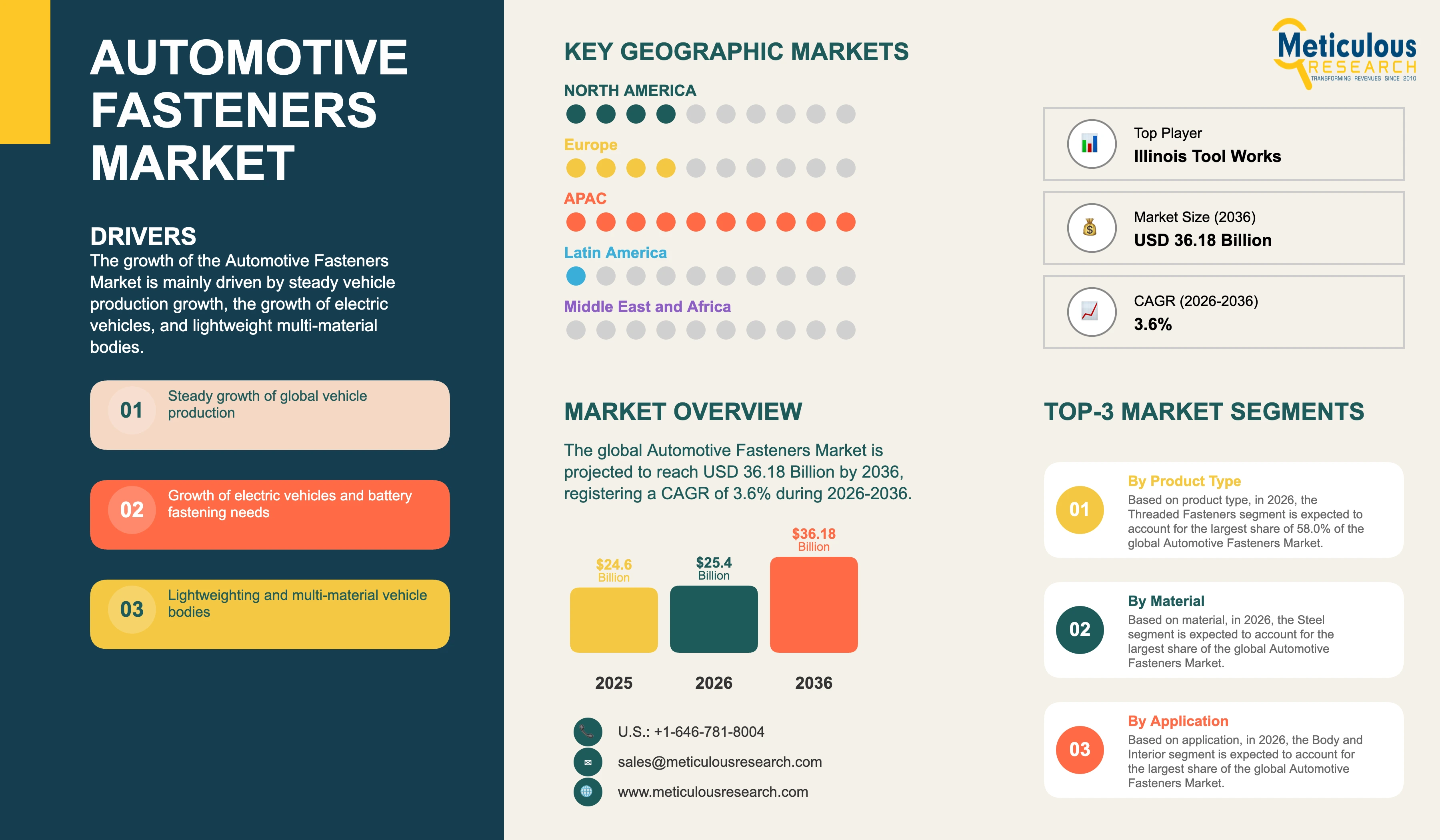
The global automotive fasteners market was valued at USD 24.60 billion in 2025. This market is expected to reach USD 36.18 billion by 2036 from an estimated USD 25.40 billion in 2026, registering a CAGR of 3.6% during the forecast period (2026-2036).
- Published
- Nov 2026
- Pages
- 259
- Format
- PDF + Excel
- Report ID
- MRAUTO - 1042860
- Base year
- 2025
- 2025 · BASELINE
- $24.60B
- 2036
- $36.18B
- CAGR 2026–2036
- 3.6%
2025 baseline · 2026–2036 forecast at 3.6% CAGR · hover a bar for the value
Key highlights
Bulten, one of Europe's largest automotive fastener makers, reported net sales of SEK 5,045 million in 2025, down 13.1% from SEK 5,807 million, after a cyberattack at one of its largest customers halted that customer's production for several weeks, according to Bulten. The company estimated lost sales of about SEK 200 million in the third quarter of 2025 alone, showing how closely fastener demand follows vehicle production.
Global electric car sales grew by 20% to more than 20 million units in 2025, accounting for one in four new cars sold, according to the IEA. Electric vehicles use fewer fasteners in the engine and transmission but many more in the battery pack, electric drive, and high-voltage system, which is shifting demand toward specialized fasteners.
Vehicle makers are using more aluminum, ultra-high-strength steel, and composites to reduce weight, which cannot always be joined by spot welding. This is increasing the use of self-piercing rivets, flow-drill screws, blind rivets, and other mechanical fasteners made by suppliers such as Stanley Engineered Fastening, Böllhoff, and ITW.
Clips and plastic fasteners are used in large numbers to attach interior trim, wiring harnesses, sensors, and exterior panels, and their use is growing as vehicles add more electronic features. ARaymond, ITW, and Nifco are among the leading suppliers of these products.
Fastener production is moving closer to vehicle plants and to fast-growing markets. Indian suppliers, such as Sundram Fasteners, and Chinese suppliers are expanding capacity, while European suppliers, such as Bulten, are diversifying into other industries and expanding in North America and Asia.
Leading suppliers include Illinois Tool Works, Stanley Black & Decker, ARaymond, Nifco, KAMAX, Bulten, Böllhoff, LISI Automotive, Agrati Group, Fontana Gruppo, Sundram Fasteners, PennEngineering, and Meidoh. Bulten has also started a strategic review and plans to broaden sales beyond automotive, with medical technology and consumer electronics growing while light vehicle volumes fell, according to the company's 2025 reports. Many European fastener makers are following a similar strategic path to reduce their dependence on vehicle production in Europe. This shift is also leading suppliers to invest in automation and new markets.
By product type, threaded fasteners account for the largest share of 58.0% in 2026, while rivets register the highest CAGR.
By material, steel accounts for the largest share in 2026, while aluminum registers the highest CAGR.
By application, body and interior accounts for the largest share in 2026, while battery and electric drive registers the highest CAGR.
By vehicle type, passenger cars account for the largest share of 72.0% in 2026 and also register the highest CAGR.
By geography, Asia-Pacific accounts for the largest share of 52.0% in 2026, while Asia-Pacific registers the highest CAGR of 4.4%.
Report summary
| Particulars | Details |
|---|---|
| Forecast Period | 2026-2036 |
| Base Year | 2025 |
| Estimated Year | 2026 |
| CAGR (Value) | 3.6% |
| Format | PDF, Excel & Cloud Portal · 259 pages |
| Market Size (Value) in 2025 | USD 24.60 billion |
| Market Size (Value) in 2026 | USD 25.40 billion |
| Market Size (Value) by 2036 | USD 36.18 billion |
| Largest Segment by Product Type (2026) | Threaded Fasteners (58.0%) |
| Largest Segment by Vehicle Type (2026) | Passenger Cars (72.0%) |
| Largest Region (2026) | Asia-Pacific (52.0%) |
| Fastest-Growing Region | Asia-Pacific (CAGR 4.4%) |
| Segments Covered | Product Type, Material, Application, Vehicle Type, Geography |
| Countries Covered | U.S., Canada, Germany, France, Spain, Italy, U.K., Sweden, Czech Republic, Slovakia, Poland, Hungary, Romania, Belgium, Rest of Europe, China, Japan, India, South Korea, Thailand, Indonesia, Malaysia, Vietnam, Taiwan, Australia, Rest of Asia-Pacific, Mexico, Brazil, Argentina, Colombia, Chile, Rest of Latin America, Turkey, Morocco, South Africa, Saudi Arabia, Egypt, Iran, Rest of Middle East & Africa |
| Key Companies | 13 companies and other companies |
Report overview
Segments covered: product type, material, application, vehicle type.
Automotive fasteners are the bolts, screws, nuts, studs, rivets, clips, clamps, washers, pins, and plastic fasteners that hold together the body, chassis, powertrain, interior, battery, and electrical parts of a vehicle. A typical passenger car contains several thousand fasteners, many of which are safety-critical and are engineered specifically for each joint.
The growth of this market is mainly driven by steady growth in global vehicle production, especially in Asia-Pacific, the growth of electric vehicles, which need many specialized fasteners for battery packs, electric motors, and power electronics, the use of mixed materials, such as aluminum, high-strength steel, and composites, which requires new joining methods, such as self-piercing rivets and flow-drill screws, and the growing number of electronic parts, trim parts, and sensors that are fixed with clips and plastic fasteners. In addition, the need to reduce vehicle weight is increasing the use of lighter, higher-strength, and plastic fasteners. However, the reduction of engine and transmission parts in electric vehicles, the move to large castings that reduce the number of parts, and volatile steel and energy prices are expected to restrain the growth of this market to some extent.
Automotive fasteners are the mechanical parts used to join vehicle components in a way that holds them firmly under vibration, heat, load, and corrosion over the life of the vehicle. They range from standard bolts and nuts to highly engineered parts, such as cylinder head bolts, wheel bolts, chassis bolts made of high-strength steel, self-piercing rivets for aluminum bodies, and plastic clips that hold trim panels and wiring. Many fasteners are safety-critical, as failure could lead to loss of a wheel, failure of a brake or suspension part, or detachment of a seat or airbag, so they must meet strict quality and traceability requirements.
This report covers the global automotive fasteners market, including threaded fasteners, such as bolts, screws, nuts, and studs, clips, clamps, and plastic fasteners, rivets, including self-piercing and blind rivets, and washers, pins, and other fasteners used in passenger cars and commercial vehicles. The market is valued at the selling price of fasteners sold to vehicle makers, tier-1 suppliers, and the aftermarket. The market is analyzed by product type, material, application, vehicle type, and geography. Fasteners used in motorcycles, off-highway vehicles, aircraft, and industrial equipment, and joining equipment such as riveting tools, are not included.
A typical passenger car contains thousands of fasteners from hundreds of different part numbers. Fasteners are used in every part of the vehicle, including the body and interior, the chassis and suspension, the engine and transmission, the electrical system, and, in electric vehicles, the battery pack and electric drive. While each fastener has a low value, the large number per vehicle makes fasteners a significant purchase category for vehicle makers and tier-1 suppliers. Fasteners are also sold through distributors to the aftermarket for repairs and maintenance.
Fasteners are made mainly by cold forming, in which steel wire is cut and shaped at high speed, followed by thread rolling, heat treatment, and coating. Plastic fasteners and clips are made by injection molding. High-strength bolts for engine, chassis, and battery applications require careful heat treatment and coating to prevent hydrogen embrittlement and corrosion. Many fastener makers also offer engineering services, helping vehicle makers design joints, reduce the number of fastener types, and lower the cost of assembly.
The market includes large global fastener groups and many regional and specialist suppliers. Illinois Tool Works, Stanley Black & Decker, ARaymond, and Nifco are major suppliers of engineered and plastic fasteners. KAMAX, Bulten, Agrati Group, LISI Automotive, Fontana Gruppo, and Böllhoff are major suppliers of threaded and specialty fasteners in Europe, while Sundram Fasteners is a leading Indian supplier and Meidoh is a key Japanese supplier. Chinese fastener makers have also grown quickly with the growth of Chinese vehicle production.
The shift to electric vehicles is changing both the number and the type of fasteners used in each vehicle. Electric vehicles do not need fasteners for many engine and transmission parts, such as cylinder heads, crankshafts, and gearboxes with many gears, but they need many fasteners for battery packs, electric motors, inverters, high-voltage cables, and thermal management systems. Battery packs alone can contain hundreds of fasteners, some of which must provide electrical insulation, fire resistance, or easy removal for repair and recycling. As a result, demand is shifting from engine fasteners toward battery and electric drive fasteners and electrical fasteners.
In 2026, threaded fasteners account for the largest share of the market by product type, while rivets are the fastest-growing product type. Steel accounts for the largest share by material, while aluminum is the fastest-growing material. Body and interior applications account for the largest share by application, while battery and electric drive applications are the fastest-growing application. Passenger cars are the largest vehicle type and are also the fastest-growing vehicle type. Asia-Pacific accounts for the largest share of the market and is also the fastest-growing region.
Market growth over the forecast period will depend on global vehicle production, the pace of electric vehicle adoption, the use of mixed materials in vehicle bodies, and the move to large castings and simpler vehicle designs that reduce the number of parts. Steel and energy prices will also affect the market, as they are major cost factors for fastener makers. Overall, steady vehicle production growth and higher-value fasteners for electric vehicles and lightweight bodies are expected to support moderate growth.
Passenger cars are expected to account for the largest share of 72.0% of the market in 2026 and are also projected to register the highest CAGR, driven by electric passenger cars and mixed-material bodies.
Asia-Pacific is expected to account for the largest share of 52.0% of the market in 2026, mainly due to the very large vehicle production of China, Japan, India, and South Korea and China's leadership in electric vehicles.
Asia-Pacific is also projected to register the highest CAGR of 4.4% during the forecast period, driven by vehicle and electric vehicle production growth in China, India, and Southeast Asia.
The report profiles 13 companies, including Illinois Tool Works, Stanley Black & Decker, ARaymond, Nifco, KAMAX, Bulten, Böllhoff, LISI Automotive, Agrati Group, Fontana Gruppo, Sundram Fasteners, PennEngineering, and Meidoh.
Electric vehicles need fewer engine and transmission fasteners but many specialized fasteners for battery packs, electric motors, and high-voltage systems, shifting demand toward higher-value engineered fasteners.
Vehicle makers are using more aluminum, ultra-high-strength steel, and composites, which are difficult to join by spot welding, so they use self-piercing rivets, blind rivets, and flow-drill screws together with adhesives.
Report infographic
Market dynamics
17 factors across 5 forcesSteady growth of global vehicle production
Fastener demand is closely linked to vehicle production, as every vehicle contains thousands of fasteners. Global vehicle production is expected to grow steadily over the forecast period, led by China, India, and Southeast Asia, while production in Europe and North America is expected to grow more slowly. Growth in vehicle production directly increases demand for fasteners from vehicle makers and tier-1 suppliers, and the growing number of vehicles on the road also supports aftermarket demand for repair and maintenance.
The close link between fastener demand and vehicle production was shown in 2025, when a cyberattack at one of Bulten's largest customers stopped that customer's production and cut Bulten's sales by about SEK 200 million in the third quarter, according to Bulten. As vehicle production grows in Asia-Pacific and other emerging markets, demand for fasteners in these regions is expected to grow faster than in mature markets.
Growth of electric vehicles and battery fastening needs
Electric vehicles need many specialized fasteners for battery packs, electric motors, inverters, onboard chargers, high-voltage cables, and thermal management systems. Battery packs use fasteners to hold modules and cells, attach covers and cooling plates, mount the pack to the vehicle body, and connect busbars, and many of these fasteners must meet special requirements for electrical insulation, sealing, fire resistance, and removal for repair and recycling. Electric motors and inverters also need high-strength and specially coated fasteners.
Global electric car sales grew by 20% to more than 20 million units in 2025, according to the IEA. As electric vehicle production continues to grow, demand for battery and electric drive fasteners is expected to grow much faster than the overall market. Battery and electric drive applications are the fastest-growing application in this market, and they partly offset the loss of engine and transmission fasteners in electric vehicles.
Lightweighting and multi-material vehicle bodies
Vehicle makers are using more aluminum, ultra-high-strength steel, magnesium, and composites to reduce vehicle weight and improve fuel economy and electric vehicle range. These materials are often difficult or impossible to join by traditional spot welding, especially when different materials are joined together. As a result, vehicle makers are using more mechanical fasteners, such as self-piercing rivets, flow-drill screws, blind rivets, and clinch bolts, together with structural adhesives.
Self-piercing rivets are widely used in aluminum-intensive vehicle bodies, and their use is spreading to mixed steel and aluminum bodies. Suppliers such as Stanley Engineered Fastening, Böllhoff, and ITW supply these fasteners together with installation equipment. Rivets are the fastest-growing product type in this market, and aluminum fasteners are the fastest-growing material, supported by the trend toward lighter vehicle bodies.
Growing electronic content and interior features
Modern vehicles contain more electronic parts, sensors, cameras, displays, and interior features than ever before, and each of these parts must be attached to the vehicle. Clips, clamps, and plastic fasteners are used to attach wiring harnesses, sensors, trim panels, displays, and other interior and exterior parts. The growth of driver assistance systems, larger screens, and advanced lighting is increasing the number of these fasteners in each vehicle.
Plastic fasteners are light, low-cost, and quick to install, and they can be designed to allow easy removal for service. ARaymond, ITW, and Nifco are among the leading suppliers of clips and plastic fasteners. As vehicles add more electronic and interior features, demand for clips, clamps, and plastic fasteners is expected to grow faster than demand for standard threaded fasteners, and electrical and electronics applications are expected to grow strongly.
Higher-strength and engineered fasteners
Vehicle makers are using higher-strength fasteners to reduce weight and size while carrying higher loads. High-strength bolts with strength classes of 10.9 and 12.9, and in some cases higher, allow smaller bolts and fewer fasteners in engine, chassis, and battery joints, but they require careful heat treatment and coating to avoid hydrogen embrittlement and fatigue failure. Vehicle makers are also asking suppliers for engineered fasteners that combine several functions, such as sealing, locating, and fastening, in one part. These higher-value fasteners increase the average value of fasteners per vehicle and favor suppliers with strong engineering, metallurgy, and testing skills, such as KAMAX, Agrati Group, LISI Automotive, Fontana Gruppo, and Bulten. Fastener makers are also offering services such as joint design, part reduction programs, and vendor-managed inventory, which help vehicle makers cut total assembly cost and add value beyond the fastener itself.
Table of contents
12 chapters · 184 sections · 259 pages · click to expandSegmental analysis
| Segment | Largest share (2026) | Fastest growth (2026–2036) |
|---|---|---|
| By Product Type | Steel | Aluminum |
By Product Type
- The steel segment is expected to account for the largest share of the automotive fasteners market, while the aluminum segment is projected to register the highest CAGR during the forecast period.
- The body and interior segment is expected to account for the largest share of the automotive fasteners market, while the battery and electric drive segment is projected to register the highest CAGR during the forecast period.
Geographic analysis
Asia-Pacific
Largest shareIn 2026, Asia-Pacific is expected to account for the largest share of 52.0% of the global automotive fasteners market. The large share of this region is mainly due to China's position as the largest vehicle producer in the world, the large vehicle production of Japan, India, South Korea, and Thailand, China's leadership in electric vehicle production, which needs many battery and electric drive fasteners, the large number of local fastener makers in China and India, and the presence of leading suppliers, such as Nifco, Meidoh, and Sundram Fasteners, as well as global suppliers with plants in the region. Asia-Pacific also has large aftermarket demand due to its large and growing vehicle fleet. Asia-Pacific is also projected to register the highest CAGR of 4.4% during the forecast period. The rapid growth of this region is mainly driven by continued growth of vehicle and electric vehicle production in China, the fast growth of vehicle production in India, where Sundram Fasteners and other suppliers are expanding capacity, the growth of vehicle production in Thailand, Indonesia, Vietnam, and Malaysia, including by Chinese electric vehicle makers, and the increasing use of engineered and higher-value fasteners as vehicle makers in the region adopt new technologies. Rising safety and quality standards in emerging Asian markets are also increasing demand for higher-value fasteners.
Europe
Europe accounts for a significant share of the market, supported by the production of premium and electric vehicles, the leading use of aluminum and mixed-material bodies, which require self-piercing rivets and other mechanical fasteners, and the presence of leading fastener makers, such as KAMAX, Bulten, Böllhoff, Agrati Group, LISI Automotive, Fontana Gruppo, and ARaymond. However, slow growth of vehicle production in Western Europe and the decline of combustion engine production are expected to limit growth in the region. Fastener makers in Europe are shifting production toward Eastern Europe and diversifying into other industries. Bulten, for example, has invested in new production capacity in Sweden and Poland, according to the company. European suppliers are also strong in the high-value rivets and engineered fasteners used in premium and electric vehicles.
North America
North America accounts for a large share of the market, supported by the production of large pickup trucks and SUVs, which use many fasteners, the presence of ITW, Stanley Black & Decker, PennEngineering, and other suppliers, and the expansion of vehicle production in Mexico. Bulten and other European suppliers are expanding in North America. Mexico is also an important production base for fastener makers that serve vehicle plants in the U.S. and Mexico, and new investment there is expected to continue as vehicle makers look to reduce tariff risks and shorten supply chains for critical parts such as wheel and chassis bolts.
Latin America
Latin America and the Middle East & Africa account for smaller shares, with growth supported by vehicle production in Brazil, Argentina, Turkey, Morocco, and South Africa and by new plants built by Chinese vehicle makers in Brazil and Turkey.
Competitive landscape
The global automotive fasteners market is fragmented, with a mix of large global fastener groups, specialist suppliers of engineered fasteners, and many regional and local suppliers. Large suppliers compete on engineering capabilities, global plant networks, product range, and quality, while smaller suppliers often compete on price and local service. The market for standard fasteners is highly price-competitive, while engineered and safety-critical fasteners command higher prices.
Illinois Tool Works, Stanley Black & Decker, ARaymond, and Nifco are major suppliers of engineered, rivet, and plastic fasteners. KAMAX, Bulten, Agrati Group, LISI Automotive, Fontana Gruppo, and Böllhoff are major European suppliers of threaded and specialty fasteners, Sundram Fasteners is a leading Indian supplier, and Meidoh is a key Japanese supplier. PennEngineering supplies self-clinching fasteners for automotive electronics and other applications.
Companies in this market compete on quality and reliability, engineering support for joint design, product range, cost, global production close to vehicle plants, and the ability to supply fasteners for new applications, such as battery packs and mixed-material bodies. Key strategies include developing fasteners for electric vehicles and lightweight bodies, expanding in Asia-Pacific and North America, investing in automation, offering engineering and inventory management services, and diversifying into other industries.
Recent competitive activity in the automotive fastener market has focused on diversification, restructuring, and new capacity. Bulten has started a strategic review and is diversifying toward medical technology and consumer electronics while expanding in North America and Asia, according to Bulten, and many suppliers are adding capacity in India, Southeast Asia, and Mexico. Suppliers are also launching new rivets and fasteners for battery packs and mixed-material bodies.
We expect competition to increase over the forecast period as low-cost suppliers from China and India expand abroad, as vehicle makers push for lower prices and fewer fastener types, and as the shift to electric vehicles changes fastener demand. Suppliers with strong engineering capabilities, broad product ranges, and global networks are expected to strengthen their positions, and further consolidation among smaller suppliers is likely. Private equity investors have also been active in buying and combining regional fastener makers into larger groups with wider product ranges and stronger engineering teams.
Some of the key players operating in the automotive fasteners market are Illinois Tool Works Inc., Stanley Black & Decker, Inc. (Stanley Engineered Fastening), ARaymond, Nifco Inc., KAMAX Holding GmbH & Co. KG, Bulten AB, Böllhoff Group, LISI Automotive, Agrati Group, Fontana Gruppo, Sundram Fasteners Limited, PennEngineering, and Meidoh Co., Ltd., among others.
- —
Bulten, a leading European supplier, reported 2025 net sales of SEK 5,045 million after a customer cyberattack cut its sales, and it is diversifying beyond automotive and expanding in North America and Asia, while many suppliers are adding capacity in India, Southeast Asia, and Mexico.
- Illinois Tool Works Inc.
- ARaymond
- Nifco Inc.
- KAMAX Holding GmbH & Co. KG
- Bulten AB
- Böllhoff Group
- LISI Automotive
- Agrati Group
- Fontana Gruppo
- Sundram Fasteners Limited
- PennEngineering
- Meidoh Co., Ltd.
Expert perspectives
Automotive fasteners are low-value parts used in very large numbers, and the market is closely linked to vehicle production. However, the market is changing as electric vehicles, lightweight bodies, and new vehicle designs shift demand from engine fasteners toward battery, electric drive, and body fasteners, and from standard fasteners toward engineered fasteners and rivets.
Over the forecast period, the market is expected to grow at a CAGR of 3.6%, from USD 25.40 billion in 2026 to USD 36.18 billion in 2036. Growth will be driven by steady vehicle production growth, the growth of electric vehicles, lightweighting and mixed-material bodies, growing electronic content, and higher-strength engineered fasteners.
Among the market segments, threaded fasteners are the largest product type, while rivets grow fastest. Steel is the largest material, while aluminum grows fastest. Body and interior applications are the largest application, while battery and electric drive applications grow fastest. Passenger cars are both the largest and the fastest-growing vehicle type. Asia-Pacific is both the largest and the fastest-growing region, at a CAGR of 4.4%.
In our view, the shift from combustion engine to electric vehicles will be the main factor reshaping this market. While electric vehicles need fewer engine and transmission fasteners, they need many specialized fasteners for battery packs and electric drives, and the net effect on fastener value per vehicle is likely to be neutral to slightly positive, depending on battery pack and body design. Suppliers that move quickly into battery and electric drive fasteners will gain share.
We also see part reduction from large castings and simpler designs as a risk to fastener volumes, but this is likely to be offset by higher-value fasteners for mixed-material joints and electric vehicles. Price pressure will remain strong, especially for standard fasteners, which favors suppliers with automation, scale, and engineering skills that allow them to move into higher-value products. We also expect more fastener makers to diversify into medical, electronics, and industrial markets to reduce their dependence on vehicle production, as Bulten is doing. In addition, local production in India, Southeast Asia, and Mexico will become more important as vehicle makers seek to cut logistics costs and tariff risks. Engineering services and inventory management will also become a larger part of the value suppliers offer.
Overall, we believe the automotive fasteners market will grow steadily over the forecast period, with rivets, aluminum fasteners, battery and electric drive applications, passenger cars, and Asia-Pacific providing the fastest growth. Companies with strong engineering capabilities, broad product ranges, and plants close to growing vehicle production will be best positioned to capture this growth.
Customer perspectives
“Our new aluminum-intensive body uses thousands of self-piercing rivets and flow-drill screws. We work closely with our fastener suppliers on every joint.”
“Our battery pack has hundreds of fasteners, and many must insulate, seal, and come out cleanly for repair. These are not standard bolts anymore.”
“We still buy far more bolts and nuts than anything else, and most of our joints are safety-critical. Quality and traceability matter more than price.”
Frequently asked questions
The global automotive fasteners market was valued at USD 24.60 billion in 2025, up from USD 24.05 billion in 2024, and is estimated at USD 25.40 billion in 2026. The market includes threaded fasteners, clips and plastic fasteners, rivets, and other fasteners for passenger cars and commercial vehicles.
The global automotive fasteners market is expected to reach USD 36.18 billion by 2036, driven by steady vehicle production growth, the growth of electric vehicles, lightweighting and mixed-material bodies, and growing electronic content.
The market is expected to register a CAGR of 3.6% from 2026 to 2036, with the fastest growth in rivets, aluminum fasteners, battery and electric drive applications, passenger cars, and Asia-Pacific.
Market growth is mainly driven by steady growth of global vehicle production, the growth of electric vehicles and battery fastening needs, lightweighting and multi-material vehicle bodies, growing electronic content and interior features, and higher-strength engineered fasteners.
Fewer engine and transmission fasteners in electric vehicles and part reduction from large castings and simpler designs restrain growth, while price pressure, raw material cost volatility, and quality and hydrogen embrittlement risks are key challenges.
Key growth opportunities include fasteners for battery packs and high-voltage systems, self-piercing rivets and flow-drill screws for mixed-material bodies, expansion in India and Southeast Asia, and lightweight, plastic, and sustainable fasteners.
Threaded fasteners are expected to account for the largest share of 58.0% of the market in 2026, while rivets are projected to register the highest CAGR, driven by mixed-material vehicle bodies.
In 2026, the steel segment is expected to account for the largest share of the automotive fasteners market, while the aluminum segment is projected to register the highest CAGR during the forecast period.
In 2026, the body and interior segment is expected to account for the largest share of the automotive fasteners market, while the battery and electric drive segment is projected to register the highest CAGR during the forecast period.
Passenger cars are expected to account for the largest share of 72.0% of the market in 2026 and are also projected to register the highest CAGR, driven by electric passenger cars and mixed-material bodies.
Asia-Pacific is expected to account for the largest share of 52.0% of the market in 2026, mainly due to the very large vehicle production of China, Japan, India, and South Korea and China's leadership in electric vehicles.
Asia-Pacific is also projected to register the highest CAGR of 4.4% during the forecast period, driven by vehicle and electric vehicle production growth in China, India, and Southeast Asia.
The report profiles 13 companies, including Illinois Tool Works, Stanley Black & Decker, ARaymond, Nifco, KAMAX, Bulten, Böllhoff, LISI Automotive, Agrati Group, Fontana Gruppo, Sundram Fasteners, PennEngineering, and Meidoh.
Bulten, a leading European supplier, reported 2025 net sales of SEK 5,045 million after a customer cyberattack cut its sales, and it is diversifying beyond automotive and expanding in North America and Asia, while many suppliers are adding capacity in India, Southeast Asia, and Mexico.
Electric vehicles need fewer engine and transmission fasteners but many specialized fasteners for battery packs, electric motors, and high-voltage systems, shifting demand toward higher-value engineered fasteners.
Vehicle makers are using more aluminum, ultra-high-strength steel, and composites, which are difficult to join by spot welding, so they use self-piercing rivets, blind rivets, and flow-drill screws together with adhesives.
Cite this report
Meticulous Research. (2026). Automotive Fasteners Market - Global Opportunity Analysis and Industry Forecast (2026-2036) (Report No. MRAUTO - 1042860). Meticulous Market Research Pvt. Ltd. https://www.meticulousresearch.com/product/automotive-fasteners-market-7543