Automotive Drive Shafts Market (2026-2036)
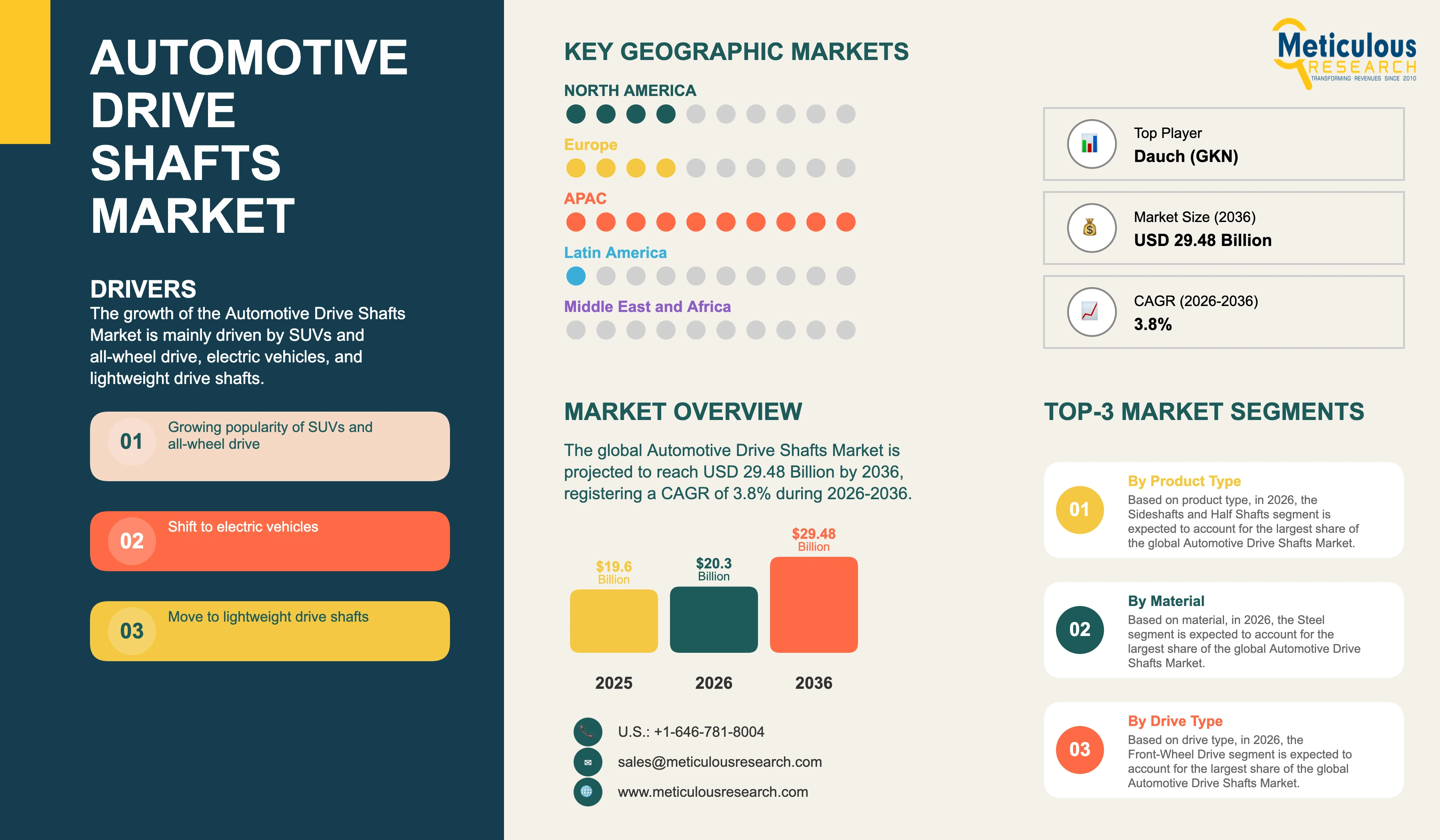
The global automotive drive shafts market was valued at USD 19.60 billion in 2025. This market is expected to reach USD 29.48 billion by 2036 from an estimated USD 20.30 billion in 2026, registering a CAGR of 3.8% during the forecast period (2026-2036).
- Published
- Nov 2026
- Pages
- 252
- Format
- PDF + Excel
- Report ID
- MRAUTO - 1042872
- Base year
- 2025
- 2025 · BASELINE
- $19.60B
- 2036
- $29.48B
- CAGR 2026–2036
- 3.8%
2025 baseline · 2026–2036 forecast at 3.8% CAGR · hover a bar for the value
Key highlights
Dauch Corporation, formerly American Axle & Manufacturing, completed its acquisition of Dowlais Group, the parent of GKN Automotive, on February 3, 2026, according to Dauch. GKN Automotive is one of the world's largest makers of sideshafts, propeller shafts, and all-wheel drive systems, and the deal created a large global driveline supplier with a broad range of axles, drive shafts, and electric drive products.
The combined Dauch Corporation operates in 24 countries and more than 175 locations, according to Dauch. The deal, valued at about USD 1.44 billion when it was announced in January 2025, combines Dauch's axle and driveline business with GKN Automotive's constant velocity joint, sideshaft, and electric drive businesses.
Global electric car sales grew by 20% to more than 20 million units in 2025, accounting for one in four new cars sold, according to the IEA. Electric vehicles produce full torque from a standstill, so they need sideshafts and constant velocity joints with higher torque capacity and lower noise, and many electric vehicles do not use propeller shafts.
Global light vehicle production exceeded 90 million units in 2025 for the first time since 2018, according to Autoliv. Most passenger cars use two sideshafts, while all-wheel drive vehicles use four sideshafts and, in combustion engine and hybrid designs, a propeller shaft.
Leading suppliers include Dauch (GKN Automotive), NTN, Nexteer, Hyundai Wia, Dana, JTEKT, Wanxiang Qianchao, Neapco, IFA Group, and Meritor (Cummins). Many vehicle makers also produce some drive shafts in-house, especially in Japan and China, while independent suppliers serve most global vehicle makers.
Lightweight drive shafts made of aluminum and carbon fiber composites are growing faster than steel shafts, as vehicle makers look to reduce weight, improve noise and vibration performance, and extend electric vehicle range. Carbon fiber propeller shafts can also replace two-piece steel shafts with a single-piece design. All-wheel and four-wheel drive vehicles are the fastest-growing drive type, as SUVs, pickup trucks, and dual-motor electric vehicles gain share in all major vehicle markets around the world.
By product type, sideshafts and half shafts account for the larger share of 62.0% in 2026 and also register the higher CAGR.
By material, steel accounts for the largest share in 2026, while carbon fiber composites register the highest CAGR.
By drive type, front-wheel drive accounts for the largest share in 2026, while all-wheel and four-wheel drive registers the highest CAGR.
By vehicle type, passenger cars account for the largest share of 80.0% in 2026 and also register the highest CAGR.
By geography, Asia-Pacific accounts for the largest share of 52.0% in 2026, while Asia-Pacific registers the highest CAGR of 4.7%.
Report summary
| Particulars | Details |
|---|---|
| Forecast Period | 2026-2036 |
| Base Year | 2025 |
| Estimated Year | 2026 |
| CAGR (Value) | 3.8% |
| Format | PDF, Excel & Cloud Portal · 252 pages |
| Market Size (Value) in 2025 | USD 19.60 billion |
| Market Size (Value) in 2026 | USD 20.30 billion |
| Market Size (Value) by 2036 | USD 29.48 billion |
| Largest Segment by Product Type (2026) | Sideshafts and Half Shafts (62.0%) |
| Largest Segment by Vehicle Type (2026) | Passenger Cars (80.0%) |
| Largest Region (2026) | Asia-Pacific (52.0%) |
| Fastest-Growing Region | Asia-Pacific (CAGR 4.7%) |
| Companies Profiled | 10 companies and other companies |
| Segments Covered | Product Type, Material, Drive Type, Vehicle Type, Geography |
| Countries Covered | U.S., Canada, Germany, France, Spain, Italy, U.K., Poland, Czech Republic, Slovakia, Hungary, Sweden, Romania, Belgium, Rest of Europe, China, Japan, India, South Korea, Thailand, Indonesia, Malaysia, Vietnam, Taiwan, Philippines, Australia, Rest of Asia-Pacific, Mexico, Brazil, Argentina, Colombia, Chile, Peru, Rest of Latin America, Turkey, Morocco, South Africa, Saudi Arabia, Egypt, Iran, Rest of Middle East & Africa |
Report overview
Segments covered: product type, material, drive type, vehicle type.
Automotive drive shafts transfer torque from the transmission, transfer case, or electric drive unit to the wheels. They include sideshafts and half shafts with constant velocity joints, which drive the wheels directly, and propeller shafts, which carry torque along the length of the vehicle to the front or rear axle in rear-wheel drive, all-wheel drive, and four-wheel drive vehicles. Drive shafts are fitted to passenger cars, light commercial vehicles, and heavy commercial vehicles.
The growth of this market is mainly driven by steady growth of global vehicle production, especially in Asia-Pacific, the growing popularity of SUVs and all-wheel drive vehicles, which need more and larger drive shafts, the shift to electric vehicles, which need sideshafts that handle higher torque and run more quietly, the use of electric all-wheel drive with separate front and rear electric motors, and the move to lightweight drive shafts made of aluminum and carbon fiber composites to improve efficiency and range. In addition, replacement demand from the large vehicle fleet supports steady sales. However, strong price pressure, the removal of propeller shafts in many electric vehicles, and the high cost of lightweight materials are expected to restrain the growth of this market to some extent.
Drive shafts are a key part of the vehicle driveline, linking the power source to the wheels. Sideshafts, also called half shafts or axle shafts, connect the transmission, differential, or electric drive unit to each driven wheel. They use constant velocity joints at each end, which allow the wheel to move up and down with the suspension and turn with the steering while transferring torque smoothly. Propeller shafts, also called prop shafts or cardan shafts, carry torque along the vehicle from the transmission or transfer case to the rear or front axle, and they use universal joints or constant velocity joints and center bearings.
This report covers the global automotive drive shafts market, including sideshafts and half shafts and propeller shafts made of steel, aluminum, and carbon fiber composites, for front-wheel drive, rear-wheel drive, and all-wheel and four-wheel drive passenger cars, light commercial vehicles, and heavy commercial vehicles. The market is valued at the selling price of complete drive shaft assemblies, including constant velocity joints and universal joints, sold to vehicle makers and in the aftermarket. The market is analyzed by product type, material, drive type, vehicle type, and geography. Axles, differentials, transfer cases, and electric drive units are not included.
The drive type of a vehicle largely determines how many drive shafts it uses and how valuable they are. Front-wheel drive vehicles, which account for most small and mid-sized cars, use two front sideshafts. Rear-wheel drive vehicles, such as many pickup trucks, commercial vehicles, and premium cars, use a propeller shaft and rear sideshafts or a solid rear axle. All-wheel and four-wheel drive vehicles use four sideshafts and, in many combustion engine and hybrid designs, one or more propeller shafts, which gives them the highest drive shaft content per vehicle.
Electrification is changing drive shaft requirements because electric motors behave very differently from engines. Electric motors produce full torque from a standstill and can change torque very quickly, so sideshafts and constant velocity joints must handle higher peak torque and torque reversals during regenerative braking. Electric vehicles are also quieter, which makes driveline noise and vibration more noticeable and requires better joint designs. Many battery electric vehicles with electric all-wheel drive use separate front and rear motors, which removes the need for a propeller shaft but adds a second pair of sideshafts.
The market is served by large global driveline suppliers, such as Dauch, which now includes GKN Automotive, NTN, Nexteer, Hyundai Wia, Dana, and JTEKT, together with Chinese suppliers, such as Wanxiang Qianchao, and specialists, such as Neapco and IFA Group in propeller shafts and Meritor, part of Cummins, in commercial vehicle drivelines. Vehicle makers, including some Japanese and Chinese vehicle makers, also produce part of their drive shafts in-house or through affiliated suppliers. The acquisition of GKN Automotive by Dauch in February 2026 was one of the largest recent deals in the driveline industry.
Drive shaft suppliers compete on durability, torque capacity, noise and vibration performance, weight, cost, and the ability to supply complete driveline systems. Constant velocity joint design is a core technology, as it determines efficiency, noise, and durability, and leading suppliers hold many patents in this area. Suppliers are also developing lightweight hollow sideshafts, aluminum and carbon fiber propeller shafts, and new joint designs with lower friction for electric vehicles.
In 2026, sideshafts and half shafts account for the largest share of the market by product type and are also the fastest-growing product type. Steel drive shafts account for the largest share by material, while carbon fiber composite drive shafts are the fastest-growing material. Front-wheel drive vehicles account for the largest share by drive type, while all-wheel and four-wheel drive vehicles are the fastest-growing drive type. Passenger cars account for the largest share by vehicle type and are also the fastest-growing vehicle type. Asia-Pacific accounts for the largest share of the market and is also the fastest-growing region.
Market growth over the forecast period will depend on global vehicle production, the mix of front-wheel, rear-wheel, and all-wheel drive vehicles, the pace of electric vehicle adoption, and the adoption of lightweight materials. The shift to electric vehicles will increase demand for high-performance sideshafts while reducing demand for propeller shafts in some vehicle types. Overall, rising all-wheel drive adoption and higher-value sideshafts for electric vehicles are expected to support steady growth in market value.
Passenger cars are expected to account for the largest share of 80.0% of the market in 2026 and are also projected to register the highest CAGR, driven by electric passenger cars and SUVs.
Asia-Pacific is expected to account for the largest share of 52.0% of the market in 2026, mainly due to China's large vehicle and electric vehicle production and the large vehicle production of Japan, India, and South Korea.
Asia-Pacific is also projected to register the highest CAGR of 4.7% during the forecast period, driven by vehicle and electric vehicle growth in China, SUV growth in India, and vehicle production growth in Southeast Asia.
The report profiles 10 companies, including Dauch (GKN Automotive), NTN, Nexteer, Hyundai Wia, Dana, JTEKT, Wanxiang Qianchao, Neapco, IFA Group, and Meritor (Cummins).
Electric vehicles need higher-value sideshafts that handle higher torque and run quietly, and electric all-wheel drive vehicles add a second pair of sideshafts, but many electric vehicles do not use propeller shafts.
Sideshafts connect the transmission, differential, or electric drive unit to each driven wheel using constant velocity joints, while propeller shafts carry torque along the length of the vehicle to the front or rear axle.
Report infographic
Market dynamics
17 factors across 5 forcesSteady growth of global vehicle production
Every vehicle needs drive shafts to move, so demand is closely linked to vehicle production. Global light vehicle production exceeded 90 million units in 2025, according to Autoliv, and production is expected to grow steadily over the forecast period, led by China, India, and Southeast Asia. Each front-wheel drive car uses two sideshafts, while all-wheel drive vehicles and commercial vehicles use more and larger drive shafts, so growth in vehicle production directly increases drive shaft demand.
The growth of vehicle production in Asia-Pacific is particularly important for drive shaft suppliers. China is the largest vehicle producer in the world and is also the largest producer of electric vehicles, while India and Southeast Asia are growing quickly. Drive shaft suppliers are expanding production in these markets to serve local vehicle makers and to reduce costs, and Chinese suppliers have grown quickly with Chinese vehicle makers, both at home and in new overseas plants.
Growing popularity of SUVs and all-wheel drive vehicles
SUVs and crossovers have become the most popular vehicle type in many markets, and a growing share of them are offered with all-wheel drive. All-wheel and four-wheel drive vehicles use four sideshafts instead of two, and many combustion engine and hybrid designs also use a propeller shaft, which roughly doubles drive shaft content per vehicle compared with front-wheel drive cars. SUVs and pickup trucks are also heavier, which requires larger and stronger drive shafts.
All-wheel drive is spreading to more vehicles because it improves traction, stability, and safety in poor weather and on rough roads, and because it is easier to offer on electric vehicles with a second electric motor. All-wheel and four-wheel drive vehicles are the fastest-growing drive type in this market, and suppliers with strong all-wheel drive and propeller shaft businesses, such as Dauch (GKN Automotive), Dana, and Neapco, benefit from this trend.
Shift to electric vehicles
Electric vehicles need sideshafts that can handle higher peak torque, fast torque changes, and torque reversals during regenerative braking. Electric motors also run at high speeds and the vehicles are quiet, so sideshafts must have very low noise and vibration. These requirements increase the value of sideshafts and constant velocity joints in electric vehicles compared with similar combustion engine vehicles.
Global electric car sales grew by 20% to more than 20 million units in 2025, according to the IEA. Many electric vehicles use electric all-wheel drive with front and rear motors, which adds a second pair of sideshafts. As electric vehicle production grows, demand for high-performance sideshafts is expected to grow faster than demand for conventional drive shafts, supporting the growth of the sideshafts and half shafts segment.
Move to lightweight drive shafts
Vehicle makers are working to reduce vehicle weight to improve fuel economy, reduce emissions, and extend electric vehicle range. Drive shafts are a target for weight reduction, and suppliers are developing hollow steel sideshafts, aluminum propeller shafts, and carbon fiber composite propeller shafts that are much lighter than solid steel designs. Lighter drive shafts also reduce rotating mass, which improves vehicle response and efficiency, and they help offset the weight of battery packs in electric vehicles.
Carbon fiber composite propeller shafts are also stiffer than steel, which allows a single-piece shaft to replace a two-piece steel shaft with a center bearing, reducing parts, weight, and vibration. They are used in performance cars, premium vehicles, and some pickup trucks. Carbon fiber composites are the fastest-growing material in this market, and aluminum is also growing faster than steel.
Replacement demand from the large vehicle fleet
Drive shafts and constant velocity joints wear over time, especially when protective boots are damaged and dirt and water enter the joint. The global vehicle fleet is very large and is getting older in many countries, which supports steady demand for replacement sideshafts, constant velocity joints, boots, and propeller shaft parts in the aftermarket. Replacement demand is especially strong in emerging markets with poor road conditions, where joints and boots wear faster, and for commercial vehicles that run long distances. Remanufactured and new aftermarket sideshafts are widely sold through parts distributors, and suppliers such as GKN, NTN, and Dana have strong aftermarket businesses. As the number of all-wheel drive and electric vehicles in the fleet grows, replacement demand for higher-value drive shafts is also expected to increase.
Table of contents
12 chapters · 184 sections · 252 pages · click to expandSegmental analysis
| Segment | Largest share (2026) | Fastest growth (2026–2036) |
|---|---|---|
| By Product Type | Steel | Carbon fiber composites |
By Product Type
- The steel segment is expected to account for the largest share of the automotive drive shafts market, while the carbon fiber composites segment is projected to register the highest CAGR during the forecast period.
- The front-wheel drive segment is expected to account for the largest share of the automotive drive shafts market, while the all-wheel and four-wheel drive segment is projected to register the highest CAGR during the forecast period.
Geographic analysis
Asia-Pacific
Largest shareIn 2026, Asia-Pacific is expected to account for the largest share of 52.0% of the global automotive drive shafts market. The large share of this region is mainly due to China's position as the largest vehicle producer in the world, China's leadership in electric vehicle production, the large vehicle production of Japan, India, South Korea, and Thailand, the growing share of SUVs in the region, and the presence of leading drive shaft suppliers, such as NTN, JTEKT, Hyundai Wia, and Wanxiang Qianchao, as well as the large Asian operations of Dauch (GKN Automotive) and Nexteer. Japanese and Chinese vehicle makers also produce some drive shafts in-house or through affiliated suppliers. India, South Korea, and Thailand are also large markets, supported by domestic and export vehicle production. Asia-Pacific is also projected to register the highest CAGR of 4.7% during the forecast period. The rapid growth of this region is mainly driven by continued growth of vehicle and electric vehicle production in China, the fast growth of vehicle production and SUV sales in India, the growth of vehicle production in Indonesia, Vietnam, and Thailand, including by Chinese electric vehicle makers, and the rising share of all-wheel drive and electric all-wheel drive vehicles in China. Drive shaft suppliers are expanding production in the region to serve local and export vehicle production, and Chinese suppliers are growing quickly with Chinese vehicle makers.
Europe
Europe accounts for a significant share of the market, supported by the production of premium vehicles, SUVs, and electric vehicles with high drive shaft content, the growing use of all-wheel drive, and the presence of leading suppliers and production sites, including large GKN Automotive and IFA Group operations. Germany, France, Spain, Italy, and Central and Eastern European countries, such as Poland, the Czech Republic, Slovakia, and Hungary, are the largest markets in the region. However, slow growth of vehicle production in Western Europe is expected to limit growth in the region compared with Asia-Pacific. Central and Eastern European countries are attractive locations for drive shaft production because of their lower costs and closeness to vehicle plants across Europe.
North America
North America accounts for a large share of the market, supported by the production of large pickup trucks and SUVs, which use propeller shafts and four-wheel drive systems with high drive shaft content, and the presence of Dauch, Dana, Nexteer, Neapco, and Meritor. Dauch, based in Detroit, completed its acquisition of GKN Automotive in February 2026, according to Dauch. The U.S. is the largest market in the region, while Mexico is an important production base.
Latin America
Latin America and the Middle East & Africa account for smaller shares, with growth supported by vehicle production in Brazil, Argentina, Turkey, and Morocco and by replacement demand on poor roads. Brazil is the largest market in Latin America, supported by large vehicle production and a large aftermarket, while Turkey and Morocco are important vehicle production bases serving Europe.
Competitive landscape
The global automotive drive shafts market is relatively concentrated in sideshafts, where a few large global suppliers hold strong positions, and more fragmented in propeller shafts, where specialists and regional suppliers compete. Vehicle makers also produce some drive shafts in-house or through affiliated suppliers, especially in Japan and China, and Chinese suppliers have grown quickly with Chinese vehicle makers.
Dauch, which completed its acquisition of GKN Automotive in February 2026, is one of the largest drive shaft suppliers in the world and operates in 24 countries and more than 175 locations, according to Dauch. NTN, Nexteer, Hyundai Wia, and JTEKT are major sideshaft suppliers, Dana and Neapco are leading suppliers of propeller shafts and all-wheel drive systems, Wanxiang Qianchao is a leading Chinese supplier, IFA Group is a major European propeller shaft supplier with plants in Europe, North America, and Asia, and Meritor, part of Cummins, supplies commercial vehicle drivelines.
Companies in this market compete on durability, torque capacity, noise and vibration performance, weight, cost, global production close to vehicle plants, and the ability to supply complete driveline systems. Key strategies include developing high-performance sideshafts and low-friction constant velocity joints for electric vehicles, developing lightweight aluminum and carbon fiber propeller shafts, expanding production in Asia-Pacific, building relationships with Chinese vehicle makers, and growing through acquisitions.
Recent competitive activity in the drive shafts market has been led by consolidation among driveline suppliers. Dauch, formerly American Axle & Manufacturing, completed its acquisition of Dowlais Group, the parent of GKN Automotive, on February 3, 2026, combining axle, driveline, sideshaft, and electric drive businesses, according to Dauch. The deal was valued at about USD 1.44 billion when it was announced in January 2025.
We expect competition to increase over the forecast period as Chinese suppliers expand abroad, as electric vehicles change drive shaft requirements, and as vehicle makers push for lower prices. Suppliers with strong constant velocity joint technology, electric vehicle expertise, lightweight materials capabilities, and global production are expected to strengthen their positions, while further consolidation is likely, especially among smaller propeller shaft and component suppliers that lack scale. Partnerships between global suppliers and Chinese companies are also likely as global suppliers look to win business with Chinese vehicle makers.
Some of the key players operating in the automotive drive shafts market are Dauch Corporation (GKN Automotive), NTN Corporation, Nexteer Automotive Group Limited, Hyundai Wia Corporation, Dana Incorporated, JTEKT Corporation, Wanxiang Qianchao Co., Ltd., Neapco Holdings LLC, IFA Group, and Meritor, Inc. (Cummins Inc.), among others.
- —
Dauch Corporation, formerly American Axle & Manufacturing, completed its acquisition of Dowlais Group, the parent of GKN Automotive, on February 3, 2026, creating a large global driveline supplier.
- Dauch Corporation (GKN Automotive)
- NTN Corporation
- Nexteer Automotive Group Limited
- Hyundai Wia Corporation
- Dana Incorporated
- JTEKT Corporation
- Wanxiang Qianchao Co., Ltd.
- Neapco Holdings LLC
- IFA Group
- Meritor, Inc. (Cummins Inc.)
Expert perspectives
Automotive drive shafts are a mature but steadily growing market, supported by vehicle production, the growth of SUVs and all-wheel drive vehicles, and the shift to electric vehicles. While front-wheel drive cars with steel sideshafts still account for most of the market, electrification and all-wheel drive are increasing the value of sideshafts per vehicle, even as propeller shaft demand declines in some electric vehicles.
Over the forecast period, the market is expected to grow at a CAGR of 3.8%, from USD 20.30 billion in 2026 to USD 29.48 billion in 2036. Growth will be driven by steady vehicle production growth, the growing popularity of SUVs and all-wheel drive vehicles, the shift to electric vehicles, the move to lightweight drive shafts, and replacement demand from the large vehicle fleet.
Among the market segments, sideshafts and half shafts are both the largest and the fastest-growing product type. Steel is the largest material, while carbon fiber composites grow fastest. Front-wheel drive is the largest drive type, while all-wheel and four-wheel drive grow fastest. Passenger cars are both the largest and the fastest-growing vehicle type. Asia-Pacific is both the largest and the fastest-growing region, at a CAGR of 4.7%.
In our view, electrification will reshape the drive shaft market more than any other factor. Electric vehicles reduce demand for propeller shafts in passenger cars but increase demand for high-performance sideshafts, especially in electric all-wheel drive vehicles with front and rear motors. Suppliers that develop low-friction, low-noise, high-torque sideshafts and constant velocity joints for electric vehicles will gain the most. We also expect lightweight propeller shafts to hold their place in pickup trucks and commercial vehicles, where electrification is slower, and to win new business as composite costs fall.
We also see consolidation and Chinese competition as major forces shaping the market. Dauch's acquisition of GKN Automotive has created a stronger global driveline supplier, while Chinese suppliers are growing quickly at home and abroad. Global suppliers will need to cut costs, expand in Asia-Pacific, and work closely with Chinese vehicle makers to compete, while propeller shaft specialists will need to focus on trucks, commercial vehicles, and lightweight designs.
Overall, we believe the automotive drive shafts market will grow steadily over the forecast period, with sideshafts, carbon fiber composites, all-wheel drive, passenger cars, and Asia-Pacific providing the fastest growth. Companies with strong electric vehicle sideshaft technology, lightweight materials capabilities, scale, and local production in growth markets will be best positioned to capture this growth over the next decade, while price pressure and the decline of propeller shafts in electric cars remain key risks.
Customer perspectives
“Our dual-motor models need four sideshafts that handle very high torque and stay silent. We spend a lot of time tuning the joints for noise and vibration.”
“Moving to a single-piece composite propeller shaft cut weight and removed a center bearing. Cost is still the main barrier for wider use.”
“SUVs are now a big part of our sales, and we are adding all-wheel drive to more models. We need suppliers with local production to keep costs down.”
Frequently asked questions
The global automotive drive shafts market was valued at USD 19.60 billion in 2025, up from USD 19.00 billion in 2024, and is estimated at USD 20.30 billion in 2026. The market includes sideshafts, half shafts, and propeller shafts for passenger cars and commercial vehicles.
The global automotive drive shafts market is expected to reach USD 29.48 billion by 2036, driven by vehicle production, SUVs and all-wheel drive vehicles, electric vehicles, and lightweight drive shafts.
The market is expected to register a CAGR of 3.8% from 2026 to 2036, with the fastest growth in sideshafts, carbon fiber composites, all-wheel drive vehicles, passenger cars, and Asia-Pacific.
Market growth is mainly driven by steady vehicle production growth, the growing popularity of SUVs and all-wheel drive vehicles, the shift to electric vehicles, the move to lightweight drive shafts, and replacement demand from the large vehicle fleet.
The removal of propeller shafts in many electric vehicles and strong price pressure and the high cost of lightweight materials restrain growth, while noise, vibration, and durability requirements and supplier consolidation and in-house production are key challenges.
Key growth opportunities include high-performance sideshafts for electric vehicles, carbon fiber and aluminum propeller shafts, growth in India, Southeast Asia, and with Chinese vehicle makers, and aftermarket and remanufactured drive shafts.
Sideshafts and half shafts are expected to account for the largest share of 62.0% of the market in 2026 and are also projected to register the highest CAGR, driven by electric vehicles and all-wheel drive.
In 2026, the steel segment is expected to account for the largest share of the automotive drive shafts market, while the carbon fiber composites segment is projected to register the highest CAGR during the forecast period.
In 2026, the front-wheel drive segment is expected to account for the largest share of the automotive drive shafts market, while the all-wheel and four-wheel drive segment is projected to register the highest CAGR during the forecast period.
Passenger cars are expected to account for the largest share of 80.0% of the market in 2026 and are also projected to register the highest CAGR, driven by electric passenger cars and SUVs.
Asia-Pacific is expected to account for the largest share of 52.0% of the market in 2026, mainly due to China's large vehicle and electric vehicle production and the large vehicle production of Japan, India, and South Korea.
Asia-Pacific is also projected to register the highest CAGR of 4.7% during the forecast period, driven by vehicle and electric vehicle growth in China, SUV growth in India, and vehicle production growth in Southeast Asia.
The report profiles 10 companies, including Dauch (GKN Automotive), NTN, Nexteer, Hyundai Wia, Dana, JTEKT, Wanxiang Qianchao, Neapco, IFA Group, and Meritor (Cummins).
Dauch Corporation, formerly American Axle & Manufacturing, completed its acquisition of Dowlais Group, the parent of GKN Automotive, on February 3, 2026, creating a large global driveline supplier.
Electric vehicles need higher-value sideshafts that handle higher torque and run quietly, and electric all-wheel drive vehicles add a second pair of sideshafts, but many electric vehicles do not use propeller shafts.
Sideshafts connect the transmission, differential, or electric drive unit to each driven wheel using constant velocity joints, while propeller shafts carry torque along the length of the vehicle to the front or rear axle.
Cite this report
Meticulous Research. (2026). Automotive Drive Shafts Market - Global Opportunity Analysis and Industry Forecast (2026-2036) (Report No. MRAUTO - 1042872). Meticulous Market Research Pvt. Ltd. https://www.meticulousresearch.com/product/automotive-drive-shafts-market-7555