Automotive DC-DC Converters Market (2026-2036)
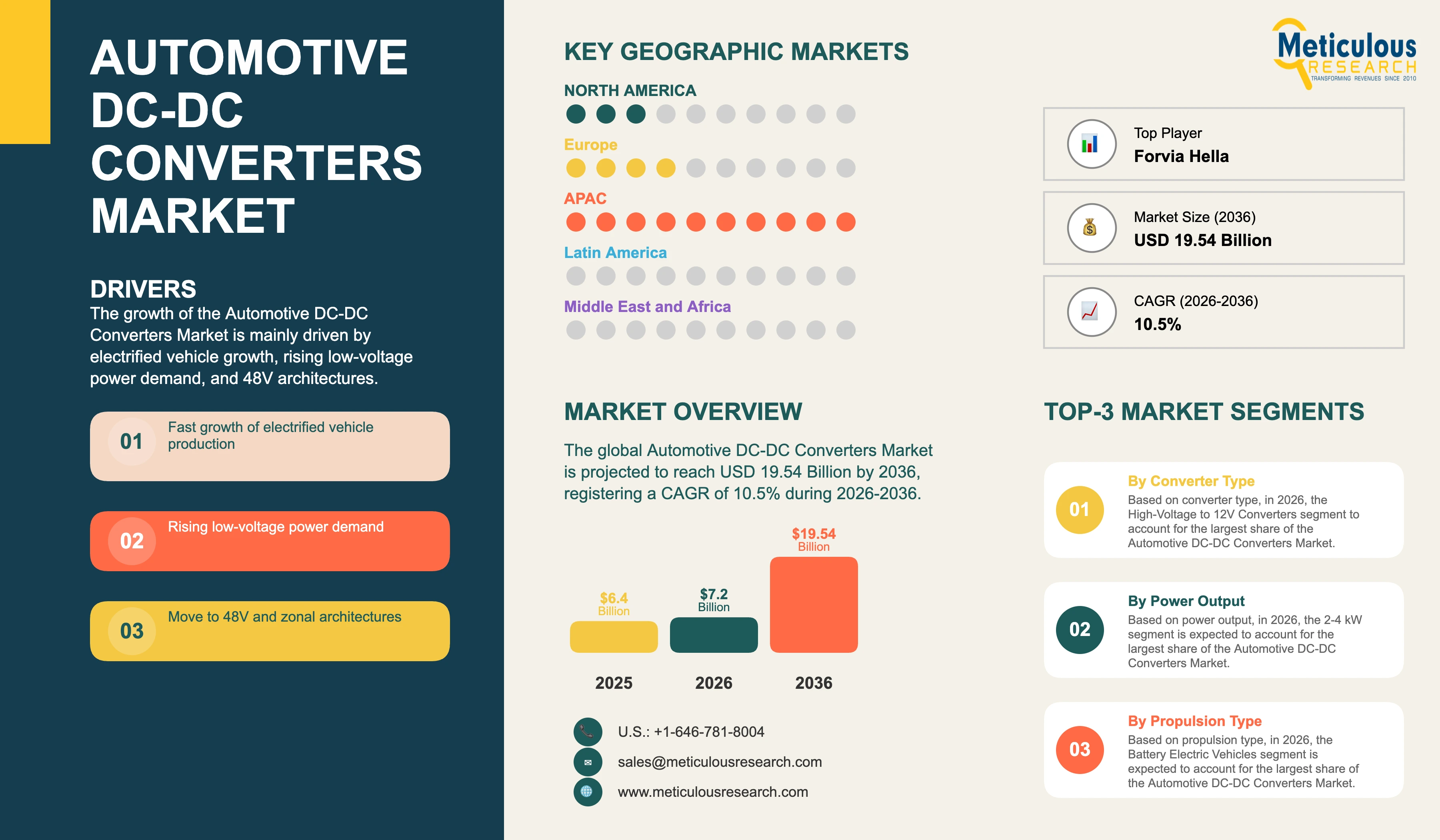
The global automotive DC-DC converters market was valued at USD 6.40 billion in 2025. This market is expected to reach USD 19.54 billion by 2036 from an estimated USD 7.20 billion in 2026, registering a CAGR of 10.5% during the forecast period (2026-2036).
- Published
- Nov 2026
- Pages
- 264
- Format
- PDF + Excel
- Report ID
- MRAUTO - 1042877
- Base year
- 2025
- 2025 · BASELINE
- $6.40B
- 2036
- $19.54B
- CAGR 2026–2036
- 10.5%
2025 baseline · 2026–2036 forecast at 10.5% CAGR · hover a bar for the value
Key highlights
Global electric car sales grew by 20% to more than 20 million units in 2025, accounting for one in four new cars sold, according to the IEA. Every battery electric and plug-in hybrid vehicle needs at least one high-voltage DC-DC converter to supply its low-voltage system, as these vehicles have no alternator.
Forvia Hella describes itself as a global leading supplier of automotive 12V and 48V DC-DC converters, producing more than 1.5 million units each year, and offers a high-voltage DC-DC converter designed for both 400V and 800V vehicles, according to Hella.
Vicor introduced automotive-grade power modules, including a 2.5 kW bus converter that converts 800V from the traction battery to 48V at 98% efficiency, to support 48V zonal architectures, according to Vicor. In September 2026, Vicor and INFAC announced an 800V battery pack design that integrates an 800V-to-48V DC-DC converter inside the battery, removing the separate cooling system needed by external converters.
Acbel Polytech presented an 800V to 48V and 12V 6 kW dual-output DC-DC converter and a 400V to 12V 3 kW converter, both developed to ISO 26262 functional safety requirements, at Power2Drive Europe 2026, along with an integrated onboard charger and DC-DC converter unit.
Tesla's Cybertruck, launched in 2023, uses a 48V low-voltage architecture instead of the traditional 12V system, and several other vehicle makers are developing 48V and zonal architectures, which require new high-voltage to 48V and 48V to 12V converters.
Leading suppliers include Forvia Hella, Toyota Industries, Denso, Shinry Technologies, Shenzhen VMAX New Energy, BYD (FinDreams), LG Magna e-Powertrain, Valeo, Lear, Delta Electronics, and Hyundai Mobis. High-voltage to 48V converters are the fastest-growing converter type, while converters above 4 kW are the fastest-growing power output as low-voltage loads rise. Integrated DC-DC units that combine the converter with the onboard charger and power distribution unit are the fastest-growing product configuration, led by Chinese vehicle makers. Forvia Hella's high-voltage converter supports both 400V and 800V vehicles with one common design.
By converter type, high-voltage to 12V converters account for the largest share of 62.0% in 2026, while high-voltage to 48V converters register the highest CAGR.
By power output, 2-4 kW accounts for the largest share in 2026, while above 4 kW registers the highest CAGR.
By propulsion type, battery electric vehicles account for the largest share of 54.0% in 2026 and also register the highest CAGR.
By product configuration, standalone DC-DC converters account for the larger share in 2026, while integrated DC-DC units register the higher CAGR.
By geography, Asia-Pacific accounts for the largest share of 56.0% in 2026, while Asia-Pacific registers the highest CAGR of 11.3%.
Report summary
| Particulars | Details |
|---|---|
| Base Year | 2025 |
| Estimated Year | 2026 |
| Forecast Period | 2026-2036 |
| Market Size in 2025 | USD 6.40 billion |
| Market Size in 2026 | USD 7.20 billion |
| Market Size by 2036 | USD 19.54 billion |
| CAGR (2026-2036) | 10.5% |
| Format | PDF, Excel & Cloud Portal · 264 pages |
| Largest Segment by Converter Type (2026) | High-Voltage to 12V Converters (62.0%) |
| Largest Segment by Propulsion Type (2026) | Battery Electric Vehicles (54.0%) |
| Largest Region (2026) | Asia-Pacific (56.0%) |
| Fastest-Growing Region | Asia-Pacific (CAGR 11.3%) |
| Companies Profiled | 11 companies and other companies |
| Segments Covered | Converter Type, Power Output, Propulsion Type, Product Configuration, Geography |
| Countries Covered | U.S., Canada, Germany, France, U.K., Spain, Italy, Sweden, Norway, Netherlands, Belgium, Poland, Czech Republic, Hungary, Romania, Rest of Europe, China, Japan, South Korea, India, Thailand, Indonesia, Malaysia, Vietnam, Philippines, Taiwan, Australia, Rest of Asia-Pacific, Mexico, Brazil, Chile, Colombia, Rest of Latin America, Turkey, UAE, Saudi Arabia, Israel, Morocco, South Africa, Rest of Middle East & Africa |
Report overview
Segments covered: converter type, power output, propulsion type, product configuration.
Automotive DC-DC converters change the voltage of direct current power between the different electrical systems in a vehicle. In electrified vehicles, the main DC-DC converter steps down power from the 400V or 800V traction battery to the 12V or 48V system that supplies lights, infotainment, control units, steering, braking, and other loads, replacing the alternator used in combustion engine vehicles. Other converters link 48V and 12V systems in mild hybrid vehicles and new 48V architectures, and high-voltage converters allow 800V vehicles to charge at 400V charging stations.
The growth of this market is mainly driven by the fast growth of battery electric and plug-in hybrid vehicle production, rising low-voltage power demand from driver assistance systems, computers, and electric chassis systems, the move to 48V low-voltage architectures and zonal electrical systems, the shift to 800V platforms, which need new converter designs and high-voltage boost converters, and the growth of mild and full hybrid vehicles. In addition, new semiconductor technologies are making DC-DC converters smaller, lighter, and more efficient. However, strong price pressure, integration of DC-DC converters into multi-in-one units, and the slower growth of electric vehicles in some markets are expected to restrain the growth of this market to some extent.
Every vehicle has a low-voltage electrical system, traditionally at 12V, that powers lights, wipers, infotainment, control units, power steering, braking systems, seats, and many other loads. In combustion engine vehicles, an alternator driven by the engine charges the 12V battery. Battery electric and plug-in hybrid vehicles have no alternator, so they use a DC-DC converter to take power from the high-voltage traction battery and supply the low-voltage system. The DC-DC converter is therefore an essential part of every electrified vehicle and must work reliably at all times, as failure would stop safety-critical systems.
This report covers the global automotive DC-DC converters market, including high-voltage to 12V converters, 48V to 12V converters, high-voltage to 48V converters, and high-voltage to high-voltage converters, for battery electric vehicles, plug-in hybrid and range-extended vehicles, and hybrid and mild hybrid vehicles, including passenger cars and commercial vehicles. The market is valued at the selling price of DC-DC converters supplied to vehicle makers, including the DC-DC converter portion of integrated units and units made in-house by vehicle makers valued at an estimated market price. The market is analyzed by converter type, power output, propulsion type, product configuration, and geography. Onboard chargers, traction inverters, and small point-of-load converters on circuit boards are not included.
Low-voltage power demand in vehicles is rising quickly as more functions become electric and electronic. Driver assistance systems, central computers, large displays, electric power steering, electronic brakes, active suspension, and heating and cooling systems all draw power from the low-voltage system, and some loads have peaks of several kilowatts. As a result, the power rating of high-voltage DC-DC converters has risen from about 1.5 kW to 2.5 kW in early electric vehicles to 3 kW to 4 kW or more in many new vehicles. Converters above 4 kW are the fastest-growing power output segment in this market.
The low-voltage system itself is also changing, after decades of using 12V. Several vehicle makers are moving from 12V to 48V low-voltage systems, which reduce current, allow thinner and lighter wiring, and better support high-power loads, such as active suspension and electric steering. Tesla's Cybertruck uses a 48V low-voltage architecture, and other vehicle makers are developing 48V and zonal architectures, in which power is distributed through zone controllers around the vehicle. These architectures need high-voltage to 48V converters and, in many designs, 48V to 12V converters for remaining 12V loads.
The move to 800V platforms is also changing DC-DC converter designs and adding new converter types. High-voltage to low-voltage converters for 800V vehicles need components rated for higher voltage, and many 800V vehicles also use high-voltage to high-voltage boost converters that allow them to charge at 400V DC fast chargers. Some suppliers offer converters that work with both 400V and 800V systems, such as Hella's high-voltage DC-DC converter, according to Hella. Silicon carbide and gallium nitride devices are increasingly used to improve efficiency and reduce size.
The market is served by global automotive electronics suppliers, such as Forvia Hella, Toyota Industries, Denso, LG Magna e-Powertrain, Valeo, Lear, Delta Electronics, and Hyundai Mobis, and Chinese suppliers, such as Shinry Technologies and Shenzhen VMAX New Energy, together with vehicle makers' in-house units, such as BYD's FinDreams. In China, integrated units that combine the DC-DC converter with the onboard charger and power distribution unit are common, while standalone converters remain widely used in other regions. Power module makers, such as Vicor, supply high-density converter modules to suppliers and vehicle makers.
In 2026, high-voltage to 12V converters account for the largest share of the market by converter type, while high-voltage to 48V converters are the fastest-growing converter type. Converters of 2-4 kW account for the largest share by power output, while converters above 4 kW are the fastest-growing power output. Battery electric vehicles account for the largest share by propulsion type and are also the fastest-growing propulsion type. Standalone DC-DC converters account for the largest share by product configuration, while integrated DC-DC units are the fastest-growing configuration. Asia-Pacific accounts for the largest share of the market and is also the fastest-growing region.
Market growth over the forecast period will depend on electrified vehicle production, the growth of low-voltage power demand, the adoption of 48V and zonal architectures, the spread of 800V platforms, and price trends. Integration into multi-in-one units and strong price pressure will limit growth in market value compared with unit volumes. Overall, electrification and rising low-voltage power needs are expected to drive steady growth of the DC-DC converter market through 2036.
Battery electric vehicles are expected to account for the largest share of 54.0% of the market in 2026 and are also projected to register the highest CAGR, driven by fast production growth, 800V platforms, and 48V architectures.
Asia-Pacific is expected to account for the largest share of 56.0% of the market in 2026, mainly due to China's large electric and plug-in hybrid vehicle production and Japan's large hybrid vehicle production.
Asia-Pacific is also projected to register the highest CAGR of 11.3% during the forecast period, driven by electric vehicle growth in China, hybrid and mild hybrid growth in India, and electric bus and truck growth.
The report profiles 11 companies, including Forvia Hella, Toyota Industries, Denso, Shinry Technologies, Shenzhen VMAX New Energy, BYD (FinDreams), LG Magna e-Powertrain, Valeo, Lear, Delta Electronics, and Hyundai Mobis.
Electric vehicles have no alternator, so they use a DC-DC converter to take power from the high-voltage traction battery and supply the 12V or 48V system that powers lights, control units, steering, braking, and other loads.
48V architectures need new high-voltage to 48V converters and, in many designs, 48V to 12V converters, which creates new demand and opportunities for suppliers with compact and efficient designs.
Report infographic
Market dynamics
17 factors across 5 forcesFast growth of electrified vehicle production
Every battery electric and plug-in hybrid vehicle needs a high-voltage DC-DC converter, and full and mild hybrid vehicles also use DC-DC converters, so demand is closely linked to electrified vehicle production. Global electric car sales grew by 20% to more than 20 million units in 2025, according to the IEA, led by China, with growing volumes in Europe, North America, and emerging markets. Full hybrid and mild hybrid vehicles are also growing in Japan, Europe, North America, and India.
Electrified vehicle production is expected to keep growing over the forecast period, supported by falling battery costs, wider model choice, emission rules, and government support. Battery electric vehicles, which use higher-power and more valuable DC-DC converters than hybrids, are expected to grow fastest, which supports growth in market value. Electric buses and trucks, which use high-power converters, add further demand.
Rising low-voltage power demand
The power needed by the low-voltage system is rising quickly as vehicles add more electronics and electrically powered functions. Driver assistance systems and central computers need reliable power, and some automated driving systems need redundant power supplies. Electric power steering, electronic brakes, active suspension, electric heating, and large displays add further load, and some loads have high short-term peaks.
To meet this demand, vehicle makers are fitting higher-power DC-DC converters, often 3 kW to 4 kW or more, and some vehicles use two converters for redundancy. Higher-power converters are more valuable than lower-power units, which increases market value. Converters above 4 kW are the fastest-growing power output segment in this market, supported by premium vehicles, vehicles with advanced driver assistance, and commercial vehicles.
Move to 48V and zonal electrical architectures
Vehicle makers are moving to 48V low-voltage systems and zonal electrical architectures to reduce wiring weight and cost and to support high-power loads. A 48V system carries the same power with a quarter of the current of a 12V system, allowing thinner and lighter cables. Zonal architectures distribute power through zone controllers placed around the vehicle, which simplifies wiring and supports software-defined vehicles.
These architectures need new types of DC-DC converters, including high-voltage to 48V converters and 48V to 12V converters for remaining 12V loads. Vicor introduced a 2.5 kW 800V-to-48V bus converter with 98% efficiency to support 48V zonal architectures, according to Vicor, and Acbel Polytech presented an 800V to 48V and 12V 6 kW dual-output converter at Power2Drive Europe 2026. High-voltage to 48V converters are the fastest-growing converter type in this market.
Shift to 800V platforms
The move to 800V vehicle platforms requires DC-DC converters designed for higher input voltage, with components rated for higher voltage and often using silicon carbide devices. These converters are more complex and valuable than 400V units. Many 800V vehicles also use high-voltage to high-voltage boost converters that allow them to charge at the many 400V DC fast chargers still in use, which adds a further converter to the vehicle.
800V platforms are spreading from premium vehicles to mid-priced models, especially in China, Korea, and Europe. Suppliers are developing converters that work with both 400V and 800V systems to simplify vehicle makers' product ranges, such as Hella's high-voltage DC-DC converter, according to Hella. The spread of 800V platforms supports growth in both the value of high-voltage to low-voltage converters and the use of high-voltage to high-voltage converters.
Growth of hybrid and mild hybrid vehicles
Full hybrid vehicles use DC-DC converters to supply the 12V system from the high-voltage battery, and mild hybrid vehicles use 48V to 12V converters to link their 48V starter-generator systems with the 12V system. Hybrid demand has grown in many markets as vehicle makers look to reduce emissions while avoiding the higher cost of battery electric vehicles, and several vehicle makers have increased their hybrid plans as battery electric vehicle growth slowed in some regions. Mild hybrid systems are widely used in Europe to help vehicle makers meet CO2 rules at low cost, and they are spreading in India, China, and other markets. Toyota Industries and Denso are major suppliers of DC-DC converters for Toyota's large hybrid vehicle production. While hybrid and mild hybrid vehicles use lower-value converters than battery electric vehicles, their large and growing production volumes provide a steady base of demand for DC-DC converter suppliers throughout the forecast period.
Table of contents
12 chapters · 179 sections · 264 pages · click to expandSegmental analysis
| Segment | Largest share (2026) | Fastest growth (2026–2036) |
|---|---|---|
| By Converter Type | 2-4 kW | Above 4 kW |
By Converter Type
- The 2-4 kW segment is expected to account for the largest share of the automotive DC-DC converters market, while the above 4 kW segment is projected to register the highest CAGR during the forecast period.
- The standalone DC-DC converters segment is expected to account for the larger share of the automotive DC-DC converters market, while the integrated DC-DC units segment is projected to register the higher CAGR during the forecast period.
Geographic analysis
Asia-Pacific
Largest shareIn 2026, Asia-Pacific is expected to account for the largest share of 56.0% of the global automotive DC-DC converters market. The large share of this region is mainly due to China's position as the largest electric vehicle producer in the world, the large production of plug-in hybrid and range-extended vehicles in China, Japan's large production of full hybrid vehicles, the wide adoption of integrated DC-DC units by Chinese vehicle makers, and the presence of leading suppliers, such as Toyota Industries, Denso, Shinry Technologies, Shenzhen VMAX New Energy, BYD (FinDreams), LG Magna e-Powertrain, and Hyundai Mobis. South Korea is also an important market, supported by electric vehicle production by Hyundai and Kia. India is expected to be one of the fastest-growing countries, supported by electric two-wheeler, three-wheeler, car, and bus production and growing mild hybrid adoption. Asia-Pacific is also projected to register the highest CAGR of 11.3% during the forecast period. The rapid growth of this region is mainly driven by continued growth of electric and plug-in hybrid vehicle production in China, the spread of 800V platforms to mid-priced Chinese vehicles, the growth of electric vehicle and hybrid production in India, Thailand, and Indonesia, the growth of mild hybrid vehicles in India, and the growth of electric buses and trucks in China and India. Chinese suppliers are also expanding production to serve vehicle makers in Southeast Asia and other regions, and Japanese suppliers continue to supply Toyota's large hybrid production across Asia.
Europe
Europe accounts for a significant share of the market, supported by strict CO2 rules, which require vehicle makers to sell more electric and mild hybrid vehicles, the wide use of 48V mild hybrid systems, the launch of new 800V electric vehicle platforms, and the presence of leading suppliers, such as Forvia Hella, Valeo, Lear, and Delta Electronics' European operations. Germany is the largest market in the region, supported by large vehicle production, followed by France, the U.K., Spain, Italy, and Central and Eastern European countries, which are important locations for vehicle and power electronics production. European vehicle makers are also developing 48V and zonal architectures for their future platforms, which is expected to make Europe one of the early adopters of high-voltage to 48V converters.
North America
North America accounts for a significant share of the market, supported by electric vehicle production by Tesla, General Motors, Ford, Hyundai, and other vehicle makers, the growth of hybrid vehicles, the early adoption of 48V low-voltage architecture in Tesla's Cybertruck, and the high power needs of electric pickup trucks and SUVs. However, the end of federal electric vehicle purchase incentives in the U.S. in 2025 has slowed electric vehicle growth. Mexico is an important production location for automotive electronics supplied to vehicle plants across North America.
Latin America
Latin America and the Middle East & Africa account for small shares, with growth supported by hybrid and electric vehicle adoption in Brazil, Mexico, Turkey, and the Gulf countries.
Competitive landscape
The global automotive DC-DC converters market includes global automotive electronics suppliers, Chinese power electronics suppliers, vehicle makers' in-house units, and power module makers. Chinese suppliers hold a large share of the market through low costs and close relationships with Chinese vehicle makers, while global suppliers serve vehicle makers in Japan, Europe, North America, and Korea. Competition is strong, and prices have fallen quickly, especially for standard high-voltage to 12V converters, where many suppliers can meet the technical requirements and vehicle makers can easily switch.
Forvia Hella is a leading supplier of 12V and 48V DC-DC converters, producing more than 1.5 million units each year, according to Hella. Toyota Industries and Denso supply converters for Toyota's large hybrid and electric vehicle production. Shinry Technologies, Shenzhen VMAX New Energy, and BYD (FinDreams) are leading suppliers in China, and LG Magna e-Powertrain, Valeo, Lear, Delta Electronics, and Hyundai Mobis are major global suppliers. Vicor supplies high-density converter modules for 48V architectures to suppliers and vehicle makers.
Companies in this market compete on cost, efficiency, power density, reliability, functional safety, and the ability to offer converters for 48V, 800V, and integrated systems. Key strategies include developing high-voltage to 48V and dual-output converters, higher-power and redundant converters, and integrated power units, adopting silicon carbide and gallium nitride devices, building local production in China, Europe, and North America, and forming partnerships with battery, e-axle, and semiconductor companies.
Recent competitive activity has focused on 48V architectures, 800V systems, and integration. Vicor and INFAC announced an 800V battery pack design with an integrated 800V-to-48V converter in September 2026, Acbel Polytech presented 800V dual-output and 400V converters developed to ISO 26262 at Power2Drive Europe 2026, and Texas Instruments released an 800V-to-48V converter reference design in 2026.
We expect competition to increase over the forecast period as Chinese suppliers expand abroad, as integration changes how converters are bought, and as vehicle makers adopt 48V and zonal architectures. Suppliers with low costs, strong 48V and 800V capabilities, functional safety expertise, and integrated product offerings are expected to strengthen their positions, while consolidation among smaller suppliers is likely, along with partnerships between converter suppliers and battery makers.
Some of the key players operating in the automotive DC-DC converters market are Forvia Hella, Toyota Industries Corporation, Denso Corporation, Shinry Technologies Co., Ltd., Shenzhen VMAX New Energy Co., Ltd., BYD Company Limited (FinDreams), LG Magna e-Powertrain Co., Ltd., Valeo SE, Lear Corporation, Delta Electronics, Inc., and Hyundai Mobis Co., Ltd., among others.
- —
Vicor and INFAC announced an 800V battery pack with an integrated 800V-to-48V converter in September 2026, and Acbel Polytech presented 800V dual-output and 400V converters developed to ISO 26262 at Power2Drive Europe 2026.
- LG Magna e-Powertrain
- Valeo
- Lear
- Delta Electronics
- Hyundai Mobis
Expert perspectives
Automotive DC-DC converters are an essential part of every electrified vehicle, and the market is growing with electric vehicle production while moving to higher-power, 48V, 800V, and integrated designs. Although price pressure on standard converters is strong, rising low-voltage power demand and new architectures are increasing converter value per vehicle.
Over the forecast period, the market is expected to grow at a CAGR of 10.5%, from USD 7.20 billion in 2026 to USD 19.54 billion in 2036. Growth will be driven by the fast growth of electrified vehicle production, rising low-voltage power demand, the move to 48V and zonal architectures, the shift to 800V platforms, and the growth of hybrid and mild hybrid vehicles.
Among the market segments, high-voltage to 12V converters are the largest converter type, while high-voltage to 48V converters grow fastest. Converters of 2-4 kW are the largest power output, while converters above 4 kW grow fastest. Battery electric vehicles are both the largest and the fastest-growing propulsion type. Standalone converters are the largest product configuration, while integrated DC-DC units grow fastest. Asia-Pacific is both the largest and the fastest-growing region, at a CAGR of 11.3%.
In our view, the move to 48V and zonal architectures will be by far the most important change in this market over the next decade. It will create demand for new high-voltage to 48V and 48V to 12V converters, which offer suppliers the chance to win new business with innovative designs. Suppliers that develop efficient, compact, and safe 48V converters early will gain the most. We expect premium and software-focused vehicle makers to adopt 48V first, followed by mainstream vehicle makers later in the forecast period.
We also see integration as both a threat and an opportunity for standalone converter suppliers. Integration into multi-in-one units, battery packs, and e-axles reduces the market for standalone converters, but suppliers that offer integrated power units or partner with battery and e-axle suppliers can capture more value. Low-cost Chinese suppliers will continue to set the price benchmark for standard converters, so global suppliers will need to focus on higher-value products, such as 48V, high-power, and redundant converters.
Overall, we believe that the automotive DC-DC converters market will grow steadily over the forecast period, with high-voltage to 48V converters, high-power converters, battery electric vehicles, integrated units, and Asia-Pacific providing the fastest growth. Companies with low costs, strong 48V and 800V capabilities, functional safety expertise, and integrated offerings will be best positioned to capture this growth, while price pressure and the uncertain pace of architecture change remain the main risks for suppliers.
Customer perspectives
Customers in the automotive DC-DC converters market are mainly vehicle makers of electric, hybrid, and mild hybrid passenger cars and commercial vehicles, along with battery, e-axle, and power electronics suppliers that integrate converters into larger units. They focus on cost, efficiency, power density, reliability, functional safety, electromagnetic compatibility, and the ability to supply converters for different voltage combinations. Vehicle makers increasingly ask for higher-power converters, redundant power supplies for automated driving, converters for 48V and zonal architectures, and integrated units that reduce size and cost. They also value suppliers that can support production in several regions and provide long-term product support. Commercial vehicle makers focus on high power and durability. Many also want converters that can be updated by software. Bus makers also need high power.
This comment explains why high-voltage to 48V converters are the fastest-growing converter type and why converters above 4 kW are growing quickly.
This comment explains why integrated DC-DC units are the fastest-growing product configuration and why Asia-Pacific is the largest region.
This comment explains why battery electric vehicles account for 54.0% of the market and why high-voltage to 12V converters account for 62.0% of the market.
“When our next platform moves to 48V with zone controllers, we will need a compact, efficient converter from the 800V battery to 48V, plus a small 12V converter.”
“We buy the DC-DC converter, charger, and distribution unit as one unit. Every year we expect a lower price for the same power.”
“Driver assistance computers and electric chassis systems have pushed our low-voltage load way up. We now need a 4 kW converter with redundancy.”
Frequently asked questions
The global automotive DC-DC converters market was valued at USD 6.40 billion in 2025, up from USD 5.60 billion in 2024, and is estimated at USD 7.20 billion in 2026. The market includes high-voltage to 12V, 48V to 12V, high-voltage to 48V, and high-voltage to high-voltage converters for electrified vehicles.
The global automotive DC-DC converters market is expected to reach USD 19.54 billion by 2036, driven by electrified vehicle growth, rising low-voltage power demand, 48V architectures, and 800V platforms.
The market is expected to register a CAGR of 10.5% from 2026 to 2036, with the fastest growth in high-voltage to 48V converters, converters above 4 kW, battery electric vehicles, integrated units, and Asia-Pacific.
Market growth is mainly driven by the fast growth of electrified vehicle production, rising low-voltage power demand, the move to 48V and zonal electrical architectures, the shift to 800V platforms, and the growth of hybrid and mild hybrid vehicles.
Strong price pressure and Chinese competition and integration into multi-in-one units and in-house production restrain growth, while functional safety and reliability requirements and the transition between 12V, 48V, and high-voltage architectures are key challenges.
Key growth opportunities include high-voltage to 48V converters for zonal architectures, higher-power and redundant converters, integrated DC-DC units and power domain controllers, and silicon carbide and gallium nitride converters.
High-voltage to 12V converters are expected to account for the largest share of 62.0% of the market in 2026, while high-voltage to 48V converters are projected to register the highest CAGR, driven by 48V and zonal architectures.
In 2026, the 2-4 kW segment is expected to account for the largest share of the automotive DC-DC converters market, while the above 4 kW segment is projected to register the highest CAGR during the forecast period.
Battery electric vehicles are expected to account for the largest share of 54.0% of the market in 2026 and are also projected to register the highest CAGR, driven by fast production growth, 800V platforms, and 48V architectures.
In 2026, the standalone DC-DC converters segment is expected to account for the larger share of the automotive DC-DC converters market, while the integrated DC-DC units segment is projected to register the higher CAGR during the forecast period.
Asia-Pacific is expected to account for the largest share of 56.0% of the market in 2026, mainly due to China's large electric and plug-in hybrid vehicle production and Japan's large hybrid vehicle production.
Asia-Pacific is also projected to register the highest CAGR of 11.3% during the forecast period, driven by electric vehicle growth in China, hybrid and mild hybrid growth in India, and electric bus and truck growth.
The report profiles 11 companies, including Forvia Hella, Toyota Industries, Denso, Shinry Technologies, Shenzhen VMAX New Energy, BYD (FinDreams), LG Magna e-Powertrain, Valeo, Lear, Delta Electronics, and Hyundai Mobis.
Vicor and INFAC announced an 800V battery pack with an integrated 800V-to-48V converter in September 2026, and Acbel Polytech presented 800V dual-output and 400V converters developed to ISO 26262 at Power2Drive Europe 2026.
Electric vehicles have no alternator, so they use a DC-DC converter to take power from the high-voltage traction battery and supply the 12V or 48V system that powers lights, control units, steering, braking, and other loads.
48V architectures need new high-voltage to 48V converters and, in many designs, 48V to 12V converters, which creates new demand and opportunities for suppliers with compact and efficient designs.
Cite this report
Meticulous Research. (2026). Automotive DC-DC Converters Market - Global Opportunity Analysis and Industry Forecast (2026-2036) (Report No. MRAUTO - 1042877). Meticulous Market Research Pvt. Ltd. https://www.meticulousresearch.com/product/automotive-dc-dc-converters-market-7560