Automotive Crash Management Systems Market (2026-2036)
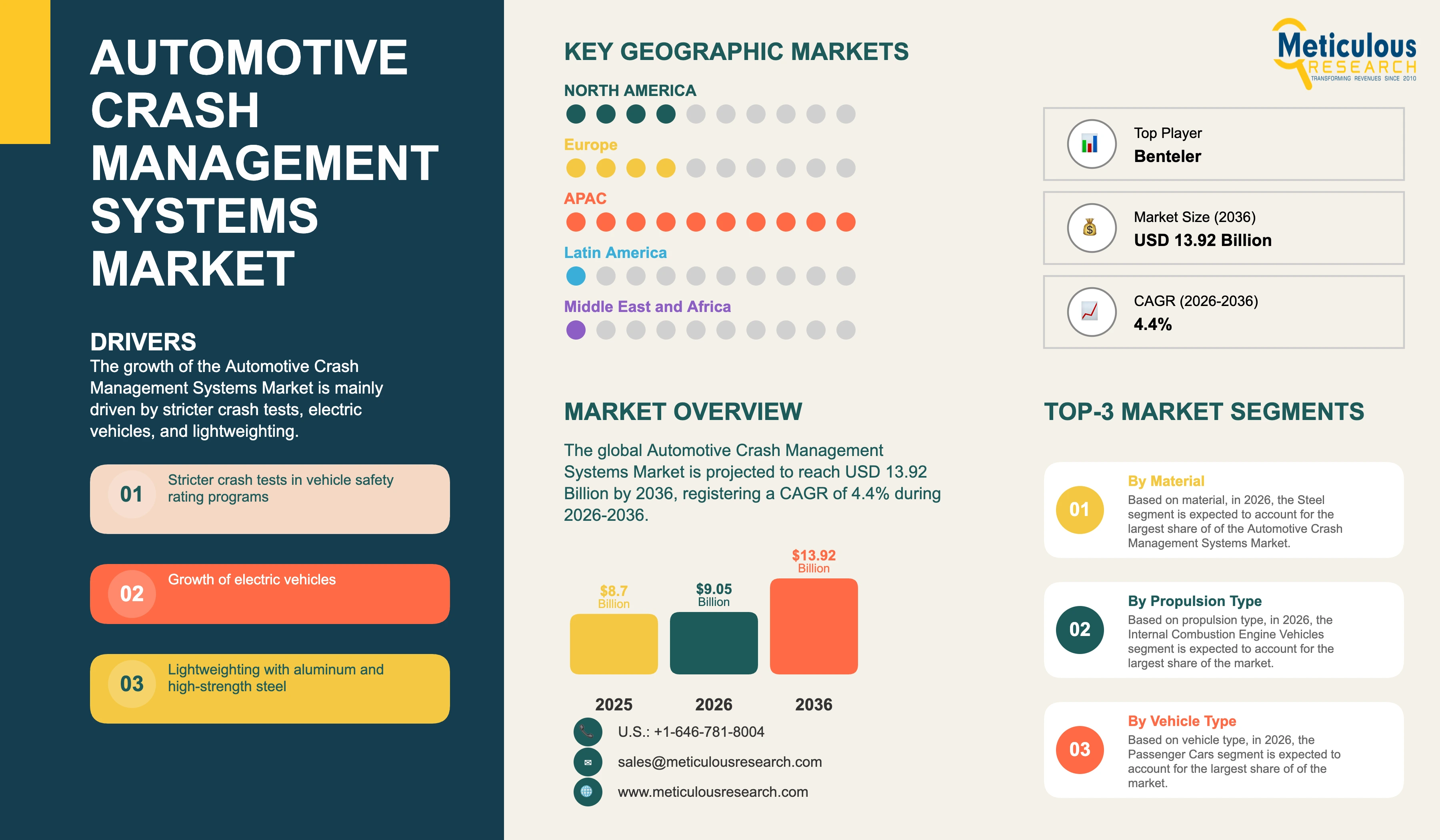
The global automotive crash management systems market was valued at USD 8.70 billion in 2025. This market is expected to reach USD 13.92 billion by 2036 from an estimated USD 9.05 billion in 2026, registering a CAGR of 4.4% during the forecast period (2026-2036).
- Published
- Nov 2026
- Pages
- 270
- Format
- PDF + Excel
- Report ID
- MRAUTO - 1042898
- Base year
- 2025
- 2025 · BASELINE
- $8.70B
- 2036
- $13.92B
- CAGR 2026–2036
- 4.4%
2025 baseline · 2026–2036 forecast at 4.4% CAGR · hover a bar for the value
Key highlights
Benteler introduced an integrated crash management system in June 2025 that combines the upper and lower crash sections in a single structure, according to Benteler. The design reduces weld seams and heat-affected zones, increases energy absorption, and delivers strong results in mobile progressive deformable barrier crash tests, with a view to top ratings in Euro NCAP and China's C-NCAP. Benteler states that its hot-formed steel crash beam offers much higher strength than cold-formed alternatives, which is especially useful for electric vehicles.
Benteler also presented a new all-in-one aluminum crash management system that integrates the upper and lower crash sections, two cross members, and several functional parts into a single structure, replacing the traditional multi-part design, according to Benteler.
Constellium supplies extrusion-based crash management systems for global vehicle programs and uses its proprietary high-strength HSA6 and high-crash HCA6 aluminum alloys to meet weight and cost targets, according to Constellium. Its systems are optimized for low-speed and high-speed crash load cases, such as pole, mobile progressive deformable barrier, and small overlap tests.
Constellium supplies front crash management systems and other aluminum structural components for the Mercedes-Benz A-Class from its plants in Gottmadingen, Germany, and San Luis Potosí, Mexico, according to Constellium, showing how crash management suppliers serve global vehicle platforms from plants in several regions.
Global electric car sales topped 20 million units in 2025, according to the IEA. Electric vehicles are heavier than comparable conventional vehicles and carry large batteries that must be protected in front, rear, and side impacts, which increases the strength and value of crash management systems.
Leading suppliers include Benteler, Constellium, Gestamp, Magna International, Kirchhoff Automotive, Shape Corp., Kobe Steel, and UACJ. Aluminum is the fastest-growing material, and battery electric vehicles are the fastest-growing propulsion type, as vehicle makers seek lighter and stronger front and rear structures for heavier electric vehicles. This shows how suppliers are using integration to cut weight and assembly steps. Suppliers are also offering simulation, testing, and series production as a single service to vehicle makers.
By material, steel accounts for the largest share of 52.0% in 2026, while aluminum registers the highest CAGR.
By position, front crash management systems account for the larger share in 2026 and also register the higher CAGR.
By propulsion type, internal combustion engine vehicles account for the largest share in 2026, while battery electric vehicles register the highest CAGR.
By vehicle type, passenger cars account for the larger share of 84.0% in 2026 and also register the higher CAGR.
By geography, Asia-Pacific accounts for the largest share of 50.0% in 2026, while Asia-Pacific registers the highest CAGR of 5.2%.
Report summary
| Particulars | Details |
|---|---|
| Base Year | 2025 |
| Estimated Year | 2026 |
| Forecast Period | 2026-2036 |
| Market Size in 2025 | USD 8.70 billion |
| Market Size in 2026 | USD 9.05 billion |
| Market Size by 2036 | USD 13.92 billion |
| CAGR (2026-2036) | 4.4% |
| Format | PDF, Excel & Cloud Portal · 270 pages |
| Largest Segment by Material (2026) | Steel (52.0%) |
| Largest Segment by Vehicle Type (2026) | Passenger Cars (84.0%) |
| Largest Region (2026) | Asia-Pacific (50.0%) |
| Fastest-Growing Region | Asia-Pacific (CAGR 5.2%) |
| Companies Profiled | 8 companies and other companies |
| Segments Covered | Material, Position, Propulsion Type, Vehicle Type, Geography |
| Countries Covered | U.S., Canada, Mexico, Germany, France, U.K., Spain, Italy, Sweden, Czech Republic, Poland, Slovakia, Hungary, Romania, Rest of Europe, China, Japan, South Korea, India, Thailand, Indonesia, Malaysia, Vietnam, Taiwan, Australia, Rest of Asia-Pacific, Brazil, Argentina, Chile, Colombia, Rest of Latin America, Turkey, Morocco, South Africa, Saudi Arabia, UAE, Israel, Rest of Middle East & Africa |
Report overview
Segments covered: material, position, propulsion type, vehicle type.
Automotive crash management systems are the structural assemblies mounted at the front and rear ends of a vehicle, behind the bumper fascia, that absorb and spread collision energy. A typical system consists of a cross beam, also called a bumper beam, and two crash boxes that connect the beam to the vehicle's longitudinal rails. In low-speed impacts, the crash boxes fold in a controlled way to absorb energy and protect the more expensive body structure, which reduces repair costs. In higher-speed impacts, the system spreads the load across both sides of the vehicle body and works with other structures to protect occupants, pedestrians, and, in electric vehicles, the battery.
The growth of this market is mainly driven by steady growth of global vehicle production, stricter crash tests in vehicle safety rating programs, such as the mobile progressive deformable barrier test and small overlap tests, the growth of electric vehicles, which need stronger front and rear structures to protect the battery and handle higher vehicle weight, the shift to lightweight aluminum and hot-formed steel systems, and insurers' low-speed repairability tests, which reward vehicles with crash boxes that protect the body structure. In addition, the growing number of sensors and ADAS components mounted at the front and rear of vehicles increases the need for well-designed crash structures. However, strong price pressure, competition between steel and aluminum suppliers, and slower vehicle production in some regions are expected to restrain the growth of this market to some extent.
Crash management systems have evolved from simple steel bumper bars into engineered energy-absorbing structures. Early bumpers were designed mainly to withstand minor parking impacts, but modern crash management systems must meet a wide range of requirements, from low-speed repairability tests to high-speed frontal, offset, and rear impact tests, pedestrian protection rules, and compatibility with other vehicles. The cross beam spreads impact loads across the vehicle front or rear, while the crash boxes, which are usually designed as thin-walled steel or aluminum sections, fold in a controlled sequence to absorb energy before the main body structure is damaged.
This report covers the global automotive crash management systems market, including front and rear crash management systems made from steel, aluminum, and composite and other materials, for internal combustion engine vehicles, battery electric vehicles, and hybrid vehicles, and for passenger cars and commercial vehicles. The market is valued at the selling price of complete crash management systems, including cross beams, crash boxes, and mounting plates, supplied to vehicle makers and front-end module suppliers. The market is analyzed by material, position, propulsion type, vehicle type, and geography. Bumper fascias, energy-absorbing foams, front-end carriers, and aftermarket replacement parts are not included.
Steel and aluminum are the main materials used in crash management systems. Steel systems, made from roll-formed, stamped, or hot-formed high-strength steel, are widely used in mass-market vehicles because of their low cost and high strength, and hot-formed press-hardening steel allows very strong, thin beams. Aluminum systems, made mainly from extruded profiles, are about 30% to 50% lighter than comparable steel systems and absorb energy well, which makes them popular in premium vehicles, electric vehicles, and vehicles from European vehicle makers. Composite systems, such as glass fiber thermoplastic beams, are used in a few vehicles where low weight and design freedom are priorities.
Vehicle safety rating programs have a strong influence on crash management system design. Euro NCAP's mobile progressive deformable barrier test, introduced in 2020, measures not only how well a vehicle protects its own occupants but also how much damage it causes to the other vehicle, which encourages stiffer and more even front structures. Small overlap tests in the U.S. and China require structures that engage the barrier even when only a small part of the front is hit. Insurers' low-speed tests, such as those developed by the Research Council for Automobile Repairs, reward vehicles whose crash boxes protect the body structure in minor collisions, which lowers repair costs and insurance premiums.
The market is led by automotive structural parts suppliers and aluminum companies. Benteler, Gestamp, Magna International, Kirchhoff Automotive, and Shape Corp. supply steel and aluminum crash management systems to vehicle makers worldwide, while Constellium, Kobe Steel, and UACJ supply aluminum crash management systems based on their extrusions and alloys. Many suppliers offer complete development services, including simulation, prototyping, crash testing, and series production, and they increasingly develop crash management systems together with front-end modules, ADAS sensor mounts, and battery protection structures.
The growth of electric vehicles is changing the requirements for crash management systems in several important ways. Electric vehicles are typically several hundred kilograms heavier than comparable conventional vehicles, which increases crash energy. They also lack an engine block in the front, which in conventional vehicles absorbs part of the crash energy, and they carry batteries that must be protected from intrusion. As a result, crash management systems in electric vehicles must be stronger and absorb more energy, which favors hot-formed steel and high-strength aluminum designs. Front trunks and new front-end layouts in electric vehicles also give designers new freedom to optimize crash structures.
In 2026, steel accounts for the largest share of the market by material, while aluminum is the fastest-growing material. Front crash management systems account for the largest share by position and are also the fastest-growing position. Internal combustion engine vehicles account for the largest share by propulsion type, while battery electric vehicles are the fastest-growing propulsion type. Passenger cars account for the largest share by vehicle type and are also the fastest-growing vehicle type. Asia-Pacific accounts for the largest share of the market and is also the fastest-growing region.
Market growth over the forecast period will depend on vehicle production, the adoption of stricter crash tests in safety rating programs worldwide, the growth of electric vehicles, the balance between steel and aluminum designs, and price pressure from vehicle makers. Electric vehicles and stricter tests will increase the value of crash management systems per vehicle, while strong price competition will limit value growth. Overall, the market is expected to grow slightly faster than vehicle production through 2036, with value per vehicle rising steadily as systems become stronger and more integrated.
Passenger cars are expected to account for the largest share of 84.0% of the market in 2026 and are also projected to register the higher CAGR, driven by electric passenger cars and stricter crash tests.
Asia-Pacific is expected to account for the largest share of 50.0% of the market in 2026, mainly due to China's large vehicle production and stricter crash tests in China and India.
Asia-Pacific is also projected to register the highest CAGR of 5.2% during the forecast period, driven by electric vehicles in China, Bharat NCAP in India, and Southeast Asian production growth.
The report profiles 8 companies, including Benteler, Constellium, Gestamp, Magna International, Kirchhoff Automotive, Shape Corp., Kobe Steel, and UACJ.
Constellium, Benteler, Kobe Steel, and UACJ are among the suppliers of aluminum crash management systems, based on extruded aluminum profiles and high-strength alloys.
A crash management system absorbs collision energy at the front or rear of the vehicle. Its crash boxes fold in low-speed impacts to protect the body structure, and its beam spreads loads in higher-speed crashes.
Electric vehicles are heavier, lack an engine block to absorb front crash energy, and carry batteries that must be protected from intrusion, so they need stronger front and rear crash structures.
Report infographic
Market dynamics
17 factors across 5 forcesStricter crash tests in vehicle safety rating programs
Vehicle safety rating programs, such as Euro NCAP, the U.S. Insurance Institute for Highway Safety, China's C-NCAP, and newer programs, such as Bharat NCAP in India, continue to add tougher crash tests. Euro NCAP's mobile progressive deformable barrier test rewards vehicles whose front structures spread loads evenly and limit damage to other vehicles, small overlap tests require structures that engage the barrier at the vehicle's outer edges, and rear impact tests are becoming more demanding as vehicles get heavier. These tests require stronger, wider, and better-engineered crash management systems.
Because high safety ratings are important for vehicle sales, vehicle makers design their vehicles to achieve top ratings in all major programs. Benteler states that its integrated crash management system delivers strong results in mobile progressive deformable barrier tests, with a view to top marks in Euro NCAP and C-NCAP, according to Benteler. Constellium's crash management systems are optimized for pole, mobile progressive deformable barrier, and small overlap load cases, according to Constellium. Stricter tests increase the value of crash management systems per vehicle and support steady market growth.
Growth of electric vehicles
Global electric car sales topped 20 million units in 2025, according to the IEA, and electric vehicles are expected to account for a growing share of new vehicle sales over the forecast period. Electric vehicles are heavier than comparable conventional vehicles, which increases crash energy, and they lack an engine block in the front to absorb part of that energy. They also carry large batteries that must not be damaged in front, rear, or side impacts, which requires strong front and rear structures that limit intrusion into the battery area.
These requirements push vehicle makers to use stronger crash management systems made from hot-formed steel or high-strength aluminum, which sell at higher prices than conventional systems. Benteler states that its hot-formed steel crash beam offers much higher strength than cold-formed alternatives and is especially advantageous for electric vehicles, according to Benteler. Battery electric vehicles are the fastest-growing propulsion type in this market, supported by electric vehicle growth and the higher value of crash management systems per electric vehicle.
Lightweighting with aluminum and high-strength steel
Vehicle makers must reduce weight to meet emission standards in conventional vehicles and to extend driving range in electric vehicles. Crash management systems are located at the very front and rear of the vehicle, where weight has a strong effect on vehicle handling, so reducing their weight is especially valuable. Aluminum crash management systems are typically 30% to 50% lighter than comparable steel systems and absorb energy well, while hot-formed and advanced high-strength steels allow thinner and lighter steel beams.
Aluminum suppliers continue to develop stronger alloys, such as Constellium's HSA6 and HCA6 alloys, which allow lighter designs that meet crash requirements, according to Constellium. Aluminum is the fastest-growing material in this market, supported by electric vehicles, premium vehicles, and vehicle makers' weight reduction targets. Steel suppliers are responding with hot-formed and integrated designs that reduce weight while keeping steel's cost advantage, which keeps competition between materials strong.
Low-speed repairability and insurance requirements
Insurers in many countries rate vehicles on how much damage they suffer in low-speed collisions, which affects insurance premiums and therefore the cost of owning a vehicle. Tests developed by the Research Council for Automobile Repairs and similar organizations measure whether crash boxes absorb low-speed impact energy without damaging the longitudinal rails and other expensive body parts. Vehicles with well-designed crash management systems can be repaired by replacing only the bumper beam and crash boxes, which reduces repair costs.
Vehicle makers therefore design crash management systems with bolted, replaceable crash boxes and beams that protect the body structure in minor impacts. This requirement supports demand for engineered crash management systems in all vehicle segments, including entry-level vehicles. It also creates aftermarket demand for replacement parts, although this report focuses on original equipment supply. Front crash management systems, which face most low-speed impacts, are the largest position in this market.
Integration of ADAS sensors and front-end modules
Modern vehicles carry radar sensors, cameras, lidar, and ultrasonic sensors behind or near the bumper, which must be mounted precisely and protected from damage. Crash management systems increasingly include mounting points for these sensors and must be designed so that minor impacts do not misalign them, which would require costly recalibration. Vehicle makers also want to reduce the number of parts and assembly steps at the front of the vehicle, which leads to integrated designs that combine the crash management system with the front-end carrier, cooling module mounts, and sensor brackets. Benteler's integrated crash management systems, which combine upper and lower crash sections and several functional parts into one structure, are examples of this trend, according to Benteler. These integrated systems increase the value supplied per vehicle and favor suppliers with strong engineering and module assembly capabilities. As ADAS features spread to more vehicles in all regions, the importance of well-designed front and rear structures that protect sensors and reduce repair costs is expected to grow, which supports steady growth in crash management system value over the forecast period.
Table of contents
12 chapters · 168 sections · 270 pages · click to expandSegmental analysis
| Segment | Largest share (2026) | Fastest growth (2026–2036) |
|---|---|---|
| By Material | Steel | Aluminum |
By Material
- The front crash management systems segment is expected to account for the larger share of the automotive crash management systems market, and it is also projected to register the higher CAGR during the forecast period.
- The internal combustion engine vehicles segment is expected to account for the largest share of the automotive crash management systems market, while the battery electric vehicles segment is projected to register the highest CAGR during the forecast period.
Geographic analysis
Asia-Pacific
Largest shareIn 2026, Asia-Pacific is expected to account for the largest share of 50.0% of the global automotive crash management systems market. The large share of this region is mainly due to China's position as the largest vehicle and electric vehicle producer in the world, the large vehicle production of Japan, South Korea, and India, stricter crash tests in China's C-NCAP and new programs, such as Bharat NCAP, and the presence of crash management system suppliers, such as Kobe Steel and UACJ, along with large plants of Benteler, Gestamp, and Magna International. China is the largest market in the region, followed by Japan, India, and South Korea. Asia-Pacific is also projected to register the highest CAGR of 5.2% during the forecast period. The rapid growth of this region is mainly driven by continued growth of vehicle and electric vehicle production in China, rising vehicle production and stricter safety requirements in India, the growth of vehicle production in Southeast Asia, including plants built by Chinese vehicle makers, and the spread of ASEAN NCAP. India is expected to be one of the fastest-growing countries, supported by Bharat NCAP and rising safety expectations from consumers, which are pushing vehicle makers to use stronger crash structures.
Europe
Europe accounts for a significant share of the market, supported by strict Euro NCAP crash tests, including the mobile progressive deformable barrier test, the wide use of aluminum crash management systems by European vehicle makers, the growth of electric vehicles, and the presence of leading suppliers, such as Benteler, Constellium, Gestamp, and Kirchhoff Automotive. Germany is the largest market in the region, followed by France, Spain, and the Czech Republic. Eastern European countries, such as Poland, Slovakia, Hungary, and Romania, are important production hubs for vehicles and crash management systems. However, slower vehicle production limits growth.
North America
North America accounts for a significant share of the market, supported by the large production of SUVs and pickup trucks, which use large crash management systems, strict IIHS crash tests, including small overlap tests, and the presence of suppliers, such as Magna International, Shape Corp., and Benteler. The U.S. is the largest market in the region, followed by Mexico and Canada. Mexico is an important production base for vehicles and crash management systems, including Constellium's plant in San Luis Potosí.
Latin America
Latin America and the Middle East and Africa account for smaller shares, with Brazil the largest market in Latin America and Turkey and Morocco important production hubs supplying Europe. Within Latin America, Brazil is the largest market, supported by local vehicle production and the new Latin NCAP requirements, while Argentina is a smaller market.
Middle East & Africa
In the Middle East and Africa, Turkey and Morocco are important vehicle production hubs that supply Europe, and their crash management system demand follows the European vehicle programs built there. South Africa also produces vehicles for export, while Saudi Arabia and the UAE are mainly import markets with growing vehicle sales.
Competitive landscape
The global automotive crash management systems market includes automotive structural parts suppliers that produce steel and aluminum systems, aluminum companies that produce extrusion-based systems, and regional suppliers that serve local vehicle makers. The market is moderately concentrated, with a few global suppliers holding strong positions with global vehicle makers, while Chinese and other regional suppliers compete strongly in their home markets. Suppliers increasingly compete on engineering capabilities, integrated designs, and the ability to offer both steel and aluminum solutions.
Benteler supplies steel and aluminum crash management systems, including its integrated steel and all-in-one aluminum systems, according to Benteler. Constellium supplies extrusion-based crash management systems using its HSA6 and HCA6 alloys and supports vehicle makers from alloy development to series production, according to Constellium. Gestamp, Magna International, Kirchhoff Automotive, and Shape Corp. supply steel and aluminum crash management systems worldwide, while Kobe Steel and UACJ supply aluminum crash management systems in Japan, North America, and Asia.
Companies in this market compete mainly on crash performance, weight, cost, engineering and testing capabilities, integration with front-end modules and sensors, global production footprint, and long-term relationships with vehicle makers. Key strategies in this market include developing integrated and one-piece crash structures, using hot-formed steel and high-strength aluminum alloys, offering complete development services from simulation to series production, building plants close to vehicle makers, and offering low-carbon materials.
Recent competitive activity in this market has mainly focused on integrated designs and new materials. Benteler introduced its integrated crash management system combining upper and lower crash sections in June 2025 and presented a new all-in-one aluminum crash management system, according to Benteler. Constellium supplies front crash management systems for the Mercedes-Benz A-Class from plants in Germany and Mexico and continues to develop its HSA6 and HCA6 alloys for crash applications, according to Constellium.
We expect competition to increase over the forecast period as suppliers compete for new electric vehicle platforms, as Chinese suppliers expand abroad, and as integrated body structures change the scope of crash management systems. Suppliers with strong engineering capabilities, both steel and aluminum solutions, integrated designs, and global production footprints are expected to strengthen their positions, while smaller regional suppliers may merge with larger groups or or focus on specific vehicle makers.
Some of the key players operating in the automotive crash management systems market are Benteler International AG, Constellium SE, Gestamp Automoción, S.A., Magna International Inc., Kirchhoff Automotive GmbH, Shape Corp., Kobe Steel, Ltd., and UACJ Corporation, among others.
- —
Benteler introduced integrated steel and all-in-one aluminum crash management systems, and Constellium supplies front crash management systems for the Mercedes-Benz A-Class using its HSA6 and HCA6 alloys.
- Benteler International AG
- Constellium SE
- Gestamp Automoción, S.A.
- Magna International Inc.
- Kirchhoff Automotive GmbH
- Shape Corp.
- Kobe Steel, Ltd.
- UACJ Corporation
Expert perspectives
Automotive crash management systems are a mature market, but their design and value per vehicle continue to change steadily. Every vehicle needs front and rear crash management systems, and stricter crash tests, heavier electric vehicles, and the integration of sensors are increasing their requirements and value. At the same time, strong price pressure and competition between steel and aluminum suppliers keep the market highly competitive.
Over the forecast period, the market is expected to grow at a CAGR of 4.4%, from USD 9.05 billion in 2026 to USD 13.92 billion in 2036. Growth will be driven by stricter crash tests in safety rating programs, the growth of electric vehicles, lightweighting with aluminum and high-strength steel, low-speed repairability and insurance requirements, and the integration of ADAS sensors and front-end modules. Price pressure from vehicle makers and volatile steel and aluminum prices will limit growth to some extent.
Among the market segments, steel is the largest material, while aluminum grows fastest. Front crash management systems are the largest position and also grow fastest. Internal combustion engine vehicles are the largest propulsion type, while battery electric vehicles grow fastest. Passenger cars are the largest vehicle type and also grow fastest. Asia-Pacific is the largest region and is also the fastest-growing region, led by China and India.
In our view, electric vehicles will be the most important driver of value growth in this market. Heavier vehicles without engine blocks need stronger and more carefully engineered crash structures, and vehicle makers are willing to pay more for systems that protect the battery and help achieve top safety ratings. Suppliers that win business on new electric vehicle platforms will gain long-term positions, as crash management systems are rarely changed during a vehicle's production life.
We also see the competition between steel and aluminum as a defining feature of the market. Aluminum offers clear weight advantages, while hot-formed steel offers strength at lower cost, and suppliers are developing integrated designs in both materials. We expect aluminum to gain share, but steel to remain the largest material because of its cost advantage in mass-market vehicles, especially in Asia-Pacific and Latin America, where cost matters most.
We also expect integrated crash structures and low-carbon materials to become more common in supplier tenders over the forecast period. Overall, we believe that the automotive crash management systems market will grow steadily over the forecast period, with aluminum, front crash management systems, battery electric vehicles, passenger cars, and Asia-Pacific providing the fastest growth. Companies with strong engineering, both steel and aluminum solutions, integrated designs, and global production footprints will be best positioned to capture this growth.
Customer perspectives
Customers in the automotive crash management systems market are mainly vehicle makers and front-end module suppliers. They focus on crash performance in all relevant tests, weight, cost, repairability in low-speed impacts, sensor protection, integration with front-end modules, engineering and testing support, global production footprint, and long-term supply. Electric vehicle makers place the highest value on systems that protect the battery and absorb more energy in heavier vehicles, while makers of mass-market vehicles focus strongly on cost and meeting safety ratings at the lowest weight possible. Customers also expect suppliers to support them across regions, as the same vehicle platform is often built in several countries. Makers of commercial vehicles focus on durability, underrun protection, and low repair costs for fleets.
This comment explains why aluminum is the fastest-growing material and why battery electric vehicles are the fastest-growing propulsion type, while steel accounts for 52.0% of the market.
This comment explains why Asia-Pacific is the fastest-growing region, supported by stricter safety ratings in India and other emerging markets.
This comment explains the competition between steel and aluminum systems, while passenger cars account for 84.0% of the market and are also the fastest-growing vehicle type.
“Without an engine block in front, the crash system has to do more of the work. Aluminum gave us the energy absorption we needed without adding weight.”
“Bharat NCAP ratings now matter to our buyers. We upgraded the front crash beams and crash boxes to reach five stars on our new models.”
“Our trucks and SUVs need strong front and rear structures for IIHS tests, but cost is critical. We source steel and aluminum systems depending on the model.”
Frequently asked questions
The global automotive crash management systems market was valued at USD 8.70 billion in 2025, up from USD 8.40 billion in 2024, and is estimated at USD 9.05 billion in 2026. The market includes front and rear steel, aluminum, and composite systems.
The global automotive crash management systems market is expected to reach USD 13.92 billion by 2036, driven by stricter crash tests, electric vehicles, lightweighting, repairability requirements, and sensor integration.
The market is expected to register a CAGR of 4.4% from 2026 to 2036, with the fastest growth in aluminum, front systems, battery electric vehicles, passenger cars, and Asia-Pacific.
Market growth is mainly driven by stricter crash tests in safety rating programs, the growth of electric vehicles, lightweighting with aluminum and high-strength steel, low-speed repairability and insurance requirements, and the integration of ADAS sensors and front-end modules.
Strong price pressure from vehicle makers and volatile steel and aluminum prices restrain growth, while meeting conflicting crash requirements and competition from integrated body structures are key challenges.
Key growth opportunities include crash management systems for electric vehicles, integrated one-piece crash structures, growth in India and Southeast Asia, and low-carbon and recycled materials.
Steel is expected to account for the largest share of 52.0% of the market in 2026, while aluminum is projected to register the highest CAGR, driven by electric vehicles and weight reduction targets.
In 2026, the front crash management systems segment is expected to account for the larger share of the automotive crash management systems market, and it is also projected to register the higher CAGR during the forecast period.
In 2026, the internal combustion engine vehicles segment is expected to account for the largest share of the automotive crash management systems market, while the battery electric vehicles segment is projected to register the highest CAGR during the forecast period.
Passenger cars are expected to account for the largest share of 84.0% of the market in 2026 and are also projected to register the higher CAGR, driven by electric passenger cars and stricter crash tests.
Asia-Pacific is expected to account for the largest share of 50.0% of the market in 2026, mainly due to China's large vehicle production and stricter crash tests in China and India.
Asia-Pacific is also projected to register the highest CAGR of 5.2% during the forecast period, driven by electric vehicles in China, Bharat NCAP in India, and Southeast Asian production growth.
The report profiles 8 companies, including Benteler, Constellium, Gestamp, Magna International, Kirchhoff Automotive, Shape Corp., Kobe Steel, and UACJ.
Benteler introduced integrated steel and all-in-one aluminum crash management systems, and Constellium supplies front crash management systems for the Mercedes-Benz A-Class using its HSA6 and HCA6 alloys.
Constellium, Benteler, Kobe Steel, and UACJ are among the suppliers of aluminum crash management systems, based on extruded aluminum profiles and high-strength alloys.
A crash management system absorbs collision energy at the front or rear of the vehicle. Its crash boxes fold in low-speed impacts to protect the body structure, and its beam spreads loads in higher-speed crashes.
Electric vehicles are heavier, lack an engine block to absorb front crash energy, and carry batteries that must be protected from intrusion, so they need stronger front and rear crash structures.
Cite this report
Meticulous Research. (2026). Automotive Crash Management Systems Market - Global Opportunity Analysis and Industry Forecast (2026-2036) (Report No. MRAUTO - 1042898). Meticulous Market Research Pvt. Ltd. https://www.meticulousresearch.com/product/automotive-crash-management-systems-market-7581