Automotive Chassis Systems Market (2026-2036)
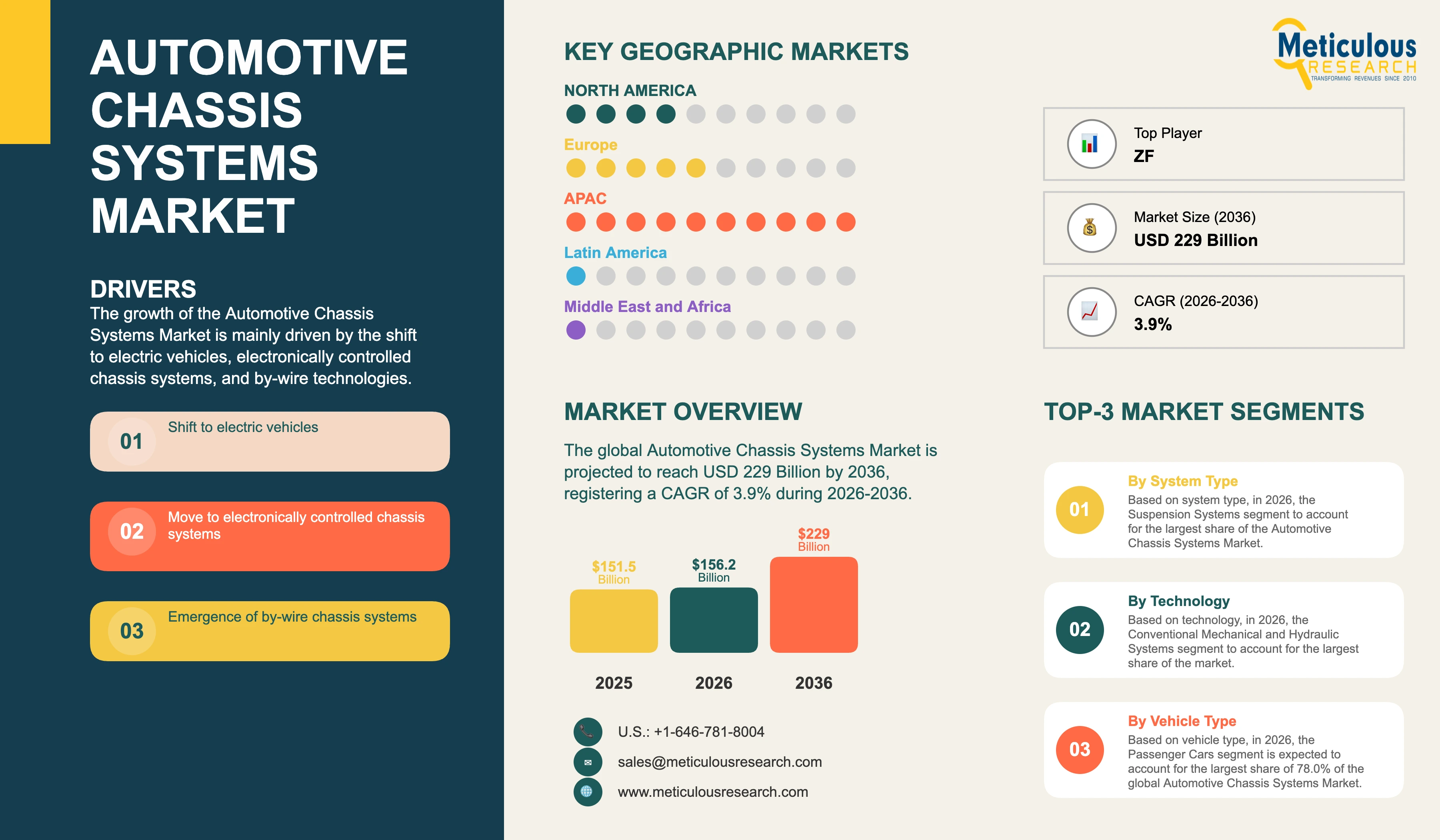
The global automotive chassis systems market was valued at USD 151.50 billion in 2025. This market is expected to reach USD 229.00 billion by 2036 from an estimated USD 156.20 billion in 2026, registering a CAGR of 3.9% during the forecast period (2026-2036).
- Published
- Nov 2026
- Pages
- 254
- Format
- PDF + Excel
- Report ID
- MRAUTO - 1042870
- Base year
- 2025
- 2025 · BASELINE
- $151.5B
- 2036
- $229.0B
- CAGR 2026–2036
- 3.9%
2025 baseline · 2026–2036 forecast at 3.9% CAGR · hover a bar for the value
Key highlights
ZF's Chassis Solutions division, one of the world's largest chassis suppliers, generated sales of €9.6 billion in 2025 with about 28,300 employees and 56 production sites, according to ZF. The division describes itself as a full-range supplier of vehicle motion control solutions for vehicles up to 7.5 tons, covering hardware and software for driving, braking, and steering. The division supplies vehicle makers around the world and is a leader in electric power steering, brake systems, and chassis parts.
ZF founded the joint venture ZF Foxconn Chassis Modules in April 2024 to supply passenger car chassis systems and transferred its axle assembly business to the joint venture, according to ZF. ZF's Chassis 2.0 approach uses intelligent, connected actuators, including steer-by-wire, brake-by-wire, and active and semi-active damping, to enable new software-based chassis functions.
Dauch Corporation, formerly American Axle & Manufacturing, completed its acquisition of Dowlais Group, including GKN Automotive, on February 3, 2026, creating a large global supplier of axles, driveline, and metal forming, according to Dauch. The combined company operates in 24 countries and more than 175 locations.
Hitachi agreed in December 2025 to transfer part of its stake in Astemo, a major supplier of brakes, steering, suspension, and drivetrain systems, to Honda, according to Hitachi. Astemo was formed by combining Hitachi Automotive Systems with the brake, suspension, and steering businesses of Honda-affiliated suppliers.
Global electric car sales grew by 20% to more than 20 million units in 2025, accounting for one in four new cars sold, according to the IEA. Electric vehicles use regenerative braking, electric brake boosters, and heavier-duty suspension and axle parts, and many new electric platforms are adopting electronically controlled and by-wire chassis systems.
Leading suppliers include ZF, Bosch, AUMOVIO, Astemo, Hyundai Mobis, HL Mando, Aisin (ADVICS), JTEKT, Nexteer, Magna, Dauch, Schaeffler, Benteler, and thyssenkrupp. China's national steering standard GB 17675-2025, which took effect on July 1, 2026, also allows full steer-by-wire systems without a mechanical link. Steer-by-wire is already used in production vehicles, such as the Nio ET9 and Tesla Cybertruck.
By system type, suspension systems account for the largest share of 28.0% in 2026, while steering systems register the highest CAGR.
By technology, conventional mechanical and hydraulic systems account for the largest share in 2026, while by-wire systems register the highest CAGR.
By propulsion type, internal combustion engine vehicles account for the largest share in 2026, while battery electric vehicles register the highest CAGR.
By vehicle type, passenger cars account for the largest share of 78.0% in 2026 and also register the highest CAGR.
By geography, Asia-Pacific accounts for the largest share of 48.0% in 2026, while Asia-Pacific registers the highest CAGR of 4.9%.
Report summary
| Particulars | Details |
|---|---|
| Forecast Period | 2026-2036 |
| Base Year | 2025 |
| Estimated Year | 2026 |
| CAGR (Value) | 3.9% |
| Format | PDF, Excel & Cloud Portal · 254 pages |
| Market Size (Value) in 2025 | USD 151.50 billion |
| Market Size (Value) in 2026 | USD 156.20 billion |
| Market Size (Value) by 2036 | USD 229.00 billion |
| Segments Covered | System Type, Technology, Propulsion Type, Vehicle Type, Geography |
| Countries Covered | U.S., Canada, Germany, France, Spain, Italy, U.K., Sweden, Czech Republic, Slovakia, Poland, Hungary, Romania, Belgium, Rest of Europe, China, Japan, India, South Korea, Thailand, Indonesia, Malaysia, Vietnam, Taiwan, Australia, Rest of Asia-Pacific, Mexico, Brazil, Argentina, Colombia, Chile, Rest of Latin America, Turkey, Morocco, South Africa, Saudi Arabia, Egypt, Iran, Rest of Middle East & Africa |
| Key Companies | 14 companies and other companies |
| Largest Segment by System Type (2026) | Suspension Systems (28.0%) |
| Largest Segment by Vehicle Type (2026) | Passenger Cars (78.0%) |
| Largest Region (2026) | Asia-Pacific (48.0%) |
| Fastest-Growing Region | Asia-Pacific (CAGR 4.9%) |
Report overview
Segments covered: system type, technology, propulsion type, vehicle type.
Automotive chassis systems are the systems that support the vehicle body and control how the vehicle moves on the road, including suspension systems, braking systems, steering systems, and axles and structural chassis parts, such as subframes, control arms, knuckles, and links. Together they determine a vehicle's ride comfort, handling, braking performance, and safety, and they are among the largest purchased system groups in a vehicle.
The growth of this market is mainly driven by steady growth of global vehicle production, especially in Asia-Pacific, the shift to electric vehicles, which need new braking, steering, and suspension solutions and carry heavier loads, the move from mechanical and hydraulic systems to electronically controlled systems, such as electric power steering, electronic brake systems, and adaptive dampers, the growing role of chassis systems in driver assistance and automated driving, and the emergence of by-wire chassis systems that replace mechanical links with electronic controls. In addition, the trend toward integrated chassis control software is increasing the value of chassis systems. However, strong price pressure, the high cost of new technologies, and the restructuring of major suppliers are expected to restrain the growth of this market to some extent.
The chassis is the part of the vehicle that connects the body to the road and controls its motion. Suspension systems, including springs, shock absorbers, control arms, stabilizer bars, and bushings, absorb road shocks and keep the tires in contact with the road. Braking systems, including brake calipers, discs, drums, boosters, master cylinders, and electronic stability control units, slow and stop the vehicle and keep it stable. Steering systems, including steering gears, columns, and electric power steering motors, allow the driver to control the direction of the vehicle. Axles and structural chassis parts, such as subframes, knuckles, and links, carry loads and connect these systems to the body.
This report covers the global automotive chassis systems market, including suspension systems, braking systems, steering systems, and axles and structural chassis parts supplied to vehicle makers for passenger cars, light commercial vehicles, and heavy commercial vehicles. The market is valued at the selling price of chassis systems and modules sold to vehicle makers, including parts made in-house by vehicle makers valued at an estimated market price. The market is analyzed by system type, technology, propulsion type, vehicle type, and geography. Wheels, tires, driveline parts such as drive shafts and gearboxes, and aftermarket replacement parts are not included. Several chassis components, such as brake friction materials, air suspension, steer-by-wire, and shock absorbers, are also covered in more detail in separate reports.
Chassis systems are among the most safety-critical systems in a vehicle, and they must work reliably for the life of the vehicle under heavy loads, vibration, and changing weather. They are also central to the driving experience, as ride comfort, handling, and steering feel are major factors in how customers judge a vehicle. Vehicle makers therefore work closely with chassis suppliers from the early stages of vehicle design, and chassis systems are tuned specifically for each vehicle model.
Chassis technology is changing quickly, as electronics replace many mechanical and hydraulic functions. Hydraulic power steering has largely been replaced by electric power steering, which uses an electric motor and allows driver assistance functions, such as lane keeping and parking assistance. Braking systems are moving from vacuum boosters to electronic brake boosters and integrated brake systems that support regenerative braking and automatic emergency braking. Suspension systems are adding electronically controlled dampers and air springs, and some vehicles now use by-wire steering and braking systems, in which electronic controls replace mechanical and hydraulic connections.
The market is served by large global chassis suppliers, such as ZF, Bosch, AUMOVIO, Astemo, Hyundai Mobis, HL Mando, Aisin through ADVICS, JTEKT, and Nexteer, which supply complete braking, steering, or suspension systems, together with structural and axle suppliers, such as Magna, Dauch, Schaeffler, Benteler, and thyssenkrupp. Chinese suppliers have also grown quickly with Chinese vehicle makers. The industry is going through major changes, including ZF's chassis joint venture with Foxconn, Dauch's acquisition of GKN Automotive, and changes in the ownership of Astemo.
Electric vehicles are changing chassis requirements in several ways, as they are heavier, which requires stronger suspension parts and axles, and they use regenerative braking, which reduces wear on friction brakes but requires electronic brake systems that blend regenerative and friction braking smoothly. Electric vehicles also lack an engine to drive a vacuum pump or hydraulic pump, so they use electric brake boosters and electric power steering. Many new electric platforms use electronically controlled chassis systems that can be updated by software and integrated with driver assistance functions.
In 2026, suspension systems account for the largest share of the market by system type, while steering systems are the fastest-growing system type. Conventional mechanical and hydraulic systems account for the largest share by technology, while by-wire systems are the fastest-growing technology. Internal combustion engine vehicles account for the largest share by propulsion type, while battery electric vehicles are the fastest-growing propulsion type. Passenger cars account for the largest share by vehicle type and are also the fastest-growing vehicle type. Asia-Pacific accounts for the largest share of the market and is also the fastest-growing region.
Market growth over the forecast period will depend on global vehicle production, the pace of electric vehicle adoption, the adoption of electronically controlled and by-wire chassis systems, and the development of automated driving. Price pressure and the restructuring of major suppliers will also shape the market. Overall, rising chassis content per vehicle, driven by electrification, electronics, and software, is expected to support steady growth in market value.
Passenger cars are expected to account for the largest share of 78.0% of the market in 2026 and are also projected to register the highest CAGR, driven by electric passenger cars and advanced chassis technologies.
Asia-Pacific is expected to account for the largest share of 48.0% of the market in 2026, mainly due to China's large vehicle and electric vehicle production and the fast adoption of advanced chassis systems by Chinese vehicle makers.
Asia-Pacific is also projected to register the highest CAGR of 4.9% during the forecast period, driven by vehicle and electric vehicle growth in China, rising chassis content in India, and early steer-by-wire adoption in China.
The report profiles 14 companies, including ZF, Bosch, AUMOVIO, Astemo, Hyundai Mobis, HL Mando, Aisin (ADVICS), JTEKT, Nexteer, Magna, Dauch, Schaeffler, Benteler, and thyssenkrupp.
By-wire chassis systems, such as steer-by-wire and brake-by-wire, replace mechanical and hydraulic connections with electronic controls and actuators, allowing new interior designs, faster response, and integration with automated driving.
This report covers complete chassis systems, while specific components and technologies, such as brake friction materials, air suspension, steer-by-wire, and shock absorbers, are analyzed in more detail in separate component reports.
Report infographic
Market dynamics
17 factors across 5 forcesSteady growth of global vehicle production
Chassis systems are needed in every vehicle, so demand is closely linked to vehicle production. Global vehicle production is expected to grow steadily over the forecast period, led by China, India, and Southeast Asia, while production in Europe and North America is expected to grow more slowly. Each new vehicle needs a complete set of suspension, braking, steering, and axle systems, and the trend toward larger vehicles, such as SUVs and pickup trucks, increases the size and value of these systems.
The growth of vehicle production in Asia-Pacific is particularly important for chassis suppliers. Chinese vehicle makers are growing quickly at home and abroad, and they are adopting advanced chassis technologies, such as electronic brake systems, adaptive dampers, and air suspension, on mainstream models. Chassis suppliers are expanding production and engineering in China, India, and Southeast Asia to serve this demand and to reduce costs.
Shift to electric vehicles
Electric vehicles require new chassis solutions because they are heavier than similar combustion engine vehicles, which requires stronger suspension parts, axles, and brakes. They use regenerative braking, which requires electronic brake systems that blend regenerative and friction braking, and they need electric brake boosters and electric power steering because they have no engine to drive vacuum or hydraulic pumps. Battery packs also change the layout of the underbody, which affects suspension and subframe design.
Global electric car sales grew by 20% to more than 20 million units in 2025, according to the IEA. As electric vehicle production grows, demand for electronically controlled chassis systems is expected to grow faster than demand for conventional systems. Battery electric vehicles are the fastest-growing propulsion type in this market, and many new electric platforms are designed around advanced chassis systems from the start.
Move to electronically controlled chassis systems
Vehicle makers are replacing mechanical and hydraulic chassis systems with electronically controlled systems, which offer better performance, efficiency, and integration with other vehicle systems. Electric power steering is now standard in most new passenger cars, electronic brake boosters and integrated brake systems are replacing vacuum boosters, and electronically controlled dampers and air suspension are spreading from premium vehicles to mainstream models, especially in China.
Electronically controlled systems are more valuable than conventional systems, which increases chassis content per vehicle. They also allow new functions, such as adjusting ride and handling with driving modes and updating chassis behavior through software. Electronically controlled systems account for a growing share of the market and are expected to grow much faster than conventional systems over the forecast period.
Role of chassis systems in driver assistance and automated driving
Driver assistance functions, such as automatic emergency braking, lane keeping assistance, adaptive cruise control, and automated parking, rely on electronically controlled braking and steering systems that can act on commands from the vehicle's computers. As these functions become standard and more capable, vehicle makers need chassis systems with faster response, more precise control, and higher reliability. Higher levels of automated driving require redundant braking and steering systems that can keep working if one part fails.
These requirements increase the complexity and value of braking and steering systems. Steering systems are the fastest-growing system type in this market, supported by the move from hydraulic to electric power steering in emerging markets, the addition of redundant steering for automated driving, and the adoption of steer-by-wire. Braking systems are also adding redundancy and new functions, such as brake-by-wire.
Emergence of by-wire chassis systems
By-wire chassis systems replace mechanical and hydraulic connections with electronic controls and actuators. Steer-by-wire systems remove the mechanical steering shaft, allowing new interior designs, variable steering ratios, and better integration with automated driving. Brake-by-wire systems, such as electromechanical brakes, replace hydraulic brake lines with electric actuators at each wheel, which saves space and weight and allows faster and more precise braking. ZF, Bosch, and other suppliers are developing or producing these systems, and ZF's Chassis 2.0 approach combines steer-by-wire, brake-by-wire, and active damping into a software-controlled chassis, according to ZF. China's new national steering standard, GB 17675-2025, which took effect on July 1, 2026, removed the requirement for a mechanical steering link and allows full steer-by-wire systems. By-wire systems are much more valuable than conventional systems, and they are the fastest-growing technology in this market, although from a small base. Their adoption is expected to accelerate in the second half of the forecast period as costs fall and as more vehicle makers launch software-defined vehicle platforms.
Table of contents
12 chapters · 181 sections · 254 pages · click to expandSegmental analysis
| Segment | Largest share (2026) | Fastest growth (2026–2036) |
|---|---|---|
| By System Type | Suspension systems | Steering systems |
| By Technology | Conventional mechanical and hydraulic systems | By-wire systems |
| By Propulsion Type | Internal combustion engine vehicles | Battery electric vehicles |
| By Vehicle Type | Passenger cars | Passenger cars |
| Other segments | Internal combustion engine vehicles | Battery electric vehicles |
By System Type
- Automotive Chassis Systems Analysis by System Type
- The suspension systems segment is expected to account for the largest share of 28.0% of the global automotive chassis systems market.
- The large share of this segment is mainly due to the large number of suspension parts in every vehicle, including springs, shock absorbers, control arms, stabilizer bars, links, and bushings, the high value of suspension modules and electronically controlled dampers and air suspension, the growth of SUVs and heavier electric vehicles that need stronger suspension parts, and the spread of advanced suspension systems to mainstream vehicles in China.
- ZF, Astemo, HL Mando, Hyundai Mobis, Magna, Benteler, and thyssenkrupp are among the leading suppliers of suspension systems and parts.
- However, the steering systems segment is projected to register the highest CAGR during the forecast period.
- The rapid growth of this segment is driven by the move from hydraulic to electric power steering in emerging markets, the addition of redundant steering systems for automated driving, the adoption of steer-by-wire systems, which are much more valuable than conventional steering, and the role of steering systems in driver assistance functions, such as lane keeping and automated parking.
- China's new steering standard allowing full steer-by-wire from July 2026 is expected to support growth.
- JTEKT, Nexteer, ZF, Bosch, HL Mando, and Hyundai Mobis are among the leading steering suppliers.
By Technology
- Automotive Chassis Systems Analysis by Technology
- The conventional mechanical and hydraulic systems segment is expected to account for the largest share of the global automotive chassis systems market.
- The large share of this segment is mainly due to the use of conventional springs, passive dampers, control arms, hydraulic brakes, mechanical axles, and subframes in almost every vehicle, the continued use of hydraulic brake systems in most vehicles, the lower cost of conventional systems, which makes them suitable for mass-market and emerging-market vehicles, and the large installed production base for these systems.
- Even vehicles with advanced electronic systems still use many conventional chassis parts.
- However, the by-wire systems segment is projected to register the highest CAGR during the forecast period.
- The rapid growth of this segment is driven by the launch of steer-by-wire systems on new vehicles, the development of brake-by-wire and electromechanical brake systems, the needs of automated driving for redundant and precisely controlled braking and steering, the benefits of by-wire systems for interior design, packaging, and weight, and the move to software-defined vehicle platforms.
- By-wire systems are growing from a small base and are expected to become a significant part of the market by the end of the forecast period.
- The conventional mechanical and hydraulic systems segment is expected to account for the largest share of the automotive chassis systems market, while the by-wire systems segment is projected to register the highest CAGR during the forecast period.
By Propulsion Type
- Automotive Chassis Systems Analysis by Propulsion Type
- The internal combustion engine vehicles segment is expected to account for the largest share of the global automotive chassis systems market.
- The large share of this segment is mainly due to the large number of combustion engine vehicles still produced each year, especially in emerging markets, such as India, Southeast Asia, Latin America, and the Middle East, the use of complete chassis systems in every combustion engine vehicle, and the large number of combustion engine pickup trucks, SUVs, and commercial vehicles with heavy-duty chassis systems.
- Combustion engine vehicles also still account for most vehicles in production in North America.
- However, the battery electric vehicles segment is projected to register the highest CAGR during the forecast period.
- The rapid growth of this segment is driven by the fast growth of battery electric vehicle production, with global electric car sales exceeding 20 million units in 2025 according to the IEA, the higher chassis content of electric vehicles, which need stronger suspension parts, electronic brake systems for regenerative braking, and electric brake boosters, and the adoption of advanced and by-wire chassis systems on new electric platforms.
- Many electric vehicles also use air suspension and adaptive dampers.
By Vehicle Type
- Automotive Chassis Systems Analysis by Vehicle Type
- The passenger cars segment is expected to account for the largest share of 78.0% of the global automotive chassis systems market.
- The large share of this segment is mainly due to the very large number of passenger cars produced each year, the growth of SUVs with larger and more valuable chassis systems, the fast adoption of electronically controlled and by-wire chassis systems in passenger cars, and the growth of electric passenger cars.
- Passenger cars also adopt driver assistance functions that require advanced braking and steering systems earlier than commercial vehicles.
- The passenger cars segment is also projected to register the highest CAGR during the forecast period.
- The rapid growth of this segment is driven by the growth of passenger car production in China, India, and Southeast Asia, the fast growth of electric passenger cars, the spread of advanced suspension, electric power steering, and electronic brake systems to mainstream passenger cars, and the adoption of by-wire systems on new passenger car platforms.
- Commercial vehicles are also adopting new chassis technologies, such as electronic braking systems and electric steering, but at a slower pace.
Other segments
- The internal combustion engine vehicles segment is expected to account for the largest share of the automotive chassis systems market, while the battery electric vehicles segment is projected to register the highest CAGR during the forecast period.
Geographic analysis
Asia-Pacific
Largest shareIn 2026, Asia-Pacific is expected to account for the largest share of 48.0% of the global automotive chassis systems market. The large share of this region is mainly due to China's position as the largest vehicle producer in the world, China's leadership in electric vehicle production, the fast adoption of advanced suspension, braking, and steering systems by Chinese vehicle makers, the large vehicle production of Japan, India, and South Korea, and the presence of leading chassis suppliers, such as Astemo, Hyundai Mobis, HL Mando, Aisin (ADVICS), and JTEKT, as well as the large Asian operations of ZF, Bosch, and Nexteer. Chinese chassis suppliers have also grown quickly with local vehicle makers. Japan and South Korea are also large markets, supported by the domestic and export production of Toyota, Honda, Hyundai, and other vehicle makers. Asia-Pacific is also projected to register the highest CAGR of 4.9% during the forecast period. The rapid growth of this region is mainly driven by continued growth of vehicle and electric vehicle production in China, the fast growth of vehicle production and chassis content in India, where electric power steering, electronic stability control, and disc brakes are spreading to more vehicles, the growth of vehicle production in Indonesia, Vietnam, and Thailand, including by Chinese electric vehicle makers, and the early adoption of steer-by-wire in China following the new steering standard. Chassis suppliers are expanding production and engineering in the region.
Europe
Europe accounts for a significant share of the market, supported by the production of premium and electric vehicles with advanced chassis systems, strict safety rules that require electronic stability control and emergency braking, and the presence of leading suppliers, such as ZF, Bosch, AUMOVIO, Schaeffler, Benteler, and thyssenkrupp. ZF's Chassis Solutions division generated sales of €9.6 billion in 2025, according to ZF. However, slow growth of vehicle production in Western Europe and restructuring of major suppliers are expected to limit growth in the region compared with Asia-Pacific. Germany, France, Spain, and the Czech Republic are the largest chassis markets in Europe, supported by large vehicle production, while Central and Eastern European countries are attractive locations for chassis parts production because of lower labor and operating costs.
North America
North America accounts for a large share of the market, supported by the production of large pickup trucks and SUVs, which use large and valuable chassis systems, and the presence of Dauch, Nexteer, Magna, and other suppliers. Dauch, based in Detroit, completed its acquisition of GKN Automotive in February 2026, according to Dauch. The U.S. is the largest market in North America, while Mexico is an important production base for chassis parts supplied to vehicle plants in the U.S. and Mexico.
Latin America
Latin America and the Middle East & Africa account for smaller shares, with growth supported by vehicle production in Mexico, Brazil, Argentina, Turkey, and Morocco and by the spread of electronic stability control and better braking systems in these markets.
Competitive landscape
The global automotive chassis systems market includes large global chassis suppliers with broad portfolios, specialist suppliers of braking, steering, or suspension systems, structural and axle suppliers, and fast-growing Chinese suppliers. The market for complete braking and steering systems is concentrated among a few large suppliers, while the market for suspension parts and structural chassis parts is more fragmented. Vehicle makers also produce some chassis parts in-house, such as subframes, knuckles, and suspension parts for their own vehicles.
ZF is one of the largest chassis suppliers, with Chassis Solutions sales of €9.6 billion in 2025, according to ZF. Bosch and AUMOVIO are leading braking suppliers, Astemo, Hyundai Mobis, and HL Mando are major suppliers of braking, steering, and suspension systems, Aisin supplies brakes through ADVICS, and JTEKT and Nexteer are leading steering suppliers. Magna, Dauch, Schaeffler, Benteler, and thyssenkrupp supply chassis structures, axles, and suspension parts.
Companies in this market compete on safety and reliability, ride and handling performance, cost, engineering support, global production close to vehicle plants, and the ability to offer electronically controlled, by-wire, and software-based chassis systems. Key strategies include developing by-wire steering and braking, integrated chassis control software, and advanced suspension systems, expanding in Asia-Pacific and with Chinese vehicle makers, forming partnerships and joint ventures, and restructuring to reduce costs.
Recent competitive activity in the chassis systems market has focused on partnerships, acquisitions, and new technologies. ZF formed ZF Foxconn Chassis Modules in April 2024 and presented its Chassis 2.0 approach in July 2025, according to ZF, Dauch completed its acquisition of GKN Automotive in February 2026, according to Dauch, and Hitachi agreed to transfer part of its Astemo stake to Honda in December 2025, according to Hitachi.
We expect competition to increase over the forecast period as Chinese chassis suppliers expand abroad, as vehicle makers push for lower prices, and as software and by-wire systems change the competitive landscape. Suppliers with strong technology, software, scale, and local production in Asia-Pacific are expected to strengthen their positions, while further consolidation and partnerships are likely, especially among smaller suppliers of conventional chassis parts that lack the funds to invest in new technologies.
Some of the key players operating in the automotive chassis systems market are ZF Friedrichshafen AG, Robert Bosch GmbH, AUMOVIO SE, Astemo, Ltd., Hyundai Mobis Co., Ltd., HL Mando Corporation, Aisin Corporation (ADVICS), JTEKT Corporation, Nexteer Automotive Group Limited, Magna International Inc., Dauch Corporation, Schaeffler AG, Benteler International AG, and thyssenkrupp AG, among others.
- —
ZF's Chassis Solutions division reported 2025 sales of €9.6 billion and presented its Chassis 2.0 approach, Dauch completed its acquisition of GKN Automotive in February 2026, and Hitachi agreed to transfer part of its Astemo stake to Honda.
- Astemo
- Hyundai Mobis
- HL Mando
Expert perspectives
Automotive chassis systems are one of the largest purchased system groups in a vehicle, and they are being transformed by electrification, electronics, software, and automated driving. While the market is closely linked to vehicle production, chassis content per vehicle is rising as vehicle makers adopt electronically controlled and by-wire systems and integrated chassis control software.
Over the forecast period, the market is expected to grow at a CAGR of 3.9%, from USD 156.20 billion in 2026 to USD 229.00 billion in 2036. Growth will be driven by steady vehicle production growth, the shift to electric vehicles, the move to electronically controlled chassis systems, the role of chassis systems in driver assistance and automated driving, and the emergence of by-wire chassis systems.
Among the market segments, suspension systems are the largest system type, while steering systems grow fastest. Conventional mechanical and hydraulic systems are the largest technology, while by-wire systems grow fastest. Internal combustion engine vehicles are the largest propulsion type, while battery electric vehicles grow fastest. Passenger cars are both the largest and the fastest-growing vehicle type. Asia-Pacific is both the largest and the fastest-growing region, at a CAGR of 4.9%.
In our view, the shift to software-defined chassis and by-wire systems will be the most important long-term change in this market. By-wire systems and integrated chassis control software will increase chassis content per vehicle and change how value is shared between hardware suppliers, software suppliers, and vehicle makers. Suppliers that combine strong hardware with software capabilities are expected to gain the most. China's new steering standard is likely to make China the first large market for steer-by-wire, which will give Chinese suppliers early production experience.
We also see Chinese vehicle makers and suppliers as a major force shaping the market. Chinese vehicle makers are adopting advanced chassis technologies quickly on mainstream models, and Chinese suppliers are growing at home and abroad. Global suppliers will need to cut costs and work closely with Chinese vehicle makers to compete, while restructuring and consolidation are likely to continue across the industry, especially in Europe, where vehicle production remains below pre-pandemic levels.
We also expect electric vehicles to raise chassis content per vehicle through heavier-duty parts, electronic brake systems, and advanced suspension. Overall, we believe the automotive chassis systems market will grow steadily over the forecast period, with steering systems, by-wire systems, battery electric vehicles, passenger cars, and Asia-Pacific providing the fastest growth. Companies with strong electronically controlled and by-wire technologies, software capabilities, scale, and local production in growth markets will be best positioned to capture this growth.
Customer perspectives
Customers in the automotive chassis systems market are vehicle makers, which buy suspension, braking, steering, and axle systems and modules for passenger cars and commercial vehicles. They focus on safety and reliability, ride comfort, handling, steering feel, braking performance, weight, cost, and engineering support for new vehicle programs. Vehicle makers increasingly ask chassis suppliers for electronically controlled and by-wire systems that can be integrated with driver assistance functions and updated by software, and for complete chassis modules that simplify assembly. They also value suppliers that can support production in several regions and that are financially stable through periods of restructuring in the industry. Chinese vehicle makers also expect fast development times and low prices. Many also want suppliers to provide software and support over-the-air updates.
This comment explains why suspension systems account for 28.0% of the market, why by-wire systems are the fastest-growing technology, and why Asia-Pacific is the fastest-growing region.
This comment explains why steering systems are the fastest-growing system type and why electronically controlled systems are growing much faster than conventional systems.
This comment explains why battery electric vehicles are the fastest-growing propulsion type and why passenger cars and light trucks account for most of the market.
“Our customers expect a smooth ride, so even our mid-priced models now use adaptive dampers. Our next platform will use steer-by-wire and a fully software-controlled chassis.”
“Every new model needs electronic steering and braking that work with our driver assistance systems. For automated driving, we need redundant steering and brakes.”
“Our electric pickup is very heavy, so we needed stronger axles, suspension parts, and brakes. Regenerative braking also changed our whole brake system design.”
Frequently asked questions
The global automotive chassis systems market was valued at USD 151.50 billion in 2025, up from USD 147.00 billion in 2024, and is estimated at USD 156.20 billion in 2026. The market includes suspension, braking, steering, and axle and structural chassis systems for passenger cars and commercial vehicles.
The global automotive chassis systems market is expected to reach USD 229.00 billion by 2036, driven by vehicle production growth, electrification, electronically controlled and by-wire chassis systems, and automated driving.
The market is expected to register a CAGR of 3.9% from 2026 to 2036, with the fastest growth in steering systems, by-wire systems, battery electric vehicles, passenger cars, and Asia-Pacific.
Market growth is mainly driven by steady vehicle production growth, the shift to electric vehicles, the move to electronically controlled chassis systems, the role of chassis systems in driver assistance and automated driving, and the emergence of by-wire chassis systems.
Strong price pressure from vehicle makers and the high cost of new chassis technologies restrain growth, while functional safety, redundancy, and cybersecurity and supplier restructuring and consolidation are key challenges.
Key growth opportunities include by-wire steering and braking systems, integrated chassis control software and vehicle motion control, advanced suspension systems for mainstream vehicles, and growth in India, Southeast Asia, and with Chinese vehicle makers.
Suspension systems are expected to account for the largest share of 28.0% of the market in 2026, while steering systems are projected to register the highest CAGR, driven by electric power steering, redundant steering, and steer-by-wire.
In 2026, the conventional mechanical and hydraulic systems segment is expected to account for the largest share of the automotive chassis systems market, while the by-wire systems segment is projected to register the highest CAGR during the forecast period.
In 2026, the internal combustion engine vehicles segment is expected to account for the largest share of the automotive chassis systems market, while the battery electric vehicles segment is projected to register the highest CAGR during the forecast period.
Passenger cars are expected to account for the largest share of 78.0% of the market in 2026 and are also projected to register the highest CAGR, driven by electric passenger cars and advanced chassis technologies.
Asia-Pacific is expected to account for the largest share of 48.0% of the market in 2026, mainly due to China's large vehicle and electric vehicle production and the fast adoption of advanced chassis systems by Chinese vehicle makers.
Asia-Pacific is also projected to register the highest CAGR of 4.9% during the forecast period, driven by vehicle and electric vehicle growth in China, rising chassis content in India, and early steer-by-wire adoption in China.
The report profiles 14 companies, including ZF, Bosch, AUMOVIO, Astemo, Hyundai Mobis, HL Mando, Aisin (ADVICS), JTEKT, Nexteer, Magna, Dauch, Schaeffler, Benteler, and thyssenkrupp.
ZF's Chassis Solutions division reported 2025 sales of €9.6 billion and presented its Chassis 2.0 approach, Dauch completed its acquisition of GKN Automotive in February 2026, and Hitachi agreed to transfer part of its Astemo stake to Honda.
By-wire chassis systems, such as steer-by-wire and brake-by-wire, replace mechanical and hydraulic connections with electronic controls and actuators, allowing new interior designs, faster response, and integration with automated driving.
This report covers complete chassis systems, while specific components and technologies, such as brake friction materials, air suspension, steer-by-wire, and shock absorbers, are analyzed in more detail in separate component reports.
Cite this report
Meticulous Research. (2026). Automotive Chassis Systems Market - Global Opportunity Analysis and Industry Forecast (2026-2036) (Report No. MRAUTO - 1042870). Meticulous Market Research Pvt. Ltd. https://www.meticulousresearch.com/product/automotive-chassis-systems-market-7553