Automotive Aluminium Extrusions Market (2026-2036)
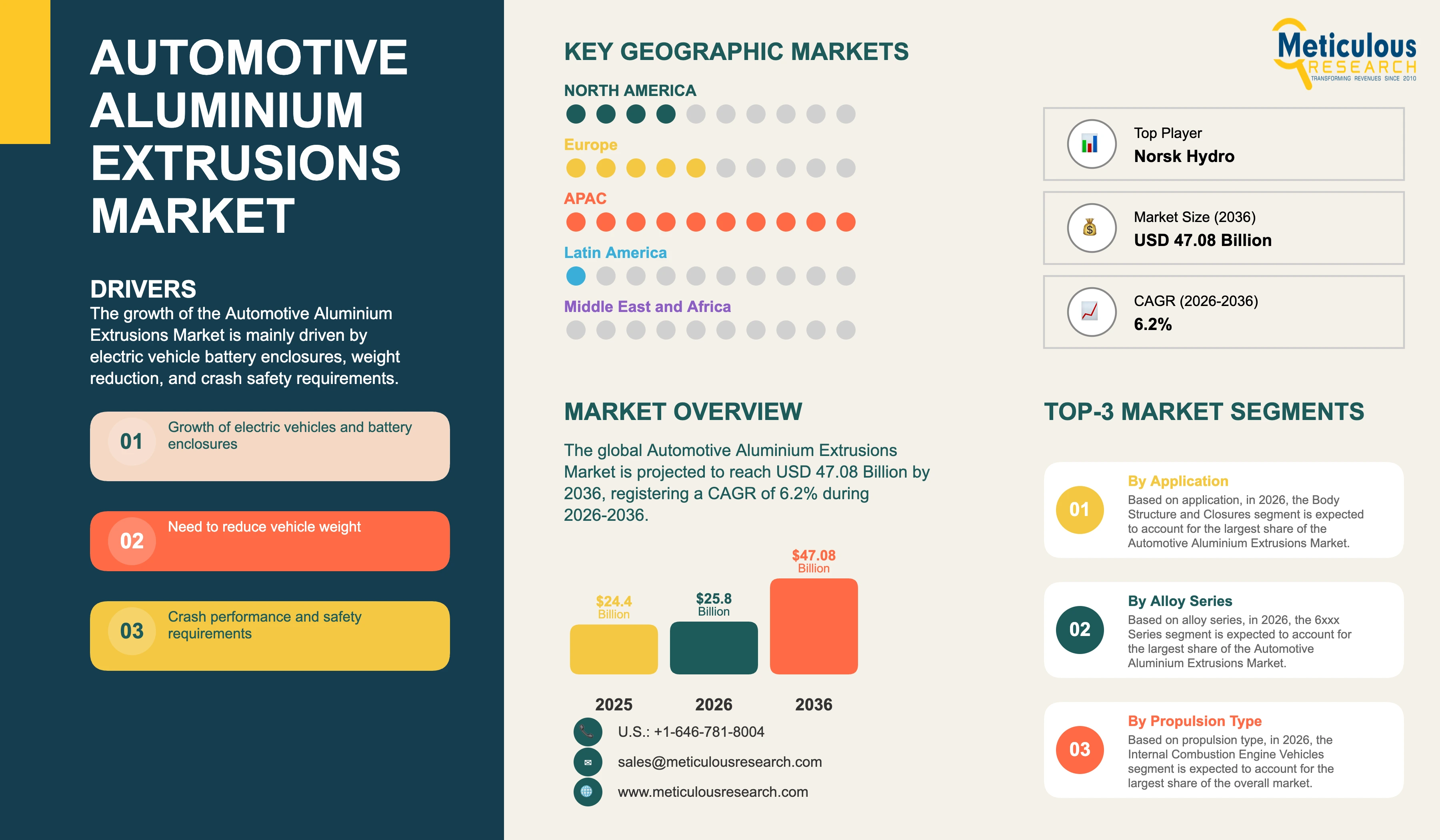
The global automotive aluminium extrusions market was valued at USD 24.40 billion in 2025. This market is expected to reach USD 47.08 billion by 2036 from an estimated USD 25.80 billion in 2026, registering a CAGR of 6.2% during the forecast period (2026-2036).
- Published
- Nov 2026
- Pages
- 257
- Format
- PDF + Excel
- Report ID
- MRAUTO - 1042894
- Base year
- 2025
- 2025 · BASELINE
- $24.40B
- 2036
- $47.08B
- CAGR 2026–2036
- 6.2%
2025 baseline · 2026–2036 forecast at 6.2% CAGR · hover a bar for the value
Key highlights
Hydro Extrusions commissioned a new 12-inch, 60 MN extrusion press at its plant in Tønder, Denmark, in 2026, which mainly serves the automotive industry and electric vehicles, according to Hydro. The press adds capacity for extrusions with larger cross-sections, matching the setup of Hydro's 12-inch automotive press at its plant in Székesfehérvár, Hungary, which is the biggest extrusion plant of its kind in Europe, according to Hydro.
Hydro began construction of a new 5, 900-tonne indirect extrusion press line at Cressona, Pennsylvania, in October 2026, with operations expected to start in the first quarter of 2028, according to Hydro. Hydro also joined Alumobility, an industry group that promotes aluminium use in vehicles, in January 2026.
Constellium has more than 100, 000 metric tons of annual automotive extrusion capacity and supplies crash management systems and body structure components from plants in Europe, North America, Mexico, and China, according to Constellium. Automotive accounted for 25% of Constellium's revenue in 2025, according to the company.
Constellium's HSA6 high-strength 6xxx alloys can accept more than 80% recycled material, and its extrusion-based solutions are up to 40% lighter than steel, according to Constellium. The company also supplies sheet and extrusion-based battery enclosure components, cooling plates, and busbars for electric vehicle batteries.
Global electric car sales topped 20 million units in 2025, according to the IEA. Battery electric vehicles typically use much more extruded aluminium than conventional vehicles, mainly in battery enclosure frames, side sills that protect the battery in side impacts, and cooling parts.
Leading suppliers include Norsk Hydro, Constellium, Benteler, UACJ, Kobe Steel, Shandong Nanshan Aluminum, Ningbo Xusheng Group, and Hindalco Industries. Battery enclosure frames and trays is the fastest-growing application, and 7xxx series alloys are the fastest-growing alloy series, supported by demand for higher strength in crash and battery protection parts. Benteler supplies aluminium crash management and structural components, while UACJ and Kobe Steel supply automotive extrusions in Japan, North America, and Asia. Chinese suppliers are also expanding quickly.
By application, body structure and closures account for the largest share of 22.0% in 2026, while battery enclosure frames and trays register the highest CAGR.
By alloy series, 6xxx series account for the largest share in 2026, while 7xxx series register the highest CAGR.
By propulsion type, internal combustion engine vehicles account for the largest share in 2026, while battery electric vehicles register the highest CAGR.
By vehicle type, passenger cars account for the larger share of 85.0% in 2026 and also register the higher CAGR.
By geography, Asia-Pacific accounts for the largest share of 48.0% in 2026, while Asia-Pacific registers the highest CAGR of 7.2%.
Report summary
| Particulars | Details |
|---|---|
| Base Year | 2025 |
| Estimated Year | 2026 |
| Forecast Period | 2026-2036 |
| Market Size in 2025 | USD 24.40 billion |
| Market Size in 2026 | USD 25.80 billion |
| Market Size by 2036 | USD 47.08 billion |
| CAGR (2026-2036) | 6.2% |
| Format | PDF, Excel & Cloud Portal · 257 pages |
| Largest Segment by Application (2026) | Body Structure and Closures (22.0%) |
| Largest Segment by Vehicle Type (2026) | Passenger Cars (85.0%) |
| Largest Region (2026) | Asia-Pacific (48.0%) |
| Fastest-Growing Region | Asia-Pacific (CAGR 7.2%) |
| Companies Profiled | 8 companies and other companies |
| Segments Covered | Application, Alloy Series, Propulsion Type, Vehicle Type, Geography |
| Countries Covered | U.S., Canada, Mexico, Germany, France, U.K., Spain, Italy, Sweden, Czech Republic, Poland, Slovakia, Hungary, Austria, Rest of Europe, China, Japan, South Korea, India, Thailand, Indonesia, Malaysia, Vietnam, Taiwan, Australia, Rest of Asia-Pacific, Brazil, Argentina, Chile, Colombia, Rest of Latin America, Turkey, Morocco, South Africa, Saudi Arabia, UAE, Israel, Rest of Middle East & Africa |
Report overview
Segments covered: application, alloy sery, propulsion type, vehicle type.
Automotive aluminium extrusions are profiles made by pushing heated aluminium billets through a shaped die, which creates long sections with complex cross-sections, such as hollow multi-chamber profiles, that are then cut, bent, machined, and welded into vehicle parts. They are used in body structures, such as side sills, roof rails, and pillars, in battery enclosure frames and trays for electric vehicles, in front and rear crash management systems, in heat exchanger tubes and thermal management parts, in chassis and suspension parts, such as subframes and control arms, and in interior and trim parts, such as seat rails and instrument panel beams.
The growth of this market is mainly driven by the fast growth of electric vehicles, whose battery enclosures use large amounts of extruded aluminium for frames, side members, and cross members, the need to reduce vehicle weight to improve driving range and meet emission standards, the high energy absorption of aluminium extrusions in crash management systems and side sills, the move to new high-strength 6xxx and 7xxx alloys that allow thinner and lighter profiles, and vehicle makers' interest in low-carbon and recycled aluminium. In addition, the flexibility of extrusion dies, which are cheaper and faster to make than stamping tools, supports the use of extrusions in lower-volume electric vehicle platforms. However, competition from advanced high-strength steel and large aluminium castings, volatile aluminium prices and trade tariffs, and high energy costs in Europe are expected to restrain the growth of this market to some extent.
Aluminium extrusions have been used in vehicles for decades, first in window frames, roof rails, trim, and radiator tubes, and then in structural and crash parts as vehicle makers looked for ways to reduce weight. Aluminium is about one-third the density of steel, and extrusion allows engineers to place material exactly where it is needed in a profile, creating hollow multi-chamber sections that are stiff and absorb crash energy well. Extrusion dies are also much cheaper and quicker to make than the stamping tools used for steel and aluminium sheet parts, which makes extrusions attractive for vehicle programs with moderate volumes and for frequent design changes.
This report covers the global automotive aluminium extrusions market, including extruded aluminium profiles and fabricated extrusion-based components used in body structure and closures, battery enclosure frames and trays, crash management systems, heat exchangers and thermal management, chassis and suspension, and interior, trim, and other applications, made from 6xxx, 7xxx, and other alloy series, for internal combustion engine vehicles, battery electric vehicles, and hybrid vehicles, and for passenger cars and commercial vehicles. The market is valued at the selling price of extruded profiles and extrusion-based components supplied to vehicle makers and parts makers. The market is analyzed by application, alloy series, propulsion type, vehicle type, and geography. Aluminium sheet, castings, forgings, and wheels are not included.
The growth of electric vehicles has changed the role of aluminium extrusions in vehicles more than any other trend in recent years. A battery electric vehicle carries a large, heavy battery pack under the floor, which must be protected against side impacts and supported by a strong but light structure. Many vehicle makers use extruded aluminium for the battery enclosure frame, side members, and cross members, often combined with aluminium or steel sheet for the bottom plate and cover, and use extruded side sills with multiple chambers to absorb side impact energy before it reaches the battery. As a result, battery electric vehicles typically contain much more extruded aluminium than comparable conventional vehicles.
Crash management systems, which include the front and rear bumper beams and crash boxes that absorb energy in low-speed and moderate-speed impacts, are another major use of extrusions. Aluminium extrusions absorb crash energy well by folding in a controlled way, and they are lighter than steel bumper systems. Heat exchanger tubes, including micro-channel tubes for radiators, condensers, and battery cooling, are also a large application, although their content per vehicle is changing as electric vehicles replace engine cooling with battery and electronics cooling.
The market is led by large aluminium companies with automotive extrusion and fabrication capabilities. Norsk Hydro, through Hydro Extrusions, operates one of the largest extrusion networks in the world, with specialized automotive plants in Europe and North America. Constellium supplies crash management systems, body structure components, and battery enclosure components. Benteler supplies aluminium crash management and structural components, UACJ and Kobe Steel supply automotive extrusions in Japan, North America, and Asia, Shandong Nanshan Aluminum and Ningbo Xusheng Group supply extrusions and components to vehicle makers in China, and Hindalco Industries supplies automotive extrusions in India.
Sustainability is becoming a key factor in how vehicle makers choose their aluminium extrusion suppliers. Primary aluminium production uses large amounts of electricity, and its carbon footprint depends heavily on the energy source, while recycled aluminium uses only a small fraction of that energy. Vehicle makers increasingly ask for low-carbon aluminium and high recycled content, and suppliers are investing in recycling plants that turn process and post-consumer scrap into extrusion billets. The EU's End-of-Life Vehicles Regulation, which entered into force in August 2026, also allows the European Commission to set recycled content targets for aluminium in vehicles from 2033, which could further support recycled aluminium.
In 2026, body structure and closures account for the largest share of the market by application, while battery enclosure frames and trays is the fastest-growing application. 6xxx series alloys account for the largest share by alloy series, while 7xxx series alloys are the fastest-growing alloy series. Internal combustion engine vehicles account for the largest share by propulsion type, while battery electric vehicles are the fastest-growing propulsion type. Passenger cars account for the largest share by vehicle type and are also the fastest-growing vehicle type. Asia-Pacific accounts for the largest share of the market and is also the fastest-growing region.
Market growth over the forecast period will depend on electric vehicle production, the design choices vehicle makers make for battery enclosures and body structures, competition from steel and large aluminium castings, aluminium prices and trade policies, and the availability of low-carbon and recycled aluminium. The shift to electric vehicles will add extruded aluminium content per vehicle, while competition from other materials and processes will limit some applications. Overall, the market is expected to grow faster than vehicle production through 2036.
Passenger cars are expected to account for the largest share of 85.0% of the market in 2026 and are also projected to register the higher CAGR, driven by electric passenger cars and extrusion-intensive battery enclosures.
Asia-Pacific is expected to account for the largest share of 48.0% of the market in 2026, mainly due to China's large vehicle and electric vehicle production and the use of aluminium in Chinese battery enclosures.
Asia-Pacific is also projected to register the highest CAGR of 7.2% during the forecast period, driven by electric vehicle production in China and rising vehicle production in India and Southeast Asia.
The report profiles 8 companies, including Norsk Hydro, Constellium, Benteler, UACJ, Kobe Steel, Shandong Nanshan Aluminum, Ningbo Xusheng Group, and Hindalco Industries.
Electric vehicles use extruded aluminium for battery enclosure frames, side members, and multi-chamber side sills that protect the battery in side impacts, as well as for cooling parts, which adds extrusion content compared with conventional vehicles.
Aluminium extrusions are much lighter than steel and absorb crash energy well, and extrusion dies cost less than stamping tools, but aluminium costs more per kilogram, and advanced high-strength steel competes in many applications.
Report infographic
Market dynamics
17 factors across 5 forcesGrowth of electric vehicles and battery enclosures
Global electric car sales topped 20 million units in 2025, according to the IEA, and electric vehicles are expected to account for a growing share of new vehicle sales over the forecast period. Each battery electric vehicle has a large battery enclosure under the floor, and many vehicle makers use extruded aluminium frames, side members, and cross members for these enclosures because they combine low weight, high stiffness, good crash performance, and design flexibility. Extruded profiles can also include channels for cooling liquid and mounting features, which reduces the number of separate parts.
Electric vehicles also use extruded side sills with multiple chambers to absorb side impact energy before it reaches the battery, and extruded parts in electric drive housings, busbars, and cooling systems. Constellium supplies sheet and extrusion-based battery enclosure components, cooling plates, and busbars, and Hydro supplies extrusions for battery trays and enclosures, according to the companies. Battery enclosure frames and trays is the fastest-growing application in this market, and battery electric vehicles are the fastest-growing propulsion type.
Need to reduce vehicle weight
Vehicle makers must reduce weight to improve fuel economy and meet carbon dioxide emission standards in conventional vehicles, and to extend driving range or reduce battery size in electric vehicles. Aluminium extrusions are one of the most effective ways to reduce weight in body structures, crash systems, and chassis parts, as aluminium is about one-third the density of steel. Constellium states that its extrusion-based solutions are up to 40% lighter than steel and 10% lighter than conventional aluminium solutions thanks to its alloys, according to Constellium.
Weight reduction is especially important in electric vehicles, where the battery adds hundreds of kilograms, and in larger vehicles, such as SUVs and pickup trucks, which are popular in North America and growing in other regions. As emission standards tighten and electric vehicle makers compete on driving range, demand for lightweight aluminium extrusions in body, crash, and chassis parts is expected to grow steadily over the forecast period.
Crash performance and safety requirements
Vehicle safety standards and rating programs, such as Euro NCAP, the U.S. Insurance Institute for Highway Safety, and China's C-NCAP, require vehicles to protect occupants in frontal, side, and rear impacts, and increasingly test small overlap and side pole impacts. Aluminium extrusions absorb crash energy well by folding in a controlled way, and multi-chamber profiles can be designed for specific crash loads. This makes them a preferred choice for bumper beams, crash boxes, side sills, and other energy-absorbing parts.
Electric vehicles add new safety requirements, as the battery must be protected from intrusion in side and underbody impacts. Extruded side sills and battery frames play a key role in meeting these requirements. Crash management systems are a large application in this market, and new high-strength alloys are allowing lighter crash parts with the same or better performance, which supports steady demand over the forecast period.
Development of high-strength alloys
Aluminium producers are developing new high-strength 6xxx and 7xxx alloys for extrusions, which allow thinner walls and lighter profiles while meeting crash and stiffness requirements. Constellium's HSA6 family of high-strength 6xxx alloys offers formability, corrosion resistance, energy absorption, and recyclability and can accept more than 80% recycled material, according to Constellium. 7xxx alloys offer even higher strength for parts such as bumper beams and side sill reinforcements, although they are harder to extrude and weld.
These alloys allow aluminium extrusions to compete with advanced high-strength steel in more applications and to reduce weight further in existing applications. 7xxx series alloys are the fastest-growing alloy series in this market, supported by their use in high-strength crash and battery protection parts. Suppliers with strong alloy development capabilities and in-house casthouses that produce billets with tight chemistry control have an advantage in supplying these demanding parts.
Demand for low-carbon and recycled aluminium
Vehicle makers have set targets to reduce carbon emissions across their supply chains, and aluminium is one of the largest sources of material emissions in many vehicles. Primary aluminium produced with coal-based electricity has a high carbon footprint, while aluminium produced with hydropower and recycled aluminium have much lower footprints. Vehicle makers increasingly ask suppliers for low-carbon aluminium and high recycled content, and some pay a premium for verified low-carbon products. Suppliers are responding by investing in recycling plants that turn process scrap and post-consumer scrap into extrusion billets, as Hydro has done at its automotive plant in Hungary, according to Hydro. The EU's Carbon Border Adjustment Mechanism, which places a carbon cost on imported aluminium, and the EU's End-of-Life Vehicles Regulation, which allows recycled content targets for aluminium from 2033, also support demand for low-carbon and recycled aluminium in Europe. Suppliers that can offer verified low-carbon and high-recycled-content extrusions are expected to gain business with vehicle makers that have strong climate targets, which supports value growth in this market over the forecast period.
Table of contents
12 chapters · 174 sections · 257 pages · click to expandSegmental analysis
| Segment | Largest share (2026) | Fastest growth (2026–2036) |
|---|---|---|
| By Application | 6xxx series | 7xxx series |
By Application
- The 6xxx series segment is expected to account for the largest share of the automotive aluminium extrusions market, while the 7xxx series segment is projected to register the highest CAGR during the forecast period.
- The internal combustion engine vehicles segment is expected to account for the largest share of the automotive aluminium extrusions market, while the battery electric vehicles segment is projected to register the highest CAGR during the forecast period.
Geographic analysis
Asia-Pacific
Largest shareIn 2026, Asia-Pacific is expected to account for the largest share of 48.0% of the global automotive aluminium extrusions market. The large share of this region is mainly due to China's position as the largest vehicle and electric vehicle producer in the world, Chinese vehicle makers' use of aluminium in battery enclosures and body structures, the large vehicle production of Japan, South Korea, and India, and the presence of large extrusion suppliers, such as Shandong Nanshan Aluminum, Ningbo Xusheng Group, UACJ, Kobe Steel, and Hindalco Industries. China is the largest market in the region, followed by Japan and India. Asia-Pacific is also projected to register the highest CAGR of 7.2% during the forecast period. The rapid growth of this region is mainly driven by continued growth of electric vehicle production in China, the expansion of Chinese vehicle makers to Southeast Asia, rising vehicle production and growing use of aluminium in India, and investments in automotive extrusion capacity by Chinese and Indian suppliers. Japanese and Korean vehicle makers are also increasing aluminium use in their electric vehicles, which supports demand in Japan and South Korea. India is expected to be one of the fastest-growing countries in the region, supported by rising vehicle production, electric vehicle programs, and local aluminium production.
Europe
Europe accounts for a significant share of the market, supported by the long use of aluminium extrusions in premium vehicles, strict carbon dioxide emission standards, the growth of electric vehicles, EU rules that favor low-carbon and recycled aluminium, and the presence of leading suppliers, such as Norsk Hydro, Constellium, and Benteler, with automotive extrusion plants across the region. Germany is the largest market in the region, followed by France, Spain, and the Czech Republic. Eastern European countries, such as Poland, Slovakia, and Hungary, are attracting new electric vehicle and battery plants, including plants built by Chinese vehicle makers, which adds demand for battery enclosure extrusions and body structure profiles. Hungary is home to Hydro's Székesfehérvár plant, the biggest extrusion plant of its kind in Europe, according to Hydro. However, high energy costs and slower vehicle production limit growth.
North America
North America accounts for a significant share of the market, supported by the large production of SUVs and pickup trucks, such as the Ford F-150, which use aluminium-intensive designs, electric vehicle production, and the push to source aluminium locally because of tariffs. The U.S. is the largest market in the region, followed by Mexico and Canada. Hydro is building a new press line at Cressona, Pennsylvania, and Constellium operates automotive extrusion plants in the U.S. and Mexico, according to the companies.
Latin America
Latin America and the Middle East and Africa account for smaller shares, with Brazil the largest market in Latin America and Turkey and Morocco important production hubs supplying Europe.
Middle East & Africa
The Middle East, including the UAE, Saudi Arabia, and Bahrain, has large primary aluminium production, which could support local extrusion supply as vehicle production develops in the region.
Competitive landscape
The global automotive aluminium extrusions market includes large integrated aluminium companies that produce primary and recycled aluminium, extrude profiles, and fabricate components, specialized automotive component suppliers that use extrusions, and regional extruders that serve local vehicle makers. The market is moderately concentrated for complex structural and crash components, which require large presses, alloy expertise, and fabrication capabilities, while simpler profiles and heat exchanger tubes are supplied by many regional companies.
Norsk Hydro, through Hydro Extrusions, operates a large global extrusion network with specialized automotive plants in Europe and North America and supplies extrusions for battery trays, crash management, and body structures, according to Hydro. Constellium supplies crash management systems, body structure components, and battery enclosure components and has more than 100,000 metric tons of annual automotive extrusion capacity, according to Constellium. Benteler supplies aluminium crash and structural components, UACJ and Kobe Steel supply automotive extrusions, Shandong Nanshan Aluminum and Ningbo Xusheng Group supply extrusions and components in China, and Hindalco Industries supplies automotive extrusions in India.
Companies in this market compete mainly on alloy and extrusion technology, crash and structural performance, design and engineering support, fabrication and assembly capabilities, carbon footprint and recycled content, price, capacity close to vehicle plants, and long-term relationships with vehicle makers. Key strategies in this market include investing in large-section extrusion presses, developing high-strength and high-recycled-content alloys, offering integrated components and modules, building recycling plants, and expanding capacity in North America, Asia-Pacific, and other growing regions.
Recent competitive activity in this market has mainly focused on new capacity and electric vehicle applications. Hydro commissioned a new 12-inch, 60 MN press at Tønder, Denmark, in 2026 and began construction of a new 5,900-tonne press line at Cressona, Pennsylvania, in October 2026, according to Hydro. Hydro also joined Alumobility in January 2026 to promote aluminium use in vehicles. Constellium completed the FlexCAR research project with ARENA2036, Mercedes-Benz, Siemens, Bosch, and others, developing a modular sill concept using HSA6 aluminium extrusions with significant recycled content, according to Constellium.
We expect competition to increase over the forecast period as suppliers expand capacity for electric vehicle applications, as Chinese suppliers grow with Chinese vehicle makers at home and abroad, and as steel and large castings compete for battery enclosure and body structure applications. Suppliers with large-section presses, high-strength and low-carbon alloys, integrated fabrication capabilities, and capacity close to vehicle plants are expected to strengthen their positions.
Some of the key players operating in the automotive aluminium extrusions market are Norsk Hydro ASA, Constellium SE, Benteler International AG, UACJ Corporation, Kobe Steel, Ltd., Shandong Nanshan Aluminum Co., Ltd., Ningbo Xusheng Group Co., Ltd., and Hindalco Industries Limited, among others.
- —
Hydro commissioned a new 60 MN automotive press at Tønder, Denmark, in 2026 and began building a new press line at Cressona, Pennsylvania, in October 2026, while Constellium developed a modular extruded sill concept with ARENA2036.
- Norsk Hydro ASA
- Constellium SE
- Benteler International AG
- UACJ Corporation
- Kobe Steel, Ltd.
- Shandong Nanshan Aluminum Co., Ltd.
- Ningbo Xusheng Group Co., Ltd.
- Hindalco Industries Limited
Expert perspectives
Automotive aluminium extrusions are benefiting from the shift to electric vehicles, which use much more extruded aluminium than conventional vehicles in battery enclosures, side sills, and cooling parts. At the same time, the need to reduce weight, improve crash performance, and lower material carbon footprints supports steady demand for extrusions in body structures, crash systems, and chassis parts.
Over the forecast period, the market is expected to grow at a CAGR of 6.2%, from USD 25.80 billion in 2026 to USD 47.08 billion in 2036. Growth will be driven by the growth of electric vehicles and battery enclosures, the need to reduce vehicle weight, crash performance and safety requirements, high-strength alloys, and demand for low-carbon and recycled aluminium. Competition from steel and large castings and volatile aluminium prices and tariffs will limit growth to some extent.
Among the market segments, body structure and closures is the largest application, while battery enclosure frames and trays grows fastest. 6xxx series alloys are the largest alloy series, while 7xxx series alloys grow fastest. Internal combustion engine vehicles are the largest propulsion type, while battery electric vehicles grow fastest. Passenger cars are the largest vehicle type and also grow fastest. Asia-Pacific is the largest region and is also the fastest-growing region, led by China.
In our view, the battle for battery enclosure designs will largely decide the long-term growth of this market. Extrusion-intensive designs compete with sheet-based aluminium, steel, cast, and composite designs, and vehicle makers are choosing different solutions for different platforms. Suppliers that can offer flexible, cost-effective designs and work across materials and processes will be best placed to win, while suppliers focused only on profiles may lose value to integrators. We expect extrusion-intensive designs to remain popular for platforms with moderate volumes and frequent design changes.
We also see low-carbon aluminium as an increasingly important factor in supplier selection, especially in Europe. Suppliers with access to hydropower-based primary aluminium, such as those in Norway and Canada, large recycling capacity, and alloys that accept high recycled content can offer clear carbon advantages, which vehicle makers increasingly value and in some cases pay for, especially in Europe, where carbon pricing and reporting rules are strictest.
Overall, we believe that the automotive aluminium extrusions market will grow steadily over the forecast period from 2026 to 2036, with battery enclosure frames and trays, 7xxx alloys, battery electric vehicles, passenger cars, and Asia-Pacific providing the fastest growth. Companies with large-section presses, high-strength and low-carbon alloys, integrated fabrication capabilities, and global capacity close to vehicle plants will be best positioned to capture this growth.
Customer perspectives
“Extruded frames let us change the battery layout for each model without new stamping tools. The side sills also take the side impact load before it reaches the cells.”
“Because our pickups and SUVs use a lot of aluminium to save weight, supply matters to us. With tariffs, we want extruders that produce locally and can show us the carbon footprint of every part.”
“We use high-strength aluminium extrusions in the sills and crash beams to pass side pole tests while keeping the car light enough for our range targets.”
Frequently asked questions
The global automotive aluminium extrusions market was valued at USD 24.40 billion in 2025, up from USD 23.20 billion in 2024, and is estimated at USD 25.80 billion in 2026. The market includes extruded profiles and extrusion-based components for passenger cars and commercial vehicles.
The global automotive aluminium extrusions market is expected to reach USD 47.08 billion by 2036, driven by electric vehicle battery enclosures, weight reduction, crash safety requirements, high-strength alloys, and low-carbon aluminium.
The market is expected to register a CAGR of 6.2% from 2026 to 2036, with the fastest growth in battery enclosure frames and trays, 7xxx alloys, battery electric vehicles, passenger cars, and Asia-Pacific.
Market growth is mainly driven by the growth of electric vehicles and battery enclosures, the need to reduce vehicle weight, crash performance and safety requirements, the development of high-strength alloys, and demand for low-carbon and recycled aluminium.
Competition from advanced high-strength steel and large castings and volatile aluminium prices and tariffs restrain growth, while joining, corrosion, and repair in mixed-material structures and high capital investment and energy costs are key challenges.
Key growth opportunities include extrusion-intensive battery enclosures, low-carbon and recycled-content extrusions, integrated extrusion-based components and modules, and growth in Asia-Pacific and North America.
Body structure and closures is expected to account for the largest share of 22.0% of the market in 2026, while battery enclosure frames and trays is projected to register the highest CAGR, driven by electric vehicle growth.
In 2026, the 6xxx series segment is expected to account for the largest share of the automotive aluminium extrusions market, while the 7xxx series segment is projected to register the highest CAGR during the forecast period.
In 2026, the internal combustion engine vehicles segment is expected to account for the largest share of the automotive aluminium extrusions market, while the battery electric vehicles segment is projected to register the highest CAGR during the forecast period.
Passenger cars are expected to account for the largest share of 85.0% of the market in 2026 and are also projected to register the higher CAGR, driven by electric passenger cars and extrusion-intensive battery enclosures.
Asia-Pacific is expected to account for the largest share of 48.0% of the market in 2026, mainly due to China's large vehicle and electric vehicle production and the use of aluminium in Chinese battery enclosures.
Asia-Pacific is also projected to register the highest CAGR of 7.2% during the forecast period, driven by electric vehicle production in China and rising vehicle production in India and Southeast Asia.
The report profiles 8 companies, including Norsk Hydro, Constellium, Benteler, UACJ, Kobe Steel, Shandong Nanshan Aluminum, Ningbo Xusheng Group, and Hindalco Industries.
Hydro commissioned a new 60 MN automotive press at Tønder, Denmark, in 2026 and began building a new press line at Cressona, Pennsylvania, in October 2026, while Constellium developed a modular extruded sill concept with ARENA2036.
Electric vehicles use extruded aluminium for battery enclosure frames, side members, and multi-chamber side sills that protect the battery in side impacts, as well as for cooling parts, which adds extrusion content compared with conventional vehicles.
Aluminium extrusions are much lighter than steel and absorb crash energy well, and extrusion dies cost less than stamping tools, but aluminium costs more per kilogram, and advanced high-strength steel competes in many applications.
Cite this report
Meticulous Research. (2026). Automotive Aluminium Extrusions Market - Global Opportunity Analysis and Industry Forecast (2026-2036) (Report No. MRAUTO - 1042894). Meticulous Market Research Pvt. Ltd. https://www.meticulousresearch.com/product/automotive-aluminium-extrusions-market-7577