Automotive Alloy Wheels Market (2026-2036)
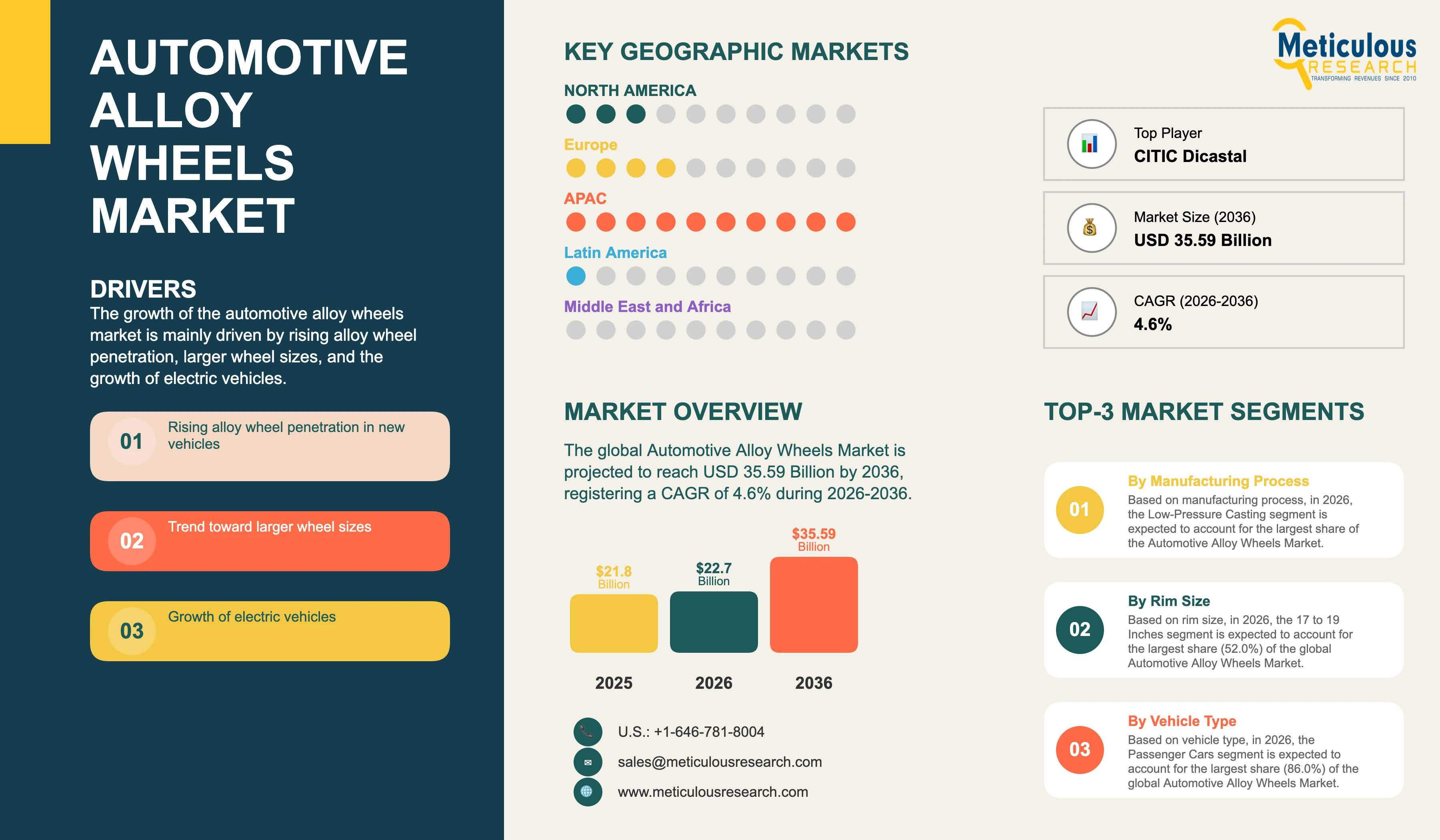
The global automotive alloy wheels market was valued at USD 21.80 billion in 2025. This market is expected to reach USD 35.59 billion by 2036 from an estimated USD 22.70 billion in 2026, registering a CAGR of 4.6% during the forecast period (2026-2036).
- Published
- Nov 2026
- Pages
- 270
- Format
- PDF + Excel
- Report ID
- MRAUTO - 1042865
- Base year
- 2025
- 2025 · BASELINE
- $21.80B
- 2036
- $35.59B
- CAGR 2026–2036
- 4.6%
2025 baseline · 2026–2036 forecast at 4.6% CAGR · hover a bar for the value
Key highlights
Superior Industries, one of the world's leading aluminum wheel suppliers, agreed in July 2025 to be acquired by a group of its term loan investors led by Oaktree Capital Management, which converted debt to equity and cut funded debt by nearly 90% from about USD 982 million to about USD 125 million, according to Weil. The company, based in Southfield, Michigan, became privately held after reporting first-quarter 2025 net sales of USD 321.6 million and withdrawing its guidance.
Global electric car sales grew by 20% to more than 20 million units in 2025, accounting for one in four new cars sold, according to the IEA. Electric vehicles are heavier than similar combustion engine vehicles and need wheels that carry higher loads, reduce weight, and lower aerodynamic drag, which favors flow-formed and forged alloy wheels and aero-optimized designs.
Wheel sizes are rising across the industry, with 19-inch, 20-inch, and larger wheels increasingly common on SUVs, premium vehicles, and electric vehicles. Larger wheels use more aluminum and more complex machining and finishing, which increases the value of each wheel.
China is the largest producer and exporter of alloy wheels, led by CITIC Dicastal, the world's largest aluminum wheel maker, as well as Wanfeng Auto Wheel and Lizhong Wheel Group. Chinese wheel exports face anti-dumping and countervailing duties in the U.S. and the European Union, which has encouraged wheel production in Mexico, Morocco, Thailand, and other countries.
The European Union's Carbon Border Adjustment Mechanism, which covers aluminum, entered its definitive phase in 2026, adding a carbon cost to imported aluminum products. Vehicle makers are asking wheel makers for low-carbon wheels made with recycled aluminum and renewable energy.
Leading suppliers include CITIC Dicastal, Ronal Group, Borbet, Superior Industries, Iochpe-Maxion (Maxion Wheels), Enkei, Wanfeng Auto Wheel, Lizhong Wheel Group, Howmet (Alcoa Wheels), Accuride, Uno Minda, and Steel Strips Wheels. Many wheel makers are also adding flow-forming lines and larger finishing capacity to serve demand for 20-inch and larger wheels on SUVs and electric vehicles.
By manufacturing process, low-pressure casting accounts for the largest share of 62.0% in 2026, while flow forming registers the highest CAGR.
By rim size, 17 to 19 inches account for the largest share in 2026, while 20 inches and above registers the highest CAGR.
By vehicle type, passenger cars account for the largest share of 86.0% in 2026, while two-wheelers register the highest CAGR.
By sales channel, OEM accounts for the larger share in 2026 and also registers the higher CAGR.
By geography, Asia-Pacific accounts for the largest share of 56.0% in 2026, while Asia-Pacific registers the highest CAGR of 5.5%.
Report summary
| Particulars | Details |
|---|---|
| Base Year | 2025 |
| Estimated Year | 2026 |
| Forecast Period | 2026-2036 |
| Market Size in 2025 | USD 21.80 billion |
| Market Size in 2026 | USD 22.70 billion |
| Market Size by 2036 | USD 35.59 billion |
| CAGR (2026-2036) | 4.6% |
| Format | PDF, Excel & Cloud Portal · 270 pages |
| Largest Segment by Manufacturing Process (2026) | Low-Pressure Casting (62.0%) |
| Largest Segment by Vehicle Type (2026) | Passenger Cars (86.0%) |
| Largest Region (2026) | Asia-Pacific (56.0%) |
| Fastest-Growing Region | Asia-Pacific (CAGR 5.5%) |
| Companies Profiled | 12 companies and other companies |
| Segments Covered | Manufacturing Process, Rim Size, Vehicle Type, Sales Channel, Geography |
| Countries Covered | U.S., Canada, Germany, France, Spain, Italy, U.K., Sweden, Czech Republic, Slovakia, Poland, Hungary, Romania, Belgium, Portugal, Austria, Rest of Europe, China, Japan, India, South Korea, Thailand, Indonesia, Malaysia, Vietnam, Philippines, Taiwan, Australia, Rest of Asia-Pacific, Mexico, Brazil, Argentina, Colombia, Chile, Peru, Rest of Latin America, Turkey, Morocco, South Africa, Saudi Arabia, Egypt, Iran, Rest of Middle East & Africa |
Report overview
Segments covered: manufacturing process, rim size, vehicle type, sales channel.
Automotive alloy wheels are wheels made mainly from aluminum alloys, and to a smaller extent magnesium alloys, by casting, flow forming, or forging. They are lighter and stiffer than steel wheels, improve handling, braking, and fuel economy or electric vehicle range, dissipate brake heat better, and allow attractive designs and finishes, which has made them standard on most new passenger cars in many markets.
The growth of this market is mainly driven by the rising share of alloy wheels on new vehicles, especially in emerging markets where steel wheels are still common, the trend toward larger wheel sizes, particularly on SUVs and electric vehicles, the growth of electric vehicles, which need light, strong, and aerodynamic wheels to carry heavier weights and extend range, the use of flow-formed and forged wheels to reduce weight, and steady aftermarket demand for styling upgrades and replacement. In addition, the growth of alloy wheels on two-wheelers in India and Southeast Asia is supporting demand. However, volatile aluminum prices, trade duties and tariffs on imported wheels, and the energy intensity and carbon footprint of aluminum are expected to restrain the growth of this market to some extent.
Wheels connect the vehicle to its tires and must carry the vehicle's weight, withstand impacts from potholes and curbs, transfer braking and driving forces, and last the life of the vehicle. Alloy wheels, made mainly from aluminum alloys, offer several advantages over steel wheels. They are lighter, which reduces unsprung weight and improves handling, ride comfort, and fuel economy or electric vehicle range, they conduct heat well, which helps cool the brakes, and they can be cast or machined into complex and attractive designs. As a result, alloy wheels have become standard on most passenger cars in Europe, North America, China, Japan, and Korea, and their use is growing in other markets.
This report covers the global automotive alloy wheels market, including wheels made by low-pressure casting, flow forming, forging, and gravity casting and other processes for passenger cars, light commercial vehicles, heavy commercial vehicles, and two-wheelers. The market is valued at the selling price of wheels sold to vehicle makers and through the aftermarket. The market is analyzed by manufacturing process, rim size, vehicle type, sales channel, and geography. Steel wheels, wheel covers, tires, and wheel hubs and bearings are not included.
Most alloy wheels are made by low-pressure casting, in which molten aluminum is pushed into a mold from below, producing strong wheels at a reasonable cost. Flow-formed wheels start as cast wheels, but the rim area is spun and stretched under pressure, which makes it thinner, stronger, and lighter. Forged wheels are made from solid aluminum billets pressed under very high force, producing the strongest and lightest wheels, which are used on premium and performance vehicles and on heavy trucks. After forming, wheels are heat treated, machined, painted or diamond-cut, and tested for strength, balance, and leaks.
Wheel design has become an important part of vehicle styling, and vehicle makers offer many wheel sizes and designs for each model, from basic wheels on entry trims to large, complex designs on premium trims. Wheel sizes have increased steadily, with 17-inch to 19-inch wheels now the most common on new passenger cars and 20-inch and larger wheels growing on SUVs and premium vehicles. Larger wheels improve appearance and handling but add weight and cost, which wheel makers address with flow forming, forging, and lightweight designs.
The market is led by large Chinese, European, and North American wheel makers. CITIC Dicastal is the world's largest aluminum wheel maker, and Wanfeng Auto Wheel and Lizhong Wheel Group are other major Chinese suppliers. Ronal Group and Borbet are leading European suppliers, Superior Industries is a leading supplier in North America and Europe, and Iochpe-Maxion, through Maxion Wheels, is one of the largest wheel makers in the world for both steel and aluminum wheels. Enkei is a leading Japanese supplier, Uno Minda and Steel Strips Wheels are growing Indian suppliers, and Howmet, through Alcoa Wheels, and Accuride are leading suppliers of aluminum wheels for trucks.
Electric vehicles are changing wheel requirements and the types of wheels vehicle makers buy. They are heavier than similar combustion engine vehicles because of their batteries, so their wheels must carry higher loads, and aerodynamic drag from wheels has a large effect on driving range. Electric vehicle wheels therefore often use flow-formed or forged rims to save weight, aerodynamic designs or covers to reduce drag, and larger diameters to fit larger brakes and tires. These requirements increase the value of wheels on electric vehicles and favor wheel makers with strong engineering capabilities.
In 2026, low-pressure casting accounts for the largest share of the market by manufacturing process, while flow forming is the fastest-growing process. Wheels of 17 to 19 inches account for the largest share by rim size, while wheels of 20 inches and above are the fastest-growing rim size. Passenger cars account for the largest share by vehicle type, while two-wheelers are the fastest-growing vehicle type. The OEM channel accounts for the larger share by sales channel and is also the faster-growing channel. Asia-Pacific accounts for the largest share of the market and is also the fastest-growing region.
Market growth over the forecast period will depend on global vehicle production, the rate at which alloy wheels replace steel wheels in emerging markets, the trend toward larger wheels, the growth of electric vehicles, and aluminum prices. Trade policies and carbon rules will also affect where wheels are made and how much they cost. Overall, rising alloy wheel penetration, larger wheel sizes, and the growth of electric vehicles are expected to support steady market growth.
Passenger cars are expected to account for the largest share of 86.0% of the market in 2026, while two-wheelers are projected to register the highest CAGR, driven by growing two-wheeler markets in India and Southeast Asia.
Asia-Pacific is expected to account for the largest share of 56.0% of the market in 2026, mainly due to China's position as the largest vehicle and alloy wheel producer and the large two-wheeler markets of India and Southeast Asia.
Asia-Pacific is also projected to register the highest CAGR of 5.5% during the forecast period, driven by rising alloy wheel penetration in India and Southeast Asia and continued vehicle and electric vehicle growth in China.
The report profiles 12 companies, including CITIC Dicastal, Ronal, Borbet, Superior Industries, Maxion Wheels, Enkei, Wanfeng Auto Wheel, Lizhong Wheel Group, Howmet (Alcoa Wheels), Accuride, Uno Minda, and Steel Strips Wheels.
Electric vehicles are heavier and more sensitive to wheel weight and aerodynamic drag, so they use stronger, lighter, and aerodynamic wheels, often flow-formed or forged, which increases wheel value per vehicle.
Anti-dumping and countervailing duties on Chinese wheels in the U.S. and the European Union, new U.S. tariffs, and the EU Carbon Border Adjustment Mechanism are raising costs and shifting wheel production to Mexico, Morocco, and Southeast Asia.
In 2026, the OEM segment is expected to account for the larger share of the automotive alloy wheels market, and it is also projected to register the higher CAGR during the forecast period.
Report infographic
Market dynamics
17 factors across 5 forcesRising alloy wheel penetration in new vehicles
Alloy wheels are already standard on most passenger cars in developed markets, but steel wheels are still common on entry-level cars, light commercial vehicles, and many vehicles in emerging markets, such as India, Southeast Asia, Latin America, and Africa. As incomes rise and customers expect better-looking and better-equipped vehicles, vehicle makers in these markets are fitting alloy wheels to more models and trims, often as standard equipment.
This shift from steel to alloy wheels increases alloy wheel demand faster than vehicle production. India in particular has seen strong growth in alloy wheel fitment on passenger cars and two-wheelers, and Indian suppliers, such as Uno Minda and Steel Strips Wheels, are expanding capacity. Rising alloy wheel penetration in emerging markets is expected to be one of the main drivers of market growth over the forecast period. Vehicle makers also use alloy wheels to differentiate trim levels, which encourages buyers to choose higher trims.
Trend toward larger wheel sizes
Wheel sizes have increased steadily as vehicle makers use larger wheels to improve appearance, handling, and braking, and as SUVs have become the most popular vehicle type in many markets. Wheels of 17 to 19 inches are now the most common on new passenger cars, and 20-inch, 21-inch, and even 22-inch wheels are increasingly offered on SUVs, premium vehicles, and electric vehicles. Larger wheels use more aluminum, require more machining and finishing, and are more valuable than smaller wheels.
This trend increases the average value of wheels per vehicle even when vehicle production grows slowly. Wheels of 20 inches and above are the fastest-growing rim size in this market, and wheel makers are investing in larger casting and flow-forming equipment and finishing lines to serve this demand. Larger wheels also often use flow-formed or forged rims to limit weight, which further increases their value.
Growth of electric vehicles
Electric vehicles need wheels that carry higher loads, reduce weight, and lower aerodynamic drag. Battery packs make electric vehicles heavier than similar combustion engine vehicles, which requires stronger wheels, and wheel weight and aerodynamics have a direct effect on driving range. Electric vehicle makers therefore often specify flow-formed or forged wheels, aerodynamic wheel designs, and wheel covers or inserts that reduce drag.
Global electric car sales grew by 20% to more than 20 million units in 2025, according to the IEA. As electric vehicle production grows, demand for lightweight and aerodynamic alloy wheels is expected to grow faster than the overall market. Flow forming is the fastest-growing manufacturing process in this market, supported by electric vehicle demand for lighter wheels at a reasonable cost.
Lightweighting for fuel economy and range
Wheels are part of the unsprung and rotating mass of a vehicle, so reducing wheel weight has a larger effect on handling, ride comfort, and energy use than reducing weight elsewhere in the vehicle. Vehicle makers are therefore asking wheel makers for lighter wheels to help meet fuel economy and carbon dioxide emission rules and to extend electric vehicle range. Flow forming and forging can reduce wheel weight significantly compared with standard cast wheels.
Wheel makers are developing new alloys, hollow-spoke designs, and optimized shapes to reduce weight while keeping strength and stiffness. These lightweight wheels are more valuable than standard cast wheels, which increases the average value of wheels per vehicle. Forged wheels, which offer the lowest weight, are also growing as their cost falls and as more premium and electric vehicles use them.
Growth of two-wheelers and steady aftermarket demand
Two-wheelers are a large and growing market for alloy wheels, especially in India, Indonesia, Vietnam, Thailand, and the Philippines, where motorcycles and scooters are the main form of personal transport. Alloy wheels have replaced spoke wheels on most new motorcycles and many scooters, and the growth of electric two-wheelers is adding new demand. Two-wheelers are the fastest-growing vehicle type in this market. The aftermarket also provides steady demand, as customers buy alloy wheels to upgrade the appearance of their vehicles, to replace damaged wheels, or to fit winter tires on a separate set of wheels in cold-climate countries. European aftermarket brands, such as those of Ronal, Borbet, and Superior Industries, are important in this segment, and online sales of aftermarket wheels are growing. The large and aging global vehicle fleet supports continued aftermarket demand over the forecast period.
Table of contents
12 chapters · 185 sections · 270 pages · click to expandSegmental analysis
| Segment | Largest share (2026) | Fastest growth (2026–2036) |
|---|---|---|
| By Manufacturing Process | Low-pressure casting | Flow forming |
| By Rim Size | 17 to 19 inches | 20 inches and above |
| By Vehicle Type | Passenger cars | Two-wheelers |
| By Sales Channel | — | Rapid growth of this |
| Other segments | 17 to 19 inches | 20 inches and above |
By Manufacturing Process
- The low-pressure casting segment is expected to account for the largest share of 62.0% of the global automotive alloy wheels market.
- The large share of this segment is mainly due to the wide use of low-pressure casting for most passenger car alloy wheels, its good balance between strength, weight, design freedom, and cost, the large installed base of low-pressure casting machines at wheel makers around the world, and its suitability for high-volume production of wheels in many sizes and designs.
- Low-pressure casting is also used as the first step in making flow-formed wheels.
- CITIC Dicastal, Ronal, Borbet, Superior Industries, Maxion Wheels, Enkei, Wanfeng Auto Wheel, and Lizhong Wheel Group are among the leading producers of cast alloy wheels.
- However, the flow forming segment is projected to register the highest CAGR during the forecast period.
- The rapid growth of this segment is driven by the need for lighter wheels on electric vehicles to carry heavier weights and extend range, the trend toward larger wheels, which benefit most from the weight savings of flow forming, the lower cost of flow forming compared with forging, and investment by wheel makers in flow-forming capacity.
- Flow-formed wheels are spreading from premium and performance vehicles to mainstream electric vehicles and SUVs, which is expected to drive strong growth.
By Rim Size
- The 17 to 19 inches segment is expected to account for the largest share of the global automotive alloy wheels market.
- The large share of this segment is mainly due to the use of 17-inch to 19-inch wheels on most new passenger cars and SUVs in Europe, North America, and China, the shift from 15-inch and 16-inch wheels to larger sizes on mainstream vehicles, the balance these sizes offer between appearance, ride comfort, and cost, and their use as standard wheels on many electric vehicles.
- These sizes are also the most common in the aftermarket, which adds to demand.
- However, the 20 inches and above segment is projected to register the highest CAGR during the forecast period.
- The rapid growth of this segment is driven by the growing popularity of large SUVs, pickup trucks, and premium vehicles, the use of large wheels on electric vehicles to fit larger brakes and improve appearance, the use of large wheels as a styling feature on higher trims, and the higher value of large wheels, which often use flow-formed or forged rims and complex finishes.
- Large wheels are increasingly offered even on mid-priced models.
By Vehicle Type
- The passenger cars segment is expected to account for the largest share of 86.0% of the global automotive alloy wheels market.
- The large share of this segment is mainly due to the very large number of passenger cars produced each year, the high and rising alloy wheel penetration on passenger cars, the trend toward larger and more valuable wheels on SUVs and premium cars, and the growth of electric passenger cars, which use lightweight and aerodynamic alloy wheels.
- Passenger cars also account for most aftermarket alloy wheel sales.
- However, the two-wheelers segment is projected to register the highest CAGR during the forecast period.
- The rapid growth of this segment is driven by the large and growing two-wheeler markets in India, Indonesia, Vietnam, Thailand, and the Philippines, the replacement of spoke wheels with alloy wheels on most new motorcycles and many scooters, the growth of electric two-wheelers, and rising incomes that support demand for better-equipped two-wheelers.
- Indian suppliers, such as Uno Minda and Steel Strips Wheels, are expanding capacity to serve this demand.
By Sales Channel
- The OEM segment is expected to account for the larger share of the global automotive alloy wheels market.
- The large share of this segment is mainly due to the large number of alloy wheels fitted to new vehicles each year, the rising penetration of alloy wheels as standard equipment, the long-term supply contracts between wheel makers and vehicle makers, and the trend toward larger and more valuable wheels on new vehicles.
- Most alloy wheel makers sell the majority of their output to vehicle makers.
- The OEM segment is also projected to register the higher CAGR during the forecast period.
- The rapid growth of this segment is driven by rising alloy wheel penetration in emerging markets, the growth of electric vehicles, which use lightweight and aerodynamic alloy wheels, the trend toward larger wheels and flow-formed and forged wheels on new vehicles, and the growth of two-wheeler production in Asia.
- The aftermarket is also growing, supported by the large vehicle fleet and demand for styling upgrades and winter wheels, but at a slower pace.
Other segments
- The 17 to 19 inches segment is expected to account for the largest share of the automotive alloy wheels market, while the 20 inches and above segment is projected to register the highest CAGR during the forecast period.
Geographic analysis
Asia-Pacific
Largest shareIn 2026, Asia-Pacific is expected to account for the largest share of 56.0% of the global automotive alloy wheels market. The large share of this region is mainly due to China's position as the largest vehicle producer and the largest alloy wheel producer in the world, led by CITIC Dicastal, Wanfeng Auto Wheel, and Lizhong Wheel Group, the large vehicle production of Japan, India, and South Korea, the very large two-wheeler markets of India and Southeast Asia, and the presence of leading suppliers, such as Enkei, Uno Minda, and Steel Strips Wheels. China's leadership in electric vehicle production also supports demand for lightweight wheels. Asia-Pacific is also projected to register the highest CAGR of 5.5% during the forecast period. The rapid growth of this region is mainly driven by rising alloy wheel penetration on passenger cars and two-wheelers in India and Southeast Asia, continued growth of vehicle and electric vehicle production in China, the growth of vehicle production in Indonesia, Vietnam, and Thailand, including by Chinese electric vehicle makers, and the trend toward larger wheels on Chinese vehicles. Wheel makers are also building new plants in Thailand, Vietnam, and Indonesia to serve export markets.
Europe
Europe accounts for a significant share of the market, supported by high alloy wheel penetration, the production of premium and electric vehicles with large and lightweight wheels, a strong aftermarket for styling and winter wheels, and the presence of leading suppliers, such as Ronal, Borbet, and Superior Industries. However, weak vehicle production in Western Europe, high energy costs, and carbon rules, including the Carbon Border Adjustment Mechanism, are expected to limit growth in the region. European wheel makers are investing in low-carbon production and shifting capacity to lower-cost countries in Eastern Europe and North Africa. Ronal and Borbet are among the leading suppliers of wheels to German premium vehicle makers, which use large and complex wheel designs. Winter wheel sets also support a strong aftermarket in Germany, the Nordic countries, and Central Europe, where many drivers change to winter tires each year.
North America
North America accounts for a large share of the market, supported by the production of large pickup trucks and SUVs with large alloy wheels, high alloy wheel penetration, and the presence of Superior Industries, Maxion Wheels, Howmet (Alcoa Wheels), and Accuride, together with wheel production in Mexico. Duties on Chinese wheels and new tariffs are encouraging local and Mexican production. In North America, large pickup trucks commonly use 20-inch and larger wheels, which supports high wheel value per vehicle in the region.
Latin America
Latin America and the Middle East & Africa account for smaller shares, with growth supported by rising alloy wheel penetration in Brazil, Mexico, Turkey, Morocco, and South Africa, and by wheel plants in Mexico and Morocco that serve export markets. Brazil is also a significant market for alloy wheels, supported by local vehicle production and new plants built by Chinese vehicle makers.
Competitive landscape
The global automotive alloy wheels market includes large Chinese wheel makers with very large scale, European and North American wheel makers with strong positions with global vehicle makers, Japanese and Indian suppliers, and makers of truck wheels. The market is moderately concentrated, with CITIC Dicastal holding the largest share, followed by several large global and regional suppliers.
CITIC Dicastal is the world's largest aluminum wheel maker, and Wanfeng Auto Wheel and Lizhong Wheel Group are other major Chinese suppliers. Ronal Group and Borbet are leading European suppliers, Superior Industries, now privately held after its 2025 recapitalization, is a leading supplier in North America and Europe, and Iochpe-Maxion, through Maxion Wheels, is one of the largest wheel makers in the world. Enkei, Uno Minda, and Steel Strips Wheels are key Asian suppliers, and Howmet (Alcoa Wheels) and Accuride lead in aluminum truck wheels.
Companies in this market compete on cost, quality, wheel weight and strength, design and finishing capabilities, engineering support for new vehicle programs, global production close to vehicle plants, and low-carbon production. Key strategies include investing in flow-forming and forging capacity, developing lightweight and aerodynamic wheels for electric vehicles, using recycled aluminum and renewable energy, shifting production to avoid trade barriers, and expanding in India and Southeast Asia.
Recent competitive activity in the alloy wheel market has focused on restructuring and production shifts. Superior Industries was acquired by its term loan investors led by Oaktree Capital Management in 2025, reducing its debt from about USD 982 million to about USD 125 million, according to Weil, and Chinese and global wheel makers are building plants in Mexico, Morocco, Thailand, and Vietnam to serve export markets.
We expect competition to remain strong over the forecast period, with Chinese wheel makers continuing to expand abroad, vehicle makers pushing for lower prices and lower carbon footprints, and trade policies shaping production locations. Wheel makers with large scale, low costs, strong engineering, and low-carbon production are expected to strengthen their positions, and further consolidation is likely. Private equity and lender ownership, as in the case of Superior Industries, may also lead to further restructuring and deals.
Some of the key players operating in the automotive alloy wheels market are CITIC Dicastal Co., Ltd., Ronal Group, Borbet GmbH, Superior Industries International, Inc., Iochpe-Maxion S.A. (Maxion Wheels), Enkei Corporation, Wanfeng Auto Wheel Co., Ltd., Lizhong Wheel Group, Howmet Aerospace Inc. (Alcoa Wheels), Accuride Corporation, Uno Minda Limited, and Steel Strips Wheels Limited, among others.
- —
Superior Industries was acquired by a group of its term loan investors led by Oaktree Capital Management in 2025, cutting its debt by nearly 90%, and wheel makers are building plants in Mexico, Morocco, Thailand, and Vietnam to avoid trade barriers.
- Morocco
- Thailand
- Vietnam to
Expert perspectives
Alloy wheels are a mature product in developed markets but continue to grow globally, supported by rising penetration in emerging markets, larger wheel sizes, the growth of electric vehicles, and the growth of two-wheelers in Asia. The market is also being reshaped by trade policies, carbon rules, and financial pressure on some wheel makers.
Over the forecast period, the market is expected to grow at a CAGR of 4.6%, from USD 22.70 billion in 2026 to USD 35.59 billion in 2036. Growth will be driven by rising alloy wheel penetration, larger wheel sizes, the growth of electric vehicles, lightweighting, and the growth of two-wheelers and steady aftermarket demand.
Among the market segments, low-pressure casting is the largest manufacturing process, while flow forming grows fastest. Wheels of 17 to 19 inches are the largest rim size, while wheels of 20 inches and above grow fastest. Passenger cars are the largest vehicle type, while two-wheelers grow fastest. The OEM channel is both the larger and the faster-growing sales channel. Asia-Pacific is both the largest and the fastest-growing region, at a CAGR of 5.5%.
In our view, the growth of electric vehicles and the trend toward larger wheels will increase the value of wheels per vehicle, as they favor flow-formed, forged, and aerodynamic wheels. Wheel makers that invest in these technologies and work closely with electric vehicle makers are expected to gain share and improve margins compared with makers of standard cast wheels.
We also see trade policies and carbon rules as major forces reshaping the industry. Duties on Chinese wheels, U.S. tariffs, and the European Union's Carbon Border Adjustment Mechanism are pushing production to new locations and favoring low-carbon production. Wheel makers with flexible global footprints and low-carbon processes will be best placed to manage these changes, while those with high costs and debt may face further restructuring. Superior Industries' 2025 recapitalization shows how quickly financial pressure can build for wheel makers when aluminum costs, tariffs, and weak volumes come together.
Overall, we believe the automotive alloy wheels market will grow steadily over the forecast period, with flow-formed wheels, wheels of 20 inches and above, two-wheelers, the OEM channel, and Asia-Pacific providing the fastest growth. Companies with large scale, lightweight wheel technologies, low-carbon production, and strong positions in growth markets will be best positioned to capture this growth. We also expect vehicle makers to rely more on a small number of large, financially strong wheel suppliers for new platforms, which should favor the market leaders. Wheel makers with strong positions in India and Southeast Asia will also benefit from the fastest-growing demand.
Customer perspectives
Customers in the automotive alloy wheels market include vehicle makers, two-wheeler makers, truck makers, and aftermarket distributors and retailers. Vehicle makers focus on wheel weight, strength, design and finish quality, cost, carbon footprint, and the ability of wheel makers to support many sizes and designs for each model and to deliver in several regions. Electric vehicle makers place particular emphasis on low weight and aerodynamics. Aftermarket customers focus on design, brand, fitment range, quality certifications, and price. Vehicle makers are also asking wheel makers to manage aluminum price changes fairly, to provide carbon footprint data for each wheel, and to show that their supply chains comply with trade rules and local content requirements, which has become more important as tariffs have increased.
This comment explains why flow forming is the fastest-growing manufacturing process and why wheels of 20 inches and above are the fastest-growing rim size.
This comment explains why two-wheelers are the fastest-growing vehicle type and why Asia-Pacific is the fastest-growing region.
This comment explains why low-pressure casting accounts for 62.0% of the market and why passenger cars account for 86.0% of the market.
“Our new electric SUV is heavy, and every kilogram on the wheel matters for range. We moved to flow-formed 20-inch wheels with aero inserts, and we ask for low-carbon aluminum.”
“Almost all our new motorcycles and many scooters now come with alloy wheels. Our volumes keep growing, and we want more local wheel suppliers.”
“Most of our cars use cast 17-inch to 19-inch wheels, even on our electric models. We buy them from local suppliers at very competitive prices, with many designs for each model.”
Frequently asked questions
The global automotive alloy wheels market was valued at USD 21.80 billion in 2025, up from USD 21.00 billion in 2024, and is estimated at USD 22.70 billion in 2026. The market includes cast, flow-formed, and forged alloy wheels for cars, commercial vehicles, and two-wheelers.
The global automotive alloy wheels market is expected to reach USD 35.59 billion by 2036, driven by rising alloy wheel penetration, larger wheel sizes, the growth of electric vehicles, and lightweighting.
The market is expected to register a CAGR of 4.6% from 2026 to 2036, with the fastest growth in flow-formed wheels, wheels of 20 inches and above, two-wheelers, the OEM channel, and Asia-Pacific.
Market growth is mainly driven by rising alloy wheel penetration in new vehicles, the trend toward larger wheel sizes, the growth of electric vehicles, lightweighting for fuel economy and range, and the growth of two-wheelers and steady aftermarket demand.
Volatile aluminum prices and trade duties, tariffs, and supply chain shifts restrain growth, while energy use and carbon footprint and price pressure and financial strain on wheel makers are key challenges.
Key growth opportunities include flow-formed and forged wheels for electric and premium vehicles, aerodynamic and smart wheel designs, low-carbon and recycled aluminum wheels, and expansion in India, Southeast Asia, and other growth markets.
Low-pressure casting is expected to account for the largest share of 62.0% of the market in 2026, while flow forming is projected to register the highest CAGR, driven by demand for lighter wheels on electric vehicles.
In 2026, the 17 to 19 inches segment is expected to account for the largest share of the automotive alloy wheels market, while the 20 inches and above segment is projected to register the highest CAGR during the forecast period.
Passenger cars are expected to account for the largest share of 86.0% of the market in 2026, while two-wheelers are projected to register the highest CAGR, driven by growing two-wheeler markets in India and Southeast Asia.
In 2026, the OEM segment is expected to account for the larger share of the automotive alloy wheels market, and it is also projected to register the higher CAGR during the forecast period.
Asia-Pacific is expected to account for the largest share of 56.0% of the market in 2026, mainly due to China's position as the largest vehicle and alloy wheel producer and the large two-wheeler markets of India and Southeast Asia.
Asia-Pacific is also projected to register the highest CAGR of 5.5% during the forecast period, driven by rising alloy wheel penetration in India and Southeast Asia and continued vehicle and electric vehicle growth in China.
The report profiles 12 companies, including CITIC Dicastal, Ronal, Borbet, Superior Industries, Maxion Wheels, Enkei, Wanfeng Auto Wheel, Lizhong Wheel Group, Howmet (Alcoa Wheels), Accuride, Uno Minda, and Steel Strips Wheels.
Superior Industries was acquired by a group of its term loan investors led by Oaktree Capital Management in 2025, cutting its debt by nearly 90%, and wheel makers are building plants in Mexico, Morocco, Thailand, and Vietnam to avoid trade barriers.
Electric vehicles are heavier and more sensitive to wheel weight and aerodynamic drag, so they use stronger, lighter, and aerodynamic wheels, often flow-formed or forged, which increases wheel value per vehicle.
Anti-dumping and countervailing duties on Chinese wheels in the U.S. and the European Union, new U.S. tariffs, and the EU Carbon Border Adjustment Mechanism are raising costs and shifting wheel production to Mexico, Morocco, and Southeast Asia.
Cite this report
Meticulous Research. (2026). Automotive Alloy Wheels Market - Global Opportunity Analysis and Industry Forecast (2026-2036) (Report No. MRAUTO - 1042865). Meticulous Market Research Pvt. Ltd. https://www.meticulousresearch.com/product/automotive-alloy-wheels-market-7548