Automotive Airbag and Seatbelt Systems Market (2026-2036)
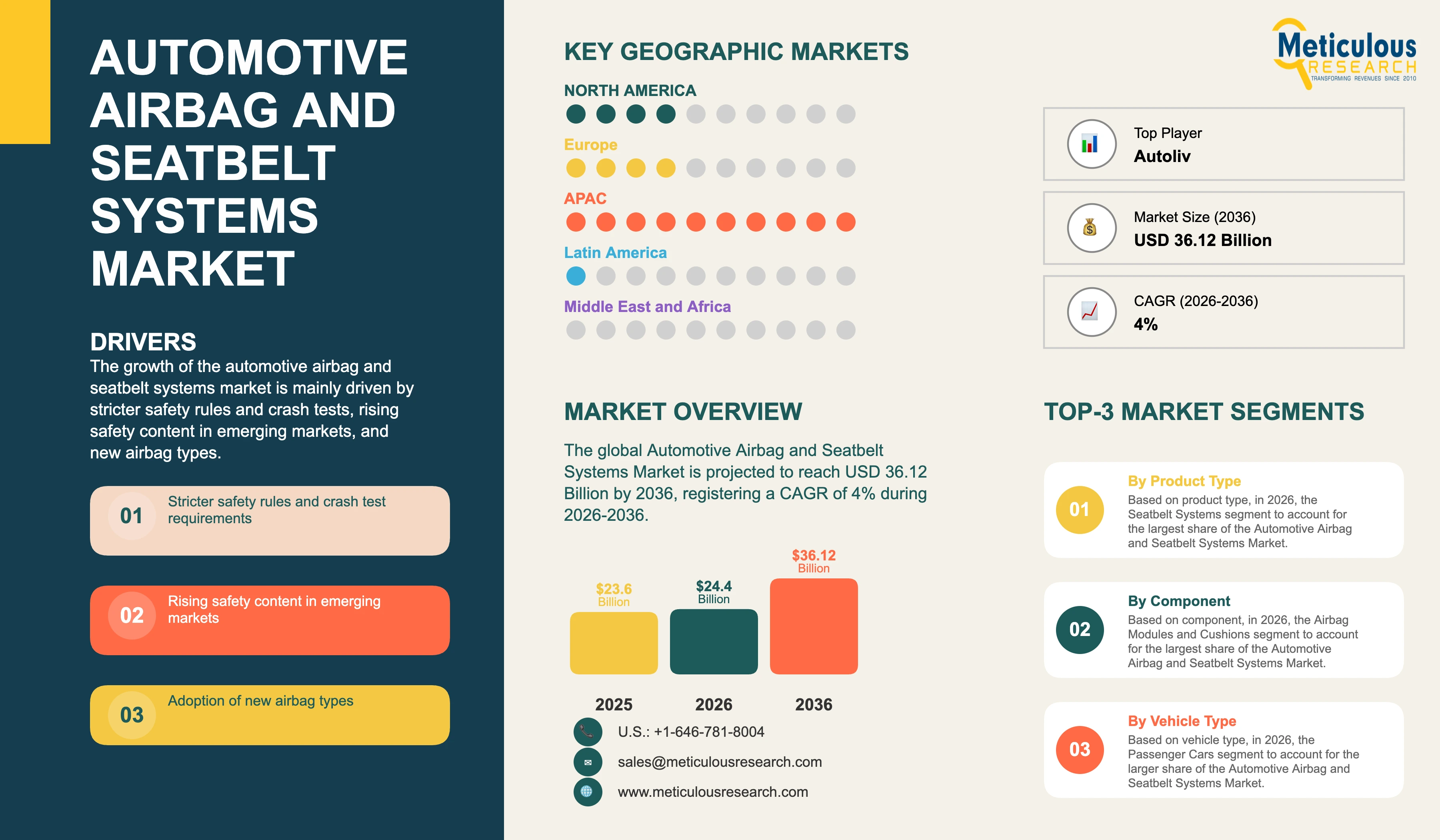
The global automotive airbag and seatbelt systems market was valued at USD 23.60 billion in 2025. This market is expected to reach USD 36.12 billion by 2036 from an estimated USD 24.40 billion in 2026, registering a CAGR of 4.0% during the forecast period (2026-2036).
- Published
- Nov 2026
- Pages
- 259
- Format
- PDF + Excel
- Report ID
- MRAUTO - 1042868
- Base year
- 2025
- 2025 · BASELINE
- $23.60B
- 2036
- $36.12B
- CAGR 2026–2036
- 4.0%
2025 baseline · 2026–2036 forecast at 4.0% CAGR · hover a bar for the value
Key highlights
Autoliv, the world's largest supplier of airbags and seatbelts, reported record net sales of USD 10.8 billion in 2025, up 4%, and a global market share of about 44%, including about 60% in India, according to Autoliv. The company's growth was driven by strong sales growth in India and with Chinese vehicle makers, and it expects around 0% organic sales growth in 2026 as global vehicle production softens.
Global light vehicle production increased by 4% in 2025 and exceeded 90 million vehicles for the first time since 2018, according to Autoliv, and Asia now produces more than half of the world's light vehicles. Autoliv's sales to Chinese vehicle makers rose by nearly 40% in the fourth quarter of 2025, according to Zacks.
ZF completed the carve-out of its passive safety business as ZF LIFETEC, which now operates as an independent brand, according to ZF. ZF's passive safety division had sales of about €4.7 billion in 2023, and ZF LIFETEC opened a new technology center in Washington, Michigan, in October 2025 to help vehicle makers meet regulatory requirements and develop safety systems for automated driving.
ZF LIFETEC is developing adaptive restraint systems that use camera and sensor data to classify occupants by size, weight, and seating posture and adjust airbag and seatbelt deployment for each person, according to ZF. In June 2026, it presented airbag concepts for comfort seating positions with more seatback recline, including seat ramp, active heel, and dual contour knee airbags.
Crash test programs, such as Euro NCAP, IIHS, C-NCAP, and Bharat NCAP, continue to add new tests, such as far-side impact and rear-seat occupant protection, which require additional airbags and advanced seatbelts with pretensioners and load limiters in the rear seats.
Leading suppliers include Autoliv, ZF LIFETEC, Joyson Safety Systems, Toyoda Gosei, Hyundai Mobis, Tokai Rika, Ashimori Industry, Daicel, Nippon Kayaku, and Nihon Plast. Many vehicle makers in India and Southeast Asia now advertise their crash test ratings, which encourages them to add more airbags and better seatbelts.
By product type, seatbelt systems account for the largest share of 36.0% in 2026, while knee, far-side, and other airbags register the highest CAGR.
By component, airbag modules and cushions account for the largest share in 2026, while electronic control units and sensors register the highest CAGR.
By seating position, front seats account for the larger share in 2026, while rear seats register the higher CAGR.
By vehicle type, passenger cars account for the larger share of 86.0% in 2026, while commercial vehicles register the higher CAGR.
By geography, Asia-Pacific accounts for the largest share of 50.0% in 2026, while Asia-Pacific registers the highest CAGR of 5.1%.
Report summary
| Particulars | Details |
|---|---|
| Base Year | 2025 |
| Estimated Year | 2026 |
| Forecast Period | 2026-2036 |
| Market Size in 2025 | USD 23.60 billion |
| Market Size in 2026 | USD 24.40 billion |
| Market Size by 2036 | USD 36.12 billion |
| CAGR (2026-2036) | 4.0% |
| Format | PDF, Excel & Cloud Portal · 259 pages |
| Largest Segment by Product Type (2026) | Seatbelt Systems (36.0%) |
| Largest Segment by Vehicle Type (2026) | Passenger Cars (86.0%) |
| Largest Region (2026) | Asia-Pacific (50.0%) |
| Fastest-Growing Region | Asia-Pacific (CAGR 5.1%) |
| Companies Profiled | 10 companies and other companies |
| Segments Covered | Product Type, Component, Seating Position, Vehicle Type, Geography |
| Countries Covered | U.S., Canada, Germany, France, Spain, Italy, U.K., Sweden, Czech Republic, Slovakia, Poland, Hungary, Romania, Belgium, Rest of Europe, China, Japan, India, South Korea, Thailand, Indonesia, Malaysia, Vietnam, Philippines, Taiwan, Australia, Rest of Asia-Pacific, Mexico, Brazil, Argentina, Colombia, Chile, Peru, Rest of Latin America, Turkey, Morocco, South Africa, Saudi Arabia, Egypt, Iran, Rest of Middle East & Africa |
Report overview
Segments covered: product type, component, seating position, vehicle type.
Automotive airbag and seatbelt systems are the passive safety systems that protect vehicle occupants in a crash. They include seatbelt assemblies with retractors, pretensioners, and load limiters, frontal airbags for the driver and front passenger, side and curtain airbags, knee airbags, far-side and center airbags, and the inflators, cushions, control units, and crash sensors that make them work.
The growth of this market is mainly driven by stricter vehicle safety rules and crash tests, the spread of multiple airbags and advanced seatbelts to vehicles in emerging markets, such as India and Southeast Asia, the addition of new airbag types, such as far-side, center, and knee airbags, to meet updated crash tests, the growing focus on rear-seat occupant protection, and steady growth of global vehicle production. In addition, adaptive restraint systems that use cabin cameras and sensors to adjust airbags and seatbelts to each occupant are increasing the value of systems per vehicle. However, strong price pressure from vehicle makers, rising costs for raw materials such as steel and yarn, and the risk of costly recalls are expected to restrain the growth of this market to some extent.
Airbags and seatbelts are the core passive safety systems in every vehicle. Seatbelts hold occupants in their seats during a crash, and modern seatbelts include retractors that lock during a crash, pretensioners that tighten the belt within milliseconds of impact, and load limiters that reduce the force on the chest. Airbags inflate within a few milliseconds of a crash to cushion occupants and prevent them from hitting hard parts of the vehicle. Airbags and seatbelts work together and are controlled by an airbag control unit that uses crash sensors to decide when and how to deploy each device.
This report covers the global automotive airbag and seatbelt systems market, including seatbelt systems, frontal airbags, side and curtain airbags, and knee, far-side, center, and other airbags, together with their main components, such as airbag modules and cushions, inflators, seatbelt retractors and pretensioners, and electronic control units and crash sensors. The market is valued at the selling price of systems and components sold to vehicle makers and tier-1 suppliers. The market is analyzed by product type, component, seating position, vehicle type, and geography. Steering wheels sold separately, active safety systems, such as automatic emergency braking, and replacement parts sold after crashes are not included.
The number of airbags and the complexity of seatbelts in vehicles have increased steadily over the past three decades. Early vehicles had only lap belts and, later, driver airbags, while many vehicles today have six to ten airbags, including frontal, side, curtain, and knee airbags, and seatbelts with pretensioners and load limiters in the front and rear seats. Some vehicles also have far-side or center airbags that protect occupants from hitting each other in side crashes, and some have seatbelt airbags or airbags in the seat. This increase in content has been driven mainly by safety rules and crash tests.
Safety rules and crash test programs are the main drivers of airbag and seatbelt content. Regulations in most countries require frontal airbags and three-point seatbelts, and many require side airbags or equivalent side impact protection. Crash test programs, such as Euro NCAP in Europe, IIHS and NHTSA in the U.S., C-NCAP in China, and Bharat NCAP in India, award star ratings that influence buyers, and they regularly add new tests that require more or better restraint systems. Vehicle makers design their vehicles to achieve top ratings, which often requires additional airbags and advanced seatbelts.
The market is highly concentrated, with a small number of large suppliers holding most of the market. Autoliv is the largest supplier, with a global market share of about 44% in 2025, according to Autoliv. ZF LIFETEC and Joyson Safety Systems are the other major global suppliers, while Toyoda Gosei, Hyundai Mobis, Tokai Rika, and Ashimori Industry are important suppliers in Japan and Korea. Daicel and Nippon Kayaku are major suppliers of inflators and pyrotechnic devices, and Nihon Plast supplies airbags and steering wheels. Chinese suppliers are also growing with Chinese vehicle makers.
The industry has been shaped by major recalls of defective inflators, especially the Takata airbag recall, which affected tens of millions of vehicles worldwide and led to Takata's bankruptcy and the creation of Joyson Safety Systems from its assets. These recalls have made vehicle makers and regulators very focused on inflator quality and reliability, and they have increased testing and quality requirements for all suppliers. Recalls remain a major risk for the industry.
In 2026, seatbelt systems account for the largest share of the market by product type, while knee, far-side, and other airbags are the fastest-growing product type. Airbag modules and cushions account for the largest share by component, while electronic control units and sensors are the fastest-growing component. Front seats account for the larger share by seating position, while rear seats are the faster-growing seating position. Passenger cars account for the larger share by vehicle type, while commercial vehicles are the faster-growing vehicle type. Asia-Pacific accounts for the largest share of the market and is also the fastest-growing region.
Market growth over the forecast period will depend on global vehicle production, the pace at which safety rules and crash tests in emerging markets catch up with those in developed markets, the adoption of new airbag types and adaptive restraint systems, and changes in vehicle interiors as automated driving develops. Price pressure and raw material costs will also affect market value. Overall, rising safety content per vehicle, especially in Asia-Pacific, is expected to support steady market growth.
Passenger cars are expected to account for the larger share of 86.0% of the market in 2026, while commercial vehicles are projected to register the higher CAGR, driven by stricter safety rules and fleet safety programs.
Asia-Pacific is expected to account for the largest share of 50.0% of the market in 2026, mainly due to Asia producing more than half of the world's light vehicles and rising safety content in the region.
Asia-Pacific is also projected to register the highest CAGR of 5.1% during the forecast period, driven by rising safety content in India and Southeast Asia and growth with Chinese vehicle makers.
The report profiles 10 companies, including Autoliv, ZF LIFETEC, Joyson Safety Systems, Toyoda Gosei, Hyundai Mobis, Tokai Rika, Ashimori Industry, Daicel, Nippon Kayaku, and Nihon Plast.
New crash tests for far-side impacts and rear-seat occupants require additional airbags, such as far-side and center airbags, and advanced rear seatbelts with pretensioners and load limiters, which increase content per vehicle.
Adaptive restraint systems use cabin cameras and sensors to identify each occupant's size, weight, and position and adjust airbag inflation and seatbelt tension accordingly, providing better protection for different occupants.
Report infographic
Market dynamics
17 factors across 5 forcesStricter safety rules and crash test requirements
Vehicle safety rules and crash test programs continue to become stricter, requiring more airbags and better seatbelts. Euro NCAP has added far-side impact tests and new rear-seat occupant tests, IIHS has updated its side impact and small overlap tests and added rear-seat seatbelt reminders and occupant protection measures, and C-NCAP and other programs have followed. Vehicle makers compete for top safety ratings, which influence buyers and are often used in advertising.
Each new test or rule can require additional airbags, such as far-side or center airbags, or improved seatbelts, such as rear-seat pretensioners and load limiters. These requirements increase the value of airbag and seatbelt systems per vehicle. Suppliers with strong engineering and testing capabilities, such as Autoliv and ZF LIFETEC, which opened a new technology center in Michigan in October 2025 to help vehicle makers meet regulatory requirements, are well placed to benefit from these changes.
Rising safety content in emerging markets
Vehicles in emerging markets, such as India, Southeast Asia, Latin America, and Africa, have historically had fewer airbags and simpler seatbelts than vehicles in developed markets. This is changing as governments introduce stricter safety rules and crash test programs, such as Bharat NCAP in India, ASEAN NCAP, and Latin NCAP, and as buyers become more safety-conscious. Vehicle makers are adding side and curtain airbags and advanced seatbelts to more models in these markets.
India is a particularly important market, with strong growth in vehicle production and rising safety content. Autoliv reported a market share of about 60% in India in 2025 and said India accounted for nearly half of its global organic growth, according to Zacks. As safety content in emerging markets catches up with developed markets, airbag and seatbelt demand in these markets is expected to grow much faster than vehicle production.
Adoption of new airbag types
Vehicle makers are adding new types of airbags to improve protection in different crash situations and to meet new crash tests. Knee airbags reduce leg injuries and help keep occupants in the right position, far-side and center airbags prevent occupants from hitting each other or the vehicle interior on the far side of a side crash, and pedestrian airbags protect people outside the vehicle. Some vehicles also use seatbelt airbags, seat-mounted airbags, and airbags in the roof.
These new airbag types increase the number and value of airbags per vehicle. Knee, far-side, and other airbags are the fastest-growing product type in this market, supported by new crash tests and the desire of vehicle makers to achieve top ratings. Suppliers are also developing new airbags for future vehicle interiors, such as ZF LIFETEC's seat ramp, active heel, and dual contour knee airbags for reclined seating positions.
Growing focus on rear-seat occupant protection
Rear-seat occupants have traditionally received less protection than front-seat occupants, with simpler seatbelts and fewer airbags. Crash tests have shown that rear-seat occupants, especially older adults and children, can be at higher risk of injury in some crashes. Crash test programs, such as IIHS and Euro NCAP, have added tests and requirements for rear-seat protection, and regulations in some markets now require rear seatbelt reminders.
Vehicle makers are responding by adding pretensioners and load limiters to rear seatbelts, rear side airbags, and new rear-seat airbags. These changes increase the value of restraint systems for rear seats, which have historically had low content. Rear seats are the faster-growing seating position in this market, and this trend is expected to continue as crash tests evolve.
Adaptive restraint systems and steady vehicle production growth
Suppliers are developing adaptive restraint systems that use cabin cameras, seat sensors, and other data to identify each occupant's size, weight, position, and seatbelt use, and that adjust airbag inflation and seatbelt tension accordingly. ZF LIFETEC presented camera-based occupant classification solutions at InCabin 2025 in Barcelona, according to ZF, and other suppliers are developing similar systems. These systems need more sensors, more complex control units, and airbags and seatbelts with adjustable performance, which increases system value. Electronic control units and sensors are the fastest-growing component in this market. At the same time, steady growth of global vehicle production supports demand, as every vehicle needs airbags and seatbelts. Global light vehicle production exceeded 90 million vehicles in 2025 for the first time since 2018, according to Autoliv, and production is expected to grow over the forecast period, led by Asia.
Table of contents
12 chapters · 182 sections · 259 pages · click to expandSegmental analysis
| Segment | Largest share (2026) | Fastest growth (2026–2036) |
|---|---|---|
| By Product Type | Airbag modules and cushions | Electronic control units and sensors |
By Product Type
- The airbag modules and cushions segment is expected to account for the largest share of the automotive airbag and seatbelt systems market, while the electronic control units and sensors segment is projected to register the highest CAGR during the forecast period.
- The front seats segment is expected to account for the larger share of the automotive airbag and seatbelt systems market, while the rear seats segment is projected to register the higher CAGR during the forecast period.
Geographic analysis
Asia-Pacific
Largest shareIn 2026, Asia-Pacific is expected to account for the largest share of 50.0% of the global automotive airbag and seatbelt systems market. The large share of this region is mainly due to Asia producing more than half of the world's light vehicles, according to Autoliv, China's position as the largest vehicle producer, the large vehicle production of Japan, India, and South Korea, rising safety content in vehicles produced in the region, and the presence of leading suppliers, such as Toyoda Gosei, Hyundai Mobis, Tokai Rika, Ashimori Industry, Daicel, Nippon Kayaku, and Nihon Plast, as well as the large Asian operations of Autoliv, ZF LIFETEC, and Joyson Safety Systems. Asia-Pacific is also projected to register the highest CAGR of 5.1% during the forecast period. The rapid growth of this region is mainly driven by the fast growth of vehicle production and safety content in India, where Autoliv has a market share of about 60%, according to Autoliv, the growth of vehicle production and safety content in Indonesia, Vietnam, Thailand, and Malaysia, supported by ASEAN NCAP, the continued growth of vehicle production in China, and the growth of Chinese vehicle makers, whose purchases from Autoliv rose by nearly 40% in the fourth quarter of 2025, according to Zacks. Bharat NCAP is also encouraging vehicle makers in India to add more airbags.
Europe
Europe accounts for a significant share of the market, supported by strict safety rules, Euro NCAP crash tests, which regularly add new requirements, such as far-side impact and rear-seat protection, the high safety content of premium vehicles, and the presence of Autoliv, ZF LIFETEC, and Joyson Safety Systems. However, slow growth of vehicle production in Western Europe and high energy and labor costs are expected to limit growth in the region. Suppliers are shifting production to lower-cost countries in Eastern Europe and North Africa, such as Romania, Hungary, and Morocco. Euro NCAP's updated protocols, which reward far-side protection, adaptive restraints, and rear-seat safety, are expected to keep raising restraint content in European vehicles. ZF LIFETEC, headquartered in Alfdorf, Germany, and Autoliv, headquartered in Stockholm, are both based in Europe.
North America
North America accounts for a significant share of the market, supported by strict safety rules from NHTSA, IIHS crash tests, the high safety content of large SUVs and pickup trucks, and the presence of Autoliv, ZF LIFETEC, which opened a new technology center in Washington, Michigan, in October 2025, according to ZF, and Joyson Safety Systems. Mexico is an important production location for airbags and seatbelts. In North America, IIHS rear-seat tests and NHTSA rules are expected to add rear-seat restraint content.
Latin America
Latin America and the Middle East & Africa account for smaller shares, with growth supported by rising safety content driven by Latin NCAP and new safety rules, and by vehicle production in Brazil, Mexico, Argentina, Turkey, and Morocco. Many lower-priced vehicles in Latin America still have only two airbags, which leaves significant room for content growth as rules tighten.
Competitive landscape
The global automotive airbag and seatbelt systems market is highly concentrated, with a small number of large global suppliers holding most of the market. These suppliers have strong engineering and testing capabilities, global production networks, and long relationships with vehicle makers. Regional suppliers in Japan, Korea, and China serve local vehicle makers, and specialist suppliers provide inflators and pyrotechnic devices.
Autoliv is the largest supplier, with 2025 net sales of USD 10.8 billion and a global market share of about 44%, according to Autoliv. ZF LIFETEC, carved out from ZF as an independent business, and Joyson Safety Systems, which was formed partly from the assets of Takata, are the other major global suppliers. Toyoda Gosei, Hyundai Mobis, Tokai Rika, and Ashimori Industry are important suppliers in Japan and Korea, Daicel and Nippon Kayaku are leading inflator suppliers, and Nihon Plast supplies airbags and steering wheels.
Companies in this market compete on safety performance, quality and reliability, cost, engineering and testing capabilities, global production close to vehicle plants, and the ability to develop new airbag types and adaptive restraint systems. Key strategies include developing far-side, knee, and rear-seat airbags, adaptive restraint systems with occupant monitoring, and restraint systems for automated driving, expanding in India and Southeast Asia, growing with Chinese vehicle makers, and reducing costs through automation.
Recent competitive activity in the airbag and seatbelt market has focused on growth in Asia and new technologies. Autoliv reported strong growth in India and with Chinese vehicle makers in 2025, according to Autoliv, ZF completed the carve-out of ZF LIFETEC and opened a new technology center in Michigan in October 2025, according to ZF, and suppliers presented new adaptive restraint systems and airbags for reclined seating positions.
We expect competition to remain intense over the forecast period, with suppliers competing for new business with Chinese vehicle makers and in emerging markets, and with vehicle makers pushing for lower prices. Suppliers with strong technology, quality systems, scale, and local production in Asia are expected to strengthen their positions. The independent status of ZF LIFETEC may also lead to changes in ownership and competition in the industry, which could reshape the top three suppliers.
Some of the key players operating in the automotive airbag and seatbelt systems market are Autoliv, Inc., ZF LIFETEC, Joyson Safety Systems, Toyoda Gosei Co., Ltd., Hyundai Mobis Co., Ltd., Tokai Rika Co., Ltd., Ashimori Industry Co., Ltd., Daicel Corporation, Nippon Kayaku Co., Ltd., and Nihon Plast Co., Ltd., among others.
- —
Autoliv reported record 2025 sales of USD 10.8 billion and a 44% market share, ZF completed the carve-out of ZF LIFETEC and opened a new technology center in Michigan, and suppliers introduced adaptive restraints and airbags for reclined seats.
- Hyundai Mobis
- Tokai Rika
- Ashimori Industry
Expert perspectives
Airbags and seatbelts are essential safety systems in every vehicle, and the market is driven by vehicle production and safety content per vehicle. Safety content continues to rise as crash tests and safety rules become stricter, as emerging markets catch up with developed markets, and as new airbag types and adaptive restraint systems are introduced. The market is highly concentrated, led by Autoliv, ZF LIFETEC, and Joyson Safety Systems.
Over the forecast period, the market is expected to grow at a CAGR of 4.0%, from USD 24.40 billion in 2026 to USD 36.12 billion in 2036. Growth will be driven by stricter safety rules and crash tests, rising safety content in emerging markets, new airbag types, the focus on rear-seat protection, and adaptive restraint systems.
Among the market segments, seatbelt systems are the largest product type, while knee, far-side, and other airbags grow fastest. Airbag modules and cushions are the largest component, while electronic control units and sensors grow fastest. Front seats are the larger seating position, while rear seats grow faster. Passenger cars are the larger vehicle type, while commercial vehicles grow faster. Asia-Pacific is both the largest and the fastest-growing region, at a CAGR of 5.1%.
In our view, rising safety content in India and Southeast Asia will be the most important source of growth over the forecast period. These markets have large and growing vehicle production and safety content that is still well below that of developed markets, and new safety rules and crash tests are closing this gap. Suppliers with strong local positions, such as Autoliv in India, are well placed to benefit.
We also see adaptive restraint systems and restraint systems for automated driving as important long-term opportunities that will increase system value and require new capabilities in electronics and software. Price pressure, raw material costs, tariffs, and recall risk will remain challenges, which favors large suppliers with scale, strong quality systems, and the ability to recover costs from vehicle makers. We expect the top three suppliers to keep a high combined share, while Chinese suppliers grow with Chinese vehicle makers at home and abroad. Over time, software and sensing may become a larger part of restraint system value for suppliers.
Overall, we believe the automotive airbag and seatbelt systems market will grow steadily over the forecast period, with knee, far-side, and other airbags, electronic control units and sensors, rear seats, commercial vehicles, and Asia-Pacific providing the fastest growth. Companies with strong safety technology, quality systems, scale, and local production in growth markets will be best positioned to capture this growth.
Customer perspectives
Customers in the automotive airbag and seatbelt systems market are vehicle makers and, to a smaller extent, seat and steering wheel suppliers. They focus on safety performance in crash tests, quality and reliability, cost, engineering and testing support for new vehicle programs, the ability to supply systems in several regions, and the ability to develop new restraint technologies. After the Takata recall, vehicle makers also place strong weight on inflator quality and supplier quality systems. Vehicle makers in emerging markets increasingly ask suppliers for help in achieving top crash test ratings at low cost, while vehicle makers developing automated vehicles ask for new restraint concepts for flexible interiors. Many also want suppliers that can integrate restraints with cabin cameras and other in-cabin systems.
This comment explains why Asia-Pacific is the fastest-growing region and why seatbelt systems account for 36.0% of the market.
This comment explains why knee, far-side, and other airbags are the fastest-growing product type, why rear seats are the faster-growing seating position, and why electronic control units and sensors are the fastest-growing component.
This comment explains why commercial vehicles are the faster-growing vehicle type and why passenger cars still account for 86.0% of the market.
“Buyers in India now look closely at crash test safety ratings before they buy a car. We are moving most of our models to six airbags and better seatbelts to win five stars.”
“New crash tests mean we need far-side airbags and better rear-seat belts. We are also adding cabin cameras so the system can adapt to each occupant.”
“Our fleet customers want driver airbags and curtain airbags in our trucks now. Driver safety has become a key part of their buying decision.”
Frequently asked questions
The global automotive airbag and seatbelt systems market was valued at USD 23.60 billion in 2025, up from USD 22.80 billion in 2024, and is estimated at USD 24.40 billion in 2026. The market includes seatbelt systems, frontal, side, curtain, knee, and other airbags, and their main components.
The global automotive airbag and seatbelt systems market is expected to reach USD 36.12 billion by 2036, driven by stricter safety rules and crash tests, rising safety content in emerging markets, new airbag types, and adaptive restraint systems.
The market is expected to register a CAGR of 4.0% from 2026 to 2036, with the fastest growth in knee, far-side, and other airbags, electronic control units and sensors, rear seats, commercial vehicles, and Asia-Pacific.
Market growth is mainly driven by stricter safety rules and crash test requirements, rising safety content in emerging markets, the adoption of new airbag types, the growing focus on rear-seat occupant protection, and adaptive restraint systems with steady vehicle production growth.
Strong price pressure from vehicle makers and rising raw material costs and tariffs restrain growth, while inflator quality and recall risk and the complexity of integrating restraints with vehicle electronics are key challenges.
Key growth opportunities include rising safety content in India and Southeast Asia, restraint systems for automated driving and new interiors, adaptive and sensor-based restraint systems, and commercial vehicle and two-wheeler safety systems.
Seatbelt systems are expected to account for the largest share of 36.0% of the market in 2026, while knee, far-side, and other airbags are projected to register the highest CAGR, driven by new crash tests.
In 2026, the airbag modules and cushions segment is expected to account for the largest share of the automotive airbag and seatbelt systems market, while the electronic control units and sensors segment is projected to register the highest CAGR during the forecast period.
In 2026, the front seats segment is expected to account for the larger share of the automotive airbag and seatbelt systems market, while the rear seats segment is projected to register the higher CAGR during the forecast period.
Passenger cars are expected to account for the larger share of 86.0% of the market in 2026, while commercial vehicles are projected to register the higher CAGR, driven by stricter safety rules and fleet safety programs.
Asia-Pacific is expected to account for the largest share of 50.0% of the market in 2026, mainly due to Asia producing more than half of the world's light vehicles and rising safety content in the region.
Asia-Pacific is also projected to register the highest CAGR of 5.1% during the forecast period, driven by rising safety content in India and Southeast Asia and growth with Chinese vehicle makers.
The report profiles 10 companies, including Autoliv, ZF LIFETEC, Joyson Safety Systems, Toyoda Gosei, Hyundai Mobis, Tokai Rika, Ashimori Industry, Daicel, Nippon Kayaku, and Nihon Plast.
Autoliv reported record 2025 sales of USD 10.8 billion and a 44% market share, ZF completed the carve-out of ZF LIFETEC and opened a new technology center in Michigan, and suppliers introduced adaptive restraints and airbags for reclined seats.
New crash tests for far-side impacts and rear-seat occupants require additional airbags, such as far-side and center airbags, and advanced rear seatbelts with pretensioners and load limiters, which increase content per vehicle.
Adaptive restraint systems use cabin cameras and sensors to identify each occupant's size, weight, and position and adjust airbag inflation and seatbelt tension accordingly, providing better protection for different occupants.
Cite this report
Meticulous Research. (2026). Automotive Airbag and Seatbelt Systems Market - Global Opportunity Analysis and Industry Forecast (2026-2036) (Report No. MRAUTO - 1042868). Meticulous Market Research Pvt. Ltd. https://www.meticulousresearch.com/product/automotive-airbag-and-seatbelt-systems-market-7551