Attention Deficit Hyperactivity Disorder (ADHD) Market (2024-2031)
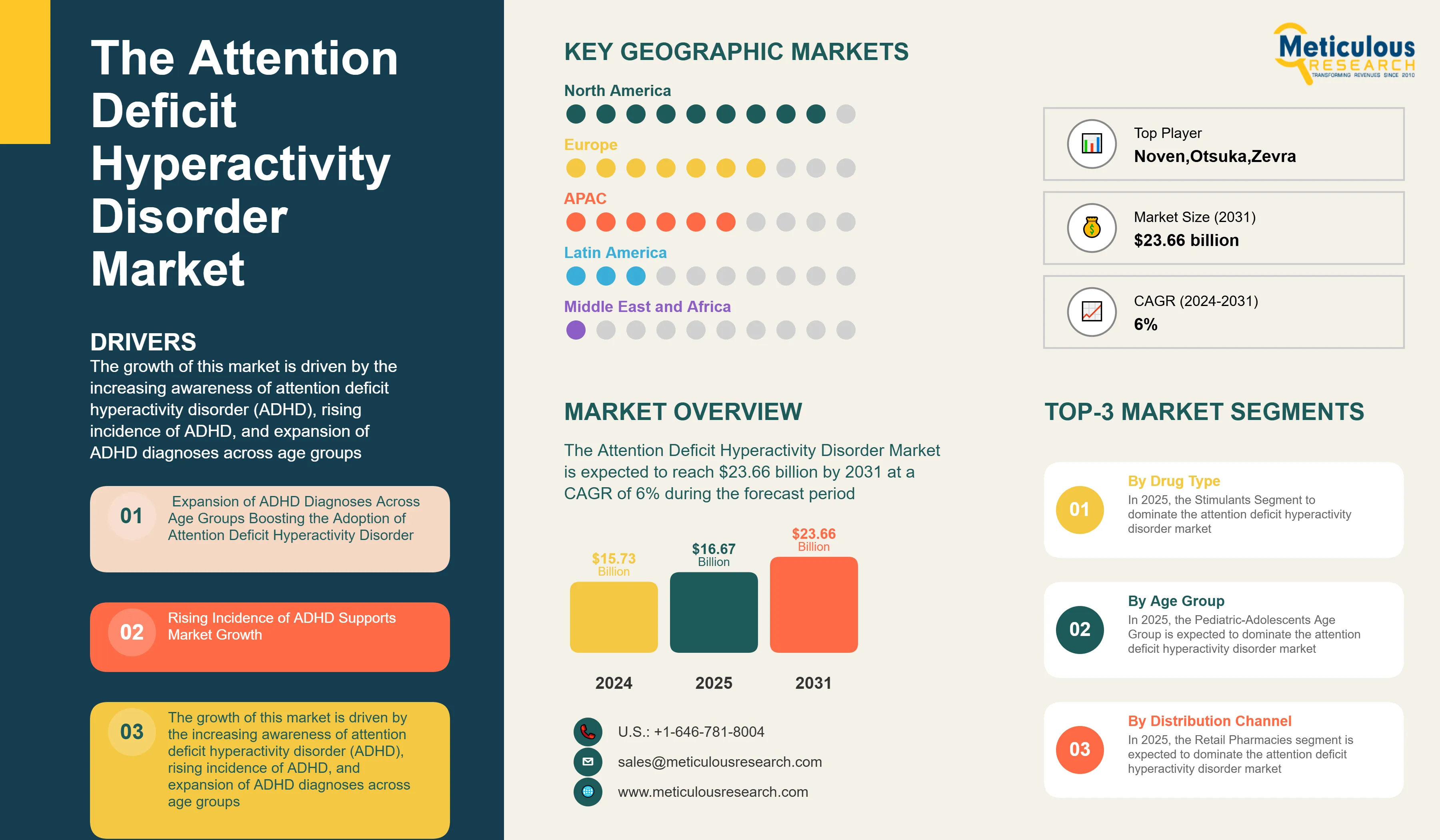
The Attention Deficit Hyperactivity Disorder Market is expected to reach $23.66 billion by 2031 from $15.73 billion in 2024, at a CAGR of 6% during the forecast period from 2024 to 2031. Attention Deficit Hyperactivity Disorder Market Size & Forecast The growth of this market is driven by the increasing
- Published
- Feb 2025
- Pages
- 130
- Format
- PDF + Excel
- Report ID
- MR-1449
- Base year
- 2023
- 2024 · ESTIMATED
- $15.73B
- 2031
- $23.66B
- CAGR 2024–2031
- 6%
2023 baseline · 2024–2031 forecast at 6% CAGR · hover a bar for the value
Key highlights
By Drug Type: In 2025, the Stimulants Segment to dominate the attention deficit hyperactivity disorder market
By Age Group: In 2025, the Pediatric-Adolescents Age Group is expected to dominate the attention deficit hyperactivity disorder market
By Distribution Channel: In 2025, the Retail Pharmacies segment is expected to dominate the attention deficit hyperactivity disorder market
By Geography: North America to Dominate the attention deficit hyperactivity disorder market in 2024
Report summary
| Particulars | Details |
|---|---|
| Number of Pages | 145 |
| Format | |
| Forecast Period | 2024–2031 |
| Base Year | 2023 |
| CAGR | 6% |
| Market Size | USD 23.66 Billion by 2031 |
| Segments Covered | By Drug Type · Stimulants · Amphetamine · Lisdexamfetamine · Methylphenidate · Dexmethylphenidate · Non-Stimulants · Atomoxetine · Clonidine · Guanfacine · Other non-stimulants · By Age Group · Pediatric-Adolescents · Adults · By Distribution Channel · Retail Pharmacies · Hospital Pharmacies · Online Pharmacies |
| Countries Covered | North America (U.S., Canada), Europe (Germany, U.K., Spain, Italy, France and Rest of Europe), Asia-Pacific (China, India, Japan, Australia, South Korea and Rest of Asia-Pacific), Latin America (Brazil, Mexico, Argentina, and Rest of Latin America), and the Middle East & Africa (Saudi Arabia, UAE, and Rest of Middle East & Africa) |
| Key Companies | Eli Lilly and Company (U.S.), Lupin Limited (India), Mallinckrodt plc (Ireland), Tris Pharma, Inc (U.S.), Takeda Pharmaceutical Company Limited (Japan), Zevra Therapeutics, Inc. (U.S.), Novartis AG (Switzerland), Aytu Biopharma, Inc. (U.S.), Otsuka Pharmaceutical Co., Ltd. (Japan), Johnson & Johnson (U.S.), Alora Pharmaceuticals, LLC (U.S.), Supernus Pharmaceuticals, Inc. (U.S.), and Noven Pharmaceuticals, Inc (U.S.). |
Report overview
Segments covered: drug type, age group, distribution channel. Regions: North America, Europe, Asia-Pacific, Latin America, Middle East & Africa.
The growth of this market is driven by the increasing awareness of attention deficit hyperactivity disorder (ADHD), rising incidence of ADHD, and expansion of ADHD diagnoses across age groups. In addition, advancements in treatment options and growth of non-pharmacological treatments are expected to create growth opportunities for the players operating in the ADHD market. Moreover, the growing focus on personalized treatment and growth of digital therapeutics are prominent trends in the market.
Report infographic
Market dynamics
3 factors across 2 forcesIncreasing Awareness of Attention Deficit Hyperactivity Disorder (ADHD)
In recent years, there has been growing awareness about mental health and ADHD among parents, educators, and healthcare professionals. If left untreated, ADHD can significantly impact a person’s life. During the COVID-19 pandemic, mental health such as stress, anxiety, and depression surged, leading to more comprehensive diagnostic evaluations. These evaluations revealed a notable increase in ADHD cases.
According to the Centers for Disease Control and Prevention (CDC), in 2022, approximately 7 million children aged 3-17 in the U.S. have ever been diagnosed with ADHD compared to 2016. ADHD diagnosis in children varies from 6% to 16%. This surge reflects both a broader recognition of the disorder and improved access to healthcare and diagnostic tools.
Moreover, public health campaigns and educational initiatives aimed at destigmatizing ADHD are encouraging individuals to pursue diagnosis and treatment. This shift in perception has led to a reduction in the stigma associated with ADHD, encouraging more people to pursue diagnosis and treatment. As awareness grows, there is increasing recognition that ADHD extends into adulthood, leading to a surge in demand for adult ADHD treatments, including medications and counseling. Thus, an increase in ADHD awareness is expected to drive the growth of this market across the globe.
Rising Incidence of ADHD
ADHD, a neurodevelopmental disorder characterized by symptoms such as inattention, hyperactivity, and impulsivity, is becoming more commonly diagnosed, particularly in children. As awareness of the disorder expands, more parents, educators, and healthcare providers are recognizing its signs, contributing to a rise in diagnosis rates.
The demand for ADHD medications, including stimulants such as methylphenidate and amphetamines, has surged as these treatments are often the first line of intervention. Additionally, non-stimulant medications and behavioral therapy options are also in higher demand, reflecting a broader approach to managing the condition.
According to the Centers for Disease Control and Prevention (CDC), in 2023, approximately 15.5 million U.S. adults had an ADHD diagnosis, with around half of them receiving their diagnosis in adulthood. In addition, among adults with ADHD, around one-third use stimulant medications, while approximately 70% report difficulties in filling their prescriptions due to ongoing medication shortages.
The prevalence of ADHD in children is also significant. Between 2020 and 2022, the CDC reported that 11.3% of children aged 5–17 years had been diagnosed with ADHD. The condition is more prevalent among boys (14.5%) compared to girls (8.0%). The increasing recognition of ADHD's impact on quality of life underscores the necessity for effective interventions and support systems. Therefore, the rising incidence of ADHD boosts the demand for ADHD drugs.
Table of contents
11 chapters · 111 sections · 130 pages · click to expandSegmental analysis
| Segment | Largest share (2024) | Fastest growth (2024–2031) |
|---|---|---|
| By Drug Type | Stimulants | — |
By Drug Type
- The stimulants segment is expected to account for a larger share of the attention deficit hyperactivity disorder market primarily due to the rapid onset of stimulants, ability to target symptoms by increasing dopamine levels and clinically suggested by healthcare professionals.
- Additionally, many studies have shown that stimulants can reduce ADHD in approximately 70-80% of users, making them highly effective as a first-line treatment option for both children and adults.
- Moreover, non-stimulants have slower onset and face challenges in gaining the same level of efficiency as stimulants.
- This attributes to consumers and healthcare professionals to shift towards stimulants.
- Furthermore, rising awareness regarding mental health diseases, recent innovations in ADHD stimulants, and strong efficiency of drugs are expected to support the growth of this market.
Geographic analysis
North America
Largest shareIn 2024, North America accounted for the largest share of the global attention deficit hyperactivity disorder market, followed by Europe and Asia-Pacific. North America's large market share is attributed to several key factors, including the large population with mental health issues, increasing prescription rates, rising product innovations, growing incidence of ADHD in the U.S., and growing demand for stimulants. Moreover, this region is slated to register the highest CAGR during the forecast period of 2024–2031 due to the approval and commercialization of new drugs, growing spending on ADHD treatment, rising diagnosis among adults, growing focus on personalized treatments, and technological integration like digital therapeutics. North America Dominates the Attention Deficit Hyperactivity Disorder Market in 2024
Competitive landscape
- May 2024
Tris Pharma, Inc. (U.S.) Onyda XR, a liquid, nonstimulant ADHD, was approved by the FDA for treatment of ADHD.
- August 2023
FDA approved several first generics of Vyvanse (lisdexamfetamine dimesylate) capsules and chewable tablets for attention-deficit/hyperactivity disorder (ADHD) in patients six years and older.
- Eli Lilly and Company (U.S.)
- Lupin Limited · India
- Mallinckrodt plc · Ireland
- Tris Pharma, Inc (U.S.)
- Takeda Pharmaceutical Company Limited · Japan
- Zevra Therapeutics, Inc. (U.S.)
- Novartis AG · Switzerland
- Aytu Biopharma, Inc. (U.S.)
- Otsuka Pharmaceutical Co., Ltd. · Japan
- Johnson & Johnson (U.S.)
- Alora Pharmaceuticals, LLC (U.S.)
- Supernus Pharmaceuticals, Inc. (U.S.)
- Noven Pharmaceuticals, Inc. (U.S.)
Frequently asked questions
The global attention deficit hyperactivity disorder market size was valued at $15.73 billion in 2024.
Cite this report
Meticulous Research. (2025). Attention Deficit Hyperactivity Disorder (ADHD) Market - Global Opportunity Analysis and Industry Forecast (2024-2031) (Report No. MR-1449). Meticulous Market Research Pvt. Ltd. https://www.meticulousresearch.com/product/attention-deficit-hyperactivity-disorder-market-6132