Antireflective Coatings for Glass Market (2026-2036)
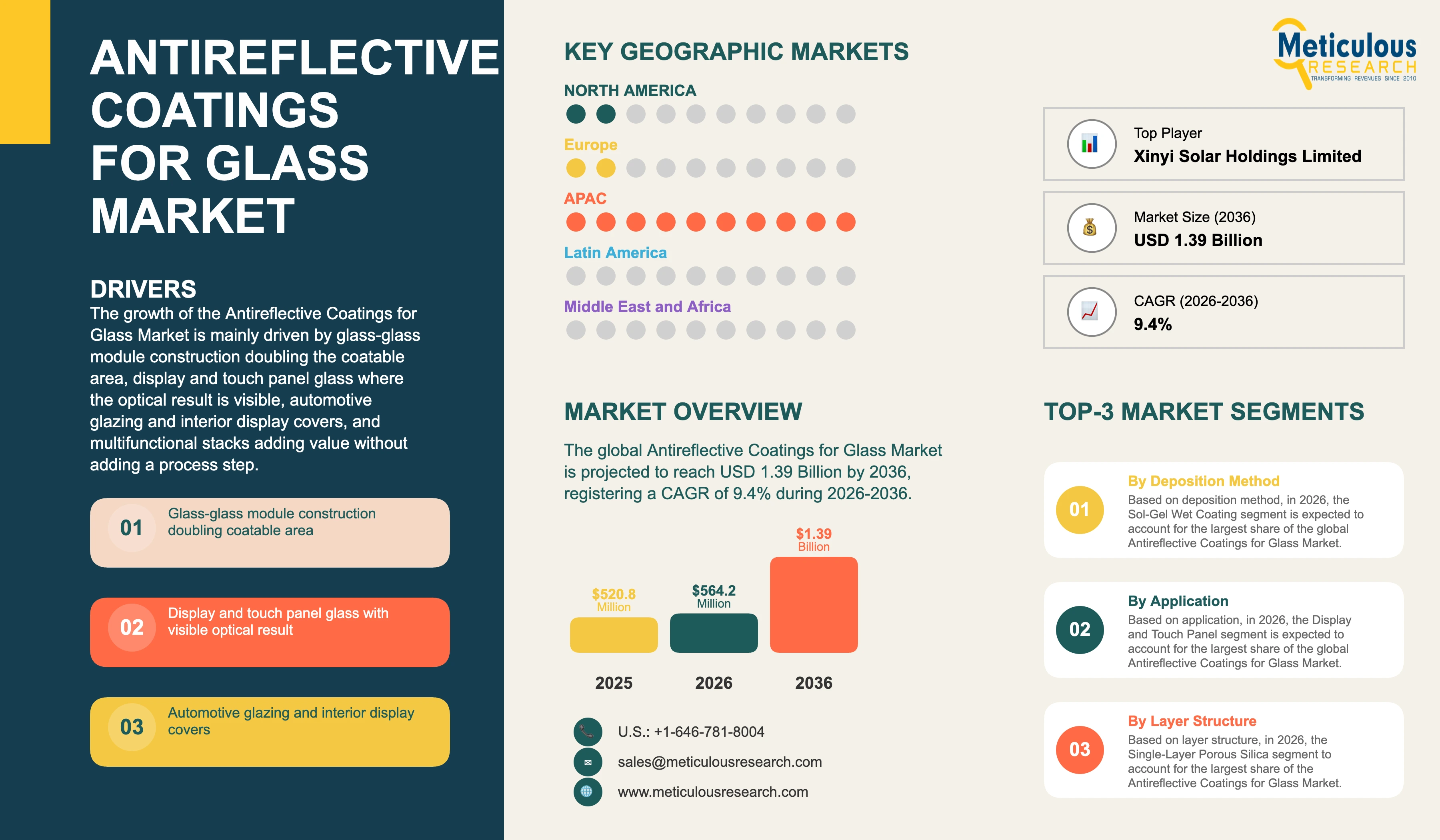
The antireflective coatings for glass market is valued at USD 564.2 million in 2026 and is projected to reach USD 1.39 billion by 2036, at a CAGR of 9.4% during the forecast period. The market was valued at USD 520.8 million in 2025 and at USD 488.4 million in 2024.
- Published
- Nov 2026
- Pages
- 262
- Format
- PDF + Excel
- Report ID
- MRCHM - 1042795
- Base year
- 2025
- 2024 · HISTORICAL
- $488.4M
- 2036
- $1.39B
- CAGR 2026–2036
- 9.4%
2024–2025 baseline · 2026–2036 forecast at 9.4% CAGR · hover a bar for the value
Key highlights
This market measures antireflective coatings applied to glass substrates, taken at the coating supplier gate and expressed per square metre of glass coated, across wet and vacuum deposition routes.
The glass substrate is excluded, as are antireflective coatings on plastic and ophthalmic lenses, anti-glare etching without an antireflective layer, deposition equipment, and screen printing pastes and encapsulants used elsewhere in a module.
The International Technology Roadmap for Photovoltaics, fifteenth edition, published by VDMA in May 2024, states that antireflective coating has become standard for improving front cover glass transmission.
That roadmap further states that antireflective coated glass will remain the dominant front cover material for crystalline silicon photovoltaic modules in the future.
It records that all antireflective coatings on the market today meet an average lifetime of at least 15 years, and expects average service life to reach a stable 25 years already by 2031.
The same roadmap records rolled or structured glass as mainly used today, with float glass at about 4% in 2023 and expected to reach about 10% within ten years.
The 2026 edition of that roadmap reports 706 GW of modules shipped in 2025 and a learning rate of 26% for the period from 1976 to 2025, against 24.9% in the fifteenth edition.
It reports module prices of about USD 0.09 per watt-peak at the end of 2025, about USD 0.01 above the level at the end of 2024.
That edition also expects glass thinner than 2 millimetres to grow from about 5% today to about 10% in 2036 while 2 to 3 millimetre glass reaches 86%, and expects glass front with foil back construction to fall below 16% share within ten years.
The Fraunhofer ISE Photovoltaics Report of 14 July 2026 records about 700 GWp of photovoltaic module production in 2025, with annual production having increased about twelvefold over the past decade and shipments stagnating from 2024 to 2025.
That report states that approximately 96% of solar modules and their components came from Asia in 2025.
It puts the global average selling price of modules at about USD 0.10 per watt-peak in 2025, with prices remaining near record lows, and the module price learning curve at about 26.6% per doubling of cumulative production.
The same report gives glass as 67.45% of total module mass at 11.6 kilograms a square metre, with the aluminium frame at 12.73%.
It puts the weighted average efficiency of commercial crystalline silicon wafer-based modules at 22.7% in the fourth quarter of 2024, against 21.6% a year earlier, with a range of 18.9% to 24.8% and a best laboratory module of 26.0%.
Silicon wafer-based technology accounted for about 98% of 2025 production, with monocrystalline silicon at 690 GWp of the 706 GWp total and thin film at 16 GWp.
Module efficiencies reported in the 2026 roadmap are 23.5% for n-type TOPCon and heterojunction, 24.1% for TOPCon-based back contact and 21.7% for p-type PERC.
Covestro acquired the solar coatings business of DSM, including its antireflective coating technology, as part of the resins and functional materials transaction announced in October 2020, with the separate photovoltaic backsheet business going to Worthen Industries.
Display and touch panel glass is expected to hold the largest value share of this market in 2026 at 36.0%, ahead of solar photovoltaic glass at 31.0%, because a multilayer vacuum-deposited stack carries an order of magnitude more value per square metre than a single-layer sol-gel silica film.
Report summary
| Particulars | Details |
|---|---|
| Base Year | 2025 |
| Actual Years | 2024-2025 |
| Forecast Period | 2026-2036 |
| Market Size (Value) in 2024 | USD 488.4 million |
| Market Size (Value) in 2025 | USD 520.8 million |
| Market Size (Value) in 2026 | USD 564.2 million |
| Market Size (Value) in 2036 | USD 1.39 billion |
| CAGR (Value) | 9.4% (2026-2036) |
| Format | PDF, Excel & Cloud Portal · 262 pages |
| Volume in 2025 | 3,100 million square metres |
| Volume in 2026 | 3,280 million square metres |
| Volume in 2036 | 5,950 million square metres |
| Volume CAGR (2026-2036) | 6.1% |
| Average Realised Value, 2026 | USD 0.172 per square metre |
| Average Realised Value, 2036 | USD 0.233 per square metre |
| Units | Value in USD million; volume in million square metres of glass coated; realised value in USD per square metre |
| Measurement Basis | Antireflective coatings applied to glass substrates, taken at the coating supplier gate and expressed per square metre of glass coated, across wet and vacuum deposition routes |
| Historical Value Growth | Value grew at 7.5% a year between 2024 and 2026 against coated area growth of 5.3% a year and realised value growth of 2.1% a year; the forecast of 9.4% is above that historical rate because display, automotive and architectural glass grow faster than photovoltaic glass across the forecast period |
| Price Mix Note | Average realised value rises 3.1% a year across the forecast period as a mix effect, because display, automotive and architectural glass grow faster than photovoltaic glass within a single blended figure; the own price of coating in each individual application continues to fall, and the figure must not be read as pricing power in any segment |
| Standardisation Note | The International Technology Roadmap for Photovoltaics, fifteenth edition, published by VDMA in May 2024, states that antireflective coating has become standard for improving front cover glass transmission and that antireflective coated glass will remain the dominant front cover material for crystalline silicon photovoltaic modules in the future, so the photovoltaic half of this market has no penetration curve remaining |
| Lifetime Basis | The same roadmap records that all antireflective coatings on the market today meet an average lifetime of at least 15 years, with average service life expected to reach a stable 25 years already by 2031 |
| Module Price Basis | The 2026 edition of that roadmap reports 706 GW of modules shipped in 2025, a learning rate of 26% for 1976 to 2025 against 24.9% previously, and module prices of about USD 0.09 per watt-peak at the end of 2025; the Fraunhofer ISE Photovoltaics Report of 14 July 2026 puts the global average selling price at about USD 0.10 per watt-peak in 2025, near record lows, with a learning curve of about 26.6% per doubling of cumulative production |
| Area Cross-Check | The Fraunhofer ISE report puts the weighted average efficiency of commercial crystalline silicon wafer-based modules at 22.7% in the fourth quarter of 2024, against 21.6% a year earlier, with a range of 18.9% to 24.8%; 706 GW at 22.7% implies about 3,110 million square metres of module area |
| Construction Mix Basis | The 2026 roadmap expects glass front with foil back construction to fall below 16% share within ten years, glass thinner than 2 millimetres to grow from about 5% today to about 10% in 2036 while 2 to 3 millimetre glass reaches 86%, and float glass to move from about 4% share in 2023 to about 10% within ten years against rolled or structured glass as the material mainly used today |
| Supply Concentration Note | The Fraunhofer ISE report states that approximately 96% of solar modules and their components came from Asia in 2025, and gives glass as 67.45% of total module mass at 11.6 kilograms a square metre |
| Overlap Note | The glass substrate itself is counted in the Low Iron Solar Glass Market and the Specialty Glass for Displays Market titles, while only the antireflective coating is counted here, so those titles are non-additive with this one on the coated glass they cover |
| Exclusions | The glass substrate; antireflective coatings on plastic substrates and ophthalmic or spectacle lenses; anti-glare etching or frosting applied without an antireflective layer; deposition equipment, sputtering targets sold as capital or spares and coating lines; encapsulants, backsheets, screen printing pastes and other module materials; low-emissivity, solar control and self-cleaning coatings sold without an antireflective function |
| Segments Covered: Deposition Method | Sol-Gel Wet Coating; Magnetron Sputtering; Vacuum Evaporation; Chemical Vapour Deposition; Other Deposition Methods |
| Segments Covered: Layer Structure | Single-Layer Porous Silica; Multilayer Interference Stack; Hybrid Antireflective with Added Function; Graded-Index and Moth-Eye |
| Segments Covered: Application | Display and Touch Panel; Solar Photovoltaic Glass; Automotive Glazing and Displays; Architectural Glass; Optics and Instrumentation; Other Applications |
| Segments Covered: Added Function | Antireflective Only; Antireflective plus Anti-Fingerprint; Antireflective plus Anti-Soiling; Antireflective plus Anti-Glare; Antireflective plus Hardcoat |
| Largest Segment by Deposition Method, 2026 | Sol-Gel Wet Coating, at 38.0% |
| Fastest-Growing Segment by Deposition Method | Magnetron Sputtering, at 11.6% |
| Slowest-Growing Segment by Deposition Method | Sol-Gel Wet Coating, at 7.2% |
| Largest Segment by Layer Structure, 2026 | Single-Layer Porous Silica, at 41.0% |
| Fastest-Growing Segment by Layer Structure | Hybrid Antireflective with Added Function, at 13.8% |
| Largest Segment by Application, 2026 | Display and Touch Panel, at 36.0% |
| Fastest-Growing Segment by Application | Automotive Glazing and Displays, at 15.0% |
| Slowest-Growing Segment by Application | Solar Photovoltaic Glass, at 6.6% |
| Largest Segment by Added Function, 2026 | Antireflective Only, at 52.0% |
| Fastest-Growing Segment by Added Function | Antireflective plus Hardcoat, at 13.6% |
| Largest Region, 2026 | Asia-Pacific, at 71.0% |
| Fastest-Growing Region | North America, at 10.6% |
| Fastest-Growing Country | U.S., at 11.0% |
| Slowest-Growing Country | Brazil, at 8.0% |
| Regions Covered | Asia-Pacific; Europe; North America; Latin America; Middle East & Africa |
| Countries Covered | China; Japan; South Korea; Taiwan; India; Germany; France; U.K.; U.S.; Canada; Mexico; Brazil |
| Key Companies | Xinyi Solar Holdings Limited; Flat Glass Group Co., Ltd.; Corning Incorporated; AGC Inc.; Nippon Sheet Glass Co., Ltd.; Saint-Gobain S.A.; Covestro AG; Borosil Renewables Limited; Dexerials Corporation; Nitto Denko Corporation |
| Top Five Share, 2026 | 47.3% |
| Profiled Companies Share, 2026 | 58.1% |
| Currency | USD |
Report overview
Market value is measured in in USD million; volume in million square metres of glass coated; realised value in USD per square metre. Segments covered: deposition method, layer structure, application, added function.
In volume terms, the market is estimated at 3,280 million square metres of glass coated in 2026, rising to 5,950 million square metres by 2036, at a CAGR of 6.1%. The average realised value is estimated at USD 0.172 per square metre in 2026 and USD 0.233 per square metre in 2036, the increase reflecting display and automotive glass taking value share from photovoltaic glass rather than any application repricing upward.
The growth of this market is mainly driven by the shift from glass-foil to glass-glass photovoltaic module construction that doubles the coatable area per module, display and touch panel cover glass where the optical result is visible to the user, automotive glazing and interior display covers under reflection and glare requirements, and multifunctional stacks that combine antireflection with hardcoat, anti-fingerprint or anti-soiling performance. However, factors such as antireflective coating already being standard on photovoltaic front glass, module prices near record lows under a learning rate of 26%, coating lifetimes that the whole market already meets, and 96% of module supply sitting with Asian manufacturers buying at Asian prices are expected to restrain the growth of this market to some extent.
Among applications, display and touch panel glass is expected to hold the largest share of this market in 2026, while automotive glazing and displays are expected to record the highest CAGR during the forecast period. Geographically, Asia-Pacific is expected to account for the largest share of this market in 2026, while North America is expected to register the highest CAGR during the forecast period.
An uncoated air-to-glass interface reflects about 4% of incident light, and a sheet of glass has two of them. An antireflective coating works by placing a layer, or a stack of layers, whose refractive index sits between air and glass and whose optical thickness causes the reflections from its two faces to interfere destructively. A single porous silica layer deposited by sol-gel can raise transmission by two to three percentage points, and a multilayer interference stack deposited under vacuum can take residual reflection below half a percent across the visible range.
Those two routes are different industries that happen to share a physical principle. Sol-gel wet coating is applied by dip, roll or slot-die to large glass sheets at line speed, the chemistry costs cents per square metre and the coater is usually the glass maker. Vacuum deposition runs sheets or rolls through a sputtering or evaporation chamber, the consumable is a target or source material rather than a liquid, and the value per square metre is an order of magnitude higher. This market measures both at the coating supplier gate per square metre of glass coated.
That split explains why the application ranking inverts between volume and value. Photovoltaic glass is by far the largest coated area, since 706 GW of modules shipped in 2025 at a weighted average module efficiency of 22.7% implies roughly 3.1 billion square metres of module area, and glass accounts for 67.45% of module mass at 11.6 kilograms a square metre. Display and touch panel glass is a fraction of that area and holds the larger value share at 36.0% against 31.0%.
The named demand driver is solar and display efficiency, and the solar half of it has already happened. The International Technology Roadmap for Photovoltaics states that antireflective coating has become standard for improving front cover glass transmission, and that antireflective coated glass will remain the dominant front cover material for crystalline silicon modules in the future. There is no adoption curve left to climb in photovoltaics; the coating is a default feature of the glass.
That matters because it removes the pricing power a new feature carries. The same roadmap puts the module learning rate at 26% over 1976 to 2025 and module prices at about USD 0.09 per watt-peak at the end of 2025, and the Fraunhofer ISE Photovoltaics Report of 14 July 2026 puts the global average selling price at about USD 0.10 per watt-peak with prices near record lows and a learning curve of about 26.6% per doubling of cumulative production.
A coating priced inside a bill of materials falling at that rate is under permanent deflationary pressure, and the buyer is not a Western module assembler. Approximately 96% of solar modules and their components came from Asia in 2025, so the coating is purchased by Asian glass makers at Asian prices, usually applied on their own lines, and specified by them rather than by the module brand.
Durability has stopped being a differentiator for the same reason. The roadmap records that all antireflective coatings on the market today meet an average lifetime of at least 15 years, and expects average service life to reach a stable 25 years already by 2031. A supplier cannot charge a premium for a property the entire market already delivers, which pushes competition back onto coating cost per square metre and line throughput.
Volume growth in photovoltaics nevertheless continues, and it comes from construction rather than from penetration. The 2026 roadmap expects glass front with foil back construction to fall below 16% share within ten years, which means the majority of modules will carry glass on both faces. A bifacial glass-glass module presents two glass surfaces to light, so the coatable area per module rises even as the glass itself thins.
Thickness moves the other way on mass but not on area. Glass thinner than 2 millimetres is expected to grow from about 5% today to about 10% in 2036 while 2 to 3 millimetre glass reaches 86%, so the glass tonnage per square metre falls while the square metres rise. A market measured per square metre of glass coated therefore grows where one measured per tonne of glass would not, which is why this title is sized on area.
Display and touch panel glass is the largest value application and it behaves on an entirely different logic. A phone, tablet, laptop or monitor cover glass is judged by a user who can see reflections, so the specification is a visible optical result rather than a two to three percentage point energy gain inside a twenty-five year module warranty. The coating is a multilayer interference stack deposited under vacuum, often combined with anti-fingerprint and hardcoat layers, and it is specified by the device brand.
Automotive glazing and interior display covers are the fastest-growing application at 15.0% a year. A vehicle interior now carries multiple large display surfaces behind cover glass positioned where sunlight strikes them, and reflection control is a legibility and distraction matter rather than a preference. Exterior glazing adds head-up display combiners and sensor windows, and the glass area per vehicle has risen with panoramic roofs and larger screens.
Architectural glass is a smaller and slower application at 8.6%, used where reflection would obscure what is behind the glass, in museum cases, retail frontage, control towers and observation glazing. The specification is aesthetic and the volumes are project-scale, so the segment supports premium pricing on small quantities rather than contributing growth.
Multifunctional stacks are where the value is migrating across every application. Antireflective only accounts for 52.0% of this market in 2026 and grows slowest at 7.0%, while antireflective plus hardcoat grows fastest at 13.6%, antireflective plus anti-fingerprint at 12.4% and antireflective plus anti-glare at 12.0%. Adding a second function to the same deposition pass raises the value per square metre without adding a process step.
Anti-soiling is the photovoltaic version of that argument and grows at 11.0%. A soiled front glass loses more transmission than an antireflective coating gains, so a hydrophilic or low-adhesion surface combined with the antireflective layer protects the gain rather than adding to it. The combination is sold on energy yield over a cleaning interval rather than on initial transmission.
Supply structure follows the deposition route. Photovoltaic antireflective coating sits with the solar glass makers, who coat in line and treat the chemistry as a consumable, while display and automotive coating sits with specialty glass makers, film converters and coating service houses. Covestro acquired the solar coatings business of DSM, including its antireflective coating technology, as part of the resins and functional materials transaction announced in October 2020.
Asia-Pacific holds 71.0% of this market in 2026 because both halves of it are concentrated there, with approximately 96% of solar module supply and the great majority of display glass and panel production in the region. North America grows fastest at 10.6% on domestic module assembly, automotive display content and architectural specification, from a base of 11.5%.
Report infographic
Market dynamics
17 factors across 5 forcesGlass-Glass Module Construction Doubling the Coatable Area
The 2026 International Technology Roadmap for Photovoltaics expects glass front with foil back construction to fall below 16% share within ten years, which leaves the majority of modules carrying glass on both faces.
A bifacial glass-glass module presents two glass surfaces to incident light, so the coatable area per module rises even where the module area itself does not, and the rear surface carries the same reflection loss at the air-to-glass interface as the front.
Glass thinner than 2 millimetres is expected to grow from about 5% today to about 10% in 2036 while 2 to 3 millimetre glass reaches 86%, so glass mass per square metre falls while coated area rises, which is why this market is measured per square metre rather than per tonne.
Float glass is expected to move from about 4% share in 2023 to about 10% within ten years against rolled or structured glass as the material mainly used today, and a float surface accepts a different coating specification from textured rolled glass, so the shift adds formulation and line qualification work to the same rising coated area rather than simply extending existing volume.
Display and Touch Panel Glass Where the Optical Result Is Visible
A phone, tablet, laptop or monitor cover glass is judged by a user who can see reflections, so the specification is a visible optical result rather than an energy gain inside a module warranty, and the device brand rather than the glass maker writes it.
The coating is a multilayer interference stack deposited under vacuum, which takes residual reflection below half a percent across the visible range and carries an order of magnitude more value per square metre than a single-layer sol-gel silica film.
Display and touch panel glass holds the largest value share of this market in 2026 at 36.0% and grows at 10.2%, above the market rate, while magnetron sputtering records the highest deposition CAGR at 11.6%.
Automotive Glazing and Interior Display Covers
A vehicle interior now carries multiple large display surfaces behind cover glass positioned where sunlight strikes them, so reflection control is a legibility and driver distraction matter rather than a preference.
Exterior glazing adds head-up display combiners and sensor windows, and the glass area per vehicle has risen with panoramic roofs and larger screens, so both the coated area and the number of coated surfaces per vehicle are increasing.
Automotive glazing and displays record the highest application CAGR in this market at 15.0% over the forecast period from a 13.0% share in 2026, the fastest growth of any application.
Multifunctional Stacks Adding Value Without Adding a Process Step
Combining antireflection with hardcoat, anti-fingerprint, anti-glare or anti-soiling performance raises the value per square metre within the same deposition pass, which is the clearest route to margin in a market where the optical function itself is commoditised.
Antireflective only accounts for 52.0% of this market in 2026 and grows slowest at 7.0%, while antireflective plus hardcoat grows at 13.6%, antireflective plus anti-fingerprint at 12.4% and antireflective plus anti-glare at 12.0%.
Hybrid antireflective layers with an added function record the highest layer structure CAGR at 13.8% from a 14.5% share in 2026, against 6.6% for single-layer porous silica.
Table of contents
12 chapters · 136 sections · 262 pages · click to expandSegmental analysis
| Segment | Largest share (2026) | Fastest growth (2026–2036) |
|---|---|---|
| By Deposition Method | Sol-gel wet coating | Magnetron sputtering |
| By Layer Structure | Single-layer porous silica | Hybrid antireflective with added function |
| By Application | Display and touch panel | Automotive glazing and displays |
| By Added Function | Antireflective only | Antireflective plus hardcoat |
By Deposition Method
- Antireflective Coatings for Glass Market Analysis by Deposition Method
- This market is segmented into sol-gel wet coating, magnetron sputtering, vacuum evaporation, chemical vapour deposition, and other deposition methods.
- Sol-gel wet coating is expected to account for the largest share of this market in 2026.
- The route applies a porous silica precursor by dip, roll or slot-die at line speed, and the chemistry costs cents per square metre against the square metres of photovoltaic front glass it covers, which is the reason it holds the position at all despite carrying the lowest value density in the market.
- Sol-gel wet coating is also the slowest-growing deposition method, at a CAGR below the market rate.
- The route is tied to the application whose coating is already standard and whose module prices sit near record lows under a learning rate of 26%, so its growth tracks photovoltaic coated area and the glass-glass construction shift rather than price or penetration.
- Magnetron sputtering is projected to register the highest CAGR among deposition methods during the forecast period.
- Sputtering deposits the multilayer interference stacks used in display, automotive and optical glass, where residual reflection below half a percent across the visible range is the specification and the value per square metre is an order of magnitude above a wet-coated silica film.
- Vacuum evaporation holds the third position and grows close to the market rate, retained in optics and instrumentation and in parts of the display supply chain where thin-film thickness control on smaller formats matters more than throughput on large sheets.
- Chemical vapour deposition grows above the market rate from a small base, used where the coating is applied on the float line itself and where conformality on textured or shaped glass is required rather than line-of-sight deposition.
By Layer Structure
- Antireflective Coatings for Glass Market Analysis by Layer Structure
- This market is segmented into single-layer porous silica, multilayer interference stack, hybrid antireflective with added function, and graded-index and moth-eye structures.
- Single-layer porous silica is expected to hold the largest share of this market in 2026 and is also the slowest-growing layer structure.
- The construction achieves its intermediate refractive index through porosity, which is what makes it cheap enough for photovoltaic glass and also what limits its abrasion resistance and handling margin as front glass thins toward the sub-2-millimetre share the roadmap expects to double by 2036.
- Multilayer interference stack holds the second position and grows above the market rate, carrying the display and automotive work where the reflection target is set across the visible range and where colour neutrality at varying angles has to be held as well as peak transmission.
- Hybrid antireflective with added function is projected to record the highest CAGR among layer structures during the forecast period.
- The construction raises value per square metre within a single deposition pass, which is the only mechanism in this market that lifts realised price rather than coated area.
- Graded-index and moth-eye structures grow well above the market rate from the smallest base, delivering broadband and wide-angle performance from surface geometry rather than from added layers, concentrated in optics, instrumentation and high-specification display work.
By Application
- Antireflective Coatings for Glass Market Analysis by Application
- This market is segmented into display and touch panel, solar photovoltaic glass, automotive glazing and displays, architectural glass, optics and instrumentation, and other applications.
- Display and touch panel is expected to account for the largest share of this market in 2026.
- The cover glass of a phone, tablet, laptop or monitor is judged by a user who can see reflections, so the specification is a visible optical result written by the device brand, deposited as a multilayer vacuum stack and usually combined with anti-fingerprint and hardcoat layers.
- Solar photovoltaic glass is by a wide margin the largest coated area and holds the second value position, and it is the slowest-growing application in this market.
- The roadmap position that antireflective coating has become standard and that antireflective coated glass will remain the dominant front cover material leaves no adoption curve, so growth comes from module area and from glass front with foil back construction falling below 16% share within ten years.
- Automotive glazing and displays are projected to register the highest CAGR among applications during the forecast period.
- Coated area per vehicle rises on more interior display surfaces, larger screens, head-up display combiners, sensor windows and panoramic glazing at once, and reflection control is specified as a legibility and driver distraction requirement.
- Architectural glass grows below the market rate at project scale, specified where reflection would obscure what sits behind the glass, in museum cases, retail frontage, control towers and observation glazing, and it supports premium pricing on small quantities rather than contributing growth.
- Optics and instrumentation grows at about the market rate on the smallest base among the named applications, covering lenses, windows, filters, laser optics and sensor covers where reflection loss accumulates across many surfaces in one optical train.
By Added Function
- Antireflective Coatings for Glass Market Analysis by Added Function
- This market is segmented into antireflective only, antireflective plus anti-fingerprint, antireflective plus anti-soiling, antireflective plus anti-glare, and antireflective plus hardcoat.
- Antireflective only is expected to hold the largest share of this market in 2026 and is also the slowest-growing function category.
- The position reflects photovoltaic front glass, where the single optical layer is the whole specification, and it falls as a proportion of the market across the forecast period as every combination grows faster.
- Antireflective plus anti-fingerprint holds the second position and grows well above the market rate, carried by touch-operated display and automotive interior surfaces where a fingerprint is as visible to the user as a reflection and the two are specified together.
- Antireflective plus hardcoat is projected to record the highest CAGR among added functions during the forecast period, resolving the mechanical weakness that porosity introduces and making the optical layer survivable on thinner glass and on surfaces that are cleaned frequently.
- Antireflective plus anti-soiling grows above the market rate and is the main route by which photovoltaic coating value can grow faster than photovoltaic coated area, since the claim is made on energy yield across a cleaning interval rather than on initial transmission.
- Antireflective plus anti-glare grows above the market rate on the smallest base, used where specular reflection has to be diffused as well as reduced, in instrument panels, signage and work surfaces viewed under mixed lighting.
Geographic analysis
Asia-Pacific
Largest shareAsia-Pacific is expected to account for the largest share of this market in 2026. Both halves of this market sit in the region: the Fraunhofer ISE Photovoltaics Report states that approximately 96% of solar modules and their components came from Asia in 2025, and the great majority of display glass and panel production is also located there, so the coating is bought, applied and specified within the region. China holds the largest country position by a wide margin, carrying both the photovoltaic glass industry that coats front glass in line and a large share of display panel capacity, and the two largest solar glass makers in this market are Chinese. Japan, South Korea and Taiwan together hold the specialty and display positions, where the coating is deposited under vacuum at far higher value per square metre, and India grows fastest in the region on domestic module and glass capacity.
Europe
Europe holds the second regional position and grows above the market rate. The region buys little photovoltaic glass coating relative to its installed base, since modules are imported, and its position rests on automotive glazing and interior display glass, architectural specification and optics, with Germany the largest country and France and the U.K. following.
North America
Fastest growthNorth America is projected to register the highest CAGR among regions during the forecast period, with the U.S. the fastest-growing country in this market. Domestic module assembly supports the photovoltaic position, while automotive display content and architectural specification carry the higher-value work, and Canada follows on a smaller base.
Latin America
Latin America grows below the market rate, with Mexico the larger of the two covered countries on automotive glazing and display assembly for the North American vehicle market, and Brazil the slowest-growing country in this market on architectural and module-assembly demand.
Middle East & Africa
The Middle East & Africa holds the smallest regional share and grows slowest among regions, where the relevant position is anti-soiling combined with antireflection on utility-scale photovoltaic plant in high-dust environments rather than any local coating or glass manufacturing base.
Competitive landscape
The competitive structure of this market follows the split between the two deposition routes rather than forming a single ranking. Photovoltaic antireflective coating sits with the solar glass makers, who coat in line, treat the chemistry as a consumable and capture the coating value inside the price of coated glass. Display, automotive and optical coating sits with specialty glass makers, film converters and coating houses selling a finished optical surface.
The top five participants in this market account for a combined share of 47.3% in 2026, and the companies profiled in this report account for 58.1%, which reflects a market where two Chinese solar glass makers hold large area positions while value is distributed across a wider set of specialty suppliers. Concentration measured on coated area would be materially higher than concentration measured on value, since the area leaders sit in the application with the lowest realised value per square metre.
Competitive activity in the photovoltaic half is concentrated on coating cost per square metre, line throughput and the ability to coat thinner glass as the sub-2-millimetre share rises, since the optical function is standard and the roadmap records that all antireflective coatings on the market today meet an average lifetime of at least 15 years. Covestro acquired the solar coatings business of DSM, including its antireflective coating technology, as part of the resins and functional materials transaction announced in October 2020.
Competitive activity in the specialty half is concentrated on function stacking, with suppliers combining antireflection with anti-fingerprint, hardcoat or anti-glare performance in one deposition pass to raise value per square metre, and on qualification into automotive interior and device programmes that run for several model or product generations. Incumbency in those programmes is durable, because a change of coating supplier reopens the whole surface specification on the customer part rather than on a test coupon, and the qualification cost falls on the challenger.
Some of the key players operating in the antireflective coatings for glass market are Xinyi Solar Holdings Limited, Flat Glass Group Co., Ltd., Corning Incorporated, AGC Inc., Nippon Sheet Glass Co., Ltd., Saint-Gobain S.A., Covestro AG, Borosil Renewables Limited, Dexerials Corporation, and Nitto Denko Corporation, among others.
- Xinyi Solar Holdings Limited
- Flat Glass Group Co., Ltd.
- Corning Incorporated
- AGC Inc.
- Nippon Sheet Glass Co., Ltd.
- Saint-Gobain S.A.
- Covestro AG
- Borosil Renewables Limited
- Dexerials Corporation
- Nitto Denko Corporation
Expert perspectives
The named demand driver for this title is solar and display efficiency, and the two halves of it behave in opposite ways. In display the efficiency argument is a visible optical result that the end user can see and the device brand will pay for. In solar it is a two to three percentage point transmission gain inside a module whose selling price sits near USD 0.09 to USD 0.10 per watt-peak and falls at a learning rate of 26%.
The solar half of the driver has therefore already been spent. The roadmap states that antireflective coating has become standard and that antireflective coated glass will remain the dominant front cover material for crystalline silicon modules in the future, which means the coating is a default property of the glass rather than an upgrade with a sales argument attached.
What remains in photovoltaics is area growth and construction change. Glass front with foil back construction is expected to fall below 16% share within ten years, which puts two coatable faces on most modules, while glass thinner than 2 millimetres doubles its share by 2036. Those move square metres, which is why this market is measured per square metre of glass coated rather than per tonne of glass.
Value accrues elsewhere. Display and touch panel glass is the largest value application at 36.0% against 31.0% for solar photovoltaic glass, despite covering a small fraction of the area, because a multilayer vacuum stack carries an order of magnitude more value per square metre than a wet-coated porous silica film. Automotive glazing and displays grow fastest at 15.0% on rising coated area per vehicle.
The blended price per square metre rising 3.1% a year across the forecast period is a mix effect and must be read as one. Each application continues to deflate under its own cost pressure; the average rises because the high-value applications grow faster than the low-value one. A reader who treats that figure as pricing power will misjudge every supplier negotiation in this market.
The commercially defensible position is function stacking. Antireflective only grows at 7.0% while hardcoat, anti-fingerprint, anti-glare and anti-soiling combinations grow at 11.0% to 13.6%, and hybrid structures record the highest layer structure CAGR at 13.8%. Adding a function to an existing pass is the only route in this market that raises realised value rather than coated area.
Frequently asked questions
The market is valued at USD 564.2 million in 2026 and is projected to reach USD 1.39 billion by 2036, at a CAGR of 9.4%. It was valued at USD 520.8 million in 2025 and USD 488.4 million in 2024.
It measures antireflective coatings applied to glass substrates, taken at the coating supplier gate and expressed per square metre of glass coated, across wet and vacuum deposition routes. Excluded are the glass substrate itself, coatings on plastic and ophthalmic lenses, anti-glare etching without an antireflective layer, deposition equipment and targets, and other module materials.
It holds in display and fails in solar. Antireflective coating is already standard on photovoltaic front glass, so there is no adoption left to win, while in display the optical result is visible to the end user and the device brand pays for it.
Because the two deposition routes differ by an order of magnitude in value per square metre. Photovoltaic front glass takes a single porous silica layer costing cents per square metre, while display and automotive glass takes a multilayer interference stack deposited under vacuum.
The 2026 roadmap gives a learning rate of 26% for module prices and module prices of about USD 0.09 per watt-peak at the end of 2025, with Fraunhofer ISE putting the average selling price at about USD 0.10 per watt-peak. A coating priced inside a bill of materials falling at that rate faces continuous cost pass-back pressure.
No. The roadmap records that all antireflective coatings on the market today meet an average lifetime of at least 15 years and expects a stable 25 years by 2031, so competition falls back onto coating cost per square metre and line throughput.
From module area and construction change. Glass front with foil back construction is expected to fall below 16% share within ten years, which puts two coatable glass faces on most modules, while glass mass per square metre falls as coated area rises.
Because the figure is a blend across applications. Display, automotive and architectural glass grow faster than photovoltaic glass, lifting the average by 3.1% a year, while the own price of coating in each application continues to fall.
Sol-gel wet coating holds the largest share in 2026 at 38.0% and is the slowest-growing method at 7.2%. Magnetron sputtering grows fastest at 11.6% from 33.5%, with chemical vapour deposition at 10.8% from a smaller base.
Hybrid antireflective layers with an added function grow fastest, at 13.8% from a 14.5% share in 2026, because a second function in the same deposition pass raises realised value per square metre. Single-layer porous silica holds 41.0% and grows slowest at 6.6%.
Because coated area per vehicle is rising on more interior display surfaces, larger screens, head-up display combiners, sensor windows and panoramic roofs. Reflection control is specified as a legibility and driver distraction requirement, and the segment grows at 15.0% from a 13.0% share.
Antireflective plus hardcoat grows fastest at 13.6%, while antireflective only holds the largest share at 52.0% and grows slowest at 7.0%. Anti-fingerprint grows at 12.4%, anti-glare at 12.0% and anti-soiling at 11.0%.
Soiling removes more transmission from a front glass than an antireflective coating adds, so an anti-soiling surface protects the optical gain across a cleaning interval. The claim is made on energy yield against cleaning labour and water cost, giving a payback argument that a transmission gain alone does not carry.
Asia-Pacific holds the largest share in 2026 at 71.0%, with China the largest country. North America grows fastest at 10.6% and the U.S. is the fastest-growing country at 11.0%.
Key players include Xinyi Solar Holdings Limited, Flat Glass Group Co., Ltd., Corning Incorporated, AGC Inc., Nippon Sheet Glass Co., Ltd., Saint-Gobain S.A., Covestro AG, Borosil Renewables Limited, Dexerials Corporation, and Nitto Denko Corporation, among others. The top five hold an estimated 47.3% in 2026 and the profiled companies 58.1%.
Antireflective coating is already standard on photovoltaic front glass, module prices sit near record lows under a learning rate of 26%, coating lifetime of at least 15 years is met by the whole market, and approximately 96% of module supply sits with Asian manufacturers who coat on their own lines and write the specification.
Cite this report
Meticulous Research. (2026). Antireflective Coatings for Glass Market - Global Opportunity Analysis and Industry Forecast (2026-2036) (Report No. MRCHM - 1042795). Meticulous Market Research Pvt. Ltd. https://www.meticulousresearch.com/product/antireflective-coatings-for-glass-market-7478