Anti-Money Laundering (AML) Software Market (2026-2036)
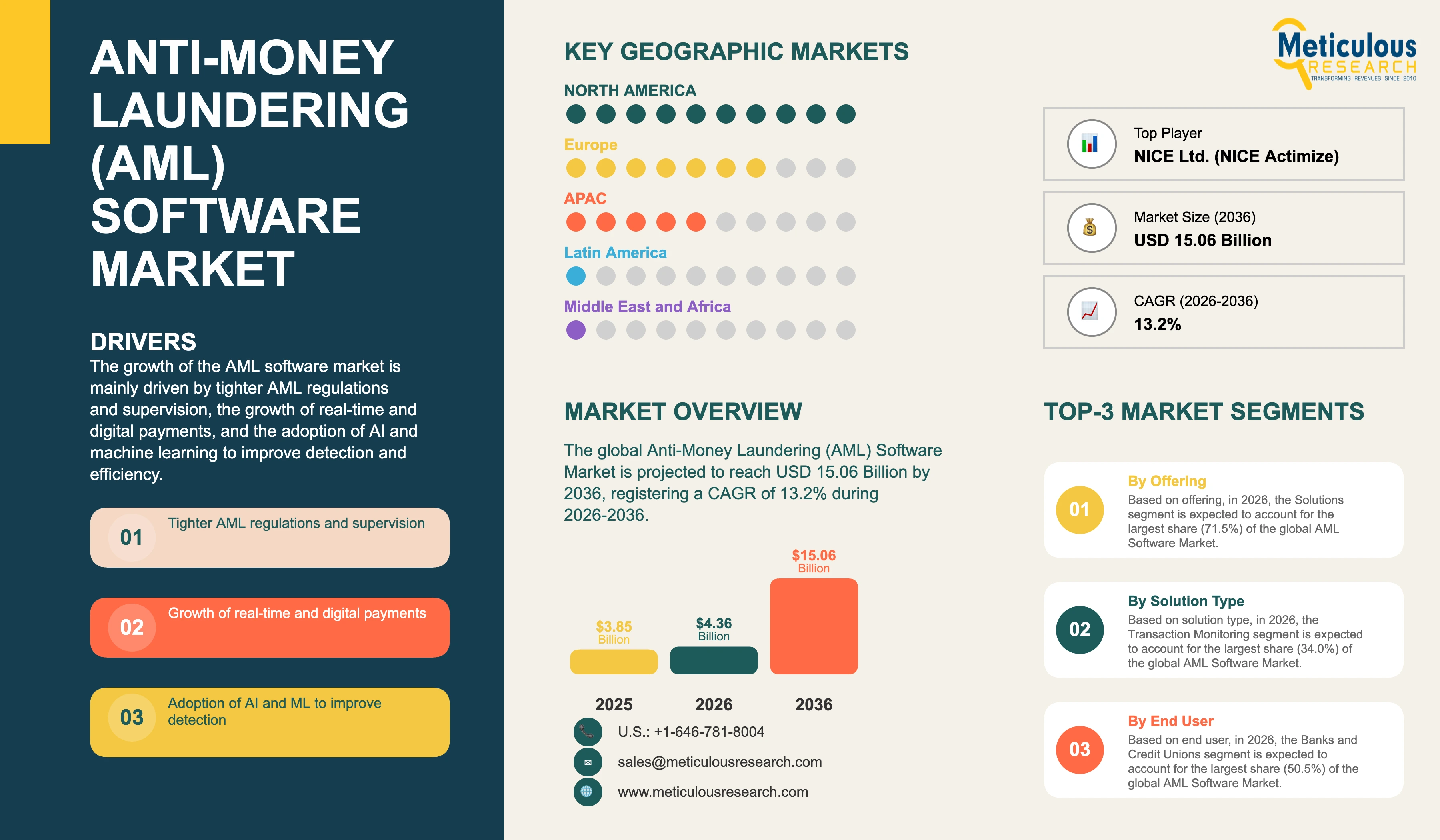
The global anti-money laundering (AML) software market was valued at USD 3.85 billion in 2025. This market is expected to reach USD 15.06 billion by 2036 from an estimated USD 4.36 billion in 2026, registering a CAGR of 13.2% during the forecast period (2026-2036).
- Published
- Nov 2026
- Pages
- 291
- Format
- PDF + Excel
- Report ID
- MRICT - 1042503
- Base year
- 2025
- 2025 · BASELINE
- $3.85B
- 2036
- $15.06B
- CAGR 2026–2036
- 13.2%
2025 baseline · 2026–2036 forecast at 13.2% CAGR · hover a bar for the value
Key highlights
The EU's Anti-Money Laundering Authority (AMLA) became operational in Frankfurt on 1 July 2025, the EU Anti-Money Laundering Regulation applies directly across all 27 member states from 10 July 2027, and AMLA will begin direct supervision of around 40 high-risk cross-border financial groups in 2028.
FinCEN issued a proposed rule on 7 April 2026 to fundamentally reform AML/CFT program requirements for U.S. financial institutions, moving toward an effectiveness-based standard, with a proposed effective date 12 months after the final rule.
NICE reported that its financial crime and compliance business, which includes NICE Actimize, generated USD 133 million in revenue in the first quarter of 2026, up 23% year over year, and NICE has said it is exploring options for its non-customer-experience assets, including financial crime and compliance.
Hawk raised USD 56 million in a Series C round in April 2025 and was selected by Commerzbank in 2026 for AI-based AML, while Quantexa raised USD 175 million in a Series F round in March 2025 to expand its decision intelligence platform.
Consolidation continues across the market, including Visa's acquisition of Featurespace, Experian's acquisition of KYC360, and Fenergo's acquisition of transaction monitoring provider Sentinels, as vendors combine KYC, screening, monitoring, and fraud capabilities.
Nasdaq Verafin provides cloud-based AML and fraud detection to thousands of U.S. and Canadian banks and credit unions, sharing intelligence across its customer base, while LSEG's World-Check and Moody's data are widely used for sanctions, PEP, and adverse media screening.
Real-time payment systems such as FedNow, SEPA Instant, UPI, and Pix, together with the EU's Instant Payments Regulation, are pushing institutions to screen and monitor payments in seconds rather than in overnight batches.
Entity resolution and network analytics is the fastest-growing solution type, cloud-based deployment is the larger and faster-growing deployment model, and crypto asset service providers are the fastest-growing end user.
By offering, solutions account for the larger share of 71.5% in 2026 and also register the higher CAGR.
By solution type, transaction monitoring accounts for the largest share of 34.0% in 2026, while entity resolution and network analytics registers the highest CAGR.
By deployment, cloud-based solutions account for the larger share in 2026 and also register the higher CAGR.
By organization size, large enterprises account for the larger share in 2026, while small and medium-sized enterprises register the higher CAGR.
By end user, banks and credit unions account for the largest share of 50.5% in 2026, while crypto asset service providers register the highest CAGR.
By geography, North America accounts for the largest share of 41.5% in 2026, while Asia-Pacific registers the highest CAGR of 16.5%.
Report summary
| Particulars | Details |
|---|---|
| Base Year | 2025 |
| Estimated Year | 2026 |
| Forecast Period | 2026-2036 |
| Market Size in 2025 | USD 3.85 billion |
| Market Size in 2026 | USD 4.36 billion |
| Market Size by 2036 | USD 15.06 billion |
| CAGR (2026-2036) | 13.2% |
| Format | PDF, Excel & Cloud Portal · 291 pages |
| Largest Segment by Offering (2026) | Solutions (71.5%) |
| Largest Segment by Solution Type (2026) | Transaction Monitoring (34.0%) |
| Largest Segment by End User (2026) | Banks and Credit Unions (50.5%) |
| Largest Region (2026) | North America (41.5%) |
| Fastest-Growing Region | Asia-Pacific (CAGR 16.5%) |
| Companies Profiled | 17 companies and other companies |
| Segments Covered | Offering, Solution Type, Deployment, Organization Size, End User, Geography |
| Countries Covered | U.S., Canada, Germany, U.K., France, Netherlands, Switzerland, Italy, Spain, Nordics, Rest of Europe, Japan, China, India, Australia, Singapore, Hong Kong, Indonesia, Rest of Asia-Pacific, Brazil, Mexico, Rest of Latin America, U.A.E., Saudi Arabia, South Africa, Nigeria, Rest of Middle East & Africa |
Report overview
Segments covered: offering, solution type, deployment, organization size, end user.
The growth of this market is mainly driven by tighter AML regulations and supervision worldwide, including the EU's new single AML rulebook and Anti-Money Laundering Authority, the rapid growth of real-time and digital payments that must be monitored instantly, large regulatory fines that push financial institutions to upgrade outdated systems, and the use of AI and machine learning to reduce false positives and lower compliance costs. However, factors such as the high cost and complexity of replacing legacy AML systems in large banks and concerns about the explainability of AI models in regulated decisions are expected to restrain the growth of this market to some extent. Nevertheless, regulatory pressure is expected to sustain steady investment in AML technology.
Anti-money laundering software helps banks, payment companies, insurers, investment firms, crypto exchanges, and other regulated businesses detect and report money laundering, terrorist financing, and sanctions violations. Core functions include customer due diligence and know your customer (KYC) checks when customers join and throughout the relationship, screening of customers and payments against sanctions lists, politically exposed persons (PEP) lists, and adverse media, monitoring of transactions for suspicious patterns, and case management tools that help investigators review alerts and file suspicious activity reports with authorities. The United Nations Office on Drugs and Crime estimates that 2% to 5% of global GDP is laundered each year, which shows the scale of the problem these systems are designed to address. Only a small share of these illicit funds is detected and seized, which keeps regulators focused on improving the effectiveness of private-sector controls.
Financial institutions are required by law to run effective AML programs, and regulators have imposed large fines on banks, payment companies, and crypto firms for weak controls. These penalties, together with stricter supervision, have made AML technology a priority for compliance budgets. At the same time, many institutions still rely on rule-based systems installed one or two decades ago, which generate very large numbers of alerts, most of them false positives, and require large teams of analysts to review. This creates strong demand for modern platforms that improve detection while lowering operating costs. Many institutions report that most of their AML budget is spent on people rather than technology, so tools that reduce manual work offer clear savings.
The market is served by several types of vendors, with large established providers include NICE Actimize, Oracle, SAS, FICO, Nasdaq Verafin, SymphonyAI, LSEG Risk Intelligence (World-Check), and Moody's, which serve large and mid-sized financial institutions with broad suites. Newer, cloud-native vendors such as Quantexa, ComplyAdvantage, Hawk, Napier AI, Lucinity, Feedzai, Silent Eight, Fenergo, and Unit21 compete on AI, ease of deployment, and modern user experience, and have won business from both fintechs and large banks. Core banking and payment technology providers such as Fiserv, FIS, Temenos, and Jack Henry also offer AML modules to their customers.
Regulation is changing in major markets, and in the EU the new AML package replaces 27 different national approaches with a single, directly applicable rulebook from 10 July 2027, and AMLA will directly supervise the highest-risk cross-border groups from 2028. In the U.S., FinCEN's April 2026 proposed rule would move AML/CFT programs toward an effectiveness-based standard, encouraging institutions to focus resources on higher risks and to use innovative technology. Other countries, including the U.K., Singapore, Australia, and the U.A.E., continue to strengthen AML requirements, and the Financial Action Task Force's evaluations keep pressure on countries to improve their frameworks.
Technology is changing how AML programs work, as machine learning models are being used alongside or instead of fixed rules to detect suspicious behavior more accurately, entity resolution and graph analytics connect data across customers, accounts, and counterparties to reveal hidden networks, and generative AI and AI agents are being used to summarize alerts, draft investigation narratives, and speed up case reviews. NICE Actimize, Hawk, and other vendors have launched AI agents for AML investigations, and many institutions are moving their AML systems to the cloud to access these capabilities more quickly.
Fraud and AML are also converging, as financial institutions increasingly want to combine fraud detection and AML monitoring, often called FRAML, because criminals use the same accounts and payment channels for both, and because shared data and teams can reduce costs. Vendors such as NICE Actimize, Feedzai, Hawk, and Featurespace (now part of Visa) offer combined fraud and AML capabilities, and this trend is shaping product strategies and acquisitions across the market. Combined platforms also help institutions respond to authorized push payment scams and money mule networks, which sit between fraud and money laundering. As a result, demand for integrated fraud and AML platforms is expected to keep rising.
Entity resolution and network analytics is projected to register the highest CAGR, while transaction monitoring holds the largest share of 34.0% in 2026.
Cloud-based deployment accounts for the larger share of the market in 2026 and is also projected to register the higher CAGR.
North America is expected to account for the largest share of 41.5% of the market in 2026.
Asia-Pacific is projected to register the highest CAGR of 16.5% during the forecast period, led by India, Singapore, Australia, and Indonesia.
The report profiles 17 companies, including NICE Ltd. (NICE Actimize), Oracle Corporation, SAS Institute Inc., Nasdaq, Inc. (Verafin), LSEG, Quantexa Ltd., and ComplyAdvantage Ltd. The top five players account for an estimated 33.5% of the market in 2025.
Solutions are expected to account for the larger share of 71.5% of the market in 2026 and also register the higher CAGR.
Report infographic
Market dynamics
15 factors across 5 forcesTighter AML regulations and supervision
Regulators around the world are raising expectations for AML programs and increasing supervision. The EU's AML package creates a single rulebook that applies directly across all member states from July 2027, sets detailed requirements for customer due diligence, beneficial ownership, and internal controls, and gives AMLA direct supervisory powers over around 40 high-risk cross-border groups from 2028. AMLA is also issuing a large number of technical standards and guidelines that institutions must implement. These changes require many European institutions to review and upgrade their AML systems.
In the U.S., FinCEN's April 2026 proposed rule would reshape AML/CFT program requirements and encourage a focus on effectiveness, while FinCEN has extended AML/CFT obligations to new types of institutions, such as investment advisers, with obligations now delayed to January 2028. Regulators in the U.K., Singapore, Hong Kong, Australia, India, and the Gulf countries are also strengthening rules and enforcement. Each new requirement adds to the need for systems that can document risk assessments, monitor activity, and produce evidence for supervisors, which supports steady investment in AML software.
Growth of real-time and digital payments
Real-time payment systems, such as FedNow in the U.S., SEPA Instant in Europe, UPI in India, and Pix in Brazil, are growing quickly, and money moves within seconds across accounts and institutions. This speed makes it harder to stop suspicious payments, and criminals use real-time payments, digital wallets, and mule accounts to move funds quickly. The EU's Instant Payments Regulation also requires payment service providers to screen customers against sanctions lists, increasing the need for fast and accurate screening.
Financial institutions therefore need AML systems that can monitor and screen transactions in real time and at very high volumes, which many legacy batch-based systems cannot do. This is driving demand for modern, cloud-based platforms that process large data volumes quickly, and for combined fraud and AML monitoring that can stop suspicious payments before funds leave the institution. Payment service providers and fintechs, which handle large volumes of digital payments, are among the fastest-growing buyers of AML software.
Large regulatory fines and the cost of legacy systems
Regulators have imposed very large penalties on financial institutions for AML failures, including multi-billion-dollar settlements in the U.S. and significant fines in Europe and Asia. Many of these cases cited weak transaction monitoring, poor data quality, or failure to update systems as the business changed. These penalties have made boards and senior managers more willing to invest in modern AML technology, as the cost of failure is far higher than the cost of the systems.
At the same time, operating costs of AML programs are rising, as legacy rule-based systems produce large volumes of alerts that require manual review. Many institutions employ large teams of analysts to clear alerts that turn out to be false positives. Modern platforms that reduce false positives and automate parts of investigations can lower these costs significantly, which gives institutions a clear financial reason to replace older systems. Modern platforms also make it easier to show regulators how detection scenarios are tuned and tested, which reduces supervisory risk.
Adoption of AI and machine learning to improve detection and efficiency
AI and machine learning are changing AML by improving the accuracy of detection and the efficiency of investigations. Machine learning models can find complex patterns of suspicious behavior that rules miss, while reducing false positives, and entity resolution and graph analytics can link customers, accounts, and counterparties to reveal networks of related activity. Generative AI and AI agents are being used to summarize alerts, gather information from internal and external sources, and draft investigation reports, which reduces the time analysts spend on each case.
Vendors have moved quickly to add these capabilities, as NICE Actimize has launched Xceed AI agents and the Actimize Insights Network for shared risk signals, Hawk has launched an AML investigative agent, and Quantexa has built its business on entity resolution and network analytics. Regulators have also signaled support for responsible innovation, provided that models are well governed and explainable. As institutions gain confidence in AI, spending on AI-driven AML capabilities is expected to grow faster than the overall market. Growing transaction volumes from real-time payments and digital wallets also make manual review impractical, which further supports investment in automated monitoring.
Table of contents
13 chapters · 142 sections · 291 pages · click to expandSegmental analysis
| Segment | Largest share (2026) | Fastest growth (2026–2036) |
|---|---|---|
| By Offering | — | — |
| By Solution Type | Transaction monitoring | Entity resolution and network analytics |
| By Deployment | — | — |
| By Organization Size | — | Rapid growth of this |
| By End User | Banks and credit unions | Crypto asset service providers |
| Other segments | Banks and credit unions | Crypto asset service providers |
By Offering
- The solutions segment is expected to account for the larger share of 71.5% of the global AML software market.
- This segment is also projected to register the higher CAGR during the forecast period.
- The large share and faster growth of this segment are mainly due to the broad use of software for transaction monitoring, KYC, screening, and case management across all types of regulated institutions, and the shift from perpetual licenses to cloud subscriptions that generate recurring revenue for vendors.
- AML solutions are core systems for regulated institutions, which must operate them continuously and cannot easily switch them off, which makes revenue in this segment stable and recurring.
- Large banks often run several AML products from different vendors, such as one for transaction monitoring, another for screening, and others for KYC and case management, and they add new modules as regulations change or new products are launched.
- Mid-sized institutions and fintechs increasingly buy integrated suites through cloud subscriptions, which allows them to add capabilities over time without major projects.
- Vendors are also adding AI features, such as machine learning detection, entity resolution, and investigation agents, as premium modules, which increases the value of each customer.
- The shift to cloud is gradually moving spending from one-time licenses and hardware to recurring subscriptions, which supports steady growth.
- The services segment, which includes implementation, model tuning and validation, managed services, and consulting, remains important because AML systems require extensive configuration and ongoing tuning to meet regulatory expectations.
By Solution Type
- AML Software Market Analysis by Solution Type
- The transaction monitoring segment is expected to account for the largest share of 34.0% of the market.
- The large share of this segment is mainly due to the legal requirement for financial institutions to monitor transactions and report suspicious activity, the very large volumes of transactions that must be analyzed, and the high cost of the systems and services used for this purpose.
- Transaction monitoring is the core of most AML programs and the area where regulators most often find weaknesses.
- These systems analyze payments, transfers, card transactions, trades, and other activity to detect patterns that may indicate money laundering, such as structuring, rapid movement of funds, or transactions with high-risk countries.
- Large banks process billions of transactions each year and need systems that can handle these volumes while producing manageable numbers of alerts.
- Many institutions are replacing or upgrading older rule-based monitoring systems with platforms that combine rules, machine learning, and network analytics, which reduces false positives and improves detection.
- The growth of real-time payments is also pushing institutions toward real-time monitoring, which requires new technology.
- Leading vendors in this segment include NICE Actimize, Oracle, SAS, Nasdaq Verafin, SymphonyAI, Hawk, and Napier AI.
- Because monitoring systems are deeply integrated with data and investigation workflows, contracts are usually long term and replacement projects are large, which keeps this segment the largest by value.
- However, the entity resolution and network analytics segment is projected to register the highest CAGR during the forecast period.
- The rapid growth of this segment is driven by the need to detect complex networks of related parties, regulatory focus on beneficial ownership, and the success of vendors such as Quantexa in helping institutions combine data and reduce false positives.
- Customer due diligence and KYC, sanctions, PEP, and adverse media screening, and case management and regulatory reporting make up the rest of the market, with KYC growing faster than the market as institutions adopt perpetual KYC.
By Deployment
- AML Software Market Analysis by Deployment
- The cloud-based segment is expected to account for the larger share of the market.
- This segment is also expected to grow at the faster rate during the forecast period.
- The large share and fast growth of this segment are mainly due to the cloud-native design of most newer AML platforms, the migration of established vendors' solutions to the cloud, and the preference of fintechs, payment providers, and mid-sized institutions for solutions that can be deployed quickly and scaled easily.
- Cloud deployment gives institutions faster access to new AI capabilities, shared intelligence across customers, and elastic processing for growing transaction volumes.
- Regulators in most major markets now accept the use of cloud for AML systems, subject to outsourcing and data protection rules.
- On-premises deployments remain important for large banks with existing installations and for institutions in countries with strict data localization requirements, but their share is expected to decline over the forecast period.
- Many large banks are adopting hybrid approaches, keeping sensitive data on-premises while using cloud services for analytics and AI.
By Organization Size
- AML Software Market Analysis by Organization Size
- The large enterprises segment is expected to account for the larger share of the market.
- The large share of this segment is mainly due to the large transaction volumes, complex product ranges, and global operations of large banks and financial groups, which require extensive AML systems and generate large software and services spending.
- Large financial institutions operate in many countries and must meet different regulatory requirements in each, which leads to complex AML programs with multiple systems, large investigation teams, and frequent regulatory reviews.
- They are also the institutions most likely to face large fines and direct supervision, such as AMLA's supervision of high-risk cross-border groups from 2028, which drives continuous investment in AML technology.
- Many large banks are now running multi-year programs to modernize their AML systems, often in partnership with consultancies and system integrators, as shown by Infosys's work with DNB Bank on NICE Actimize's X-Sight platform.
- However, the small and medium-sized enterprises segment is projected to register the higher CAGR during the forecast period.
- The rapid growth of this segment is driven by the expansion of AML obligations to smaller banks, credit unions, payment companies, and non-financial businesses, and the availability of affordable cloud-based solutions designed for smaller institutions.
- Smaller institutions also face the same regulatory expectations as larger ones in many areas, but with much smaller compliance teams, which makes automation especially valuable to them.
By End User
- The banks and credit unions segment is expected to account for the largest share of 50.5% of the market.
- The large share of this segment is mainly due to the central role of banks in the financial system, their strict AML obligations, their large transaction volumes, and their history of large regulatory fines, which drive high spending on AML software.
- Banks were the first institutions subject to comprehensive AML requirements and remain the main focus of regulators and supervisors.
- They handle a wide range of products, including retail and business accounts, payments, trade finance, correspondent banking, and wealth management, each with its own money laundering risks and monitoring needs.
- Large global banks spend heavily on AML technology and staff, and many are in the middle of multi-year transformation programs to replace legacy systems, adopt machine learning, and move to the cloud.
- Community banks and credit unions, particularly in the U.S., rely on vendors such as Nasdaq Verafin, Jack Henry, and Fiserv for AML solutions tailored to smaller institutions, and many are moving to cloud-based platforms that share intelligence across institutions.
- The EU's new AML rulebook and AMLA supervision, along with FinCEN's proposed program reforms, will require further investment by banks over the forecast period.
- However, the crypto asset service providers segment is projected to register the highest CAGR during the forecast period.
- The rapid growth of this segment is driven by new licensing and AML requirements for crypto firms, such as the EU's Markets in Crypto-Assets Regulation and the Travel Rule, enforcement actions against crypto exchanges, and the growing integration of crypto services with traditional finance.
- Payment service providers and fintechs, capital markets and wealth management firms, insurance companies, gaming and gambling operators, and designated non-financial businesses make up the rest of the market.
Other segments
- Banks and credit unions are expected to account for the largest share of 50.5% of the market in 2026, while crypto asset service providers are projected to register the highest CAGR.
Geographic analysis
North America
Largest shareIn 2026, North America is expected to account for the largest share of 41.5% of the global AML software market. The large share of this region is mainly due to the strict requirements of the U.S. Bank Secrecy Act and FinCEN, the history of large AML enforcement actions against U.S. and foreign banks, the large number of banks, credit unions, payment companies, and fintechs in the region, and the presence of leading vendors such as NICE Actimize, Oracle, SAS, FICO, Nasdaq Verafin, and Unit21. The U.S. is the largest single country market, supported by a large and diverse financial sector, frequent regulatory examinations, and high spending on compliance. FinCEN's April 2026 proposed rule to reform AML/CFT program requirements and its extension of AML obligations to investment advisers from 2028 will shape spending over the forecast period, as institutions adjust their programs to new expectations. Canada adds demand from its large banks and from FINTRAC's expanding requirements for payment and crypto businesses. U.S. sponsor banks that serve fintechs and the growth of digital payments are also creating new demand for real-time monitoring and oversight tools.
Asia-Pacific
Fastest growthAsia-Pacific is projected to register the highest CAGR of 16.5% during the forecast period. Growth is driven by the rapid expansion of digital payments, such as UPI in India, the growth of fintechs and digital banks, stronger AML regulation and enforcement in countries such as Singapore, Australia, Hong Kong, India, and Indonesia, and Financial Action Task Force evaluations that push countries to improve their frameworks. Australia's expansion of AML obligations to lawyers, accountants, real estate agents, and other businesses is also expected to create new demand. Asia-Pacific also continues to grow strongly.
Europe
Europe holds a significant share of the market, supported by the new EU AML package, AMLA's direct supervision from 2028, and strong enforcement in the U.K. and the Nordic countries after major money laundering scandals. The U.K., Germany, France, the Netherlands, and the Nordic countries are the largest markets, and Europe is home to vendors such as Quantexa, ComplyAdvantage, Fenergo, Hawk, Napier AI, and Lucinity.
Latin America
Latin America and the Middle East & Africa are growing faster than the global average, led by Brazil and Mexico, where digital payments and fintechs are expanding rapidly, and by the U.A.E. and Saudi Arabia, where governments have strengthened AML frameworks as part of efforts to meet international standards.
Competitive landscape
The AML software market is fragmented, with large established vendors, specialized regtech companies, and core banking and payment technology providers. NICE Actimize is one of the largest providers, offering a broad suite for transaction monitoring, screening, KYC, and case management on its X-Sight platform, and NICE reported strong growth in its financial crime and compliance business in 2026. Oracle, SAS, FICO, SymphonyAI, and Nasdaq Verafin also hold strong positions, with Verafin particularly strong among U.S. community banks and credit unions. LSEG Risk Intelligence (World-Check) and Moody's are major providers of screening data and KYC solutions.
Newer, cloud-native vendors are gaining share with AI-driven products and faster deployment. Quantexa offers entity resolution and network analytics, ComplyAdvantage provides screening and monitoring for fintechs and banks, Hawk offers AI-based monitoring, screening, and fraud prevention, Napier AI, Lucinity, Silent Eight, and Unit21 focus on monitoring and investigations, and Fenergo provides client lifecycle management and KYC for large institutions. Feedzai and Featurespace (now part of Visa) combine fraud and AML capabilities, and core banking providers such as Fiserv, FIS, Temenos, and Jack Henry offer AML modules to their customers.
The top five players are estimated to account for 33.5% of the market in 2025, reflecting a fragmented market with many vendors serving different institution sizes, regions, and functions. Competition is expected to center on AI-driven detection and investigations, cloud delivery, combined fraud and AML capabilities, and support for new regulations such as the EU AML package.
Vendors use several strategies to grow in this market, including acquisitions to add KYC, screening, fraud, or AI capabilities, partnerships with system integrators and consultancies for large bank transformations, expansion into fast-growing segments such as fintechs and crypto firms, and the launch of AI agents for investigations. Vendors are also building partner ecosystems with data providers, identity verification companies, and core banking platforms to offer more complete solutions. NICE's review of options for its financial crime business, if it leads to a sale, could significantly change the competitive landscape.
Some of the key players operating in the AML software market are NICE Ltd. (NICE Actimize), Oracle Corporation, SAS Institute Inc., Fair Isaac Corporation (FICO), Nasdaq, Inc. (Verafin), SymphonyAI, London Stock Exchange Group plc (LSEG Risk Intelligence), Moody's Corporation, Quantexa Ltd., ComplyAdvantage Ltd., Fenergo Ltd., Hawk AI GmbH, Napier AI Ltd., Feedzai, Inc., Lucinity ehf., Silent Eight Pte. Ltd., and Unit21, Inc., among others. Vendors compete on detection accuracy, false positive reduction, and ease of deployment.
- —
FinCEN proposed a major reform of AML/CFT program requirements in April 2026, AMLA has been operational since July 2025 ahead of the EU AML Regulation applying in July 2027, NICE reported 23% growth in its financial crime and compliance business in the first quarter of 2026, and Commerzbank selected Hawk for AI-based AML in 2026. These moves show strong investment momentum.
- NICE Ltd. (NICE Actimize)
- Oracle Corporation
- SAS Institute Inc.
- Fair Isaac Corporation (FICO)
- Nasdaq, Inc. · Verafin
- SymphonyAI
- Moody's Corporation
- Quantexa Ltd.
- ComplyAdvantage Ltd.
- Fenergo Ltd.
- Hawk AI GmbH
- Napier AI Ltd.
- Feedzai, Inc.
- Lucinity ehf
- Silent Eight Pte. Ltd.
- Unit21, Inc.
Expert perspectives
The AML software market is supported by a basic and lasting need: regulated institutions must detect and report financial crime, and the penalties for failure are severe. Regulation is the main driver of spending, and the coming years will bring some of the largest regulatory changes in decades, including the EU's single rulebook and AMLA supervision and potential reforms to U.S. AML program requirements. These changes will require many institutions to review and upgrade their systems.
Technology is shifting the market from rule-based systems to AI-driven platforms that can detect more complex activity and reduce the cost of investigations. Institutions are under pressure to lower AML operating costs, which are dominated by staff time spent on false positives and investigations, and AI offers a clear path to savings. However, regulators' expectations for explainability and model governance mean that adoption will be gradual, with most institutions combining rules and AI rather than replacing rules entirely.
Entity resolution and network analytics is the fastest-growing solution type, as institutions look for ways to detect networks of related parties and use data more effectively. Crypto asset service providers are the fastest-growing end user, and payment service providers and fintechs are also growing quickly. Cloud-based deployment is the larger and faster-growing deployment model, and small and medium-sized enterprises are growing faster than large enterprises as AML obligations extend to smaller institutions.
North America remains the largest market, while Asia-Pacific is the fastest-growing region at a CAGR of 16.5%, supported by digital payment growth and stronger regulation. The main swing factors are the pace of AI adoption in regulated institutions, the final shape of U.S. AML program reforms, and the speed of AML system replacement in large banks. A more risk-based U.S. framework could free resources for innovation, while the EU's single rulebook will create a clear, common standard that favors vendors with strong European capabilities.
For buyers, the key decision is shifting from replacing individual tools to building integrated financial crime platforms that combine KYC, screening, monitoring, fraud, and investigations with strong data foundations and AI. Vendors that can support this shift with proven, explainable AI and smooth migration from legacy systems will be best placed to win large, long-term contracts.
Overall, growth in this market rests on tightening regulation, the growth of digital and real-time payments, and the need to lower compliance costs through AI. Vendors that combine regulatory expertise, cloud delivery, and explainable AI are expected to capture most of this growth. Consolidation between fraud and AML vendors is also expected to continue over the forecast period.
Customer perspectives
Modernization of transaction monitoring is the largest area of AML spending, which is why transaction monitoring holds 34.0% of the market and banks and credit unions account for 50.5% of demand. The EU AML package and AMLA supervision are accelerating these upgrades in Europe.
Chief Compliance Officer - crypto exchange, Singapore
Our licenses in several countries depend on showing regulators we can trace where funds come from and go to. We needed screening, monitoring, and Travel Rule tools that work through APIs and scale as our volumes grow.
New licensing and Travel Rule requirements are driving rapid AML adoption among crypto firms, making crypto asset service providers the fastest-growing end user and supporting Asia-Pacific's position as the fastest-growing region at a CAGR of 16.5%.
BSA Officer - community bank, U.S.
We do not have a large compliance team, so we rely on a cloud platform that shares intelligence across many banks. It flags patterns we would never see on our own and keeps our examiners satisfied.
Cloud-based platforms that share intelligence across institutions are helping smaller banks and credit unions meet regulatory expectations, supporting the growth of cloud-based deployment and the small and medium-sized enterprises segment. Buyers also value faster alert review.
“Our monitoring system generates thousands of alerts a day, and almost all of them turn out to be nothing. With the new EU rulebook coming, we are rebuilding on a platform that uses machine learning and network data so our investigators spend their time on real risk.”
Frequently asked questions
The market was valued at USD 3.85 billion in 2025 and USD 3.42 billion in 2024, and is estimated at USD 4.36 billion in 2026.
The market is expected to reach USD 15.06 billion by 2036, supported by tighter AML regulations, the growth of real-time and digital payments, large regulatory fines, and the adoption of AI to improve detection and efficiency.
The market is expected to register a CAGR of 13.2% from 2026 to 2036.
Growth is driven by tighter AML regulations and supervision, the growth of real-time and digital payments, large regulatory fines and the cost of legacy systems, and the adoption of AI and machine learning to improve detection and efficiency.
The high cost and complexity of replacing legacy systems and concerns about AI explainability and model risk restrain growth, while data quality and fragmented systems and the shortage of skilled financial crime professionals remain key challenges.
Key opportunities include cloud migration and AML-as-a-service, entity resolution, network analytics, and data sharing, AML for fintechs, payment providers, and crypto asset service providers, and generative AI and AI agents for investigations.
The EU Anti-Money Laundering Regulation applies directly across all member states from 10 July 2027, replacing national rules with a single rulebook, and AMLA will begin direct supervision of around 40 high-risk cross-border groups in 2028. These changes will require many European institutions to review and upgrade their AML systems and controls.
AI and machine learning improve detection of complex suspicious activity and reduce false positives, entity resolution and graph analytics reveal hidden networks, and generative AI and AI agents help investigators gather information and draft case reports, lowering the cost of AML programs.
Solutions are expected to account for the larger share of 71.5% of the market in 2026 and also register the higher CAGR.
Entity resolution and network analytics is projected to register the highest CAGR, while transaction monitoring holds the largest share of 34.0% in 2026.
Cloud-based deployment accounts for the larger share of the market in 2026 and is also projected to register the higher CAGR.
Banks and credit unions are expected to account for the largest share of 50.5% of the market in 2026, while crypto asset service providers are projected to register the highest CAGR.
North America is expected to account for the largest share of 41.5% of the market in 2026.
Asia-Pacific is projected to register the highest CAGR of 16.5% during the forecast period, led by India, Singapore, Australia, and Indonesia.
The report profiles 17 companies, including NICE Ltd. (NICE Actimize), Oracle Corporation, SAS Institute Inc., Nasdaq, Inc. (Verafin), LSEG, Quantexa Ltd., and ComplyAdvantage Ltd. The top five players account for an estimated 33.5% of the market in 2025.
FinCEN proposed a major reform of AML/CFT program requirements in April 2026, AMLA has been operational since July 2025 ahead of the EU AML Regulation applying in July 2027, NICE reported 23% growth in its financial crime and compliance business in the first quarter of 2026, and Commerzbank selected Hawk for AI-based AML in 2026. These moves show strong investment momentum.
Cite this report
Meticulous Research. (2026). Anti-Money Laundering (AML) Software Market - Global Opportunity Analysis and Industry Forecast (2026-2036) (Report No. MRICT - 1042503). Meticulous Market Research Pvt. Ltd. https://www.meticulousresearch.com/product/anti-money-laundering-aml-software-market-7186