Aerospace Special Process Services Market (2026-2036)
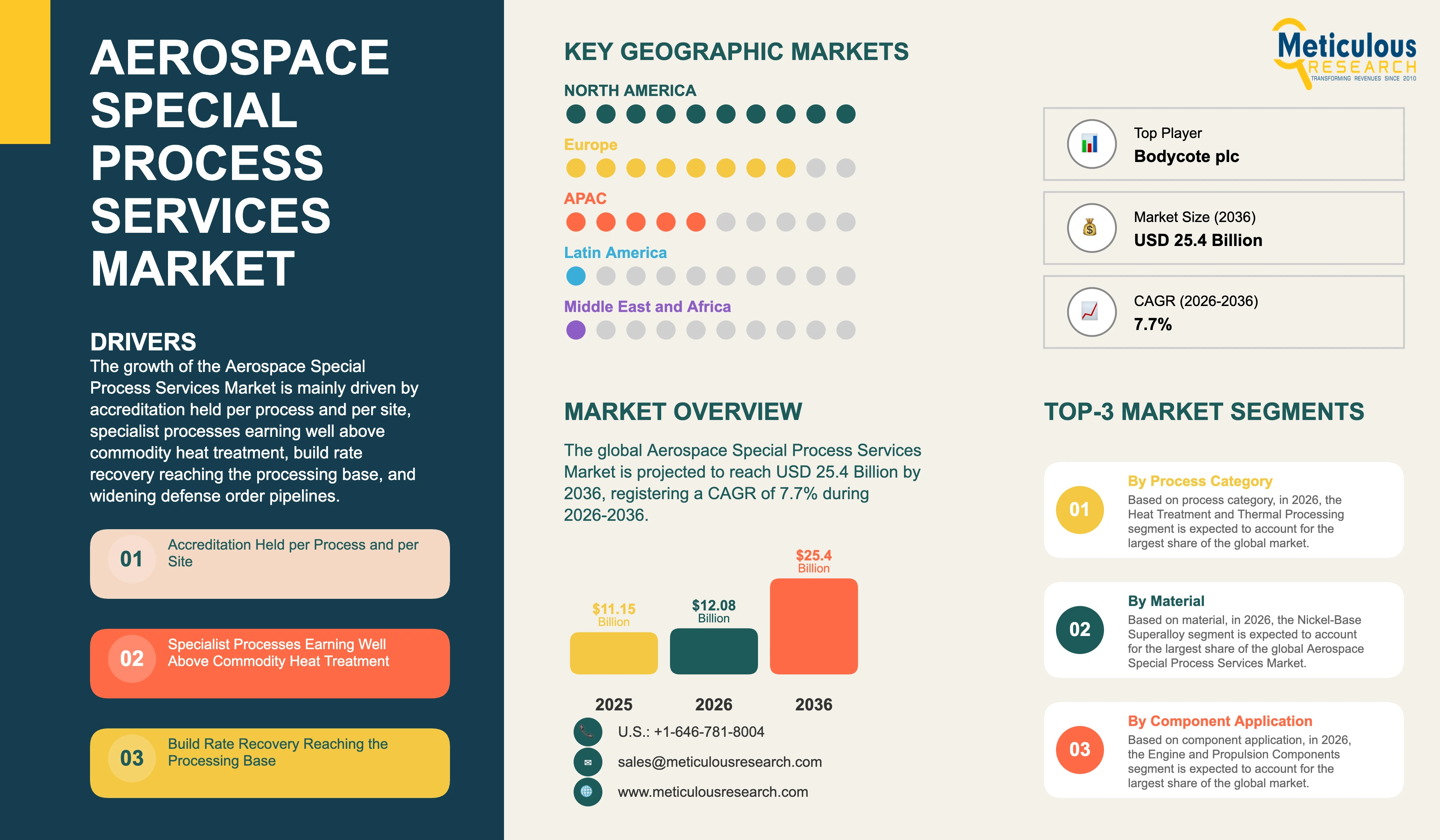
The global Aerospace Special Process Services Market was valued at USD 11.15 billion in 2025. This market is expected to reach USD 25.40 billion by 2036 from an estimated USD 12.08 billion in 2026, registering a CAGR of 7.7% during the forecast period (2026-2036).
- Published
- Nov 2026
- Pages
- 280
- Format
- PDF + Excel
- Report ID
- MRAD - 1042837
- Base year
- 2025
- 2025 · BASELINE
- $11.15B
- 2036
- $25.40B
- CAGR 2026–2036
- 7.7%
2025 baseline · 2026–2036 forecast at 7.7% CAGR · hover a bar for the value
Key highlights
The global Aerospace Special Process Services Market is projected to reach USD 25.40 billion by 2036, driven by accreditation held per process and per site, specialist processes earning well above commodity heat treatment, build rate recovery reaching the processing base, and widening defense order pipelines.
North America is expected to account for the largest market share in 2026 and is also projected to register the fastest growth during the forecast period, supported by the concentration of engine and airframe manufacture in the region together with the largest installed base of accredited processing sites.
By process category, Heat Treatment and Thermal Processing are expected to account for the largest market share, whereas Hot Isostatic Pressing and Specialist Processes are projected to witness the fastest growth through 2036.
By material, Nickel-Base Superalloy are expected to account for the largest market share, whereas Nickel-Base Superalloy are projected to witness the fastest growth through 2036.
By component application, Engine and Propulsion Components are expected to account for the largest market share, whereas Engine and Propulsion Components are projected to witness the fastest growth through 2036.
Approximately 4, 700 suppliers hold over 8,000 accreditations across 24 special process areas, each governed by its own task group and spanning additive manufacturing, composites, heat treating, nondestructive testing and welding among others, with more than 5,000 supplier audits scheduled annually.
Nearly 60 subscribing original equipment manufacturers participate in that program, which replaces redundant auditing of suppliers with one approved audit.
Bodycote recorded 2025 group revenue of GBP 727.1 million against GBP 757.1 million, with core revenue of GBP 671.6 million down 0.3% organically and the second half up 3.2% year on year across 136 operational locations.
Specialist Technologies delivered revenue of GBP 212.3 million at a 27.1% adjusted operating margin against Precision Heat Treatment revenue of GBP 459.3 million at a 16.0% margin, a gap of more than eleven points between specialist and commodity processing.
Aerospace and defense growth in precision heat treatment accelerated in the second half of 2025 as supply chain conditions improved materially, and the German defense order pipeline widened over the year.
Capacity is being reorganized before it is expanded, with one site serving aerospace and industrial gas turbine work recording poor throughput that was limiting the capacity available for growth until a pilot reorganization addressed it.
Hot isostatic pressing capacity is being increased to serve aerospace and defense with commissioning in late 2026 or early 2027, and capital expenditure rose to GBP 77.0 million from GBP 60.5 million on growth and modernization projects.
Processing capacity is being acquired for its aerospace position, with the January 2026 acquisition of Spectrum Thermal Processing, an aerospace-focused business in Rhode Island, strengthening North American aerospace and defense coverage.
Report summary
| Particulars | Details |
|---|---|
| Forecast Period | 2026-2036 |
| Base Year | 2025 |
| Estimated Year | 2026 |
| CAGR (Value) | 7.7% |
| Format | PDF, Excel & Cloud Portal · 280 pages |
| CAGR (Volume) | 4.7% |
| Market Size (Value) in 2026 | USD 12.08 billion |
| Market Size (Value) in 2036 | USD 25.40 billion |
| Market Size (Volume) in 2026 | 58.00 million process lots |
| Market Size (Volume) in 2036 | 92.00 million process lots |
| Average Selling Price, 2026 | USD 208 per process lot |
| Average Selling Price, 2036 | USD 276 per process lot |
| Segments Covered | By Process Category: Heat Treatment and Thermal Processing, Surface Treatment and Finishing, Coatings and Thermal Spray, Nondestructive Testing, Welding, Brazing and Joining, Hot Isostatic Pressing and Specialist Processes, Other Processes. By Material: Nickel-Base Superalloy, Titanium Alloy, Aluminum Alloy, Steel and Stainless Steel, Other Materials. By Component Application: Engine and Propulsion Components, Structural Airframe Components, Landing Gear and Actuation Components, Fasteners and Small Hardware, Other Components. By Buyer: Tier One and Tier Two Suppliers, Airframe and Engine Original Equipment Manufacturers, Maintenance, Repair and Overhaul Providers, Tier Three Suppliers and Machine Shops, Other Buyers. |
| Countries Covered | U.S.; Canada; France; Germany; U.K.; Italy; China; India; Japan; South Korea; Mexico; Brazil |
| Key Companies | Bodycote plc, Curtiss-Wright Corporation, Linde plc, Aalberts N.V., OC Oerlikon Corporation AG, and Chromalloy Gas Turbine LLC |
Report overview
Segments covered: process category, material, component application, buyer.
The growth of this market is mainly driven by accreditation held per process and per site, with approximately 4,700 suppliers carrying over 8,000 accreditations across 24 areas, specialist processes earning a 27.1% adjusted operating margin against 16.0% on precision heat treatment, build rate recovery reaching the processing base as supply chain conditions improved materially, and defense order pipelines widening process demand. However, factors such as throughput limits inside existing plants that constrain the capacity available for growth, furnace and line capacity added in whole increments with commissioning measured in years, energy intensity and site permitting, and mixed end market exposure that masks aerospace growth in reported results are expected to restrain the growth of this market to some extent.
The Aerospace Special Process Services Market comprises controlled manufacturing processes performed as outsourced services on aerospace components, taken at the processor gate with volume expressed as process lots. The market includes Heat Treatment and Thermal Processing, Surface Treatment and Finishing, Coatings and Thermal Spray, Nondestructive Testing, Welding, Brazing and Joining, and Hot Isostatic Pressing and Specialist Processes, performed on nickel-base superalloy, titanium alloy, aluminum alloy and steel, for engine and propulsion components, structural airframe components, landing gear and actuation components, and fasteners and small hardware, bought by tier one and tier two suppliers, airframe and engine original equipment manufacturers, maintenance, repair and overhaul providers, and tier three suppliers and machine shops. Processes performed in-house by component manufacturers for their own parts, machining and forming operations, accreditation auditing and quality management services, furnaces, coating equipment and inspection systems sold as capital, and the components themselves fall outside the scope.
A heat-treated forging, an anodized fitting or a shot-peened gear leaves the processing plant with properties that cannot be inspected back out of the part. The industry therefore controls the process rather than the product, approving a named plant to run a named process to a named specification and recording the result against the part. Approximately 4,700 suppliers hold over 8,000 accreditations across 24 process areas on that basis, each area governed by its own task group, with more than 5,000 supplier audits scheduled annually and nearly 60 subscribing original equipment manufacturers accepting the result.
More than one accreditation per supplier on average is the structural fact in this market. A processing house that heat treats, anodizes and inspects holds three separate approvals, each with its own audit cycle, findings and corrective action, and each tied to the plant rather than to the company. Capacity in one accredited plant therefore cannot be substituted for capacity in another without reopening the approval, which is why availability and utilization in this market are local rather than aggregate.
Not all of those approvals are worth the same. Bodycote reported Specialist Technologies revenue of GBP 212.3 million at a 27.1% adjusted operating margin in 2025 against Precision Heat Treatment revenue of GBP 459.3 million at a 16.0% margin, on group revenue of GBP 727.1 million across 136 operational locations. Eleven points of margin separate processes that few plants can run from processes that many can, and the difference is approval scarcity rather than equipment cost.
Aerospace demand reached the processing base late in the period rather than steadily through it. Precision heat treatment aerospace and defense growth accelerated in the second half of 2025 as supply chain conditions improved materially, with core group revenue down 0.3% organically for the year but the second half up 3.2%, and the German defense order pipeline widened over the year. Processing sits behind machining and forming in the chain, so it records a rate recovery after the operations ahead of it have absorbed one.
The response has been to recover capacity before adding it. One site serving aerospace and industrial gas turbine work recorded poor throughput that was limiting the capacity available for growth until a pilot reorganization addressed it, while capital expenditure rose to GBP 77.0 million from GBP 60.5 million on growth and modernization projects and hot isostatic pressing capacity for aerospace and defense was committed for commissioning in late 2026 or early 2027. Reorganizing an approved plant releases hours inside an existing approval, which a new furnace cannot do until it is qualified.
Acquisition is the other route to approved capacity, and the January 2026 purchase of Spectrum Thermal Processing, an aerospace-focused business in Rhode Island, was made to strengthen North American aerospace and defense coverage rather than to add tonnage. Value grows ahead of volume throughout the forecast period at 7.7% against 4.7%, because the mix moves toward hot isostatic pressing and the other specialist processes and because price per process lot follows approval scarcity rather than throughput.
One site serving aerospace and industrial gas turbine work recorded poor throughput that was limiting the capacity available for growth until a pilot reorganization addressed it. Recovering hours inside a plant that already holds the approvals releases saleable capacity immediately, where a new furnace cannot contribute until it has been qualified. For an operator with 136 locations, rolling that reorganization across the estate is the cheapest capacity available.
North America is expected to account for the largest share of this market in 2026, supported by the largest concentration of engine manufacture and the deepest installed base of accredited processing sites, strengthened by the January 2026 acquisition of Spectrum Thermal Processing in Rhode Island.
Europe is projected to grow at 7.2% and holds the second largest regional position in this market in 2026. France, Germany, the United Kingdom and Italy carry the engine, aerostructure and systems work packages that generate controlled process demand before final assembly, and the German defense order pipeline widened over 2025. Precision heat treatment aerospace and defense growth accelerated in the second half of the year as supply chain conditions improved materially. Energy cost and site permitting weigh more heavily on regional processors than elsewhere, which constrains where new thermal and chemical capacity can be added.
The Middle East & Africa region is projected to grow at 8.8% from the smallest regional base, concentrated in maintenance, repair and overhaul operations at the Gulf hub carriers where hot section components are reprocessed at every shop visit, and in capability established alongside defense procurement, with first accreditation and trained operators both largely imported. Latin America is projected to grow at 8.6%, with Mexico accounting for most regional volume through heat treatment, chemical processing and finishing capacity built alongside the machining clusters in Querétaro and Chihuahua, and Brazilian demand following regional jet manufacture.
Some of the key players operating in the aerospace special process services market are Bodycote plc, Curtiss-Wright Corporation, Linde plc, Aalberts N.V., OC Oerlikon Corporation AG, and Chromalloy Gas Turbine LLC, among others.
Key strategies include acquiring accredited aerospace-focused processing sites, as in the January 2026 purchase of Spectrum Thermal Processing, since approvals and the part numbers attached to them cannot be installed; committing capacity to specialist processes that carry the wider margin, including hot isostatic pressing for aerospace and defense; recovering throughput inside existing approvals before installing new equipment; qualifying in newer accreditation areas including additive manufacturing; and locating processing inside machining clusters in Asia-Pacific and Mexico to remove freight and days from the component cycle.
Report infographic
Market dynamics
18 factors across 4 forcesAccreditation Held per Process and per Site
Approximately 4,700 suppliers hold over 8,000 accreditations across 24 special process areas, each governed by its own task group, with more than 5,000 supplier audits scheduled annually and nearly 60 subscribing original equipment manufacturers accepting the result in place of their own audits. The approval attaches to a named plant running a named process to a named specification, not to the company that owns it. A component requiring three controlled processes therefore has to pass through three approved plants, or one plant holding three approvals, and no amount of unapproved capacity elsewhere can substitute. Demand in this market is consequently created by the specification rather than by the buyer, and it cannot be deferred without stopping the part.
Specialist Processes Earning Well Above Commodity Heat Treatment
Bodycote reported Specialist Technologies revenue of GBP 212.3 million at a 27.1% adjusted operating margin in 2025 against Precision Heat Treatment revenue of GBP 459.3 million at a 16.0% margin. The eleven point gap reflects how few plants hold the approvals and the capability for hot isostatic pressing and the other specialist processes, against a much wider base able to run conventional thermal processing. Hot Isostatic Pressing and Specialist Processes is projected to be the fastest-growing process category in this market at 10.6% as a result, and hot isostatic pressing capacity for aerospace and defense has been committed for commissioning in late 2026 or early 2027. Processors are directing investment at the scarce approvals rather than at throughput.
Build Rate Recovery Reaching the Processing Base
Aerospace and defense growth in precision heat treatment accelerated in the second half of 2025 as supply chain conditions improved materially, with core group revenue down 0.3% organically across the year but the second half up 3.2% year on year. The Federal Aviation Administration raised the Boeing 737 MAX production cap from 38 to 42 aircraft a month in October 2025 over the same period. A component reaches a processing plant only after machining and forming are complete, so this part of the chain absorbs a rate increase after the operations ahead of it have done so. That lag means the recovery recorded in late 2025 flows through processing volumes during 2026 rather than having already been captured, which is why Engine and Propulsion Components lead growth in this market.
Defense Order Pipelines Widening Process Demand
The German defense order pipeline widened over 2025, and defense programs bring process requirements that commercial work does not, including specifications held to national standards and sourcing restricted to approved domestic or allied plants. Boeing recorded 131 defense, space and security deliveries in 2025 alongside its commercial output. Defense work therefore adds approvals rather than only volume, because an existing plant frequently cannot serve it without a separate qualification. For processors already accredited, that converts a rising order pipeline into higher-priced work on capacity they already hold.
Outsourcing of Processes Primes Will Not Hold Internally
Controlled processes carry environmental permitting, chemical handling, energy intensity and audit obligations that a machining or assembly operation would rather not own, and the approval has to be maintained whether the plant is busy or not. Component manufacturers consequently place these steps with specialist processors and buy the approval alongside the process. Tier One and Tier Two Suppliers hold the largest buyer share of this market in 2026 on that basis. Because the processor rather than the component maker carries the permitting and the audit, the outsourcing decision is difficult to reverse once a part number is approved at a given plant.
Table of contents
12 chapters · 141 sections · 280 pages · click to expandSegmental analysis
| Segment | Largest share (2026) | Fastest growth (2026–2036) |
|---|---|---|
| By Process Category | Heat Treatment and Thermal Processing | Hot Isostatic Pressing and Specialist Processes |
| By Material | Nickel-Base Superalloy | Nickel-Base Superalloy |
| By Component Application | Engine and Propulsion Components | Engine and Propulsion Components |
| By Buyer | Tier One and Tier Two Suppliers | Maintenance, Repair and Overhaul Providers |
| Other segments | Nickel-Base Superalloy | Nickel-Base Superalloy |
By Process Category
- Heat Treatment and Thermal Processing are expected to account for the largest share of the global Aerospace Special Process Services Market.
- The large share of this segment is mainly due to the requirement to heat treat almost every structural forging, casting and machined component to achieve specified properties, which places it on more part numbers than any other controlled process, and the breadth of accredited capacity able to perform it.
- However, Hot Isostatic Pressing and Specialist Processes are projected to register the highest CAGR during the forecast period.
- The rapid growth of this segment is attributed to the closure of internal porosity that castings and additive parts require before flight qualification, the scarcity of plants holding both the vessels and the approvals, and committed capacity additions for aerospace and defense commissioning in late 2026 or early 2027.
- Heat Treatment and Thermal Processing are expected to account for the largest market share in 2026.
- Hot Isostatic Pressing and Specialist Processes are projected to register the highest CAGR during the forecast period, owing to the closure of internal porosity that castings and additive parts require before flight qualification, the scarcity of plants holding both the vessels and the approvals, and committed capacity additions for aerospace and defense commissioning in late 2026 or early 2027.
- Maintenance, Repair and Overhaul Providers are projected to register the highest CAGR during the forecast period, owing to growth in the installed fleet and in shop visit volumes, where every hot section component removed is reprocessed before return to service and repair approvals expand as older aircraft remain in service longer.
By Material
- Nickel-Base Superalloy are expected to account for the largest market share.
- The large share of this segment is mainly due to the number of controlled processes a hot section component passes through, including solution and age treatment, coating, nondestructive inspection and in many cases hot isostatic pressing, each priced above the equivalent operation on a lighter alloy.
- However, Nickel-Base Superalloy are projected to register the highest CAGR during the forecast period.
- The rapid growth of this segment is attributed to engine build supporting record narrowbody and widebody deliveries together with overhaul demand that follows flying hours, since hot section hardware is reprocessed at every shop visit rather than only at build.
By Component Application
- Engine and Propulsion Components are expected to account for the largest market share.
- The large share of this segment is mainly due to the density of controlled processes on engine hardware relative to any other component class, with a single hot section part commonly requiring several separately accredited operations before it can be released.
- However, Engine and Propulsion Components are projected to register the highest CAGR during the forecast period.
- The rapid growth of this segment is attributed to the acceleration in aerospace and defense processing demand recorded in the second half of 2025 as supply chain conditions improved materially, together with aftermarket reprocessing at every shop visit.
By Buyer
- Tier One and Tier Two Suppliers are expected to account for the largest market share.
- The large share of this segment is mainly due to the volume of components they manufacture combined with a preference to place permitting, chemical handling and audit obligations with specialist processors rather than carry them internally.
- However, Maintenance, Repair and Overhaul Providers are projected to register the highest CAGR during the forecast period.
- The rapid growth of this segment is attributed to growth in the installed fleet and in shop visit volumes, where every hot section component removed is reprocessed before return to service and repair approvals expand as older aircraft remain in service longer.
Other segments
- Nickel-Base Superalloy are expected to account for the largest market share in 2026.
- Nickel-Base Superalloy are projected to register the highest CAGR during the forecast period, owing to engine build supporting record narrowbody and widebody deliveries together with overhaul demand that follows flying hours, since hot section hardware is reprocessed at every shop visit rather than only at build.
- Engine and Propulsion Components are expected to account for the largest market share in 2026.
- Engine and Propulsion Components are projected to register the highest CAGR during the forecast period, owing to the acceleration in aerospace and defense processing demand recorded in the second half of 2025 as supply chain conditions improved materially, together with aftermarket reprocessing at every shop visit.
- Tier One and Tier Two Suppliers are expected to account for the largest market share in 2026.
Geographic analysis
Asia-Pacific
Fastest growthAsia-Pacific is projected to be the fastest-growing region in this market at 9.8%, with India the fastest-growing country at 12.4%, and Latin America grows at 8.6% on the processing capacity built alongside the machining clusters in Querétaro and Chihuahua. Because a component has to travel to an approved plant and back, processing located within a machining cluster removes freight and days from the cycle, and new clusters create first approvals rather than reassessing existing ones. India is projected to be the fastest-growing country at 12.4%, with work packages transferring into the region creating first process approvals rather than reassessing established ones, so accreditation and capability arrive together with the capacity. China holds the largest regional volume across domestic programs and work package manufacture. Japan is projected to be the slowest-growing country at 5.4%, where the processing base is long established and load tracks the platforms already supplied. South Korean capacity serves engine components, aerostructures and defense programs. Asia-Pacific is projected to register the highest CAGR at 9.8%, as work package transfer creates first process approvals rather than reassessing established ones, with India projected to be the fastest-growing country at 12.4%. Asia-Pacific and Mexico Processing Clusters Geographic Analysis
North America
Largest shareNorth America is expected to account for the largest share of this market in 2026 and is projected to grow at 7.0%. The United States carries the largest concentration of engine manufacture and the deepest installed base of accredited processing sites, and capacity there is being strengthened through acquisition rather than construction, with the January 2026 purchase of Spectrum Thermal Processing, an aerospace-focused business in Rhode Island, made to improve North American aerospace and defense coverage. Surface treatment services supplied to original equipment manufacturers on both narrowbody and widebody platforms contributed to commercial aerospace sales of USD 430 million at Curtiss-Wright in 2025, up 14%. Canadian demand follows engine component, aerostructure and defense work. Mexico accounts for most regional volume, with heat treatment, chemical processing and finishing capacity built alongside the machining clusters in Querétaro and Chihuahua that supply North American assembly. Because a component has to travel to an approved plant and return, processing located inside a machining cluster removes freight and days from the cycle, which is why regional processing capacity follows regional machining rather than leading it. Brazilian demand follows regional jet manufacture and its supplier base.
Europe
Europe is projected to grow at 7.2% and holds the second largest regional position in this market in 2026. France, Germany, the United Kingdom and Italy carry the engine, aerostructure and systems work packages that generate controlled process demand before final assembly, and the German defense order pipeline widened over 2025. Bodycote operates 136 locations across its network and reported precision heat treatment aerospace and defense growth accelerating in the second half of the year as supply chain conditions improved materially. Energy cost and site permitting weigh more heavily on regional processors than elsewhere, which constrains where new thermal and chemical capacity can be added.
Latin America
Latin America is projected to grow at 8.6%.
Middle East & Africa
The Middle East & Africa region is projected to grow at 8.8% from the smallest regional base in this market. Demand is concentrated in maintenance, repair and overhaul operations at the Gulf hub carriers, where hot section components are reprocessed at every shop visit, and in processing capability established alongside defense procurement programs. New sites require first accreditation together with the trained operators to hold it, and because both are largely imported, the cost of establishing approved capacity is higher than in regions with an existing processing base.
Competitive landscape
The global Aerospace Special Process Services Market is fragmented, with competition among international thermal and surface processing groups, coatings and specialist process providers and regional accredited job shops. Market participants compete primarily on accreditation scope by process area and site, proximity to component manufacturing clusters, throughput and lead time against customer schedules, capability in specialist processes such as hot isostatic pressing, and price per process lot.
acquiring accredited aerospace-focused processing sites, committing capacity to specialist processes that carry the wider margin, recovering throughput inside existing approvals before installing new equipment, and qualifying in newer accreditation areas including additive manufacturing
The report provides a comprehensive competitive assessment of the leading companies operating in the global Aerospace Special Process Services Market. The key players profiled in the report include Bodycote plc (U.K.), Curtiss-Wright Corporation (U.S.), Linde plc (Ireland), Aalberts N.V. (Netherlands), OC Oerlikon Corporation AG (Switzerland), and Chromalloy Gas Turbine LLC (U.S.).
- Bodycote plc
- Curtiss-Wright Corporation
- Linde plc
- Aalberts N.V.
- OC Oerlikon Corporation AG
- Chromalloy Gas Turbine LLC
Expert perspectives
Eleven points of margin separate specialist processing from commodity processing, and that gap should direct every capital decision in this market. Specialist Technologies delivered a 27.1% adjusted operating margin on GBP 212.3 million of 2025 revenue against 16.0% on GBP 459.3 million of precision heat treatment, on broadly comparable industrial assets. What separates them is how many plants hold the approval and the capability, so the return comes from scarcity of qualification rather than from the equipment, and hot isostatic pressing capacity committed for commissioning in late 2026 or early 2027 is the practical expression of that.
Accredited capacity is far less fungible than its total suggests, and buyers and sellers both misread this. An approval names the plant, the process and the specification, so a processor with 136 operational locations cannot move a part number between its own sites without requalification, and a buyer blocked at one site cannot be served from another. That is why a pilot reorganization recovering throughput at a single constrained site mattered enough to report, and why shortages persist in this market alongside underused plants.
Processing records a rate recovery after the operations ahead of it have absorbed one, which makes reported results a lagging read on aerospace demand. Core revenue fell 0.3% organically across 2025 while the second half rose 3.2% and aerospace and defense growth accelerated as supply chain conditions improved materially, with group revenue of GBP 727.1 million held back by automotive, energy and general industrial exposure in the same plants. Anyone sizing this market from headline processor revenue will understate it, and the aerospace momentum visible in late 2025 flows through processing volumes during 2026.
Customer perspectives
“A single hot section part goes out to three different approved houses before we can release it, and each one of those approvals names the plant, not the company. When one of them is loaded we wait, because sending the part to their sister site means requalifying it. The lead time we quote our customer is mostly other people queues.”
“The cheapest capacity we found last year was already inside our own walls. One site was turning out far less than the furnaces could take because of how work was being loaded and inspected, and fixing the flow gave us saleable hours straight away. A new furnace gives us nothing until it is qualified, and that is a long way out.”
“Every hot section component that comes off an engine gets reprocessed before it goes back on, so our processing demand tracks flying hours rather than new aircraft. The specialist work is where we feel the squeeze, because there are only a handful of approved houses for it and they are serving new build at the same time.”
Frequently asked questions
The global Aerospace Special Process Services Market is estimated at USD 12.08 billion in 2026.
The market is projected to reach USD 25.40 billion by 2036.
The market is expected to grow at a CAGR of 7.7% during 2026-2036.
Growth is driven by accreditation held per process and per site, specialist processes earning a 27.1% adjusted operating margin against 16.0% on precision heat treatment, and build rate recovery reaching the processing base. The German defense order pipeline widening over 2025 and the outsourcing of processes that component makers will not hold internally also contribute.
Properties created by heat treatment, finishing or coating cannot be inspected back out of a finished part, so the industry approves the process rather than the product. A named plant is approved to run a named process to a named specification, with approximately 4,700 suppliers holding over 8,000 accreditations across 24 process areas.
Bodycote reported Specialist Technologies at a 27.1% adjusted operating margin against 16.0% for Precision Heat Treatment in 2025. The difference reflects how few plants hold the approvals and capability for hot isostatic pressing and other specialist processes, rather than equipment cost.
No, not freely: an approval names the plant, the process and the specification, so moving a part number to another accredited site reopens qualification even inside the same company. Recovering throughput inside an approved plant is the faster route.
The principal challenges are throughput limits inside existing plants, furnace and line capacity added in whole qualified increments, and energy intensity and site permitting. Mixed end market exposure and approvals tied to the individual plant, which leaves shortages and underused capacity coexisting, are also challenges.
Emerging technologies include hot isostatic pressing for castings and additive parts, vacuum and controlled atmosphere heat treatment, thermal spray and diffusion coating processes, and automated and digital nondestructive testing. Accreditation extended to additive manufacturing and process data capture and traceability records are also transforming the market.
Supply requires special process accreditation held per process and per site, aerospace quality management system certification, and customer process specification and source approval on each part number. Thermal and chemical processing also carries environmental permitting requirements, and defense and space work adds export control and domestic sourcing requirements.
Heat Treatment and Thermal Processing are expected to account for the largest market share in 2026.
Hot Isostatic Pressing and Specialist Processes are projected to register the highest CAGR during the forecast period, owing to the closure of internal porosity that castings and additive parts require before flight qualification, the scarcity of plants holding both the vessels and the approvals, and committed capacity additions.
Nickel-Base Superalloy are expected to account for the largest market share in 2026.
Nickel-Base Superalloy are projected to register the highest CAGR during the forecast period, owing to engine build supporting record deliveries together with overhaul demand that follows flying hours. Hot section hardware is reprocessed at every shop visit rather than only at build.
Engine and Propulsion Components are expected to account for the largest market share in 2026.
Engine and Propulsion Components are projected to register the highest CAGR during the forecast period, owing to the acceleration in aerospace and defense processing demand recorded in the second half of 2025, together with aftermarket reprocessing at every shop visit.
Tier One and Tier Two Suppliers are expected to account for the largest market share in 2026.
Maintenance, Repair and Overhaul Providers are projected to register the highest CAGR during the forecast period, owing to growth in the installed fleet and in shop visit volumes. Every hot section component removed is reprocessed before return to service.
North America is expected to account for the largest share of this market in 2026, supported by the largest concentration of engine manufacture and the deepest installed base of accredited processing sites. It is strengthened by the January 2026 acquisition of Spectrum Thermal Processing in Rhode Island.
Asia-Pacific is projected to register the highest CAGR at 9.8%, as work package transfer creates first process approvals rather than reassessing established ones. India is projected to be the fastest-growing country at 12.4%.
Europe is projected to grow at 7.2% and holds the second largest regional position in 2026. France, Germany, the United Kingdom and Italy carry the engine, aerostructure and systems work packages, though energy cost and site permitting constrain where new capacity can be added.
The Middle East & Africa region is projected to grow at 8.8% from the smallest regional base, concentrated in maintenance, repair and overhaul operations at the Gulf hub carriers. Latin America is projected to grow at 8.6%, with Mexico accounting for most regional volume and Brazilian demand following regional jet manufacture.
Some of the key players operating in the aerospace special process services market are Bodycote plc, Curtiss-Wright Corporation, Linde plc, Aalberts N.V., OC Oerlikon Corporation AG, and Chromalloy Gas Turbine LLC, among others.
Key strategies include acquiring accredited aerospace-focused processing sites, committing capacity to specialist processes that carry the wider margin, and recovering throughput inside existing approvals before installing new equipment. Companies are also qualifying in newer accreditation areas including additive manufacturing and locating processing inside machining clusters in Asia-Pacific and Mexico.
Cite this report
Meticulous Research. (2026). Aerospace Special Process Services Market - Global Opportunity Analysis and Industry Forecast (2026-2036) (Report No. MRAD - 1042837). Meticulous Market Research Pvt. Ltd. https://www.meticulousresearch.com/product/aerospace-special-process-services-market-7520